Overview
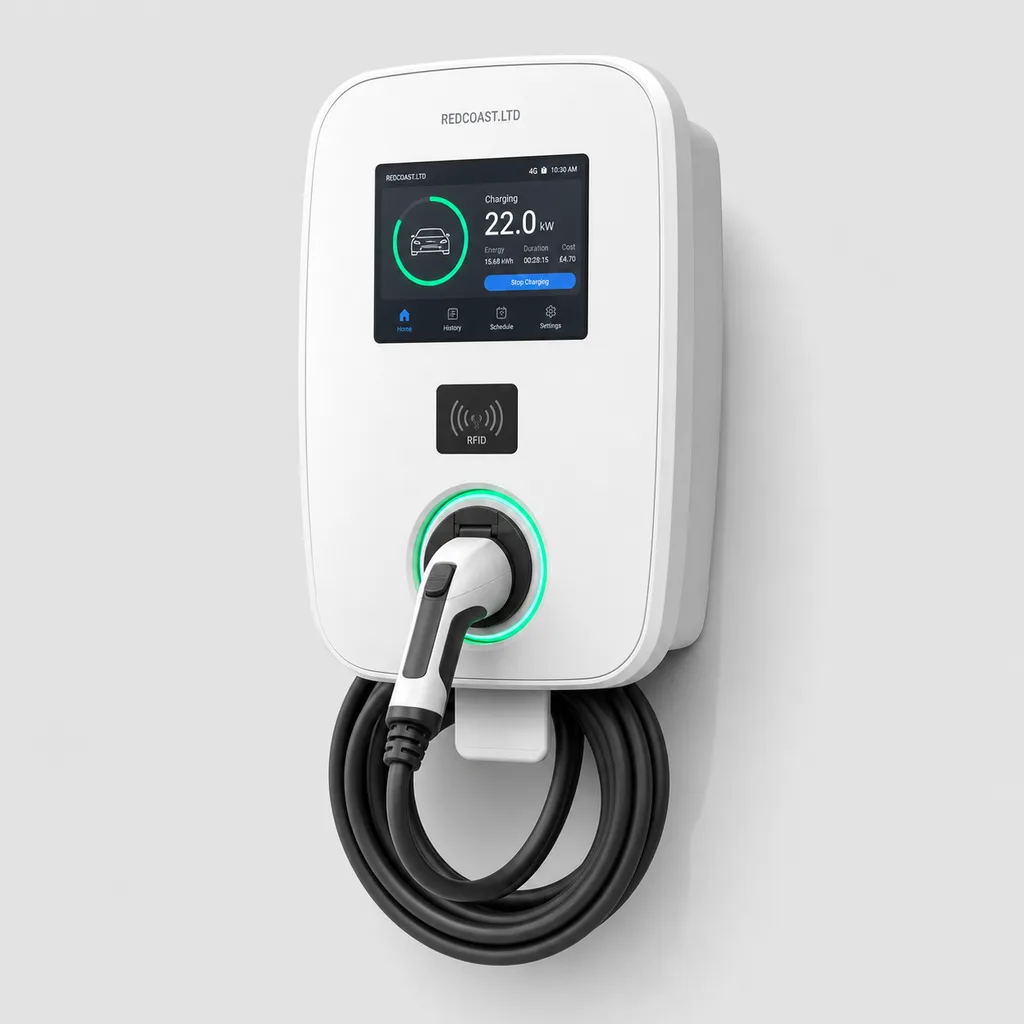
The REDCOAST.LTD RC-ACEV-22 is a grid-connected AC smart EV charging station engineered for urban and commercial deployment where utility power is already available — shopping malls, office buildings, hotels, residential complexes, municipal parking lots, dealerships and corporate fleet depots. It is offered in 7.4 kW single-phase and 11 / 22 kW three-phase configurations, in wall-mounted and pedestal (single- or dual-gun) form factors, with Type 2 (IEC 62196-2) connectors as standard and NACS or GB/T as factory options. The charger is delivered as a complete software-hardware solution: REDCOAST.LTD designs the main control PCB, AC metering front-end, control-pilot circuit, Type B residual-current protection and OCPP firmware in-house, and pairs the hardware with our cloud back-end, web operator console and mobile end-user app — one team, one supply chain, one point of accountability.
Key Features
- Three power tiers in one platform: 7.4 kW (single-phase 32 A), 11 kW (three-phase 16 A) and 22 kW (three-phase 32 A), software-selectable at commissioning.
- Dual OCPP stack: OCPP 1.6J and OCPP 2.0.1 both certified, so the charger talks to virtually any charge-point management system in the market.
- ISO 15118-2 / 15118-20 Plug & Charge ready, with optional smart-grid / V2G signalling support on request.
- Multi-standard connector lineup: Type 2 tethered (5 m or 7.5 m cable), Type 2 socket with shutter, NACS for North America and GB/T 20234.2 for China.
- Integrated MID-class B energy meter and signed metering records for transparent, dispute-proof per-session billing.
- Type B residual current device with 6 mA DC fault detection (per IEC 62955) plus class II surge protection on L/N/PE.
- 4G LTE Cat-4 / Gigabit Ethernet / dual-band Wi-Fi, with secure TLS 1.3 to the management backend and signed OTA firmware updates.
- Authentication options: RFID (ISO/IEC 14443 A/B and 15693), mobile-app QR code, Plug & Charge, free-vend or whitelist mode.
- 4.3-inch or 7-inch capacitive colour touchscreen, multilingual UI (EN/ES/FR/AR/DE/PT/ZH and more on request) and full-graphic status indicators.
- IP54 wall units / IP65 pedestal units, IK10 impact-rated polycarbonate-and-aluminium housing, salt-spray-tested finish for coastal and humid climates.
Technical Architecture
At the heart of the RC-ACEV-22 sits a REDCOAST.LTD-designed main control PCB built around an STM32 MCU with a hardware secure element for key storage and OCPP authentication. The board generates the IEC 61851-1 control-pilot signal (1 kHz PWM with adjustable duty cycle to advertise the available current), reads the proximity pilot, drives the AC contactor, and continuously monitors phase current and voltage through isolated shunt and Hall sensors that feed a dedicated MID-class B energy-metering front-end. A second board handles safety: a Type B RCD with a 6 mA DC residual-current sensor compliant with IEC 62955, surge protection diodes for transient suppression, plus over-voltage, under-voltage, over-current, over-temperature and contactor-welding detection. All safety events trigger a galvanically reliable contactor opening within the time limits specified by IEC 61851-22.
The OCPP firmware runs on an embedded Linux system-on-module that handles the cloud session, end-user authentication and the local human-machine interface. It maintains a persistent OCPP 2.0.1 WebSocket to the configured backend, queues transactions locally if connectivity drops and re-uploads them with signed timestamps once the link is restored — so revenue data is never lost in transit. The same firmware exposes a Modbus TCP / RTU interface for site-level dynamic load management, allowing multiple chargers behind one main breaker to share the available grid capacity in real time without tripping the building feed.
On the operator side, REDCOAST.LTD's cloud platform provides a multi-tenant web console (site map, real-time status, session history, fault diagnostics, firmware fleet update, pricing and tariff editor, CDR export) and a white-label mobile app for end users (start/stop charging, plan trips, view receipts, top up wallet, find nearby stations). For customers who already run their own CPMS, the charger plugs straight into Greenflux, AMPECO, Driivz, Has-to-be, Etrel, EVBox Everon, ChargePoint Network, MSI EVSE, Monta and any other OCPP 2.0.1 backend without firmware modification.
Connectivity & Power
Connectivity is multi-path by design so the unit stays online regardless of site conditions: 4G LTE Cat-4 with worldwide-band modem and dual SIM (nano-SIM + eSIM), Gigabit Ethernet for fibre-fed sites, and dual-band 2.4 / 5 GHz Wi-Fi for residential and indoor garages. Bluetooth 5.0 LE supports the technician commissioning app and end-user pairing. On the supply side, the unit accepts AC 230 V single-phase or AC 400 V three-phase, 50 / 60 Hz, with software-configurable maximum current per phase. Standby consumption is below 5 W and the unit fully complies with IEC 61000 EMC requirements, so it can be installed indoors next to sensitive equipment without electromagnetic disturbance. Because this is a grid-tied product for sites with existing electrical infrastructure, no solar array, battery bank or MPPT controller is included — REDCOAST.LTD's off-grid solar EV charging station is the right choice when there is no utility feed.
Protection & Reliability
The housing is rated IP54 for wall versions and IP65 for pedestal versions, with IK10 impact resistance for vandal- and parking-knock survival. The enclosure is fabricated from UV-stabilised polycarbonate with cast-aluminium structural parts; the metallic pedestal column is hot-dip galvanised as a corrosion base and then powder-coated to a smooth matte finish (RAL options on request), so it does not present as a raw zinc surface in the field. Operating temperature range is -30 °C to +55 °C; storage range is -40 °C to +70 °C; humidity tolerance is 5–95 % RH non-condensing. Salt-spray testing per ISO 9227 qualifies the finish for coastal and high-humidity climates. Designed MTBF exceeds 50,000 hours and the unit carries Type B RCD plus a 6 mA DC fault sensor in line with IEC 62955, surge protection per IEC 61643-11 class II, and ground-fault contactor monitoring.
Application Scenarios
Shopping malls and retail centres. Wall-mounted or pedestal 22 kW units are installed across visitor parking decks. Customers authenticate by QR code or RFID; dynamic load management balances multiple chargers behind a single feeder so the mall does not need to upgrade its incoming switchgear.
Office buildings and corporate campuses. 11 / 22 kW units serve employee parking with whitelist RFID authentication and free or subsidised tariffs. The HR system pushes employee badges to the REDCOAST.LTD backend so onboarding and off-boarding is automatic.
Hotels and resorts. White or branded OEM units deliver 7.4–22 kW at guest parking spaces, integrated with the property-management system so a charging session can be added to the room folio.
Residential complexes and apartment garages. 7.4 kW wall units per stall, with simple plug-and-charge for residents and prepaid wallet billing — perfect for retrofitting existing underground parking without expensive grid upgrades.
Fleet depots, taxis and municipal vehicles. Dual-gun 22 kW pedestals with overnight scheduled charging and site-wide load management keep large vehicle batches ready by morning without exceeding the depot's contracted demand.
EV dealerships and showrooms. Branded OEM units in dealership colours showcase the brand to prospective buyers and double as test-drive charging points.
Case-style Examples
Corporate office park retrofit. A multi-tenant office park required 60 charging stalls across three underground levels with strict aesthetic constraints and a hard 600 A site limit. REDCOAST.LTD supplied 60 dual-gun 11 kW pedestal units in matte anthracite RAL 7016 with dynamic load management balancing all 60 ports below the site cap. Energy consumption is automatically allocated to each tenant via OCPP smart-charging profiles, and the office park operator bills tenants monthly via the REDCOAST.LTD cloud.
Hotel chain pilot rollout. A regional hotel chain wanted branded charging at fifteen properties without the operational burden of running their own backend. REDCOAST.LTD delivered 7.4 kW wall units in the chain's white-and-gold livery, with the chain logo on the bezel and a custom guest-app skin. The chargers are connected to the chain's existing PMS through a REST adapter so guests simply unlock a session from the room TV and the charging cost appears on checkout.
Municipal parking authority deployment. A city parking authority replaced legacy 3.7 kW units with 80 mixed 11 / 22 kW pedestals across surface lots and parking garages. REDCOAST.LTD provided the chargers, the cloud back-end, multilingual end-user apps and on-site commissioning. The authority now publishes real-time availability to public mapping services through the REDCOAST.LTD OCPI 2.2 endpoint, and revenue reconciliation is fully automated through the operator console.
Customization & Selection Guide
For a typical commercial parking deployment we recommend 11 kW three-phase pedestals: most modern EVs accept the full 11 kW on AC and the per-stall cost is far lower than DC fast charging. Choose 22 kW pedestals where vehicles dwell less than two hours and where the local distribution panel can support the higher current per port. For residential and overnight charging, 7.4 kW wall units are the most cost-effective choice. NACS connectors are recommended for North American projects where Tesla compatibility matters; Type 2 tethered remains the standard across Europe, the Middle East, Africa, Latin America, Southeast Asia and Oceania; Type 2 socket is preferred for public free-vend deployments where users bring their own cable. When the site already runs a CPMS, choose the OCPP 2.0.1 firmware build and skip the REDCOAST.LTD cloud. When the customer wants an OEM-branded product, REDCOAST.LTD can ship custom housing colours, custom logos, custom touchscreen skin, custom voice prompts and custom default tariffs from the first batch.
Deployment & After-sales
Standard lead time is 25–45 days for catalogue configurations and 50–70 days for OEM-customised orders. The unit ships with a wall-mount bracket or pedestal base, M10 anchor set, cable-gland kit, RFID enrolment cards and a commissioning manual. Installation by a qualified electrician typically takes under 60 minutes per unit; commissioning is performed through the REDCOAST.LTD technician app via Bluetooth and the unit then registers itself to the configured OCPP backend. Remote diagnostics, log retrieval, parameter changes and firmware updates are all performed over-the-air, so most service tickets are resolved without a site visit. Standard warranty is two years on the full unit and three years on the metering subsystem, extendable to five years.
Standards & Compliance
The RC-ACEV-22 is engineered to meet IEC 61851-1 (electric vehicle conductive charging system), IEC 61851-21-2 (EMC requirements for off-board chargers), IEC 61851-22 (AC charging stations), IEC 62196-2 (Type 2 connector), ISO 15118-2 and ISO 15118-20 (Plug & Charge and bidirectional), IEC 62955 (Type B RDC-DD), IEC 61000-6-1/6-3 (EMC immunity and emission), IEC 61643-11 (surge protection), MID class B (metering instrument directive), CE, RoHS and REACH. OCPP 1.6J and OCPP 2.0.1 are both certified through Open Charge Alliance test suites. Country-specific certifications such as UKCA, FCC, KC, BIS, INMETRO, SASO and TISI can be added on request as part of the project.
Why REDCOAST.LTD
REDCOAST.LTD is a smart-IoT total-solution provider — and our hardware is engineered in-house, including custom PCB design for the control board, AC metering, Type B RCD subsystem and OCPP communication module. We deliver the charger, the operator web console, the end-user mobile app, the cloud back-end and the field-engineering support as one integrated package, from one team and one accountable supply chain. That means custom firmware behaviour, OEM branding, special connectors, special tariff logic, special integrations and special form factors are not impossible exceptions — they are how we work every day. Whether your project is fifty stalls in one parking lot or five thousand units across a national network, REDCOAST.LTD adapts the product to fit the project, not the other way around.
Ready to specify your AC charging deployment? Contact REDCOAST.LTD for sizing, single-line diagrams, load-management studies, OEM branding samples, certification roadmap and pilot units.
Specifications
Charging Output
- Single-phase AC Output
- 7.4 kW (1P, 32 A)
- Three-phase AC Output (16 A)
- 11 kW (3P, 16 A)
- Three-phase AC Output (32 A)
- 22 kW (3P, 32 A)
- Number of Outlets
- 1 or 2 guns
- Cable Length (tethered)
- 5 or 7.5 m
- Charging Mode
- Mode 3 per IEC 61851-1
Power Input (Grid AC)
- Input Voltage (single-phase)
- AC 230 ±15% V
- Input Voltage (three-phase)
- AC 400 ±15% V
- Frequency
- 50 / 60 Hz
- Maximum Input Current
- 32 per phase A
- Standby Power Consumption
- < 5 W
- Power Factor at Full Load
- ≥ 0.99
Connector & Protocol
- Connector (standard)
- Type 2 (IEC 62196-2) tethered or socket
- Connector (options)
- NACS / GB/T 20234.2
- Communication to EV
- IEC 61851-1 PWM + ISO 15118-2 / 15118-20
- Plug & Charge
- ISO 15118 Plug & Charge ready
- Backend Protocol
- OCPP 1.6J + OCPP 2.0.1
- Roaming
- OCPI 2.2.1 endpoint
Metering, Authentication & UI
- Energy Meter
- MID class B, signed records
- Measurement Accuracy
- ± 1 %
- RFID
- ISO/IEC 14443 A/B, ISO/IEC 15693
- Touchscreen
- 4.3 or 7 inch capacitive
- User Languages
- EN / ES / FR / DE / AR / PT / ZH and more
- Tariff Modes
- Time / kWh / Session / Tiered / Free-vend
Connectivity
- Cellular
- 4G LTE Cat-4 with global bands
- SIM
- Nano-SIM + eSIM
- Wired
- 10 / 100 / 1000 Ethernet (RJ45)
- Wi-Fi
- 2.4 / 5 GHz dual-band, WPA3
- Bluetooth
- BT 5.0 LE (commissioning)
- Security
- TLS 1.3, signed OTA, hardware secure element
Protection
- Ingress Protection
- IP54 (wall) / IP65 (pedestal)
- Impact Rating
- IK10
- Residual Current Device
- Type B + 6 mA DC (IEC 62955)
- Surge Protection
- Class II, L/N/PE
- Protections
- OV / UV / OC / OT / contactor-weld / ground-fault
- Operating Temperature
- -30 to +55 °C
- Humidity
- 5–95 (non-condensing) % RH
Mechanical
- Housing
- UV-stabilised polycarbonate + cast aluminium
- Finish
- Smooth matte powder coating (RAL on request)
- Wall Unit Dimensions
- approx. 380 × 250 × 150 mm
- Pedestal Height
- 1500 mm
- Wall Unit Weight
- approx. 8 kg
- Pedestal Weight
- approx. 45–60 kg
Capabilities — configurable per project
Specifications are tailored to each project — the options below show what we can support.
Power Rating
- 7.4 kW single-phase
- 11 kW three-phase
- 22 kW three-phase
- Dual-gun 2 × 22 kW pedestal
Connector
- Type 2 tethered
- Type 2 socket with shutter
- NACS (North America)
- GB/T 20234.2 AC (China)
Mounting
- Wall mount
- Single-gun pedestal
- Dual-gun pedestal
- Back-to-back island pedestal
Authentication
- RFID only
- Mobile-app QR
- Plug & Charge (ISO 15118)
- Free vend
- Whitelist
Backend
- REDCOAST.LTD cloud + web + mobile app
- Customer-owned OCPP 1.6J / 2.0.1 backend
- Third-party CPMS (Greenflux, AMPECO, Driivz, Etrel, Has-to-be, Monta, EVBox Everon, etc.)
Branding
- REDCOAST.LTD standard livery
- OEM colour and logo on housing
- Custom UI skin and voice prompts
- Custom factory default tariffs
Related solution guidance

Industrial Parks
Industrial park IoT for lighting, access areas, environmental monitoring, energy visibility, parking and maintenance operations.

Municipalities
Municipal smart city programs for lighting, traffic safety, parking, smart poles and environmental monitoring with one hardware and software partner.
Solar Off-Grid IoT
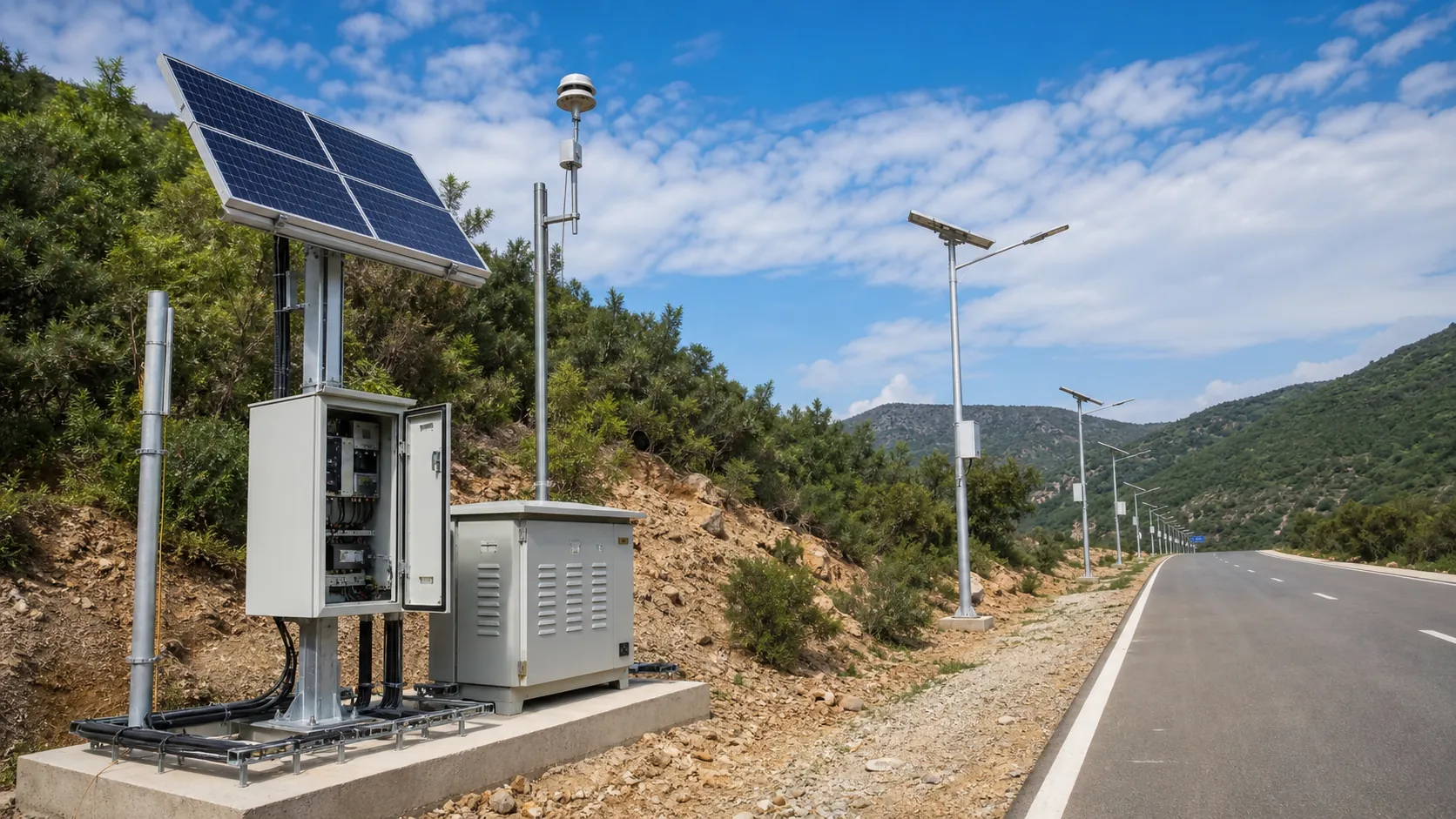
Design solar-powered outdoor IoT systems with panels, batteries, controllers, low-power devices, gateways and remote power monitoring.
Frequently Asked Questions
What is the difference between this AC charger and a DC fast charger?
An AC charger like the RC-ACEV-22 delivers up to 22 kW from the grid through the vehicle's onboard charger, with full charge times of 4–8 hours and a much lower per-port installed cost. DC fast chargers bypass the onboard charger and deliver 50–360 kW directly, giving 20–80 % charge in 20–40 minutes but at several times the equipment and grid-connection cost. AC is the right choice for dwell-time locations such as parking lots, offices, hotels, residential and fleet depots; DC is for highway corridors and rapid top-up stations.
Does it support OCPP 2.0.1 and existing OCPP 1.6 networks at the same time?
Yes. The charger ships with a dual-stack OCPP firmware that supports OCPP 1.6J and OCPP 2.0.1 in the same image. The active version is selected at commissioning and can be switched over-the-air, so you can keep older sites on 1.6J while new sites use 2.0.1, all from the same hardware platform.
Is the unit Plug & Charge ready and compatible with ISO 15118?
Yes. The hardware supports the ISO 15118-2 PLC communication layer and is firmware-upgradeable to ISO 15118-20, including Plug & Charge with X.509 certificate handling. Plug & Charge is a software-licence option and requires the customer's contract certificate pool to be provisioned, but the hardware is ready out of the box.
Which connector should I order for my country?
Type 2 (IEC 62196-2) is the standard in Europe, the Middle East, Africa, Latin America, Southeast Asia and Oceania, and is the recommended default. NACS is recommended in North America when Tesla compatibility matters. GB/T 20234.2 is required for the Chinese domestic market. REDCOAST.LTD can mix connectors across the same project.
Can the unit operate in very hot or very cold climates?
Yes. The certified operating range is -30 °C to +55 °C, the housing is IP54 (wall) or IP65 (pedestal), and the powder-coated finish is salt-spray-tested per ISO 9227, so the same hardware works in Nordic winters, desert summers and humid coastal sites without changes. Heaters and active cooling are available as factory options for extreme cases.
How is payment and billing handled?
There are three common models. (1) Closed user group via RFID whitelist with no payment at the charger — used in offices and fleet depots. (2) Cloud-based wallet and per-session payment through the REDCOAST.LTD mobile app, including card, Apple Pay, Google Pay and local methods. (3) Roaming via OCPI 2.2.1, so any user of any partner network can charge and the home network settles the bill. All sessions produce signed MID-class-B metering records.
Can REDCOAST.LTD ship OEM-branded units with custom housing colour, logo and UI?
Yes. OEM and ODM are core capabilities. REDCOAST.LTD can deliver custom housing colour (any RAL), custom screen-printed or laser-etched logo, custom touchscreen UI skin, custom voice prompts and even custom default tariffs straight from the first production batch. Minimum order quantities are project-friendly and the engineering fee is normally waived for committed volumes.
How does dynamic load management work when several chargers share one site feed?
Each charger acts as both an OCPP smart-charging endpoint and a Modbus participant. A REDCOAST.LTD-provided site controller (or any compatible third-party energy management system) reads the building's main-feed current in real time and distributes the available capacity across active charging sessions through OCPP smart-charging profiles, throttling individual ports rather than tripping the main breaker.