Overview
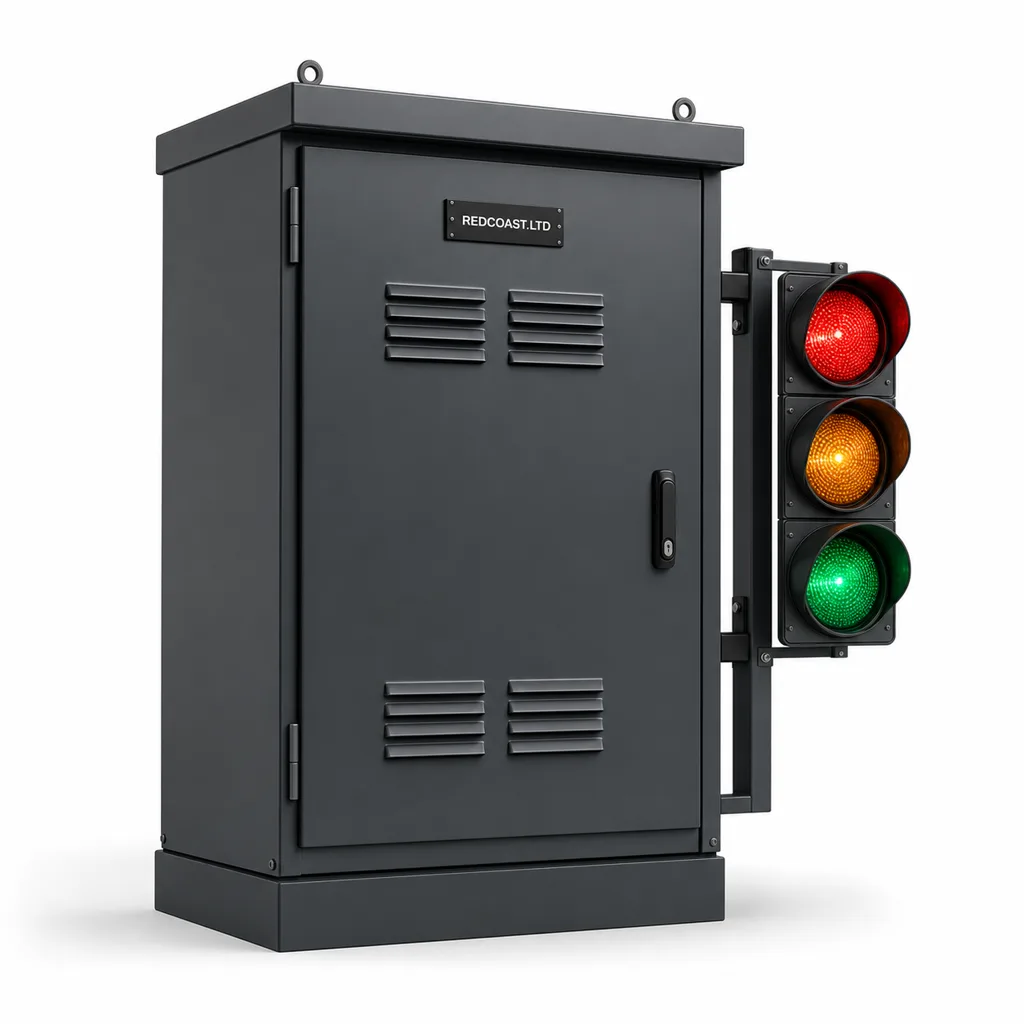
The RC-TSC-2200 is an adaptive urban smart traffic signal controller and complete intersection system from REDCOAST.LTD, engineered for grid-powered city intersections that need more than legacy fixed-time control. It bundles our in-house developed main controller PCB, multi-channel signal driver board, hardware-isolated Malfunction Management Unit (MMU), and edge AI detection module into a NEMA TS2 or EN 12675 cabinet, then ties everything to a cloud SaaS dashboard and a field operator app. City traffic authorities, smart-city integrators, EPC contractors, and ITS consultants use the system to retrofit congested arterials, deliver bus and emergency-vehicle priority, prepare corridors for connected and autonomous vehicles, and meet rising pedestrian-safety expectations — all while staying compatible with the central ATMS already in place.
Key Features
- Multi-phase adaptive control with up to 16 vehicle phases and 8 rings, ring-and-barrier compatible with NEMA TS2 dual-ring logic and European stage-based plans.
- AI traffic-flow optimization that adjusts splits second-by-second and tunes offsets cycle-by-cycle from real-time vehicle, pedestrian and bicycle demand.
- Edge AI video detection that replaces buried inductive loops on most approaches and classifies six vehicle categories, queue length, turn movement and pedestrian intent.
- Hardware MMU conflict monitor, fully isolated from the main controller, that forces flash-all-red when conflicting greens or other dangerous combinations are detected.
- Emergency Vehicle Preemption (EVP) and Transit Signal Priority (TSP) for ambulance, fire, BRT and regular bus services with configurable check-in/check-out zones.
- V2X-ready radio module supporting DSRC IEEE 802.11p or 3GPP C-V2X PC5 on 5.9 GHz, broadcasting SPaT and MAP messages to connected vehicles.
- Native NTCIP 1202 v3 over SNMP/UDP-IP, so the controller drops into existing central traffic management systems without proprietary gateways.
- Integrated LiFePO4 UPS keeps the controller and key red-phase signal heads alive for up to 4 hours of grid outage — critical for downtown reliability.
- Pedestrian-first features: countdown indications, vibrotactile/audio accessible pushbuttons, and extended walk times triggered by AI pedestrian detection.
- Cloud SaaS plus mobile field app for remote programming, simulation, alarm management, and AR-overlay cabinet diagnostics.
Technical Architecture
The RC-TSC-2200 is built around three REDCOAST.LTD-designed PCBs. The Main Controller Board uses an industrial ARM Cortex-A55 quad-core SoC running at 1.5 GHz with 2 GB DDR4 RAM and 16 GB eMMC, hosting a hybrid real-time Linux signal timing engine. The Signal Driver Board provides 16 isolated AC channels rated 10 A each, every channel monitored for current, open-load and short-circuit conditions and capable of driving 90–240 V AC LED signal heads of any compliant vendor. The MMU Conflict Monitor is an entirely independent hardware unit with its own watchdog and power supply; it never trusts the main controller and will drop the intersection into flash-all-red within 200 ms of detecting an illegal state, in line with NEMA TS2 and EN 12675 safety requirements.
The Detection Subsystem fuses inputs from an onboard edge AI inference accelerator processing 1080p video at 30 fps with optional 24 GHz traffic radar for low-light, sandstorm or heavy-rain conditions. The fusion engine emits presence, count, queue, intent and speed events into the adaptive timing engine, which optimizes splits in real time and recomputes offsets and cycle lengths every cycle. Legacy inductive loops, video walk-on detectors and microwave detectors are also supported through 16 isolated inputs so phased retrofit is straightforward.
The Communication Subsystem combines cellular (4G LTE Cat-4 standard, optional 5G NR Sub-6) with Gigabit Ethernet for fiber backhaul, RS-485 and CAN bus for in-cabinet expansion, and an integrated V2X radio. All telemetry is encrypted with TLS 1.3 and devices are mutually authenticated using X.509 certificates managed by our cloud PKI. The Cloud SaaS provides corridor view, intersection editor, signal-timing simulation, SLA dashboards and alarming, and the operator app supports field engineers offline with all configuration and diagnostic tooling.
Connectivity & Power
Connectivity options are tailored to the urban environment. Standard build includes 4G LTE Cat-4 with optional 5G NR Sub-6 NSA/SA module, two Gigabit Ethernet RJ45 ports for fiber or leased-line backhaul, NTCIP 1202 v3 over SNMP/UDP-IP for the central ATMS, and the V2X radio with selectable DSRC or C-V2X PC5 mode 4 firmware. NB-IoT is offered as a low-cost telemetry fallback. Power is taken from the urban grid — 100–240 V AC, 50/60 Hz — with built-in Class II 40 kA surge protection and lightning arrest. This is a deliberately grid-only product: urban intersections sit on reliable distribution networks and do not need solar PV. The integrated LiFePO4 12 V / 24 Ah UPS keeps the controller, MMU and at least four red-phase signal heads operating for up to 4 hours during outages, plenty of time for utility restoration or generator backup. For remote rural crossings with no grid coverage, our companion solar product RC-TS-1200 (off-grid solar traffic signal) is the right fit.
Protection & Reliability
The outdoor cabinet is rated IP55 with thermostatically controlled ventilation, filtered intake and heated dry-air management for cold climates. Internal electronics sit in an IP65 sub-enclosure to defeat condensation and dust ingress. The full assembly is qualified from -40 to +75 ℃, 5–95 % non-condensing humidity, and salt-spray tested to IEC 60068-2-52 for coastal deployments. EMC immunity is qualified to EN 50293 for road traffic signal systems and IEC 61000-4 series. Main controller MTBF exceeds 100,000 hours, all boards are field-replaceable on DIN-rail, and design life is 5 years on PCBs and 8 years on LED signal heads. A standard 3-year warranty applies, extendable to 5 years.
Application Scenarios
- Downtown arterial coordination: deliver green waves on congested arterials and reduce average vehicle delay by 20–35 % versus legacy fixed-time control.
- School-zone and pedestrian-priority intersections: extend walk times based on AI pedestrian detection and accessible audio pushbuttons.
- BRT and bus corridors: transit signal priority for line-haul buses, configurable by route and time of day.
- V2X test corridors: broadcast SPaT and MAP to connected vehicles to support OEM trials and future autonomous services.
- Hospital and emergency districts: EVP cuts response times for ambulance and fire vehicles entering and exiting key intersections.
- Major-event venues: temporary plans for stadium, convention and concert ingress/egress, loaded remotely without a truck roll.
Case-style Examples
- Downtown arterial retrofit (12 km corridor): 24 legacy fixed-time controllers replaced with RC-TSC-2200 over a phased weekend deployment, integrated into the city ATMS through NTCIP 1202 with no central rewrite. Result: average vehicle delay down 28 %, bus travel time down 35 %, fuel consumption proxies down ~12 %.
- Connected-vehicle pilot corridor (8 intersections): dual-mode DSRC + C-V2X PC5 radios broadcast SPaT/MAP to OEM test fleets, enabling green-light optimal speed advisory and red-light violation warnings on production vehicles.
- Hospital district EVP rollout (16 intersections): ambulance preemption deployed with sub-second activation, demonstrated to cut average emergency-route signal delay by more than 40 % during peak hours, without disrupting non-emergency progression plans.
Customization & Selection Guide
Intersection size: 4-phase entry-level, 8-phase typical, or 16-phase for complex multi-leg or diamond/SPUI interchanges. Detection: video AI only is the lowest-CAPEX baseline; radar-only suits harsh climates with poor optics; video + radar fusion is the premium reliability tier; loop-compatible hybrid lets you reuse existing buried loops in phased retrofits. V2X: choose none, DSRC, C-V2X, or dual-mode based on your regulatory environment and connected-vehicle roadmap. Cabinet: NEMA TS2 Type 1/2 for North America, EN 12675 for Europe, or customized cabinets for projects with strict aesthetic or footprint constraints. Backhaul: 4G LTE for fastest rollout, fiber for high-density downtowns, hybrid for resilient mission-critical corridors.
Deployment & After-sales
Cabinets are pre-assembled and factory pre-configured against your intersection plans, palletized for EU/US road freight, and shipped with a commissioning kit. Typical field commissioning is around 30 minutes per intersection once cabling is in place. We support local certified contractors with installation documentation, training packs, and remote engineering call-in during go-live. After delivery, the cloud SaaS provides 24/7 health telemetry, ticketing, and automatic over-the-air firmware updates for both controller and V2X stack. Service contracts include 24-hour remote diagnostics and 24/48-hour on-site response options.
Standards & Compliance
The RC-TSC-2200 is designed to meet NEMA TS2 Type 1 and Type 2, EN 12675 functional safety for traffic signal controllers, EN 12368 for LED signal heads, EN 50293 EMC for road traffic signal systems, NTCIP 1202 v3 for central management interoperability, IEC 61000-4 immunity series, IEEE 802.11p and 3GPP Release 14+ for V2X, plus CE, RoHS, and FCC marks for global market access.
Why REDCOAST.LTD
REDCOAST.LTD is an end-to-end smart-IoT solution provider — and we design our own PCBs. Our main controller, signal driver, MMU and edge AI boards are developed and revised in-house, which means we can tune channel counts, V2X firmware, accessibility features, cabinet form factors and central system integrations to the specific demands of your project rather than forcing you to live with an off-the-shelf product. Software, mobile app, and cloud SaaS come from the same team, so the hardware and the central system speak the same language out of the box. We deliver globally and adapt to local electrical, climatic, and regulatory environments.
Ready to upgrade an arterial, retrofit a downtown, or stand up a V2X corridor? Contact REDCOAST.LTD for a tailored intersection plan, NTCIP integration assessment, and a customized RC-TSC-2200 quotation.
Specifications
Controller Performance
- CPU
- ARM Cortex-A55 quad-core 1.5 GHz
- RAM
- 2 GB DDR4
- Storage
- 16 GB eMMC
- Max Vehicle Phases
- 16
- Max Rings
- 8
- Cycle Length Range
- 30-240 s
- Adaptive Split Update Rate
- 1 s
Signal Driver Outputs
- AC Output Channels
- 16
- Per-Channel Current
- 10 A AC
- Signal Head Voltage Range
- 90-240 V AC
- Per-Channel Diagnostics
- Open/Short/Over-current monitoring
- Driver Compliance
- NEMA TS2 / EN 12675
- MMU Flash-All-Red Reaction
- <200 ms
Detection
- Edge AI Video
- 1080p @ 30 fps, 4 channels
- Vehicle Classes
- 6 (car/SUV/truck/bus/motorcycle/bicycle)
- Pedestrian Detection Range
- 0-30 m
- Optional 24 GHz Traffic Radar
- 0-150 m
- Legacy Loop Detector Inputs
- 16 isolated
- Queue Length Estimation Accuracy
- >90 %
Communication
- Cellular
- 4G LTE Cat-4 standard; 5G NR Sub-6 optional
- Ethernet
- 2 x Gigabit RJ45
- V2X
- DSRC IEEE 802.11p / C-V2X PC5 mode 4 (5.9 GHz)
- Central Management Protocol
- NTCIP 1202 v3 over SNMP/UDP
- In-Cabinet Bus
- RS-485, CAN
- Security
- TLS 1.3, X.509 mutual auth
Power (Grid)
- Input Voltage
- AC 100-240, 50/60 V/Hz
- Controller Power Consumption
- 30-80 W
- Surge Protection
- Class II 40 kA
- Integrated UPS Chemistry
- LiFePO4 12 V / 24 Ah
- Backup Runtime (red-phase essential load)
- up to 4 h
- Solar PV
- Not included (grid-only product)
Cabinet & Environmental
- Cabinet Standard
- NEMA TS2 Type 1/2 or EN 12675
- Cabinet IP Rating
- IP55 ventilated
- Inner Electronics IP Rating
- IP65 sub-enclosure
- Operating Temperature
- -40 to +75 C
- Humidity
- 5-95 non-condensing %
- Salt-Spray Qualification
- IEC 60068-2-52
Compliance & Standards
- Functional Safety
- EN 12675
- EMC
- EN 50293, IEC 61000-4 series
- LED Signal Heads
- EN 12368
- North America
- NEMA TS2 Type 1/2
- Region Marks
- CE / RoHS / FCC
- V2X Radio
- IEEE 802.11p / 3GPP Release 14+
Capabilities — configurable per project
Specifications are tailored to each project — the options below show what we can support.
Intersection Size
- 4-phase entry
- 8-phase typical
- 16-phase complex / diamond / SPUI
Detection
- Video AI only
- Radar only
- Video + Radar fusion
- Loop-compatible hybrid
V2X Module
- None
- DSRC IEEE 802.11p
- C-V2X PC5
- Dual-mode DSRC + C-V2X
Cabinet Standard
- NEMA TS2 Type 1
- NEMA TS2 Type 2
- EN 12675 European
- Custom enclosure
Backhaul
- 4G LTE
- 5G Sub-6
- Fiber Ethernet
- Hybrid cellular + fiber
Related solution guidance
Traffic Safety
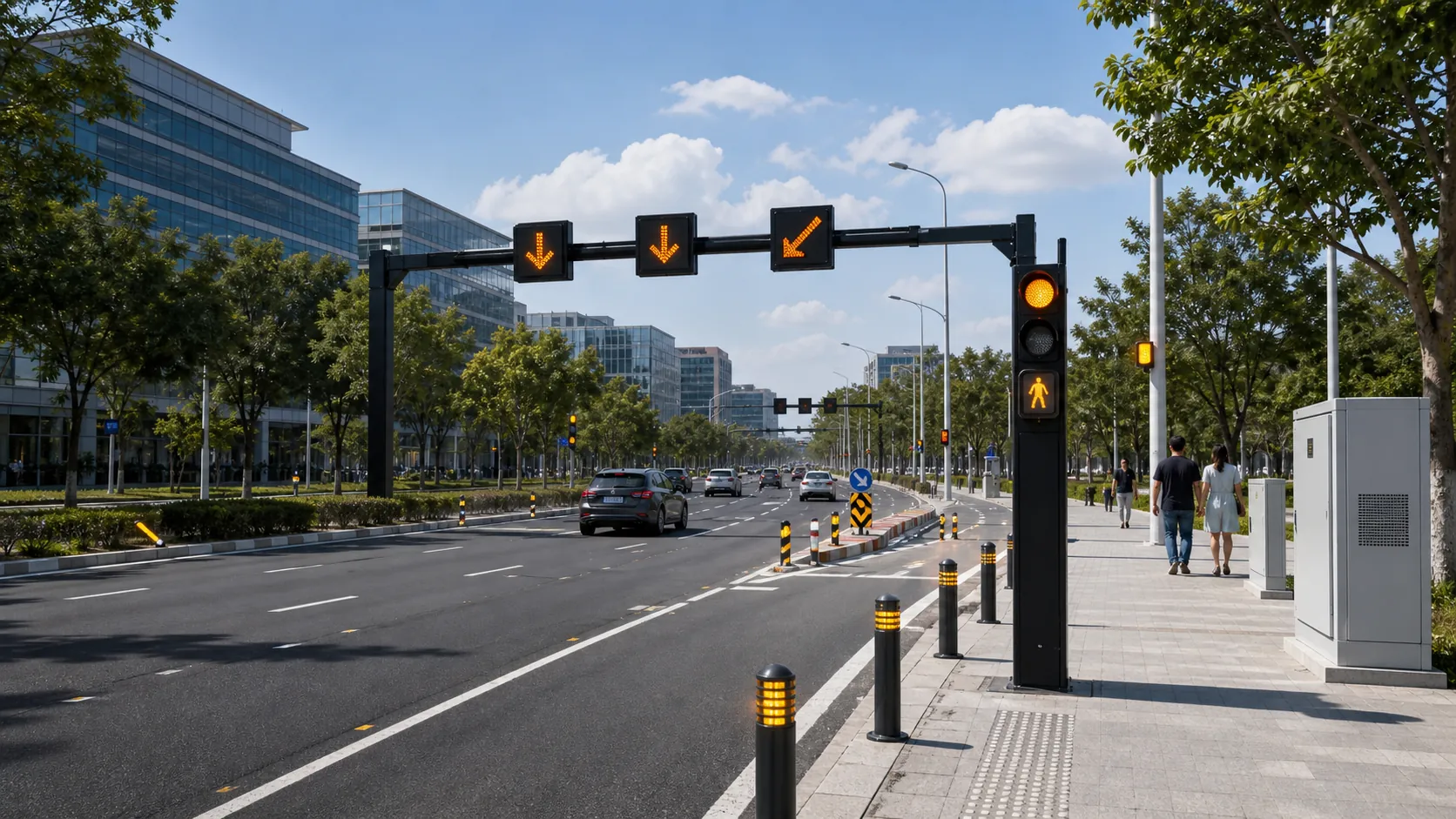
Plan connected traffic safety systems with warning beacons, LED signs, road guidance devices, sensing, control cabinets and monitoring software.
Airports and Hubs
IoT infrastructure for transport hubs: parking guidance, road safety, outdoor lighting, signage, monitoring and operational dashboards.
Municipalities
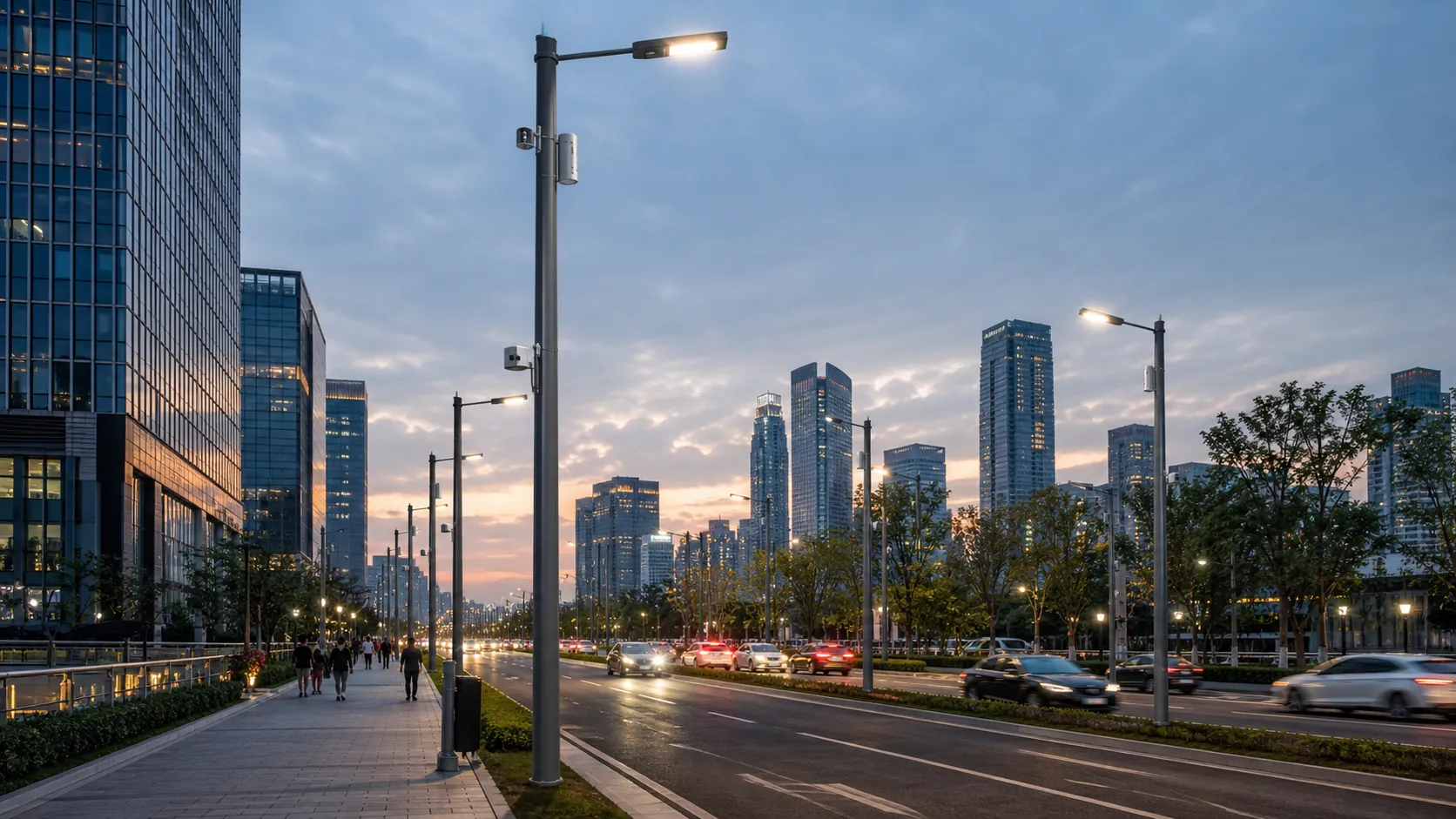
Municipal smart city programs for lighting, traffic safety, parking, smart poles and environmental monitoring with one hardware and software partner.
Frequently Asked Questions
What is an adaptive traffic signal controller and how is it different from a fixed-time controller?
An adaptive controller continuously adjusts green splits, offsets and cycle lengths based on real-time vehicle and pedestrian demand, while a fixed-time controller cycles on a pre-programmed schedule regardless of traffic. The RC-TSC-2200 updates splits second-by-second from edge AI detection and re-optimizes offsets cycle-by-cycle, typically cutting average vehicle delay 20-35 % on congested arterials.
Does the RC-TSC-2200 integrate with our existing central ATMS or do we need to replace it?
It speaks native NTCIP 1202 v3 over SNMP/UDP-IP, so the controller plugs into virtually any NTCIP-compliant central traffic management system without a proprietary gateway. Most cities keep their existing ATMS and only replace the field controllers.
Can the system work without inductive loops buried in the road?
Yes. Edge AI video detection plus optional 24 GHz traffic radar covers vehicle presence, classification, queue length and pedestrian intent without buried loops. Existing loops can still be connected through 16 isolated detector inputs for phased retrofits.
Is the controller V2X ready for connected and autonomous vehicles?
The RC-TSC-2200 includes an optional V2X radio module supporting either DSRC IEEE 802.11p or C-V2X PC5 mode 4 on 5.9 GHz, with dual-mode firmware available. It broadcasts SPaT and MAP messages so connected vehicles can run green-light optimal speed advisory, red-light violation warning and similar safety applications.
What happens during a grid power outage?
An integrated LiFePO4 12 V / 24 Ah UPS keeps the controller, MMU and at least four red-phase signal heads running for up to 4 hours, which covers most utility restoration windows. Beyond that, the controller cleanly enters flash-all-red and resumes normal operation when grid power returns.
Can it prioritize emergency vehicles and public transit?
Yes. Emergency Vehicle Preemption (EVP) provides sub-second green calls for ambulance and fire vehicles, while Transit Signal Priority (TSP) supports BRT and regular bus services with configurable check-in/check-out zones, route filtering and time-of-day rules to avoid disrupting general progression.
Why is this product grid-only and not solar-powered?
Urban intersections are deployed on reliable distribution grids and require continuous power for multiple signal heads, detection and communication, which solar PV cannot economically deliver at urban-load levels. For remote rural crossings without grid coverage, REDCOAST.LTD offers the companion RC-TS-1200 off-grid solar traffic signal system.
What are typical lead times and how is the system commissioned?
Cabinets ship pre-assembled and factory pre-configured against your intersection plans, typically within 6-10 weeks of purchase order. Field commissioning takes around 30 minutes per intersection once cabling is in place, supported by our cloud SaaS, mobile field app and 24/7 remote engineering.