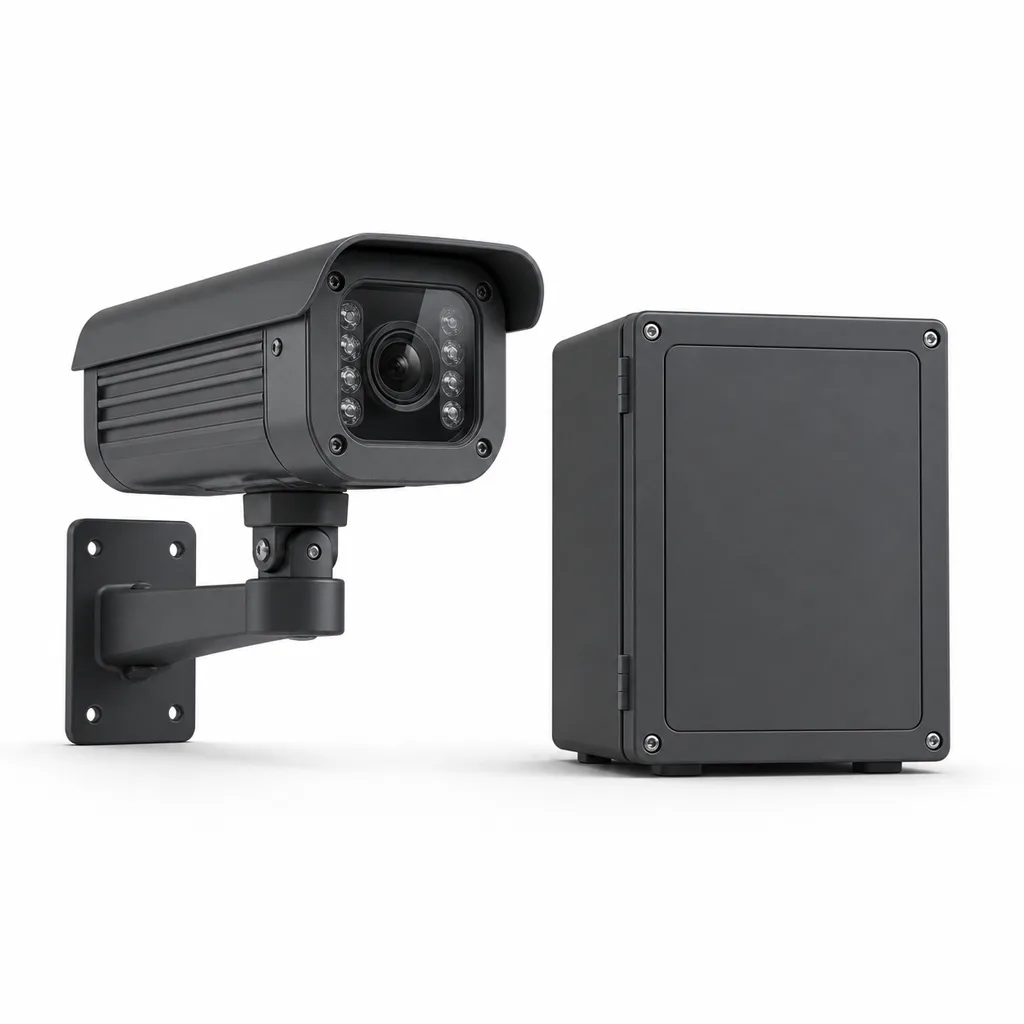
Overview
The REDCOAST.LTD RC-AID-700 is a grid-powered AI Video Incident Detection (AID/VID) system that automatically identifies dangerous events on highways, in road tunnels and across urban corridors within seconds. Purpose-built for road authorities, tunnel operators, expressway concessionaires and traffic management centers, it turns ordinary CCTV coverage into an intelligent early-warning layer that spots a stopped vehicle, a wrong-way driver, a pedestrian on the carriageway, dropped debris, smoke or a forming traffic jam long before an operator would notice. By cutting the time-to-detect from minutes to seconds, the system dramatically reduces secondary crashes, speeds up emergency response and helps operators meet mandatory tunnel-safety obligations. Because tunnels, highways and city roads already have mains power and structured cabling, the RC-AID-700 is engineered as a grid-powered, fiber-connected fixed installation — not a solar node.
Key Features
- Multi-incident AI detection — stopped/slow vehicle, wrong-way driving, pedestrian on carriageway, dropped object/debris, smoke and fire, traffic congestion, illegal stop in emergency lane or lay-by, over-speed and lane blockage, all extracted from the same camera stream.
- Long detection range — up to 300 m per camera using a hybrid of deep-learning object detection and pixel-motion analytics, well beyond what deep learning alone can reach.
- Second-level response — typical time-to-detect of 2–6 seconds and alarm within 10 seconds of the event.
- High accuracy, low false alarms — ≥95% stopped-vehicle detection on open roads and ≥98% inside tunnels, with a false-alarm rate below 0.1 per camera per day after site tuning.
- Edge-first processing — detection runs on the camera NPU or a roadside edge controller, so alarms are generated locally and keep working even if the backhaul link drops.
- Closed-loop actuation — verified alarms automatically trigger variable message signs, lane-control signals, tunnel ventilation and lighting, barriers and public-address, not just a screen alert.
- Open integration — ONVIF, RTSP, NTCIP and REST/MQTT let it plug into existing traffic management centers, SCADA and third-party VMS.
- Forensic evidence — every alarm auto-records a time-stamped pre/post video clip for incident review and accountability.
- Self-developed hardware — REDCOAST.LTD designs the edge-AI inference board, the multi-channel PoE++ camera interface board, the roadside I/O relay board and the UPS power-management board in-house, so channel counts, I/O and detection logic adapt to each corridor.
Technical Architecture
The RC-AID-700 is a three-tier system. At the field layer, edge-AI detection cameras (fixed bullet, PTZ or thermal dual-spectrum) are mounted on tunnel ceilings and side walls, roadside gantries, cantilever arms or existing CCTV poles at 30–150 m spacing to give continuous carriageway coverage. At the roadside layer, an edge AI controller housed in the ITS cabinet aggregates 4–16 camera streams, runs the detection models on a dedicated NPU, correlates and de-duplicates events across overlapping fields of view, and drives local outputs. At the management layer, the central incident-management software at the traffic management center provides a live video wall, alarm workflow, operator verification, automatic device response and full reporting.
The data flow is edge-first: each camera performs on-device inference and raises an event with a confidence score and a bounded video clip; the roadside controller fuses these events, suppresses duplicates and false positives, then pushes structured alarms upstream over NTCIP or REST while simultaneously firing opto-isolated dry contacts and relays that actuate warning devices in real time. This architecture means detection continues even during a network outage, and only meaningful events — not raw video — need to travel to the center.
All the critical boards are developed by REDCOAST.LTD: an NPU carrier / edge-AI inference board, a managed multi-channel 802.3bt PoE++ camera interface board, a roadside I/O board with opto-isolated inputs and relay outputs for VMS, lane signals, ventilation and barriers, and a UPS power-management board combining AC-DC conversion, LiFePO4 ride-through and health monitoring. The detection software is tuned per site — lane geometry, region-of-interest, perspective calibration and per-scene thresholds — to hold accuracy high while keeping false alarms low.
Connectivity & Power
The backbone is single-mode fiber (SFP 1G/10G), the standard for highway and tunnel corridors, with Gigabit Ethernet distribution and optional 4G/5G for remote or standalone sites. Cameras speak ONVIF (Profiles S/G/M/T) and RTSP; system integration uses NTCIP 1205 for CCTV and NTCIP 1203 for dynamic message signs, plus MQTT and REST APIs for cloud and TMC connectivity, and Modbus / dry-contact for legacy tunnel PLC and SCADA. Power is grid AC 100–240 V feeding the roadside or tunnel cabinet, with 802.3bt PoE++ delivering up to 90 W per port to cameras (enough for integrated IR and heaters), and an on-board LiFePO4 UPS providing 30–120 minutes of detection ride-through during a mains outage. There is deliberately no solar option: this product lives where grid power and cabling are already present, so its power design is optimized for continuous mains operation rather than off-grid autonomy.
Protection & Reliability
Cameras are rated IP66/IP67 with IK10 vandal resistance, 140 dB wide dynamic range and starlight low-light sensitivity plus IR for tunnel and night conditions. The roadside controller sits in an IP55 ventilated or IP66 sealed cabinet with a smooth matte powder-coated finish for corrosion protection. All boards are conformal-coated and hardened against salt fog, dust and vibration, with 6–10 kV surge protection on power, PoE and signal lines. A hardware watchdog and dual-image firmware guard against lock-ups, and the wide −40 to +70 °C operating range suits tunnels, hot desert corridors and cold-climate highways alike. Warranty options run 3–5 years, with a design and component-selection philosophy aimed at long, low-maintenance service life.
Application Scenarios
- Long road tunnels — satisfies control-center AID mandates; smoke/fire and stopped-vehicle alarms are linked to ventilation and evacuation lighting for immediate life-safety response.
- Urban underpasses and short tunnels — catches pedestrians, wrong-way entries and congestion in confined, high-risk sections where a stalled vehicle can quickly become a pile-up.
- Highway mainline and bridges — detects stopped vehicles, debris and forming queues to prevent deadly secondary collisions, especially on curves and known blackspots.
- Interchanges and on/off ramps — flags wrong-way entry and illegal stopping at the exact points where these events most often occur.
- Toll plazas and gantries — spots stopped vehicles and pedestrians in the approach zone and detects congestion build-up before it spreads.
- Urban arterials and intersections — identifies pedestrians in the lane, illegal stops and incidents that block through traffic.
Case-style Examples
- Long-tunnel safety upgrade — an operator needing to satisfy a control-center AID obligation retrofits detection cameras every 100 m along the bore and ties them into the existing ventilation and lighting; stopped-vehicle and smoke alarms now trigger fans and evacuation cues automatically, cutting operator reaction time to seconds.
- Mountain expressway secondary-crash reduction — on a corridor plagued by rear-end collisions on blind curves, stopped-vehicle and queue detection on the approaches feeds upstream variable message signs to slow traffic before drivers reach the hazard.
- Urban corridor pilot — a city integrates underpass and intersection incident detection into its existing TMC video wall over NTCIP, gaining automatic alerts without replacing its cameras or central platform.
Customization & Selection Guide
Start from the deployment package — Tunnel, Open Highway or Urban Intersection — which presets the detection model set. Choose camera type by need: fixed edge-AI bullets are the most cost-effective for defined lanes; PTZ cameras add operator verification and tracking; thermal dual-spectrum cameras give the earliest smoke/fire detection and the best night performance. Pick the processing architecture — distributed edge-AI cameras minimize cabinets, a roadside aggregation controller suits dense coverage, and a hybrid balances both. Decide integration depth: standalone with a local video wall, NTCIP into an existing TMC, or full REST API into third-party VMS/SCADA. For life-safety tunnels, specify longer UPS runtime and a dual-fiber ring for redundancy.
Deployment & After-sales
Cameras mount on tunnel walls and ceilings, overhead gantries, cantilever poles or existing CCTV infrastructure, with pole adapters for Ø60–140 mm. Each camera is calibrated and ROI-tuned during commissioning; controllers ship factory pre-configured to shorten on-site work. REDCOAST.LTD provides commissioning support, remote diagnostics, firmware updates, spare-parts programs and SLA-based technical support, with delivery scheduled per project scope and site count.
Standards & Compliance
The system is engineered to align with EU Directive 2004/54/EC on minimum tunnel safety requirements and PIARC incident-detection guidance, and to integrate via NTCIP 1201/1203/1205 and ONVIF. Hardware targets EN 62676 video-surveillance, EN 50293 / IEC 61000 EMC, IEC 60068 environmental testing, CE / RoHS / UKCA, IP66/IP67 and IK10, and supports road-safety management frameworks such as ISO 39001. Specific certifications are confirmed per project and region.
Why REDCOAST.LTD
REDCOAST.LTD delivers the complete solution — detection hardware, management platform and mobile app — as one integrated, project-tailored system from a single team. Because we design our own PCBs (edge-AI board, PoE camera interface, roadside I/O and power management), we can adapt channel counts, I/O, detection logic and integration to your corridor instead of forcing your project into a fixed box. That control is what lets us tune accuracy, meet local standards and keep the whole system maintainable for its full service life.
Talk to REDCOAST.LTD about a custom AI video incident detection deployment for your tunnels, highways or urban corridors — we will size cameras, edge processing and TMC integration to your exact site and standards.
Specifications
Detection & AI Performance
- Incident Types Detected
- 10+ types
- Detection Range (per camera)
- up to 300 m
- Time to Detect (TTD)
- 2-10 s
- Detection Rate (open road / tunnel)
- ≥95 / ≥98 %
- False Alarm Rate (stopped vehicle)
- < 0.1 FA/camera/day
- AI Method
- Deep learning (CNN) + pixel-motion analytics
- Camera Channels per Edge Controller
- 4-16 ch
- Detection Zones / Lanes per Camera
- up to 8
Detection Camera
- Image Sensor
- 1/1.8-inch CMOS
- Resolution
- 2 / 4 / 8 MP
- Frame Rate
- 25-60 fps
- Lens
- motorized varifocal 8-32 / 10-50 mm
- Wide Dynamic Range
- 140 dB
- Min. Illumination
- 0.001 (color), 0 with IR lux
- IR Distance
- up to 150 m
- Camera Protection
- IP66/IP67, IK10
Edge AI Processing
- Edge Controller AI Compute
- up to 40 TOPS
- Edge-AI Camera Compute
- 4-8 TOPS
- CPU
- multi-core ARM / x86
- System Memory
- 8-32 GB
- Local Evidence Storage
- 256 GB - 4 TB
- Video Decoding
- up to 16-ch @ 1080p
- Operating System
- Embedded Linux
Connectivity & Integration
- Backbone
- single-mode fiber (SFP 1G/10G)
- Ethernet
- Gigabit RJ45
- Cellular (optional)
- 4G LTE / 5G
- Camera Protocols
- ONVIF S/G/M/T, RTSP
- ITS Integration
- NTCIP 1201/1203/1205, MQTT, REST API
- Legacy I/O
- Modbus RTU/TCP, opto-isolated dry contacts
- Digital I/O
- 8-16 DI / 8-16 DO relay
Power (grid)
- Input Voltage
- AC 100-240 V
- Mains Frequency
- 50/60 Hz
- Camera Power (PoE)
- 802.3bt PoE++, up to 90 W/port
- Node Power Consumption
- 60-300 W
- UPS Ride-through
- 30-120 min
- Backup Battery
- LiFePO4
- Surge Protection
- 6-10 kV
Environmental & Mechanical
- Operating Temperature
- -40 to +70 °C
- Storage Temperature
- -40 to +85 °C
- Humidity
- 5-95 (non-condensing) %RH
- Cabinet Protection
- IP55 (ventilated) / IP66 (sealed)
- Cabinet Finish
- smooth matte powder-coated (RAL 7016)
- EMC
- IEC 61000-4 / EN 50293
- Camera Mounting
- wall / ceiling / gantry / pole Ø60-140 mm
Capabilities — configurable per project
Specifications are tailored to each project — the options below show what we can support.
Detection Package
- Tunnel
- Open Highway
- Urban Intersection
- Bridge / Viaduct
Camera Type
- Fixed edge-AI bullet
- PTZ tracking
- Thermal dual-spectrum (smoke/fire)
- 4G standalone edge-AI
Processing Architecture
- Distributed edge-AI cameras
- Roadside aggregation controller
- Hybrid
ITS Integration
- Standalone + local video wall
- NTCIP to TMC
- REST API to third-party VMS/SCADA
Connectivity
- Fiber backbone
- Gigabit Ethernet
- 4G/5G
Related solution guidance
Ports and Logistics
Outdoor IoT infrastructure for ports, yards and logistics areas: lighting, guidance, safety, solar power, monitoring and maintenance visibility.
Traffic Safety Checklist
Deployment checklist for connected traffic warning signs, beacons, road guidance devices, power, visibility, monitoring and acceptance tests.
Traffic Safety
Plan connected traffic safety systems with warning beacons, LED signs, road guidance devices, sensing, control cabinets and monitoring software.
Frequently Asked Questions
What is an automatic incident detection (AID) system?
AID is a video-analytics system that automatically watches traffic on highways and in tunnels and raises an alarm the moment a dangerous event occurs. The REDCOAST.LTD RC-AID-700 uses deep-learning cameras and roadside edge AI to detect events in seconds and notify the traffic management center, cutting response time from minutes to seconds.
What incidents can the RC-AID-700 detect?
It detects stopped and slow vehicles, wrong-way driving, pedestrians on the carriageway, dropped objects and debris, smoke and fire, traffic congestion, illegal stopping in emergency lanes, over-speed and lane blockage. Each alarm includes a confidence score and an auto-recorded time-stamped video clip for verification and evidence.
How fast does it detect an incident?
Typical time-to-detect is 2–6 seconds, with an alarm raised within 10 seconds of the event. Because inference runs at the edge, alarms are generated locally and continue even if the network link to the central platform is temporarily lost.
Is automatic incident detection mandatory in road tunnels?
In many regions it is. EU Directive 2004/54/EC requires video monitoring and automatic detection of stopping vehicles and/or fires in tunnels operated from a control center. The RC-AID-700 is engineered to help operators meet these tunnel-safety obligations and integrates with ventilation, lighting and evacuation systems.
Does this system use grid power or solar?
It is grid-powered. Tunnels, highways and urban corridors already have mains power and structured cabling, so the RC-AID-700 runs on AC 100–240 V with 802.3bt PoE++ to the cameras and a LiFePO4 UPS for 30–120 minutes of ride-through during outages. Solar is not used for this product because it is deployed where grid power is present.
Can it integrate with our existing traffic management center and cameras?
Yes. It supports ONVIF and RTSP for cameras and NTCIP 1201/1203/1205, MQTT and REST APIs for integration with traffic management centers, SCADA and third-party variable message signs, so many sites can add detection without replacing existing infrastructure.
What is the false alarm rate?
After site tuning, the stopped-vehicle false-alarm rate is below 0.1 per camera per day, while detection reaches ≥95% on open roads and ≥98% in tunnels. The combination of deep learning and pixel-motion analytics, plus per-scene region-of-interest calibration, keeps false alarms low without missing real events.
Does it work at night and inside tunnels?
Yes. The detection cameras offer 140 dB wide dynamic range, starlight low-light sensitivity and IR illumination up to 150 m, and thermal dual-spectrum cameras are available for the earliest smoke and fire detection and best night and low-visibility performance.