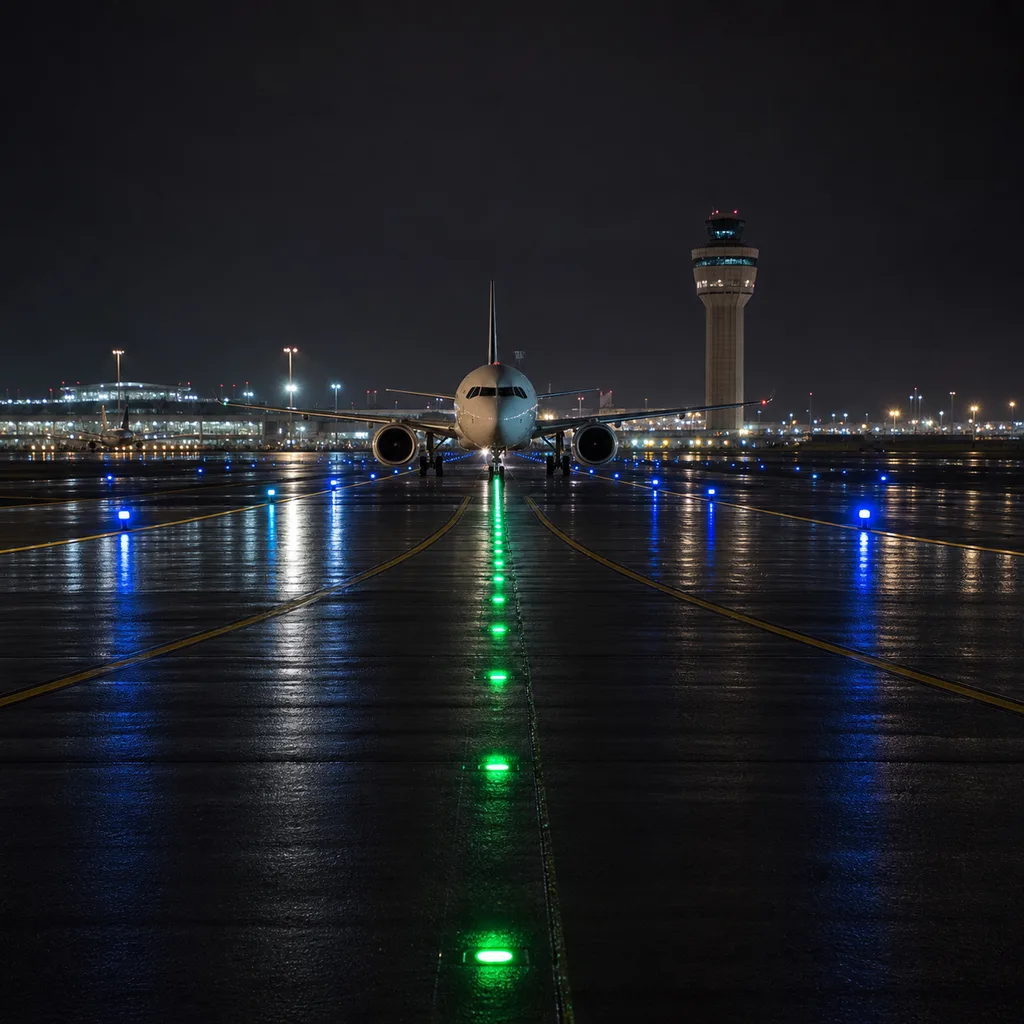
Overview
Airfield Ground Lighting (AGL) is the visual-guidance backbone of every aerodrome: the precisely arranged pattern of runway, taxiway, approach and indicator lights that lets flight crews align, land, roll out and taxi safely at night and in low visibility. The REDCOAST.LTD RC-AGL-6600 is a complete, mains-powered LED airfield ground lighting solution that brings together the full fixture portfolio, constant current regulators (CCR), series isolation transformers and an Individual Lamp Control & Monitoring System (ILCMS), and ships with a web supervisory platform and a mobile app — engineered, built and integrated by one team. It targets civil and commercial airports, regional and general-aviation aerodromes, military airfields and heliports that need ICAO Annex 14 and FAA-grade guidance while cutting the energy use, lamp-replacement labour and downtime of legacy halogen circuits. Instead of a blind, all-or-nothing series loop, every fixture becomes an addressable, individually monitored point of light, so a single failed lamp is pinpointed before it turns into an operational or safety finding.
Key Features
- Full ICAO/FAA fixture portfolio in LED: runway edge, threshold/end, runway and touchdown-zone centreline, taxiway edge and centreline, stop bars, runway guard lights, PAPI, REIL and approach lighting systems.
- Grid-powered 6.6 A constant-current series circuit driven by thyristor or IGBT sine-wave CCRs, the proven backbone of airfield lighting worldwide.
- Five field-selectable brightness steps (B1–B5) with output-current accuracy within ±1 %, giving uniform intensity from roughly 1 % to 100 % across day, dusk and CAT II/III conditions.
- ILCMS power-line communication: individual lamp on/off, dimming and real-time fault/burn-out reporting over the existing series cable — no extra control wiring.
- Long-life LED optics rated 50,000–100,000 hours, slashing relamping and the runway closures that halogen replacement demands.
- Mixed-circuit support: LED and remaining halogen fixtures can share one regulated circuit during phased retrofits.
- Frangible mountings and low-protrusion inset fixtures (≤6.5 mm) meet impact-safety and obstacle-clearance requirements.
- Dual-fed, redundant architecture with standby-generator changeover within one second for CAT II/III runways.
- AGLCMS supervisory software with web dashboard, mobile app and tower/SCADA integration for control, monitoring and predictive maintenance.
- Self-developed CCR power electronics, LED constant-current driver and PLC ILCMS node PCBs, tuned per project.
Technical Architecture
The system is built on the classic airfield series circuit. A constant current regulator (CCR) takes the airport's mains supply and delivers a precisely controlled current — selectable in five steps up to 6.6 A — into a high-voltage series loop, holding that current within ±1 % regardless of how many fixtures are connected or how the load varies. Each light is fed through a series isolation transformer (L-830/L-831 style, 10–200 VA), so a single lamp or cable fault cannot open the whole circuit and maintenance crews are protected from the loop's high open-circuit voltage. Inside each LED fixture, a REDCOAST-designed driver converts the 6.6 A series feed into the regulated current the LED array needs and keeps chromaticity and beam intensity within ICAO/IEC photometric tolerances at every brightness step.
Layered on top is the ILCMS. A power-line-communication modem at the CCR injects addressed data onto the same series cable that carries power; a small PLC node at every isolation transformer decodes commands and reports back. This lets operators switch and dim individual lamps or groups — stop bars, guard lights, lead-on routes — and receive lamp-level health in real time. The AGLCMS supervisory layer aggregates every circuit into a single SCADA-grade picture, exposed through a redundant hot-standby server pair to the control-tower HMI, a web dashboard and a mobile app. Open protocols (Modbus TCP, OPC-UA, SNMP) let the AGL tie into A-SMGCS, surface-movement guidance and the airport's wider asset-management stack, while logged lamp data drives predictive maintenance and energy reporting.
Connectivity & Power
The RC-AGL-6600 is a grid-powered system: CCRs are fed from the airport's low/medium-voltage distribution, typically single-phase AC 220 V or three-phase 380–415 V at 50/60 Hz. Because runway lighting is safety-critical and must always be available, the primary supply is backed by a standby generator and, for CAT II/III, a secondary power source with changeover within one second — not by solar, which cannot meet the always-on, high-intensity, dual-feed redundancy that aviation rules require. Lamp control and status ride the series cable via PLC, while the supervisory network uses fibre or industrial Ethernet between the CCR vault, tower and equipment rooms. For remote sites or multi-airport operators, the AGLCMS can additionally report over 4G/5G to the cloud platform and mobile app.
Protection & Reliability
Field fixtures are die-cast aluminium with toughened-glass optics, rated IP66/IP67 for in-pavement and elevated use and engineered for −55 to +55 °C, salt fog, sand, water immersion and aircraft tyre and jet-blast loads. Elevated units use frangible couplings that break away cleanly on impact. CCRs include open-circuit and over-current protection that removes lethal voltage in milliseconds, and the series architecture means one failed lamp never darkens the rest of the loop. ILCMS servers run hot-standby, regulators support N+1 redundancy, and surge protection guards against lightning on long airside cable runs. LED life of 50,000–100,000 hours, combined with single-lamp monitoring, turns reactive night call-outs into planned daytime maintenance.
Application Scenarios
- Commercial CAT I–III runways: high-intensity edge, centreline, touchdown-zone and approach lighting with full redundancy for scheduled airline operations in poor visibility.
- Regional and general-aviation aerodromes: medium-intensity runway and taxiway lighting, PAPI and REIL sized for cost-sensitive operators.
- Military and rapid-deployment airfields: ruggedised, quickly commissioned circuits with secure, hardened control.
- Heliports and helidecks: perimeter, TLOF/FATO and approach guidance for hospital, offshore and urban rooftop sites.
- Taxiway and apron expansion: addressable centreline, stop bars and runway guard lights for safe ground movement and routing.
- Halogen-to-LED retrofit: dropping LED fixtures and ILCMS onto existing series circuits to cut energy and maintenance without a full rebuild.
Case-style Examples
- Regional airport halogen-to-LED retrofit: an operator facing rising lamp-replacement costs and night runway closures swapped halogen edge and taxiway fixtures for RC-AGL LED units on the existing CCRs, added ILCMS for single-lamp monitoring, and reduced lighting energy and unplanned outages while keeping the runway open through phased night works.
- New CAT I runway commissioning: a greenfield runway was equipped with high-intensity edge and centreline lighting, an SSALR approach system, PAPI and REIL, a dual-fed CCR vault and AGLCMS tower integration, then commissioned and photometrically verified to ICAO Annex 14.
- Military airfield redundancy upgrade: an air base deployed dual redundant CCR feeds with one-second generator changeover and hardened control, ensuring continuous visual guidance for round-the-clock operations.
Customization & Selection Guide
Selection starts with the aerodrome category and approach minima (non-instrument, CAT I, II or III), which set fixture intensity classes, spacing and redundancy. From there, choose circuit count and CCR sizing (2.5–30 kVA) to match lamp load, control depth (basic series switching, full ILCMS single-lamp control, or AGLCMS with tower/SCADA integration), and fixture mix (elevated vs in-pavement, full LED vs phased retrofit). REDCOAST tailors photometrics, connector and transformer ratings, cabinet form factor and compliance target (ICAO, FAA Part 139, EASA CS-ADR-DSN or military) to each project, so the delivered system fits the runway rather than the other way around.
Deployment & After-sales
Delivery covers site survey and photometric/circuit design, factory production and testing to ICAO/FAA/IEC, on-site installation supervision, energised commissioning and flight-check support, operator and maintenance training, and a recommended spares package. The AGLCMS enables remote diagnostics and predictive maintenance; REDCOAST.LTD provides documentation, warranty and long-term technical support, with lead times confirmed per project scope at quotation.
Standards & Compliance
Designed to ICAO Annex 14 Volume I and the Aerodrome Design Manual Part 4 (Visual Aids); FAA AC 150/5345-46 (LED fixtures), AC 150/5345-10 (constant current regulators), AC 150/5345-7 (isolation transformers) and AC 150/5345-53 (equipment certification); IEC 61822 (CCRs), IEC 61827 (fixture characteristics) and the IEC 61820 series; and EASA CS-ADR-DSN. Electronics carry CE and RoHS conformity.
Why REDCOAST.LTD
REDCOAST.LTD delivers airfield lighting as one integrated solution — fixtures, regulators, control and software from a single team — and backs it with genuine hardware engineering: we develop our own CCR power electronics, LED constant-current drivers and PLC ILCMS node boards in-house and open new PCB designs to fit each project. That control means photometrics, redundancy, cabinet design and integration are tuned to your aerodrome instead of being forced into an off-the-shelf box, and the hardware, web platform and mobile app are built to work as one.
Talk to REDCOAST.LTD about a custom airfield ground lighting design, retrofit or upgrade — share your runway category, circuit layout and compliance target, and our engineers will scope a complete LED AGL solution for your site.
Specifications
Constant Current Regulator (Grid-Powered)
- Input Voltage
- AC 220 (1-ph) / 380–415 (3-ph) V
- Mains Frequency
- 50 / 60 Hz
- Output Current Range
- 2.8–6.6 A
- Output Current Accuracy
- ±1 %
- Output Power (model range)
- 2.5–30 kVA
- Brightness Steps
- 5 (B1–B5) steps
- Regulation Technology
- Thyristor / IGBT sine-wave
- Efficiency
- ≥96 %
LED Airfield Fixtures
- LED Service Life (L70)
- 50,000–100,000 h
- Fixture Power
- 8–45 W
- High-Intensity Runway Edge (white)
- ≥10,000 cd
- Chromaticity / Colour
- ICAO Annex 14 / IEC 61827
- Inset Protrusion Height
- ≤6.5 mm
- Beam Distribution
- Uni- / bi-directional
- Operating Temperature
- −55 to +55 °C
Series Circuit & Isolation Transformers
- Series Circuit Current
- 6.6 (20 A option) A
- Isolation Transformer Ratings
- 10 / 15 / 20 / 30 / 45 / 65 / 100 / 200 VA
- Primary / Secondary Current
- 6.6 / 6.6 A
- Fixture Connectors
- L-823 2-pin / 3-pin
- Insulation Voltage
- 5 kV
- Max Lamps per Circuit
- up to 100 fixtures
ILCMS Control & Monitoring
- Communication
- Power-Line Communication (PLC) over series cable
- Addressable Points
- up to 2,000 lamps
- Lamp Status
- Real-time on/off + fault/burn-out
- Control Granularity
- Individual / group / pattern
- Switching Response
- ≤1 s
- Integration Protocols
- Modbus TCP / OPC-UA / SNMP
- Server Architecture
- Hot-standby redundant + Web/App
Approach & Visual Guidance
- PAPI Configuration
- 2 / 4-unit (L-880 / L-881)
- PAPI Approach Angle
- 2.5–4.0 (adjustable) °
- REIL Flash Rate
- 60–120 flashes/min
- Approach System Types
- MALSR / SSALR / ALSF-2
- Threshold / End Colour
- Green / red
- PAPI Visual Range (night)
- ≥20 NM
Protection & Compliance
- Fixture IP Rating
- IP66 / IP67
- CCR Cabinet IP Rating
- IP54 (indoor) / IP55 (outdoor)
- Surge Protection
- 10 / 20 kA
- Fixture Housing
- Die-cast aluminium, frangible mount
- Secondary Power Changeover
- ≤1 s
- Compliance
- ICAO Annex 14 / FAA AC 150/5345 / IEC 61822–61827
Capabilities — configurable per project
Specifications are tailored to each project — the options below show what we can support.
Regulation
- Thyristor CCR
- IGBT sine-wave CCR
- Dedicated LED low-power driver
Control Depth
- Basic series switching
- ILCMS single-lamp control
- Full AGLCMS with tower/SCADA
Fixture Mounting
- Elevated
- In-pavement (inset)
- Mixed
Compliance Target
- ICAO Annex 14
- FAA Part 139
- EASA CS-ADR-DSN
- Military
Circuit Architecture
- Single circuit
- Multi-circuit
- Dual-fed redundant (CAT II/III)
Related solution guidance
Airports and Hubs
IoT infrastructure for transport hubs: parking guidance, road safety, outdoor lighting, signage, monitoring and operational dashboards.

Smart Street Lighting
Plan an IoT street lighting system with LED luminaires, pole controllers, adaptive dimming, fault alarms, asset management and platform integration.
Ports and Logistics
Outdoor IoT infrastructure for ports, yards and logistics areas: lighting, guidance, safety, solar power, monitoring and maintenance visibility.
Frequently Asked Questions
What is an airfield ground lighting (AGL) system and what does it include?
An AGL system is the network of runway, taxiway, approach and indicator lights that guides aircraft on the ground and on final approach. The RC-AGL-6600 includes LED fixtures (runway/taxiway edge and centreline, stop bars, guard lights, PAPI, REIL and approach lighting), constant current regulators, series isolation transformers, and an ILCMS control-and-monitoring system with web and mobile software.
Do REDCOAST.LTD airfield fixtures comply with ICAO Annex 14 and FAA standards?
Yes. Fixtures, regulators and transformers are designed to ICAO Annex 14 Volume I, the FAA AC 150/5345 series and IEC 61822/61827, with EASA CS-ADR-DSN available as an option. Photometrics, colours and intensity classes are verified to the applicable approach category.
Why do airfields use a 6.6 A constant-current series circuit instead of normal mains wiring?
A series circuit driven by a CCR delivers identical current to every fixture along kilometres of cable, so all lights show uniform, precisely dimmable intensity regardless of position. Constant-current operation also tolerates long cable runs and single-lamp faults far better than parallel mains lighting.
What is ILCMS and how does individual lamp monitoring work?
ILCMS (Individual Lamp Control & Monitoring System) uses power-line communication over the existing series cable. A node at each fixture decodes switching and dimming commands and reports real-time status, so operators can control single lamps or groups and detect a burned-out light immediately without any extra control wiring.
Can LED and existing halogen fixtures run on the same circuit during a retrofit?
Yes. The CCR and series circuit support mixed LED/halogen loads, allowing phased conversion so an airport can move to LED runway by runway without replacing everything at once.
Is the system grid-powered, or does it use solar?
It is grid-powered. CCRs run from the airport's mains supply, backed by a standby generator and, for CAT II/III, a secondary source with changeover within one second. Solar is not used for primary AGL because runway lighting must be always-on, high-intensity and redundantly fed, which dual utility feeds plus generator backup provide.
What approach categories and visual aids do you support?
We supply non-instrument through CAT I/II/III configurations, including high-intensity runway and approach lighting (MALSR/SSALR/ALSF), PAPI, REIL, stop bars and runway guard lights, sized to the aerodrome's approach minima.
How customizable is the system and what is the typical delivery scope?
Every project is engineered to its runway category, circuit layout and compliance target. Delivery covers survey and photometric design, factory testing, installation supervision, commissioning, training and spares, with lead time confirmed at quotation.