Overview
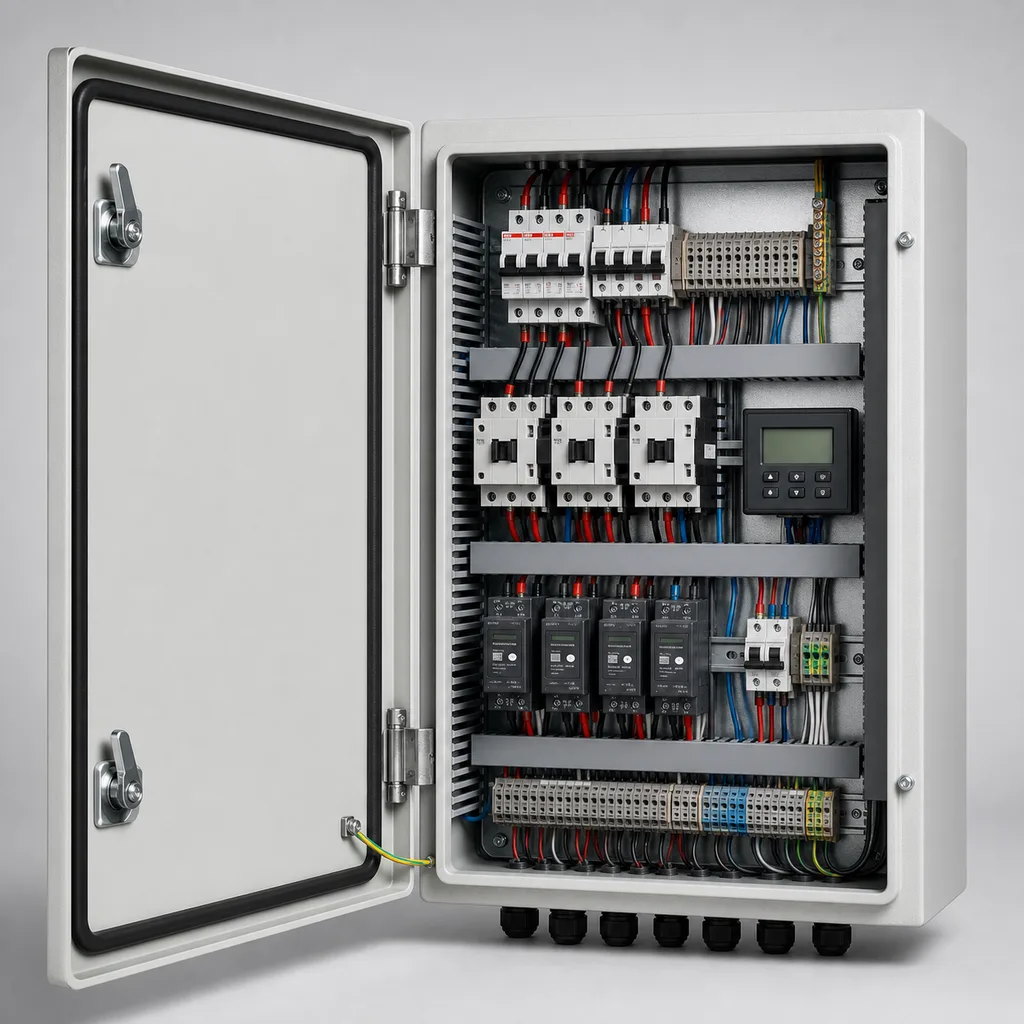
The REDCOAST.LTD RC-SIM-600 Automatic Snow & Ice Melting Control System (SIM) is an end-to-end, mains-powered solution that keeps critical outdoor walking and driving surfaces free of snow and black ice — automatically, without salt, plows or manual labour. It combines aerial precipitation sensing, in-pavement moisture-and-temperature probes, a self-testing ground-fault-protected master controller, and multi-zone contactor/SSR power panels that switch embedded electric heating cable or mats. A Web management platform and mobile App give facility operators live surface status, per-zone energy metering and remote hold-on/hold-off control. RC-SIM-600 targets municipalities, transit authorities, hospitals, airports, campuses and property managers who must eliminate slip-and-fall liability and keep ramps, stairs, bridge decks, crosswalks and EV charging bays operational through every winter storm.
Key Features
- Fully automatic activation — energises heating only when precipitation is present and the surface is near or below freezing, avoiding wasted energy on cold-but-dry days.
- Dual-layer sensing — mast/roof-mounted aerial snow sensor detects falling or blowing precipitation before ice forms; embedded pavement sensors confirm surface moisture and temperature for closed-loop control.
- Self-testing GFEP — integral 30 mA Ground-Fault Equipment Protection verifies healthy circuits before each contactor closes, and re-tests on start-up and every 24 hours, per NEC 426/427 practice.
- Multi-zone scalability — a single master drives up to 16 independently scheduled zones through 3-phase contactor or solid-state-relay (SSR) power panels rated to 50 A per zone.
- Idle-hold economy mode — optionally pre-warms slabs to just above freezing so full-power melt-down is faster and total kWh is lower during long events.
- Programmable after-run timer — continues heating after precipitation stops to fully dry the surface and prevent refreeze.
- Per-zone energy metering — three-phase metering reports kWh, power factor and load health for every circuit, enabling cost allocation and fault detection.
- IoT platform + App — cloud dashboard, weather-forecast pre-heat triggers, alarm push, event logs and OTA firmware.
- REDCOAST-developed board-level hardware — custom master-control PCB, sensor signal-conditioning front-end and contactor/SSR driver boards, all project-tunable.
Technical Architecture
RC-SIM-600 is organised in three tiers. At the sensing tier, an aerial snow sensor uses a heated grid to detect and evaporate incident precipitation, reporting a precipitation flag together with ambient temperature; in-slab SIT-type sensors measure surface temperature and the presence of a moisture film. Signals are digitised by a REDCOAST signal-conditioning PCB with isolation and surge protection, then handed to the master controller.
The control tier runs REDCOAST's edge master-control board. Its firmware fuses the sensor inputs against configurable temperature and moisture thresholds, applies hysteresis and after-run logic, and can accept a forecast-based pre-heat command from the cloud so slabs are already warm when a storm arrives. The master issues low-current switching signals and continuously supervises GFEP status, load current and zone temperature.
The power tier is one or more distribution panels. Each panel takes the master's low-amperage command and closes high-amperage 3-phase contactors (or drives SSRs for silent, high-cycle operation) that feed the embedded heating cable or mats. Every branch carries GFEP and over-current protection. Data flows upward — sensor → master → cloud — while control flows downward — cloud/App → master → panel → heating element — giving a clean edge-plus-cloud split where the site keeps melting safely even if the network drops.
Connectivity & Power
The master controller and sensors run from AC 100–240 V, 50/60 Hz auxiliary supply and draw only tens of watts. The heating load is served from the building/site distribution as 3-phase 380–415 V (208/230/480 V variants available), switched by the panels. Because these installations are urban, campus, transit and building-adjacent — sites with grid power and significant heating load (hundreds of watts per square metre) — RC-SIM-600 is a mains-powered system; it is not solar-powered, as no practical off-grid array could sustain resistive snow-melt loads. For connectivity, the master offers wired Ethernet as the default backhaul, with 4G/5G or NB-IoT cellular and LoRa options for remote panels and satellite sensors. Modbus RTU/TCP and BACnet/IP allow integration into building management (BMS/SCADA) systems.
Protection & Reliability
Control and power enclosures are rated IP66 / NEMA 4X for outdoor, wash-down and coastal exposure, with a smooth powder-coated or fluorocarbon-painted finish over hot-dip-galvanised or 316 stainless steel. Electronics operate from -40 to +60 °C, suiting hard-freeze climates. Surge protection (Type 2 SPD), circuit-level GFEP and thermal cut-outs protect both people and equipment. Heating cables and mats are selected for a 20+ year embedded service life; the control system carries a standard 3-year warranty with extension options. Self-testing GFEP, watchdog timers and load-health monitoring make the system fault-tolerant and maintainable, with alarms surfaced to the App before a failure becomes a safety issue.
Application Scenarios
- Pedestrian bridges, overpasses & stairs — keeps decks and treads ice-free where plowing is impossible and a single fall is a serious liability; zones follow the walking path exactly.
- Transit platforms, ramps & station entrances — maintains accessible, slip-free routes for boarding and ADA compliance throughout snow events.
- Hospital and emergency-service driveways & entrances — guarantees ambulance and patient access; heating starts automatically before storms close in.
- EV charging bays & forecourts — keeps charging positions clear and safe so drivers and cables stay dry in winter.
- Building ramps, loading docks & underground-garage approaches — prevents ice on steep grades where vehicles lose traction.
- Historic plazas, hotel forecourts & campus walkways — invisible, salt-free melting that protects landscaping, stonework and reinforced concrete from chloride damage.
Case-style Examples
Transit interchange stair & ramp retrofit. A commuter interchange suffered repeated winter closures of its exposed footbridge stairs. RC-SIM-600 was deployed with an aerial sensor on the canopy mast, four pavement zones covering the stairs and both ramps, and a single 4-zone SSR panel. Idle-hold plus forecast pre-heat cleared surfaces before the morning peak, and per-zone metering let the operator prove energy cost against the labour previously spent salting.
Hospital emergency-entrance & ambulance ramp. A regional hospital needed a guaranteed ice-free ambulance approach. A 6-zone contactor panel drove mineral-insulated cable in the ramp and self-regulating cable at the entrance apron. Redundant sensors and self-testing GFEP satisfied the facility's safety audit, and BACnet integration surfaced status on the existing BMS.
Off-street EV charging hub. A fleet-charging operator added RC-SIM-600 heating mats under eight fast-charging bays. Automatic activation kept bays clear during storms, cellular backhaul provided remote oversight of a lightly staffed site, and the App's event log documented uptime for the service-level agreement.
Customization & Selection Guide
Start by mapping the heated area and layout: predictable rectangular slabs favour cost-efficient constant-wattage cable or pre-fabricated mats (typically 300–540 W/m²); irregular retrofits favour cut-to-length self-regulating cable. Choose watt density by climate severity — moderate zones ~300–400 W/m², heavy-snow zones ~430–540 W/m². Size zones and panels to the total load: use contactors for large infrequent loads, SSRs where silent, high-cycle or fine modulation is wanted. Add forecast pre-heat and idle-hold where energy cost matters, and BMS/SCADA integration on institutional sites. For remote panels or satellite entrances, specify cellular or LoRa in place of Ethernet. REDCOAST tunes sensor thresholds, after-run time and metering channels per project.
Deployment & After-sales
Heating cable/mats are installed in the concrete pour, asphalt or under pavers by the civil contractor to REDCOAST layout drawings; sensors are set flush in the surface and on a mast, and the control and power panels are wall- or pillar-mounted nearby. REDCOAST supplies wiring schedules, commissioning support and remote factory acceptance. Typical control-system lead time is project-dependent and confirmed at order. After-sales covers remote diagnostics through the platform, spare-part supply, firmware updates and multi-year technical support.
Standards & Compliance
Designed toward IEC 60800 / IEC 62395 (electric surface heating and self-regulating heating cable systems), IEEE 515.1, and ground-fault practice per IEC 60364 / NEC Articles 426 & 427. Enclosures meet IP66 / NEMA 4X; electronics are CE / RoHS aligned, with UL-listed heating components available for North American projects. Accessibility of heated routes supports ADA / EN 16005 site requirements.
Why REDCOAST.LTD
REDCOAST.LTD delivers this as one integrated, project-tailored solution — hardware, Web platform and mobile App from a single team — not a box of third-party parts. Because we develop our own board-level hardware (custom master-control, sensor signal-conditioning and contactor/SSR driver PCBs), we can match your zone count, sensor mix, metering and integration protocols exactly, and adapt to any climate, grid voltage and compliance regime. Contact REDCOAST.LTD for a site-specific snow-melt design, load calculation and quotation.
Specifications
Snow & Ice Detection
- Aerial Sensor Type
- Heated precipitation + ambient temperature
- Pavement Sensor
- Embedded moisture film + surface temperature
- Precipitation Detection
- Falling & blowing snow before ice forms
- Aerial Sensor Power
- 15 W
- Sensor Supply
- 100-240 VAC 50/60 Hz
- Activation Logic
- Moisture present AND temp below setpoint
Control & Zoning
- Zones per Master
- up to 16 zones
- Switching
- 3-phase contactor or SSR
- Per-Zone Current
- up to 50 A
- Idle-Hold Mode
- Pre-warm to +1 to +3 above freezing °C
- After-Run Timer
- 0-10 (programmable) h
- Forecast Pre-heat
- Cloud weather-triggered
Power & Electrical
- Control Supply
- AC 100-240 V
- Heating Load Supply
- 3-phase 380-415 (208/230/480 variants) V
- Frequency
- 50/60 Hz
- Per-Zone Metering
- kWh, current, power factor
- Controller Consumption
- 20-60 W
Heating Elements (integrated / compatible)
- Element Types
- Self-regulating, constant-wattage, MI cable, pre-fab mats
- Watt Density (pavement)
- 300-540 W/m²
- Self-Regulating Output
- up to 30-50 W/m
- Target Surface Rise
- +2 to +5 °C
- Embedded Service Life
- 20+ years
Protection & Safety
- GFEP Trip
- 30 mA
- GFEP Self-Test
- Pre-close, start-up, every 24 h
- Surge Protection
- Type 2 SPD
- Enclosure Rating
- IP66 / NEMA 4X
- Thermal Cut-out
- Per-zone over-temperature
Connectivity & Environment
- Backhaul
- Ethernet / 4G-5G / NB-IoT / LoRa
- Integration
- Modbus RTU/TCP, BACnet/IP
- Management
- Web platform + mobile App
- Operating Temperature
- -40 to +60 °C
- Warranty (control system)
- 3 (extendable) years
Capabilities — configurable per project
Specifications are tailored to each project — the options below show what we can support.
Heating Element
- Self-regulating cable
- Constant-wattage cable
- Mineral-insulated (MI) cable
- Pre-fabricated mats
Switching
- Contactor panel
- Solid-state relay (SSR)
- Hybrid
Connectivity
- Ethernet
- 4G/5G
- NB-IoT
- LoRa
Integration
- Standalone
- Modbus SCADA
- BACnet BMS
Grid Voltage
- 3-phase 380-415 V
- 208 V
- 230 V
- 480 V
Related solution guidance
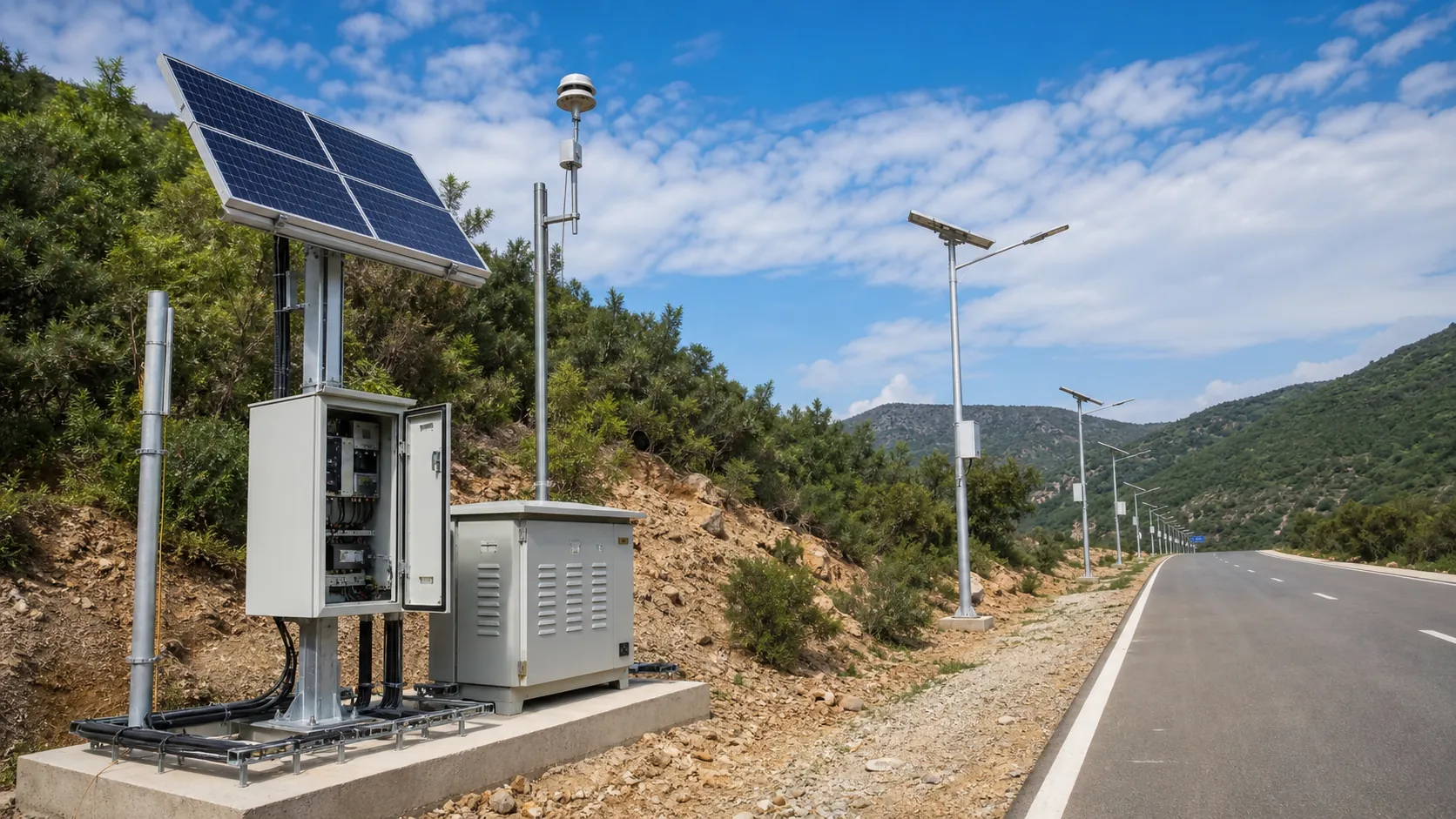
Solar IoT Guide
A design guide for solar-powered outdoor IoT: load calculation, battery autonomy, low-power firmware, telemetry and maintenance planning.

Environmental Monitoring
Deploy environmental monitoring stations with sensors, solar power, gateways, dashboards, alarms and data integration for city and industrial sites.

Street Lighting Guide
A practical guide to choosing smart street lighting controllers, connectivity, platform features, dimming logic and acceptance tests.
Frequently Asked Questions
How does an automatic snow melting system know when to turn on?
It combines an aerial precipitation sensor with in-pavement moisture and temperature probes. Heating energises only when precipitation is detected and the surface is at or below the freezing setpoint, so it never wastes energy on cold-but-dry days. A programmable after-run timer keeps heating until the surface is fully dry to prevent refreeze.
Is the RC-SIM-600 solar-powered or grid-powered?
It is a grid (mains) powered system. Resistive snow-melt loads run to hundreds of watts per square metre, which no practical solar array can sustain, so RC-SIM-600 is designed for urban, campus, transit and building-adjacent sites that already have three-phase power.
How much power does electric snow melting use?
Embedded pavement heating is typically designed for 300–540 W/m² depending on climate severity, switched from a three-phase supply. Idle-hold pre-warming and forecast-based pre-heat reduce total kWh, and per-zone metering lets operators track and allocate exact energy use.
What is GFEP and why does a snow melt controller need it?
GFEP (Ground-Fault Equipment Protection) trips the circuit at about 30 mA to protect embedded heating cable and people from ground faults. RC-SIM-600 uses self-testing GFEP that verifies each circuit before the contactor closes and re-tests on start-up and every 24 hours, following NEC 426/427 practice.
How many zones and how large an area can one system control?
One master controller drives up to 16 independently scheduled zones through contactor or SSR power panels rated to 50 A per zone. Multiple panels can be daisy-chained, so a single system scales from a short entrance apron to a full multi-ramp facility.
Can it integrate with our building management or SCADA system?
Yes. The master exposes Modbus RTU/TCP and BACnet/IP, and offers Ethernet, 4G/5G, NB-IoT or LoRa backhaul. Status, alarms and per-zone energy data can be surfaced on your existing BMS/SCADA or on the REDCOAST.LTD Web platform and mobile app.
What heating elements does REDCOAST.LTD supply with the control system?
The system works with self-regulating cable, constant-wattage cable, mineral-insulated (MI) cable and pre-fabricated mats. REDCOAST.LTD selects the element type and watt density per project layout and climate, and provides installation layout drawings for the civil contractor.
Which standards does the system follow?
It is designed toward IEC 60800 / IEC 62395 for electric surface and self-regulating heating, IEEE 515.1, and ground-fault practice per IEC 60364 and NEC Articles 426 & 427. Enclosures are IP66 / NEMA 4X and electronics are CE / RoHS aligned, with UL-listed heating components available for North American projects.