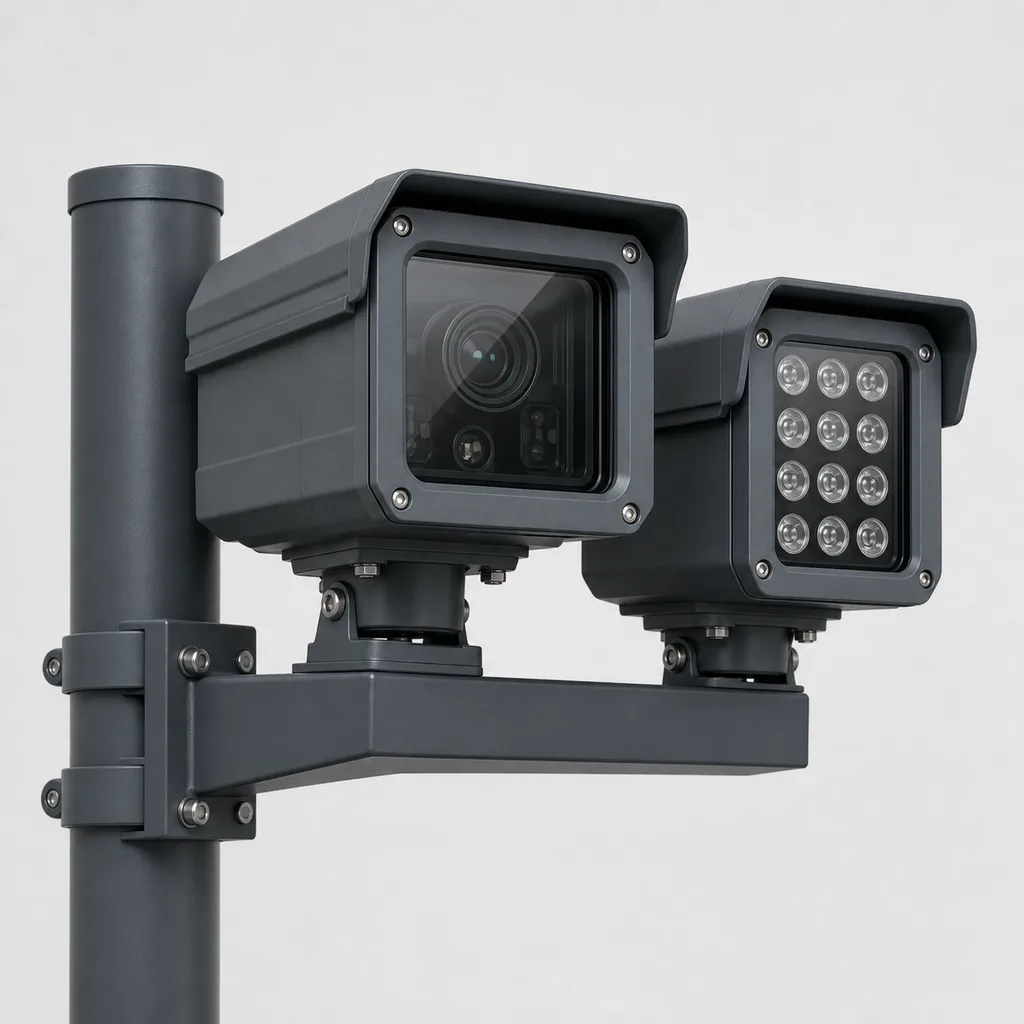
Overview
The REDCOAST.LTD RC-ASE-700 Average Speed Enforcement & Section Control System measures the average speed of every vehicle travelling between two (or more) certified reading points, rather than an instantaneous speed at a single spot. Each point captures a time-stamped, ANPR-read image; the back office matches the anonymised entry and exit records and divides the officially surveyed distance by the elapsed time. Because drivers cannot simply brake at one camera and accelerate again, section control smooths speed over the whole corridor — the enforcement approach most consistently linked to lower average speeds, fewer casualties and better traffic flow. RC-ASE-700 is a mains-powered, roadside/gantry system engineered for motorways, dual carriageways, long tunnels, bridges, mountain passes, temporary work zones and dense urban corridors. It is a complete solution: REDCOAST.LTD supplies the in-house-designed edge-AI hardware, the enforcement back-office/Web platform and a supervisor mobile app, integrated and delivered by one team.
Key Features
- True point-to-point average-speed measurement over configurable section lengths from 0.5 km to 30 km, with 2, 3 or more reading points on long or curved corridors.
- Multi-lane free-flow capture — up to 4 lanes per reading point with a single gantry or cantilever, no in-road loops required (video-based virtual trigger).
- Self-developed edge-AI ANPR camera board delivering >98% capture rate and multi-script plate recognition (Latin, Arabic, Cyrillic, CJK) with downloadable country plate packs.
- Covert 24/7 operation using REDCOAST.LTD's constant-current IR illuminator driver — no visible flash, clear reads in darkness, rain, fog, glare and backlight.
- GNSS-disciplined time synchronisation (PTP/NTP) keeping all points within sub-millisecond agreement, the foundation of legally defensible speed calculation.
- Privacy-by-design matching — plates are hashed/anonymised at each point; only confirmed violations are de-anonymised, aligning with GDPR-style data-protection regimes.
- Tamper-evident encrypted evidence — AES-256 storage, digitally signed violation records with hash-chain integrity for court admissibility.
- Legal-metrology ready design targeting OIML R 91:2025 (Traffic speed meters) and MID type approval.
- Grid-powered with LiFePO4 UPS ride-through, so brief mains dips or outages never break a section run.
- Open integration via HTTPS/TLS REST API, ONVIF and MQTT into national back-office, ITS and tolling platforms.
Technical Architecture
A section-control corridor is built from two or more reading points, each a self-contained enforcement node. At its core is REDCOAST.LTD's multi-lane edge-AI ANPR camera board: a 9 MP global-shutter imager with motorised varifocal optics feeds an on-board NPU that performs plate detection, optical character recognition, vehicle classification and make/model/colour recognition (MMR) locally, so only compact metadata plus evidential images leave the roadside. A companion IR illuminator driver PCB pulses 850 nm (covert) or 940 nm LED arrays in lock-step with the shutter, guaranteeing legible plates around the clock without dazzling drivers.
The defining subsystem is timing. Each node carries a GNSS/PTP time-sync board that disciplines a local oscillator to satellite time and distributes IEEE-1588 Precision Time Protocol across the corridor, so a vehicle's entry and exit timestamps share a common, traceable time base to better than one millisecond. A synchronised multi-lane capture/trigger board time-stamps every passage and tags it with lane, direction and a rolling plate hash. Records travel over the backhaul to the enforcement engine, which matches entry/exit hashes, computes average speed against the certified section distance, and — only for over-limit matches — assembles a signed, AES-256-encrypted violation record (plate images, overview image, timestamps, computed speed, section ID, calibration reference). A self-developed UPS power-management PCB monitors the LiFePO4 pack, mains health, cabinet temperature and door tamper, feeding diagnostics to the platform. The REDCOAST.LTD Web platform manages devices, review/adjudication workflow, statistics and evidence export, while the mobile app gives supervisors live health, capture previews and alarm acknowledgement.
Connectivity & Power
Reading points are linked to each other and to the back office over single-mode fibre (SFP) where a corridor duct exists — the preferred option for long tunnels and motorways — or over 4G/5G and Gigabit Ethernet where trenching is impractical. All traffic is encrypted (TLS/IPSec) and the system exposes ONVIF, HTTPS REST and MQTT for third-party integration. As an urban/highway roadside product the RC-ASE-700 runs on mains power (AC 100–240 V, 50/60 Hz); each point draws roughly 45–120 W (up to ~150 W with IR at full output). A LiFePO4 UPS provides 2–8 hours of ride-through so momentary outages do not corrupt a section run, and the power board includes IEC 61643 surge protection for exposed roadside installations. No solar array is used — these deployments sit on grid-served corridors, and REDCOAST.LTD reserves solar/off-grid power for genuinely remote sites.
Protection & Reliability
Camera and illuminator housings are die-cast aluminium rated IP66/IP67 with hydrophobic front glass and sun shields. The roadside cabinet is IP55 with active thermal management (heater and forced-air/fan) for a -40 °C to +70 °C operating window, 5–100% RH humidity, and salt-fog-resistant coatings for coastal corridors. Poles, cantilevers and gantry brackets are hot-dip galvanised for corrosion protection and then finished with a smooth matte powder-coat or fluorocarbon topcoat, not left as bare galvanised steel. Vibration-tolerant mounts keep optical alignment on gantries, and the modular architecture lets a single camera, illuminator or board be hot-swapped without re-surveying the section. Design life targets 8–10 years outdoors, backed by REDCOAST.LTD warranty and spares support.
Application Scenarios
- Motorways & dual carriageways: gantry-mounted reading points enforce a steady safe speed over multi-kilometre high-casualty stretches, cutting the 'brake-and-accelerate' behaviour of spot cameras and smoothing flow.
- Long road tunnels: covert IR reading points at portals and mid-tunnel hold speeds down where a crash would be catastrophic, integrating with tunnel ventilation and incident-detection systems.
- Bridges & viaducts: average-speed control protects sensitive structures and reduces heavy-vehicle impact, with ANPR data doubling as classified traffic counts.
- Roadworks & temporary work zones: relocatable pole-mounted points protect workers by enforcing reduced limits along the works, then move to the next site.
- Mountain passes & accident black-spots: section control over winding descents where instantaneous cameras are hard to site and easy to evade.
- Urban arterials & school corridors: point-to-point enforcement of city speed limits along residential and school routes, improving compliance where casualties are highest.
Case-style Examples
Motorway corridor safety upgrade. A 6 km high-casualty motorway segment is fitted with two four-lane gantry reading points linked by existing fibre. RC-ASE-700 nodes with covert IR run 24/7; the back office reports a sharp fall in mean and 85th-percentile speeds and steadier headways, with ANPR classification feeding the operator's traffic-data dashboard.
Long-tunnel enforcement retrofit. A twin-bore tunnel adds portal-and-midpoint reading points on mains power with LiFePO4 UPS ride-through. Because plate reads are hashed at entry and only matched violations are de-anonymised, the deployment satisfies the authority's strict data-protection review while giving control-room staff live device health via the mobile app.
Mobile work-zone protection. A maintenance authority orders relocatable pole-mounted nodes with 5G backhaul. Crews stand up a temporary 2 km enforced section in hours, enforce the reduced work-zone limit for the project duration, then redeploy the same equipment to the next site — no trenching, no fixed civil works.
Customization & Selection Guide
- Section geometry: choose 2 points for a simple stretch, or 3+ points to handle junctions, curves and very long corridors where a single origin/destination pair would be ambiguous.
- Mounting: gantry or cantilever for multi-lane motorways; roadside pole for two-lane roads; tunnel-wall brackets for bores; relocatable poles for work zones.
- Backhaul: fibre for permanent high-throughput corridors; 5G/4G for rapid or temporary deployment; Ethernet where a cabinet is already networked.
- Plate/region pack: GCC/Arabic, EU/Latin, Cyrillic, Latin-American, Southeast-Asian or East-Asian recognition packs, combinable for cross-border corridors.
- Enforcement mode: pure section (average) control, spot speed at each point, ANPR-only travel-time/journey-time mode, or a combined configuration.
- Add-ons: make/model/colour recognition, dangerous-goods (ADR) placard capture, secondary AI (seat-belt/phone), and roadside weather sensing for advisory speed logic.
Deployment & After-sales
Deployment follows a fixed method: certified survey and marking of the section distance, gantry/pole installation, camera aiming and focus, GNSS/PTP synchronisation check, and a metrological verification run before go-live. REDCOAST.LTD provides factory acceptance testing, on-site commissioning support, operator training and documented calibration procedures. Because the hardware is our own, lead times and configuration (lane count, region pack, backhaul, enforcement mode) are set per project rather than constrained by an off-the-shelf catalogue. After sales, the platform delivers remote diagnostics, firmware/plate-pack updates and health alarms; spares, extended warranty and SLA-based technical support are available worldwide.
Standards & Compliance
The RC-ASE-700 is designed toward OIML R 91:2025 (Traffic speed meters) and MID (Measuring Instruments Directive) type approval for legal-metrology use, with data security aligned to ISO/IEC 27001 and privacy practices consistent with GDPR-style regimes (plate anonymisation/hashing). Hardware targets IP66/IP67 (IEC 60529) enclosures, IEC 60068 environmental testing, IEC 61000 EMC, IEC 61643 surge protection, and CE / RoHS, manufactured under ISO 9001. Exact certification is scoped to each jurisdiction's enforcement rules.
Why REDCOAST.LTD
REDCOAST.LTD delivers the whole solution — roadside hardware, enforcement Web platform and mobile app — integrated by one team. Our edge in section control is that we design and fabricate the boards ourselves: the multi-lane edge-AI ANPR camera board, the IR illuminator driver, the GNSS/PTP time-sync and synchronised capture board, and the UPS power-management PCB are all in-house, so timing accuracy, evidence integrity and roadside power behaviour are fully under our control and can be tuned per project. That means custom lane counts, region-specific plate recognition, jurisdiction-specific evidence formats and bespoke back-office integrations — not a fixed product you must bend your tender around. Talk to REDCOAST.LTD about your corridor and enforcement rules, and we will engineer an average-speed section-control system to fit — contact us for a custom proposal.
Specifications
ANPR Camera & Imaging
- Image Sensor
- 9 MP global shutter (4096×2160)
- Frame Rate
- up to 60 fps
- Lanes per Reading Point
- up to 4 lanes
- Max Capture Speed
- up to 320 km/h
- ANPR Capture Rate
- >98 %
- Plate Recognition
- multi-script (Latin/Arabic/Cyrillic/CJK), 100+ region packs
- Lens
- motorised varifocal, remote focus/zoom
- Trigger
- free-flow video virtual loop (no in-road loop)
Speed Measurement & Metrology
- Method
- point-to-point average speed (time-over-distance)
- Section Length
- 0.5–30 (configurable) km
- Reading Points per Section
- 2–8 points
- Speed Range
- 20–250 km/h
- Section Speed Accuracy
- ±2 (≤100 km/h) / ±2% (>100 km/h) km/h
- Time Sync
- GNSS-disciplined PTP/NTP, <1 ms between points
- Timestamp Resolution
- 1 ms
- Target Standards
- OIML R 91:2025, MID type approval
Illumination & Optics
- IR Illuminator
- 850 nm covert / 940 nm
- IR Driver
- self-developed constant-current LED driver PCB
- Effective IR Range
- up to 40 m
- Operation
- 24/7, no visible flash
- White-light Overview
- optional context camera
Edge AI & Evidence
- Edge AI NPU
- up to 40 TOPS
- On-board Analytics
- ANPR, vehicle class, MMR (make/model/colour)
- Local Storage
- 512 GB–4 TB SSD ring buffer
- Encryption
- AES-256; plate hashing/anonymisation
- Evidence Integrity
- digitally signed, hash-chain, tamper-evident
- Data Privacy
- GDPR-style anonymise-until-violation
Connectivity
- Backhaul
- Fibre (SFP) / 5G / 4G / Gigabit Ethernet
- Inter-point Link
- fibre or 4G/5G with PTP
- Protocols
- HTTPS/TLS REST, ONVIF, MQTT
- Security
- TLS 1.3, IPSec VPN
- Integration
- back-office / ITS / tolling API
Power (grid)
- Input Voltage
- AC 100–240 V
- Frequency
- 50/60 Hz
- Power per Reading Point
- 45–150 W
- UPS Backup
- LiFePO4, 2–8 h ride-through (self-developed PMU PCB)
- Surge Protection
- IEC 61643, up to 20 kA
Enclosure & Environment
- Camera/IR Housing
- IP66/IP67 die-cast aluminium
- Roadside Cabinet
- IP55 with active thermal management
- Operating Temperature
- -40 to +70 °C
- Humidity
- 5–100 (non-condensing) %RH
- Pole/Gantry Finish
- hot-dip galvanised + matte powder-coat/fluorocarbon
- Design Life
- 8–10 years
Capabilities — configurable per project
Specifications are tailored to each project — the options below show what we can support.
Mounting
- Overhead gantry
- Cantilever pole
- Roadside pole
- Tunnel-wall bracket
- Relocatable work-zone pole
Backhaul
- Fibre (SFP)
- 5G
- 4G
- Gigabit Ethernet
Plate/Region Pack
- GCC/Arabic
- EU/Latin
- Cyrillic
- Latin America
- Southeast Asia
- East Asia
Enforcement Mode
- Section/average speed
- Spot speed at points
- ANPR travel-time only
- Combined section + spot
Add-ons
- Make/Model/Colour (MMR)
- ADR dangerous-goods placard
- Seat-belt/phone AI
- Roadside weather sensing
Related solution guidance
Traffic Safety Checklist
Deployment checklist for connected traffic warning signs, beacons, road guidance devices, power, visibility, monitoring and acceptance tests.
Traffic Safety
Plan connected traffic safety systems with warning beacons, LED signs, road guidance devices, sensing, control cabinets and monitoring software.
Ports and Logistics
Outdoor IoT infrastructure for ports, yards and logistics areas: lighting, guidance, safety, solar power, monitoring and maintenance visibility.
Frequently Asked Questions
What is the difference between section control and a normal speed camera?
A normal (spot) speed camera measures instantaneous speed at one point, so drivers often brake at the camera and accelerate again. Section control measures a vehicle's average speed between two ANPR reading points over a certified distance, enforcing a steady safe speed across the whole corridor. RC-ASE-700 supports section, spot or combined modes.
How accurate is average speed measurement and is it legally admissible?
Accuracy comes from a precisely surveyed section distance and sub-millisecond GNSS-disciplined time synchronisation (PTP/NTP) shared by all reading points. The system is designed toward OIML R 91:2025 and MID type approval, and produces digitally signed, AES-256-encrypted, tamper-evident violation records suitable for legal adjudication in most jurisdictions.
How does the system protect driver privacy?
Plates are hashed and anonymised at each reading point. Only records that match as over-limit between entry and exit are de-anonymised for enforcement; compliant vehicles' data is discarded. This anonymise-until-violation approach aligns with GDPR-style data-protection regimes.
Does it work at night and in bad weather?
Yes. Each reading point uses covert 850 nm (or 940 nm) infrared illumination driven by REDCOAST.LTD's constant-current IR driver, giving legible plate reads 24/7 with no visible flash, in darkness, rain, fog and glare. Capture rate exceeds 98% across day and night.
How long can an enforced section be and how many lanes are covered?
Section length is configurable from 0.5 km up to about 30 km, using 2 to 8 reading points to handle junctions and curves. Each point covers up to 4 lanes per gantry or cantilever using free-flow video triggering, so no in-road loops are needed.
Is this a solar system? What power does it need?
No. Section control is deployed on grid-served motorways, tunnels and urban corridors, so the RC-ASE-700 runs on mains power (AC 100–240 V) with a LiFePO4 UPS for ride-through during brief outages. REDCOAST.LTD reserves solar/off-grid power for genuinely remote sites, not grid corridors.
Can it be moved for roadworks and temporary sites?
Yes. With relocatable pole mounts and 5G backhaul, a temporary enforced section can be stood up in hours to protect a work zone, then redeployed to the next site without trenching or fixed civil works.
Which countries' number plates can it read?
Recognition uses AI plate packs for Latin, Arabic, Cyrillic and CJK scripts, with region packs for the GCC, Europe, Latin America, Southeast Asia and East Asia that can be combined for cross-border corridors. Packs are updatable over the air.