Overview
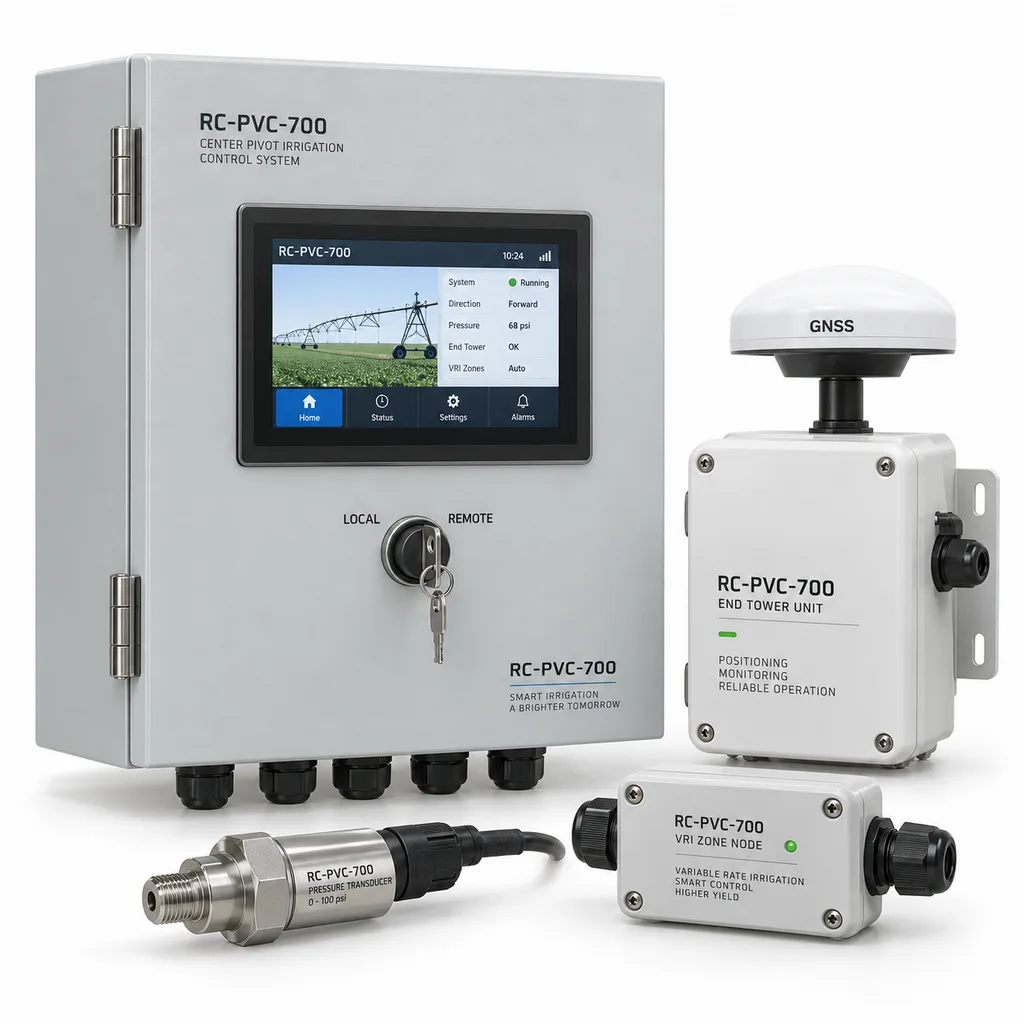
The REDCOAST.LTD RC-PVC-700 is a brand-agnostic remote monitoring, control and Variable Rate Irrigation (VRI) retrofit system for electric-drive center pivots and linear-move irrigation machines. It is built for large arable farms, agricultural investment companies, state farms, government irrigation schemes and irrigation dealers who run fleets of machines from different brands and years, spread across many kilometres of farmland. Staff no longer have to drive out to check whether each pivot is moving, pressurised and on schedule. Operators see every machine on one live map, start, stop and reprogram machines remotely, and get an alert within seconds when a machine stalls, loses pressure or has its span cable cut. The system takes its power from each machine's own AC supply (utility grid or on-farm generator), so no separate power infrastructure is needed. It upgrades existing pivots without replacing the OEM main control panel.
Key Features
- Retrofit for mixed fleets: connects to the OEM main panel through isolated inputs and pilot-duty relays wired alongside the existing controls. Most electric-drive pivots and linear moves can be upgraded regardless of brand or age, and the original panel keeps working normally.
- Real end-of-machine position: a dual-band, multi-constellation GNSS receiver on the last regular drive unit reports where the end of the machine actually is. Accuracy is typically within ±0.5° on a 400 m pivot. An RTK option brings this to about ±2 cm for linear moves and precise end-of-field stops.
- Complete remote control: start/stop, forward/reverse, wet/dry, travel speed, up to three end guns or booster pumps, well and booster pump start, chemigation interlock, and auto-stop or auto-reverse at virtual barricades.
- VRI speed and zone control: speed control across up to 360 angular sectors per circle. Optional zone control covers up to 32 radial zones by pulsing sprinkler solenoid valves. Prescriptions are imported as Shapefile, GeoJSON or CSV.
- Stall and over-watering protection: if the machine is told to run but its GNSS position does not change within a configurable 3–30 minute window, the controller raises an alarm. It can also stop the pump before ruts, runoff and crop damage develop.
- Pressure-aware operation: two 4–20 mA pressure transducers (one at the pivot point, one at the end of the machine) enable pressure-start and low/high pressure shutdown. End-pressure trends help detect leaks, clogged nozzles and pump wear.
- Span cable theft alarm: an extra-low-voltage supervision loop and an internal LiFePO4 backup battery keep theft detection running even when the machine is switched off at the main disconnect.
- Power and motor protection: Class 1 three-phase energy metering detects phase loss, phase reversal, imbalance and under/over-voltage. This protects tower motors and records kWh (or generator run time) for each irrigation.
- Farm-wide connectivity: LTE Cat-1 bis/LTE-M cellular, Ethernet, optional Iridium satellite messaging for areas without coverage, and a private LoRa farm network that lets one connected controller relay up to 16 machines or pump nodes.
- Web platform and mobile app: fleet map, program scheduling, prescription management, as-applied maps, water and energy reports, and alarm escalation by app push, SMS and automated voice call.
Technical Architecture
Each machine is fitted with two core units.
The Pivot Point Controller (PPC) mounts beside the OEM main panel:
- Its main board combines an industrial application processor with a real-time I/O co-processor.
- An isolated input board reads machine state directly from the 120 V or 230 V control circuit: run, direction, safety circuit status, pressure switch and pump running.
- A relay board with eight pilot-duty outputs drives start, stop, forward, reverse, the end-tower run signal, pump start, end gun and auxiliary functions.
- A three-phase metering front-end measures voltage, current, power factor and energy through split-core CTs.
- A 4.3-inch sunlight-readable touch display and a keyed LOCAL/REMOTE switch give the operator full control at the pivot point.
The End Tower Unit (ETU) mounts on the last regular drive unit. It carries the GNSS receiver, the end-of-machine pressure input and the end gun/booster pump output. When VRI zone control is fitted, it also runs the CAN bus that drives the VRI zone nodes along the spans. The ETU talks to the PPC over a private sub-GHz LoRa link, so no extra wiring has to be pulled through the span cables.
Irrigation programs run locally on the PPC and do not depend on the cloud. A program sets direction, speed or target application depth, start and stop angles, end-gun arcs and an optional VRI prescription.
- Speed control works like a conventional percent timer. The PPC switches the end-tower run signal on and off within a 60-second cycle (1–100 %), and the machine's own alignment system keeps managing the intermediate towers.
- VRI speed control: the PPC looks up the prescription for the current GNSS sector and adjusts the duty cycle as the machine travels. Applied depth is calculated from measured flow, machine length and a calibrated end-tower speed.
- VRI zone control: each zone node pulses the solenoid valves on its group of sprinkler drops over a configurable 30–120 s cycle. This reduces or cuts off water in specific radial zones, such as over waterways, farm tracks or rocky outcrops.
- Safety: the OEM safety circuit stays hard-wired and always has final authority. The controller can only request movement or a stop through the OEM panel logic, and turning the key to LOCAL disables every remote command during maintenance.
Telemetry goes to the REDCOAST.LTD cloud or to a customer-hosted server using MQTT over TLS. The PPC reports every 10 seconds while the machine is running, every 15 minutes when it is idle, and immediately on any alarm. It stores up to 90 days of data locally and uploads the backlog automatically after a communications outage. The platform keeps machine history, calculates applied depth per sector, and produces as-applied maps and water/energy reports. A REST API and a Modbus TCP interface connect it to farm management software, water-accounting systems or SCADA. Firmware updates are cryptographically signed and delivered over the air.
Connectivity & Power
Connectivity is chosen farm by farm:
- Cellular: where coverage reaches the pivot points, each PPC uses its own LTE Cat-1 bis or LTE-M modem, with a multi-band global module and eSIM.
- LoRa hub: on large farm blocks where only some locations have coverage (typically near the farm office or a main road), one PPC acts as a hub. It relays up to 16 machines, pump nodes and weather sensors over the private LoRa network. Typical range is 2–5 km across open farmland and up to 10 km line-of-sight with a mast antenna.
- Ethernet: farms with their own fibre, point-to-point radio or satellite broadband terminal can connect the PPC by cable.
- Satellite: for remote blocks with no terrestrial coverage, an optional Iridium Short Burst Data modem sends alarms and essential commands as short messages.
- Bluetooth LE: used for local commissioning from a phone or tablet.
The RC-PVC-700 runs on the host machine's own AC supply, with no solar panels or separate power cabling:
- The PPC accepts AC 100–240 V, 50/60 Hz from the main panel's control transformer and typically draws about 12 W.
- The ETU draws about 6 W from the tower box control circuit.
- Host machines on three-phase 380–480 VAC or single-phase 220–240 VAC are supported, whether fed from the utility grid or an engine-driven generator. The metering front-end tolerates 45–65 Hz and the voltage swings typical of generator sets.
- An internal 12.8 V, 7 Ah LiFePO4 battery keeps the PPC reporting, watches the theft loop and sends a last-gasp alarm when the main disconnect is opened. It gives up to seven days of monitoring-only operation at a 15-minute reporting interval.
- Battery charging is temperature-managed (0 to +45 °C), with an optional pack heater for cold climates.
- Pivots are tall metal structures in open fields, so the AC input has a Type 2 surge protective device rated 20 kA (8/20 µs), and all field I/O is surge-protected.
Protection & Reliability
The PPC sits in a powder-coated aluminium enclosure rated IP66. The ETU and VRI zone nodes are rated IP67, with UV-stabilised glass-fibre-reinforced polycarbonate housings. All units are dust-tight (IP6X) for desert and dry-land farming. PCBs are conformal-coated against condensing humidity, fertiliser vapour and dust. Enclosures use pressure-equalisation vents, stainless-steel fasteners and sealed cable glands.
The electronics operate from -30 to +60 °C ambient, and a sun shield is supplied for hot-climate pivot points. Tower-mounted units ride on moving towers over uneven wheel tracks, so they are vibration- and shock-tested to IEC 60068-2-6 and IEC 60068-2-27. Coastal variants are salt-mist tested to IEC 60068-2-52. Hardware watchdogs, dual firmware banks with automatic rollback, and non-volatile program storage let the controller recover cleanly from power interruptions. The design service life is at least ten years. The standard warranty is three years, extendable to five.
Application Scenarios
Large-scale grain and forage farms: farms running dozens of pivots on maize, wheat, alfalfa or soybean manage the whole fleet from one screen. Staff visit a machine only when an alarm or scheduled service calls for it. This cuts daily inspection drives and catches stalls hours earlier.
Water-scarce and abstraction-regulated regions: where groundwater or canal allocations are capped, measured flow, applied depth and run hours are logged per field and per irrigation event. Growers can show compliance with water licences and use VRI to spread a limited allocation across more hectares.
Government irrigation schemes and state farms: agencies running pivot clusters on newly reclaimed land need central visibility, standard reporting and protection against equipment theft. Role-based access gives scheme managers, farm operators and maintenance contractors each the data they need.
Seed, potato and vegetable production: high-value crops suffer from both over- and under-irrigation. VRI zone control avoids waterlogging in low spots. The chemigation interlock makes sure injection pumps run only when the machine is moving and pressurised.
Treated effluent and dairy effluent irrigation: municipal water-reuse schemes and dairy farms that apply effluent through pivots must avoid ponding, runoff and application over buffer zones. Virtual barricades, zone shut-off over sensitive areas and complete application records support environmental permit conditions.
Dealer-managed irrigation services: irrigation dealers and service companies can retrofit customer fleets and sell monitoring as a managed service. Multi-tenant platform access lets them watch machine health, dispatch technicians and plan pre-season maintenance.
Case-style Examples
Mixed-brand pivot fleet retrofit on a large arable farm
A farm ran 28 center pivots from four different brands, installed over 20 years. Two field staff drove roughly 150 km a day to check them, and cellular coverage was reliable at only a few pivot points. REDCOAST.LTD supplied PPC and ETU kits with brand-specific interface harnesses. Six PPCs with good LTE coverage were set up as LoRa hubs for the other machines. Pump nodes were added at 18 wells so that pivots start their pumps automatically on pressure demand. After commissioning, the farm switched to alarm-driven visits and found stalled machines within minutes instead of at the next inspection round. It also used VRI speed control on its sandiest fields to cut the water applied to soils that hold little moisture.
Generator-driven pivots on a remote farm block
A remote block of eight pivots ran on diesel generator sets and suffered repeated span cable theft and unexplained generator shutdowns. There was no cellular signal on site. The configuration combined the theft supervision loop, three-phase metering to track generator voltage and frequency, and an Iridium satellite modem. Night-time cable cutting now triggers an immediate call and SMS to the farm manager and security contractor. The power-quality logs also showed that two machines had undersized generators; the farm replaced them, which ended nuisance tower-motor trips.
VRI demonstration program for an agricultural development agency
An agency responsible for a newly reclaimed irrigation district wanted to show local growers what precision irrigation can do. REDCOAST.LTD fitted eight pivots with VRI zone control (24 radial zones each) and turned the agency's soil electrical-conductivity maps into prescriptions. Catch-can uniformity tests following ISO 11545 were run at commissioning to verify zone performance. The agency now publishes seasonal water-use and yield comparisons from the web platform. It uses the same system as the reference design for later pivot tenders.
Customization & Selection Guide
Use the table below as a starting point. REDCOAST.LTD engineers finalise the configuration after reviewing machine and site data.
| Requirement | Recommended configuration |
|---|---|
| Remote visibility and start/stop for an existing fleet | PPC + ETU with standalone GNSS, LTE or LoRa hub |
| Water savings on variable soils, limited budget | Add VRI speed control licence and a flow meter at the pivot point |
| Strong in-field variability, non-cropped areas, effluent buffers | VRI zone control with zone nodes and sprinkler solenoid valves |
| Linear-move machines or precise end-of-field stops | RTK GNSS via NTRIP correction service or local base station |
| No cellular coverage | LoRa hub to the nearest covered point, or Iridium satellite option |
| Theft-prone areas | Span cable supervision loop plus siren/strobe output at the pivot point |
Other points to confirm when selecting:
- The machine supply (three-phase 380–480 VAC or single-phase 220–240 VAC) and control voltage (120 V or 230 V), so the interface board and CTs can be pre-configured.
- The pack heater for sites that often fall below 0 °C, and the sun shield for desert sites.
- Flow-meter type (pulse or Modbus) and pressure ranges.
- REDCOAST.LTD cloud, or a private or on-premise server where data sovereignty rules apply.
For dealer or OEM programs, enclosure colour, HMI branding, app branding and harness connectors can be adapted to the partner's range.
Deployment & After-sales
Every project starts with a machine survey questionnaire covering brand, model and year, panel type, supply and control voltages, machine length and number of towers, end guns, pump arrangement and coverage at each pivot point. From this, REDCOAST.LTD prepares wiring diagrams and pre-configured interface harnesses, so installation is mostly plug-and-terminate.
- A trained electrician typically installs and commissions the PPC and ETU on one machine in three to five hours.
- Retrofitting VRI zone nodes and sprinkler valves takes one to two days per machine, depending on the number of zones.
- Commissioning is done from the mobile app over Bluetooth: pivot centre survey, end-tower speed calibration at 100 %, pressure sensor zeroing, and a remote-command test with the key switch in each position.
Standard kits typically ship four to six weeks after drawing approval. Projects that need customised PCBs, harnesses or enclosures typically take eight to twelve weeks. After-sales support includes:
- installer training, on-site or remote
- English-language technical documentation
- remote diagnostics through the platform
- over-the-air firmware updates
- spare-part kits for large fleets
- optional service-level agreements with defined response times
Standards & Compliance
The RC-PVC-700 is designed with reference to the following standards and certification pathways. The final certification scope is confirmed per project and market.
- CE marking: Low Voltage Directive 2014/35/EU, EMC Directive 2014/30/EU, Radio Equipment Directive 2014/53/EU; RoHS 2011/65/EU
- IEC 61131-2 (programmable controller I/O and environmental requirements) and IEC 61010-1 (electrical safety of control equipment)
- IEC 61000-6-2 / IEC 61000-6-4 (industrial EMC immunity and emission); IEC 61000-4-5 surge immunity
- IEC 60529 IP66 (PPC) and IP67 (ETU, VRI zone nodes); IEC 60068-2-6, -2-27 and -2-52 environmental testing
- IEC 62053-21 Class 1 active energy metering
- Installation practice aligned with NEC Article 675 and ASABE S362 in North America, and with IEC 60204-1 for machinery electrical equipment elsewhere
- ISO 11545 and ASABE S436.1 for water distribution uniformity testing during VRI commissioning
- FCC/ISED-certified radio modules for North American variants; cybersecurity design aligned with ETSI EN 303 645 principles
Why REDCOAST.LTD
REDCOAST.LTD delivers the complete solution: field hardware, web management platform and mobile app, designed, integrated and supported by one team. You do not get a box of third-party parts that you have to make work together yourself. Pivot fleets are rarely uniform, and this is where our in-house hardware development matters. We design our own PCBs and board-level hardware, so the interface board, I/O mix, harness connectors and enclosure are adapted to the exact panels, voltages and machine brands in your fleet. Your machines do not have to fit a fixed product. The same engineering team maintains the controller firmware and the cloud platform. New requirements can be added within the project, such as a different flow meter protocol, a water-authority reporting format or a dealer-branded app. From a single-farm pilot to a national irrigation scheme, you have one accountable partner from site survey to long-term support.
Tell us how many machines you operate, their brands and power supply, and what you want to achieve. REDCOAST.LTD will propose a tailored RC-PVC-700 configuration and quotation for your project.
Specifications
Irrigation Control Functions
- Remote Commands
- Start/stop, forward/reverse, wet/dry, end gun, pump, auto-stop/auto-reverse
- Speed Control (percent-timer takeover)
- 1-100 (60 s duty cycle) %
- VRI Speed Control Resolution
- up to 360 sectors per circle (1°)
- VRI Zone Control
- up to 32 radial zones × 360 sectors
- Zone Valve Pulse Cycle
- 30-120 s
- Virtual Barricades
- up to 16 angular/linear positions (stop or reverse)
- End Gun / Booster Outputs
- up to 3, 24 arcs each
- Stall Detection Window
- 3-30 (configurable) min
Positioning & Sensing
- GNSS Receiver
- Dual-band L1/L5, GPS/GLONASS/Galileo/BeiDou, SBAS
- Position Accuracy (standalone)
- ≤1.5 CEP m
- Position Accuracy (RTK option)
- ≤2 cm + 1 ppm (horizontal, NTRIP or local base)
- Angular Accuracy (400 m machine, standalone)
- ±0.5 (95 %) °
- Pressure Inputs
- 2 × 4-20 mA, 0-10 bar (0-145 psi), ±0.5 % FS, 316L wetted parts
- Flow Measurement
- Pulse (≤1 kHz) or Modbus RTU electromagnetic flow meter
- Weather Inputs
- Rain gauge 0.2 mm/tip; anemometer 0-60 m/s
- Three-phase Metering
- 3 × 100-600 VAC L-L, split-core CT 50/100 A, IEC 62053-21 Class 1
Controller I/O (Pivot Point Controller)
- Isolated Digital Inputs
- 8 (24 VAC/DC or 100-240 VAC per bank, 3 kV isolation)
- Relay Outputs
- 8 × SPDT, 5 A @ 250 VAC resistive, pilot duty B300
- Analog Inputs
- 4 × 4-20 mA / 0-10 V, 16-bit
- Pulse Inputs
- 2, up to 1 kHz
- Field Buses
- 2 × RS-485 Modbus RTU, 1 × CAN (VRI zone bus)
- Local HMI
- 4.3-inch touch display, 1000 cd/m², keyed LOCAL/REMOTE switch
- Span Cable Theft Loop
- SELV ≤24 VDC supervision, open-loop alarm ≤10 s
- On-device Data Buffer
- 90 days, automatic back-fill
Connectivity
- Cellular
- LTE Cat-1 bis / LTE-M, global multi-band, eSIM + nano-SIM
- Private Farm Radio
- LoRa sub-GHz (EU868/US915/AS923/AU915/IN865), region-compliant TX power
- Farm Radio Range
- 2-5 typical open farmland; up to 10 LOS with mast antenna km
- Hub Capacity
- up to 16 machines/pump nodes per connected PPC
- Satellite (option)
- Iridium SBD, messages up to 340 bytes
- Wired / Local
- 1 × 10/100 Ethernet; Bluetooth LE 5 for commissioning
- Protocols & Security
- MQTT over TLS 1.2/1.3, REST API, Modbus TCP; X.509 device certificates; signed OTA
- Reporting Interval
- 10 s running / 15 min idle / immediate alarms
Power (host machine AC supply: utility grid or on-farm generator)
- Controller Input Voltage
- AC 100-240, 50/60 Hz (45-65 Hz tolerant) V
- Host Machine Supply
- 3-phase 380-480 VAC or 1-phase 220-240 VAC, 50/60 Hz
- Power Consumption - Pivot Point Controller
- ≤12 typical, 20 peak W
- Power Consumption - End Tower Unit
- ≤6 typical W
- Power Consumption - VRI Zone Node
- ≤2 idle (excluding valve coils) W
- Backup Battery
- LiFePO4 12.8 V 7 Ah (≈90 Wh), charge window 0 to +45 °C
- Monitoring Autonomy on Battery
- up to 7 (15-min reporting, 25 °C) days
- Surge Protection
- Type 2 SPD 20 kA (8/20 µs) on AC input; field I/O per IEC 61000-4-5
Enclosure & Environmental
- PPC Enclosure
- Powder-coated aluminium, 400 × 300 × 180 mm, IP66
- ETU / VRI Node Enclosure
- UV-stabilised glass-fibre-reinforced polycarbonate, IP67
- Operating Temperature
- -30 to +60 (battery discharge -20 to +60) °C
- Humidity
- 5-100 % RH condensing, conformal-coated PCBs
- Vibration / Shock (tower units)
- IEC 60068-2-6: 5-150 Hz, 2 g; IEC 60068-2-27: 15 g
- Salt Mist
- IEC 60068-2-52 (coastal variant)
- Design Life / Warranty
- ≥10 years / 3 years standard, extendable to 5
Platform & App
- Web Platform
- Fleet map, live status, multi-farm and role-based access
- Mobile App
- iOS / Android; push, SMS and automated voice-call alarms
- Programs
- Time, calendar, pressure-start and target-depth programs; up to 20 steps each
- Prescription Import
- Shapefile, GeoJSON, CSV
- Reports
- Applied depth (mm), volume (m³), energy (kWh), run hours, as-applied maps
- Cloud Data Retention
- 5 years
- Hosting
- REDCOAST.LTD cloud, private cloud or on-premise
Capabilities — configurable per project
Specifications are tailored to each project — the options below show what we can support.
Positioning
- Standalone dual-band GNSS (≤1.5 m CEP)
- RTK GNSS via NTRIP or local base (≤2 cm)
- Pivot-point angle resolver interface
VRI Level
- Monitoring & remote control only
- VRI speed control (360 sectors)
- VRI zone control (up to 32 radial zones)
Connectivity
- LTE Cat-1 bis / LTE-M
- Private LoRa farm hub
- Iridium SBD satellite
- Ethernet to farm LAN / satellite broadband
Machine Type
- Center pivot
- Center pivot with corner arm
- Linear move (lateral)
- Towable pivot (multi-position)
Add-on Modules
- Span cable theft loop + siren/strobe
- Remote well & booster pump node
- Chemigation/fertigation injector interlock
- Rain gauge & anemometer weather kit
Related solution guidance

Environmental Monitoring
Deploy environmental monitoring stations with sensors, solar power, gateways, dashboards, alarms and data integration for city and industrial sites.
Solar IoT Guide
A design guide for solar-powered outdoor IoT: load calculation, battery autonomy, low-power firmware, telemetry and maintenance planning.
Solar Off-Grid IoT
Design solar-powered outdoor IoT systems with panels, batteries, controllers, low-power devices, gateways and remote power monitoring.
Frequently Asked Questions
Can the RC-PVC-700 be retrofitted to center pivots from different manufacturers?
Yes. The Pivot Point Controller connects to the existing main panel through isolated inputs and pilot-duty relays. Most electric-drive center pivots and linear moves can be upgraded regardless of brand or age, and the OEM panel keeps working normally. Before shipment, REDCOAST.LTD reviews each machine's panel type, supply and control voltage and supplies matching wiring diagrams and harnesses. Hydraulic or water-driven machines are assessed case by case and are typically supported for monitoring and start/stop only.
Does remote pivot control bypass the machine's safety circuit?
No. The machine's hard-wired safety circuit and tower alignment switches stay fully in charge. The controller can only request start, stop, direction and speed through the OEM panel logic. A keyed LOCAL/REMOTE switch at the pivot point disables all remote commands during maintenance, and every remote command is logged with the user and time.
What happens if the cellular or radio connection is lost during irrigation?
Programs run locally on the controller, so an active irrigation continues or finishes as scheduled without the cloud. The operator chooses what each machine does when communication is lost: continue, stop at the next virtual barricade, or stop immediately. Up to 90 days of data are buffered and uploaded automatically when the link returns. Critical alarms can also be sent through the optional Iridium satellite modem.
How accurate is GNSS pivot positioning, and do I need RTK?
The standard dual-band GNSS receiver achieves about 1.5 m CEP. At the end of a 400 m pivot that equals roughly ±0.5°, which is enough for sector programs, end guns, barricades and VRI speed control. RTK correction from an NTRIP service or a local base station improves accuracy to about 2 cm. RTK is recommended for linear moves, narrow buffer zones and research plots.
What is the difference between VRI speed control and VRI zone control?
VRI speed control changes the machine's travel speed by angular sector, so the whole machine applies more or less water in each wedge of the field. It needs no extra hardware on the spans. VRI zone control also pulses solenoid valves on groups of sprinklers, so different distances from the pivot centre receive different depths, giving up to 32 radial zones × 360 sectors. Zone control costs more but handles in-field variability such as wet spots, waterways and farm tracks much better.
How does span cable theft detection work when the pivot is switched off?
The controller watches a spare conductor in the span cable (or a dedicated sensing conductor) using an extra-low-voltage loop that ends at the last tower. The internal LiFePO4 battery keeps this loop and the LTE or satellite modem running for up to seven days after the main disconnect is opened. A cut cable triggers an app push, SMS and voice call within seconds, plus an optional local siren and strobe.
Can the system run on pivots powered by diesel generators instead of the grid?
Yes. The controller is powered from the machine's own control circuit, whether that circuit is fed from the utility grid or an on-farm generator. It tolerates the voltage and frequency swings typical of generator sets. The three-phase metering also logs generator voltage, frequency and run hours, which helps diagnose tower motor trips and track fuel use per irrigation.
How long does installation take and what is the lead time?
A trained electrician typically installs and commissions the Pivot Point Controller and End Tower Unit on one machine in three to five hours. VRI zone retrofits take one to two days per machine. Standard kits usually ship four to six weeks after drawing approval. Projects that need customised PCBs, harnesses or enclosures typically take eight to twelve weeks.