Overview
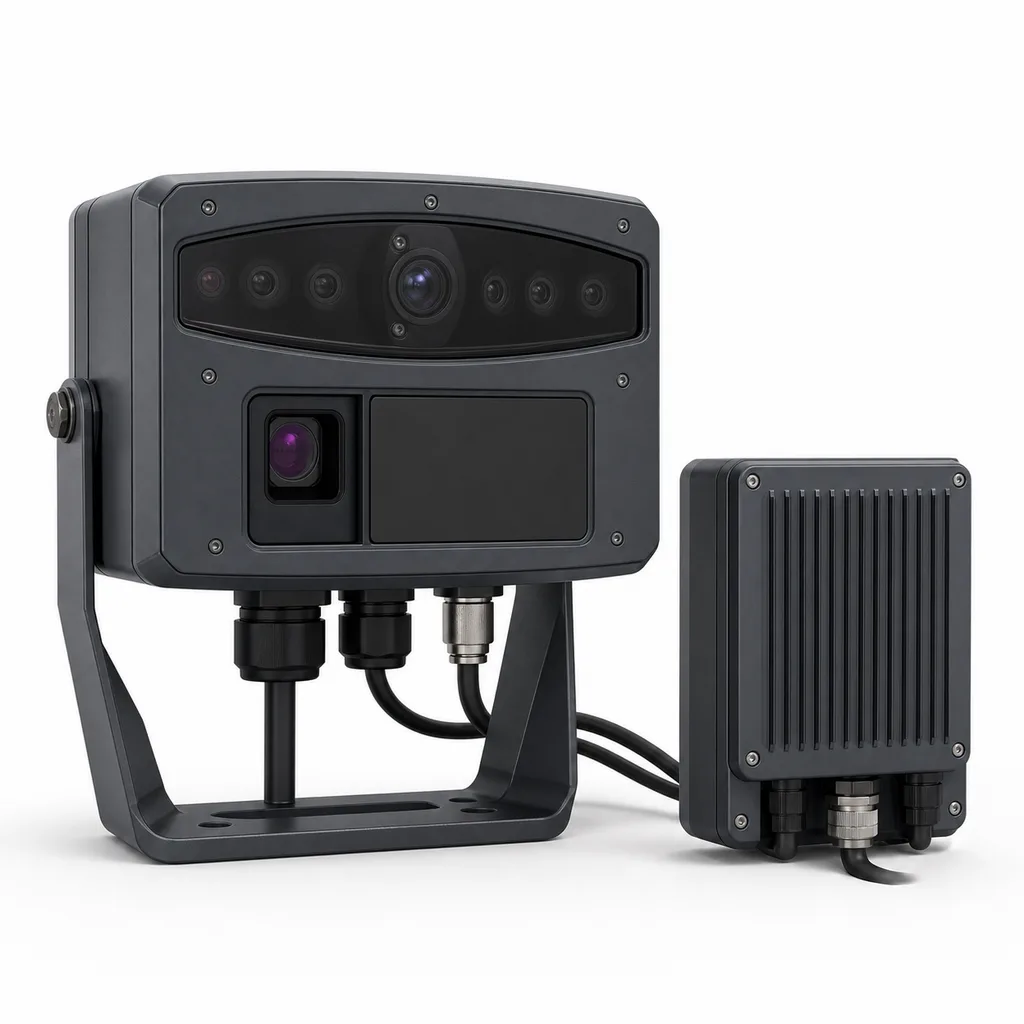
The REDCOAST.LTD RC-CDM-700 is a grid-powered, permanently installed crowd density monitoring and stampede early-warning system for high-occupancy public spaces. It continuously measures how many people occupy each defined zone, converts that into density (people per square metre) and a Fruin-style crowd Level of Service (LOS A–F), and raises tiered alerts the moment a zone trends toward dangerous compression — typically minutes before a crush or stampede can develop. By fusing panoramic AI cameras, thermal imaging and mmWave radar on a self-developed edge platform, it stays accurate in darkness, glare, dust and dense packing where a single camera would fail. It is built for stadium concourses, transport interchanges, religious and pilgrimage sites, festivals, exhibition halls, stampede-prone corridors and stairways, giving safety operators the objective, real-time picture they need to slow inflow, open reserve routes and prevent tragedy rather than react to it.
Key Features
- Real-time density measurement in people/m² per zone, with configurable warning and critical thresholds independently set for entrances, corridors, stairs, platforms and open areas.
- Fruin Level of Service (LOS A–F) grading and directional flow-rate estimation (persons/metre/minute), the internationally recognised language of crowd safety planning.
- Triple-sensor fusion — panoramic/PTZ AI cameras + thermal imager + 77 GHz mmWave radar — for reliable counting in low light, backlight, haze, smoke and extreme packing where optical-only systems saturate.
- Multi-camera spatial fusion via homography projection onto a site plan, so overlapping fields of view are de-duplicated into one continuous density heat-map across large venues.
- Congestion forecasting: short-horizon trend prediction (build-up rate, time-to-threshold) that warns operators before a zone reaches critical, not after.
- Automated tiered response: dry-contact and IP interlocks drive public-address voice messages, variable message / guidance signs, gate and turnstile hold signals and control-room alarms without manual intervention.
- Edge-first architecture with on-device inference, so alerting continues even if the network or cloud link drops; privacy-preserving anonymous counting (no facial identity required).
- Self-developed hardware — multi-channel PoE++ camera interface board, edge AI inference board, thermal/IR sensor interface, I/O relay/interlock board and UPS power-management PCB — designed and manufactured in-house for full customisation.
- Open integration with existing VMS/CCTV, SCADA, BMS, ticketing and command-and-control platforms via ONVIF, RTSP, Modbus TCP, MQTT and REST APIs.
Technical Architecture
Each RC-CDM-700 sensing node combines up to four high-resolution AI cameras (fixed panoramic and/or PTZ), an optional long-wave thermal imager and a 77 GHz mmWave radar, all cabled back to a pole- or wall-mounted edge enclosure. Inside, REDCOAST.LTD's self-developed multi-channel PoE++ interface board powers and aggregates the cameras, while the edge AI inference board runs person-detection and density-estimation models (YOLO-family detectors plus crowd-density regression for saturated scenes) on a GPU/NPU compute module delivering up to 100+ TOPS. The thermal/IR interface board conditions the thermal stream for count validation in darkness and glare; the radar signal-conditioning path supplies motion, direction and count cross-checks when optical scenes are obscured.
Detections from every sensor are projected through calibrated homography onto a shared 2D site model, so counts are spatially correct and de-duplicated across overlapping views. The edge controller computes per-zone occupancy, density (people/m²), LOS grade, directional flow and build-up rate, evaluates them against per-zone rulebooks, and — through the self-developed I/O relay/interlock board — drives local PA, guidance signage and gate-hold outputs. Aggregated, anonymised metrics (never raw identities) stream over MQTT/REST to the REDCOAST.LTD crowd-management platform and mobile app, providing live heat-maps, zone dashboards, historical analytics, evidential event clips and cross-site command views. A UPS power-management PCB with LiFePO4 backup keeps each node and its cameras alive through mains dips and outages.
Connectivity & Power
The RC-CDM-700 is a grid-powered product intended for venues and urban infrastructure with mains electricity — stadiums, stations, malls, plazas, mosques and exhibition centres — so it is not fitted with solar panels. Each node accepts AC 100–240 V and is protected by an integrated UPS with LiFePO4 backup for 2–4 hours of continued operation and graceful shutdown during outages. Cameras and edge equipment are powered locally over PoE++ (IEEE 802.3bt). Backhaul is flexible: fibre or Gigabit Ethernet for fixed venues, with 4G/5G and Wi-Fi as alternatives or redundancy; NB-IoT/LoRa are available for low-bandwidth status telemetry from outlying nodes. Time synchronisation via NTP/PTP keeps multi-node events correlated across a large site.
Protection & Reliability
Outdoor sensing heads and enclosures are rated IP66 with an IK08+ vandal-resistant housing option for public areas; indoor concourse variants are available. The system operates from −30 °C to +60 °C, tolerates 0–95 % RH, and is specified for salt-fog, dust and high-wind exposure so it suits coastal, desert and tropical deployments alike. Metalwork uses hot-dip-galvanised corrosion protection finished with smooth powder-coat or fluorocarbon topcoat. Redundant power, watchdog-supervised edge compute, local rule execution and store-and-forward buffering ensure alerting survives network loss. Design service life is 8–10 years for electronics with a standard warranty and extended options.
Application Scenarios
- Stadiums & arenas: monitor concourses, vomitories, stairwells and exit routes during ingress/egress; hold gates and reroute spectators before pinch points reach critical density.
- Transport interchanges: platforms, ticket halls and interchange corridors in metro, rail and bus terminals; slow inflow with automated PA and signage when platforms approach LOS E/F.
- Religious & pilgrimage sites: manage the extreme, rhythmic crowd surges of mass gatherings and processions, with density heat-maps guiding stewards and reserve-route activation.
- Festivals, parades & public squares: temporary or permanent coverage of dense open areas, stages and bottlenecks where compression builds quickly.
- Exhibition & convention centres: track hall occupancy against fire-code limits and steer visitor flow between entrances and popular stands.
- Places of worship, markets & tourist attractions: continuous occupancy assurance and early warning for narrow lanes, gates and viewing points.
Case-style Examples
Stadium concourse retrofit. A multi-tier arena needed objective ingress control after near-miss crushes at its main gates. Panoramic AI cameras and thermal imagers were mounted over four concourse throats, calibrated to a site plan, with warning thresholds at 3 persons/m² and critical at 4. During egress the system now automatically triggers hold messages on PA and gate indicators when build-up rate signals a zone will hit critical within 90 seconds, smoothing outflow and eliminating dangerous back-pressure.
Transport hub platform safety. A busy interchange fitted RC-CDM-700 nodes over island platforms and the stair landings feeding them. When density on a landing climbs toward LOS E, the system dims platform inflow via concourse guidance signs and voice announcements, and flags the control room with a live heat-map — letting operators dispatch extra services and marshal staff before the platform saturates.
Mass-gathering pilgrimage route. For a seasonal high-density procession corridor, a chain of pole-mounted nodes with radar-assisted counting delivered continuous density mapping across a kilometre of route in bright glare and dust. Reserve-lane opening and one-way flow enforcement were triggered from objective LOS data rather than steward guesswork, giving the command centre minutes of lead time on emerging bottlenecks.
Customization & Selection Guide
- Sensor mix: camera-only for well-lit indoor concourses (lowest cost); add thermal for night/glare-critical outdoor areas; add mmWave radar for smoke/dust/extreme-packing corridors and redundancy. REDCOAST.LTD tunes the mix per zone.
- Coverage & node count: sized from ceiling/mounting height, area geometry and required density resolution — a single node covers up to ~1,500–2,500 m² of open area depending on optics; corridors and stairs use dedicated tight-angle nodes.
- Compute tier: choose 40 / 100 / 275 TOPS edge modules by camera count and model complexity; central server aggregation for very large multi-site estates.
- Interlocks: specify how many PA zones, signage groups and gate/turnstile outputs each node must drive; add SCADA/BMS integration as needed.
- Housing: standard outdoor IP66, vandal-resistant IK10, or discreet indoor architectural finishes.
- Software: on-prem, private-cloud or REDCOAST.LTD-hosted platform, with role-based dashboards, mobile app and reporting.
Deployment & After-sales
Deployment covers site survey and crowd-risk zoning, mounting design (poles, brackets, ceiling mounts), camera/radar calibration and homography mapping, threshold configuration to venue operating procedures, and integration testing with existing PA/CCTV/command systems. Nodes are pre-configured and factory-tested to shorten on-site commissioning. REDCOAST.LTD provides operator training, remote diagnostics, firmware/model updates, spare-parts support and SLA-based maintenance. Because the hardware is developed in-house, boards, interfaces and firmware can be adapted to project-specific sensors, protocols and control logic.
Standards & Compliance
Engineered toward CE, RoHS and REACH; enclosures to IEC 60529 IP66 and IEC 62262 IK impact ratings; EMC to EN/IEC 61000 and radar emissions to ETSI EN 302 264 (77 GHz). Video interoperability via ONVIF Profile S/T. Crowd-safety methodology aligns with Fruin Level of Service and recognised crowd-management guidance (e.g. the UK Green Guide / Purple Guide principles and ISO 22341 security-by-design). Data handling supports privacy-by-design and GDPR-style anonymised counting. Final certification scope is confirmed per project and destination market.
Why REDCOAST.LTD
REDCOAST.LTD delivers the complete solution — sensing hardware, edge AI, management platform and mobile app — integrated and supported by one team. Our differentiator is genuine in-house hardware development: we design and fabricate the PoE++ camera interface, edge AI inference, thermal/IR interface, I/O interlock and UPS power-management PCBs ourselves, so the system can be tailored to your venue's sensors, protocols, interlocks and control-room stack rather than forced onto off-the-shelf boxes. That control means better fusion accuracy, cleaner integration and a system that evolves with your operation.
Talk to REDCOAST.LTD about a crowd-safety assessment and a custom RC-CDM-700 configuration for your venue.
Specifications
Crowd Analytics
- Density Metric
- People per square metre (people/m²)
- Level of Service Grading
- Fruin LOS A–F
- Directional Flow Rate
- persons/metre/minute
- Counting Accuracy
- up to 95–98 (typical scenes) %
- Forecast Horizon
- 30–180 (time-to-threshold) s
- Configurable Zones per Node
- up to 16
- Update Rate
- 1–5 Hz
Sensing
- AI Cameras per Node
- up to 4 (panoramic/PTZ)
- Camera Resolution
- 4–12 (4K/panoramic) MP
- Thermal Imager
- 640×512 LWIR (optional) px
- Radar
- 77 GHz mmWave (optional)
- Radar Range
- up to 80 m
- Open-area Coverage per Node
- 1,500–2,500 m²
Edge Compute
- AI Inference
- 40 / 100 / 275 (selectable) TOPS
- Detection Models
- YOLO-family + crowd-density regression
- Local Storage
- 256 GB–2 TB (event buffering)
- Time Sync
- NTP / PTP (IEEE 1588)
- Processing
- On-device edge, cloud-optional
Interfaces & Interlock
- Camera Power/Data
- PoE++ (IEEE 802.3bt)
- Dry-contact Outputs
- 8–16 (PA/signage/gate hold)
- Video Protocols
- ONVIF Profile S/T, RTSP
- Data Protocols
- MQTT, REST API, Modbus TCP
- Integration
- VMS/CCTV, SCADA, BMS, C2
Connectivity
- Backhaul
- Fibre / Gigabit Ethernet
- Wireless
- 4G/5G, Wi-Fi
- Telemetry (optional)
- NB-IoT / LoRa
Power (grid)
- Input Voltage
- AC 100–240 V
- Frequency
- 50/60 Hz
- Node Power Consumption
- 40–180 W
- UPS Backup (LiFePO4)
- 2–4 h
Protection & Environment
- Enclosure Rating
- IP66
- Impact Resistance
- IK08–IK10 (option)
- Operating Temperature
- -30 to +60 °C
- Humidity
- 0–95 (non-condensing) %RH
- Finish
- Hot-dip galvanised + powder/fluorocarbon coat
Capabilities — configurable per project
Specifications are tailored to each project — the options below show what we can support.
Sensor Fusion
- Camera-only
- Camera + Thermal
- Camera + Thermal + mmWave Radar
Edge Compute Tier
- 40 TOPS
- 100 TOPS
- 275 TOPS
Deployment
- Outdoor IP66 pole/wall
- Vandal-resistant IK10
- Discreet indoor concourse
Automated Response
- PA voice interlock
- Guidance/VMS signage
- Gate/turnstile hold
- Control-room alarm only
Software Hosting
- On-premises
- Private cloud
- REDCOAST.LTD-hosted
Related solution guidance
Ports and Logistics
Outdoor IoT infrastructure for ports, yards and logistics areas: lighting, guidance, safety, solar power, monitoring and maintenance visibility.
Traffic Safety Checklist
Deployment checklist for connected traffic warning signs, beacons, road guidance devices, power, visibility, monitoring and acceptance tests.
Traffic Safety
Plan connected traffic safety systems with warning beacons, LED signs, road guidance devices, sensing, control cabinets and monitoring software.
Frequently Asked Questions
How does an AI crowd density monitoring system prevent a stampede?
It continuously measures how many people occupy each zone, converts that to density in people per square metre and a Level of Service grade, and detects the rate of build-up. When a zone trends toward a critical threshold it automatically triggers public-address messages, guidance signage and gate holds, giving operators lead time to slow inflow and open reserve routes before a crush forms.
What sensors does the RC-CDM-700 use and why fuse them?
It fuses panoramic/PTZ AI cameras with optional long-wave thermal imaging and 77 GHz mmWave radar. Cameras give high-resolution counting in good light; thermal maintains accuracy in darkness, glare and backlight; radar cross-checks motion and count through smoke, dust and extreme packing. Fusion keeps density estimates reliable where any single sensor would saturate or fail.
Is the system grid-powered or solar?
The RC-CDM-700 is grid-powered for venues and urban infrastructure with mains electricity — stadiums, stations, malls and worship sites — so it is not fitted with solar panels. Each node runs on AC 100–240 V with an integrated LiFePO4 UPS giving 2–4 hours of backup through outages.
Does crowd counting require facial recognition or identify individuals?
No. The system counts anonymously using person detection and density estimation, and streams only aggregated metrics and heat-maps — not identities. It is designed privacy-by-design and supports GDPR-style anonymised operation, which is why it is suitable for public venues.
How accurate is the people counting in dense crowds?
In typical scenes counting accuracy is around 95–98%. In very dense scenes where individuals overlap, the system switches from discrete detection to crowd-density regression and fuses thermal/radar inputs to maintain a reliable density estimate rather than an exact head count, which is what crowd-safety thresholds actually need.
Can it integrate with our existing CCTV, PA and command-and-control systems?
Yes. It ingests existing cameras via ONVIF/RTSP and drives PA, variable message signs, gates and turnstiles via dry contacts and IP. Data integrates with VMS, SCADA, BMS and command-and-control platforms over MQTT, REST API and Modbus TCP, so it augments rather than replaces your infrastructure.
What area does one node cover and how many nodes do I need?
A single node covers roughly 1,500–2,500 m² of open area depending on mounting height and optics, with tighter dedicated nodes for corridors and stairs. Node count is determined during a site survey from geometry, sightlines and the density resolution your safety plan requires.
Does it keep working if the network or cloud goes down?
Yes. All density calculation, threshold logic and local interlock outputs run on the edge device, so alerting and PA/signage/gate responses continue during network or cloud outages. Events are buffered locally and forwarded once connectivity returns.