Overview
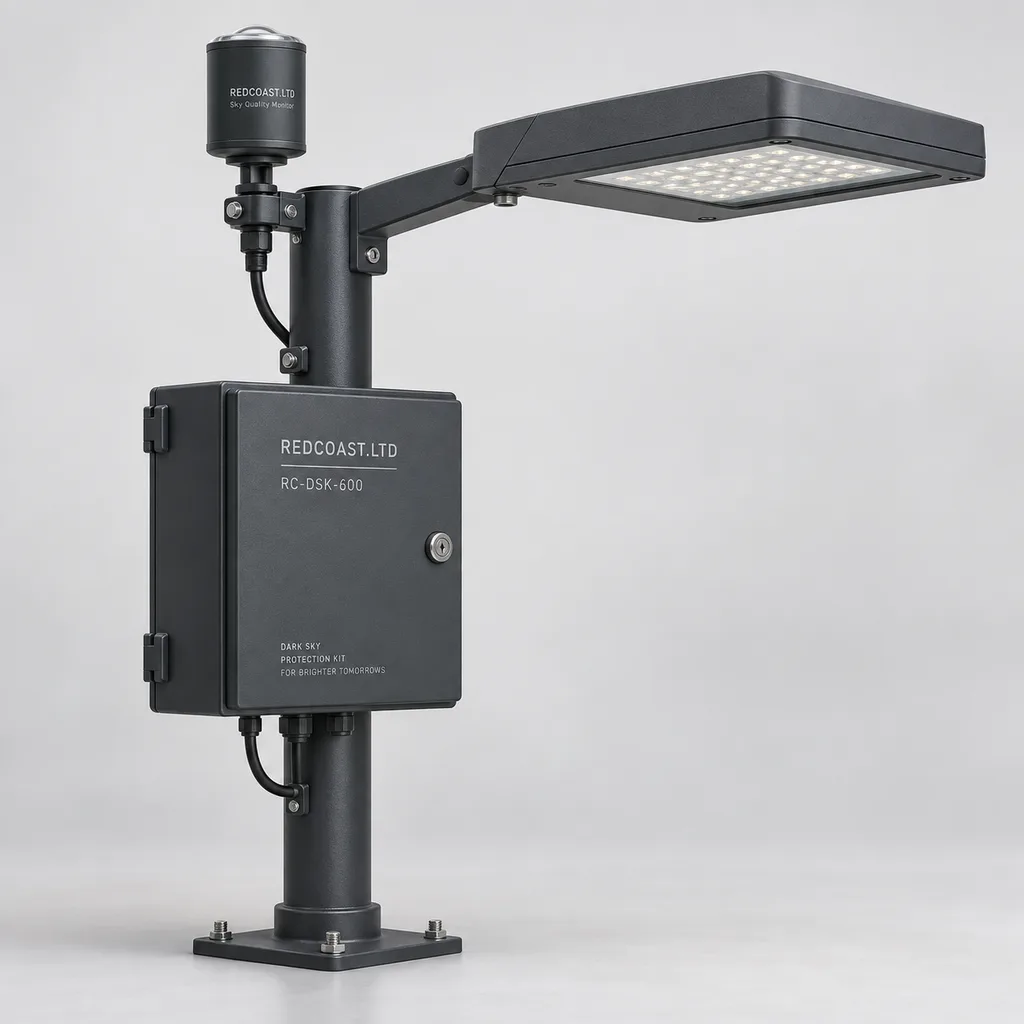
The RC-DSK-600 is a project-configured dark sky protection kit from REDCOAST.LTD, combining permanent sky brightness monitoring, fully shielded outdoor lighting, lighting controls, a Web management platform and a mobile maintenance application. It is designed for grid-connected parks, observatory campuses, visitor facilities, accommodation properties and communities that need to manage outdoor lighting while maintaining a defensible environmental record. Operators can connect lighting inventories, curfew schedules, maintenance actions and sky observations in one system instead of maintaining disconnected equipment and spreadsheets. The reference package includes one monitoring station, one site gateway, twelve controlled luminaires and a reporting workspace; the specifications below are proposed engineering and acceptance targets for a made-to-order configuration, rather than claims of completed product certification.
Key Features
- Permanent zenith monitoring: A factory-calibrated Unihedron SQM-LE photometer records night sky brightness alongside instrument identity, measurement time and sensor temperature.
- Shielded lighting package: Twelve 20 W or 30 W luminaires provide downward illumination with flat glass optics, fixed horizontal mounting and optional house-side shields.
- Warm spectral options: Specify 2200 K as the reference configuration or 2700 K where the lighting assessment calls for different color appearance; sensitive habitats receive a separate spectral assessment.
- Local operating schedules: Stored astronomical switching, curfews and occupancy scenes continue during a cloud connection failure while mains power remains available.
- Evidence-linked asset records: Each luminaire record holds its location, wattage, optical configuration, installation angle, approved schedule and maintenance history.
- Qualified trend reporting: Raw readings remain available alongside filtered comparisons, with moonlight, twilight, weather, missing data and maintenance flags visible to reviewers.
- Custom board-level engineering: REDCOAST.LTD develops the gateway carrier, isolated field interfaces, heater controller, luminaire controller and power-management PCB assemblies around the project requirements.
- Recurring maintenance workflow: Cleaning reminders, sensor comparisons, failed-lamp tickets and annual reporting tasks support a planned service program over multiple years.
Technical Architecture
The monitoring station uses a narrow-field SQM photometer mounted vertically beneath a replaceable optical window. The reference SQM-LE provides Ethernet communication and factory calibration information; REDCOAST.LTD supplies the outdoor station architecture, regulated power, window heating control, environmental interfaces and data acquisition logic. This division preserves an identifiable measurement instrument while allowing the surrounding hardware to be engineered for the installation. Unihedron specifies an adaptive sampling time of approximately 1–80 seconds, so the gateway records completed measurements and their actual timestamps rather than claiming a fresh optical measurement at every polling request. The nominal logging interval is five minutes. See the SQM-LE manufacturer specifications.
A separate lighting network connects individual controllers to the site gateway. Each controller translates locally stored scenes into DALI commands for its luminaire driver and reports communication status, commanded level and available driver diagnostics. REDCOAST.LTD can develop new controller and LED driver PCBs when an existing board architecture does not meet the required enclosure, dimming behavior or interface arrangement. The gateway associates these events with the monitoring timeline, making it possible to inspect whether a scheduled lighting change actually occurred. Sky brightness is a supervisory observation: a brighter sky does not automatically command every lamp to dim, because clouds, moonlight and lighting beyond the property may explain the change.
The platform stores raw observations separately from processed summaries and preserves calibration versions, window corrections and exclusion reasons. A reference comparison filter selects astronomical night with the Moon below the horizon, then adds weather and maintenance screening; cloud status requires an optional cloud sensor, an all-sky camera or reviewed observations. Missing weather evidence is labeled unknown. SQM values use a logarithmic scale, so reports distinguish median magnitude statistics from radiance-domain averages and never calculate a percentage improvement directly from a percentage change in magnitude. A single zenith instrument measures one portion of the sky and cannot locate every offending light source.
Connectivity & Power
The reference deployment uses permanent AC 100–240 V, 50/60 Hz mains power for both monitoring and lighting. Monitoring equipment requires an unswitched supply so that daytime diagnostics and overnight data capture continue independently of the lighting contactor. The monitoring station operates from a regulated 24 V DC distribution bus with a dedicated converter for the selected photometer. Its design allowance is 15 W average with the optical heater off and 40 W maximum including heating and communication peaks; luminaire loads are budgeted separately. This configuration contains no photovoltaic panel or storage battery.
Ethernet is preferred where park buildings or campus infrastructure already provide a network. LTE Cat 1 is an alternative uplink for sites with mains power but no practical data cable. The reference luminaire network uses regional sub-GHz radio modules with local driver interfaces; deployment follows a coverage survey and applicable radio rules. A wired RS-485 field-network variant is available for new construction or radio-restricted sites. Remote commands are supervisory, while operating schedules and approved fallback settings remain at the controller.
Protection & Reliability
The enclosure design targets IP66 for the monitoring station, gateway cabinet and luminaires. The reference assembled-system operating range is -20 to +50 °C, with a separately qualified cold-weather configuration targeting -35 °C. A controlled 0–15 W optical-window heater reduces condensation risk; it does not guarantee valid measurements through snow, heavy frost, dirt or standing water. Suspect readings are flagged until inspection or recovery confirms a clear optical path.
Steel poles and brackets receive hot-dip galvanizing followed by a smooth matte powder-coated finish; coated aluminum housings protect the luminaires and monitoring head. Coastal projects can specify a fluorocarbon topcoat, isolated dissimilar-metal joints and suitable stainless fasteners. Dust, salt deposits and insects still require inspection and cleaning. Mast foundations, anchoring and wind loading are calculated for the actual installation; the product is not assigned a universal storm-resistance rating.
Replaceable drivers, surge devices, optical windows and control boards make field servicing practical. A 50,000-hour L80 lighting design target is assessed against the selected LED package data, drive current and measured thermal conditions; it is not a whole-system service-life guarantee. The proposed commercial package includes a 24-month hardware warranty, with exclusions, response times and extended maintenance terms defined in the supply contract.
Application Scenarios
Grid-connected dark sky park visitor facilities
Install monitoring near an unobstructed observing area and controlled luminaires along necessary visitor routes and parking approaches. Staff can enforce closing-time scenes, document equipment changes and review comparable observations over successive seasons.
Observatory campus and education center
Coordinate access lighting with observing sessions while keeping the monitoring head away from building shadows and direct local light. Timed staff overrides retain access when needed, and the event history helps explain interruptions during observing nights.
Stargazing accommodation and lodge grounds
Manage pathways, reception approaches and service areas from one workspace. Property teams receive lighting inventory records and maintenance tasks that support their operational commitments, while unnecessary decorative lighting can remain off.
Community lighting protection zone
Use several stations across a grid-connected neighborhood or protected landscape gateway to compare local trends. The platform helps administrators track retrofit progress and operating schedules, while independent field measurements address glare and property-boundary spill.
Ecological park and habitat buffer
Apply shielded, scheduled lighting to essential access routes beside sensitive habitat. An ecologist and lighting designer determine whether ordinary warm-white LEDs are appropriate or whether a separately assessed narrowband amber configuration is needed.
Case-style Examples
The following examples are illustrative configurations, not completed customer installations or measured performance claims.
Visitor-center lighting retrofit
A park operator has twelve continuously operated pathway lights and only occasional handheld sky readings. The proposed package adds twelve 20 W, 2200 K shielded luminaires, one independently positioned SQM station, occupancy inputs at selected access points and a curfew scene that reduces output only where the approved lighting assessment permits. The intended result is a repeatable operating policy with recorded exceptions and a continuous observation history; actual energy use and sky changes are evaluated after commissioning.
Observatory access-road coordination
An observatory campus needs service access without leaving every approach light at full output throughout observing sessions. Two monitoring stations and twenty-four controlled luminaires separate the visitor entrance from the instrument area, with staff-initiated access scenes that expire automatically. The system records the timing of these scenes so researchers can review potentially affected observations without assuming that every brightness fluctuation originated on campus.
Multi-property annual reporting
An accommodation operator manages three grid-connected properties with different opening hours and maintenance teams. Each property receives its own monitoring station and lighting inventory, while a shared platform applies consistent report definitions and access permissions. The intended operational benefit is a traceable reporting process with visible missing data, outstanding repairs and changes to the lighting estate.
Customization & Selection Guide
Start with the site boundary, available power, night access requirements, existing lighting inventory and the purpose of monitoring. One station can establish a local trend, but larger sites or varied surroundings may require several stations; station count is determined by representativeness rather than a fixed coverage radius. Select positions with unobstructed zenith views and document nearby trees, rooflines and potential local light sources.
Choose luminaire power and optical distribution through a lighting calculation using the actual mounting height, route width, surface reflectance and maintenance factor. The reference 20 W and 30 W options are intended for pedestrian facilities and modest access areas, with nominal mounting heights of 3–5 m. A curfew level of 10% is an available control setting, not a universal recommendation for safe illumination. Emergency and legally required lighting retain their separately approved operating provisions.
For basic operational records, select SQM monitoring, temperature/humidity sensing and the standard reporting workspace. Add a cloud sensor or all-sky camera when automated weather screening matters, and commission a calibrated illuminance survey when property-boundary spill must be assessed. Where spectrum is a contractual issue, specify spectral measurements rather than relying on correlated color temperature alone. Budget separately for calibration comparisons, cleaning visits, connectivity, hosting and report preparation.
Deployment & After-sales
Deployment begins with a site survey and a documented lighting management plan. Installation includes electrical protection, earthing, gateway commissioning, luminaire addressing, clock synchronization and verification of the monitoring head's orientation. An initial reference comparison is performed with the final optical window installed, and its correction is recorded without overwriting the original observations. Existing stations should be compared before and after instrument replacement to preserve continuity.
Acceptance covers the approved photometric layout, delivered lighting scenes, communication-loss behavior, restart behavior, data completeness and sample report exports. Start with one representative monitoring station and several luminaires when the site presents uncertain radio coverage or unusual environmental conditions. Procurement schedules should separate board development, prototypes, environmental verification, pilot acceptance and production; delivery dates are confirmed against that scope.
Service contracts can cover three or five years of platform access, device-health review, scheduled cleaning, annual instrument comparison and reporting assistance. Local teams receive wiring documents, configuration backups, maintenance instructions and spare-part references. Calibration intervals begin at twelve months and are adjusted using observed drift, environmental exposure and the instrument supplier's guidance.
Standards & Compliance
The RC-DSK-600 supports evidence collection and controlled lighting operation; purchasing it does not confer DarkSky approval or site certification. DarkSky International's annual-report guidance addresses lighting changes and sky-quality observations and asks about permanent monitoring, but it does not establish a universal requirement for continuous electronic monitoring at every certified site. Owners should apply the requirements of their specific program and category. See the International Dark Sky Places annual-report guidance.
The proposed optics target zero direct uplight at the specified horizontal mounting angle, with restricted high-angle output and available shielding. These design targets must be checked using the final luminaire's photometric report; CCT and shielding alone do not demonstrate approval. Product recognition requires a separate application under the applicable DarkSky Approved Luminaires guidelines.
Project assessments can use CIE 150:2017 for obtrusive-light evaluation. Luminaire electrical safety is assessed against applicable IEC 60598 requirements, including IEC 60598-2-3 where relevant. IP and IK targets require enclosure testing; EMC, radio, electrical and material documentation is established for the destination market and final bill of materials. SQM measurements do not replace illuminance, glare, spectral or electrical-safety verification.
Why REDCOAST.LTD
REDCOAST.LTD delivers the outdoor hardware, controls, Web platform and mobile application as one coordinated solution. Its in-house hardware development includes new PCB layouts, board-level interface design, power management and firmware adaptation, allowing the system to follow the site's requirements instead of forcing every project into an unchanged gateway or controller. A specialist calibrated photometer can remain identifiable and serviceable while REDCOAST.LTD engineers the surrounding monitoring and lighting system.
This approach gives owners a practical route from initial lighting inventory to deployment, maintenance and recurring reporting. Integrators can specify their existing network, preferred hosting arrangement and service responsibilities at the beginning of the project, with those choices reflected in the hardware and software configuration.
Contact REDCOAST.LTD with your site plan, lighting inventory and monitoring objectives to request a customized RC-DSK-600 configuration and lifecycle service proposal.
Specifications
Reference Package and Installation
- Specification Status
- Proposed made-to-order design targets; final configuration subject to engineering acceptance
- Reference Package
- 1 SQM station, 1 site gateway, 12 controlled luminaires, 1 platform workspace
- Luminaire Mounting Height
- 3–5 m
- Monitoring Head Alignment
- Zenith-facing; installation alignment target within ±1 °
- Gateway Cabinet Envelope
- 400 × 300 × 200 mm
- Local Expansion Design Capacity
- Up to 64 luminaires and 4 SQM stations per site gateway
Sky Quality Measurement
- Reference Photometer
- Unihedron SQM-LE with individual factory calibration record
- Recorded Quantity
- Night sky brightness in the selected SQM instrument band mag/arcsec²
- Nominal Angular Response
- Approximately 20 FWHM; not a hard-edged field stop °
- Photometer Sampling Time
- Approximately 1–80, brightness-dependent s
- Station Logging Interval
- 300 default; 120–900 selectable, recording completed measurements only s
- Installed Comparison Acceptance Target
- Absolute difference ≤0.15 against an agreed reference under stable co-located conditions after window correction mag/arcsec²
- Initial Calibration Comparison Interval
- 12; revise according to drift and exposure months
Shielded Lighting
- Rated Luminaire Input Power
- 20 / 30 W
- Nominal Delivered Flux Target
- 20 W: 1600–2000; 30 W: 2400–3000, dependent on CCT and optics lm
- Correlated Color Temperature
- 2200 reference / 2700 alternative K
- Color Rendering Index
- Ra ≥70 for warm-white configurations
- Direct Uplight Design Target
- 0% at fixed 0° tilt; verify by final goniophotometry
- High-angle Output Design Target
- ≤2% of total luminaire flux between 80° and 90° from nadir
- Optics and Shielding
- Type II / Type III distribution; flat glass; optional house-side shield
- Driver Dimming Interface
- DALI; 10–100% nominal light output plus OFF
Connectivity and Local Control
- Primary Uplink
- 10/100 Ethernet Mbps
- Alternative Cellular Uplink
- LTE Cat 1; regional band configuration
- Luminaire Field Network
- 868 or 915 MHz regional sub-GHz radio; wired RS-485 variant
- Wired Field Interfaces
- 2 isolated RS-485 ports; 4 digital inputs; 2 dry-contact outputs
- Scheduled Scene Capacity
- 8 transitions per night per lighting group
- Occupancy Hold Time
- 30–900 s
- Temporary Manual Override
- 5–120 with automatic expiry min
- Communication-loss Behavior
- Stored local schedule; preset fallback level; automatic data backfill after reconnection
Mains Power
- AC Input
- 100–240 V AC
- Input Frequency
- 50/60 Hz
- Monitoring Station and Gateway Budget
- 15 average with heater off; 40 maximum including heater; excludes luminaires W
- Optical-window Heater
- 0–15 controlled output W
- Reference Lighting Load
- 240 with 12 × 20 W; 360 with 12 × 30 W, plus up to 12 W controller overhead W
- Monitoring Distribution Bus
- 24 V DC with dedicated 5–6 V converter for reference photometer
- Luminaire Power Factor Target
- ≥0.90 at rated output
- Supply Arrangement
- Permanent unswitched monitoring feed; separately protected lighting circuits
Protection and Mechanical Design
- Ingress Protection Target
- IP66 for complete station, cabinet and luminaires
- Impact Protection Target
- IK08 for cabinet and luminaires; optical monitoring window excluded
- Reference Operating Temperature
- -20 to +50 °C
- Cold-weather Variant Target
- -35 to +50 after configuration-specific qualification °C
- External Relative Humidity
- 5–100; optical condensation requires heating, inspection and data qualification % RH
- Steel Surface Finish
- Hot-dip galvanized substrate with 80–120 µm smooth matte powder topcoat; RAL 7016 reference
- Luminaire Lumen Maintenance Target
- L80 at 50000 hours at 25 °C ambient, subject to LED data and thermal verification
- Proposed Hardware Warranty
- 24; contractual terms apply months
Platform, Data and Service
- Local Storage
- 32 GB
- Offline Buffer Design Target
- ≥90 at 5-minute logging for 4 stations and control events; excludes images days
- Platform Retention Options
- 3 / 5 / 10 under the selected hosting and service contract years
- Data Exchange
- CSV, JSON, PDF reports; HTTPS API; MQTT over TLS
- Standard Comparison Filter
- Sun altitude below -18° and Moon below horizon; weather and maintenance qualification applied separately
- Audit Metadata
- UTC timestamp, station ID, calibration version, raw reading, quality flag and lighting-event reference
- User Roles
- Administrator / operator / maintenance / read-only reviewer
- Maintenance Contract Options
- 3 / 5, with scope-defined cleaning, comparison checks and report assistance years
Capabilities — configurable per project
Specifications are tailored to each project — the options below show what we can support.
Monitoring Configuration
- Single SQM station with temperature and humidity sensing
- Two-station local and reference comparison
- SQM station with infrared cloud sensor
- SQM station with all-sky camera and reviewed cloud classification
Lighting Configuration
- 2200 K warm-white, 20 W or 30 W
- 2700 K warm-white, 20 W or 30 W
- Narrowband amber, nominal 590 nm peak, with separate spectral and ecological assessment
- Existing dimmable luminaires retained after photometric and interface verification
Network Architecture
- Ethernet uplink with regional sub-GHz luminaire network
- LTE Cat 1 uplink with regional sub-GHz luminaire network
- Ethernet uplink with wired RS-485 field controllers
Environmental Build
- Standard -20 to +50 °C configuration
- Cold-weather -35 °C configuration with qualification testing
- Coastal coating and fastener package
- Dust-exposed installation with enhanced optical inspection schedule
Software and Lifecycle Service
- Hosted platform with 3-year data retention
- Private deployment with customer-managed retention
- 5-year monitoring and maintenance service package
- Annual-report preparation assistance with customer review
Related solution guidance

Industrial Parks
Industrial park IoT for lighting, access areas, environmental monitoring, energy visibility, parking and maintenance operations.
Ports and Logistics
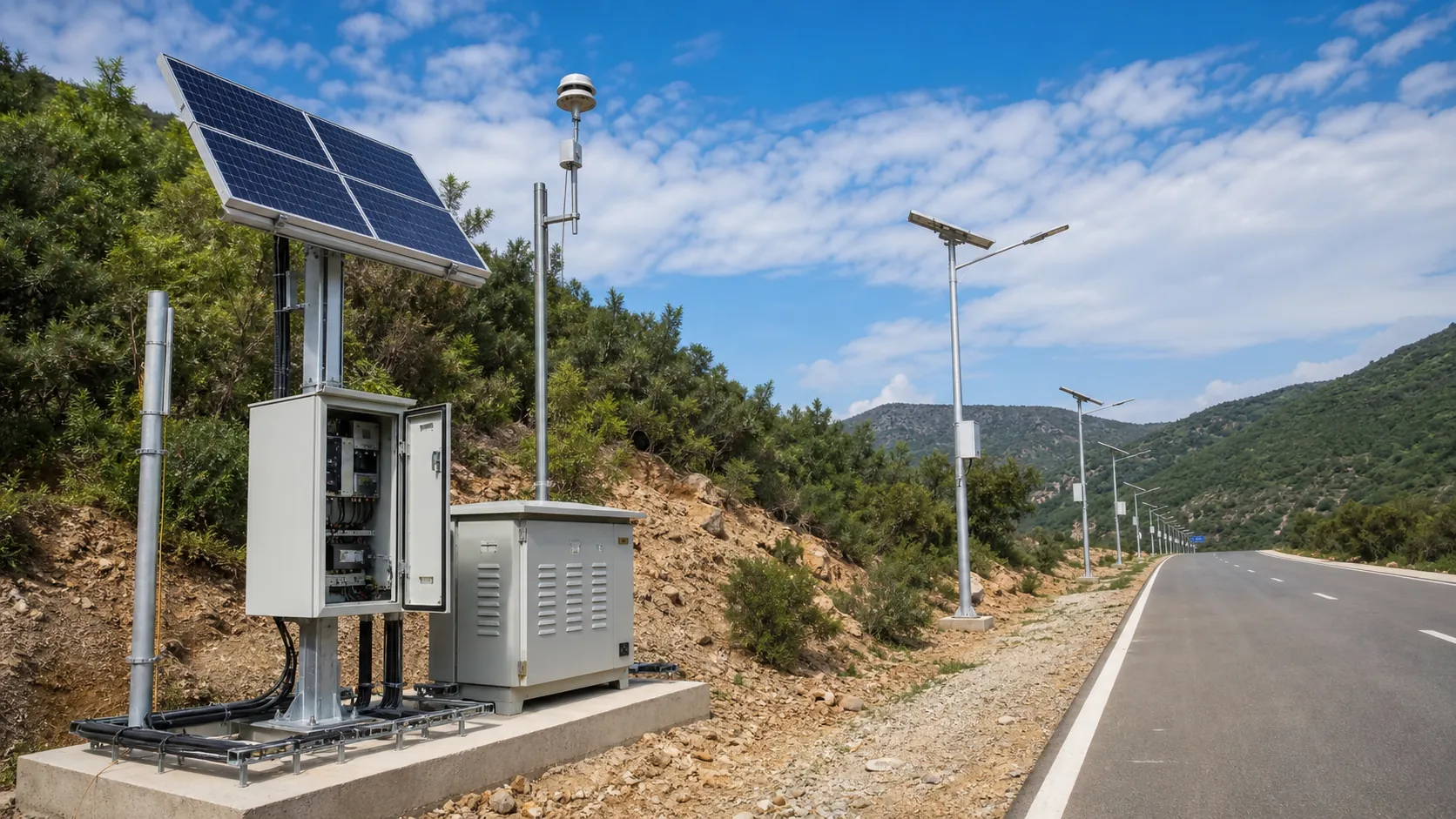
Outdoor IoT infrastructure for ports, yards and logistics areas: lighting, guidance, safety, solar power, monitoring and maintenance visibility.
Street Lighting Guide
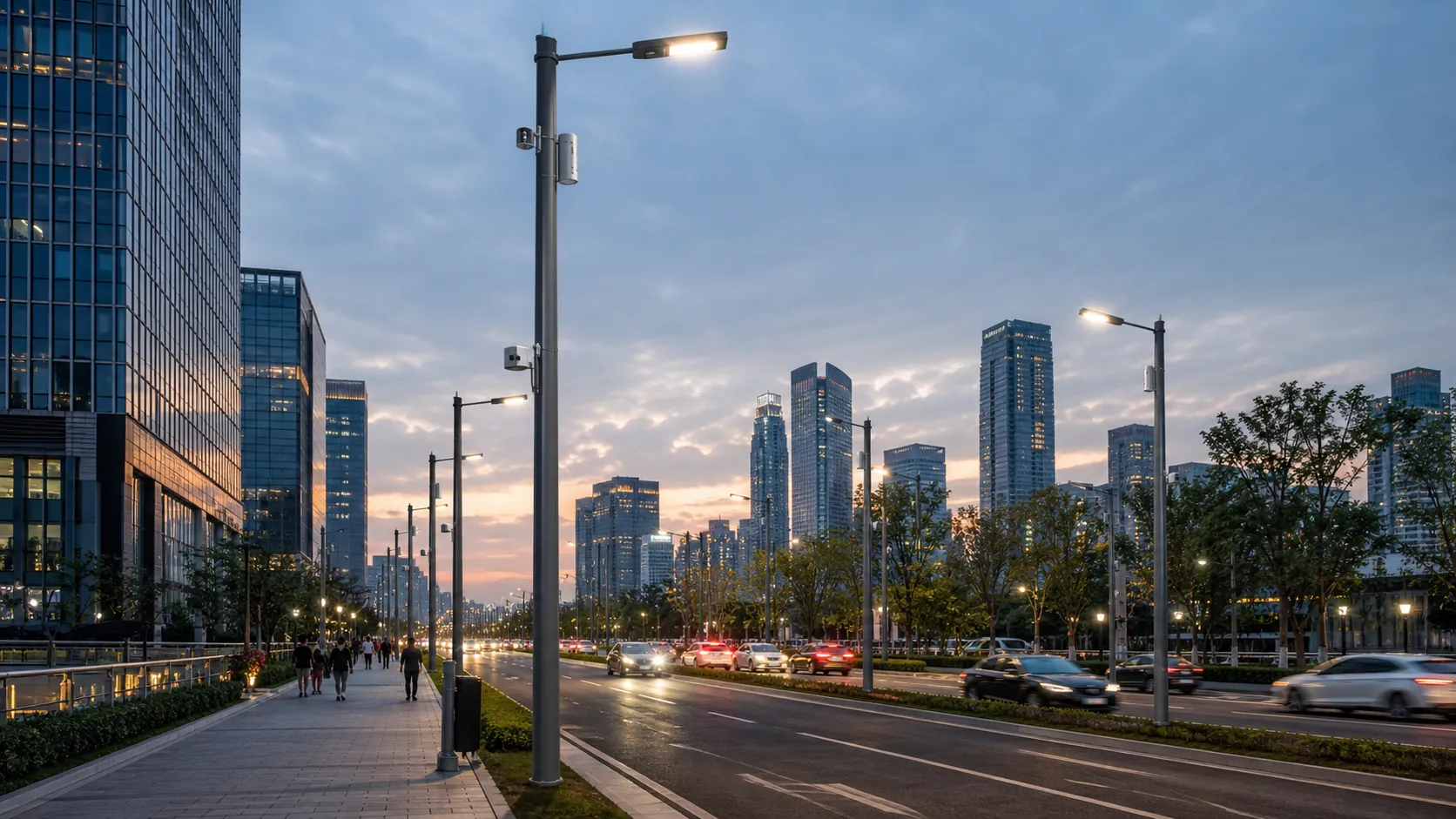
A practical guide to choosing smart street lighting controllers, connectivity, platform features, dimming logic and acceptance tests.
Frequently Asked Questions
What does a complete dark sky protection kit include?
The RC-DSK-600 reference package includes one outdoor SQM monitoring station, a site gateway, twelve individually controlled shielded luminaires, a Web platform and a mobile maintenance application. The system connects sky observations with lighting inventories, schedules and maintenance records. Site surveys determine the final number of stations and lights.
Does DarkSky certification require continuous SQM monitoring?
Requirements depend on the certification program and category, and permanent continuous monitoring is not a universal requirement for every site. DarkSky's annual-report guidance addresses sky-quality records and asks whether permanent monitoring is installed. Automated monitoring helps maintain consistent records, but site owners must follow their applicable program requirements. See the [official annual-report guidance](https://darksky.org/app/uploads/bsk-pdf-manager/2019/08/Annual-Report-Content-Guidelines-2.pdf).
Can an SQM reading prove that outdoor lighting complies with a dark sky policy?
No. An SQM records sky brightness within its angular and spectral response; it does not independently establish fixture uplight, glare, boundary illuminance or spectral compliance. The evidence package should combine qualified sky observations with lighting calculations, final photometric files, installation checks and any required field measurements.
How are moonlight, clouds and dirty optical windows handled?
The platform preserves raw readings and attaches quality flags instead of silently deleting inconvenient observations. Comparable trend reports can filter for astronomical night and a Moon below the horizon, while cloud screening requires additional sensor data or reviewed observations. Window cleaning, condensation events and calibration changes are recorded because they can alter apparent sky brightness.
Is the kit solar powered, and what happens when communications fail?
The reference kit uses AC 100–240 V mains power and is intended for sites with an existing electricity supply. Local controllers continue their stored schedules during an uplink failure, and the gateway buffers records for later upload. The reference configuration has no backup battery, so a mains outage interrupts operation and is recorded as a data gap after recovery.
Does REDCOAST.LTD develop its own hardware or only integrate purchased products?
REDCOAST.LTD delivers the complete hardware and software system and develops custom PCBs for field interfaces, lighting controllers, power management and environmental control. The reference design retains a specialist factory-calibrated SQM instrument so its identity and calibration remain traceable. New board layouts, firmware and platform functions can be developed around project-specific requirements.
Will warmer LEDs and dimming guarantee a darker sky?
They can reduce the installation's contribution when paired with suitable shielding, light levels and operating hours, but the measured outcome also depends on surrounding sources, weather and natural sky brightness. Warm-white CCT does not by itself establish spectral suitability for sensitive wildlife. Performance should be evaluated using comparable observations and the final lighting design, without promising a fixed sky-brightness improvement.
What should be included in a multi-year monitoring maintenance budget?
Include optical-window cleaning, instrument comparison or recalibration, replacement surge devices and drivers, connectivity, hosting and report preparation. The RC-DSK-600 can be configured with three- or five-year service contracts that define visit frequency, data retention and support responsibilities. Final intervals depend on exposure, measured drift and the selected instrument's guidance.