Overview
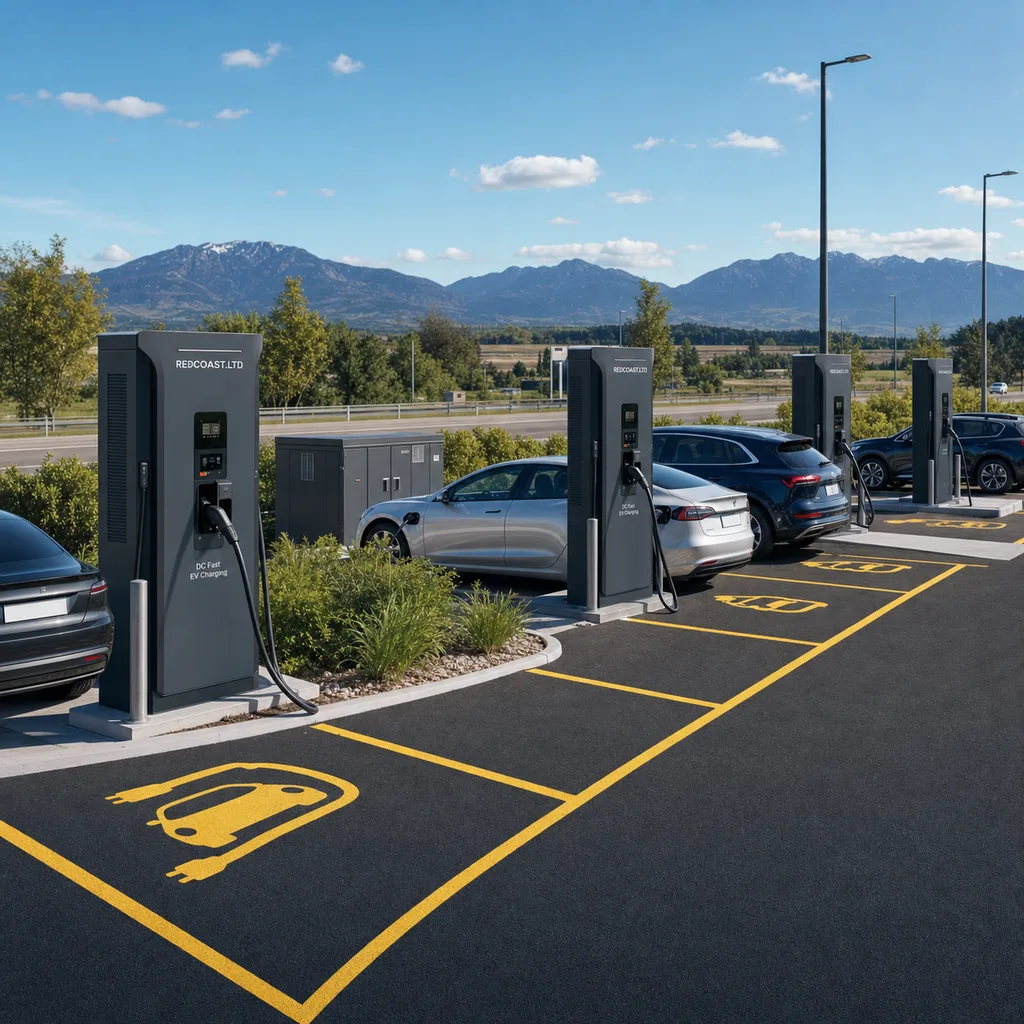
The REDCOAST.LTD RC-DCEV-360 is a grid-powered, modular DC fast charging station built to deliver rapid energy transfer to passenger EVs, commercial fleets, and heavy-duty vehicles at sites where minutes matter — highway service plazas, logistics depots, retail destinations, and dense urban charging hubs. Available in 60 kW, 120 kW, 180 kW, 240 kW, and 360 kW configurations, the station combines high-efficiency power conversion, multi-standard connectors, OCPP 2.0.1 cloud integration, and ISO 15118 Plug & Charge into a single platform that operators can configure per project rather than retrofit later. As a software-and-hardware integrator with in-house PCB design, REDCOAST.LTD ships the charger ready for the client's CSMS, payment ecosystem, and grid environment from day one — not as a generic enclosure rebadged from a contract manufacturer.
Key Features
- Modular 30 kW power blocks scalable from 60 kW to 360 kW per cabinet, with N+1 redundancy and hot-swappable maintenance
- Multi-standard connector options: CCS2, CHAdeMO, NACS (SAE J3400), CCS1, and GB/T — mix-and-match per outlet to match local vehicle fleets
- 200–1000 V DC output with liquid-cooled cable rated up to 500 A for 800 V high-voltage EV architectures
- OCPP 2.0.1 native cloud integration; ISO 15118-2 with a clear roadmap to 15118-20 for bidirectional V2G readiness
- Dynamic load management and intelligent power sharing across multiple dispensers on a shared DC bus
- Conversion efficiency above 96% and power factor above 0.99 at rated load, total harmonic distortion below 5%
- 15-inch sunlight-readable HMI with RFID, QR code, contactless EMV, and credit-card payment options
- IP54 outdoor cabinet rated –30 to +55 °C with optional coastal anti-corrosion package
- Split-system topology: a single power cabinet feeds two to four slim dispensers, dramatically reducing curbside footprint
- Cybersecurity by design per IEC 62443, with signed firmware updates and TLS 1.3 backhaul
Technical Architecture
The RC-DCEV-360 follows a modular split architecture engineered for serviceability and uptime. The power cabinet houses 30 kW AC-DC power modules in N+1 redundancy supervised by REDCOAST.LTD's in-house Charger Control Unit (CCU) PCB. The CCU sequences module activation, balances load across the DC bus, manages isolation monitoring per IEC 61851-23, and coordinates thermal control of the liquid-cooled cable loop. Because the CCU is REDCOAST.LTD's own design, firmware can be adapted on a per-project basis to match local grid codes, BMS protocols, or operator-specific charging curves — something contract-manufactured chargers simply cannot offer.
The dispenser is the user-facing pillar and integrates the Charge Communication Controller (CCC) PCB, which implements DIN 70121 and the ISO 15118 PLC stack required for CCS handshake and Plug & Charge authentication. A dedicated HMI controller PCB drives the sunlight-readable touchscreen, the RGB status ring, and the secure payment terminal. Telemetry from every channel — voltage, current, insulation resistance, module temperature, fan RPM, and cable temperature — is published to the cloud over MQTT at one-second granularity, giving operators forensic-grade insight into each session and enabling predictive maintenance.
Site-level intelligence is handled by an edge controller that talks OCPP 2.0.1 northbound and Modbus TCP / IEC 61850 southbound, letting the station integrate with battery energy storage, transformer monitoring, or building energy management systems. The same edge controller hosts the dynamic load management function that throttles concurrent sessions when the upstream transformer is constrained, avoiding nuisance trips and demand-charge penalties.
Connectivity & Power
Northbound communications support 4G/5G cellular, Gigabit Ethernet, and Wi-Fi. Multi-WAN failover keeps the station online for billing reconciliation even if the primary carrier degrades. The OCPP 2.0.1 implementation supports the full security profile, smart-charging profiles, ISO 15118 EXI message tunneling for Plug & Charge, and signed remote firmware updates. Operators can point the station at their preferred CSMS or use REDCOAST.LTD's white-label backend, which ships with an operator web console and an end-user mobile app.
Grid input is 3-phase 380/400 V AC at 50 Hz for international markets and 480 V AC at 60 Hz for North American deployments. An active-front-end PFC rectifier maintains a power factor above 0.99 and total harmonic current distortion below 5%, satisfying the strictest utility power-quality requirements (EN 50160, IEC 61000-3-12). The architecture is V2G-ready and exposes a DC bus tie-in for direct integration with on-site battery storage — useful for peak shaving, demand-charge reduction, and operating from constrained grid connections where a full-power utility upgrade would otherwise be required.
Protection & Reliability
The cabinet carries an IP54 rating with IK10 impact-resistant front panels and stainless steel hardware on coastal variants. The operating window of –30 °C to +55 °C is supported by intelligent forced-air cabinet cooling and a closed-loop coolant circuit for liquid-cooled cables, ensuring rated power delivery even on the hottest summer afternoon or the coldest winter morning. Class C+M surge protection sits on both AC and DC sides; type B residual-current monitoring covers DC fault detection; insulation monitoring complies with IEC 61851-23; and a hardware emergency-stop circuit independently disconnects the contactors regardless of firmware state.
Reliability is engineered structurally rather than through warranties alone. N+1 module redundancy means a single module fault does not take the station offline — concurrent sessions simply de-rate gracefully. Hot-swappable modules let field engineers restore full power in under an hour without specialized lifting gear. Daily duty-cycle testing through IEC 60068 vibration and shock profiles validates the cabinet for the long term. Expected service life is 10 years for the cabinet and 5 years for the liquid-cooled cable assembly under intensive public use, with project-configurable warranty terms typically running 2 years standard and extending to 5 years on contract.
Application Scenarios
- Highway service plazas: 240–360 kW dual-CCS2 multi-stall stations along intercity corridors where road-trippers need to recover 200+ km of range within a 10–15 minute coffee stop. Liquid-cooled cables and 800 V output match the latest passenger EVs.
- Fleet & logistics depots: 60–180 kW units optimized for overnight or midday depot charging of e-bus, taxi, and last-mile delivery EVs. Dynamic load management shares a single transformer across 20+ vehicles with scheduling tied to dispatch routes.
- Retail destination charging: 60–120 kW units at supermarkets, shopping malls, and big-box retailers where a 30–60 minute shopping visit aligns naturally with mid-power top-up. Advertising-capable HMI generates supplementary revenue.
- Public parking & curbside hubs: split-system 60–120 kW dispensers in dense city centers where a slim pillar footprint matters; the remote power cabinet hides in a utility room or basement.
- Hospitality & destinations: hotels, resorts, and tourist attractions deploy 60–150 kW chargers integrated with property management systems and Plug & Charge for frictionless guest authentication.
- Government & utility infrastructure: 180–360 kW chargers as part of public-charging rollouts, with full OCPP 2.0.1 reporting to comply with funding and audit requirements.
Case-style Examples
Highway corridor rollout: An intercity corridor required eight charging hubs at 80–120 km intervals, each with four CCS2 dispensers totalling 600 kW per site. REDCOAST.LTD supplied a split-system configuration — two 360 kW power cabinets per site feeding four slim dispensers — plus OCPP 2.0.1 integration with the operator's existing CSMS. Civil works were dramatically simplified because each dispenser only needed a small 500×280 mm footprint at the parking bay, and the discrete power cabinets sat behind a service shed.
Urban e-bus depot retrofit: An electric-bus depot needed to charge 30 buses overnight on a 1.5 MVA transformer originally sized for diesel-era pumps and workshops. REDCOAST.LTD deployed twelve 120 kW dispensers under dynamic load management, coordinated with the dispatch system so each bus received exactly the energy its next-day route required. The depot avoided a full transformer upgrade and saved roughly 18 months of grid-connection lead time.
Shopping-mall destination charging: A retail group rolled out 60 kW chargers across 40 shopping centers to serve customer dwell-time charging. Standardized RC-DCEV-60 pillar units with 10-inch HMIs and advertising playback let the operator co-fund deployment with on-screen brand campaigns, with REDCOAST.LTD's white-label CSMS providing centralized reporting and revenue reconciliation.
Customization & Selection Guide
- Power per cabinet: 60 / 120 / 180 / 240 / 360 kW. Pick by site dwell time, vehicle mix, and transformer headroom.
- Connector mix: CCS2-only for European and most international markets; add CHAdeMO for legacy Japanese fleets; add NACS for the North American Tesla-compatible ecosystem; add GB/T for sites serving Chinese-built vehicles.
- Cable type: tethered air-cooled rated 200 A for stations up to 150 kW; liquid-cooled 500 A for stations above 150 kW where 800 V vehicles are expected.
- HMI tier: 7-inch basic for self-service depots; 10-inch standard for retail; 15-inch premium with advertising and content module for public hubs.
- Topology: integrated pillar (compact site, single dispenser) vs. split power cabinet + multiple dispensers (multi-stall, dense urban, curbside).
- Payment: RFID + QR baseline; add contactless EMV and credit-card terminal for public sites under operator-acquirer agreements.
- Software: connect to your CSMS over OCPP 2.0.1, or take REDCOAST.LTD's white-label CSMS including web operator console and end-user mobile app.
Deployment & After-sales
The split-system option dramatically simplifies civil works because slim 500×280 mm dispensers replace the need for full-cabinet foundations at every parking bay. Foundation drawings, single-line diagrams, and load-flow calculations are provided as part of the deliverable so EPC partners can break ground without waiting on detailed engineering.
REDCOAST.LTD's after-sales package covers remote diagnostic access, signed over-the-air firmware updates, spare-parts pre-positioning, and on-site training for the operator's field-service team. Modules are hot-swappable, so a single technician can restore full power within an hour without specialized cranes or lifting gear. Service-contract tiers run from basic remote support to fully managed uptime SLAs with response-time guarantees.
Standards & Compliance
- Charging: IEC 61851-1 (general), IEC 61851-23 (DC stations), IEC 62196 (connectors), IEC 62893 (cable)
- Communication: ISO 15118-2 / -20 (V2G Plug & Charge), DIN 70121, OCPP 2.0.1
- Safety: IEC 61851-23 isolation monitoring, IEC 60364-7-722 installation, IEC 62752 in-cable protection where applicable
- EMC: IEC 61851-21-2, EN 61000-6-2 / -6-4
- Marking: CE (LVD, EMC, RED), CB scheme, RoHS, REACH
- North America variant: UL 2202 listing, Energy Star DCFC ready
- Cybersecurity: IEC 62443-4-2, ISO 27001-aligned firmware lifecycle
Why REDCOAST.LTD
REDCOAST.LTD designs the Charger Control Unit, the Charge Communication Controller, the HMI controller, and the LED status driver PCBs in-house. That capability is uncommon among integrators and gives projects three concrete advantages: (1) firmware-level customization for local grid codes, payment ecosystems, or operator-specific charging curves without waiting on a third-party vendor; (2) faster turnaround on new connector or protocol support as standards evolve — for example, mapping ISO 15118-20 V2G features to your fleet roadmap; (3) end-to-end software and hardware delivered by a single team, including the operator web console and the driver mobile app, instead of bolting together hardware, gateway, and software from separate vendors.
REDCOAST.LTD's smart-pole, video-surveillance, and outdoor IoT product lines share the same edge controller and CSMS platform, so adding DC fast charging to an existing smart-city or smart-campus deployment is a configuration exercise rather than a new integration project.
If you are planning a charging hub, a fleet depot, or a public-infrastructure rollout, contact REDCOAST.LTD with your power budget, connector mix, transformer headroom, and target site layout — our engineering team will return a detailed configuration, single-line diagram, and project schedule within five business days.
Specifications
Charging Output
- Rated DC Output Power
- 60 / 120 / 180 / 240 / 360 kW
- DC Output Voltage Range
- 200–1000 V DC
- DC Output Current (liquid-cooled cable)
- up to 500 A
- DC Output Current (air-cooled cable)
- up to 200 A
- Peak Conversion Efficiency
- >96 %
- Number of Outlets per Cabinet
- 1–4 outlets
Connector Standards
- CCS2 (global)
- IEC 62196-3 Combo 2
- CHAdeMO
- v2.0, optional
- NACS / SAE J3400
- North America, optional
- CCS1 / SAE J1772 Combo
- North America, optional
- GB/T
- GB/T 20234 / 27930, optional
Input Power (Grid)
- Input Voltage
- 3-phase AC 380/400 (50 Hz) or 480 (60 Hz) V
- Input Frequency
- 50 / 60 Hz
- Power Factor at Rated Load
- >0.99
- Input THDi
- <5 %
- Standby Power
- <60 W
Communication & Software
- OCPP
- 2.0.1 (Security Profile 3, Smart Charging)
- ISO 15118 Plug & Charge
- -2 standard, -20 roadmap
- Backhaul
- 4G/5G, Ethernet, Wi-Fi (multi-WAN failover)
- Site Bus
- Modbus TCP, IEC 61850 (BESS / EMS tie-in)
- Cybersecurity
- IEC 62443-4-2, TLS 1.3, signed OTA
User Interface & Payment
- HMI Display
- 7" / 10" / 15" sunlight-readable touchscreen
- Status Indication
- 360° RGB LED ring
- Payment
- RFID, QR code, contactless EMV, EMV credit card
- UI Languages
- 30+, configurable
- Accessibility
- audio prompts, braille labels, ADA-height variant
Protection & Environment
- Ingress Protection (cabinet)
- IP54
- Ingress Protection (connector)
- IP55
- Impact Rating (front panel)
- IK10
- Operating Temperature
- -30 to +55 °C
- Storage Temperature
- -40 to +70 °C
- Relative Humidity
- 5–95 (non-condensing) %
- Surge Protection
- Class C+M, AC and DC sides
Mechanical
- Power Cabinet (240 kW typical)
- 1200 × 800 × 2000 mm (W×D×H)
- Dispenser (slim pillar)
- 500 × 280 × 1800 mm (W×D×H)
- Power Cabinet Weight
- 800–1200 kg
- Dispenser Weight
- 75–120 kg
- Mounting
- ground-anchored, optional concrete plinth
- Cable Length
- 4 / 5 / 7 m
Capabilities — configurable per project
Specifications are tailored to each project — the options below show what we can support.
Power Rating
- 60 kW
- 120 kW
- 180 kW
- 240 kW
- 360 kW
Connector Mix
- Dual CCS2
- CCS2 + CHAdeMO
- CCS2 + NACS
- Quad multi-standard
Topology
- Integrated pillar
- Split power cabinet + 2–4 dispensers
- Wall-mounted dispenser
Software
- OCPP 2.0.1 to client CSMS
- REDCOAST.LTD white-label CSMS
- ISO 15118 Plug & Charge enabled
- V2G-ready firmware
Site Add-ons
- BESS DC-bus tie-in
- Dynamic load management
- Advertising / content module
- Coastal anti-corrosion package
Related solution guidance
Solar Off-Grid IoT
Design solar-powered outdoor IoT systems with panels, batteries, controllers, low-power devices, gateways and remote power monitoring.

Environmental Monitoring
Deploy environmental monitoring stations with sensors, solar power, gateways, dashboards, alarms and data integration for city and industrial sites.
Power and Connectivity
How to choose power, battery, solar, NB-IoT, LTE, LoRaWAN, gateways and monitoring strategy for outdoor IoT infrastructure.
Frequently Asked Questions
What is the maximum charging speed of the REDCOAST.LTD RC-DCEV-360?
The RC-DCEV-360 delivers up to 360 kW per outlet with a liquid-cooled cable rated to 500 A and 1000 V DC. For vehicles that accept 250 kW peak, this adds roughly 200 km of range in about 10 minutes. Smaller 60 kW and 120 kW variants are available for fleet depots, destination charging, and curbside hubs where 30–60 minute top-ups are more typical.
Is the charger compatible with OCPP 2.0.1 and ISO 15118 Plug & Charge?
Yes. The station is natively OCPP 2.0.1 compliant with Security Profile 3 and smart-charging profiles, and it supports ISO 15118-2 with a clear firmware roadmap to 15118-20 for bidirectional V2G. Plug & Charge lets supported vehicles authenticate and start a session by simply plugging in, without an app or RFID tap.
Which connector standards can REDCOAST.LTD supply on a single station?
CCS2 (global), CHAdeMO, NACS / SAE J3400 (North America), CCS1, and GB/T are all available, and any combination can be configured on a multi-outlet cabinet. CCS2-only is the default for European, Middle Eastern, South-East Asian, and most African markets; NACS is added for North America; CHAdeMO supports legacy Japanese and earlier-generation fleets.
How does the modular N+1 architecture improve uptime?
The cabinet contains multiple 30 kW power modules supervised by REDCOAST.LTD's in-house Charger Control Unit PCB. If one module fails, the station gracefully de-rates rather than going offline, and the failed module can be hot-swapped in the field in under an hour without specialized lifting gear. This typically yields fleet uptime above 99% in operator audits.
Can the charger integrate with on-site solar PV and battery energy storage?
Yes. The active-front-end rectifier supports a DC-bus tie-in to a BESS for peak shaving and demand-charge reduction, and the edge controller exposes Modbus TCP and IEC 61850 interfaces to a site energy management system. This is particularly useful for sites with constrained grid connections where a full utility upgrade is impractical.
What civil works and grid capacity does a 240 kW station require?
A 240 kW station typically requires a 400 V / 400 A three-phase supply or roughly 280 kVA of transformer capacity, plus a small concrete plinth for the power cabinet and 500×280 mm footings for each dispenser. REDCOAST.LTD provides foundation drawings, single-line diagrams, and load-flow calculations as part of the engineering deliverable so EPC partners can break ground immediately.
Does the charger operate reliably in extreme climates?
The standard cabinet operates from –30 °C to +55 °C with intelligent forced-air cooling, and the liquid-cooled cable assembly keeps full power available even under sustained desert summer ambient temperatures. A coastal-spec package adds stainless-steel hardware and conformally coated PCBs for salt-spray environments, and a high-altitude variant adjusts insulation coordination for sites above 2000 m.
What certifications and standards does the charger meet?
IEC 61851-1 and IEC 61851-23 for DC charging, IEC 62196 for connectors, ISO 15118-2/-20 for Plug & Charge, OCPP 2.0.1 for cloud integration, IEC 62443-4-2 for cybersecurity, and CE marking under the LVD, EMC, and RED directives. The North American variant carries UL 2202 listing and is Energy Star DCFC ready.