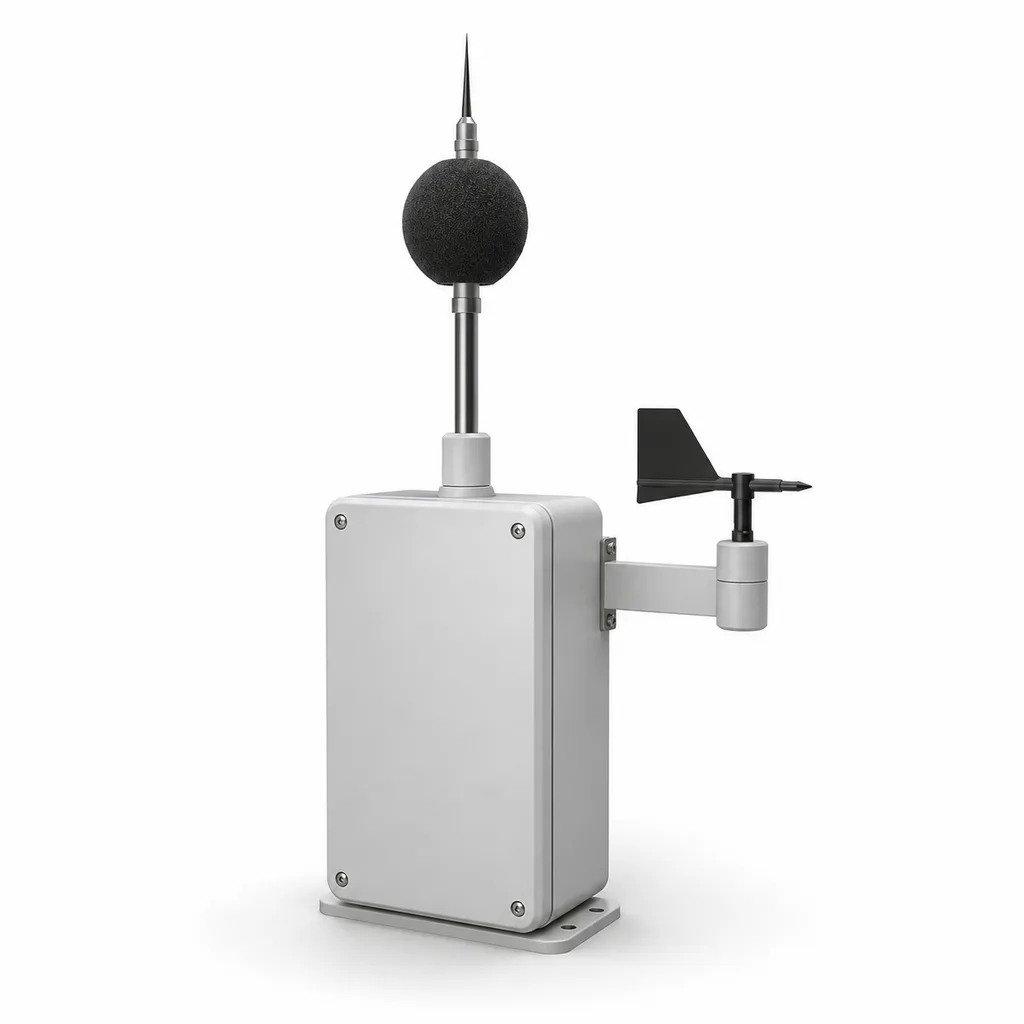
Overview
The REDCOAST.LTD RC-ENM-500 is a permanent, unattended outdoor terminal that continuously measures, classifies and reports environmental noise to Class 1 accuracy under IEC 61672-1, ISO 1996-2 and ISO 20906. It is built for organisations that must prove compliance — airport authorities managing noise contours, city environmental agencies enforcing day/evening/night limits, industrial parks under permit conditions, and construction contractors bound to consent thresholds. Instead of sending a technician with a handheld meter, operators get a fixed station that runs 24/7 for years, streams calibrated data and trigger-based audio evidence to a cloud dashboard, and uses edge AI to attribute each noise event to its true source. The result is defensible, continuous, audit-ready acoustic data and far lower monitoring labour cost.
Key Features
- Class 1 measurement chain — 1/2" prepolarised free-field measurement microphone with REDCOAST.LTD self-designed low-noise preamplifier and signal-conditioning PCB, type-approvable to IEC 61672-1 Class 1 (±1.1 dB @ 1 kHz), 25–140 dB(A) range, <18 dB(A) self-noise.
- Automatic self-verification — built-in electrostatic actuator (CIC) performs a daily sensitivity check on the full electrical path; optional field calibrator support (94/114 dB @ 1 kHz) for periodic reference calibration, so data stays traceable without site visits.
- Full acoustic metrics — real-time LAeq, LAFmax/LASmax, LCpeak, SEL, statistical percentiles (L1/L5/L10/L50/L90/L95) and rating levels Lday / Levening / Lnight / Lden per the Environmental Noise Directive framework.
- 1/1 and 1/3-octave real-time analysis plus optional FFT for tonal and low-frequency assessment (fan noise, transformer hum, HVAC).
- Edge AI sound-source classification — on-terminal inference separates aircraft flyovers, road traffic, rail, construction plant, industrial, wind, rain, dog bark and music/PA, so exceedances are attributed to the responsible source rather than masked.
- Trigger-based audio & event capture — when a threshold or duration criterion is met the terminal stores time-stamped WAV/MP3 clips and event records for evidence, with privacy-safe pre/post buffering.
- Integrated meteorology — ultrasonic or cup/vane wind speed & direction, temperature, humidity, barometric pressure and rain detection, so measurements can be validated and invalidated per ISO 1996-2 wind/rain rules.
- Optional triaxial vibration — ISO 4866 / DIN 4150-compliant geophone channel for construction and blasting ground-vibration monitoring on the same platform.
- Weatherised outdoor unit — all-weather windscreen with bird spike, microphone dehumidification heater, and IP66 electronics enclosure for years of unattended service.
Technical Architecture
The RC-ENM-500 is a three-layer system. At the sensing layer, the outdoor microphone unit combines the Class 1 capsule, a REDCOAST.LTD-designed preamplifier/signal-conditioning PCB (low-noise, high-input-impedance, driving the capsule through long cable runs without degradation), the electrostatic actuator for automatic verification, and an environmental protection assembly (windscreen, rain hood, dehumidifier, bird deterrent). The optional vibration transducer feeds a separate synchronised channel.
At the edge-processing layer, a purpose-built acquisition and controller board digitises the audio at 48 kHz / 24-bit, runs the parallel filter banks that generate broadband, 1/1-octave and 1/3-octave levels in real time, and computes all statistical and rating metrics on a rolling basis. A low-power AI accelerator runs the sound-source classification model against the live spectrum and temporal envelope. The controller time-stamps every record against GNSS/NTP so multi-terminal networks and — at airports — flight-track correlation stay aligned. A REDCOAST.LTD power-management and UPS PCB conditions mains input, manages the backup battery and provides watchdog, surge protection and remote power cycling.
At the cloud layer, terminals push calibrated time-history data, statistical summaries, classified events and audio clips over the network to a Web platform and mobile App. Operators build noise maps, set per-period limits and schedules, receive threshold alarms, generate regulator-ready reports, and drill from an exceedance down to its spectrum, weather context, AI-classified source and audio clip. Edge buffering means no data is lost during connectivity gaps; the terminal backfills automatically on reconnection.
Connectivity & Power
Connectivity is selectable by site: native Gigabit Ethernet for fixed installations with structured cabling, integrated 4G/5G for standalone urban and remote sites, and Wi-Fi for local commissioning. NB-IoT/LoRa uplinks are available for low-bandwidth summary reporting where only aggregated metrics are required. All units support MQTT/HTTPS to the REDCOAST.LTD platform and can integrate to third-party environmental or airport systems via API.
Because the RC-ENM-500 is designed for airports, cities, construction sites and industrial parks — locations that have grid infrastructure — it is mains powered: AC 100–240 V, 50/60 Hz, with an optional 802.3bt PoE++ variant for pole-top or edge-cabinet integration. An internal LiFePO4 UPS rides through outages and clean-shuts to protect data. Solar/off-grid supply is offered only as a project option for truly gridless perimeter or open-country sites and is not the default configuration.
Protection & Reliability
The electronics enclosure is rated IP66 with an internal condensation-managed climate; the microphone protection unit keeps the capsule dry and stable in rain, fog and dew via a heated dehumidifier. The terminal operates from -30 °C to +60 °C, tolerates 0–100 % RH, and is finished for coastal and industrial atmospheres. Surge/EMC protection is applied on mains, signal and data ports. Automatic daily self-check plus long-term microphone stability keep drift within Class 1 limits between service intervals, and the modular design allows the microphone unit, controller and power board to be replaced independently in the field. Target design life is 8–10 years with a standard product warranty and extended options.
Application Scenarios
- Airport noise & flight-track monitoring — a network of terminals around runways and under approach paths continuously measures aircraft events, correlates them to flight tracks, and produces the Lden/Lnight contours and complaint evidence required by ISO 20906 and local aviation authorities.
- Construction & demolition compliance — contractors mount terminals at the site boundary to monitor against consent limits, with combined noise + ground-vibration (DIN 4150) alarms that warn the site before a breach and log evidence to protect against disputes.
- Industrial park & permit monitoring — factories and logistics hubs demonstrate they stay within permitted day/night noise limits at sensitive receptors, with AI source classification separating their own plant from passing traffic.
- Urban nightlife & entertainment districts — city agencies monitor bars, clubs and open-air venues for music and crowd noise during evening/night periods, using tonal analysis and audio clips to handle complaints objectively.
- Road & rail corridor monitoring — permanent stations quantify traffic and rail noise for noise-action-plan reporting and to verify the effectiveness of barriers and low-noise surfaces.
- Smart-city sensor pole integration — a PoE variant rides on multifunctional smart poles or edge cabinets to add certified noise data to a wider urban monitoring network.
Case-style Examples
-
Airport perimeter network: An airport authority needed defensible night-time data to manage complaints and demonstrate contour compliance. A network of RC-ENM-500 terminals was deployed under approach and departure paths, mains-powered from existing airfield cabinets, with GNSS time-sync for flight-track correlation. Automatic daily verification eliminated routine calibration trips, and AI classification let staff filter aircraft events from ground traffic — cutting manual analysis time substantially while producing regulator-ready monthly reports.
-
Major construction boundary monitoring: A city-centre construction project operating under strict consent conditions installed boundary terminals with the optional triaxial vibration channel. Real-time SMS/App alarms fired before limits were breached, letting the site adjust plant operation in time; time-stamped audio and vibration logs resolved neighbour disputes without escalation.
-
Industrial park compliance package: An environmental regulator commissioned a fixed monitoring network across an industrial zone. Grid-powered terminals streamed Lday/Levening/Lnight to a shared dashboard, and edge source-classification attributed exceedances to specific facilities, giving the regulator objective enforcement evidence and the operators early warning to self-correct.
Customization & Selection Guide
- Accuracy class: choose Class 1 (regulatory/airport/permit work) or a lower-cost Class 2 build for indicative screening and awareness networks.
- Vibration: add the ISO 4866 / DIN 4150 triaxial geophone channel for construction, blasting and rail projects; omit for pure noise sites.
- Meteorology depth: basic (wind + rain for data validation) or full station (adds temperature, humidity, pressure) where atmospheric correction and reporting are required.
- Calibration model: automatic electrostatic daily check as standard; add field-calibrator support and traceable annual certification for the most demanding compliance regimes.
- Connectivity & power: Ethernet/PoE++ for cabled smart-pole sites; 4G/5G with UPS for standalone urban sites; solar/off-grid only for gridless perimeter locations.
- Mounting: pole-top, wall/façade, mast at prescribed measurement heights (e.g. 4 m / 1.2 m) or tripod for semi-permanent campaigns.
Deployment & After-sales
Each terminal ships pre-configured and factory-verified; site work is limited to mounting the microphone unit at the specified height, connecting mains/PoE and network, and confirming the cloud link. REDCOAST.LTD provides commissioning support, platform onboarding, report-template setup to local regulations, and remote diagnostics. Because the platform, firmware and PCBs are developed in-house, we adjust metrics, reporting formats, alarm logic and integrations to each project. Spare microphone units and modules are stocked for rapid field swap, and firmware updates are delivered over the air.
Standards & Compliance
Designed against IEC 61672-1 (Class 1 sound level meters), IEC 61260 (octave/fractional-octave filters), ISO 1996-1/-2 (environmental noise description and measurement), ISO 20906 (unattended aircraft-noise monitoring), and — for the vibration option — ISO 4866 / DIN 4150. Enclosure protection to IP66; electrical safety, EMC, CE and RoHS aligned. Reporting frameworks support the EU Environmental Noise Directive (Lden/Lnight) and equivalent national noise regulations; the product is climate- and grid-adaptable for global deployment.
Why REDCOAST.LTD
REDCOAST.LTD delivers end-to-end solutions — the outdoor hardware, the self-designed preamplifier/signal-conditioning, acquisition and power-management PCBs, the edge AI, and the Web platform plus mobile App — integrated and supported by one team. Because we design our own boards, we control the low-noise front end that Class 1 accuracy depends on, and we can tailor channels, metrics, reporting and integrations project by project rather than forcing customers onto a fixed black box. That combination of self-developed hardware (custom PCBs included) and software-hardware integration is what lets us fit airports, construction sites, industrial parks and cities alike.
Talk to REDCOAST.LTD about a Class 1 noise monitoring network sized to your regulations, sites and reporting needs — we will configure and quote to your project.
Specifications
Acoustic Measurement
- Accuracy Class
- Class 1 per IEC 61672-1 (Class 2 option)
- Measurement Range
- 25-140 dB(A)
- Frequency Range
- 3.15 Hz - 20 kHz
- Inherent Self-noise
- < 18 dB(A)
- Microphone
- 1/2" prepolarised free-field
- Digitisation
- 48 kHz / 24-bit
- Frequency Weighting
- A / C / Z
- Time Weighting
- Fast / Slow / Impulse
Metrics & Analysis
- Broadband Metrics
- LAeq, LAFmax, LASmax, LCpeak, SEL
- Statistical Levels
- L1/L5/L10/L50/L90/L95
- Rating Levels
- Lday / Levening / Lnight / Lden
- Spectral Analysis
- 1/1 & 1/3 octave real-time (+ FFT option)
- Logging Interval
- 0.1 - 3600 (configurable) s
- AI Source Classes
- aircraft/road/rail/construction/industrial/music/wind/rain
Calibration & Evidence
- Auto Self-check
- daily electrostatic actuator (CIC)
- Field Calibrator
- 94 / 114 dB @ 1 kHz supported
- Event Audio Capture
- trigger-based WAV/MP3, pre/post buffer
- Time Sync
- GNSS + NTP/PTP
- Local Storage
- 32-256 (event + backfill buffer) GB
Meteorology & Vibration (option)
- Wind Speed / Direction
- 0-60 / 0-360 m/s / °
- Temperature
- -40 to +60 °C
- Humidity
- 0-100 %RH
- Rain Detection
- yes (measurement validation)
- Vibration Option
- triaxial geophone, ISO 4866 / DIN 4150
Connectivity
- Wired
- 10/100/1000 Ethernet
- Cellular
- 4G / 5G
- Local / Low-power
- Wi-Fi, NB-IoT / LoRa (summary)
- Protocols
- MQTT / HTTPS / REST API
Power (grid)
- Input Voltage
- AC 100-240 V
- Frequency
- 50 / 60 Hz
- PoE Option
- 802.3bt PoE++
- Typical Power
- 8-20 W
- UPS Backup
- internal LiFePO4, 8-24 h ride-through
Mechanical & Environmental
- Enclosure Rating
- IP66
- Operating Temperature
- -30 to +60 °C
- Mic Protection
- all-weather windscreen, heater, bird spike
- Mounting
- pole / wall / mast (4 m or 1.2 m)
- Design Life
- 8-10 years
Capabilities — configurable per project
Specifications are tailored to each project — the options below show what we can support.
Accuracy Class
- Class 1 (IEC 61672)
- Class 2 (indicative)
Vibration Channel
- None
- Triaxial geophone (ISO 4866 / DIN 4150)
Meteorology
- Wind + rain (validation)
- Full weather station
Connectivity
- Ethernet / PoE++
- 4G/5G
- NB-IoT / LoRa summary
Power
- Grid AC
- PoE++
- Solar/off-grid (gridless sites only)
Mounting
- Pole-top
- Wall / façade
- Mast
- Tripod (semi-permanent)
Related solution guidance

Environmental Monitoring
Deploy environmental monitoring stations with sensors, solar power, gateways, dashboards, alarms and data integration for city and industrial sites.
Industrial Parks
Industrial park IoT for lighting, access areas, environmental monitoring, energy visibility, parking and maintenance operations.

Municipalities
Municipal smart city programs for lighting, traffic safety, parking, smart poles and environmental monitoring with one hardware and software partner.
Frequently Asked Questions
What is a permanent environmental noise monitoring terminal?
It is a fixed, unattended outdoor station that continuously measures environmental noise to a certified accuracy class and reports the data to a cloud platform. The REDCOAST.LTD RC-ENM-500 runs 24/7 for years, computing LAeq, statistical and Lden/Lnight rating levels, so agencies and operators can prove compliance without sending a technician with a handheld meter.
Is the RC-ENM-500 Class 1 or Class 2?
It is built to IEC 61672-1 Class 1 (±1.1 dB at 1 kHz), which most national regulations and airports require for legal and permit work. A lower-cost Class 2 build is available for indicative screening and awareness networks where legal accuracy is not mandated.
How does it stay calibrated when installed outdoors for years?
A built-in electrostatic actuator (CIC) performs an automatic daily check of the full electrical measurement path and flags any drift. The terminal also supports periodic reference calibration with a 94/114 dB field calibrator, and the microphone unit is heated and weather-protected to keep sensitivity stable.
Can it tell what is making the noise?
Yes. On-terminal edge AI classifies each event by source — aircraft, road traffic, rail, construction plant, industrial, music/PA, wind and rain — so exceedances are attributed to the responsible source instead of being lumped together. Trigger-based audio clips provide supporting evidence.
Does it also measure vibration for construction sites?
It can. An optional triaxial geophone channel measures ground vibration to ISO 4866 / DIN 4150 on the same platform, so construction and blasting projects monitor noise and vibration together with combined alarms.
How is it powered — does it need solar?
Because it is designed for airports, cities, construction sites and industrial parks that have grid power, it runs on mains AC 100–240 V (or 802.3bt PoE++) with an internal LiFePO4 UPS for outage ride-through. Solar/off-grid supply is offered only as a project option for truly gridless perimeter sites.
Which standards and reporting frameworks does it support?
It is designed against IEC 61672-1, IEC 61260, ISO 1996-1/-2 and ISO 20906 for unattended aircraft-noise monitoring, plus ISO 4866/DIN 4150 for the vibration option. Reporting supports the EU Environmental Noise Directive (Lden/Lnight) and equivalent national noise regulations.
Can REDCOAST.LTD supply a full airport or city noise network?
Yes. REDCOAST.LTD delivers the terminals, the self-designed front-end and power PCBs, the edge AI and the Web/App platform as one integrated, project-configured solution, including GNSS time-sync for flight-track correlation and report templates matched to local regulations.