Overview
The RC-EVP-500 is a multi-mode Emergency Vehicle Preemption and Transit Signal Priority (EVP/TSP) system that gives emergency vehicles and public transit buses a clear green path through signalized intersections — cutting ambulance and fire-truck response times, improving bus schedule adherence, and reducing collision risk at controlled junctions. Designed to scale from a single arterial corridor to a metropolitan network of hundreds of intersections, the system integrates with existing NTCIP-compliant traffic signal controllers without requiring controller replacement or civil modifications. REDCOAST.LTD engineers every subsystem from the ground up — the OVU-300 onboard vehicle PCB, the IPC-200 intersection preemption controller, the OD-100 optical detector signal-processing board, and the PriorityNet™ cloud management platform — so every element of the signal chain is auditable, deeply customizable, and free of third-party black-box dependencies.
Key Features
- Triple-mode detection: GPS/4G-LTE cellular, 940 nm pulsed optical infrared (IR), and optional DSRC/C-V2X radio — operators configure the mix that matches their infrastructure and budget
- Sub-two-second actuation: GPS-path preemption request-to-controller output in under 2 seconds; optical path under 1 second from detector trigger — green is ready before the vehicle reaches the stop line
- 10-class priority hierarchy: distinguishes fire apparatus (Class 10, highest), ambulance, police, transit bus, utility and maintenance vehicles — simultaneous multi-vehicle requests resolved deterministically, highest class always wins
- NTCIP 1211-native IPC-200: interfaces directly with NEMA TS-2 and ATC 5201 signal controllers via serial or Ethernet; no controller swap, no rewiring, no civil work
- Selective conflict clearing: only conflicting approaches hold red; non-conflicting phases continue normally, minimising grid-wide delay disruption
- Predictive approach modelling: GPS path-ahead algorithm sends preemption requests 300–600 m before arrival, dynamically adjusting ETA as vehicle speed changes
- Fail-safe degradation: loss of cellular or optical link causes the intersection to revert to normal timed operation — no phase lock-up, no safety compromise
- Edge-local operation: IPC-200 stores intersection geometry and vehicle class maps locally; preemption can execute without cloud connectivity in degraded-network scenarios
- Fleet-wide real-time dashboard: dispatchers track every OVU on a live map with active preemption status per intersection, event logs, and response-time analytics
Technical Architecture
The RC-EVP-500 operates across three tiers. At the vehicle tier, each OVU-300 onboard unit — a custom four-layer PCB in an IP67 polymer housing — integrates a high-sensitivity GNSS receiver (GPS + GLONASS, CEP < 2.5 m), a 4G LTE Cat-1 cellular modem (with optional 5G NR upgrade), and a switchable 940 nm pulsed IR emitter. The OVU-300 draws from the vehicle's 12/24 VDC supply and streams encrypted position, heading, speed, and vehicle-class telemetry to both the cloud platform and nearby intersection controllers. When the vehicle enters a configurable geofence around a mapped intersection — default 600 m radius — the OVU-300 issues a signed preemption request packet containing vehicle ID, class, approach lane, and estimated time-to-stop-line.
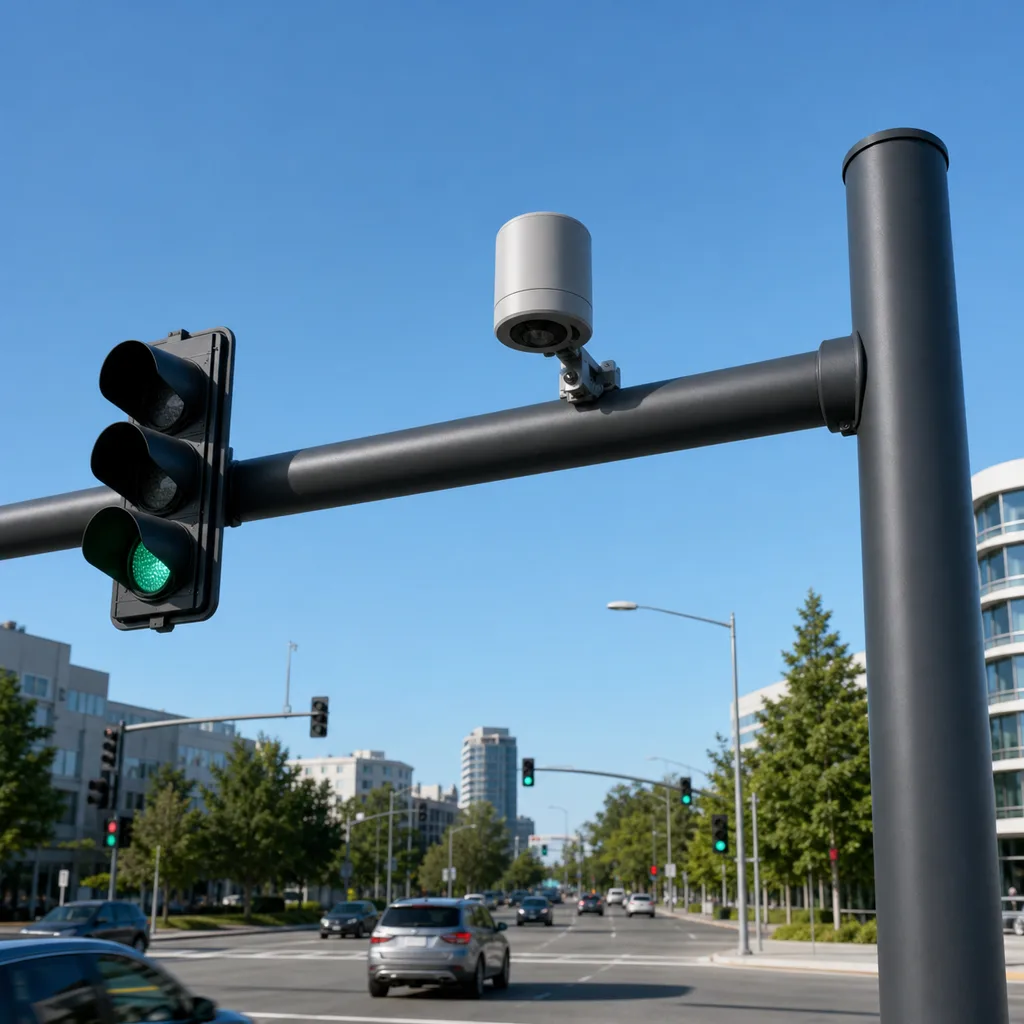
At the intersection tier, the IPC-200 Intersection Preemption Controller mounts inside the existing traffic signal cabinet and connects to the native controller via NTCIP 1211 serial/IP interface plus a direct hardware preemption input. Up to four OD-100 mast-arm optical detectors per IPC-200 feed decoded IR pulse data through a purpose-built pulse-decode ASIC on the PCB, filtering out solar noise and distinguishing coded 940 nm emitter signatures at ranges up to 750 m. The IPC-200 arbitrates simultaneous priority requests by class, executes the preemption sequence (terminate current phase → establish conflict red → activate protected green → hold for configurable duration → restore normal operation), queues lower-priority requests, and logs every event to on-board non-volatile flash (30 days of local history). An embedded eSIM provides 4G LTE backhaul to the cloud platform and receives OTA firmware updates.
At the cloud tier, the PriorityNet™ SaaS platform provides a real-time map of all OVUs and active preemptions, schedule-adherence analytics for TSP-mode transit buses (cross-referenced against GTFS-RT feeds), after-action reports (seconds saved per run, intersection utilisation heat maps), and a REST API for integration with existing CAD/dispatch, AVL, and transit management systems. PriorityNet™ is available as cloud-hosted or on-premise deployments for agencies requiring data sovereignty.
Connectivity & Power
The IPC-200 connects to the traffic signal cabinet via RS-232/RS-485 serial or 100Base-T Ethernet depending on controller generation, and draws 120/240 VAC mains power directly from the existing cabinet supply — no additional power run is needed. OD-100 detectors connect to IPC-200 via shielded RS-485 twisted-pair cable along existing conduit runs. The OVU-300 onboard unit operates on 12/24 VDC vehicle power, consuming under 3 W at idle and under 8 W when the IR emitter is active. Cloud backhaul for IPC-200 uses an embedded multi-band eSIM (LTE 700/850/900/1800/1900/2100 MHz) covering over 190 countries; optional 5G NR Sub-6 GHz daughter-card reduces round-trip latency to under 20 ms for latency-sensitive deployments. The optional DSRC/C-V2X radio daughter-card (SAE J2945.1 / IEEE 802.11p or 3GPP Rel-16 C-V2X PC5) prepares intersections for connected-vehicle ecosystem integration. All cloud communications use TLS 1.3 with hardware PKI-backed device certificates.
Protection & Reliability
The OD-100 optical detector is housed in UV-stabilised polycarbonate rated IP66 and IK10, withstanding direct water jets, sand ingress, and minor vandal impacts. Both OD-100 and IPC-200 are rated for the full NEMA TS-2 environmental envelope: operating temperature −40 to +74 °C, 95% non-condensing humidity, and vibration per NEMA TS-2 Section 2. The IPC-200 PCB is fully conformally coated and tested to IEC 60068-2-1/2/6/14 for thermal shock, damp heat, sinusoidal vibration, and thermal cycling. The OVU-300 meets IP67 (fully sealed, immersion-rated for in-vehicle installation) and operates from −40 to +70 °C. IPC-200 MTBF target is > 80,000 hours. A hardware watchdog on every unit triggers autonomous reboot on firmware fault within 30 seconds, with automatic safe-state output ensuring the intersection defaults to timed operation during recovery.
Application Scenarios
Urban Emergency Medical Corridor: A city equips its EMS fleet with OVU-300 and deploys IPC-200 at signalized intersections along the primary hospital access arterial. Ambulances receive green phases at each equipped intersection, reducing average per-intersection delay from 18 seconds to near zero and cutting end-to-end response times by 1.5–2.5 minutes — critical for cardiac and stroke calls where outcome correlates directly with arrival speed.
Bus Rapid Transit (BRT) Schedule Recovery: A transit authority operating mixed-traffic BRT lines enables TSP mode for articulated buses. PriorityNet™ cross-references GTFS-RT schedule data and only triggers green extension or early-green when a bus is delayed beyond a configurable threshold — preserving general traffic performance when buses are on schedule, and recovering schedule adherence without dedicated infrastructure.
Airport Landside Emergency Access: An international airport deploys IPC-200 at key airside gate intersections and equips fire tenders and medical response units with OVU-300 at Class 10 (highest) priority. Emergency vehicles gain immediate corridor clearance from the fire station to any terminal gate, meeting ICAO CAT-1 airport rescue response-time targets without dedicated segregated roadways.
Multi-agency Metropolitan Network: A metropolitan TMC deploys a city-wide installation spanning police, fire, EMS, and public transit in one unified PriorityNet™ instance. Priority classes are assigned per agency and vehicle type; the REST API feeds live event data into the TMC's existing C2 dashboard, and the GTFS-RT integration gives transit operations a real-time view of bus delay recovery.
University and Hospital Campus Roads: A large academic medical centre deploys IPC-200 at campus internal intersections and equips security patrol, medical transport shuttles, and emergency response units. The lightweight campus-scale deployment delivers full preemption performance at a fraction of city-scale project cost.
Industrial Port and Logistics Hub: A major container port equips fire engines and emergency response vehicles with OVU-300 and deploys IPC-200 at high-risk junctions between pedestrian zones and heavy freight lanes. Controlled preemption provides a clear path for emergency vehicles without halting port operations beyond the minimum necessary conflict clearance.
Case-style Examples
Emergency Response Time Reduction on a Major Arterial: A city EMS department identified that ambulances were losing 12–18 seconds at each of 14 signalized intersections along the hospital corridor, accumulating over 3 minutes of delay per run. After deploying RC-EVP-500 with GPS/cellular preemption at all 14 intersections and equipping 32 ambulances with OVU-300 (no controller replacements, no civil works), the department recorded an average of 2.3 minutes saved per hospital-bound run in the first six months. The optical IR fallback layer ensured preemption continuity during periods of peak cellular congestion.
BRT On-time Performance Recovery: A transit authority operating a 16 km BRT corridor was recording 24% late-arrival rate at terminus due to signal cycle conflicts. Deploying RC-EVP-500 in TSP mode at 22 intersections and connecting PriorityNet™ to the agency's GTFS-RT feed improved on-time performance to 91% within three months. General traffic delay at equipped intersections increased by an average of 3.8 seconds per cycle — within acceptable tolerance per the agency's level-of-service policy — and the city avoided the capital cost of a dedicated BRT guideway.
Tiered Priority at a Campus Medical Network: A hospital system covering a 4 km² combined campus deployed 26 IPC-200 controllers, assigning medical transport shuttles TSP Class 5 and emergency first-responders EVP Class 9. The tiered hierarchy guaranteed that a true emergency would always supersede a late-running shuttle request. Integration of the PriorityNet™ REST API with the campus security camera VMS provided time-synced video clips for every preemption event, simplifying incident review and liability documentation.
Customization & Selection Guide
- GPS/Cellular only: lowest installation cost, no mast-arm hardware; best for new deployments where conduit access is limited. Typical actuation latency ~1.5–2 s. Requires reliable 4G coverage at each intersection.
- Optical IR only: retrofit-compatible with fleets already carrying coded IR emitters; IPC-200 replaces older discriminator hardware without changing vehicle units. Sub-1-second actuation; performance degrades in heavy fog (>200 m visibility impairment).
- Hybrid GPS + Optical (recommended): GPS handles advance geofenced requests and provides backup; optical provides fastest final-approach actuation and lowest stop-line latency. Highest reliability across weather and network conditions.
- DSRC/C-V2X add-on: for cities investing in V2I/V2X infrastructure; IPC-200 DSRC/C-V2X daughter-card enables interoperability with future connected-vehicle fleets and V2X RSU ecosystems.
- EVP-only vs. combined EVP+TSP: agencies needing only emergency preemption can deploy IPC-200 in EVP-only mode (lower licence tier); adding TSP unlocks GTFS-RT integration, schedule-based conditional priority, and bus delay analytics.
- On-premise vs. cloud platform: cloud SaaS is fastest to deploy; on-premise PriorityNet™ server suits agencies with data-sovereignty mandates or restricted-network environments (e.g., government or defence campuses).
Deployment & After-sales
IPC-200 installation inside a standard NEMA TS-2 or ATC cabinet takes under 2 hours per intersection — DIN-rail mount, terminal-strip wiring, no controller swap. OD-100 detectors affix to existing mast arms with a single stainless-steel U-bolt bracket; wiring routes through existing conduit to the cabinet. OVU-300 installs on a vehicle dashboard or A-pillar in under 45 minutes with supplied mount and OBD/power harness; no CAN-bus or ECU integration is required. REDCOAST.LTD ships IPC-200 units pre-configured with intersection GPS coordinates and phase maps, minimising on-site commissioning time. Typical project delivery for 20–50 intersections (hardware, platform, commissioning) runs 8–14 weeks from purchase order. PriorityNet™ includes 24/7 automated device health monitoring with email/SMS alerting on device fault. REDCOAST.LTD provides a 24-month hardware warranty on all units, with optional managed-service SLA covering remote diagnostics and on-site corrective maintenance within 48 hours for critical-path contracts.
Standards & Compliance
- NTCIP 1211 (Signal Control Priority — EVP/TSP messaging standard)
- NEMA TS-2 and ATC 5201 (traffic signal controller compatibility)
- FHWA MUTCD Section 4D (intersection preemption requirements)
- IEC 60068-2-1/2/6/14 (environmental testing: thermal, humidity, vibration)
- IP66 / IP67 (IEC 60529 enclosure ingress protection)
- IK10 (IEC 62262 impact resistance — OD-100 detector)
- SAE J2945.1 / IEEE 802.11p / 3GPP Rel-16 C-V2X PC5 (optional V2X radio)
- GTFS-RT (General Transit Feed Specification Realtime — TSP data integration)
- CE marking / RoHS 2 (EU market)
- FCC Part 15B (North America RF emissions)
- AES-256 + TLS 1.3 (cybersecurity — all over-air and cloud communications)
Why REDCOAST.LTD
Most EVP/TSP vendors supply closed, OEM-sourced hardware that locks agencies into proprietary emitter-detector pairs and firmware update cycles outside their control. REDCOAST.LTD designs and manufactures every PCB in the RC-EVP-500 system in-house — from the OVU-300 vehicle unit's GNSS/cellular board, to the IPC-200 intersection controller's NTCIP interface and pulse-decode ASIC circuit, to the OD-100 detector's signal-processing front-end. This full hardware ownership means priority class definitions, preemption timing parameters, encryption key management, and detector sensitivity thresholds can all be adjusted for local regulatory requirements or agency operating procedures — at the board level, not through a constrained configuration GUI. When a national road authority needs a custom vehicle class for military convoy priority, or a hospital network needs NTCIP 1211 extended with proprietary message fields for its CAD integration, REDCOAST.LTD engineers it into the firmware and PCB without a change-order from an upstream OEM. Every project is delivered as a complete integrated package: hardware, edge firmware, cloud platform, mobile dispatcher app, API documentation, and post-deployment technical support from a single team. Reach out to REDCOAST.LTD with your intersection count, fleet composition, and integration requirements — we will produce a project-specific configuration, BOM, and commissioning plan.
Specifications
System Performance
- Detection Range (Optical IR)
- up to 750 m
- Detection Range (GPS/Cellular)
- citywide (within LTE coverage)
- Preemption Actuation Latency — Optical
- <1 s
- Preemption Actuation Latency — GPS
- <2 s
- Priority Classes Supported
- 10 classes
- Concurrent Requests per Intersection
- up to 8
- Predictive Preemption Geofence Range
- 300–600 (configurable) m
Intersection Preemption Controller (IPC-200)
- Input Voltage
- AC 120/240, 50/60 Hz (from signal cabinet) V
- Power Consumption
- <15 W
- Signal Controller Interface
- NTCIP 1211 / RS-232 / RS-485 / 100Base-T Ethernet
- Controller Compatibility
- NEMA TS-2, ATC 5201
- Optical Detector Ports
- 4 (expandable to 8 via daisy-chain)
- Local Event Log Storage
- 30 days (non-volatile flash)
- Cellular Backhaul
- 4G LTE Cat-1 eSIM / optional 5G NR
- Operating Temperature
- -40 to +74 °C
Onboard Vehicle Unit (OVU-300)
- Input Voltage
- 12/24 VDC (vehicle power) V
- Power Consumption — Idle
- <3 W
- Power Consumption — Active (IR emitting)
- <8 W
- GNSS
- GPS + GLONASS, CEP <2.5 m
- Cellular Modem
- 4G LTE Cat-1 (700/850/900/1800/1900/2100 MHz)
- Optional IR Emitter
- 940 nm pulsed, 16 Hz coded nm / Hz
- Enclosure Rating
- IP67
- Operating Temperature
- -40 to +70 °C
Optical Priority Detector (OD-100)
- Spectral Sensitivity
- 900–1000 nm (IR band)
- Detection Range (adjustable)
- 450–750 m
- Field of View
- 12° horizontal × 10° vertical
- Mounting
- Mast arm or pole clamp (standard 1.5″–2.5″ OD)
- Enclosure Rating
- IP66, IK10
- Interface to IPC-200
- Shielded RS-485 twisted pair
- Operating Temperature
- -40 to +74 °C
Communication & Integration
- Cloud Protocol
- HTTPS REST API, WebSocket, SNMP over TCP/IP
- Transit Data Integration
- GTFS-RT (real-time bus schedule feed)
- Optional V2X Radio
- DSRC IEEE 802.11p or C-V2X PC5 (3GPP Rel-16)
- OTA Firmware Update
- Over cellular, AES-256 encrypted
- Cybersecurity
- TLS 1.3, hardware PKI device certificates
Environmental & Reliability
- IPC-200 PCB Protection
- Conformal coating, IEC 60068-2 tested
- OD-100 Enclosure
- IP66, IK10, UV-stabilised polycarbonate
- OVU-300 Enclosure
- IP67
- Operating Temperature (all field units)
- -40 to +74 °C
- IPC-200 MTBF (target)
- >80,000 h
- Hardware Warranty
- 24 months
Capabilities — configurable per project
Specifications are tailored to each project — the options below show what we can support.
Detection Mode
- GPS/Cellular only
- Optical IR only
- Hybrid GPS + Optical (recommended)
- Hybrid + DSRC/C-V2X add-on
Priority Scope
- EVP-only (emergency vehicles)
- TSP-only (transit buses)
- Combined EVP + TSP (up to 10 classes)
- Multi-agency unified deployment
Platform Deployment
- Cloud SaaS (PriorityNet™ hosted)
- On-premise server (data-sovereignty)
- Hybrid cloud/on-premise
Cellular Generation
- 4G LTE Cat-1 (standard)
- 5G NR Sub-6 GHz (low-latency upgrade)
V2X Readiness
- None (cellular + optical only)
- DSRC IEEE 802.11p daughter-card
- C-V2X PC5 daughter-card (3GPP Rel-16)
Related solution guidance
Traffic Safety
Plan connected traffic safety systems with warning beacons, LED signs, road guidance devices, sensing, control cabinets and monitoring software.
Airports and Hubs
IoT infrastructure for transport hubs: parking guidance, road safety, outdoor lighting, signage, monitoring and operational dashboards.

Municipalities
Municipal smart city programs for lighting, traffic safety, parking, smart poles and environmental monitoring with one hardware and software partner.
Frequently Asked Questions
What is the difference between emergency vehicle preemption (EVP) and transit signal priority (TSP)?
Emergency vehicle preemption (EVP) immediately interrupts normal signal operation and holds a protected green exclusively for a fire truck, ambulance, or police vehicle — all conflicting approaches go red. Transit signal priority (TSP) is a softer intervention: it extends an existing green phase or advances the next green by a few seconds to help a bus recover schedule delay, without fully interrupting the signal cycle. The RC-EVP-500 supports both modes simultaneously within a 10-class priority hierarchy, so an emergency vehicle always overrides an active TSP request.
Does the RC-EVP-500 require replacing existing traffic signal controllers?
No. The IPC-200 Intersection Preemption Controller connects to any NEMA TS-2 or ATC 5201-compliant signal controller via NTCIP 1211 serial or Ethernet interface and uses the controller's existing hardware preemption input. Installation takes under 2 hours per intersection with no civil works and no controller swap. REDCOAST.LTD pre-configures IPC-200 units with intersection geometry and phase maps before shipment to further reduce on-site commissioning time.
How does the system handle two emergency vehicles approaching the same intersection simultaneously from different directions?
The IPC-200 arbitrates concurrent preemption requests using the configured priority class hierarchy. If two vehicles of equal class arrive simultaneously, the IPC-200 serves the vehicle with the earlier estimated time-to-stop-line and queues the second request; the second vehicle receives its preemption phase immediately after the first vehicle clears. If vehicles are of different classes (e.g., fire truck Class 10 vs. ambulance Class 9), the higher-class vehicle always takes precedence, and the lower-class request queues. The IPC-200 handles up to 8 simultaneous requests per intersection.
What happens if the cellular network goes down at an equipped intersection?
The RC-EVP-500 is designed with fail-safe degradation at every layer. If cellular backhaul fails, GPS-mode preemption requests from vehicles cannot reach the IPC-200 via the cloud path, but optical IR detection continues operating locally without any network dependency. If both cellular and optical paths are unavailable, the IPC-200 defaults to normal timed signal operation — the intersection never locks up or holds a phase indefinitely. REDCOAST.LTD's PriorityNet™ platform also alerts operators within 60 seconds of any device going offline.
Can the RC-EVP-500 integrate with our existing CAD/dispatch software?
Yes. PriorityNet™ exposes a documented REST API and WebSocket stream for real-time preemption event data (vehicle ID, intersection, timestamp, class, duration). Most CAD and dispatch platforms can consume this feed via standard HTTP integration. For transit deployments, PriorityNet™ also accepts GTFS-RT feeds from existing AVL systems to enable schedule-conditional TSP triggering. REDCOAST.LTD provides integration documentation and engineering support as part of the project delivery package.
How far away can the optical detector reliably detect an approaching vehicle in heavy rain or fog?
The OD-100 detector's 940 nm IR band performs significantly better than visible-light systems in rain and light fog, maintaining detection at ranges of 450–600 m in heavy rain. In dense fog (visibility below approximately 150 m), optical detection range is reduced — this is a physical limitation of any IR line-of-sight system. For environments with frequent dense fog or heavy snowfall, REDCOAST.LTD recommends deploying the hybrid GPS + Optical configuration: GPS/cellular preemption provides weather-independent advance requests, while optical IR supplies the lowest-latency final-approach confirmation in clear conditions.
What does NTCIP 1211 compliance mean, and why does it matter for procurement?
NTCIP 1211 is the AASHTO/ITE/NEMA national standard that defines the messaging protocol for signal control priority and preemption between a priority management server, intersection controllers, and vehicle on-board units. Compliance means the RC-EVP-500 IPC-200 can interoperate with any NTCIP 1211-compliant traffic management center or signal controller from any vendor — protecting the agency's investment if controllers are upgraded later and enabling multi-vendor city deployments without custom integration work.
How long does it typically take to deploy the system across 50 intersections and equip a 30-vehicle EMS fleet?
For a 50-intersection / 30-vehicle project, REDCOAST.LTD targets 8–12 weeks from purchase order to full commissioning. Hardware (IPC-200 pre-configured, OD-100 detectors, OVU-300 vehicle units) ships within 4–6 weeks; field installation of IPC-200 and OD-100 runs at approximately 3–5 intersections per technician per day; OVU-300 vehicle-unit installation is 45 minutes per vehicle. PriorityNet™ platform provisioning and system acceptance testing typically run in parallel with the final installation days.