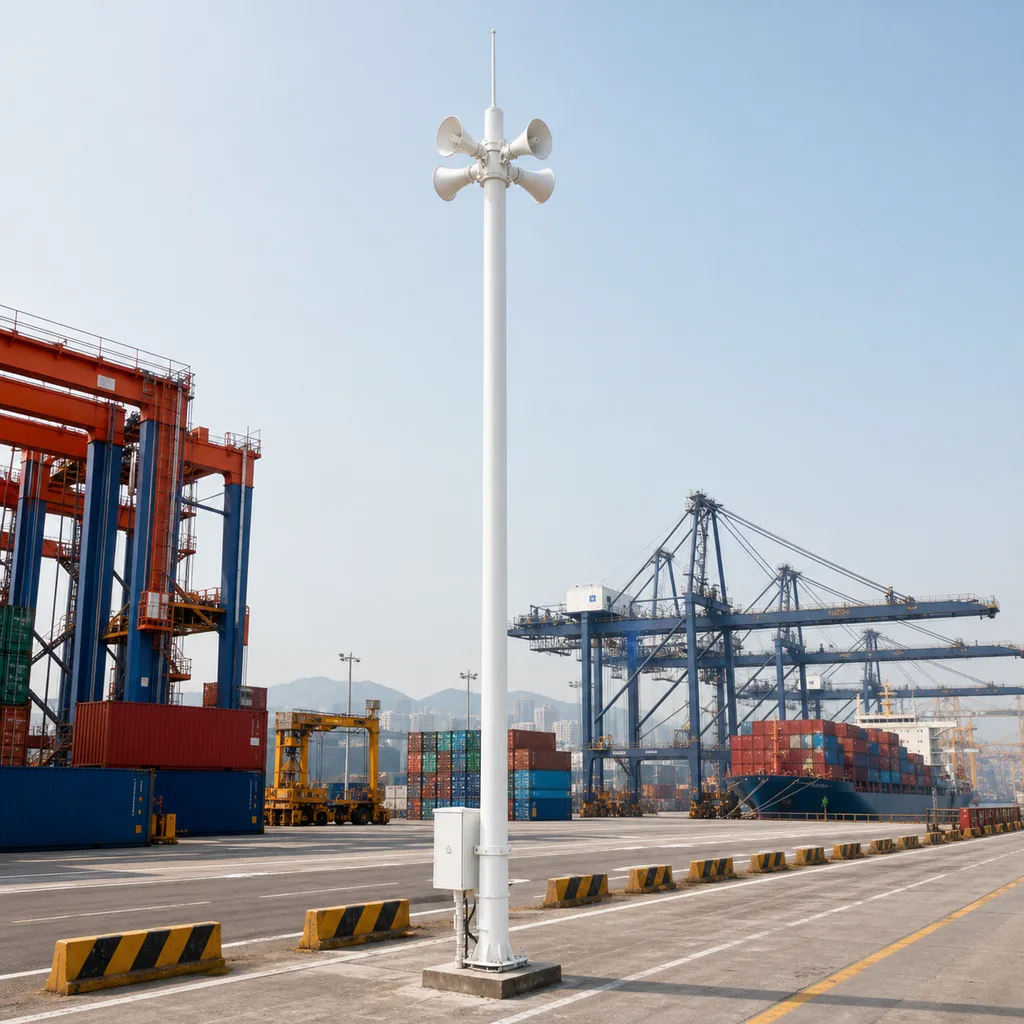
Overview
The REDCOAST.LTD RC-MNS-1000 is a grid-powered, fully IP-based Public Address (PA) and Mass Notification System (MNS) engineered for cities, university and corporate campuses, container ports, oil & gas terminals, mining operations, transit hubs and critical infrastructure where rapid, intelligible voice communication can save lives. The platform is built around REDCOAST.LTD-designed Class-D supervised amplifier PCBs, IP audio processor boards and pole-mounted UPS power management boards, paired with long-throw horn loudspeakers and a centralized Notification Management Server (NMS). It delivers daily zone paging, severe-weather alerts, evacuation instructions, terror and active-threat notification, and CBRN / chemical-spill warnings with EN 54-16 / EN 54-24 compliant voice intelligibility at ranges of several hundred metres per pole and several kilometres per cluster.
Key Features
- Distributed IP-audio backbone over single-mode fibre, Gigabit Ethernet or 4G/5G LTE, with sub-50 ms ring failover
- High-power supervised Class-D pole amplifiers from 200 W to 1000 W, A/B line monitoring per channel
- Long-throw horn loudspeakers in single, dual, quad and 360° omnidirectional configurations
- Live microphone broadcast, pre-recorded multilingual voice files, scheduled chimes and SIP zone paging
- Native CAP v1.2 ingestion from national meteorological, seismic and civil-protection alert feeds
- Redundant dual power supply with integrated LiFePO4 UPS for 24 h standby / 4 h active broadcast
- Self-supervised loudspeaker lines with end-of-line monitoring and per-driver fault reporting
- Edge AI ambient-noise sensing for adaptive output level maintaining STI ≥ 0.5 in any environment
- Lightning protection class III, IP66/IP67 enclosures, salt-spray-rated finish for coastal and desert deployment
- EN 54-16 / EN 54-24 / IEC 60849 compliant voice alarm; optional ATEX horns for hazardous areas
Technical Architecture
At the heart of the RC-MNS-1000 pole node is a REDCOAST.LTD three-board stack designed from scratch in-house. An IP audio engine board handles AES67 / Dante streams, Opus / G.711 / G.722 codec processing, priority arbitration and zone routing. A supervised Class-D power amplifier board provides per-channel impedance monitoring, line-fault detection, thermal and short-circuit protection, and configurable 70 V / 100 V / 4 Ω outputs. A power management board with PFC AC input, hot-swap DC backup and 24 V LiFePO4 battery interface guarantees uninterrupted operation across grid disturbances.
Each pole node connects to a central Notification Management Server running at the customer's emergency operations centre. The NMS orchestrates message routing, zone selection, priority arbitration (life-safety always pre-empts paging), audit logging and operator workflows. A ring or mesh fibre topology with sub-50 ms failover ensures that loss of any single segment does not interrupt broadcasts; full EN 54-16 redundancy class C deployments use dual independent NMS nodes with cross-replication.
Every pole continuously self-supervises amplifier health, loudspeaker line impedance, microphone integrity, network reachability and power source state, reporting to the NMS with email / SMS / SNMP alerts on any degradation. Edge AI ambient-noise sensors adapt output level in real time to maintain a constant Speech Transmission Index (STI ≥ 0.5) regardless of traffic, machinery or wind noise. For integration with broader civil-protection and industrial control infrastructure, the NMS accepts CAP feeds from meteorological agencies, seismic networks, fire alarm panels (EN 54-2 interface) and SCADA via Modbus TCP, MQTT or REST API.
Connectivity & Power
Pole nodes connect to the central server primarily over single-mode fibre (LC duplex, up to 40 km point-to-point) for backbone reliability, with Gigabit Ethernet copper drops inside campuses. Where fibre is impractical, 4G/5G LTE modems with dual-SIM and APN failover are supplied as the primary path, with LoRa as a command-and-status fallback that keeps tone activation alive even if data links degrade. Time synchronization is via NTP and PTPv2, guaranteeing synchronized cluster broadcast.
Power input is universal 100–240 V AC, 50/60 Hz mains. An integrated LiFePO4 12/24 V backup battery (50–100 Ah) provides up to 24 hours of standby and 4 hours of active broadcast at 50 % rated power — keeping the system online during exactly the storms, earthquakes and grid outages that trigger evacuation. PFC, Type II 40 kA surge protection and wide-range over/under-voltage protection are built in.
Protection & Reliability
All pole-mounted enclosures are rated IP66/IP67, with marine-grade stainless steel fasteners and a smooth matte powder-coated finish on aluminium or galvanized-steel housings — engineered for coastal, desert and tropical environments. Operating temperature range is -30 to +60 °C; humidity 5–95 % non-condensing. Lightning protection class III is integrated at the pole base. Horn drivers are IP67, salt-spray tested to ISO 9227 (1000 h). MTBF on the electronics exceeds 60,000 hours; horn driver service life is rated above 100,000 hours under continuous use. The standard warranty is 3 years on electronics and 5 years on horn drivers, with extended programmes available.
Application Scenarios
- Coastal cities and tsunami warning zones: pole-mounted MNS clusters along beaches, marinas and coastal arterials broadcast tsunami sirens and multilingual evacuation instructions on receipt of seismic-network CAP alerts.
- University and corporate campuses: zoned daily paging (class changes, security drills) plus full-campus emergency broadcast for active-threat or fire-evacuation scenarios, integrated with the campus fire alarm via EN 54-16.
- Petrochemical, refining and LNG sites: gas-leak and toxic-release notification driven by site SCADA, with intrinsically safe horns for hazardous-area zones and multilingual evacuation for multinational workforces.
- Container ports and logistics terminals: shift-change paging, machinery-warning broadcasts and emergency notification covering large open yards 24/7, surviving heavy ambient crane and reefer noise.
- Mining sites and quarries: blast-warning announcements, shift-end calls and emergency evacuation across multi-kilometre pits, with rugged enclosures for dust and vibration.
- Stadiums, airports and transit hubs: public information broadcast, lost-child paging, crowd management and active-threat notification with the redundancy demanded by life-safety regulators.
Case-style Examples
- Coastal tsunami warning network (medium-sized coastal city deployment): 48 MNS nodes at 12 m mast height along 22 km of coastline, each with a quad-horn 1000 W cluster, fibre-ring backbone and ingestion of the national meteorological CAP feed. Activation latency from CAP receipt to live broadcast was under 4 seconds in the commissioning drill, with measured STI ≥ 0.52 at 500 m on the shore-front esplanade.
- Petrochemical site mass notification upgrade: 36 MNS nodes integrated with the refinery's safety instrumented system and SCADA, hazardous-area certified horn extensions for Zone 1/2 areas, and pre-recorded announcements in English, Arabic and Tagalog matching the on-site workforce. Self-supervision detected two horn-driver failures within the first 6 months, both replaced before the next emergency drill.
- University campus modernization: 18 MNS nodes replacing legacy 25 V line-array PA across 7 buildings, with EN 54-16 interface to the central fire alarm panel and SIP integration so the security operations centre can announce from any IP phone. Daily announcement scheduling is fully automated from a web NMS.
Customization & Selection Guide
- Define coverage geometry: linear coverage (coast, arterial road) favours directional dual / quad horns; open campuses and yards favour 360° omnidirectional clusters; high-rise environments need elevated array mounting.
- Calculate target SPL at coverage radius — typically 75–85 dB(A) above ambient noise at the furthest listener. REDCOAST.LTD provides acoustic modelling (ODEON / CATT) and propagation maps as part of the proposal.
- Select pole height: 6–9 m for campuses and pedestrian zones, 12–15 m for urban streets and ports, 20 m for open yards, coastlines and mining pits.
- Select backhaul: single-mode fibre for highest reliability, LTE for distributed/remote nodes, LoRa for control-only fallback.
- Decide language packs and CAP feeds at the NMS — REDCOAST.LTD supports any voice talent and any CAP profile.
- Specify redundancy class: A (single feed), B (dual feed), or C (full ring + dual NMS, EN 54-16 compliant for voice alarm).
Deployment & After-sales
REDCOAST.LTD delivers turnkey: acoustic modelling and site survey, in-house custom amplifier and audio PCB manufacturing, pole and enclosure fabrication, factory acceptance testing, on-site commissioning supervision, operator and maintenance training. Typical lead time from signed contract to delivery is 8–12 weeks for standard configurations, and 12–18 weeks for hazardous-area, marine-grade or ATEX-certified projects. After-sales covers remote monitoring of node health from the NMS (cloud or on-premise), a 24/7 technical hotline, spare-parts SLA up to 4 hours in priority regions, and optional annual on-site preventive maintenance.
Standards & Compliance
The RC-MNS-1000 platform is designed to support EN 54-16 (voice alarm control and indicating equipment), EN 54-24 (loudspeakers for voice alarm), IEC 60849 (sound systems for emergency purposes), CAP v1.2 (Common Alerting Protocol), AES67 and Dante audio over IP, ITU-T G.711 / G.722 codecs, IP66 / IP67 to IEC 60529, ISO 9227 salt-spray testing, IEC 61643-11 surge protection, CE / RoHS / FCC Part 15 Class B, and EN 50121-4 for railway transit deployments. Optional ATEX / IECEx certified horn drivers are available for hazardous-area zones in oil, gas and petrochemical sites.
Why REDCOAST.LTD
REDCOAST.LTD designs and manufactures the IP audio engine PCB, the supervised Class-D amplifier PCB with per-channel line monitoring, and the power management / UPS PCB in-house — we do not resell off-the-shelf PA boxes. We co-design the entire mass notification system with each client's geography, languages, integration targets and regulatory environment, then deliver software, hardware and field commissioning as one accountable team. Whether the project is an EN 54-16 voice alarm for a stadium, a tsunami warning network for a thousand-kilometre coastline, or a hazardous-area mass notification for a petrochemical complex, REDCOAST.LTD's combination of board-level hardware design, end-to-end software stack ownership and global field experience delivers a system that survives the very conditions it is meant to warn about.
Contact our engineering team for an acoustic model, CAP integration plan and quotation tailored to your site.
Specifications
Audio & Loudspeaker
- Output Power per Node
- 200-1000 W
- Peak SPL @ 1 m
- 130-145 dB
- Speech Transmission Index (STI)
- ≥ 0.5
- Effective Voice Range
- 300-1500 m
- Frequency Response
- 300-7000 Hz
- Horn Driver Configurations
- 1 / 2 / 4 / 360° cluster
- Driver Diaphragm Material
- Titanium
Amplifier & Audio Processor (REDCOAST.LTD custom PCB)
- Amplifier Class
- Class-D, supervised
- Supervised Output Channels
- 2-8
- Line Output Modes
- 70 V / 100 V / 4 Ω
- Audio Codecs
- G.711, G.722, Opus, MP3
- IP Audio Protocols
- AES67, Dante
- Line Monitoring
- A/B impedance + end-of-line
- Total Harmonic Distortion
- < 1 %
Network & Control
- Backbone Options
- SM fibre / GbE / 4G/5G LTE
- Topology
- Ring / Star / Mesh
- Failover Time
- < 50 ms
- Time Synchronization
- NTP / PTPv2
- Max Nodes per NMS
- up to 4096
- Control Protocols
- CAP v1.2, SIP, SNMP, Modbus TCP, REST API, MQTT
- Priority Levels
- 8
Power (Grid)
- Input Voltage
- AC 100-240 V
- Input Frequency
- 50 / 60 Hz
- Power Consumption
- 100-1200 W
- Backup Battery
- LiFePO4 12/24 V, 50-100 Ah
- Backup Standby Time
- 24 h
- Backup Active Broadcast (50 % load)
- 4 h
- Surge Protection
- Type II, 40 kA
Protection & Environment
- IP Rating (Cabinet)
- IP66
- IP Rating (Horn Driver)
- IP67
- Operating Temperature
- -30 to +60 °C
- Humidity
- 5-95 (non-condensing) %
- Salt-Spray Test
- ISO 9227, 1000 h
- Lightning Protection Class
- III
- MTBF (Electronics)
- > 60,000 h
- Horn Driver Service Life
- > 100,000 h
Pole & Mechanical
- Pole Height Options
- 6 / 9 / 12 / 15 / 20 m
- Pole Material
- Hot-dip galvanized steel + smooth matte powder coat
- Standard Finishes
- RAL 7016 anthracite / RAL 9010 white / custom
- Wind Load Resistance
- up to 60 m/s
- Mounting
- Direct embed / anchor base / wall bracket / existing structure
- Node Head Weight
- 15-45 kg
Standards & Compliance
- Voice Alarm
- EN 54-16 / EN 54-24
- Emergency Sound Systems
- IEC 60849
- Alerting Protocol
- CAP v1.2
- EMC
- CE / FCC Part 15 Class B
- Environmental
- RoHS, ISO 9227
- Hazardous Area (optional)
- ATEX / IECEx Zone 1/2
Capabilities — configurable per project
Specifications are tailored to each project — the options below show what we can support.
Coverage Geometry
- Single-horn directional
- Dual-horn
- Quad-horn cluster
- 360° omnidirectional cluster
Pole Height
- 6 m
- 9 m
- 12 m
- 15 m
- 20 m
Backhaul
- Single-mode fibre
- Gigabit Ethernet
- 4G/5G LTE dual-SIM
- LoRa control fallback
Language Packs
- English
- Arabic
- Spanish
- Mandarin
- French
- Portuguese
- Russian
- Custom voice talent
Integration & Redundancy
- CAP v1.2 ingestion
- SIP zone paging
- Modbus TCP / MQTT to SCADA
- EN 54-16 redundancy class A/B/C
- ATEX hazardous-area horns
Related solution guidance
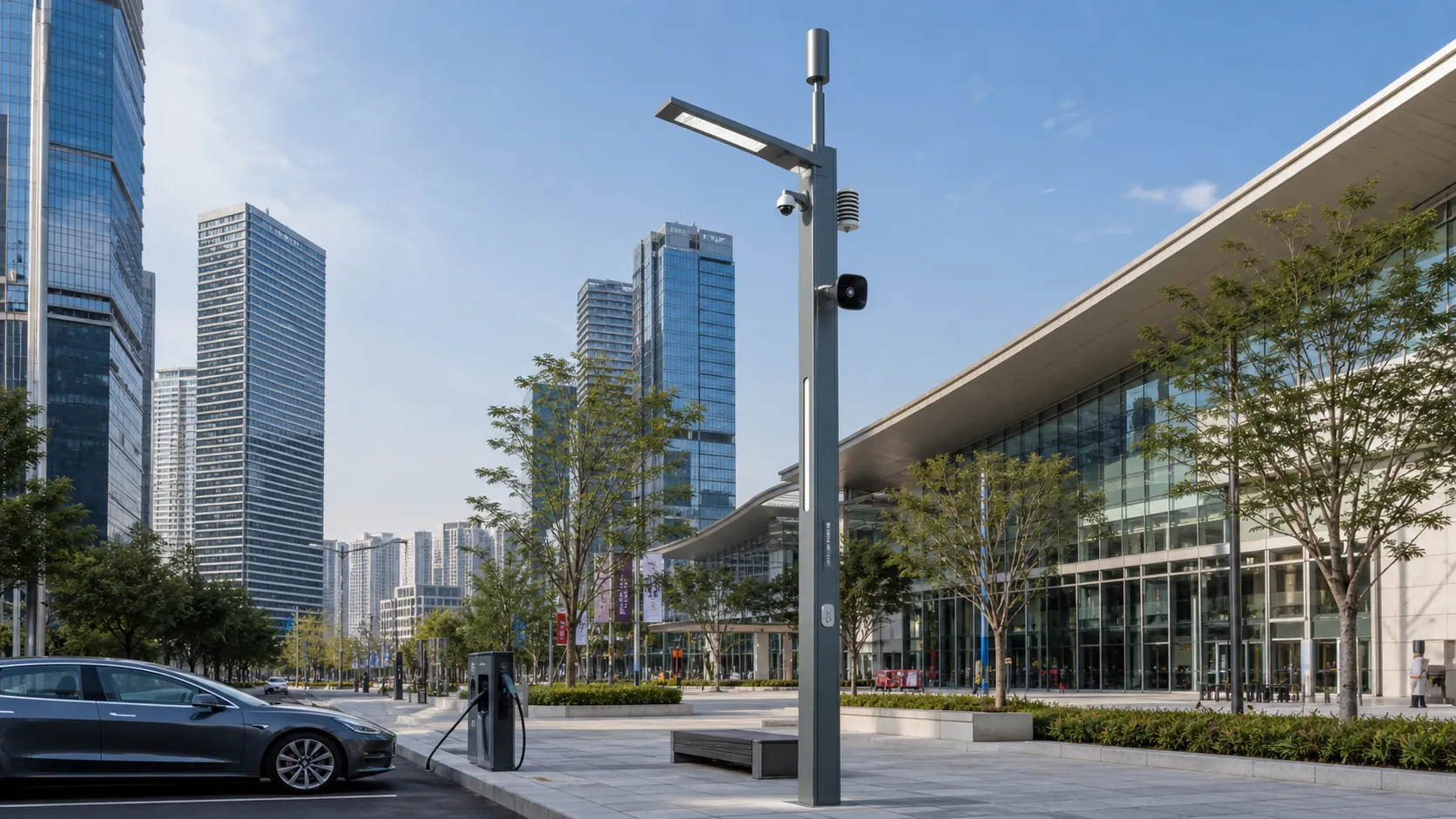
Campuses
Campus IoT for lighting, parking, safety, smart poles, environmental data and facility maintenance workflows.

Municipalities
Municipal smart city programs for lighting, traffic safety, parking, smart poles and environmental monitoring with one hardware and software partner.
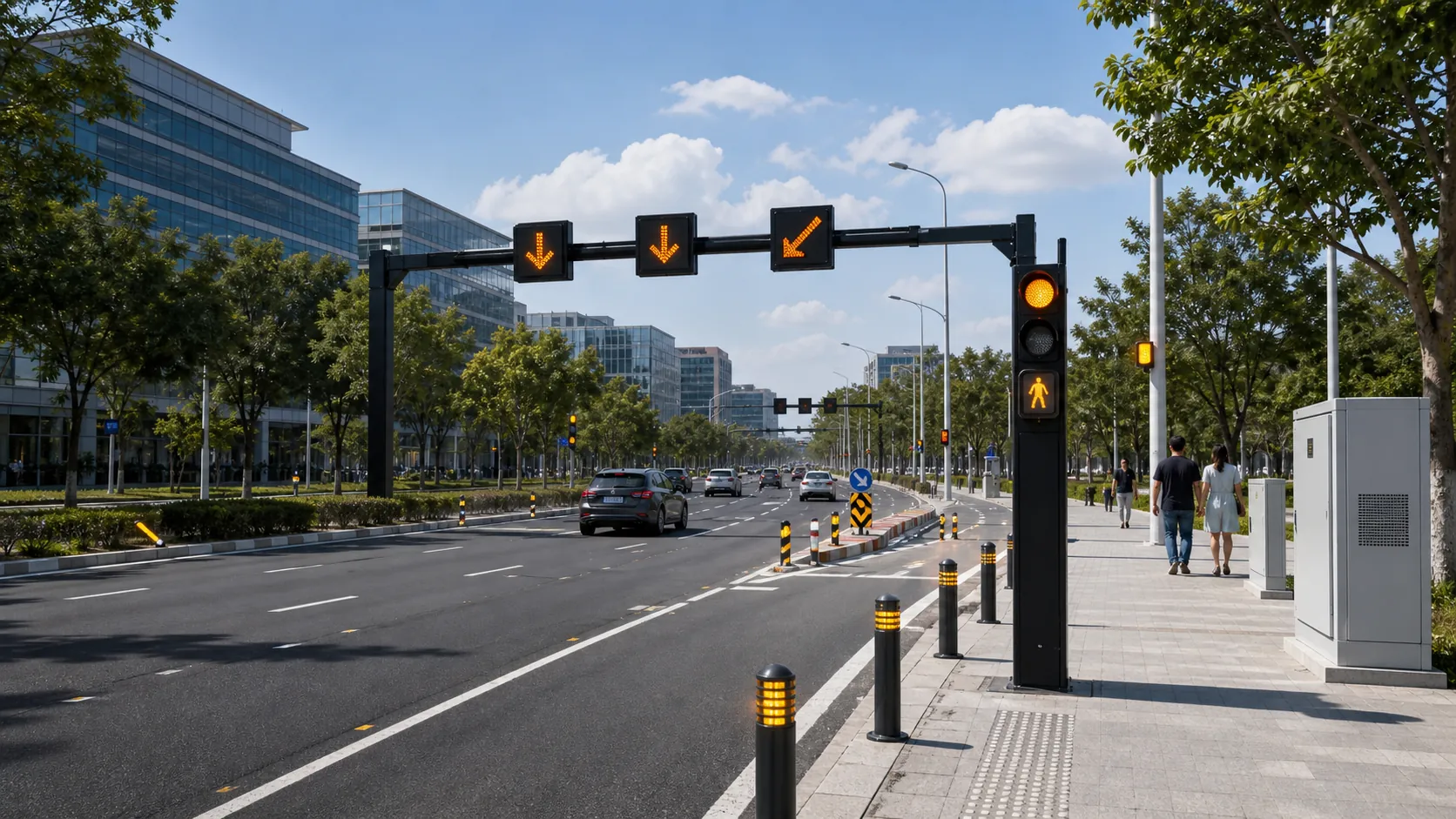
Traffic Safety Checklist
Deployment checklist for connected traffic warning signs, beacons, road guidance devices, power, visibility, monitoring and acceptance tests.
Frequently Asked Questions
What is the difference between Public Address (PA) and Mass Notification System (MNS), and does this solution cover both?
PA handles routine zone paging and announcements; MNS focuses on life-safety alerts such as evacuation, severe weather and CBRN warnings, usually with stricter redundancy and certifications. The RC-MNS-1000 is engineered to cover both on the same IP backbone, with priority arbitration so life-safety messages always pre-empt routine paging.
How does the system stay operational during a power outage?
Every pole node has an integrated LiFePO4 backup battery delivering up to 24 hours of standby or 4 hours of active broadcast at 50 % load. The central Notification Management Server is dual-feed with UPS, and fibre/LTE backhauls support sub-50 ms failover so a single grid or link outage cannot silence the network.
Is the RC-MNS-1000 EN 54-16 compliant for use as a voice alarm in public buildings?
Yes. The platform is engineered to EN 54-16 (control and indicating equipment) and EN 54-24 (loudspeakers), including supervised lines, fault reporting, redundancy class A/B/C options and EN 54-2 interfacing to fire alarm panels. REDCOAST.LTD supplies the documentation and test reports required for local certification.
How is voice intelligibility maintained in noisy environments such as ports, refineries or busy streets?
Each pole has an edge AI ambient-noise sensor that continuously measures background dB(A) and adapts amplifier output to maintain STI ≥ 0.5 at the design radius. Horn cluster geometry, throat angle and equalization are also tuned per site using acoustic modelling so that speech remains intelligible above industrial and traffic noise.
Can the system ingest alerts from a national meteorological or seismic agency automatically?
Yes. The NMS natively ingests CAP v1.2 feeds from meteorological, seismic and civil-protection authorities, plus MQTT and REST APIs from SCADA or third-party systems. A geo-fenced rule engine translates incoming alerts into zone selection, language and pre-recorded message — typically activating broadcast within a few seconds of receipt.
How many languages can be pre-recorded and how are they triggered?
There is no fixed limit on the number of language packs — typical deployments carry 3 to 8. Languages can be triggered manually from the operator console, automatically by zone (assigning a language to each geographic area), or by CAP metadata. REDCOAST.LTD provides professional voice-talent recordings or can integrate the client's own audio assets.
What is the maximum coverage range per pole, and how do I plan the spacing between poles?
Effective voice range per pole varies from about 300 m for a single-horn 200 W node to roughly 1500 m for a 1000 W quad-horn cluster under quiet conditions. REDCOAST.LTD performs acoustic modelling for each project using ODEON or CATT to recommend pole spacing that maintains the target SPL and STI even at the worst-case ambient noise level.
Can REDCOAST.LTD customise horn configurations for hazardous areas such as refineries or LNG terminals?
Yes. The RC-MNS-1000 is offered with ATEX / IECEx certified horn driver options for Zone 1 and Zone 2 hazardous areas, intrinsically safe wiring practices and stainless steel hardware. We also provide cybersecurity hardening, SIL-rated interfaces to safety instrumented systems and multilingual evacuation packs for multinational workforces typical of oil, gas and petrochemical sites.