Overview
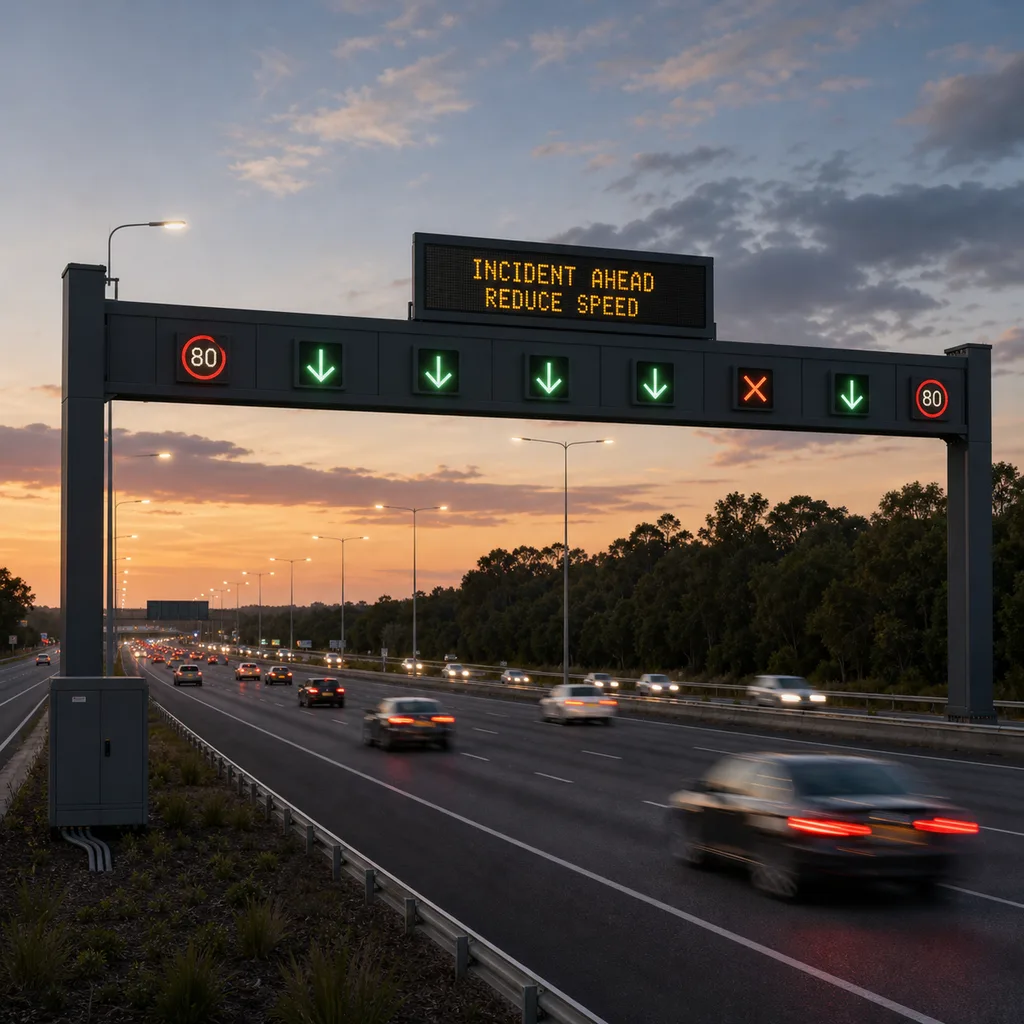
The REDCOAST.LTD RC-LUMS-3000 is a grid-powered, overhead-mounted Lane Use Management System (LUMS) and Active Traffic Management (ATM) gantry for motorways, expressways, urban ring roads and tunnel approach zones. Mounted as a cantilever, half-portal or full-portal steel structure that spans all running lanes, the gantry combines per-lane Lane Control Signals (LCS) — red X, green down-arrow, amber diagonal merge arrow — with a central full-matrix Dynamic Message Sign (DMS) and lane-side Variable Speed Limit (VSL) signs. A single NTCIP 1203-compliant edge controller orchestrates the entire gantry, executes local fallback strategies during link loss, and interfaces northbound to the Traffic Management Centre (TMC) over fibre. The whole platform is engineered around REDCOAST.LTD's own LCS LED driver PCB, DMS pixel-tile driver PCB, VSL controller PCB, gantry edge controller PCB and LiFePO4 UPS power-management PCB — meaning every electronic block can be tuned to the project's mast geometry, climate, electrical code and TMC protocol stack without rebuilding the system from third-party black boxes.
LUMS/ATM gantries are the backbone of modern smart-highway programmes worldwide: they enable hard-shoulder running, dynamic lane closures during incidents, queue-end protection, work-zone management, harmonised variable speed limits, and pre-tunnel safety messaging — all driven by data from CCTV, radar, AID (automatic incident detection) and weather inputs. RC-LUMS-3000 brings that capability as a fully integrated, end-to-end deliverable from one vendor.
Key Features
- Per-lane LCS over every running lane with high-brightness red X, green down-arrow, amber merge arrows, fully NEMA TS 4 / EN 12966 class P3/L3/R3 compliant.
- Central full-matrix DMS (amber or full-colour RGB) for text, graphics, pictograms and multi-line messages, driven by REDCOAST.LTD's own pixel-tile driver PCB.
- Variable Speed Limit (VSL) discs alongside each LCS panel for legally enforceable harmonised speed regulation.
- NTCIP 1201 / 1203 v3 edge controller with full MIB exposure to ATMS, plus proprietary fallback for legacy TMCs.
- LiFePO4 UPS with autonomy of 4–12 hours sized per project; managed by an in-house battery management PCB with cell-level monitoring.
- Auto-dimming based on ambient lux sensors so signs stay legible by day and don't glare drivers at night.
- Hot-swappable LED tiles — pixel modules can be replaced from the gantry walkway without dropping the sign.
- Detection-ready I/O: integrates radar, video AI incident detection, inductive loops or lidar straight into the edge controller.
- Hardened cabinet with active thermal management, surge protection up to Class B + C, EMC tested for highway noise.
- Web management platform + maintenance mobile app (Android/iOS) for asset status, sign content workflow, fault tickets and field engineering.
Technical Architecture
Each gantry is a self-contained edge node in the smart-highway network. At the heart sits the RC-LUMS-EC1 edge controller PCB, an industrial Linux-RT board (quad-core ARM Cortex-A55, 4 GB RAM, eMMC + redundant SD) running a deterministic scheduler that arbitrates between TMC commands and local rules. It implements the NTCIP 1201/1203 v3 stack, SNMPv3 management, NTP/PTP synchronisation across the gantry chain, and a deterministic local fallback engine: if the fibre to the TMC drops, the controller can hold the last validated sign plan or switch to a pre-loaded incident plan, ensuring drivers are never left in front of dark or contradictory signs.
Lane Control Signals are driven by the RC-LCS-D1 LED driver PCB, a constant-current multi-channel driver that supports symbolic (red X / green arrow / amber arrow) panels and full-matrix RGB panels interchangeably, with per-pixel calibration for uniform luminance over the panel's lifetime. The full-matrix DMS uses the RC-DMS-T1 pixel-tile driver PCB with cabinet-level controller-redundancy (active/standby), per-tile heartbeat, pixel-fault reporting back to NTCIP MIB. VSL signs share the same driver platform tuned to the lower pixel count.
Power flows through the RC-PWR-G1 power management PCB: grid AC input → PFC rectifier → 48 V DC bus → LiFePO4 UPS bank with BMS → DC/DC rails for LCS/DMS/VSL/controller. The PCB monitors leakage current, surge events, battery state-of-health and ambient temperature; alarms propagate via SNMP and to the maintenance app. Communications use a primary gigabit fibre uplink to the TMC, with 4G/5G backup and inter-gantry SDH/MPLS-TP ring options.
Connectivity & Power
Primary uplink: single-mode fibre (1 GbE or 10 GbE) to the regional TMC, with optional ring topology so the chain of gantries survives a single fibre cut. Backup: dual-SIM 4G LTE Cat-4 or 5G NSA module. Local I/O: RS-485 (NTCIP), Gigabit Ethernet for cabinet devices, dry contacts for legacy interlocks.
Power: RC-LUMS-3000 is mains-powered (AC 220 V / 110 V, 50/60 Hz). Solar is not the right architecture for high-luminance, multi-lane overhead gantries on built-up motorways — the energy budget is dominated by the LED panels (kW-class peaks) and the gantry sits where utility power is already routed for tolling and lighting. Backup is provided by a LiFePO4 UPS sized 4 / 8 / 12 hours depending on the operator's reliability SLA.
Protection & Reliability
Displays are rated IP66 with reinforced polycarbonate front masks; the equipment cabinet is IP65 with active thermal management (forced-air + heater) qualified for -40 °C to +70 °C ambient. Surge protection is Type 1 + Type 2 on the AC mains and Class D on signal lines per IEC 61643, with separate gas-discharge tubes on the fibre/copper transitions. Structures are hot-dip galvanised steel with a smooth matte powder-coated or fluorocarbon-painted topcoat (custom RAL, typically anthracite grey for highway visual codes), engineered for 45–55 m/s wind loads and seismic zone 3. MTBF target on electronics is >100 000 hours; LED panels rated L80 ≥ 100 000 hours. Standard warranty is 36 months with extended SLA options.
Application Scenarios
- Hard-shoulder running on congested motorways: operators open the emergency lane during peak hours with green arrows + reduced VSL, then close it with red X during incidents.
- Tunnel approach safety zones: pre-tunnel gantries reduce speed limits, close affected lanes after fire/incident detection inside the tunnel, and display pictogram warnings.
- Queue-end protection on expressways: AID-triggered automatic deployment of upstream lane closures and reduced VSL to protect drivers from rear-end collisions at queue tails.
- Work-zone management: pre-programmed work-zone plans on contiguous gantries deliver consistent lane shifts, lower limits and instruction graphics.
- Reversible / contraflow lane operation: morning/evening peak direction reversal on tidal urban arterials and bridge approaches.
- Major-event traffic plans: stadium, airport and port surges executed as TMC-pushed plans with synchronised messaging across multiple gantries.
Case-style Examples
- Expressway hard-shoulder running upgrade: A six-lane (3+3) motorway is fitted with full-portal RC-LUMS-3000 gantries every 800 m over a 12 km congested section. Each gantry carries seven LCS+VSL pairs (six lanes + hard shoulder) and a central P20 amber DMS. The TMC opens the hard shoulder Monday–Friday 07:00–09:30 and 16:30–19:00; the system automatically reverts to closed (red X) outside those hours or on AID incidents. Result: peak-hour throughput increase, evidenced safety reduction at the queue tail.
- Pre-tunnel safety harmonisation: A 4 km road tunnel uses three cantilever gantries on each approach. On smoke/CO detection inside the tunnel, the gantries automatically display a closure pictogram on the affected bore, drop VSL to 40 km/h and route over-height vehicles to the bypass via DMS pictograms — all within 2 s of the detection event.
- Urban ring-road active traffic management: A 24 km urban ring is equipped with 26 half-portal gantries forming a fibre ring. Variable speed harmonisation, lane closures during accidents, and event-day plans for the stadium are pushed from one TMC; the maintenance app gives the highway authority's field crews live fault tickets per gantry.
Customization & Selection Guide
- Gantry structure: cantilever (≤2 lanes), half-portal (≤4 lanes), full-portal (4–8+ lanes). Span and foundation engineered per highway cross-section.
- LCS panel type: symbolic 3-aspect / 4-aspect for cost-optimised projects; full-matrix RGB for projects needing custom pictograms.
- DMS resolution: P16 amber for fast roads with long viewing distances; P20 amber for standard motorway; P20/P16 full-colour RGB for premium urban ATM.
- VSL: EU disc style or MUTCD-style rectangular numerals, sized to road class.
- UPS autonomy: 4 h (typical), 8 h (mission-critical), 12 h (remote sections without rapid utility restoration).
- Communications: fibre-only for new builds; fibre + 4G/5G backup for resilient projects; inter-gantry ring for high-availability corridors.
- Edge AI: optional on-gantry video AI module for AID, queue detection, slow-vehicle alarms — integrates with the same edge controller.
Deployment & After-sales
REDCOAST.LTD delivers the full stack: structural engineering of the gantry, electronics manufacturing, factory acceptance testing (FAT), shipment with all spares, on-site commissioning supervision, TMC protocol integration (NTCIP or proprietary), operator training, web management platform and mobile maintenance app. Typical project lead time is 14–22 weeks from contract depending on gantry count and structural complexity. After-sales is supported by remote diagnostics through the management platform, spare-parts stocking plans, and a maintenance app that turns every site visit into a structured digital workflow with photo evidence and signed completion.
Standards & Compliance
Designed to align with NTCIP 1201 / 1203 v3 (DMS object definitions), NEMA TS 4 (LCS performance), EN 12966 (variable message signs, class P3 / L3 / R3 / C2 / TS3), AASHTO LRFD (gantry structural), CIE 88 (tunnel approach lighting harmonisation), IEC 61643 (surge), IEC 61000-6-4/-6-2 (EMC), IP65/IP66 (enclosures), and CE / RoHS for the European market. Project-specific compliance — for example with Middle East, Latin American or South-East Asian national highway codes — is part of the engineering scope.
Why REDCOAST.LTD
Most LUMS/ATM tenders end up as multi-vendor jigsaws: gantry from a steel fabricator, signs from a sign OEM, controller from a third party, software from a system integrator. REDCOAST.LTD delivers all of it as a single accountable package, because the LCS driver, DMS driver, VSL driver, edge controller and UPS management are our own PCBs — not relabelled modules. That means we can re-pitch the LED, tune the optics for a specific viewing geometry, add an NTCIP object the operator's TMC needs, or harden a board for high-altitude or coastal climates — and we ship the same platform globally, adapted to local electrical codes, languages and compliance environments.
If you are planning a smart-highway corridor, a tunnel-approach safety upgrade, a hard-shoulder-running pilot or a city ring-road ATM programme, talk to REDCOAST.LTD about a tailored RC-LUMS-3000 configuration — we will design the gantry, manufacture the electronics, integrate with your TMC and stand behind the system for its full operating life.
Specifications
Lane Control Signals (LCS)
- Signal Aspects
- Red X / Green down-arrow / Amber diagonal merge arrow / 4-aspect option
- Panel Size (per lane)
- 900 x 900 / 1200 x 1200 mm
- Peak Luminance
- up to 10,000 cd/m²
- Color Uniformity
- ≥ 0.85 (per-pixel calibrated)
- Viewing Distance
- 200–300 m
- Compliance Class
- EN 12966 P3 / L3 / R3 / C2 / TS3, NEMA TS 4
- Auto-Dimming Range
- 1–100 (256 steps via lux sensor) %
Dynamic Message Sign (DMS)
- Pixel Pitch
- P16 / P20 / P25 mm
- Typical Display Area
- 6.0 x 1.5 to 12.0 x 2.4 m
- Resolution (example P20, 6m wide)
- 300 x 75 pixels
- Colors
- Amber monochrome / Full-color RGB
- Peak Luminance
- up to 10,000 cd/m²
- Module Replacement
- Hot-swappable from rear walkway
- Protocol
- NTCIP 1203 v3 + proprietary fallback
Variable Speed Limit (VSL)
- Sign Style
- EU disc 800/1000/1200 mm or MUTCD rectangular
- Display Type
- Full-matrix LED, red ring + white/amber digits
- Speed Range
- 20–130 (configurable per jurisdiction) km/h
- Visibility
- ≥ 250 m
- Compliance
- EN 12966 / Vienna Convention / MUTCD
Gantry Structure
- Configuration
- Cantilever / Half-portal / Full-portal
- Clear Span
- 8–40 m
- Vertical Clearance
- ≥ 5.5 (configurable) m
- Wind Load Rating
- 45–55 m/s
- Material & Finish
- Hot-dip galvanised steel + smooth matte powder-coated or fluorocarbon paint (custom RAL)
- Walkway
- Integrated rear maintenance walkway with fall arrest anchor points
Edge Controller & Communication
- CPU
- Quad-core ARM Cortex-A55 @ 1.8 GHz, 4 GB RAM
- Operating System
- Hardened Linux-RT
- Northbound Protocol
- NTCIP 1201 / 1203 v3, SNMPv3, proprietary fallback
- Primary Uplink
- Single-mode fibre 1 GbE (10 GbE option)
- Backup Uplink
- Dual-SIM 4G LTE Cat-4 / 5G NSA
- Time Sync
- NTP + IEEE 1588 PTPv2 across gantry chain
- Local Fallback
- Hold last validated plan or pre-loaded incident plan on link loss
Power & UPS (Grid)
- Input Voltage
- AC 100–240 (50/60 Hz) V
- Typical Gantry Power Draw
- 3–8 (depends on sign count and dimming) kW
- UPS Chemistry
- LiFePO4 with cell-level BMS
- UPS Autonomy Options
- 4 / 8 / 12 h
- Surge Protection
- Type 1 + Type 2 on AC, Class D on signal lines (IEC 61643)
Protection & Environmental
- Display IP Rating
- IP66
- Cabinet IP Rating
- IP65 with active thermal management
- Operating Temperature
- -40 to +70 °C
- Relative Humidity
- 5–100 (condensing) %
- Salt Mist
- Qualified per IEC 60068-2-52 (coastal option)
- LED Lifetime
- L80 ≥ 100,000 h
Capabilities — configurable per project
Specifications are tailored to each project — the options below show what we can support.
Gantry Type
- Cantilever (≤2 lanes)
- Half-portal (≤4 lanes)
- Full-portal (4–8+ lanes)
- Tunnel-portal variant
LCS Panel
- 3-aspect symbolic
- 4-aspect symbolic
- Full-matrix RGB
DMS Configuration
- P16 amber
- P20 amber
- P20 full-color RGB
- P25 amber long-distance
Communications
- Fibre only
- Fibre + 4G/5G backup
- Fibre ring (inter-gantry)
- MPLS-TP / SDH integration
UPS Autonomy
- 4 h standard
- 8 h mission-critical
- 12 h remote section
Edge AI Add-on
- Video AID (automatic incident detection)
- Queue-end detection
- Slow-vehicle alarm
- Wrong-way driver detection
Related solution guidance
Traffic Safety
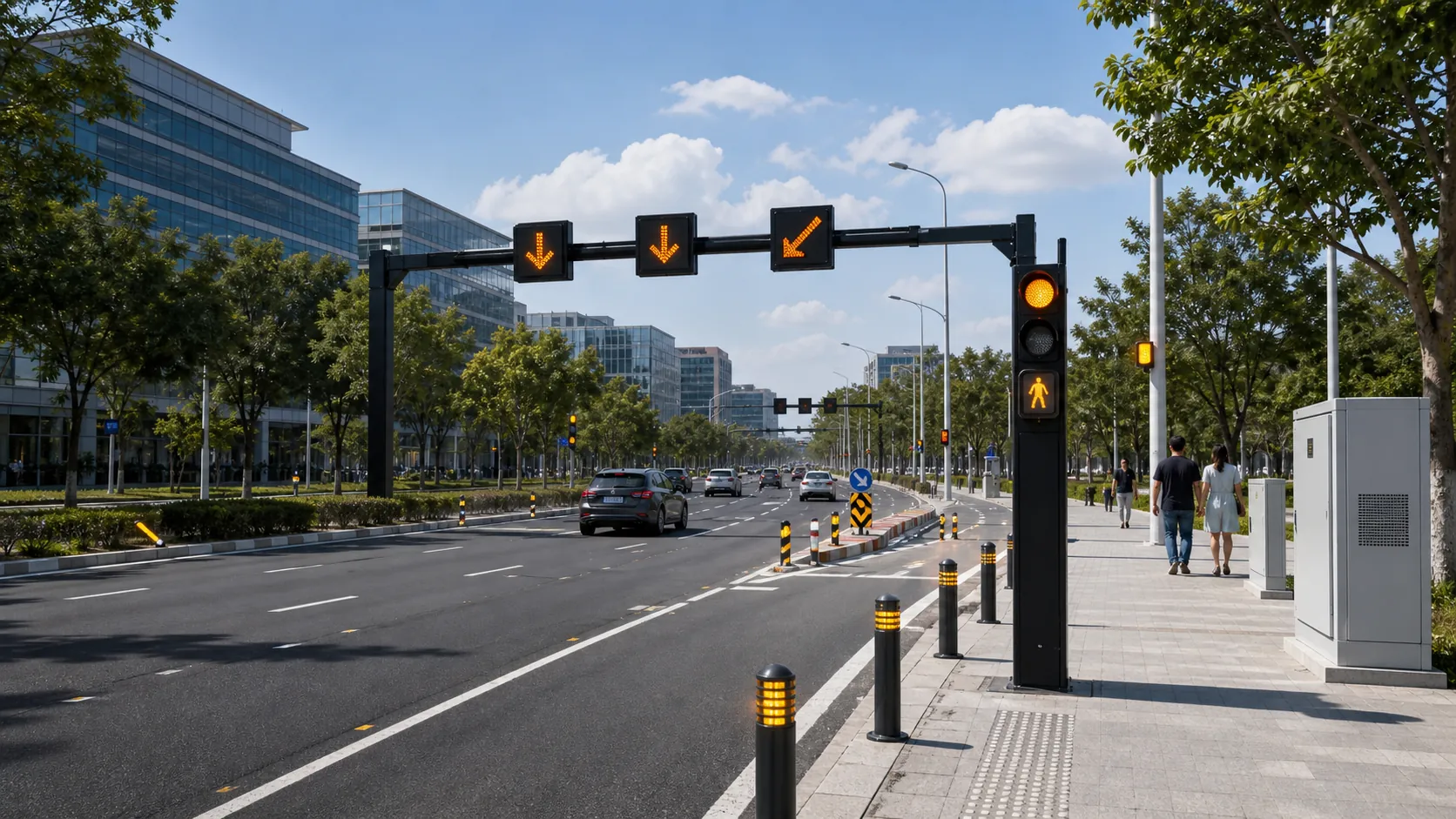
Plan connected traffic safety systems with warning beacons, LED signs, road guidance devices, sensing, control cabinets and monitoring software.
Airports and Hubs
IoT infrastructure for transport hubs: parking guidance, road safety, outdoor lighting, signage, monitoring and operational dashboards.
Solar IoT Guide
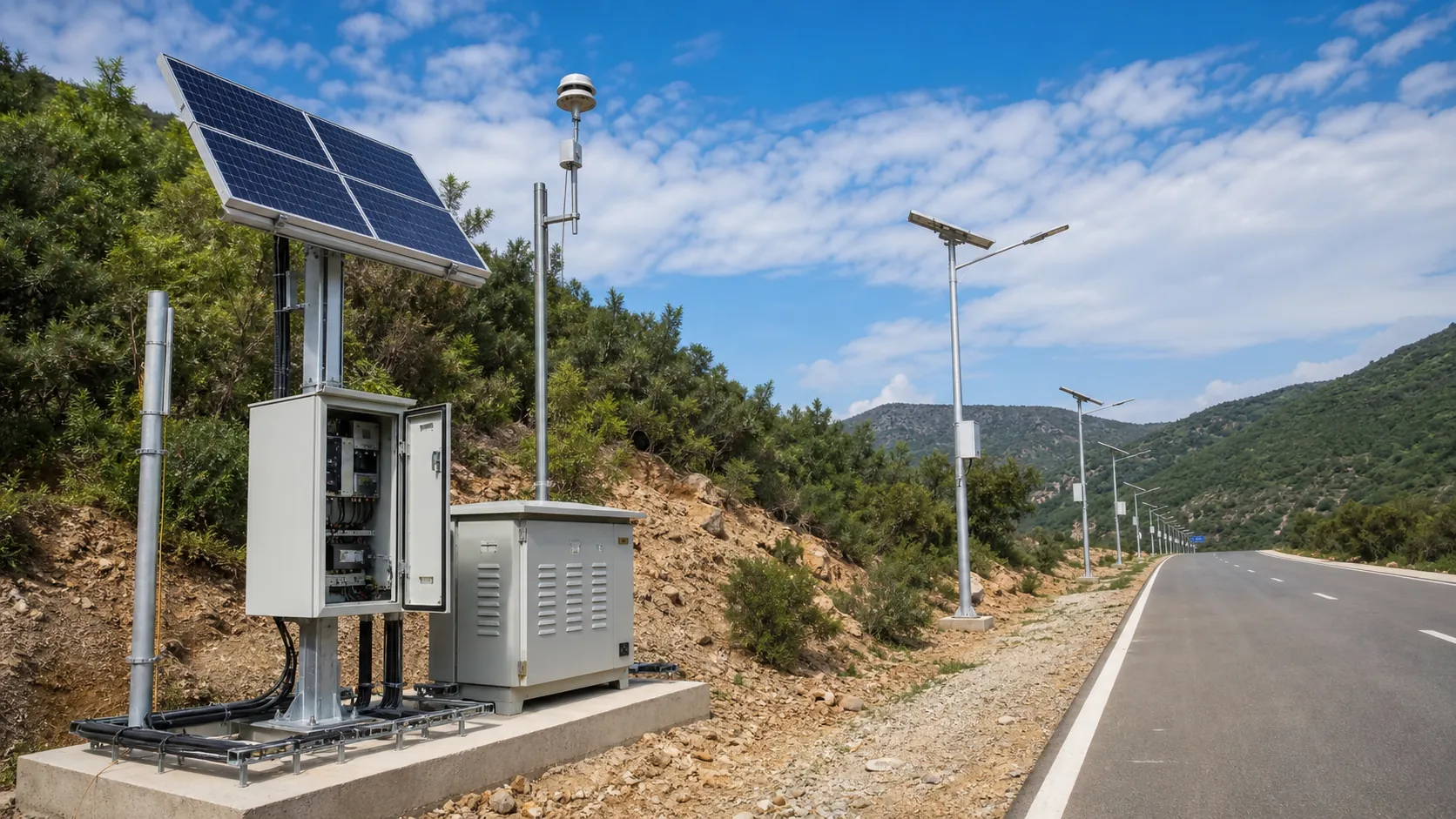
A design guide for solar-powered outdoor IoT: load calculation, battery autonomy, low-power firmware, telemetry and maintenance planning.
Frequently Asked Questions
What is a LUMS / ATM gantry and how is it different from a roadside VMS?
A LUMS/ATM gantry is an overhead steel structure that spans all running lanes of a motorway and carries one Lane Control Signal (red X / green arrow) plus a Variable Speed Limit sign over every individual lane, with a Dynamic Message Sign in the centre. Unlike a single roadside VMS that informs all drivers with one message, the gantry controls each lane separately — closing one lane during an incident while keeping others open, or opening the hard shoulder during peak hours. RC-LUMS-3000 delivers the full gantry, signs, edge controller and TMC integration as one package.
Is the RC-LUMS-3000 compliant with NTCIP and EN 12966?
Yes. The edge controller implements NTCIP 1201 and NTCIP 1203 v3 with full MIB exposure over SNMPv3, and a proprietary protocol fallback is available for legacy TMCs. The LCS, VSL and DMS panels are designed to meet EN 12966 classes P3 / L3 / R3 / C2 / TS3 and align with NEMA TS 4 for LCS performance, so the gantry can be deployed in EU, GCC, ASEAN and Latin American programmes that mandate these standards.
Why is this system grid-powered instead of solar?
An overhead LUMS/ATM gantry on a busy motorway draws 3–8 kW peak across its LED signs and must remain legible day and night, including during incidents. That energy budget is far beyond what a roof-mounted PV array can sustain reliably. Because LUMS gantries are normally installed along motorways that already have utility power for tolling, lighting and CCTV, REDCOAST.LTD uses AC mains as the primary supply and a LiFePO4 UPS for backup, which is the industry-standard architecture for this product class.
How long can the system keep operating during a power outage?
RC-LUMS-3000 ships with a LiFePO4 UPS that provides 4 hours of autonomy as standard, with 8-hour and 12-hour options for mission-critical or remote sections. The battery management PCB monitors cell-level state-of-health and surfaces capacity degradation to the maintenance app, so operators can plan battery replacements before performance drops.
Can the gantry span and lane configuration be customised for our highway?
Yes. RC-LUMS-3000 is offered in cantilever, half-portal and full-portal configurations with clear spans from 8 m to 40 m, supporting 2 to 8+ running lanes. Foundations, wind ratings (45–55 m/s), seismic class and topcoat colour are engineered per project. The number and type of LCS, VSL and DMS panels on each gantry are configured to match the road authority's signing standard.
How does the gantry integrate with our Traffic Management Centre?
The edge controller exposes the gantry as a standard NTCIP 1203 device over a fibre uplink, so most modern ATMS platforms can drive it directly. For TMCs that use proprietary protocols, REDCOAST.LTD provides a protocol adapter and supplies the integration documentation. A local fallback engine ensures the gantry holds a safe pre-loaded plan if the link to the TMC is lost.
What is the typical project lead time and what does REDCOAST.LTD deliver?
Typical lead time is 14–22 weeks from contract signature, depending on gantry count and structural complexity. REDCOAST.LTD delivers structural engineering, all electronics manufacturing, factory acceptance testing, shipment with spares, on-site commissioning supervision, TMC protocol integration, operator training, the web management platform and the field maintenance mobile app — as one accountable package.
Is the system suitable for tunnel approach zones and coastal motorways?
Yes. A tunnel-portal variant is offered for restricted vertical clearance applications, and the system supports automatic actions triggered by tunnel SCADA — for example dropping VSL to 40 km/h and closing the affected bore on smoke/CO detection. For coastal deployments, REDCOAST.LTD qualifies enclosures to IEC 60068-2-52 salt mist, uses marine-grade gasketing, and applies a fluorocarbon-painted finish on the steelwork for extended corrosion life.