Overview
The RC-ORT-G8 is a complete multi-lane free-flow (MLFF) open road tolling (ORT) gantry system engineered by REDCOAST.LTD for modern highway operators, toll concessionaires, transport authorities and PPP infrastructure programs that are phasing out cash booths and moving to barrier-free electronic toll collection. The system identifies, classifies and charges every vehicle passing under the gantry at full highway speed — without lane separation, without slowing traffic and without manual handling. Each gantry combines high-resolution ANPR (Automatic Number Plate Recognition) cameras, DSRC/RFID on-board unit (OBU) readers, laser/radar vehicle classification, lane indication and a hardened roadside lane controller cabinet. All key boards — the ANPR camera control PCB, the DSRC/RFID reader PCB, the laser vehicle profiler signal-conditioning PCB and the multi-lane controller — are designed in-house by REDCOAST.LTD, which means the whole gantry stack can be tailored to a country's tag standard, plate format, lane width and back-office protocol instead of forcing the project to fit an off-the-shelf product.
Key Features
- True multi-lane free-flow capture at speeds from crawl up to 250 km/h, with per-vehicle event records joined across ANPR, OBU and classification sensors.
- REDCOAST-designed ANPR PCB driving 9 MP global-shutter cameras with synchronized white/IR strobe, dual-plate readers (front + rear) and on-board deep-learning plate recognition.
- Standards-ready OBU reading: ISO 14906 / EN 15509 DSRC at 5.8 GHz, plus optional UHF RFID (ISO 18000-6C) and 915 MHz variants — selectable per country.
- Laser + radar vehicle classification for 3D vehicle profile, axle count and height, supporting class-based tariffs (motorcycle, car, light truck, heavy goods, multi-axle).
- Hot-swappable lane controller modules — each lane is an independent slot, so a faulty module can be exchanged in minutes without taking the whole gantry down.
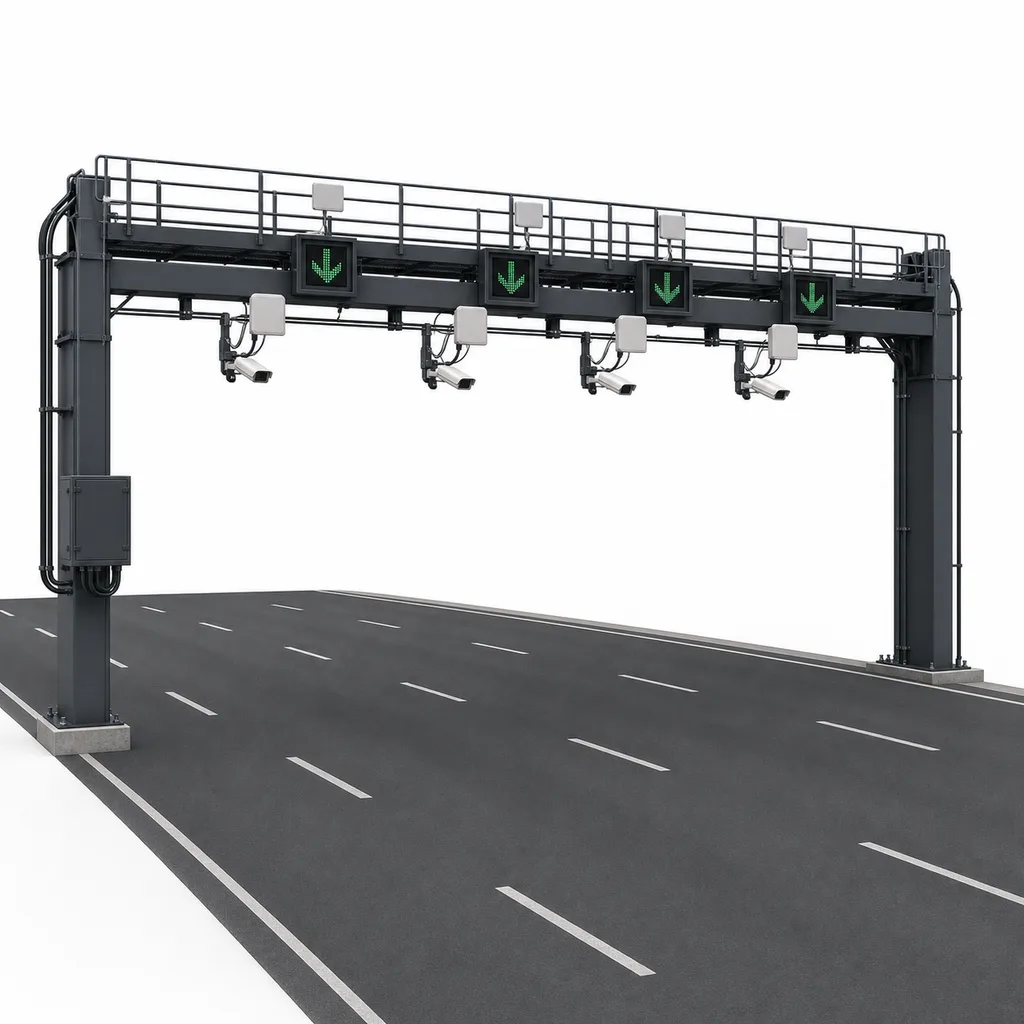
- Overhead lane indication with full-color LED matrix per lane (open / closed / detour / status) driven by a REDCOAST CMS-compatible driver board.
- Edge transaction engine assembles a complete toll event (timestamp, plate text + image, tag ID, vehicle class, lane, GPS) and pushes it to the back office within ~300 ms.
- Designed for IP-everywhere backhaul — fiber, 4G/5G, microwave or all three in redundant configuration.
- Open back-office integration with REST/JSON, MQTT and country-specific tolling protocols, so it slots into existing host systems instead of forcing a rip-and-replace.
Technical Architecture
A RC-ORT-G8 site is built around three layers. The gantry layer is the over-road structure carrying, per lane: one front ANPR camera, one rear ANPR camera, one DSRC/RFID antenna head, one laser scanner pair for 3D profiling and one overhead LED lane indicator. The structure is a powder-coated steel gantry sized to the carriageway width (typically 1–8 lanes).
The roadside lane controller cabinet sits beside the gantry. Inside is a REDCOAST-designed backplane that hosts one lane controller card per lane plus a master fusion controller. Each lane card runs an industrial SoC with our ANPR firmware and time-synchronizes (PTP / IEEE 1588) with the master so that the camera trigger, strobe pulse, DSRC read window and laser profile timestamp can be correlated to better than 1 ms. The master fusion controller stitches per-lane data into a single transaction record, performs cross-checks (e.g. tag-to-plate match), runs local anti-fraud rules and queues transactions for upload. The cabinet also contains the PoE++ camera switch, fiber/SFP termination, an industrial UPS with LiFePO4 backup, and our CMU monitoring PCB that streams door, temperature, voltage and tamper telemetry to the operator NOC.
The central layer is the operator's back office — tolling host, customer service system, enforcement system, financial clearing. RC-ORT-G8 talks to it via REST/JSON over IPsec VPN by default, with country-specific tolling protocol adapters (e.g. CEN TS 17444 family, national e-toll schemas) developed per project.
Connectivity & Power
The gantry is mains-powered: AC 200–400 V three-phase or single-phase input, with onboard surge protection (Type 1+2, 40 kA), galvanic isolation and an industrial UPS giving up to 4 hours of full-load runtime so toll capture continues through short outages. There is no solar option — open road tolling gantries are deployed on built-up highways where utility power is already available and uptime requirements (typically 99.9%+) demand the stability of grid + UPS rather than a solar/battery profile.
Backhaul is selectable per site: single-mode fiber over SFP is the default for trunk-road deployments; dual 4G/5G cellular (multi-carrier, with VPN) is available for sites without fiber; redundant fiber + cellular failover is offered for mission-critical corridors. The local cabinet is a managed L2/L3 island that can keep storing and forwarding transactions even when the WAN drops.
Protection & Reliability
Gantry electronics are rated IP66; the lane controller cabinet is IP55 with active forced-air cooling and heating, operating from -30 °C to +60 °C and tolerating 95% RH. Steel is hot-dip galvanized for corrosion base plus a smooth matte powder-coated topcoat (typically RAL 7016 anthracite or RAL 9016 traffic white). The roadside cabinet has a tamper switch, door alarm and CMU board monitoring. MTBF for the lane controller card is targeted ≥80,000 hours and modules are hot-swappable, so corrective maintenance does not require lane closure of the whole gantry.
Application Scenarios
- Existing toll plazas being converted to free flow, where lanes are reopened to traffic by removing booths and installing a gantry overhead — cuts congestion and accident rates at the toll point.
- New greenfield expressways and ring roads designed from day one with no physical toll plaza, only ORT gantries every section.
- Cross-border / inter-regional toll corridors that need to interoperate with multiple tag schemes (DSRC + RFID) on the same gantry.
- Urban congestion charging cordons around city cores, where the gantry charges vehicles entering a zone during defined hours.
- Truck-only road user charging (RUC) corridors where heavy goods vehicles are charged per kilometer, requiring strong vehicle classification.
- Bridge and tunnel tolling where space for a plaza does not exist and overhead capture is the only viable form factor.
Case-style Examples
- Expressway toll plaza removal project (8-lane bi-directional). The operator wanted to demolish two cash plazas and run the corridor barrier-free. REDCOAST.LTD delivered two RC-ORT-G8 gantries with 8 lanes each, DSRC at 5.8 GHz matching the country's existing OBUs, and 9 MP dual ANPR per lane for non-tag enforcement. Travel time across the section dropped notably during peaks and rear-end collisions at the old plaza were eliminated.
- Greenfield expressway ORT deployment (multi-section). A new highway concession used RC-ORT-G8 as the only tolling point along the route. Configuration: fiber backhaul, redundant 4G failover, laser + radar classification for 6 vehicle classes, and integration with the concessionaire's existing customer service host via REST.
- Urban low-emission zone enforcement cordon. A municipality used a stripped-down RC-ORT-G8 (ANPR-only, no DSRC) on slim single-lane gantries around the city core to read every entering plate and feed an emission-class enforcement back end.
Customization & Selection Guide
- Lane count: 1–8 lanes per gantry; for ≥6 lanes we typically recommend splitting into two cabinets for redundancy.
- Tag technology: pick DSRC 5.8 GHz if the country already uses ETSI EN 12253-class OBUs; pick UHF RFID if the program uses passive sticker tags; pick both for cross-border corridors.
- Classification depth: laser-only is enough for 3-class tariffs; laser + radar is recommended for 5+ classes or axle-based heavy-vehicle tariffs.
- Backhaul: fiber for trunk roads, dual cellular for remote sections, redundant fiber + cellular for mission-critical corridors.
- Enforcement integration: optional rear ANPR + driver-side camera package for legal evidence packages where the country requires it.
Deployment & After-sales
REDCOAST.LTD delivers the gantry as a turnkey package: site survey, civil drawings, foundation design, gantry fabrication and powder coating, electronics integration, factory acceptance test (FAT), shipping, on-site installation supervision, commissioning, site acceptance test (SAT) and operator training. Lead times for a standard 4-lane gantry are typically 10–14 weeks ex-works after design freeze. After commissioning, customers receive remote NOC monitoring tooling, firmware update channels and a tiered support contract (8×5, 24×7 with on-call, or full O&M).
Standards & Compliance
- DSRC: ISO 14906, EN 15509, ETSI EN 12253 / 12795
- Tolling interoperability: CEN/TS 17444 family, ISO 17575 reference where applicable
- RFID: ISO/IEC 18000-6C (EPC Gen2)
- Cameras and image evidence: ANPR accuracy validated per project to local enforcement criteria
- Electrical: IEC 61000 (EMC), IEC 60529 (IP), IEC 60068 (environmental), CE / RoHS
- Cabinet: IP55 active cooling per IEC 62208
Why REDCOAST.LTD
REDCOAST.LTD designs the lane controller, the ANPR PCB, the DSRC/RFID reader board, the laser classification signal conditioner and the LED lane indicator driver in-house. That means when a country needs a non-standard plate format, a national tolling protocol variant, a custom tag scheme, a particular vehicle class table or a back-office that nobody else has heard of, we change firmware and PCB — not shipping schedules. Hardware, web management platform and operator mobile app come from one team, so a project lands as one accountable end-to-end delivery rather than a stack of vendor handoffs.
Talk to us with your concession map, lane count, existing tag scheme and back-office protocol — REDCOAST.LTD will return a tailored RC-ORT-G8 configuration, civil and electrical drawings and a project timeline.
Specifications
ANPR Cameras & Vision
- Resolution per Camera
- 9 MP
- Sensor
- Global-shutter CMOS
- Shutter Speed
- 1/2000 - 1/20000 s
- Vehicle Speed Range
- 0 - 250 km/h
- Plate Read Accuracy (clean plate, day/night)
- >=98 %
- Cameras per Lane
- Front + Rear (optional driver-side)
- Illumination
- Synchronized white + IR strobe
OBU / Tag Reader
- DSRC Standard
- ISO 14906 / EN 15509 / ETSI EN 12253
- DSRC Frequency
- 5.795 - 5.815 GHz
- RFID Option
- ISO/IEC 18000-6C UHF (860 - 960 MHz)
- Tag Read Range
- up to 30 m
- Reads per Second per Lane
- >=200
- Antenna per Lane
- 1 (optional 2 for cross-traffic)
Vehicle Classification
- Sensor Type
- Dual laser scanner + 77 GHz radar
- Profile Resolution
- <=20 mm
- Classes Supported
- 2 - 9 (configurable)
- Axle Detection
- Yes (optional in-pavement loops)
- Height Accuracy
- +-30 mm
Lane Controller & Computing
- Architecture
- Per-lane card + master fusion controller
- Lanes per Gantry
- 1 - 8
- Time Sync
- PTP IEEE 1588 (<1 ms)
- Transaction Latency to Back Office
- <=300 ms
- Local Storage
- 1 - 4 TB SSD
- Hot-Swappable
- Yes (per-lane card)
Connectivity & Backhaul
- WAN
- Fiber SFP / 4G / 5G / Microwave
- Cellular
- Dual SIM, multi-carrier
- Protocols
- REST/JSON, MQTT, IPsec VPN, country tolling protocols
- LAN
- Managed L2/L3 with PoE++
Power (Grid)
- Input Voltage
- AC 200 - 400 (1ph or 3ph) V
- Frequency
- 50 / 60 Hz
- Power Consumption per Gantry
- 600 - 1800 W
- UPS Backup (LiFePO4)
- up to 4 h
- Surge Protection
- Type 1+2, 40 kA
Enclosure & Protection
- Gantry Electronics IP
- IP66
- Roadside Cabinet IP
- IP55 active cooling
- Operating Temperature
- -30 to +60 deg C
- Humidity
- 5 - 95 (non-condensing) %RH
- Finish
- Hot-dip galvanized + smooth matte powder coat (RAL 7016 / 9016)
- Tamper / Door Alarm
- Yes (CMU board)
- MTBF (Lane Card)
- >=80000 h
Capabilities — configurable per project
Specifications are tailored to each project — the options below show what we can support.
Lane Count per Gantry
- 1 lane
- 2-4 lanes
- 5-8 lanes
Tag Technology
- DSRC 5.8 GHz (ISO 14906 / EN 15509)
- UHF RFID (ISO 18000-6C)
- DSRC + RFID dual
Vehicle Classification
- Laser only (3 classes)
- Laser + radar (5-7 classes)
- Laser + radar + in-pavement loops (9 classes, axle)
Backhaul
- Fiber SFP
- Dual 4G/5G
- Fiber + cellular redundant
- Microwave
Enforcement Package
- ANPR only
- ANPR + driver-side evidence camera
- ANPR + overview context camera
Related solution guidance
Traffic Safety Checklist
Deployment checklist for connected traffic warning signs, beacons, road guidance devices, power, visibility, monitoring and acceptance tests.
Traffic Safety
Plan connected traffic safety systems with warning beacons, LED signs, road guidance devices, sensing, control cabinets and monitoring software.
Power and Connectivity
How to choose power, battery, solar, NB-IoT, LTE, LoRaWAN, gateways and monitoring strategy for outdoor IoT infrastructure.
Frequently Asked Questions
What is multi-lane free-flow (MLFF) open road tolling?
MLFF, also called open road tolling (ORT), is a barrier-free electronic toll collection method where an overhead gantry identifies, classifies and charges every vehicle at full highway speed without lane separation or physical barriers. It replaces traditional toll plazas, eliminates queues and reduces accidents at the toll point.
How accurate is the RC-ORT-G8 license plate recognition?
Under normal conditions with clean plates, the dual 9 MP ANPR cameras with synchronized white/IR strobe achieve >=98% read accuracy day and night, including at highway speeds up to 250 km/h. Final accuracy is tuned per country plate format during commissioning.
Does the gantry support both DSRC and RFID on-board units?
Yes. The reader head can be configured as ISO 14906 / EN 15509 DSRC at 5.8 GHz, UHF RFID (ISO 18000-6C) at 860-960 MHz, or both simultaneously. This is important for cross-border corridors that need to accept tags from multiple tolling schemes.
Can RC-ORT-G8 integrate with our existing back-office tolling host?
Yes. The gantry talks to the back office via REST/JSON and MQTT over IPsec VPN by default, and REDCOAST.LTD develops country-specific tolling protocol adapters per project so the gantry fits the existing host rather than forcing a host replacement.
What happens during a power or network outage?
The roadside cabinet includes a LiFePO4 UPS that keeps the gantry capturing transactions for up to 4 hours on grid loss, and the lane controller stores and forwards transactions locally (1-4 TB SSD) when the WAN is down, syncing automatically once connectivity returns.
How many lanes can one gantry cover?
A single RC-ORT-G8 gantry covers 1 to 8 lanes. For sites with 6 or more lanes we recommend splitting the lane controllers across two cabinets so that a cabinet-level fault still leaves part of the carriageway operational.
How long does deployment of one gantry take?
A standard 4-lane gantry is typically 10-14 weeks ex-works after design freeze and FAT, plus site civil works and on-site installation/commissioning supervised by REDCOAST.LTD engineers. Greenfield highway programs are usually planned in batches of gantries along the corridor.
Can the gantry be used for urban congestion charging or low-emission zones?
Yes. A stripped-down configuration with ANPR only (no DSRC/RFID, no laser classification) on slim single-lane gantries is commonly deployed around city cores to enforce congestion charges, low-emission zones or restricted-access cordons.