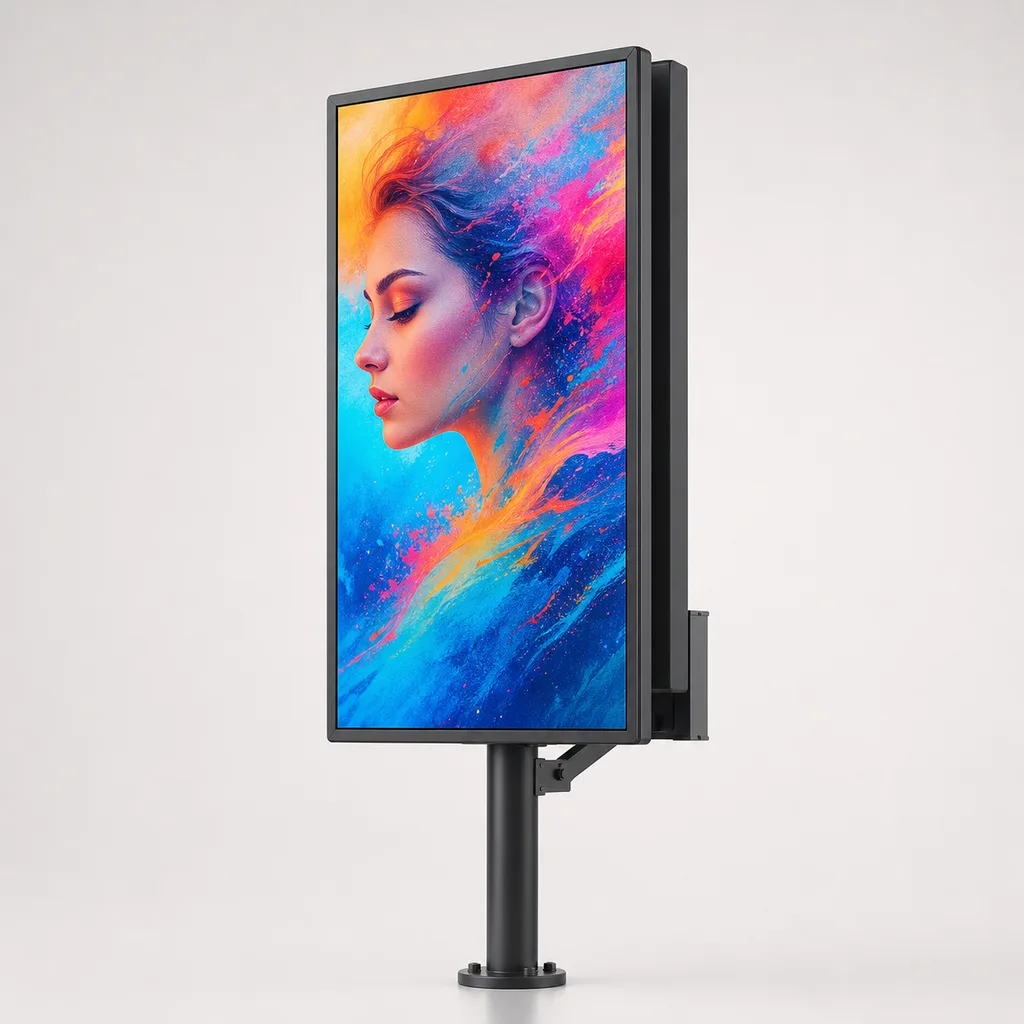
Overview
The REDCOAST.LTD RC-DOOH-800 is a grid-powered outdoor full-color LED digital signage and Digital-Out-Of-Home (DOOH) advertising display engineered for permanent installation across cities, transport hubs, retail streets, campuses and stadiums. It is a complete solution — high-brightness LED cabinets, an in-house-designed driving and receiving-card electronics stack, redundant multimedia playback controllers, and a cloud Content Management System (CMS) with a companion mobile app — delivered and integrated by one team. Unlike a monochrome traffic Variable Message Sign, a transit passenger information board, or an interactive touch kiosk, the RC-DOOH-800 is a dedicated high-refresh, high-brightness full-color canvas for animated advertising, public campaigns, wayfinding and live event content, remotely managed at fleet scale. It solves the core pain points of outdoor screens: sunlight readability, energy cost, weather survivability, uptime, and the operational headache of updating dozens of screens across a city.
Key Features
- Sunlight-readable brightness up to 10,000 nits with automatic ambient-light dimming, so content stays crisp at noon and comfortable at night without light-pollution complaints.
- Full pixel-pitch range from P2.5 close-range street furniture to P10 highway-scale, letting one product family serve pedestrian, mid-range and long-throw viewing distances.
- In-house LED driving and receiving-card PCBs with 16-bit grayscale, ≥3,840 Hz refresh and low-brightness/high-grayscale calibration for flicker-free camera capture and smooth video.
- Front- and rear-service die-cast aluminum cabinets for fast module swap in tight pole or wall installations, cutting maintenance time and lane closures.
- Redundant playback with dual controllers and offline caching — content keeps playing through a network outage and fails over automatically.
- Cloud CMS + mobile app for scheduling, playlists, dayparting, proof-of-play logs, remote brightness/temperature monitoring and multi-screen grouping.
- Energy-saving power architecture with common-cathode/energy-saving driver options reducing consumption by 20–30% versus conventional outdoor screens.
- IP66 front / IP65 rear protection with conformal-coated boards for coastal, humid, dusty and high/low-temperature climates.
- Modular scalability — cabinets tile seamlessly into any width/height, from a single pole banner to a full billboard array.
- Integration-ready for smart-pole platforms, environmental sensors, cameras and emergency public-notification override.
Technical Architecture
The RC-DOOH-800 is built from standardized die-cast aluminum cabinets, each populated with modular LED tiles carrying SMD or GOB-encapsulated lamps. Behind each module sits a REDCOAST.LTD-designed driving PCB and a receiving card that decode the incoming video stream, apply per-pixel brightness/chroma calibration, and drive the LEDs with constant-current PWM at high refresh. Cabinets connect to a sending/processing controller (video processor) that ingests HDMI, DVI or network video, performs scaling, color management and low-latency mapping, and distributes frames over Cat-class cabling or fiber to the receiving cards. A dedicated multi-media playback engine (Android/x86 media player options) stores scheduled content locally and plays it even when the WAN link drops, synchronizing back to the cloud when connectivity returns.
Control and data flow on two planes: the media/video plane (content, playlists, live feeds) and the management/telemetry plane. An onboard controller board — also a REDCOAST.LTD design — aggregates ambient-light-sensor readings, cabinet temperature/humidity, fan/door status, power-supply health and smoke/tamper inputs, then reports over 4G/5G or wired Ethernet to the CMS. Automatic brightness follows a light-sensor curve so the screen ramps down at dusk and to a night minimum, protecting drivers and neighbors from glare while saving energy. Edge logic handles local scheduling, emergency-message override (CAP-style public alerts can pre-empt advertising instantly), and watchdog-based auto-recovery of the playback engine.
Connectivity & Power
Communication is chosen per deployment: wired Gigabit Ethernet or fiber for fixed billboards and campus networks; integrated 4G/5G modems for standalone poles and roadside screens; Wi-Fi for temporary or event setups. All screens roll up into a single cloud CMS regardless of transport, so a mixed fleet is managed from one dashboard and app.
Because the RC-DOOH-800 is designed for urban roads, plazas, transit hubs, retail frontages and campuses — locations with reliable grid coverage — it is mains-powered and does not use solar panels. It accepts AC 100–277 V, 50/60 Hz single phase (three-phase distribution for large billboard arrays), with industrial-grade redundant power supplies, surge protection and per-cabinet fusing. Typical average power density is 250–350 W/m² with a maximum around 600–800 W/m² at full white/peak brightness; energy-saving driver options and daylight-adaptive dimming keep the running cost low. An optional maintenance UPS keeps controllers and telemetry alive through short grid dips so the CMS never loses visibility of the screen.
Protection & Reliability
Cabinets are die-cast aluminum with a smooth matte powder-coated finish for corrosion resistance and a clean architectural appearance. The display face is rated IP66 and the rear IP65, with a fully sealed front mask, waterproof connectors and conformal-coated electronics for salt-fog, humidity, dust and driving rain. The operating range is -30 to +60 °C with thermostatically controlled ventilation or optional air conditioning for hot climates. LED lamps are rated for 100,000 hours to 50% brightness, and hot-swappable modules plus front/rear service access keep any single-point failure to a fast module replacement rather than a screen-down event. Wind-load-rated mounting brackets and steel structures are engineered per site for pole, wall and freestanding installations.
Application Scenarios
- City-center DOOH advertising: Pole- and wall-mounted screens on retail streets and plazas run rotating advertising campaigns with dayparting and audience-triggered content, generating municipal or operator revenue.
- Transport hubs and mobility: Concourse and forecourt screens at bus stations, metro entrances, airports and ferry terminals blend advertising with public information and emergency notices.
- Campus and stadium: University, corporate-park and sports-venue screens show wayfinding, event schedules, live feeds and safety messaging on one managed platform.
- Retail and commercial frontage: Shopping-mall entrances and showroom facades use high-brightness screens for promotions and live social content visible in direct sun.
- Public information and civic messaging: Municipalities push wayfinding, weather, air quality and civic campaigns, with instant override for emergency alerts.
- Roadside and gateway billboards: Large P8/P10 arrays at city gateways and highway approaches deliver long-throw advertising and public-service messages.
Case-style Examples
City-center smart-pole DOOH network: A city deploys a network of P4 pole-mounted portrait screens along a shopping avenue. REDCOAST.LTD configured 6,000-nit modules with light-sensor auto-dimming to satisfy night light-pollution limits, wired the poles to a campus fiber ring, and delivered a CMS with proof-of-play reporting so the advertising concession could bill by verified impressions. The operator now schedules city-wide campaigns and civic messages from one app.
Transit terminal information-and-advertising wall: A bus-rapid-transit terminal needed one screen wall for both advertising and service information, with instant emergency override. A front-service P3.91 array was integrated with the terminal's public-address and alert system so a CAP-style emergency message pre-empts all content within seconds, then restores the advertising loop automatically.
Stadium gateway billboard: A sports venue required a large sunlight-readable billboard at its main gateway. REDCOAST.LTD supplied a 10,000-nit P8 array on a wind-load-rated steel structure with redundant three-phase power and dual controllers, so match-day live feeds and sponsor content run without interruption.
Customization & Selection Guide
Start with viewing distance to pick pixel pitch: P2.5–P4 for pedestrian street-level screens (4–15 m), P5–P6.67 for mid-range commercial billboards (15–40 m), and P8–P10 for gateway and highway-scale displays (50 m+). Choose brightness by exposure — 6,000 nits for shaded/urban canyons, 8,000–10,000 nits for direct-sun and highway sites — always with auto-dimming to control night glare and energy. Select cabinet size and mounting (pole clamp, wall bracket, or freestanding steel structure) per structural survey and wind zone. For coastal or industrial air, specify GOB encapsulation and reinforced conformal coating. Add the maintenance UPS, air-conditioned cabinets, camera/sensor integration or emergency-override module as the site demands. REDCOAST.LTD tunes the driving electronics, power sizing and structure to the exact project.
Deployment & After-sales
Deployment covers site and structural survey, wind-load-rated bracket/steel design, power and network provisioning, cabinet assembly, calibration and CMS commissioning. Front- or rear-service configuration is selected by access constraints. REDCOAST.LTD provides remote monitoring, spare-module stocking, firmware and CMS updates, and responsive technical support, with training for the operator's content and maintenance teams. Because the hardware and software are developed in-house, issues are resolved at board and platform level rather than bounced between vendors.
Standards & Compliance
Engineered toward CE (EMC, LVD), RoHS, IP66/IP65 (IEC 60529), FCC where required, and IEC/EN safety and photobiological (IEC 62471) references, with energy-efficiency-oriented driver design. Structural and wind-load design follows applicable local codes. The platform adapts to diverse climate, grid (100–277 V, 50/60 Hz) and regulatory environments worldwide.
Why REDCOAST.LTD
REDCOAST.LTD delivers an end-to-end solution — hardware, web management platform and mobile app — integrated by one team, backed by genuine in-house engineering: we design and fabricate our own LED driving and receiving-card PCBs and control electronics (custom PCB per project), so the whole screen is controllable and deeply customizable rather than assembled from black-box parts. That means we tune brightness curves, power sizing, refresh, calibration, mounting and CMS features to your exact site and regulations.
Contact REDCOAST.LTD to specify a custom outdoor LED digital signage and DOOH display for your city, campus or transit project.
Specifications
Display & Optical
- Pixel Pitch Options
- P2.5 / P3.91 / P4.81 / P6.67 / P8 / P10 mm
- Peak Brightness
- 6,000-10,000 nits
- Brightness Adjustment
- 0-100 auto (ambient light sensor), 256 levels %
- Refresh Rate
- ≥3,840 Hz
- Grayscale
- 16 bit
- Color Temperature
- 3,200-9,300 adjustable K
- Viewing Angle (H/V)
- 140 / 140 °
- Contrast Ratio
- 5,000:1
Cabinet & Mechanical
- Cabinet Material
- Die-cast aluminum, powder-coated
- Cabinet Size Options
- 960×960 / 1000×1000 / 1000×500 mm
- Cabinet Depth
- 80-120 mm
- Weight
- 35-45 kg/m²
- Service Access
- Front and/or rear (module hot-swap)
- LED Encapsulation
- SMD / GOB
- LED Lifespan
- 100,000 (to 50% brightness) h
Video Processing & Control
- Video Inputs
- HDMI / DVI / SDI (optional) / Network
- Max Resolution per Processor
- up to 3.9 million (10.4M optional) px
- Playback Engine
- Android / x86 media player, dual redundant
- Local Content Cache
- 32-256 GB
- Processing Latency
- <1 (frame-accurate) frame
- Calibration
- Per-pixel brightness & chroma
Connectivity & Management
- Wired
- Gigabit Ethernet / Fiber
- Cellular
- 4G / 5G (integrated modem)
- Wireless
- Wi-Fi 2.4/5 GHz
- CMS
- Cloud web platform + mobile app
- Telemetry
- Brightness, temp/humidity, fan, door, power, proof-of-play
- Emergency Override
- CAP-style alert pre-emption
Power (grid)
- Input Voltage
- AC 100-277 (single/three-phase for large arrays) V
- Frequency
- 50 / 60 Hz
- Average Power Density
- 250-350 W/m²
- Max Power Density
- 600-800 W/m²
- Power Supply
- Redundant industrial PSU, per-cabinet fusing
- Surge Protection
- Class II/III SPD
- Maintenance UPS
- Optional (controllers & telemetry)
Protection & Environmental
- IP Rating (front / rear)
- IP66 / IP65
- Operating Temperature
- -30 to +60 °C
- Operating Humidity
- 10-95 non-condensing %RH
- Board Treatment
- Conformal coating (salt-fog/humidity)
- Thermal Management
- Thermostatic fans / optional A/C
- Wind Load
- Structure engineered per site
Capabilities — configurable per project
Specifications are tailored to each project — the options below show what we can support.
Pixel Pitch
- P2.5
- P3.91
- P4.81
- P6.67
- P8
- P10
Mounting
- Pole clamp
- Wall bracket
- Freestanding steel structure
Service Access
- Front service
- Rear service
Connectivity
- Gigabit Ethernet
- Fiber
- 4G/5G
- Wi-Fi
Options
- Air-conditioned cabinet
- Maintenance UPS
- Camera/sensor integration
- Emergency-override module
Related solution guidance
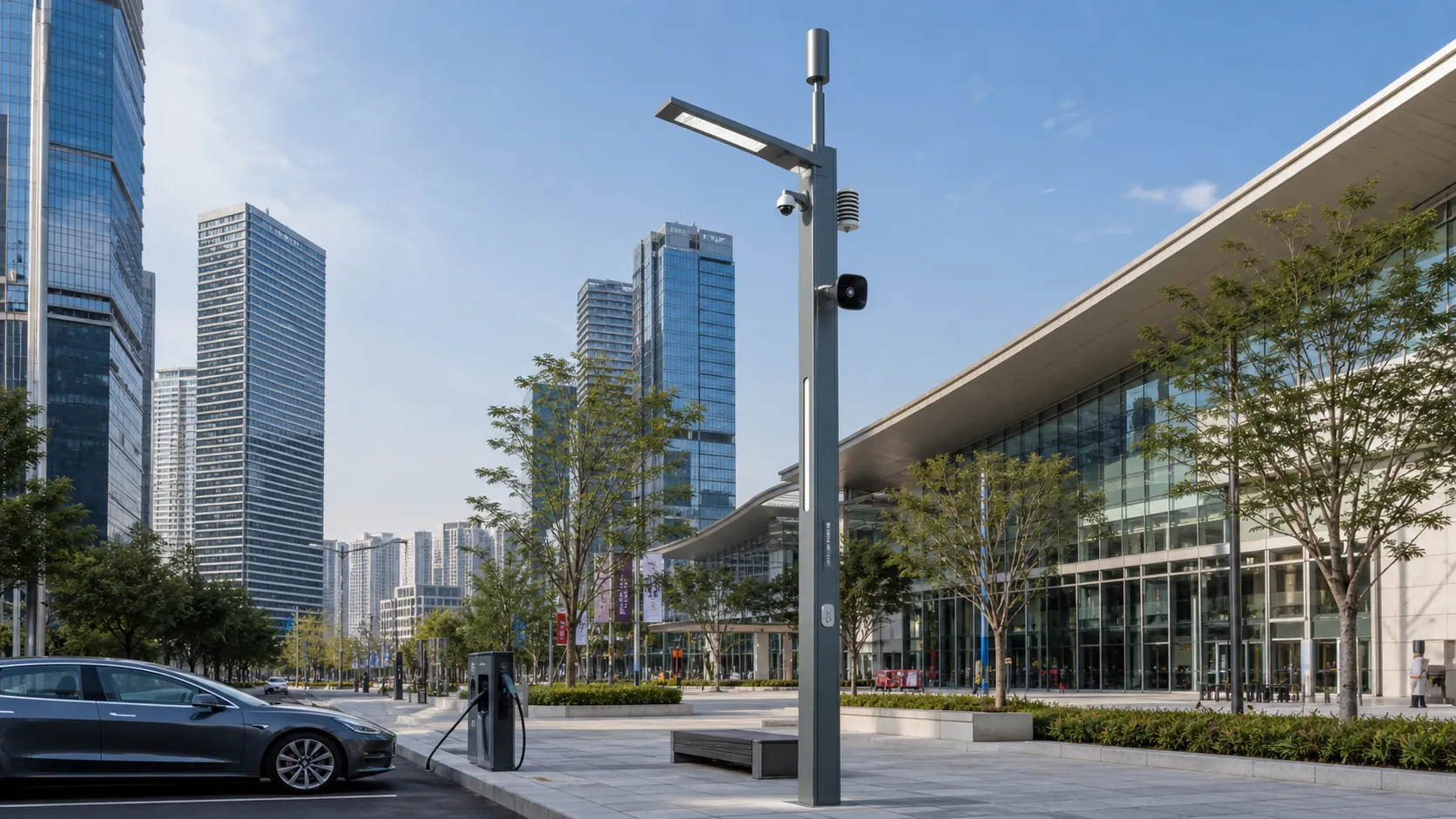
Campuses
Campus IoT for lighting, parking, safety, smart poles, environmental data and facility maintenance workflows.
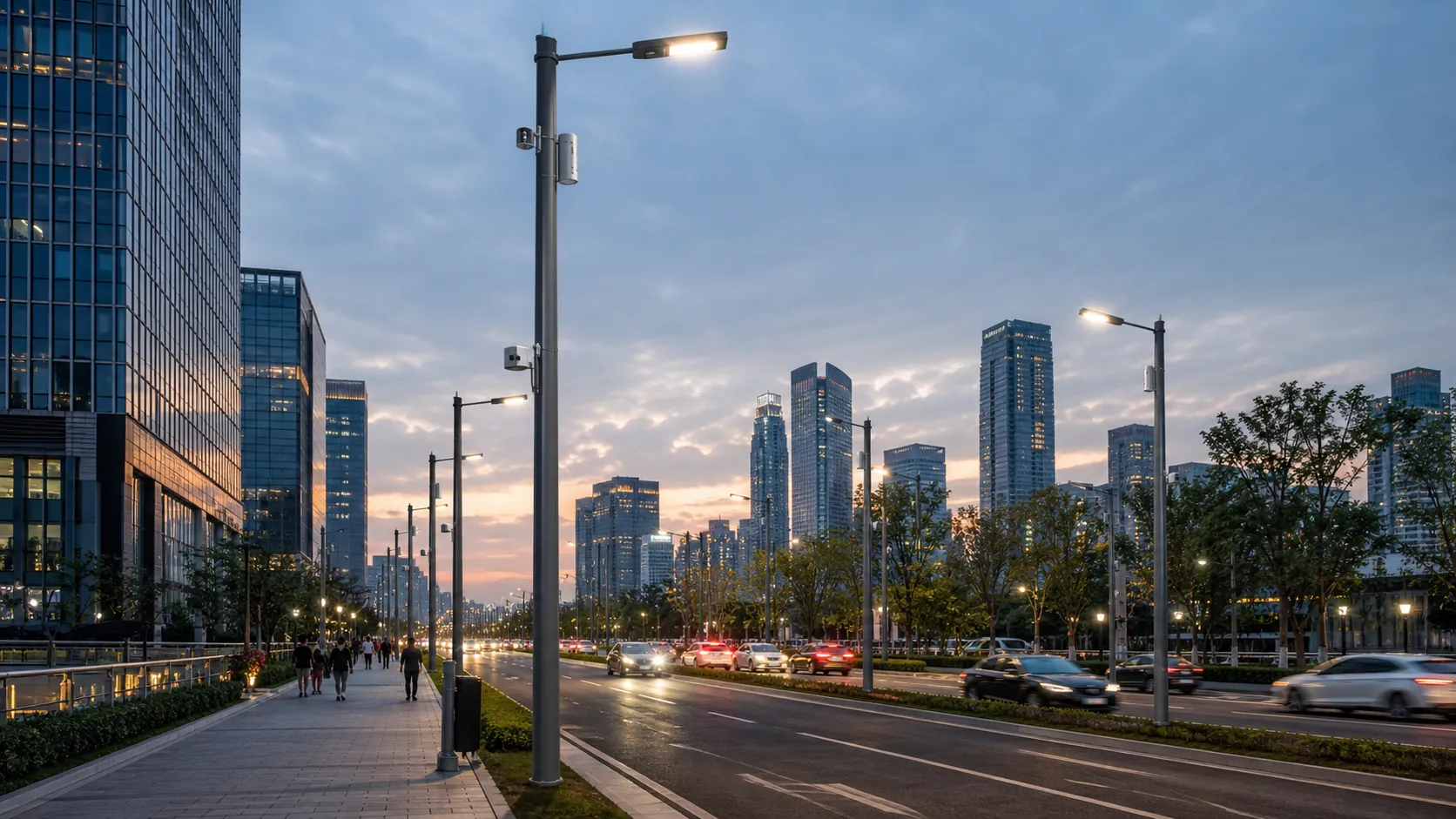
Municipalities
Municipal smart city programs for lighting, traffic safety, parking, smart poles and environmental monitoring with one hardware and software partner.
Smart Pole
Build smart pole infrastructure with lighting, cameras, environmental sensors, communication modules, public safety devices and a unified management platform.
Frequently Asked Questions
How bright does an outdoor LED advertising display need to be?
For direct sunlight and highway sites, 8,000–10,000 nits is recommended; 6,000 nits suits shaded urban streets. The RC-DOOH-800 reaches up to 10,000 nits with automatic ambient-light dimming, staying readable at noon and glare-free at night while saving energy.
What pixel pitch should I choose for a street-level versus billboard display?
Pick pitch by viewing distance: P2.5–P4 for pedestrian street-level screens (4–15 m), P5–P6.67 for mid-range commercial billboards (15–40 m), and P8–P10 for gateway or highway-scale displays (50 m+). REDCOAST.LTD offers the full range in one product family.
Is the display solar-powered or grid-powered?
The RC-DOOH-800 is designed for urban roads, plazas, transit hubs and campuses with reliable grid coverage, so it is mains-powered (AC 100–277 V) and does not use solar panels. Energy-saving drivers and auto-dimming keep running costs low; an optional UPS protects controllers during grid dips.
How is content managed across many screens?
All screens roll up into one cloud CMS with a mobile app, regardless of whether they use Ethernet, fiber, 4G/5G or Wi-Fi. Operators schedule playlists, use dayparting, group screens, monitor brightness and temperature, and pull proof-of-play logs from a single dashboard.
What weather protection does the display offer?
The face is IP66 and the rear IP65, with sealed connectors, conformal-coated boards and a -30 to +60 °C operating range. GOB encapsulation and reinforced coating are available for coastal, humid or dusty environments, and thermostatic cooling or air conditioning handles hot climates.
Can advertising content be overridden for emergency alerts?
Yes. The playback engine supports CAP-style emergency override that instantly pre-empts advertising with civic or safety messaging, then automatically restores the normal content loop. It can integrate with public-address and mass-notification systems.
How is the screen serviced and how long do the LEDs last?
Cabinets support front and/or rear service with hot-swappable modules, so a fault is a quick module replacement rather than a screen-down event. LED lamps are rated for 100,000 hours to 50% brightness, and dual redundant controllers keep content playing during a network outage.
What makes REDCOAST.LTD different from a screen reseller?
REDCOAST.LTD designs its own LED driving and receiving-card PCBs and control electronics (custom PCB per project) and delivers the full solution — hardware, web platform and mobile app — as one integrated team, so brightness, power, calibration, mounting and CMS features are tuned to your exact site and regulations.