Overview
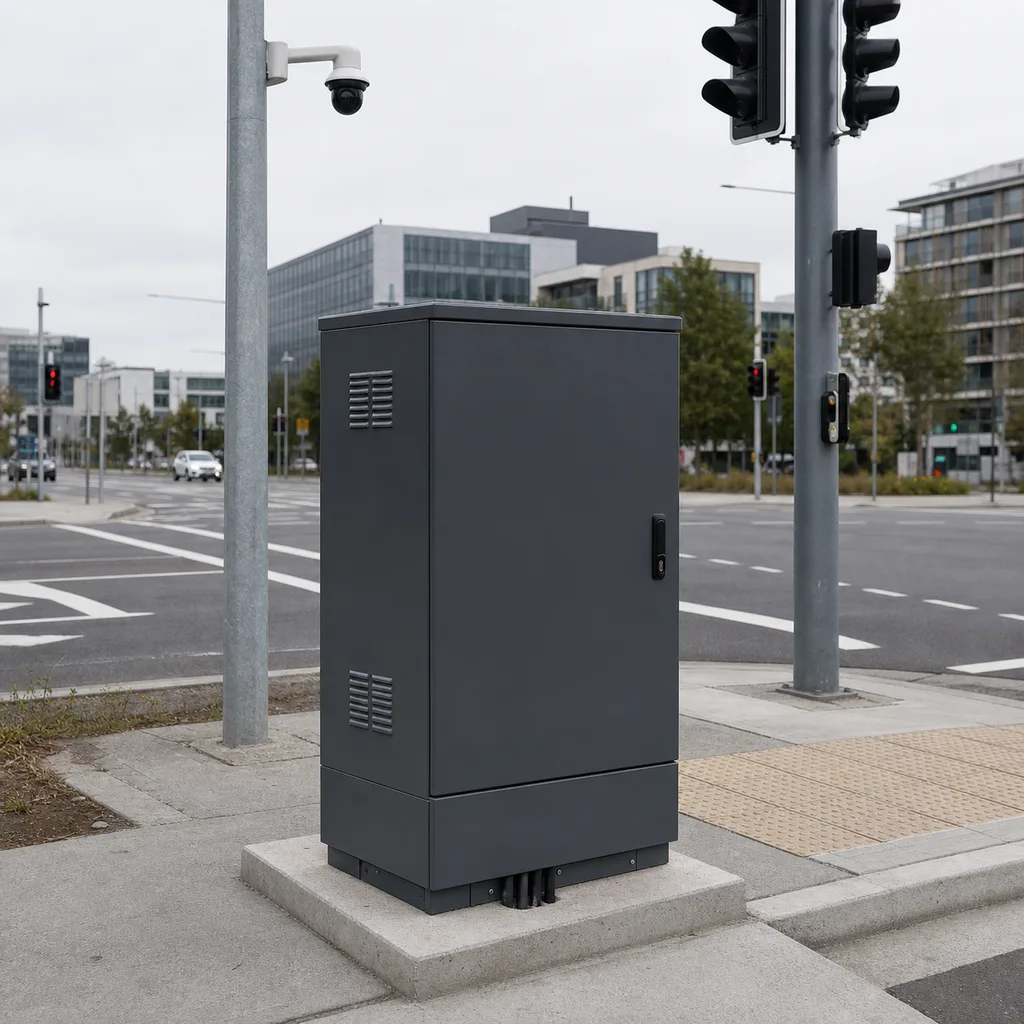
The REDCOAST.LTD Grid-Powered Outdoor Smart Edge Cabinet is a 19-inch roadside field enclosure purpose-built to host the brains of a modern smart city. Every signal controller, edge server, 5G small-cell baseband, NVR, network switch and IoT gateway needs a hardened outdoor home — and that home is exactly what RC-CAB-700 provides. Engineered around an IP55 double-skin steel shell, active thermal management, an integrated LiFePO4 UPS and a fully self-developed Cabinet Monitoring Unit (CMU) PCB, the cabinet is the silent infrastructure layer that lets traffic engineers, mobile operators, video-surveillance integrators and smart-pole platform owners deploy reliable kerbside equipment from city centres to industrial parks. Every unit ships configured for the project's specific climate, load profile, communication protocols and installation surface.
Key Features
- IP55 / NEMA 3R double-skin outdoor enclosure with thermal-isolated inner door, controlled airflow path and salt-spray-resistant powder-coat finish
- Standard 19-inch rack mounting with selectable 24U / 36U / 47U usable height and 600 / 800 / 1000 mm depth
- Active thermal management options: variable-speed inverter air-conditioner (1.0–2.5 kW cooling) or air-to-air heat exchanger (40–80 W/K), switchable by climate zone
- Integrated rack-mount online double-conversion UPS (1–5 kVA) with hot-swappable LiFePO4 battery cassette delivering 30–120 min of backup
- Dual-zone architecture: equipment compartment electrically and thermally isolated from the battery / power compartment to extend battery life
- Self-developed Cabinet Monitoring Unit PCB with door, smoke, water-leak, temperature, humidity, tilt and AC mains telemetry over SNMPv3, Modbus, MQTT, REST and NTCIP
- Surge-protected AC mains distribution with Type 1+2 SPD (40 kA / 20 kA Iimp/In), residual-current detection and per-outlet remote switching
- Triple-point anti-vandal locking with mechanical key plus optional electronic / NFC smart lock for audited site access
- Pad-mount, pole-mount or wall-mount installation kits with seismic and wind-load engineered bases
- Lightning earthing bar, 50 mm² ground bus and sealed gland-plate cable entries for fibre, copper and AC
Technical Architecture
At the heart of every RC-CAB-700 sits the REDCOAST.LTD Cabinet Monitoring Unit (CMU) — a fully self-developed PCB that supervises every electrical, thermal and security event in the enclosure. The CMU exposes 16 to 32 dry-contact inputs for door, smoke, water and tamper sensors, eight analog channels for PT100 temperature and 4–20 mA humidity transducers, and four to eight relay outputs that drive fan banks, heater elements, lockable outlets and audible alarms. A second-generation IoT gateway block on the same PCB speaks SNMPv3, Modbus TCP/RTU, MQTT, REST and NTCIP 1201 / 1218, so the cabinet drops directly into existing network management systems, SCADA and smart-city platforms without a translator gateway.
Mains power enters through a service disconnect, passes a Type 1+2 surge protection device and is metered by a custom AC distribution PCB with per-circuit current measurement and remotely switchable outlets. A 1–5 kVA online double-conversion UPS module lives in the lower battery compartment, isolated by an insulated thermal partition that keeps the LiFePO4 cassette inside its optimal 15–35 °C window even when the upper compartment is running hot under heavy compute load. The thermal management subsystem — either an inverter air-conditioner with PID temperature regulation or a passive air-to-air heat exchanger for mild climates — keeps the equipment compartment between 5 °C and 35 °C across ambient swings from -40 °C to +60 °C.
Connectivity is built around dual SFP fibre uplinks, four RJ45 Gigabit Ethernet ports, and optional always-on 4G LTE Cat-6 or 5G NR sub-6 GHz modems for out-of-band management. Telemetry — temperature curves, door-open events, mains failures, UPS battery state, lock audit trails — is published live to the operator's NMS or smart-city platform and stored on a 32 GB microSD ring buffer for forensic review. Firmware on the CMU is dual-bank with rollback so remote updates over the cellular path cannot brick a field asset.
Connectivity & Power
RC-CAB-700 is a grid-powered product designed for urban and peri-urban kerbside, intersection, smart-pole-base, substation and tunnel-portal deployments where mains supply is already available — usually tapped from a street-lighting feeder, a low-voltage substation lateral or a building-side panel. Single-phase AC 100–240 V or three-phase 380 / 415 V input is supported. Because every cabinet sits under existing LV infrastructure, no solar array is fitted; ride-through of grid outages is handled by the on-board LiFePO4 UPS, not by photovoltaic generation. For communications, customers choose any combination of fibre SFP, copper Ethernet, 4G LTE Cat-6, 5G NR sub-6 GHz, RS-485 / RS-232 to legacy traffic controllers, plus optional LoRa 868 / 915 MHz and Bluetooth 5.2 for clustered IoT sensors around the cabinet site.
Protection & Reliability
The enclosure is fabricated from 2.0 mm cold-rolled steel with a hot-dip galvanised primer and a smooth matte polyester powder-coat top finish in RAL 7035 light grey or RAL 7016 anthracite — engineered to survive coastal salt spray, desert UV, tropical humidity and -40 °C winters. IP55 ingress protection and NEMA 3R compliance keep wind-driven rain, sand and airborne dust out, while the double-skin construction creates a thermal break that reduces solar heat gain by up to 35 % compared with single-skin cabinets. The CMU monitoring PCB is qualified to MTBF in excess of 200 000 h, the LiFePO4 battery cassette is rated for ≥6 000 cycles at 80 % depth-of-discharge, and the inverter air-conditioner compressor is hermetically sealed for ten-year maintenance-free service. Every cabinet ships with a five-year structural warranty and a three-year electronics warranty.
Application Scenarios
- Roadside traffic-signal cabinet: replaces aging single-skin signal cabinets at urban intersections, hosting NEMA TS-2 / NTCIP signal controllers, conflict monitors and edge AI vehicle-detection appliances while delivering remote door, temperature and UPS telemetry to the city traffic management centre.
- 5G small-cell aggregation hub: houses the baseband unit, fronthaul switch, timing source and power-supply units for a cluster of small-cell radios mounted on adjacent smart poles, with cooling sized for continuous high-load operation.
- Smart-pole cluster controller: anchors a cluster of REDCOAST.LTD multifunctional smart poles by providing a single managed switching, power-distribution and edge-compute point, simplifying maintenance and metering.
- Tunnel and BRT surveillance NVR housing: provides a sealed, vibration-tolerant home for NVRs, encoders, fibre patch panels and edge analytics servers at tunnel portals or rapid-transit stations.
- Smart-parking edge-computing node: aggregates parking-bay sensors, ANPR cameras and LED count-board controllers for a parking lot or kerbside zone, with rugged backup for ticketing continuity during outages.
- Substation IoT gateway and protection cabinet: turns legacy unmonitored LV substations into observable assets by hosting a protocol gateway, environmental sensors and a remote-controllable distribution PCB.
Case-style Examples
Urban arterial intersection cluster upgrade. A mid-size city replaces fifty legacy traffic-signal cabinets at busy arterial intersections. Each new RC-CAB-700 is delivered preconfigured at 24U depth-600, with a 1.5 kW inverter air-conditioner, a 2 kVA UPS and a 60-minute LiFePO4 cassette, NTCIP 1218 over fibre to the traffic management centre and the existing TS-2 controller pre-fitted at the factory. Site teams swap the old cabinet out and the new one in inside a two-hour traffic window, and the central NMS sees the new asset come online before the road opens.
5G small-cell aggregation along a transit corridor. A mobile operator densifying coverage along a busy avenue chooses 36U RC-CAB-700 units at every fourth pole, each fitted with a 2.5 kW air-conditioner, a 5 kVA UPS and a 90-minute battery cassette. The cabinets aggregate fronthaul from four small-cell radios per site, deliver -48 V DC and AC outlets to baseband modules, and stream environmental telemetry back to the network operations centre, where predictive maintenance flags compressor degradation weeks before failure.
Smart parking edge processing for a logistics park. An industrial-park operator rolling out smart kerbside parking deploys 24U RC-CAB-700 units at three zones, each housing an edge analytics server, a PoE++ switch driving ten ANPR cameras and an LED count-board controller. The integrated UPS keeps ticketing and gate control alive during 30-minute brownouts, and the CMU's remote door-open alarm has already prevented two attempted thefts of edge servers since commissioning.
Customization & Selection Guide
Five questions drive cabinet selection. First, how much rack space is needed? A 24U cabinet fits one signal controller, one switch and a small UPS; 36U is the sweet spot for traffic, surveillance and 5G aggregation; 47U is required for multi-radio small-cell hubs or larger edge data centres. Second, what is the local climate? Coastal and tropical sites take air-conditioner cooling and stainless-steel hardware; temperate sites can use heat exchangers; cold sites add door heaters and battery-compartment warming. Third, how long must the load survive a mains outage? Order the LiFePO4 cassette in 30, 60, 90 or 120-minute autonomy, sized for the actual load. Fourth, what installation surface? Concrete pad with cast-in anchor bolts, pole-mount kit with stainless-steel straps, wall-mount bracket or street-furniture pedestal. Fifth, what management plane? SNMPv3 for telco NOCs, Modbus TCP for SCADA, MQTT or REST for cloud platforms, NTCIP 1201 / 1218 for transport authorities. REDCOAST.LTD configures the CMU firmware accordingly before shipment.
Deployment & After-sales
Each cabinet is preassembled, factory-wired and burned-in for 48 hours before shipment, with every rack unit, cable harness and SPD labelled to match the project drawings. REDCOAST.LTD provides full mechanical, electrical, foundation and earthing documentation, plus a project-specific commissioning checklist. Standard lead time from order confirmation is typically 4–6 weeks for catalog configurations and 6–10 weeks for heavily customised builds. Onsite installation is performed by the customer's local civil contractor following REDCOAST.LTD method statements, or by a REDCOAST.LTD field team for landmark projects. After commissioning, the cabinet self-registers to the customer's NMS and to REDCOAST.LTD's optional cloud monitoring service, where remote firmware updates, health analytics and predictive maintenance alerts are delivered for the life of the asset. Spare parts — fan trays, SPD modules, smart locks, battery cassettes, A/C units — are stocked for next-business-day shipment worldwide.
Standards & Compliance
- Enclosure & ingress protection: IEC 60529 IP55, NEMA 3R, IEC 62208 (empty enclosures for LV switchgear)
- Environmental testing: IEC 60068-2-1 / -2 / -30 / -52 (cold, dry heat, damp heat, salt mist)
- Electrical safety: IEC 62368-1, IEC 60950 (as applicable)
- EMC: EN 55032 Class A, EN 61000-6-2
- Surge protection: IEC 61643-11 Type 1+2
- UPS classification: IEC 62040-3 VFI-SS-111 (online double-conversion)
- Markings: CE, RoHS, REACH; UKCA, RCM and FCC available on request
Why REDCOAST.LTD
REDCOAST.LTD is a smart-IoT solution provider that designs its own PCBs end-to-end — so every RC-CAB-700 ships with PCBs that REDCOAST.LTD designed, manufactured and firmware-developed in-house: the Cabinet Monitoring Unit, the AC distribution and metering board, and the smart-lock controller. That means buyers get a single accountable supplier, true protocol-level customisation (need NTCIP 1218 instead of generic SNMP, a private MQTT topic schema or a bespoke Modbus map? we re-flash the CMU rather than asking an OEM), and rapid field fixes when a new traffic controller, switch or radio joins the standard load list. The cabinet also plugs straight into REDCOAST.LTD's wider smart-pole, smart-lighting, surveillance and IoT-platform portfolio, so the same engineering team can deliver the cabinet and what goes inside it as one coherent solution.
Talk to REDCOAST.LTD about your next smart-city, traffic, telecom or smart-pole field-cabinet project — share your equipment list, climate zone, communication protocol and lead-time target, and we will come back with a tailored configuration and competitive quotation within five working days.
Specifications
Enclosure
- Material
- 2.0 mm cold-rolled steel, hot-dip galvanised primer
- Finish
- Smooth matte powder coat, RAL 7035 / 7016 (custom available)
- Ingress Protection
- IP55 / NEMA 3R
- Rack Capacity
- 24 / 36 / 47 U
- Depth Options
- 600 / 800 / 1000 mm
- Door Configuration
- Double-skin front + rear, triple-point lock
- Wind Load Rating
- ≤ 45 m/s
- Salt-Spray Resistance
- ≥ 1000 (ISO 9227) h
Thermal Management
- Cooling Option A
- Inverter air-conditioner, 1.0–2.5 kW
- Cooling Option B
- Air-to-air heat exchanger, 40–80 W/K
- Internal Setpoint Range
- 5 – 35 °C
- Ambient Operating Range
- -40 – +60 °C
- Heater (cold-climate option)
- 200 – 500 W
- Air Filter
- G3 / G4 swappable cartridge
- Compressor Service Interval
- ≥ 10 (sealed) years
Power & UPS
- AC Input
- AC 100–240 single-phase or 380 / 415 three-phase V
- Frequency
- 50 / 60 ±5 Hz
- UPS Rating
- 1 – 5 kVA
- UPS Topology
- Online double-conversion, IEC 62040-3 VFI-SS-111
- Battery Chemistry
- LiFePO4 hot-swappable cassette
- Battery Capacity
- 1.0 – 15.0 kWh
- Backup Autonomy
- 30 / 60 / 90 / 120 (selectable) min
- Surge Protection
- Type 1+2 SPD, 40 / 20 (Iimp / In) kA
Self-Developed Monitoring (CMU PCB)
- Dry Contact Inputs
- 16 – 32 ch
- Analog Inputs
- 8 (PT100 + 4–20 mA) ch
- Relay Outputs
- 4 – 8 (5 A @ 250 V AC) ch
- Sensors Included
- Door ×2, smoke, water-leak, temp/humidity ×2, tilt
- Protocols
- SNMPv3, Modbus TCP / RTU, MQTT, REST, NTCIP 1201 / 1218
- Local Storage
- 32 GB microSD ring buffer
- Audit Logging
- Tamper-proof, NTP-synced
- MTBF
- ≥ 200 000 h
Connectivity
- Fibre Uplinks
- 2 × SFP (1G / 10G optional)
- Copper Uplinks
- 4 × RJ45 Gigabit Ethernet
- Cellular
- 4G LTE Cat-6 standard, 5G NR sub-6 GHz optional
- Local IoT (optional)
- LoRa 868 / 915 MHz, BLE 5.2, RS-485 Modbus
- Antenna
- External SMA, lightning-protected
- Out-of-Band Management
- Always-on cellular, dual-bank firmware
Compliance & Reliability
- Safety
- IEC 62208, IEC 62368-1
- Environmental
- IEC 60068-2-1 / -2 / -30 / -52
- EMC
- EN 55032 Class A, EN 61000-6-2
- Battery Cycle Life
- ≥ 6 000 @ 80 % DoD cycles
- Structural Warranty
- 5 years
- Electronics Warranty
- 3 years
- Markings
- CE, RoHS, REACH (UKCA / RCM / FCC optional)
Capabilities — configurable per project
Specifications are tailored to each project — the options below show what we can support.
Rack Size
- 24U / depth 600 mm
- 36U / depth 800 mm
- 47U / depth 1000 mm
Thermal Management
- Inverter air-conditioner (tropical / coastal)
- Air-to-air heat exchanger (temperate)
- Hybrid A/C + heat exchanger
- Cold-climate heater package
UPS Backup Autonomy
- 30 min
- 60 min
- 90 min
- 120 min
Installation
- Pad-mount concrete plinth
- Pole-mount with stainless straps
- Wall-mount bracket
- Street-furniture pedestal
Management Plane
- SNMPv3 (telco NOC)
- Modbus TCP / RTU (SCADA)
- MQTT + REST (cloud)
- NTCIP 1201 / 1218 (transport)
Related solution guidance
Traffic Safety
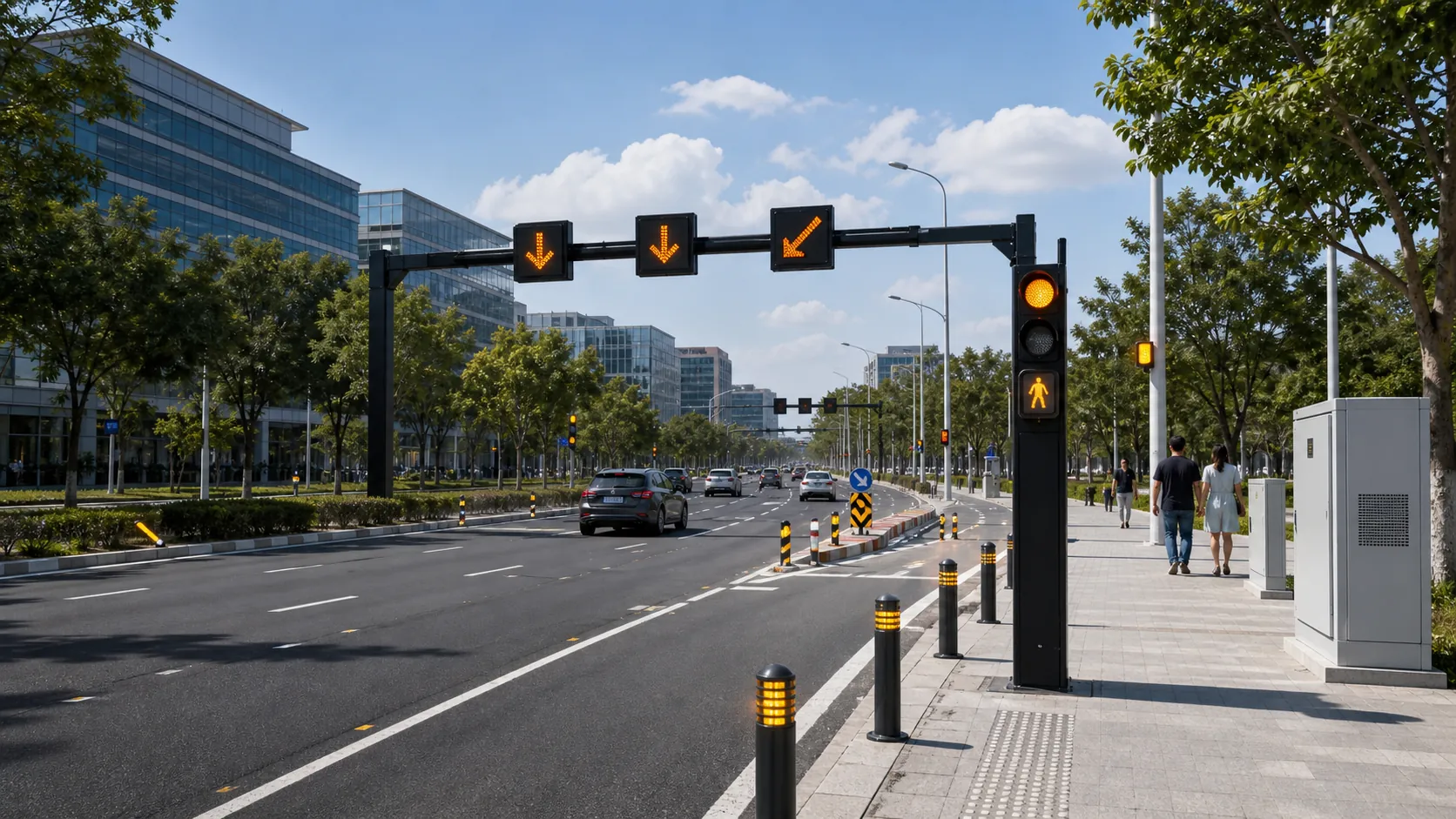
Plan connected traffic safety systems with warning beacons, LED signs, road guidance devices, sensing, control cabinets and monitoring software.

Municipalities
Municipal smart city programs for lighting, traffic safety, parking, smart poles and environmental monitoring with one hardware and software partner.
Smart Pole Checklist
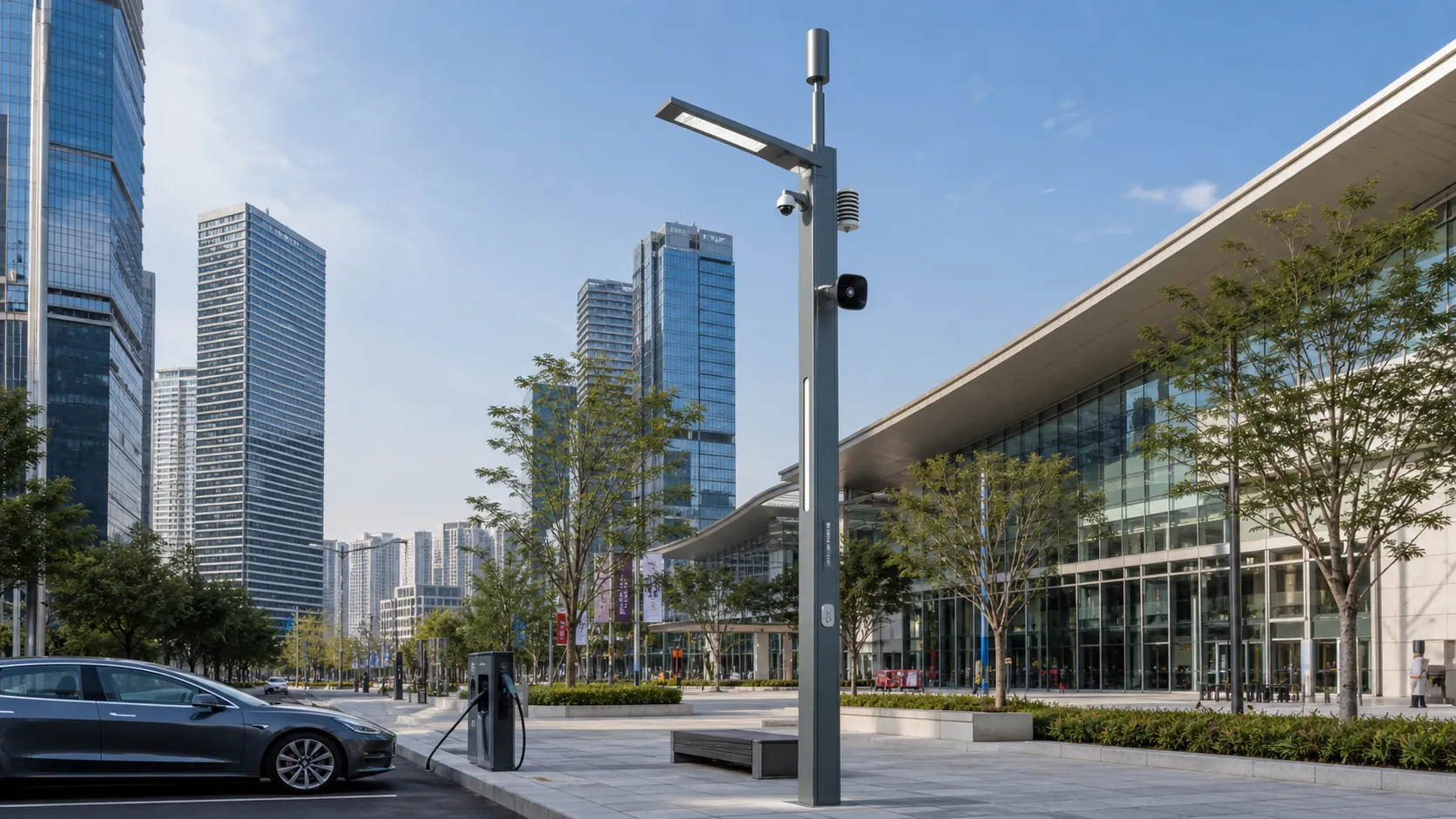
A buyer checklist for smart pole modules, structure, power, communication, cabinet layout, platform integration and maintenance access.
Frequently Asked Questions
What is an outdoor smart edge cabinet used for in a smart-city deployment?
It is the hardened roadside enclosure that hosts the active equipment a smart city actually runs on — traffic signal controllers, 5G small-cell aggregation, edge AI servers, NVRs, IoT gateways and network switches. The cabinet provides weather protection, regulated temperature, surge-protected mains, UPS backup, and remote telemetry so this equipment can survive years on a kerbside or under a smart pole.
Why does REDCOAST.LTD specify IP55 instead of IP65 for a roadside cabinet?
IP55 is the standard rating for actively cooled outdoor cabinets because the cabinet must exchange air with the outside via filters, an air-conditioner condenser or a heat exchanger — a fully sealed IP65 enclosure traps heat and shortens equipment life. IP55 stops dust ingress and wind-driven rain, which covers more than 90 % of urban kerbside deployments.
Can a single RC-CAB-700 host both a traffic-signal controller and a 5G small-cell baseband?
Yes. Order the 36U or 47U variant with the 2.5 kW air-conditioner and a 3–5 kVA UPS. The dual-zone architecture keeps the baseband running cool in the equipment compartment while the LiFePO4 cassette stays in its optimal window, and the CMU presents both NTCIP for the transport operator and SNMPv3 for the mobile operator simultaneously.
How long will the integrated UPS keep the cabinet alive during a power outage?
Autonomy is selectable at order time — 30, 60, 90 or 120 minutes — sized against the actual equipment load. A 36U cabinet hosting a typical traffic-signal controller and edge analytics server with a 90-minute cassette will ride through almost every urban brownout without dropping a single packet.
Does the RC-CAB-700 need solar panels?
No. This is a grid-powered product for urban and peri-urban deployments where mains is already available from street-lighting feeders or LV laterals. Grid outages are handled by the integrated LiFePO4 UPS. For genuinely off-grid sites REDCOAST.LTD offers separate solar-powered cabinet and pole platforms, but those are different products for different environments.
What management protocols does the REDCOAST.LTD CMU PCB support out of the box?
SNMPv3 for telco network operations centres, Modbus TCP and Modbus RTU for SCADA, MQTT and REST for cloud and smart-city platforms, and NTCIP 1201 / 1218 for transport authorities. Because the CMU firmware is developed in-house, customer-specific extensions and private topic schemas are added before shipment rather than requiring a separate gateway.
Can the cabinet survive coastal, desert and cold climates?
Yes. The double-skin shell, hot-dip galvanised primer and matte powder-coat finish are tested to ISO 9227 salt spray ≥ 1000 h. For coastal and tropical sites order the inverter air-conditioner and stainless-steel hardware; for desert sites add the high-efficiency dust filter; for cold sites add the 200–500 W door and battery heaters. Operating range is -40 °C to +60 °C ambient.
What are the lead time, warranty and after-sales arrangements?
Standard catalog configurations ship in 4–6 weeks from order confirmation; heavily customised builds in 6–10 weeks. Each cabinet carries a 5-year structural warranty and a 3-year electronics warranty. Spare parts — fan trays, SPD modules, smart locks, battery cassettes, A/C units — are kept on shelf for next-business-day shipment, and an optional REDCOAST.LTD cloud monitoring service delivers remote firmware updates, health analytics and predictive maintenance alerts for the life of the asset.