Overview
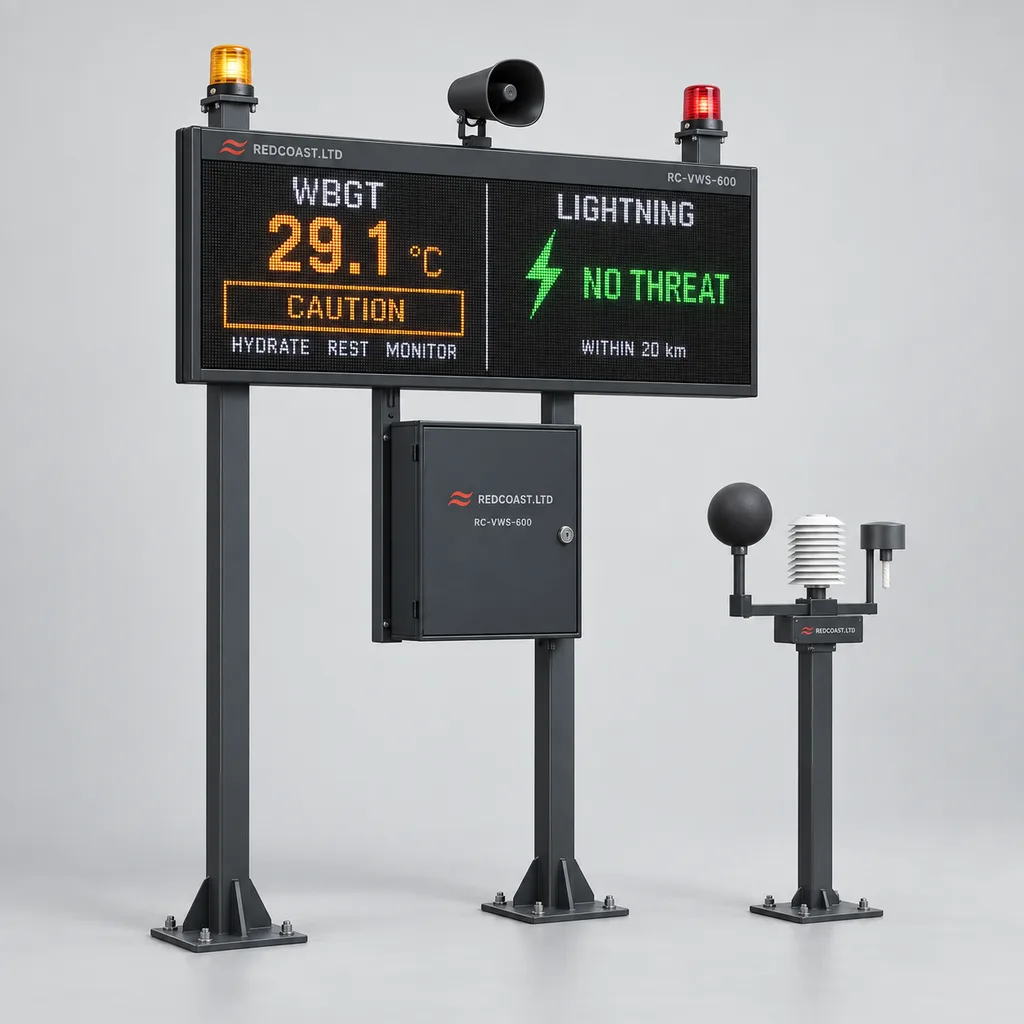
The RC-VWS-600 is a configurable outdoor venue weather safety system from REDCOAST.LTD, combining field-level wet bulb globe temperature measurement, lightning alert data, public warning displays, and documented operator actions. It is designed for schools, sports complexes, recreation facilities, and outdoor event venues that need consistent instructions across multiple activity areas. The system brings together sensor hardware, an edge controller, an outdoor LED message board, audible and visual warning devices, a Web management platform, and mobile apps. Permanent installations use existing mains electricity, with separate low-voltage sensor assemblies positioned to represent participant exposure. This model is a proposed project-engineered configuration; the specifications below are design and procurement targets to be confirmed through prototype testing and the agreed acceptance plan.
Key Features
- Direct three-temperature WBGT measurement: A 150 mm black globe, a naturally ventilated wetted sensor, and a shielded dry-bulb sensor measure the inputs used to calculate outdoor heat stress.
- Independent field monitoring: Connect one to eight WBGT assemblies so artificial turf, natural grass, exposed courts, and shaded activity areas can have separate readings and policies.
- Lightning data integration: Receive geolocated events from a contracted lightning network, with configurable distance rules, source timestamps, and data-health supervision.
- Readable public instructions: A 1,280 × 640 mm outdoor LED board displays the relevant field, WBGT value, activity restriction, lightning hold status, and time of the latest valid update.
- Coordinated audible and visual warnings: A directional horn and separate beacons accompany text messages, helping communicate restrictions without relying on color alone.
- Local policy execution: The edge controller evaluates heat thresholds and operates connected outputs while the management platform is unavailable, provided local power and sensor communications remain healthy.
- Recorded operational decisions: Store measurements, policy versions, alert transitions, acknowledgements, maintenance flags, and authorized release decisions in a searchable event history.
- Custom hardware development: REDCOAST.LTD designs the sensor acquisition, display interface, amplifier control, and power distribution PCBs around the project, supporting both complete branded systems and OEM delivery.
Technical Architecture
Each WBGT assembly has three physically distinct temperature elements. The black globe captures the combined effect of radiant heat and convection; the naturally ventilated wet-bulb element uses a replaceable wick supplied with distilled water; and the dry-bulb probe sits inside a radiation shield. These components connect to a REDCOAST.LTD acquisition PCB with four-wire Pt100 measurement, a precision analog front end, and an isolated RS-485 interface. Direct natural wet-bulb measurement requires water and wick maintenance. Commercial instruments also use this three-probe approach, including 150 mm globes and reservoir-fed probes for extended measurements, as documented in the Delta OHM WBGT instrument manual.
For outdoor exposure with solar radiation, the controller calculates WBGT as 0.7 × natural wet-bulb temperature + 0.2 × globe temperature + 0.1 × dry-bulb temperature. For a configured environment without solar radiation, it uses 0.7 × natural wet-bulb temperature + 0.3 × globe temperature. Exposure mode belongs to the individual sensor location and is recorded with its measurements. Ten-second acquisition and one-minute reporting do not mean that the globe responds within one minute: commissioning must allow thermal equilibration, normally at least 20–30 minutes after relocation and longer when conditions remain unstable. Low reservoir level, sensor faults, and maintenance status prevent affected measurements from being presented as valid clearance evidence.
Lightning events enter through a licensed service adapter or a separately commissioned local warning system. The controller checks event age, coordinates, source health, and the configured venue perimeter before applying distance rules. Commercial global lightning feeds are available for this architecture; their coverage, latency, event types, and redistribution rights must be confirmed in the service contract, as illustrated by Vaisala's real-time lightning data offering. Heat and lightning remain separate state machines. A lightning evacuation message takes presentation priority while any heat restriction remains active in the background. The platform synchronizes policies and records, while the edge controller drives the display, amplifier, beacons, and local inputs.
Connectivity & Power
The reference installation uses AC 100–240 V, 50/60 Hz at the display and controller assembly. An isolated 24 V DC supply feeds the sensor network and control electronics; the LED modules and amplifier use appropriately rated internal supplies. Expected operating consumption is 180–300 W for a single display station, depending on brightness and message content, with a 700 W design ceiling for the specified configuration. Additional display stations require separate branch-circuit calculations. Solar panels are not included because the intended venues have permanent electrical infrastructure.
Ethernet is the preferred connection where a venue network is available. An LTE Cat 4 modem provides an alternative uplink or an independently provisioned backup route. Isolated RS-485 carries measurements over local field cabling; inter-building or long exposed links should use fiber to reduce conductive paths between structures. Cloud loss does not stop locally powered WBGT measurement or local heat warnings. Loss of the lightning feed, however, produces an explicit unavailable state and blocks automatic release; cached data cannot establish current storm conditions. A complete power outage requires the venue's manual procedure unless the installation is supplied by an appropriately sized site emergency circuit.
Protection & Reliability
The controller enclosure targets IP66 and the LED display enclosure targets IP65 under the specified assembly and cable-entry conditions. These ratings apply to the electronics enclosures, not to the intentionally exposed globe, ventilated temperature shield, or wet-bulb wick. A vented solar shield, sealed connectors, conformal-coated control boards, and segregated mains and signal wiring address outdoor exposure. Electronics target operation from -20 to +55 °C; the water-based WBGT assembly has a narrower validated measurement envelope of +5 to +50 °C ambient temperature.
Steel posts and brackets receive hot-dip galvanizing beneath a smooth powder-coated or fluorocarbon-painted finish. Coastal projects add a specified coating system, suitable fasteners, and a cleaning schedule; dust-prone sites require more frequent wick and shield inspection. Pole dimensions, foundations, and display attachment loads must be calculated for local wind conditions rather than inferred from enclosure protection ratings. Surge protection, bonding, and earthing are coordinated with the venue electrical design; the warning station is not a lightning protection structure.
Serviceable LED modules, replaceable temperature probes, removable terminal assemblies, and watchdog-supervised electronics simplify maintenance. A 24-month hardware warranty can be specified in the supply agreement, with consumables, calibration services, lightning data subscriptions, and communications charges listed separately. Final environmental ratings and measurement acceptance results belong in the project handover documentation.
Application Scenarios
School Athletics and Training Grounds
Install sensors beside representative practice surfaces and a public display near the supervised field entrance. Athletic staff can apply approved heat policies, acknowledge warnings, and document changes to practice while coaches and participants see the same instruction.
Multi-field Sports Complexes
Use separate assemblies for artificial turf, natural grass, and exposed courts rather than treating one remote weather reading as representative of every surface. A central dashboard coordinates lightning holds across the complex while individual displays retain field-specific heat restrictions.
Outdoor Aquatic Recreation Facilities
Place the sensing assembly near the occupied deck environment, away from direct splash, misting outlets, and equipment exhaust. The station communicates heat restrictions and lightning evacuation instructions to staff and visitors; it complements the facility's existing supervision and emergency procedures.
Golf Practice and Club Facilities
A mains-powered station at a driving range or practice center gives instructors and visitors a shared weather status. Additional networked displays at staffed access points can communicate a suspension and the designated route to shelter without assuming that an open-sided shelter provides lightning protection.
Permanent Outdoor Event Venues
Use the platform to coordinate heat and lightning messages at amphitheaters, festival grounds, or outdoor exhibition spaces with installed utilities. Different operator roles can acknowledge alerts, issue approved announcements, and record reopening decisions across multiple entrances.
Case-style Examples
The following examples illustrate proposed configurations and expected operational benefits; they are not claims of completed customer deployments.
Training Campus with Contrasting Playing Surfaces
A campus operates a natural-grass field, an artificial-turf field, and exposed hard courts, but previously recorded conditions at only one location. The proposed configuration uses three wired WBGT assemblies, two LED stations, an Ethernet-connected controller, and separate activity policies for each training area. Staff gain field-specific records and public messages, reducing ambiguity when one surface requires restrictions earlier than another.
Recreation Complex Requiring a Shared Lightning Hold
A recreation operator needs consistent suspension instructions across several outdoor activity zones. One licensed lightning feed supplies a common venue policy, while distributed display stations and locally surveyed horn locations announce the hold. Each qualifying new event resets the release timer; feed failure leaves the system in a restricted or unavailable state according to the approved procedure, and an authorized operator handles the final release.
OEM Upgrade for an Existing Venue Platform
A systems integrator already operates scheduling software and a venue dashboard but needs durable WBGT hardware and field warning devices. REDCOAST.LTD develops a customer-specific acquisition and I/O PCB, supplies the display and amplifier assemblies, and maps measurements and events into the integrator's documented API. This arrangement provides purpose-built hardware while allowing the customer to retain its existing software workflow and data hosting arrangement.
Customization & Selection Guide
Start with the exposure map: list playing surfaces, occupied zones, shade patterns, nearby heat sources, and safe service access. Choose one sensor assembly per representative microclimate; a sensor mounted high above the field on the display pole should not be assumed to represent participant exposure. A nominal mounting height of 1.1 m is a practical starting point for the reference installation, but the final height and any multi-height assessment must follow the chosen measurement protocol.
Select display quantity by actual sightlines and walking routes. The reference P5 display suits concise instructions and large numbers; longer multilingual messages may require a larger panel or additional stations. Horn quantity follows an acoustic survey that considers ambient noise, neighboring properties, and speech intelligibility. A quoted sound pressure level at one meter does not establish coverage across an entire stadium.
Heat thresholds must be supplied or approved by the venue's responsible authority and should account for activity intensity, clothing, acclimatization, participant groups, and local requirements. Do not treat a universal color chart as suitable for every sport or age group. Select lightning alert distances using evacuation travel time, shelter capacity, terrain, and the selected data service. The configuration offers three rule radii between 5 and 50 km; these are policy settings, not a claimed detection range or guaranteed warning distance.
Deployment & After-sales
Deployment begins with a site survey, exposure assessment, electrical review, network design, and an agreed responsibility matrix for alarms and reopening. Install the display outside playing clearances and place the sensing assembly where it samples representative conditions without shading or heating from the sign, nearby walls, or mechanical equipment. Commissioning checks temperature channels against a reference, verifies wetting and reservoir alarms, measures display visibility and horn performance, and simulates sensor loss, feed loss, power restoration, and a new lightning event during a hold.
Planning allowances are 6–10 weeks for a pilot based on an approved reference configuration and 10–16 weeks when new PCB development or additional laboratory testing is required; the contractual schedule follows design freeze and component availability. Handover includes wiring drawings, a bill of materials, policy configuration records, operating instructions, and maintenance training. Check water availability and wick condition before activity sessions, establish refill intervals from actual site evaporation, and arrange periodic comparison or calibration checks, initially at 12-month intervals unless the measurement program requires more frequent service.
Standards & Compliance
ISO 7243:2017 provides a WBGT-based screening method for heat stress assessment. It is a measurement and assessment reference, not a universal school-sport participation policy or a medical diagnosis. Measurement placement, instrument suitability, exposure duration, and activity rules require separate review for the intended users.
IEC 62793:2020 provides a framework for thunderstorm warning systems using individual sensors or sensor networks. The RC-VWS-600 project should document the selected data source, warning logic, failure states, and operational response against the applicable requirements. It does not promise first-strike prediction or protection from a direct strike. The National Weather Service sports safety guidance recommends waiting at least 30 minutes after the last thunder before resuming outdoor activity. The system therefore includes a manual observed-thunder input and a configurable 30–60 minute hold; reaching zero indicates eligibility for operator review rather than proof that outdoor conditions are safe.
Enclosure verification follows the applicable tests in IEC 60529. Electrical safety, EMC, radio approvals, material restrictions, and any required conformity marking are defined for the final hardware configuration and destination. CE, RoHS, FCC, and other approval claims must be supported by the relevant documentation; none is implied merely by listing this concept specification.
Why REDCOAST.LTD
REDCOAST.LTD delivers the complete operating system: outdoor equipment, Web management, mobile apps, installation interfaces, and ongoing technical support. Its in-house PCB and board-level design capability allows sensor channels, isolated interfaces, display drivers, amplifier supervision, power distribution, and enclosure layouts to be developed around the customer's project. Qualified sensing elements, communications modules, and licensed lightning data are combined with purpose-built electronics and software, with responsibilities and interfaces documented from the outset. Buyers can select a complete REDCOAST.LTD solution or an OEM hardware package with agreed API access and service terms.
Contact REDCOAST.LTD with your venue layout, playing surfaces, weather policies, electrical infrastructure, and software requirements to request a tailored RC-VWS-600 configuration.
Specifications
WBGT Measurement — Design Targets
- Measurement Method
- Direct natural wet-bulb, black-globe and shielded dry-bulb temperatures
- Black Globe Diameter
- 150 mm
- Temperature Elements
- 3 × four-wire Pt100 per assembly
- WBGT Ambient Operating Envelope
- +5 to +50; unfrozen water and maintained wick required °C
- Globe Temperature Measurement Range
- 0 to +80 °C
- WBGT Comparison Acceptance Target
- ±1.0 against a calibrated reference after equilibrium within the agreed test envelope °C
- Acquisition / Reporting Interval
- 10 / 60; reporting interval is not sensor response time s
- Distilled-water Reservoir
- 500; replaceable wick and low-level alarm mL
Weather Policy & Alarm Control
- WBGT Assemblies per Controller
- 1–8
- Heat Policy Bands
- 3–5 per field; venue-approved thresholds
- Lightning Rule Radii
- 3 independently configured radii, each 5–50 km
- Lightning Hold Timer
- 30–60; reset by qualifying events or manual thunder input min
- Lightning Feed Health Timeout
- 30–120; default 60, based on heartbeat or successful polling s
- Local Output Response Target
- ≤2 after receipt and validation of an alarm event; excludes upstream latency s
- Digital Inputs / Relay Outputs
- 4 / 4; isolated inputs and dry contacts rated 30 V DC, 2 A resistive
- Release Logic
- Healthy data + completed hold + authorized operator release; active heat restrictions retained
Public Display & Notification — Reference Configuration
- LED Active Display Area
- 1280 × 640 mm
- Pixel Pitch / Resolution
- 5 mm / 256 × 128 pixels
- Peak Display Luminance Target
- 5000; automatic day/night dimming cd/m²
- Display Information
- WBGT, field ID, restriction text, hold status and last valid update time
- Horn Amplifier Output
- 60 W RMS
- Horn Alarm Level Target
- 110–120 at 1 m on axis; adjustable and subject to acoustic commissioning dB(A)
- Visual Beacons
- 2 × 10 W maximum; separate heat and lightning indications
- Notification Methods
- LED text, beacon, prerecorded audio, app push and email
Connectivity, Storage & Software
- Ethernet
- 1 × 10/100BASE-T
- Optional Cellular Uplink
- LTE Cat 4; deployment-specific bands and operator SIM
- Sensor Network
- 2 × isolated RS-485; Modbus RTU at 9600–38400 bit/s
- RS-485 Design Cable Length
- Up to 300 per bus at 9600 bit/s with specified cable, termination and topology m
- Platform Interfaces
- HTTPS REST and MQTT over TLS 1.2 or later
- Local Data Storage
- 8 GB industrial flash; minimum 90 days of one-minute records for 8 assemblies
- User Access Roles
- Viewer, operator, administrator and service
- Time and Export
- NTP synchronization, UTC event timestamps, local-time display and CSV export
Mains Power — Reference Configuration
- Input Voltage
- AC 100–240 V
- Input Frequency
- 50/60 Hz
- Sensor and Controller DC Bus
- 24, isolated from mains V DC
- Typical System Consumption
- 180–300; one display, one sensor assembly, controller and idle audio W
- Maximum LED Display Consumption
- 550 W
- Maximum Configured System Consumption
- 700; one display, one horn channel, two beacons and one sensor assembly W
- Additional Sensor Assembly Load
- ≤3 per assembly W
- Supply Protection
- Lockable isolator, protective earth, branch overcurrent protection and Type 2 AC SPD
Mechanical, Environmental & Service Targets
- Controller / Display Enclosure Protection
- IP66 / IP65 targets; excludes exposed sensing elements
- Electronics Operating Temperature
- -20 to +55; installation thermal assessment required °C
- Electronics Operating Humidity
- 5–95, non-condensing inside enclosure % RH
- Display Station Height
- 2.5–3.5; final structure and foundation site-engineered m
- Separate WBGT Sensor Mounting Height
- 1.1 nominal; adjustable 0.6–1.7 according to measurement protocol m
- Steel Surface Finish
- Hot-dip galvanized substrate with smooth powder coating or fluorocarbon topcoat; RAL 7016 or RAL 9016
- Initial Calibration Review Interval
- 12; shorten according to site procedure and comparison results months
- Proposed Hardware Warranty
- 24 under agreed supply terms; consumables and subscriptions separately specified months
Capabilities — configurable per project
Specifications are tailored to each project — the options below show what we can support.
Field Measurement Layout
- Single representative playing surface
- Three-zone turf, grass and court monitoring
- Eight-zone venue monitoring
Public Notification Package
- Reference P5 LED board with horn and two beacons
- Multiple field-specific LED stations
- LED stations with existing venue PA interface
Lightning Information Source
- Licensed cloud-to-ground lightning feed
- Licensed cloud-to-ground and in-cloud lightning feed
- Existing local warning system through a commissioned interface
Network and Hosting
- Ethernet with REDCOAST.LTD hosted platform
- Ethernet plus LTE backup
- Customer-hosted platform with documented API
- Fiber backbone with local field controllers
OEM Hardware and Finish
- REDCOAST.LTD complete system in RAL 7016
- Private-label enclosure in RAL 9016
- Customer-specific acquisition and I/O PCB
- Coastal coating and fastener package
Related solution guidance

Environmental Monitoring
Deploy environmental monitoring stations with sensors, solar power, gateways, dashboards, alarms and data integration for city and industrial sites.
Campuses
Campus IoT for lighting, parking, safety, smart poles, environmental data and facility maintenance workflows.
Ports and Logistics
Outdoor IoT infrastructure for ports, yards and logistics areas: lighting, guidance, safety, solar power, monitoring and maintenance visibility.
Frequently Asked Questions
Does this station measure WBGT directly or estimate it from ordinary weather data?
The reference configuration measures natural wet-bulb, black-globe and dry-bulb temperatures on site, then calculates WBGT from those inputs. It uses a 150 mm globe and a maintained wet wick rather than substituting air temperature and humidity alone. Its one-minute reporting interval does not remove the time needed for the sensors to reach thermal equilibrium.
Does the RC-VWS-600 detect lightning by itself?
The reference configuration receives lightning events from a separately licensed network service; it does not contain its own lightning location network. An existing local thunderstorm warning system can be integrated through a commissioned interface. Coverage, event types, latency and licensing must be checked for the chosen provider and deployment.
Can one WBGT sensor represent an entire sports complex?
One sensor may be sufficient for a genuinely uniform exposure area, but it should not automatically represent different playing surfaces or shaded and exposed locations. The controller accepts up to eight assemblies so each representative microclimate can have its own measurement history and heat policy. Final placement should follow the venue's measurement protocol and avoid artificial heating, shading or spray.
What happens if the internet connection or lightning data service fails?
Locally powered WBGT measurement, heat policy evaluation and connected warning outputs continue when the cloud connection is lost. If lightning data health cannot be confirmed, the station displays an unavailable state and prevents automatic release from an active hold. An optional LTE connection can provide another communications route, but a complete power outage still requires the venue's manual procedure unless site emergency power is provided.
Does a completed lightning countdown mean it is safe to resume activity?
No countdown can prove that outdoor conditions are safe. The timer resets after qualifying lightning events or an operator's observed-thunder input, and the reference workflow requires healthy data and an authorized release decision. Staff must continue following the approved venue procedure, including responding to visible lightning or audible thunder.
Does the station require solar panels or a battery?
No. The RC-VWS-600 reference installation uses AC 100–240 V because permanent sports and recreation venues typically have electrical infrastructure. It includes neither a solar array nor a battery, and any required power continuity is addressed through the site's separately engineered emergency supply.
What maintenance does a permanent wet-bulb WBGT station need?
The natural wet-bulb sensor requires distilled water, a clean wick and unobstructed natural ventilation. Check these before activity sessions and establish refill and wick replacement intervals from local evaporation, dust and contamination conditions. A low-water alarm helps identify a problem but cannot prove that a dirty wick is measuring correctly.
Can REDCOAST.LTD supply OEM hardware for an existing weather safety platform?
Yes. REDCOAST.LTD can develop project-specific PCBs for temperature acquisition, isolated I/O, display control, amplifier supervision and power distribution, alongside enclosure and firmware changes. OEM delivery can include documented measurement and event interfaces for the customer's platform. Prototype validation, conformity documentation, data-service licenses and support responsibilities are defined in the project scope.