Overview
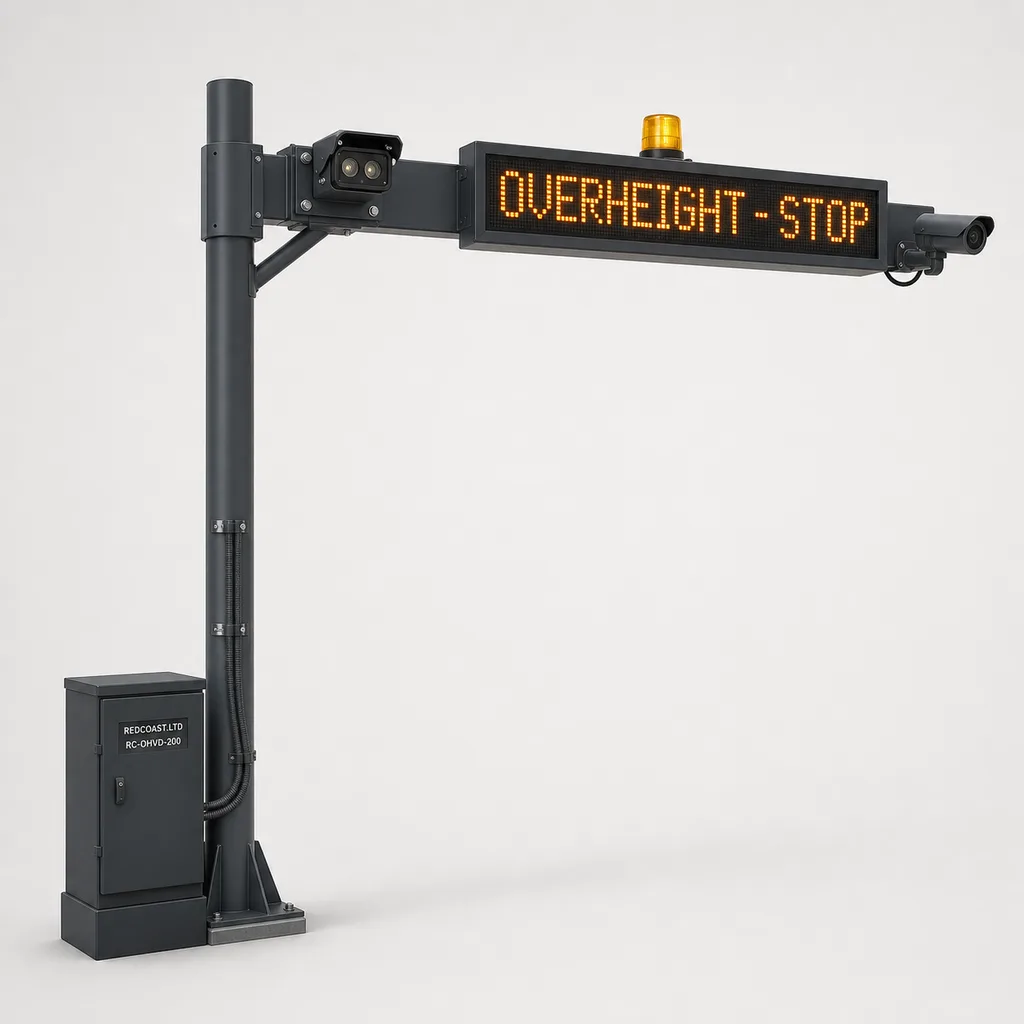
The REDCOAST.LTD RC-OHVD-200 is a mains-powered Over-Height Vehicle Detection and Warning System (OHVDS) purpose-built to protect low road bridges, rail-over-road bridges, tunnel portals, overhead utility pipe racks, and any roadway feature with a defined vertical clearance. Trucks that ignore static height signs and strike low bridges cause structural damage measured in millions of dollars, multi-day road closures, fatal cab shears, and rail-line shutdowns every year — and operators repeatedly report that the overwhelming majority of strikes occur at sites where a static height sign was already in place. The RC-OHVD-200 replaces that passive sign with an active, redundant detection-and-warning loop: an infrared and scanning-laser curtain ranges every approaching vehicle in real time, a full-matrix LED warning sign and rotating beacon immediately command the offending driver to stop, and an integrated ANPR camera captures the license plate, date, vehicle class, and an event video clip for enforcement. The entire chain runs on REDCOAST.LTD-designed PCBs and integrates natively with NTCIP-compliant traffic management centers so highway operators can correlate the event, dispatch enforcement, and trigger downstream variable message signs or ramp meters within seconds.
Key Features
- Dual-redundant detection — a 905 nm scanning laser and a modulated 940 nm IR break-beam array operate side by side so the system is fail-warning rather than fail-silent in rain, snow, fog, dust, and direct sun glare.
- Adjustable height threshold from 2.5 m up to 6.5 m, configurable in 1 cm steps to match the local statutory bridge clearance, tunnel signage class, or rail bridge gauge.
- Sub-100 ms reaction time from beam-break to LED warning command — enough margin for a 90 km/h truck to brake before reaching most protected structures when the system is set back at the recommended 80–150 m stand-off.
- Full-matrix LED warning sign with EN 12966 photometric performance (C2 / B2 / L3 selectable), 1–100 % automatic dimming, and a built-in library of pictograms (OVERHEIGHT, STOP, DETOUR, TUNNEL CLOSED, SPEED LIMIT, plus custom multi-language text).
- Integrated 5 MP ANPR + 4K overview camera with on-board edge AI that captures the violating vehicle's plate, axle count, hazardous-goods placard, fleet livery, and a 10-second pre/post video clip.
- NTCIP 1203 v3 messaging and OCIT-OUTSTATIONS C interface for native plug-in to existing traffic management centers; MQTT, OPC UA, and REST APIs are also available for proprietary platforms and city SCADA.
- Mains-powered with on-board LiFePO4 UPS that keeps both detection and warning active for 4–8 hours after a grid outage — keeping the most dangerous failure mode (a silent, dark system) off the table.
- Pole-, cantilever-, or full-gantry-mount; IP66 enclosures; -30 to +60 °C operating range; field-replaceable plug-in PCB cassettes (signal conditioning, LED driver, AI gateway) for sub-one-hour mean-time-to-repair.
- Self-test heartbeat with every-second curtain ping; automatic detection of optical misalignment, lens contamination, beacon failure, and grid loss, pushed both to the TMC and to the operator's mobile app.
- Designed to align with CE, RoHS, IEC 61000-6-2 / 6-4 EMC, IEC 60529 IP66, EN 12966, and IEC 61643 surge protection.
Technical Architecture
The RC-OHVD-200 is built around three REDCOAST.LTD-designed PCBs that we manufacture per project: the Detection Signal Conditioning Board, the LED Driver & Sign Controller Board, and the Edge AI Gateway Board. The Detection Board reads the scanning laser rangefinder and the IR break-beam array, time-stamps every beam-break to ±1 ms with a PTP-disciplined clock, applies adaptive thresholding to reject windborne debris, birds, and rain streaks, and outputs a confirmed over-height event over RS-485 to the Edge AI Gateway. The Gateway runs an NXP i.MX 8M Plus or Rockchip RK3588 SoC with a 6 TOPS NPU that cross-validates the detection event against the camera feed (vehicle silhouette, axle count, motion vector), runs license-plate recognition on the overview camera, and writes a complete event record — geometry, plate, vehicle class, video — to the TMC via NTCIP or MQTT in under 500 ms. The Sign Controller Board drives a string of high-brightness LED modules with per-pixel constant-current control, automatic dimming based on the ambient-light sensor (so the sign is never blinding at night nor washed out at noon), and a watchdog that forces the sign into a known-safe "OVERHEIGHT — STOP" state if the gateway loses heartbeat. All three boards share a backplane with hot-swap connectors so a single defective board can be replaced in under five minutes without touching the optics.
Connectivity & Power
The standard configuration runs on AC 100–240 V mains. This is intentionally a grid-only product: it is designed for permanently-installed roadside, bridge-approach, and tunnel-portal locations where a mains feed is already pulled to the structure for lighting, ITS cabinets, or signage, and where the always-on duty cycle of the LED warning sign and ANPR camera makes a stand-alone solar configuration neither necessary nor cost-effective. A built-in LiFePO4 UPS (200–600 Wh, sized per project) keeps detection, warning sign, and beacon fully active for 4–8 hours of grid outage so the system never silently fails during a city-wide power dip. Connectivity is field-selectable: fiber Ethernet for trunked ITS networks, copper Gigabit Ethernet for tunnel and gantry deployments, and a dual-SIM 4G / 5G modem with NB-IoT fallback for remote bridges that lack fiber. The Gateway natively speaks NTCIP 1203 v3 (DMS), OCIT-OUTSTATIONS C, MQTT 5.0, OPC UA, and REST/HTTPS, and supports IPsec and OpenVPN tunneling to TMC. PTP (IEEE 1588v2) clock sync is available for tunnel deployments where event timestamps must align with adjacent ITS subsystems.
Protection & Reliability
All outdoor enclosures are IP66-sealed die-cast aluminum, powder-coated for UV and salt-spray resistance, and tested through a 500-hour salt-spray cycle. The detection optics are protected by hydrophobic-coated tempered glass with an automatic heater (defrosting and demisting) and an integrated contamination self-test that pulses the IR emitter at low duty and verifies the expected back-reflection — a contaminated lens triggers a maintenance alert long before it would cause a missed detection. The full system operates from -30 °C to +60 °C, withstands 60 m/s wind on standard pole mounts, complies with IEC 61000-6-2 and IEC 61000-6-4 EMC requirements, and is surge-protected to 20 kA on the AC line and 10 kA on every signal port. Every PCB is conformal-coated. The designed service life is 10 years for the structural enclosure and 100 000 hours (L70) for the LED warning sign at typical duty cycle, supported by REDCOAST.LTD's standard 2-year manufacturer warranty with optional extension to 5 years.
Application Scenarios
- Low rail-over-road bridges in urban areas — protect Class 1 rail infrastructure from truck strikes that close lines for 24–72 hours; the RC-OHVD-200 measures, warns, and records the offender in one box.
- Highway tunnel portals — protect tunnel ventilation ducts, fire-suppression piping, and lighting catenaries from oversized loads; integrated with the tunnel's SCADA to close the lane or trigger the queue-end warning automatically.
- Container-port and intermodal terminal access roads — detect improperly-secured or stacked containers before they enter low-clearance urban corridors; the ANPR record gives the port operator immediate enforcement leverage against the haulier.
- Bus depot, tram-line, and trolleybus junctions — protect overhead catenary wires from delivery trucks and refuse lorries that exceed the safe gauge.
- Industrial-park overhead pipe racks — protect process-piping bridges across plant roads, with the warning sign tied directly to the plant DCS to halt incoming traffic.
- Temporary clearance enforcement during structural works — short-term deployments on cantilever mounts to enforce a reduced clearance during scaffolding, deck repair, or bridge-jacking operations.
Case-style Examples
- Urban rail-bridge protection retrofit — A municipal works department retrofitted 18 low rail bridges previously protected only by static height signs. Configuration per site: dual laser + IR curtain set back 120 m, a 320 × 160-pixel full-matrix amber warning sign with rotating beacon, an ANPR overview camera, and NTCIP integration with the city traffic management center. Outcome: bridge strikes on the protected sites dropped to zero within the first 12 months of operation, and the captured ANPR evidence allowed the municipality to recover repair costs from the responsible haulier through a streamlined enforcement workflow.
- Motorway tunnel-portal protection — A motorway operator deployed the RC-OHVD-200 at six tunnel approaches. The system was integrated with the existing tunnel SCADA so a confirmed over-height event automatically triggers the in-tunnel "TUNNEL CLOSED" gantry, drops the queue-end warning 800 m upstream, and pages the duty controller. Outcome: average lane-closure time after an avoided strike fell from roughly 90 minutes (manual response) to under 4 minutes (automated response), with zero false positives reported across 14 months of operation.
- Container-terminal outbound-gate enforcement — A container terminal deployed the system on its main outbound access road, where over-stacked containers had repeatedly damaged the urban gantry crane downstream of the gate. The ANPR records are pushed in real time to the terminal operator's truck-appointment system, so a confirmed over-height event blocks the offending haulier from booking further slots until the load is regularized.
Customization & Selection Guide
For city-street rail bridges where vehicle speeds are low and the warning sign is mounted close to the structure, a single laser curtain plus a fixed-pictogram LED sign and beacon is usually the most cost-effective package (RC-OHVD-200-Lite). For motorway tunnel portals where speeds reach 110 km/h and the system must integrate with SCADA and downstream lane-control gantries, the dual-curtain plus full-matrix VMS plus ANPR plus fiber Ethernet package is the standard choice (RC-OHVD-200-Pro). For port and industrial sites where vehicle classification and downstream gate logic matter more than speed of warning, the 4K-camera plus edge-AI vehicle-classification option is added (RC-OHVD-200-Port). All variants support pole, cantilever, and full-gantry mounts. REDCOAST.LTD provides the structural calculations and the embedment/foundation drawings on request, and can match the pole and enclosure color to the highway authority's branding (RAL-numbered, smooth matte powder-coated).
Deployment & After-sales
A typical site is delivered as a pre-wired kit (detection head, warning sign with integrated LED driver, ANPR camera, edge controller, UPS, surge-protected AC inlet, cable harnesses) so on-site installation is reduced to pole or gantry erection, AC connection, optical alignment, and TMC commissioning. REDCOAST.LTD offers remote commissioning support, on-site training for local installers and the customer's maintenance team, and an optional multi-year remote-monitoring service contract that includes firmware updates, heartbeat monitoring, and 24-hour replacement-part dispatch. The plug-in PCB cassettes (signal conditioning, LED driver, edge gateway) are field-replaceable, keeping the typical mean-time-to-repair under one hour and avoiding the need to dismount the optics.
Standards & Compliance
Designed to align with EN 12966 (variable message signs), NTCIP 1203 v3 (DMS messaging), OCIT-OUTSTATIONS C, IEC 61000-6-2 / -6-4 (EMC immunity / emissions), IEC 60529 IP66, IEC 61643 surge protection, IEC 61730 / IEC 60598 (LED luminaire safety), IEC 60825-1 Class 1 (eye-safe laser), RoHS, REACH, and CE marking. Country-specific certifications (FCC, UKCA, GCC, CCC, INMETRO, BIS) are added on a per-project basis. Adaptable to local highway-authority MUTCD, TSRGD, RVV, or equivalent regulatory pictograms.
Why REDCOAST.LTD
REDCOAST.LTD is an end-to-end smart-infrastructure solutions house that owns the entire stack of this product: the detection signal-conditioning board, the LED driver, the edge AI gateway, the firmware, the operator web platform, and the mobile inspection app. Because we design and manufacture every PCB ourselves, we can tailor the system to the exact clearance, approach speed, integration protocol, and signage layout of each protected site — including local-language pictograms, custom enclosure colors and finishes (smooth matte powder-coated, RAL-numbered for highway-authority compliance), and integration with whichever ITS vendor's TMC the operator already runs. We do not resell other people's hardware: we engineer it, build it, and stand behind it.
Contact REDCOAST.LTD for a site-specific quote, structural drawings, and a free clearance-profile assessment of your protected structure.
Specifications
Detection Sensor
- Detection Technology
- Dual: scanning laser 905 nm + modulated IR break-beam 940 nm
- Detection Range (road width)
- 0.5–25 m
- Height Threshold
- 2.5–6.5, adjustable in 1 cm steps m
- Reaction Time (beam-break to warning)
- <100 ms
- False Alarm Rate
- <1 per 10,000 vehicles
- Laser Safety Class
- Class 1 (eye-safe, IEC 60825-1)
- All-weather Operation
- Rain, snow, fog, dust, direct sun glare
LED Warning Sign
- Display Type
- Full-matrix amber or RGB
- Resolution (standard)
- 320×160 px
- Pixel Pitch
- 16 or 20 mm
- Peak Luminance
- 8,000 cd/m²
- Auto Dimming
- 1–100 %
- Refresh Rate
- ≥1,200 Hz
- LED Lifetime (L70)
- 100,000 h
- Pictogram Library
- 50+ built-in symbols, custom multi-language text
ANPR Camera & Edge AI
- ANPR Sensor
- 5 MP
- Overview Camera
- 8 MP / 4K
- ANPR Accuracy
- ≥98 % at 0–120 km/h
- AI Accelerator
- 6 TOPS NPU (Rockchip RK3588 / NXP i.MX 8M Plus)
- Vehicle Classification
- 8 classes (motorcycle/car/van/truck/bus/HGV/trailer/specialty)
- Local Storage
- 256 GB eMMC, ~30-day rolling video
- Night Vision
- Integrated 940 nm IR illuminator, up to 50 m
Edge Controller & Communication
- CPU
- Quad-core ARM Cortex-A55 + 6 TOPS NPU, 4 GB RAM
- OS
- Hardened Linux (Yocto), signed OTA updates
- Ethernet
- 2× Gigabit RJ45, 1× SFP fiber optional
- Cellular
- 4G LTE Cat 6 + 5G NSA/SA, dual SIM, NB-IoT fallback
- Serial / IO
- 4× RS-485, 4× RS-232, 16× DI / 16× DO opto-isolated
- Protocols
- NTCIP 1203 v3, OCIT-O, MQTT 5.0, OPC UA, REST/HTTPS
- Clock Sync
- PTP IEEE 1588v2, NTP, GNSS optional
Power (grid-only product, no solar)
- Input Voltage
- AC 100–240, 50/60 Hz V
- Typical Power Consumption
- 250 W
- Peak Power (full sign brightness)
- 600 W
- UPS Backup
- LiFePO4, 200–600 Wh, project-sized
- Autonomy on UPS
- 4–8 h
- Surge Protection
- 20 kA AC line, 10 kA signal ports
- Power Factor / Efficiency
- ≥0.95 / ≥92 %
Mechanical & Mounting
- Enclosure
- Die-cast aluminum, smooth matte powder-coated
- Standard Color
- RAL 7016 anthracite grey (other RAL on request)
- Mounting Options
- Cantilever pole, full overhead gantry, side-mount mast, tunnel-portal mount
- Pole Height
- 6–8 (cantilever), 6–7 (gantry) m
- Pole Material
- Q345B steel, hot-dip galvanized + smooth matte powder-coated
- Wind Resistance
- 60 m/s
- Sign Weight (depending on size)
- 25–80 kg
Protection & Standards
- Ingress Protection
- IP66 (outdoor enclosures)
- Operating Temperature
- -30 to +60 °C
- Storage Temperature
- -40 to +75 °C
- Humidity
- 0–95 % non-condensing
- EMC
- IEC 61000-6-2 / -6-4
- Salt-spray Test
- 500 h pass
- Compliance
- CE, RoHS, REACH, EN 12966, NTCIP 1203 v3, IEC 60825-1 Class 1
Capabilities — configurable per project
Specifications are tailored to each project — the options below show what we can support.
Detection Technology
- Laser curtain only
- IR break-beam only
- Dual laser + IR (standard)
- Triple-redundant laser + IR + 24 GHz radar
Warning Output
- Fixed-pictogram LED sign
- Full-matrix amber VMS
- Full-matrix RGB VMS
- Rotating beacon + audible siren add-on
Connectivity
- Fiber Ethernet (SFP)
- Copper Gigabit Ethernet
- 4G LTE
- 5G NSA/SA
- NB-IoT fallback
Mounting
- Cantilever pole
- Full overhead gantry
- Side-mount mast
- Tunnel-portal frame mount
Integration
- NTCIP 1203 v3 TMC
- OCIT-OUTSTATIONS C
- MQTT cloud broker
- OPC UA SCADA
- Custom REST API bridge
Related solution guidance
Traffic Safety Checklist
Deployment checklist for connected traffic warning signs, beacons, road guidance devices, power, visibility, monitoring and acceptance tests.
Traffic Safety
Plan connected traffic safety systems with warning beacons, LED signs, road guidance devices, sensing, control cabinets and monitoring software.
Airports and Hubs
IoT infrastructure for transport hubs: parking guidance, road safety, outdoor lighting, signage, monitoring and operational dashboards.
Frequently Asked Questions
How does the RC-OHVD-200 detect an over-height vehicle?
It uses a dual-redundant sensor head — a 905 nm scanning laser rangefinder paired with a modulated 940 nm IR break-beam array — installed across the road at the configured height threshold. Any vehicle that interrupts both beams is flagged as a confirmed over-height event in under 100 ms, and the data is cross-validated by an edge-AI camera to suppress false positives from birds, debris, or rain streaks.
What is the typical stand-off distance between the detection point and the protected bridge or tunnel?
For highway speeds of 80–110 km/h, the detection head is mounted 80–150 m upstream of the protected structure so a driver has enough time to brake or change lanes after the warning sign activates. For urban settings at 30–50 km/h, 30–60 m is normally sufficient. REDCOAST.LTD performs a site-specific stopping-distance calculation as part of the quotation.
Does the system work reliably in heavy rain, snow, fog, and direct sun?
Yes. The dual-technology curtain combines laser ranging with IR break-beam, and adaptive thresholding rejects rain streaks, snow flakes, and windborne debris. The optics include a hydrophobic-coated heated front window for defrosting and demisting, and a self-test continuously verifies that the optics are clean. The system holds full performance from -30 °C to +60 °C.
Can the system capture the license plate of a violating vehicle for enforcement?
Yes. A 5 MP ANPR camera with on-board edge AI captures the violator's plate at up to 120 km/h with ≥98 % accuracy, together with vehicle class, axle count, and a 10-second pre/post 4K video clip. The full enforcement package is pushed to the customer's TMC, ANPR enforcement back-office, or cloud platform in under 500 ms.
Does it integrate with existing traffic management centers and SCADA?
Yes. The Edge AI Gateway natively speaks NTCIP 1203 v3 (DMS), OCIT-OUTSTATIONS C, MQTT 5.0, OPC UA, and REST/HTTPS, with IPsec or OpenVPN tunneling supported. The system has been integrated with multiple TMC and tunnel SCADA platforms, and can trigger downstream lane-control gantries, queue-end warnings, and ramp metering automatically on a confirmed event.
What happens if the grid power fails?
An on-board LiFePO4 UPS sized at 200–600 Wh keeps the detection sensor, LED warning sign, beacon, and edge controller fully active for 4–8 hours of grid outage. The system reports the grid-loss event over its data link so the operator is aware, and reverts to normal operation automatically when mains power returns.
Is the system compliant with international standards?
Yes. It is designed to align with EN 12966 (variable message signs), NTCIP 1203 v3 (DMS messaging), IEC 61000-6-2 / -6-4 EMC, IEC 60529 IP66, IEC 60825-1 Class 1 laser safety, IEC 61643 surge protection, RoHS, REACH, and CE marking. Country-specific certifications (FCC, UKCA, GCC, CCC, INMETRO, BIS) are added per project.
Can the warning sign show local-language messages and pictograms?
Yes. The full-matrix LED sign is fully programmable and ships with a 50+ pictogram library plus free-text rendering in any Unicode script (Latin, Arabic, Cyrillic, CJK, Devanagari, Thai). Local highway-authority pictograms (MUTCD, TSRGD, RVV, GCC, GB 5768, etc.) are loaded at commissioning.