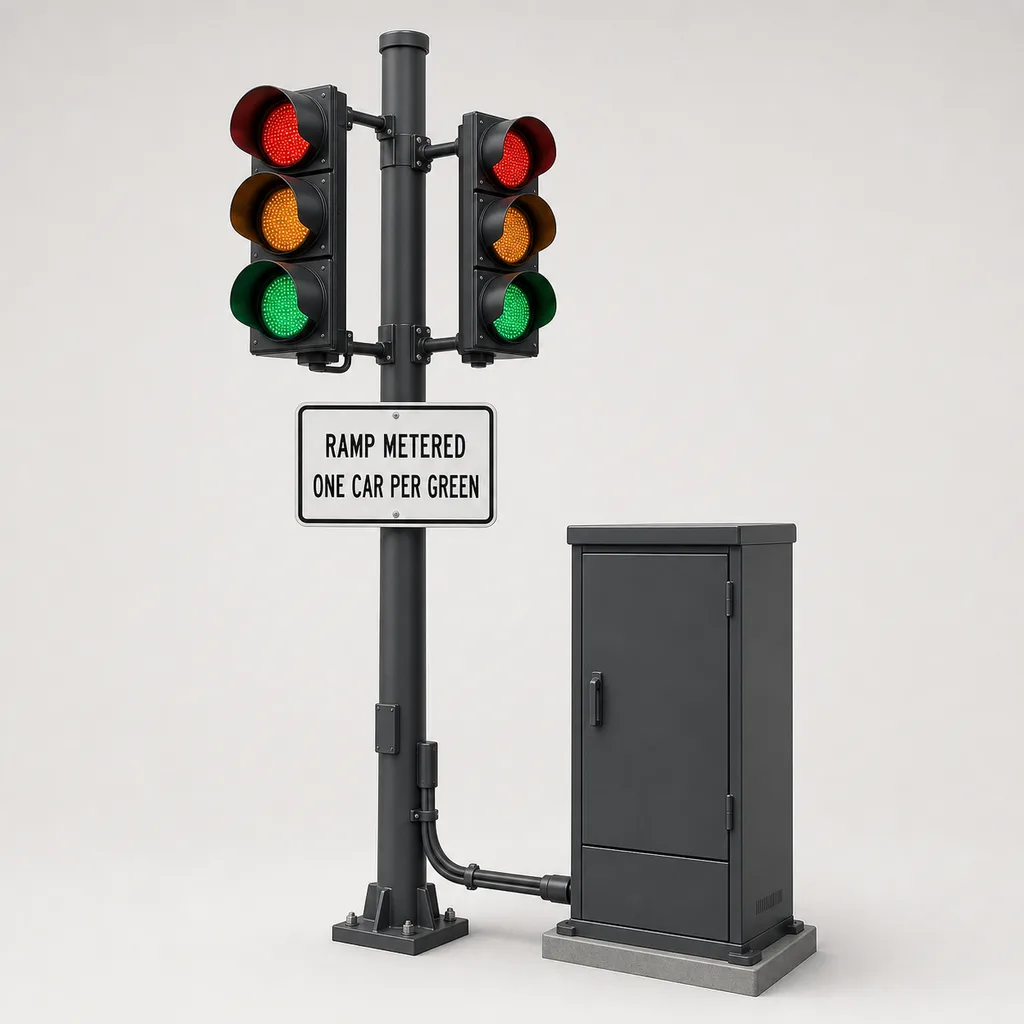
Overview
The REDCOAST.LTD RC-RMS-500 is a grid-powered ramp metering system that regulates the rate at which vehicles enter a freeway from an on-ramp. By holding vehicles at a compact LED signal and releasing them one (or two) per green, the system breaks up the platoons that trigger merge-area turbulence, preserves mainline throughput and reduces rear-end and side-swipe collisions in the merge zone. It is engineered for urban and interurban freeway interchanges that sit inside the grid — on-ramps, collector-distributor roads, managed-lane entrances and metropolitan ring roads — and therefore runs on mains AC with LiFePO₄ UPS backup, not solar. REDCOAST.LTD delivers the full stack as one integrated project: field hardware, the ramp-meter control logic, a central management platform and a mobile app, with the ramp signal LED driver, the ramp-meter controller (RMC), the multi-zone detector signal-conditioning front end and the UPS power-management board all designed and built in-house.
Key Features
- One-car-per-green metering with selectable one- or two-per-green release, dual-lane HOV/bypass support and 'signal ahead' advance warning integration.
- NTCIP 1207-compliant ramp-meter controller interoperable with ATC / 2070 / NEMA TS2 central systems and traffic management centers.
- Full multi-zone detection: demand, passage, queue, merge and mainline occupancy — via inductive loops, non-intrusive 24 GHz radar or a mix, letting the meter respond to real demand and back-off before the ramp spills onto surface streets.
- Local and coordinated algorithms: fixed-time, local traffic-responsive (demand–capacity, occupancy, ALINEA) and system-wide coordinated metering across a corridor.
- Queue override automatically relaxes the metering rate when the ramp queue reaches a detector, preventing spill-back onto arterials.
- High-intensity LED signal heads (200 mm / 300 mm) with per-segment current monitoring and lamp-out fault reporting.
- UPS ride-through keeps metering — or fails safe to dark/flash — through mains dips and outages.
- Remote everything: rates, schedules, plans, firmware and diagnostics are all pushed and monitored from the central platform and mobile app.
Technical Architecture
At the heart of each ramp is the RC-RMS-500 ramp-meter controller (RMC), a REDCOAST-designed board built around an industrial SoC running the metering engine. It ingests detector states from the multi-zone detector signal-conditioning front end — a self-developed PCB that conditions and debounces inductive-loop cards and/or digitizes the radar detector outputs for the demand, passage, queue, merge and mainline zones. From these inputs the engine computes a metering rate (vehicles per hour per lane), sequences the signal intervals (green → amber → red → red-clearance) and enforces minimum/maximum rates, startup and shutdown ramps, and queue-override logic.
Signal output is driven by the self-developed LED ramp-signal driver, a constant-current, individually-monitored driver that powers the red/amber/green sections and reports lamp-out and conflicting-indication faults back to the RMC. A supervision channel guards against showing conflicting or dark-when-required indications. The UPS power-management PCB takes mains AC, runs the cabinet electronics off a regulated DC bus, and charges/monitors a LiFePO₄ pack for ride-through. Field data flows over Ethernet/fiber or cellular using NTCIP 1207 objects to the central metering platform, which handles corridor-wide coordination, time-of-day plans, incident-responsive plans, and analytics; operators and maintenance crews use the web console and mobile app for live status, rate changes, alarms and firmware updates. Edge autonomy is deliberate: if the backhaul drops, the ramp keeps metering on its last plan and local traffic-responsive logic.
Connectivity & Power
Backhaul is chosen per site. Interchanges already trenched for ITS typically use fiber / Gigabit Ethernet to the traffic management center; standalone ramps use 4G/5G cellular with NTCIP over IP. Because these installations sit within the grid, the system runs on AC 100–240 V mains, with an internal LiFePO₄ UPS sized to ride through outages and to fail the meter to a safe state (dark, or all-flash per local policy) on prolonged loss. No solar array is used or required — supplying a mains freeway interchange from PV would be neither necessary nor cost-effective.
Protection & Reliability
The cabinet and pole-mounted signal heads are rated IP66 / NEMA 4X, with a wide operating range of -30 °C to +65 °C, conformal-coated boards, surge/transient protection on power and detector lines, and salt-fog-resistant, powder-coated steel and aluminium hardware for coastal and industrial corridors. LED signal modules are rated for ≥100,000 h service life with continuous per-segment monitoring, and every field board is designed for hot-swap replacement to keep mean-time-to-repair low. Conflict-monitor supervision and watchdog-protected firmware ensure the meter never displays an unsafe or conflicting indication.
Application Scenarios
- Congested urban freeway on-ramps: meter entering vehicles during peak periods to protect mainline flow and cut merge-area crashes.
- Managed-lane and HOV entrances: dual-lane metering with an HOV/bus bypass lane that runs a preferential or unmetered release.
- Interchange collector-distributor roads: coordinate several closely-spaced ramps so no single ramp starves or floods the mainline.
- Incident and event response: the TMC can push tighter or looser metering plans during crashes, road works or stadium egress.
- Corridor-wide coordinated metering: balance demand across an entire freeway corridor rather than optimizing one ramp in isolation.
- Arterial spill-back protection: queue-override automatically eases the rate so ramp queues never block the feeding surface street.
Case-style Examples
- Metropolitan ring-road deployment: A city ring road suffered daily merge break-downs at three adjacent interchanges. RC-RMS-500 units with radar detection and fiber backhaul were installed and coordinated from the TMC; peak metering held mainline speeds up while queue-override kept the arterials clear — a configuration chosen to avoid any road-cutting for loops.
- Managed-lane entrance retrofit: A freeway managed-lane project needed metering with a bus/HOV bypass. A two-lane RC-RMS-500 with a preferential bypass release and 'signal ahead' advance signs was delivered turnkey, integrating into the existing ATC central system over NTCIP 1207.
- Interchange modernization: An aging fixed-time meter was replaced with a traffic-responsive RC-RMS-500 using demand–capacity logic and full multi-zone detection, improving throughput without new civil works beyond the cabinet and pole foundations.
Customization & Selection Guide
Choose detection by site: inductive loops where pavement can be cut and long life is priority; non-intrusive radar for retrofits, poor pavement or to avoid lane closures; or a hybrid. Choose algorithm tier by network: local traffic-responsive for isolated ramps, coordinated metering for corridors. Choose lanes (single, dual, or dual + HOV bypass) and signal size (200 mm for low-speed approaches, 300 mm for high-speed or sun-glare sites). Choose backhaul (fiber vs cellular) by available infrastructure, and UPS autonomy by local reliability requirements. REDCOAST.LTD tunes controller parameters, sign legends and cabinet layout to the local standard and operating agency.
Deployment & After-sales
Systems ship as pre-wired, factory-tested cabinets with matched pole assemblies and signal heads for fast field commissioning. REDCOAST.LTD provides installation drawings, on-site or remote commissioning, integration with the customer's TMC/ATMS, operator and maintenance training, spare-parts kits and a warranty-backed support program with remote diagnostics and firmware maintenance over the life of the system.
Standards & Compliance
Designed to align with NTCIP 1207 (ramp meter controller objects), MUTCD / EN signalized-ramp practice, ITE VTCSH LED signal performance, NEMA TS2 / ATC / 2070 controller ecosystems, and CE / RoHS / IEC for electrical safety and EMC, with IP66 / NEMA 4X enclosure protection. Exact certifications are matched to the destination jurisdiction on a project basis.
Why REDCOAST.LTD
REDCOAST.LTD delivers ramp metering as one integrated, project-tailored solution — not a bag of third-party parts. Because we design and fabricate our own PCBs (the ramp-signal LED driver, the NTCIP ramp-meter controller, the multi-zone detector front end and the UPS power board), we control the whole signal chain and can adapt the legend, lane configuration, detection mix, algorithm and central integration to each agency's standard and corridor. Hardware, control logic, platform and mobile app come from one team, fully supported.
Contact REDCOAST.LTD to scope a ramp metering deployment tailored to your interchange, detection preference and traffic management center.
Specifications
Ramp Signal & Display
- Signal Head Type
- 3-section (R/A/G) or 2-section (R/G)
- Lens Diameter
- 200 / 300 mm
- Release Mode
- one-per-green / two-per-green
- LED Signal Life
- ≥100,000 h
- Fault Monitoring
- per-segment current, lamp-out, conflict
- Advance Warning
- 'Ramp Metered / Signal Ahead' sign integration
Detection
- Detection Zones
- demand, passage, queue, merge, mainline
- Loop Detector Channels
- up to 16 ch
- Non-intrusive Radar
- 24 GHz
- Radar Detection Range
- up to 60 m
- Radar Lanes per Sensor
- up to 8 lanes
- Detection Outputs
- presence, count, speed, occupancy
Metering Controller
- Standard
- NTCIP 1207
- Controller Ecosystem
- ATC / 2070 / NEMA TS2 compatible
- Metering Rate Range
- 240–900 veh/h/lane
- Metering Cycle
- 4–15 s
- Algorithms
- fixed-time, demand–capacity, ALINEA, coordinated
- Metered Lanes per Controller
- 1–3 (incl. HOV bypass)
- Queue Override
- automatic on queue-detector occupancy
Communication
- Backhaul
- Fiber / Gigabit Ethernet, 4G/5G
- Field Protocol
- NTCIP over IP
- Local Detector Bus
- SDLC / RS-485
- Edge Autonomy
- continues metering on backhaul loss
Power (grid) & Backup
- Input Voltage
- AC 100–240 V
- Frequency
- 50 / 60 Hz
- Cabinet Power Consumption
- 60–180 W
- UPS Battery
- LiFePO₄
- UPS Ride-through
- 4–12 h
- Surge Protection
- power & detector lines
- Fail-safe State
- dark / all-flash per policy
Enclosure & Environmental
- Enclosure Rating
- IP66 / NEMA 4X
- Operating Temperature
- -30 to +65 °C
- Humidity
- 5–95 (non-condensing) %RH
- Board Protection
- conformal coated
- Finish
- powder-coated steel / aluminium, salt-fog resistant
- Mounting
- pole / mast-arm signal heads, ground cabinet
Capabilities — configurable per project
Specifications are tailored to each project — the options below show what we can support.
Detection
- Inductive loops
- 24 GHz radar (non-intrusive)
- Hybrid loop + radar
Metering Algorithm
- Fixed-time
- Local traffic-responsive (demand–capacity/ALINEA)
- Corridor coordinated
Lane Configuration
- Single lane
- Dual lane
- Dual + HOV/bus bypass
Backhaul
- Fiber/Ethernet
- 4G/5G cellular
UPS Autonomy
- 4 h
- 8 h
- 12 h
Related solution guidance

Traffic Safety
Plan connected traffic safety systems with warning beacons, LED signs, road guidance devices, sensing, control cabinets and monitoring software.
Traffic Safety Checklist
Deployment checklist for connected traffic warning signs, beacons, road guidance devices, power, visibility, monitoring and acceptance tests.
Airports and Hubs
IoT infrastructure for transport hubs: parking guidance, road safety, outdoor lighting, signage, monitoring and operational dashboards.
Frequently Asked Questions
What is a ramp metering system and how does it work?
A ramp metering system is a traffic signal on a freeway on-ramp that releases vehicles one (or two) per green to break up platoons entering the mainline. Detectors measure ramp demand and mainline occupancy, and a controller computes a metering rate that smooths merges, preserves freeway throughput and reduces merge-area crashes.
Is the RC-RMS-500 solar-powered or mains-powered?
It is mains (grid) powered because freeway interchanges are inside the electrical grid. It runs on AC 100–240 V with a LiFePO₄ UPS for ride-through during outages, and fails safe to a dark or all-flash state on prolonged power loss. No solar array is used.
Does it comply with NTCIP and integrate with existing traffic management centers?
Yes. The controller implements NTCIP 1207 ramp-meter objects over IP and is compatible with ATC, 2070 and NEMA TS2 controller ecosystems, so it integrates with existing ATMS/TMC central software for rates, plans, diagnostics and coordinated corridor control.
What detection technologies does it support?
It supports inductive loops, non-intrusive 24 GHz radar, or a hybrid, covering demand, passage, queue, merge and mainline zones. Radar is preferred for retrofits, poor pavement or to avoid lane closures, while loops suit new builds needing long service life.
How does the system prevent ramp queues from backing onto surface streets?
A queue detector near the ramp entrance triggers automatic queue-override, which relaxes the metering rate (or temporarily suspends metering) so the ramp queue never spills back onto the feeding arterial, balancing freeway protection against local street impact.
Can it meter multiple lanes or provide an HOV/bus bypass?
Yes. A single controller can meter up to three lanes and support a preferential or unmetered HOV/bus bypass lane, with independent or coordinated release across lanes depending on the site configuration.
What metering algorithms are available?
It offers fixed-time metering, local traffic-responsive logic (demand–capacity, occupancy and ALINEA), and corridor-wide coordinated metering, selectable by time-of-day plan or pushed from the TMC for incident and event response.
Does REDCOAST.LTD design the hardware or just integrate off-the-shelf parts?
REDCOAST.LTD designs and fabricates its own PCBs — the LED ramp-signal driver, the NTCIP ramp-meter controller, the multi-zone detector front end and the UPS power board — and delivers the field hardware, control logic, web platform and mobile app as one project-tailored, fully supported solution.