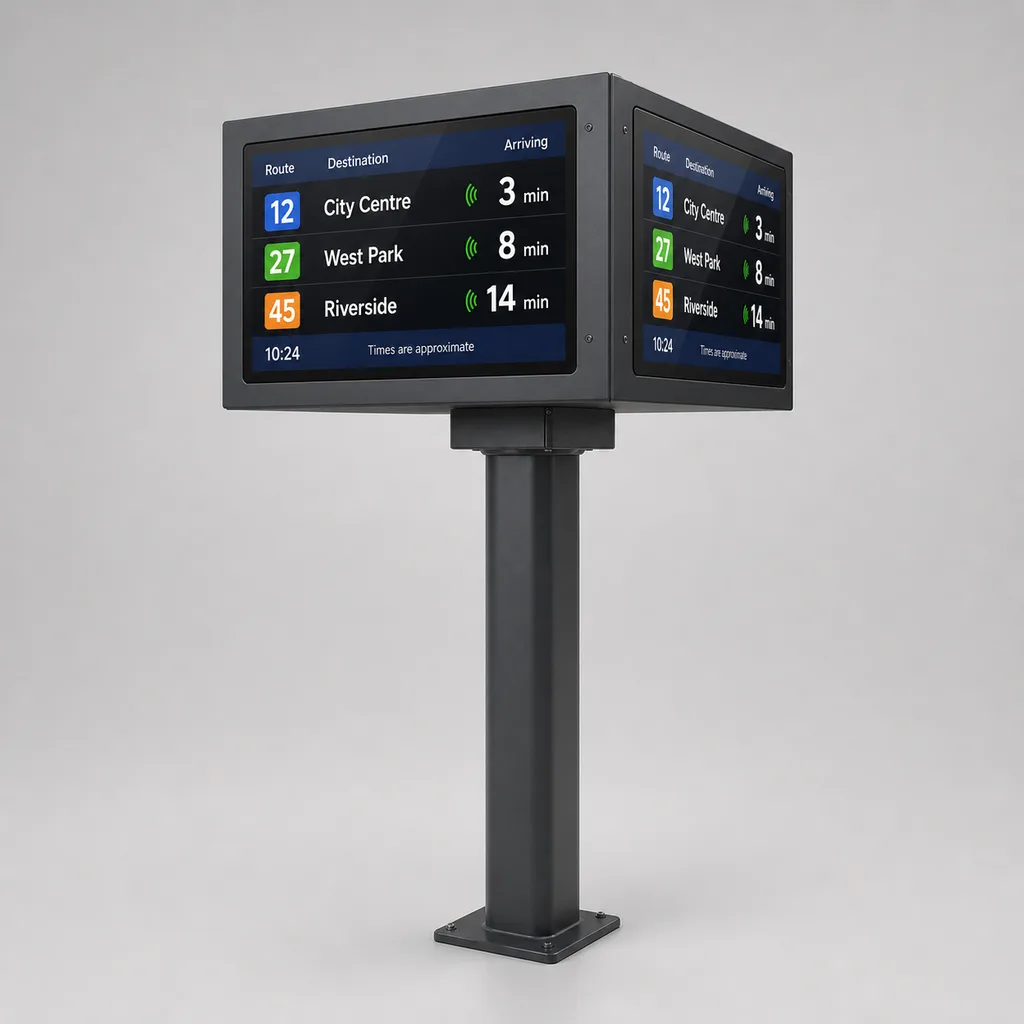
Overview
The REDCOAST.LTD RC-PID-500 is a mains-powered outdoor Passenger Information Display System (PIDS) that delivers real-time arrival, departure, delay and service-alert information to travellers at BRT platforms, tram and bus stops, metro entrances and multimodal interchanges. Deployed in urban and campus environments where grid power is available, it replaces static printed timetables with live, data-driven displays that increase perceived service reliability, reduce passenger uncertainty and support accessibility mandates. Delivered as an end-to-end solution — sunlight-readable display hardware, a central web content-management and data-integration platform, and an operator mobile app — the RC-PID-500 is engineered by REDCOAST.LTD around in-house board-level hardware so the entire chain from live feed to pixel is controllable and project-customisable.
Key Features
- True sunlight readability: high-brightness display (2,500–5,000 nits) with anti-glare, optically-bonded glazing and automatic ambient-light dimming for legibility from bright noon sun to night.
- Live real-time data: native ingestion of GTFS-Realtime and SIRI feeds for arrivals, countdowns, cancellations, platform changes and service disruptions, with graceful fallback to scheduled timetables if a feed drops.
- Two display technologies: choice of ruggedised high-bright TFT LCD (rich graphics, maps, video) or SMD LED matrix (long viewing distance, ultra-wide angle) on the same controller and CMS.
- Audio and accessibility: built-in text-to-speech announcements, push-button "speak" trigger for visually-impaired passengers, hearing-induction loop option and high-contrast/large-font modes aligned with accessibility regulations.
- Edge intelligence: on-board media/data player caches schedules and content, so displays keep counting down and showing timetables even during a network outage.
- Central fleet management: browser-based CMS schedules content, pushes emergency messages network-wide, and monitors the health of every display; role-based operator mobile app for field staff.
- Automatic brightness and thermal control: front-facing lux sensor plus internal temperature-driven fan/heater management protect the panel and cut power at night.
- Cyber-hardened remote management: TLS-encrypted feeds, signed firmware, VPN/APN support and remote diagnostics reduce site visits.
Technical Architecture
At the core of every RC-PID-500 unit is a REDCOAST.LTD-developed edge media/data player mainboard built around an industrial ARM SoC. This board terminates the transit data feeds (GTFS-Realtime, SIRI, or a proprietary operator API over a secure link), renders the passenger-facing layout, drives the display and manages audio. A second REDCOAST-designed board handles the display interface: for the LED variant it is a receiving/driver card that shifts pixel data to the SMD LED modules with per-module calibration; for the TFT variant it is a timing-controller and LED-backlight driver board with local-dimming and constant-current channels. A supervisory power-and-telemetry PCB manages PoE++/AC input, surge protection, the ambient-light sensor, internal temperature, door tamper, and fan/heater outputs, reporting all housekeeping data back over the network.
The data flow is edge-and-cloud collaborative. The central CMS aggregates operator feeds, timetables, media playlists and emergency-message templates, then distributes them to displays over cellular or wired IP. Each display renders locally from cached data, so predictions continue on-screen if connectivity is briefly lost, and re-syncs automatically on reconnection. Health telemetry (brightness, temperature, feed status, uptime) streams back to the platform for proactive maintenance and SLA reporting.
Connectivity & Power
Connectivity is selectable per site. Wired Gigabit Ethernet with PoE++ is preferred inside stations and canopies where structured cabling exists; 4G/5G with an embedded SIM suits distributed street-side stops; Wi-Fi and RS-485/Modbus are available for local integration with shelters, CCTV or lighting. As a grid-powered urban product, the RC-PID-500 runs on mains AC (100–240 V, 50/60 Hz) or is powered entirely over PoE++ for smaller panels — it does not carry a solar array, because it is designed for BRT platforms, station canopies, interchanges and street stops that already have grid or PoE infrastructure. An optional in-cabinet LiFePO4 UPS keeps a display and its announcements alive through short outages where continuity of passenger information is safety-relevant.
Protection & Reliability
Outdoor units are rated IP65 with a die-cast aluminium and steel enclosure, thermally managed for a wide operating range of −30 to +60 °C and high humidity, with anti-condensation heaters for cold and coastal climates. Optically-bonded, laminated safety glazing resists impact, glare and vandalism, and salt-mist-tolerant coatings suit seaside corridors. SMD LEDs are rated 50,000+ hours; with automatic brightness management and proper thermal design, 7–10 year field service lives are achievable before major component replacement. Enclosures use REDCOAST's hot-dip-galvanised-then-powder-coated finish for long outdoor corrosion protection.
Application Scenarios
- BRT trunk-line platforms: median-platform displays show live headways and next-vehicle countdowns, cutting perceived wait time and smoothing boarding on high-frequency corridors.
- Metro and tram entrances: concourse and street-level displays present service status, first/last service and disruption alerts, guiding passengers before they enter fare-paid areas.
- Multimodal interchanges: large-format screens consolidate bus, tram, rail and shuttle departures on one wall, improving transfers between modes.
- Street-side bus stops: compact pole-mounted TFT or LED signs deliver next-bus predictions and city notices at ordinary kerbside stops with grid or PoE feed.
- Campus, airport and hospital shuttles: private-operator interchanges display internal shuttle schedules and wayfinding for staff, patients and visitors.
- Event and stadium egress: temporary or permanent displays broadcast crowd-management and departure guidance during peak dispersal.
Case-style Examples
BRT corridor upgrade: A high-frequency trunk-line operator retrofitted median platforms with double-sided high-bright LED RC-PID-500 units fed by GTFS-Realtime over PoE++ from platform cabinets. Live countdowns and disruption banners reduced passenger complaints about "not knowing when the bus comes" and improved on-platform crowd flow.
Interchange hub deployment: A multimodal interchange installed large TFT wall-mounted displays in the concourse plus pole-mounted units at kerbside bays, all managed from one CMS. Emergency-message broadcast and text-to-speech announcements were integrated for accessibility compliance, and central health monitoring cut reactive maintenance trips.
Street-stop rollout: A city transit authority equipped ordinary kerbside stops with compact PoE-powered TFT signs on existing shelter poles, avoiding solar because grid/PoE was already present — delivering real-time arrivals at a fraction of a full smart-shelter cost.
Customization & Selection Guide
Choose the LED matrix variant for long viewing distances, wide platforms and text-forward countdowns; choose the high-bright TFT variant where graphics, maps, route diagrams or video are needed. Size and pixel pitch scale to viewing distance and budget. For fully-exposed south/west-facing sites specify 4,000–5,000 nits; sheltered canopies can use 1,000–1,500 nits to save energy. Add the UPS option where information continuity is safety-critical, the induction-loop and TTS options where accessibility is mandated, and 4G/5G where structured cabling is unavailable. Mounting is selectable: platform pole, wall/facade, suspended/ceiling, canopy fascia or freestanding totem.
Deployment & After-sales
Units ship pre-configured and pre-addressed to the customer's CMS for rapid on-site commissioning; installation uses standard pole, wall or fascia brackets and a single AC or PoE feed. REDCOAST.LTD provides feed-integration engineering (GTFS-Realtime/SIRI or custom API), CMS setup, operator training, and remote diagnostics with firmware-over-the-air updates. Project lead times, spares packages and multi-year support agreements are scoped per deployment.
Standards & Compliance
Designed toward CE, RoHS and REACH; enclosure ingress protection to IEC 60529 (IP65); ruggedisation guided by MIL-STD-810G (shock, vibration, temperature); EMC to relevant IEC/EN emissions and immunity standards; electrical safety to IEC/EN 62368-1; data integration compliant with GTFS-Realtime and SIRI; accessibility features aligned with common public-transport accessibility guidelines. Exact certifications are confirmed per target market and project.
Why REDCOAST.LTD
REDCOAST.LTD delivers the complete solution — display hardware, data-integration and content-management platform, and operator mobile app — integrated by one team. Because we design our own board-level hardware and open project-specific PCBs (edge player, display driver, power and telemetry boards), we control the full chain from live feed to pixel and can tailor size, brightness, protocol, mounting and enclosure to each corridor, climate and grid environment rather than reselling fixed catalogue parts.
Contact REDCOAST.LTD to specify a passenger information display network tailored to your transit corridors, interchanges and stops.
Specifications
Display
- Technology Options
- High-bright TFT LCD / SMD LED matrix
- TFT Brightness
- 2500-5000 nits
- TFT Panel Sizes
- 21.5 / 32 / 43 / 55 inch
- LED Pixel Pitch
- 1.5-10 mm
- LED Brightness
- up to 7000 nits
- Viewing Angle
- ≥178 °
- Auto Brightness Range
- 5-100 (lux-sensor controlled) %
- LED Rated Life
- 50000+ h
Content & Data
- Edge Processor
- Industrial quad-core ARM SoC
- RAM / Storage
- 2-4 / 16-64 GB
- Real-time Protocols
- GTFS-Realtime, SIRI, custom API
- Offline Cache
- Timetable + content retained on outage
- Text-to-Speech
- Multi-language announcement engine
- Content Scheduling
- Web CMS + mobile app, day-part playlists
Audio & Accessibility
- Speaker Output
- 10-20 W
- Passenger "Speak" Button
- Yes (on-demand TTS)
- Hearing Induction Loop
- Optional
- High-contrast / Large-font Mode
- Yes
Connectivity
- Wired
- Gigabit Ethernet, PoE++ (IEEE 802.3bt)
- Cellular
- 4G LTE / 5G (embedded SIM)
- Wireless
- Wi-Fi 5/6 (2.4/5 GHz)
- Local Bus
- RS-485 / Modbus, digital I/O
- Security
- TLS feeds, signed OTA firmware, VPN/APN
Power (Grid)
- Input Voltage
- AC 100-240 V
- Frequency
- 50/60 Hz
- PoE++ Powering
- Up to 90 (small panels) W
- Power Consumption
- 40-350 (size/brightness dependent) W
- Surge Protection
- AC 4-6 kV, signal 4 kV
- Optional UPS
- LiFePO4 in-cabinet backup
Environmental & Protection
- Ingress Protection
- IP65
- Operating Temperature
- -30 to +60 °C
- Storage Humidity
- 10-95 non-condensing %RH
- Thermal Management
- Fan + anti-condensation heater
- Glazing
- Optically-bonded laminated anti-glare safety glass
- Vibration/Shock
- Guided by MIL-STD-810G
Physical
- Enclosure
- Die-cast aluminium + steel
- Finish
- Hot-dip galvanised + powder-coat
- Mounting
- Pole / wall / suspended / fascia / totem
- Faces
- Single or double-sided
- Design Life
- 7-10 years
Capabilities — configurable per project
Specifications are tailored to each project — the options below show what we can support.
Display Technology
- High-bright TFT LCD
- SMD LED matrix
- E-paper (sheltered low-power)
- Hybrid LED+TFT
Mounting
- Platform pole-mounted
- Wall / facade
- Suspended / ceiling
- Canopy fascia
- Freestanding totem
Power
- Mains AC
- PoE++
- Grid + LiFePO4 UPS backup
Connectivity
- Gigabit Ethernet / PoE++
- 4G/5G
- Wi-Fi
- RS-485/Modbus
Passenger Features
- Text-to-speech announcements
- Hearing induction loop
- QR/NFC live info
- Emergency broadcast override
Related solution guidance
Street Lighting Guide
A practical guide to choosing smart street lighting controllers, connectivity, platform features, dimming logic and acceptance tests.
Smart Street Lighting
Plan an IoT street lighting system with LED luminaires, pole controllers, adaptive dimming, fault alarms, asset management and platform integration.
Power and Connectivity
How to choose power, battery, solar, NB-IoT, LTE, LoRaWAN, gateways and monitoring strategy for outdoor IoT infrastructure.
Frequently Asked Questions
What is a Passenger Information Display System (PIDS)?
A PIDS is a networked system of digital displays that shows travellers real-time transit information such as next-vehicle countdowns, arrivals, departures, delays, platform changes and service alerts. The REDCOAST.LTD RC-PID-500 combines outdoor sunlight-readable displays, a central content-management platform and live data integration into one solution.
How does the display get real-time arrival data?
It natively ingests GTFS-Realtime and SIRI feeds, or a custom operator API, over a secure IP link. The on-board edge player renders countdowns locally and caches the timetable, so predictions keep showing even if the network briefly drops, then re-sync automatically on reconnection.
Is the display readable in direct sunlight?
Yes. The TFT variant runs at 2,500–5,000 nits (LED up to 7,000 nits) with anti-glare, optically-bonded glazing and an ambient-light sensor that auto-dims. This keeps content legible in bright noon sun and reduces power and glare at night.
Is it solar-powered?
No. The RC-PID-500 is a grid-powered urban product designed for BRT platforms, station canopies, interchanges and street stops that already have mains or PoE infrastructure. It runs on AC 100–240 V or PoE++, with an optional LiFePO4 UPS for outage continuity — no solar array is fitted.
Should I choose LED or TFT displays?
Choose SMD LED for long viewing distances, wide platforms and text-forward countdowns with very wide viewing angles. Choose high-bright TFT where graphics, route maps or video are needed. Both run on the same controller and central CMS, so a network can mix technologies.
Does it support accessibility requirements?
Yes. It offers text-to-speech audio announcements, an on-demand passenger 'speak' button for visually-impaired travellers, an optional hearing-induction loop, and high-contrast/large-font display modes aligned with common public-transport accessibility guidelines.
How are displays managed across a whole network?
A browser-based CMS schedules content, pushes emergency messages network-wide and monitors the health of every display, backed by an operator mobile app for field staff. Telemetry such as brightness, temperature and feed status streams back for proactive maintenance.
Can REDCOAST.LTD customise the hardware for our project?
Yes. Because REDCOAST.LTD designs its own edge-player, display-driver and power/telemetry boards, size, pixel pitch, brightness, protocol, mounting, enclosure finish and connectivity are tailored per corridor and climate rather than sold as fixed catalogue parts.