Overview
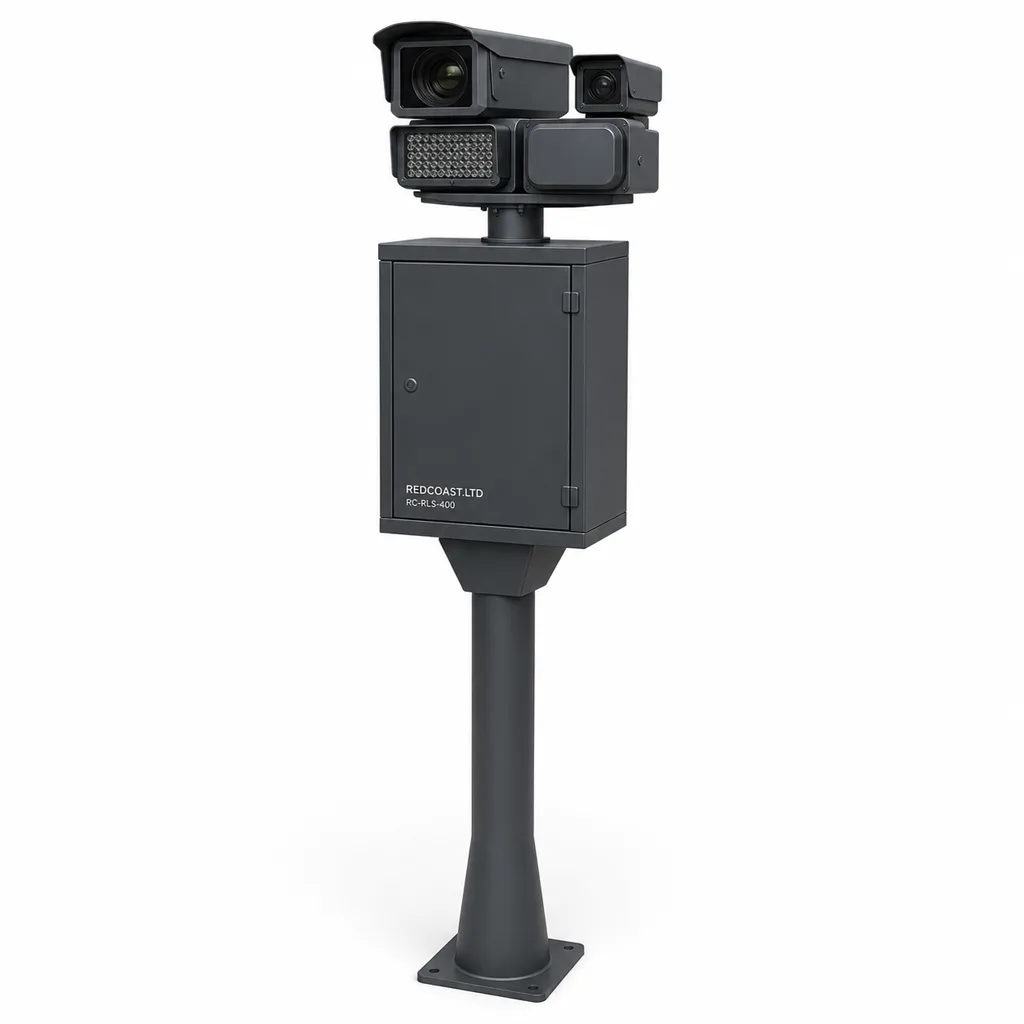
The REDCOAST.LTD RC-RLS-400 Grid-Powered Red Light Running and Speed Enforcement Camera System is an end-to-end intersection enforcement solution engineered for urban arterials, school zones, accident black-spots, and any signalized intersection where running a red light or excessive speed causes serious safety incidents. A single cabinet simultaneously captures, classifies, and produces court-admissible evidence of red-light violations and over-speed events across up to six lanes. It fuses high-resolution machine-vision imaging, type-approval-grade tracking radar, on-device ANPR, and a hardware signal-phase interface into one mains-powered, UPS-backed roadside unit — built end-to-end by REDCOAST.LTD on self-developed PCBs, customized to each project's lane geometry, plate formats, and back-office workflows.
Key Features
- Combined enforcement in one box: Red light running (RLR), stop-line crossing, over-speed, bus-lane infringement, and illegal turning — captured by a single cabinet, no need to deploy multiple stand-alone systems on the same pole.
- Multi-lane, multi-direction coverage: Configurations for 2, 3, 4 or 6 lanes per approach, or two approaches with one gantry-mounted cabinet.
- Type-approval-class metrology: Tracking Doppler radar (24 GHz or 77 GHz) with ±2 km/h accuracy traceable to OIML R-91 / R-115 — evidence holds up in court and survives metrology re-verification.
- High-resolution evidence imaging: 4K / 8 MP global-shutter machine-vision sensor for plate, scene, and driver-side context, paired with a high-output infrared illuminator for 24/7 capture without intrusive visible flash.
- Edge ANPR and AI vehicle classification: REDCOAST.LTD's on-device ANPR engine recognizes EU/UK, GCC/Arabic, LATAM, and ASEAN plate formats at ≥98% read rate; vehicle classification across 7 classes (car, van, light truck, heavy truck, bus, motorcycle, taxi).
- Tamper-evident, signed evidence packets: Each violation is bundled into a digitally signed JSON + JPEG/MP4 packet, hashed with a hardware secure element and time-stamped from a GNSS-disciplined clock — no chain-of-custody disputes.
- Hardware signal-phase tap: Reads red-amber-green phase directly from NEMA TS-2, EN 12675, or NTCIP-compatible signal controllers via an opto-isolated interface — never has to visually guess the lamp state.
- Self-developed PCB stack: Multi-channel radar signal-conditioning board, IR illuminator driver, ANPR edge AI carrier board, and battery-backed UPS management PCB — all designed in-house, all customizable per project.
- Mains-powered with seamless UPS: AC 100–240 V input with a LiFePO4 UPS module sized for ≥4 hours of full operation through grid outages, so evidence is never lost during a brown-out.
- Open back-office integration: Push evidence to your existing Traffic Management Center over REST / SFTP / MQTT, or use REDCOAST.LTD's bundled cloud violation-management portal with operator workflows, ticket issuance, and analytics.
Technical Architecture
RC-RLS-400 is built around three subsystems housed in an IP66 roadside cabinet on a 6–8 m enforcement pole or gantry. The sensor subsystem combines a tracking Doppler radar (24 GHz K-band or 77 GHz), a 4K or 8 MP global-shutter machine-vision camera with motorized varifocal lens, a wider-angle context camera, and an infrared illuminator panel. The radar continuously tracks every vehicle approaching the stop line, returning instantaneous speed, lane, and trajectory; the cameras frame and lock to the offending vehicle the moment an event is triggered.
The processing subsystem is a REDCOAST.LTD self-developed edge AI gateway with an octa-core SoC and a 6 TOPS NPU dedicated to ANPR and vehicle-class inference. The gateway ingests synchronized camera frames and radar tracks, fuses them with the live signal phase pulled directly from the intersection's traffic-signal controller cabinet via a hardware opto-isolated phase tap, and reconstructs each violation as a multi-frame sequence — typically 3–5 evidential stills plus a 5–10 second MP4 clip showing the vehicle before, on, and after the stop line, with plate, speed, lane, and signal phase rendered as legal metadata. All inference runs on the box; no recurring cloud-AI fees, no privacy-sensitive raw video leaves the cabinet.
The integrity and communication subsystem signs each evidence packet using an on-board secure element, time-stamps it from a GNSS-disciplined OCXO, encrypts it at rest in a 1 TB local vault, and forwards it over 4G/5G, gigabit ethernet, or fibre to your back office. A tamper switch, door-open log, and 3-axis accelerometer detect physical interference; any tamper event is logged with photos and pushed to operators in real time.
Connectivity & Power
RC-RLS-400 is mains-powered — the right choice for urban intersections that already have permanent grid feed. Input is AC 100–240 V, 50/60 Hz, protected by a Class II surge arrester (40 kA, Type 2 SPD) and a self-developed LiFePO4 UPS PCB sized for ≥4 hours of full operation through grid disturbances. Steady-state consumption is 65–110 W, peaking briefly during IR illumination cycles.
For backhaul, the cabinet supports 4G LTE Cat-6 or 5G NSA/SA modems (multi-band, region-specific SIM), gigabit ethernet over RJ45 or SFP for fibre/PON connections, and automatic failover between the two. Field-side interfaces include opto-isolated RS-485 / RS-232 (radar, signal-controller phase tap, environmental sensors), 1000Base-T (cameras), and dry-contact I/O (auxiliary devices such as flashing beacons or external strobes). An optional Wi-Fi 6 maintenance access point lets field engineers configure the unit from a tablet without opening the cabinet.
Protection & Reliability
The cabinet is rated IP66 with IK10 impact protection, finished in smooth matte powder-coat (default RAL 7016 anthracite, project-customizable). Operating temperature is -30 to +60 °C with active thermal management; an internal heater enables cold-start down to -40 °C as a project option. Components and finishes are qualified for salt-spray, dust, UV, and humidity — equally suitable for coastal cities, desert highways, tropical urban centres, and high-altitude plateau roads. Critical electronic components are rated for ≥80,000 hours MTBF; the IR illuminator carries an L70 rating of 60,000 hours. A standard 3-year warranty is extendable to 5 or 7 years with SLA tiers.
Application Scenarios
- Urban arterial intersections: Four-to-six-lane signalized junctions where red-light running causes T-bone collisions; RC-RLS-400 replaces legacy film cameras and stand-alone radar units with one converged box.
- School zones: Time-of-day adaptive speed thresholds (e.g., 30 km/h during school hours, 50 km/h otherwise) plus permanent 24/7 red-light enforcement on the same hardware.
- Accident black-spot remediation: Rapid deployment to intersections flagged by safety audits, providing both deterrence and evidence-based prosecution.
- Bus-lane and HOV enforcement: ANPR + lane-assignment logic catches unauthorized vehicles in bus or carpool lanes during restricted hours.
- Protected-turn enforcement: Detection of drivers running protected left/right-turn arrows or filtering into oncoming traffic.
- All-red pedestrian-phase protection: Capture of vehicles entering the crosswalk while a dedicated pedestrian phase is active — a high-political-priority safety use case in many cities.
Case-style Examples
- Urban arterial corridor upgrade: A municipal traffic agency identified eight high-risk intersections along a 12 km arterial corridor where red-light running had caused 40+ injury crashes over two years. RC-RLS-400 cabinets were specified with 4-lane coverage, 77 GHz tracking radar, and direct integration into the legacy NEMA TS-2 controllers already on-site. Within nine months of activation, red-light violations dropped by 71% and serious injury crashes by 38%; all evidence flowed through REDCOAST.LTD's cloud back-office and out to the existing infringement-ticketing system over SFTP.
- School-zone safety roll-out: A regional road authority deployed 24 RC-RLS-400 cabinets at 24 schools, each configured with school-hour adaptive speed thresholds and integrated with school-zone flashing-beacon controllers. Speeding violations during school hours fell by 62% in the first term; the same cabinets continue to enforce red-light violations 24/7 outside school hours, maximizing return on the capital investment.
- Accident black-spot rapid retrofit: After a fatal crash, a city requested urgent enforcement at one intersection. REDCOAST.LTD shipped, installed, and commissioned an RC-RLS-400 cabinet within four weeks, retrofitting onto an existing signal-controller pole foundation. The signed evidence packets were ingested directly by the police-court IT system, and the first prosecution was upheld two months later.
Customization & Selection Guide
- Lanes covered: Pick the variant for 2, 3, 4, or 6 lanes per approach; multi-approach configurations are available for diamond, scissor, and complex urban intersections via a gantry-mount option.
- Speed sensor: Doppler radar (24 GHz) is the cost-effective default; 77 GHz tracking radar adds per-vehicle ID and lane-by-lane tracking; LIDAR is recommended where radar use is regulated (some EU states) or where strict vehicle-by-vehicle attribution is required.
- ANPR regional pack: The ANPR engine ships with EU+UK, GCC/Arabic, LATAM, or ASEAN plate models out of the box; REDCOAST.LTD trains a custom regional plate model for projects with non-standard formats or mixed scripts.
- Cabinet style: Pole-side cabinet for standard intersections, gantry-mounted for wide multi-lane crossings, or compact roadside enclosure for school-zone retrofits.
- Backhaul: 4G LTE or 5G for greenfield deployments; gigabit ethernet/fibre where the city already has dark fibre to the intersection; hybrid for evidence-critical sites.
- Back-office integration: Choose REDCOAST.LTD's bundled cloud violation portal + mobile inspector app, or direct integration into an existing TMC, Smart City platform, or police ticket-issuance system over REST / SFTP / MQTT.
Deployment & After-sales
A typical project moves from contract to live enforcement in 8–12 weeks: 2 weeks for survey, lane mapping, and signal-controller compatibility audit; 4–6 weeks for factory build and factory acceptance test (FAT); 1–2 weeks for installation, signal-phase tap, and on-site radar calibration with type-approval witness if required; a final 1 week for back-office integration and operator training. REDCOAST.LTD provides remote diagnostics, signed firmware OTA, on-site spares, and a structured 3-year warranty extendable to 5 or 7 years with response-time SLAs. Operator and field-engineer training is delivered in English by default, with other languages on request.
Standards & Compliance
Designed for global deployment, RC-RLS-400 targets the relevant standards in each market: OIML R-91 / R-115 for traffic speed measurement, EU MID (Measuring Instruments Directive) where speed evidence is regulated, EN 60068 for environmental qualification, IEC 60529 IP66 for ingress protection, EN 50130-4 for EMC, NEMA TS-2 / EN 12675 / NTCIP 1202 for signal-controller interfacing, and GDPR / local data-privacy law for ANPR data handling. National metrology type approval (e.g., PTB Germany, UTAC France, NMi Netherlands, China NIM, GSO GCC) can be supported through partner test houses on a per-project basis.
Why REDCOAST.LTD
REDCOAST.LTD delivers a complete software + hardware enforcement solution under one roof. Our self-developed PCB capabilities — multi-channel radar signal conditioning, IR illuminator driver, ANPR edge AI carrier, and UPS power management — let us tune each RC-RLS-400 to local plate formats, lane geometry, signal-controller types, and evidence-management workflows that off-the-shelf integrators simply cannot match. Custom enclosure colours (any RAL), custom firmware features, custom back-office integrations, and custom regional plate models are part of the project package, not an extra. Hardware ships factory-calibrated and is delivered together with a turnkey enforcement portal, mobile inspector app, and operator training — so your agency can prosecute violations from day one rather than spending months stitching together third-party components. We have built across grid and off-grid scenarios in equal measure, but for permanent urban intersections we always recommend the mains-powered RC-RLS-400 — it is the right architecture when the grid is already there at the foot of the pole.
Contact REDCOAST.LTD to discuss your enforcement programme. We will spec the exact RC-RLS-400 configuration for your intersections, traffic-signal controllers, ANPR regional pack, and back-office integration, with pilot cabinets ready in as little as 8 weeks.
Specifications
Imaging & Optics
- Main Sensor Resolution
- 8 MP (4096×2160)
- Shutter
- Global shutter CMOS
- Main Lens
- Motorized varifocal, 12.5–50 (8–32 optional) mm
- Frame Rate
- up to 60 fps
- Context Camera
- 4 MP, fixed 6 mm wide-angle
- IR Illuminator
- 850 / 940 nm, range 30–60 m
- Low-Light Sensitivity
- 0.005 (B/W) with IR lux
Speed Measurement (Radar)
- Sensor Type
- Tracking Doppler radar (24 GHz / 77 GHz)
- Speed Range
- 10–250 km/h
- Accuracy
- ±2 km/h (≤100 km/h), ±2% (>100 km/h)
- Detection Range
- up to 80 m
- Lanes Tracked Simultaneously
- up to 6
- Approval Class
- OIML R-91 / R-115 capable
ANPR & Edge AI
- Plate Recognition Rate
- ≥98 %
- Plate Regional Packs
- EU/UK, GCC/Arabic, LATAM, ASEAN, custom
- Vehicle Classes
- 7 (car, van, light truck, HGV, bus, motorcycle, taxi)
- Edge AI
- Octa-core SoC + 6 TOPS NPU
- Local Evidence Vault
- 1 TB encrypted SSD
- Pre/Post-Event Buffer
- 30/30 s
- Time Source
- GNSS-disciplined OCXO, <100 ns
Power & UPS (Grid)
- Input Voltage
- AC 100–240 V
- Frequency
- 50/60 Hz
- Power Consumption (typ.)
- 65–110 W
- Surge Protection
- Class II Type 2 SPD, 40 kA
- UPS Chemistry
- LiFePO4
- UPS Autonomy
- ≥4 h full operation
- UPS Lifespan
- ≥6 years / 3,000 cycles
Connectivity & Backhaul
- Cellular
- 4G LTE Cat-6 or 5G NSA/SA, multi-band
- Wired
- Gigabit Ethernet (RJ45 + SFP)
- Field-Side Serial
- RS-485 / RS-232, opto-isolated
- Signal-Controller Tap
- NEMA TS-2 / EN 12675 / NTCIP 1202
- Maintenance Access
- Wi-Fi 6 (optional)
- Protocols (Back-Office)
- REST / SFTP / MQTT
Mechanical & Protection
- Cabinet IP Rating
- IP66
- Impact Rating
- IK10
- Operating Temperature
- -30 to +60 (-40 option) °C
- Finish
- Smooth matte powder coat, RAL 7016 default (custom RAL on request)
- Pole Height
- 6–8 m
- Tamper Detection
- Door sensor + 3-axis accelerometer
- Cabinet Weight
- 28–42 kg
Capabilities — configurable per project
Specifications are tailored to each project — the options below show what we can support.
Enforcement Type
- Red light + speed combined
- Red light only
- Speed only
- Bus-lane / HOV enforcement
Lanes Covered
- 2-lane
- 3-lane
- 4-lane
- 6-lane
Speed Sensor
- Doppler radar 24 GHz
- Tracking radar 77 GHz
- LIDAR (per regulation)
ANPR Regional Pack
- EU / UK
- GCC / Arabic
- LATAM
- ASEAN / custom
Backhaul
- 4G LTE
- 5G NSA/SA
- Ethernet / fibre
- Hybrid with auto-failover
Related solution guidance
Traffic Safety
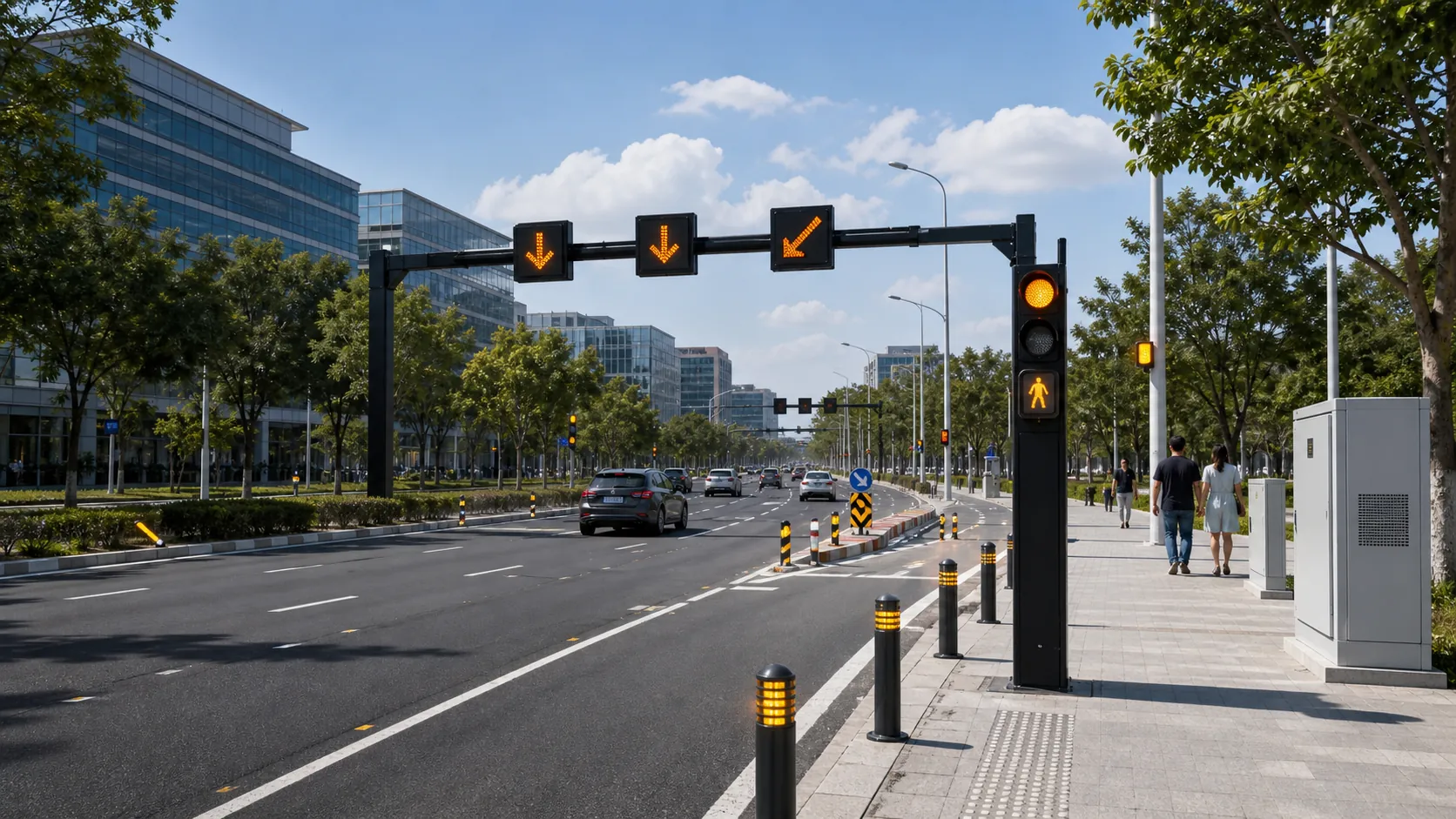
Plan connected traffic safety systems with warning beacons, LED signs, road guidance devices, sensing, control cabinets and monitoring software.
Traffic Safety Checklist
Deployment checklist for connected traffic warning signs, beacons, road guidance devices, power, visibility, monitoring and acceptance tests.
Airports and Hubs
IoT infrastructure for transport hubs: parking guidance, road safety, outdoor lighting, signage, monitoring and operational dashboards.
Frequently Asked Questions
How is RC-RLS-400 different from a regular traffic surveillance camera?
A surveillance camera only records video; RC-RLS-400 is a metrology-grade enforcement system. It combines tracking radar, a global-shutter machine-vision camera, an ANPR engine, and a hardware tap into the intersection's traffic-signal controller, then assembles a tamper-evident, digitally signed evidence packet for each violation. The output is court-admissible legal evidence, not just video footage.
Does RC-RLS-400 need to be wired into the intersection's traffic signal controller?
Yes, and that is by design. The system uses a hardware opto-isolated phase tap compatible with NEMA TS-2, EN 12675, and NTCIP 1202 controllers to read the red-amber-green phase directly. This is far more reliable than visually inferring the lamp state from the camera image, and it is the only architecture accepted by most courts for red-light enforcement evidence.
How accurate is the speed measurement, and is it admissible as legal evidence?
RC-RLS-400 uses a tracking Doppler radar (24 GHz or 77 GHz) with ±2 km/h accuracy up to 100 km/h and ±2% above, traceable to OIML R-91 / R-115. The system is designed to pass national metrology type approval (PTB, UTAC, NMi, NIM, GSO and similar) on a per-project basis, so the speed reading is admissible as legal evidence under the EU Measuring Instruments Directive and equivalent regimes worldwide.
How is evidence protected from tampering?
Each violation packet is hashed and digitally signed by an on-board secure element, time-stamped from a GNSS-disciplined oscillator, then encrypted at rest in a 1 TB local vault before being pushed to the back office. The cabinet has door-open detection, a 3-axis accelerometer, and tamper logs — any physical interference is recorded with photos and pushed to operators in real time.
Up to how many lanes can a single RC-RLS-400 cabinet enforce?
A single cabinet supports 2, 3, 4, or 6 lanes per approach using a tracking radar and a motorized varifocal camera. For very wide multi-lane crossings or two-approach coverage, REDCOAST.LTD offers a gantry-mounted configuration with multiple sensor heads sharing the same processing and UPS subsystems.
Which number plate formats can the ANPR engine read?
RC-RLS-400 ships with regional ANPR packs for EU/UK, GCC/Arabic, LATAM, and ASEAN plates, with ≥98% recognition rate on standard formats. For projects with non-standard plates, mixed Latin/Arabic/local scripts, or unusual layouts, REDCOAST.LTD trains a custom regional plate model as part of the project package.
Can RC-RLS-400 be retrofitted onto existing intersection poles?
Yes. The cabinet and sensor head can be retrofitted onto existing 6–8 m enforcement or signal poles with a flange or band-clamp mount. Typical retrofit installations are commissioned in 4–6 weeks once survey and signal-controller compatibility are confirmed.
Does REDCOAST.LTD provide the back-office portal, or do we integrate with our existing Traffic Management Center?
Either option is supported. REDCOAST.LTD bundles a cloud violation-management portal and mobile inspector app for agencies that need a turnkey deployment. For agencies with an existing TMC, Smart City platform, or police ticket-issuance system, the cabinet pushes signed evidence packets over REST, SFTP, or MQTT — REDCOAST.LTD handles the integration as part of the project.