Overview
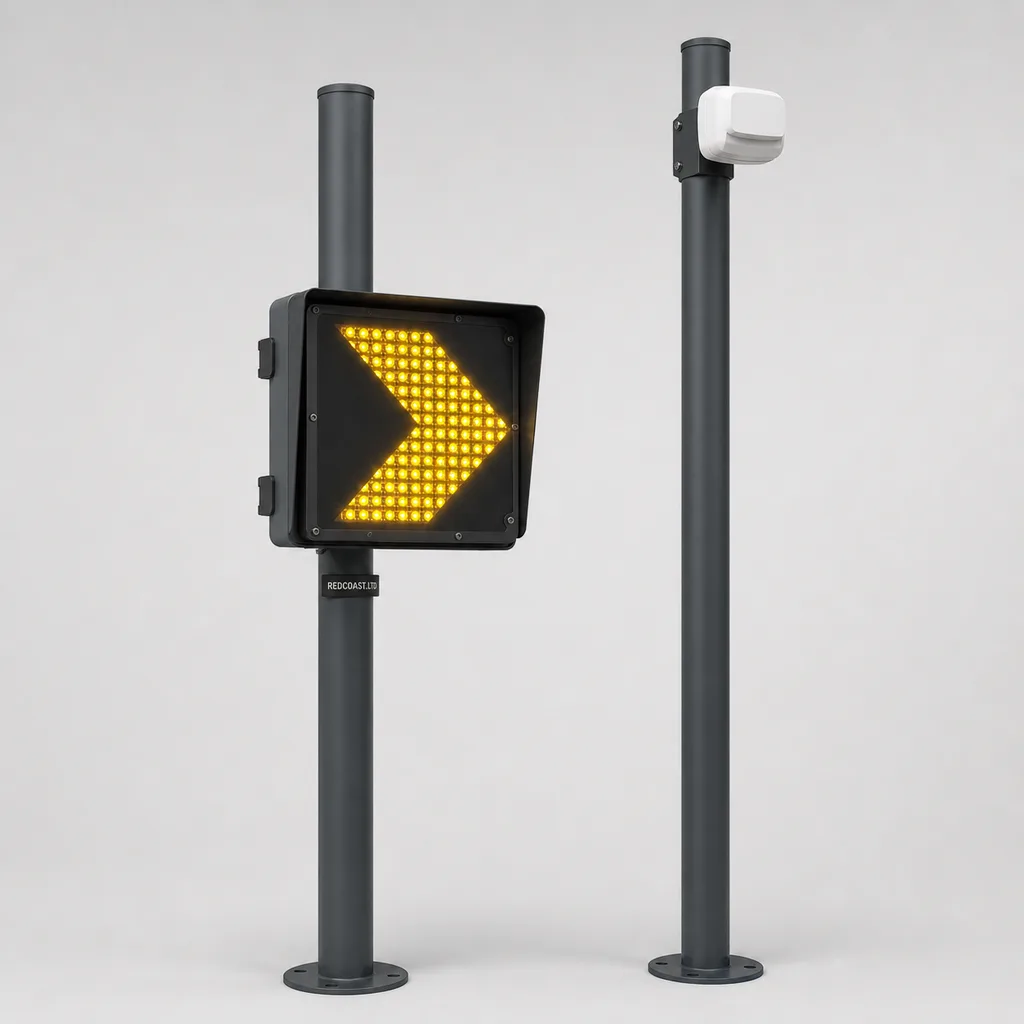
Horizontal curves are persistently overrepresented in run-off-road, head-on, and rollover crash statistics worldwide. Federal Highway Administration (FHWA) evaluations of sequential dynamic chevron systems have associated this treatment with reductions of up to 60% in fatal and injury crashes on treated curves. The REDCOAST.LTD RC-CWS-300 is a grid-powered, vehicle-activated dynamic curve warning system engineered for road authorities, design-build contractors, tunnel operators, and ITS integrators who need a credible, conforming, and fully customizable safety treatment for accident black-spot horizontal curves. Because REDCOAST.LTD designs every critical board in-house — the 24 GHz K-band radar signal-conditioning module, the constant-current LED chevron driver, the NTCIP-ready edge controller, and the supervised mains-power management PCB — the system can be tuned to local MUTCD, EN, or national chevron standards and integrated into existing traffic management centers without being locked to a foreign black-box vendor.
Key Features
- Sequential or simultaneous chevron activation modes, configurable on-site or remotely, compliant with MUTCD §2A.07 flash-rate ranges of 50–60 flashes per minute.
- Self-developed 24.125 GHz K-band radar front-end with multi-vehicle tracking, programmable speed and direction triggers, lane discrimination, and rain/foliage rejection.
- High-intensity SMD3030 LED chevron tiles rated at up to 1,000,000 mcd nominal daylight intensity, with automatic ambient dimming down to 5% at night to avoid driver glare.
- Synchronized sub-GHz wireless mesh coordinates up to 16 chevron units along a single curve — well beyond the 10-unit benchmark of typical North American systems.
- Mains-fed AC 100–240 V input with integrated wide-input SMPS, surge-protected to Class II 10 kA, and an optional 4-hour LiFePO4 UPS for ride-through during grid sags and short outages.
- IP66 / IK10 die-cast aluminum enclosures with smooth matte powder-coated finish (RAL 7016 anthracite default), qualified for tropical, coastal, alpine, and desert deployments.
- NTCIP 1203 / 1206 compatible edge controller with REST and MQTT APIs for direct integration with municipal or motorway traffic management centers.
- Optional integrated ANPR/AI camera module for crash data collection, dwell-time analytics, and operational dashboards.
- Centralized REDCOAST CMS web portal and mobile App for fault notifications, OTA firmware updates, scheduled patterns, and full audit logs of activation events.
- Modular field-replaceable chevron tiles for fast post-incident restoration without dismounting the whole assembly.
Technical Architecture
The RC-CWS-300 is built around three REDCOAST.LTD self-developed PCBs and a ruggedized aluminum chevron tile family. The radar trigger PCB carries a 24.125 GHz K-band module with custom analog conditioning, a digital signal processor for FFT and CFAR target detection, and a 32-bit MCU that publishes per-vehicle speed, range, lane estimate, and direction to the edge controller. Detection envelopes are software-shaped: for downhill curves with long sight distance, the activation zone can extend out to 250 m to give drivers time to react; for short interchange ramps, it can be tightened to 30 m to avoid spurious activations from cross-traffic or oncoming lanes.
The constant-current chevron driver PCB drives high-power SMD3030 white or DOT-yellow LED tiles with closed-loop dimming, per-string short and open detection, and per-channel current trimming so that aging tiles can be color- and intensity-matched without field replacement. Each chevron unit hosts an ARM Cortex-A53 quad-core edge controller running a hardened Linux that handles sequencing logic, NTCIP messaging, time synchronization, and on-site event logging. A sub-GHz wireless mesh links the radar master to all downstream chevrons with sub-50 ms latency, which keeps the visual chase effect crisp even on long compound curves. Time synchronization across the mesh is anchored to a 1-PPS GNSS pulse on the master radar pole, ensuring that the leading chevron lights up first and the cascade visibly tracks the driver through the curve. All activation events, fault states, vehicle counts, and 85th-percentile speeds are buffered locally and uplinked over 4G LTE Cat-4 (5G NR optional) to the REDCOAST CMS for the road authority's operations team.
Connectivity & Power
Each pole is fed from AC 100–240 V mains via the internal supervised power management PCB, which integrates a Class II 10 kA 8/20 µs surge protection device, residual-current monitoring, ground-fault detection, and per-unit energy metering reported back to the CMS. A LiFePO4 UPS module rated for four hours of full operation is offered as a factory option for sites prone to brown-outs or where road operators require continuity through scheduled maintenance outages. The system is grid-default because curve safety treatments are deployed where road, electricity, and signage already coexist — typical sites are urban arterials, suburban interchanges, mountain pass roads with adjacent service power, and tunnel approach zones. For genuinely remote off-grid sites, REDCOAST.LTD can substitute the AC input with a solar/MPPT module as a configured variant rather than a default. Backhaul uses 4G LTE Cat-4 with optional 5G NR or fiber on the master pole; chevron units talk to the master over the sub-GHz mesh. RS-485 and CAN buses are exposed for legacy traffic-cabinet interfacing.
Protection & Reliability
The aluminum housings are pretreated, primed, and finished with smooth matte powder coating (RAL 7016 anthracite by default; white, traffic-yellow, and custom RAL on request) for the long surface life needed in coastal and tropical climates. Each unit is qualified to IP66, IK10, the IEC 60068-2-52 salt-spray cycle, and the IEC 60068-2-30 damp-heat cycle. Operating temperature is rated −40 to +70 °C, sufficient for Scandinavian winters and Middle Eastern roadside summers. MTBF target for the LED chevron tile exceeds 70,000 hours; the LEDs themselves are nominal 100,000-hour units derated to 60% drive current to maintain sustained brightness across a 10-year service life. Survival wind load is 60 m/s, with mounting hardware qualified for cyclonic-zone deployment.
Application Scenarios
- Accident black-spot horizontal curves on rural two-lane highways: paired with static chevron post-mounted signs to alert drivers descending into tight curves, especially at night and in fog.
- Interchange off-ramps and tight loop ramps: where excessive entry speed is the dominant single-vehicle crash factor.
- Urban arterial reverse and compound curves: where surrounding land use creates visual clutter and standard static chevrons get lost against the background.
- Mountain pass and switchback descents: combined with grade and brake-cool advisory signs to reinforce a consistent speed-reduction message.
- Tunnel approach curves: synchronized with tunnel entry lighting (REDCOAST.LTD's CIE 88 tunnel lighting platform) to manage adaptation contrast for entering drivers.
- Industrial and mining haul roads: where loaded heavy vehicles benefit from a clearly cascaded visual guidance pattern at sharp curves.
Case-style Examples
Urban arterial reverse curve, mains-powered retrofit (8 chevrons). A municipal road authority faced repeated rear-end and run-off-road crashes on an S-curve between two signalized intersections. RC-CWS-300 was installed on existing 6 m streetlight poles tapped from the same 220 V feeder. Eight chevron units sequenced at 110 ms intervals, triggered only when vehicles exceeded the posted 60 km/h advisory by more than 5 km/h. After-deployment data showed the mean 85th-percentile speed dropping by 11 km/h and a measurable reduction in conflict events recorded by the integrated AI camera.
Mountain descent with frequent fog (14 chevrons). On a winding mountain road with limited sight distance, a design-build contractor specified RC-CWS-300 with the integrated fog/visibility sensor option and the 4-hour LiFePO4 UPS. The system activates whenever radar detects approaching vehicles, and continuously whenever fog visibility falls below 200 m, providing chase-pattern guidance through the corner even with no vehicles in the radar zone.
Interchange off-ramp at an international airport (6 chevrons). An airport land-side authority retrofitted a tight loop ramp with RC-CWS-300 tied directly into its existing ITS NTCIP back-end. Sequential activation, paired with a static curve advisory speed sign, helped curb single-vehicle ramp departures in the first six months of operation.
Customization & Selection Guide
- For single short curves, choose a 4–6 unit kit with a single radar trigger pole.
- For long compound or reverse curves, specify 8–16 units with a mesh extender and dual radar triggers at each entry direction.
- For sites with poor grid quality, add the LiFePO4 UPS option and the supervised energy-metering reporting package.
- For operations centers that want data, add the AI ANPR camera and the curve-speed analytics dashboard.
- For bilingual or specific MUTCD / EN / national visual standards, REDCOAST.LTD adapts tile geometry, LED color, and flash pattern to local code at the design stage.
- For tunnel approaches, bundle with REDCOAST.LTD's CIE 88 tunnel lighting controller for coordinated adaptation control.
Deployment & After-sales
Each system ships as a pre-commissioned kit: radar master pole, chevron units, mounting hardware, terminations, factory-tested mesh keys, and a USB commissioning dongle. On-site commissioning is typically completed in one shift per kilometer of curve by a two-person crew, with REDCOAST.LTD engineers available for remote commissioning support and acceptance testing. Standard warranty is 12 months and is extendable to 5 years; a spare-tile stock-and-swap program is available for road authorities operating large fleets across multiple corridors.
Standards & Compliance
- MUTCD §2A.07 (flash rate) and §2C Curve Warning chapter compatibility for North America.
- EN 12966 (variable message signs, photometric and colorimetric) referenced for chevron tile photometric performance.
- IEC 60529 IP66, IEC 62262 IK10, IEC 60068-2-52 salt-spray, IEC 60068-2-30 damp-heat.
- CE, RoHS, FCC Part 15 / R&TTE radio approvals for the 24 GHz K-band radar.
- NTCIP 1203 / 1206 for traffic management center integration.
- Designed for compliance review against national curve signing codes (e.g., AS 1742.2, BS EN 12899) on request.
Why REDCOAST.LTD
REDCOAST.LTD delivers an end-to-end smart-IoT solution — hardware, web platform, and mobile App — built on PCBs we draw, assemble, and stand behind ourselves. Because the K-band radar conditioning, LED chevron driver, supervised power management, and edge controller are all in-house designs, we can adapt photometric output, flash pattern, radar zone shaping, sequencing logic, and protocol bindings to a project's specific road geometry, signage code, and traffic-management back end. That is the difference between a stock chevron set sold off a catalog and a curve treatment that fits the actual site, the actual code, and the actual operations team.
Contact REDCOAST.LTD with your curve geometry, advisory speed, and grid availability — we will return a sized configuration, a photometric simulation, an NTCIP integration plan, and an indicative project price.
Specifications
Vehicle Detection (Radar)
- Operating Frequency
- 24.125 GHz K-band
- Detection Range
- 5-250 (configurable) m
- Speed Measurement Range
- 0-250 km/h
- Speed Accuracy
- ±2 km/h
- Lane Discrimination
- 1-4 lanes
- Trigger Latency
- <80 ms
- Direction Filtering
- Approaching / Departing / Both
- Radio Approval
- FCC Part 15, EN 300 440
LED Chevron Display
- LED Type
- High-power SMD3030
- LEDs per Tile
- 80-160 (size-dependent) pcs
- Nominal Daylight Intensity
- up to 1,000,000 mcd
- LED Color Options
- White / DOT Yellow / Bi-color
- Flash Rate
- 50-60 (MUTCD §2A.07) fpm
- On-time Configurable
- 100-1000 ms
- Ambient Auto-Dimming Range
- 5-100 %
- Rated LED Life
- 100,000 h
Edge Controller
- CPU
- ARM Cortex-A53 quad-core, 1.5 GHz
- RAM / Storage
- 2 GB DDR4 / 32 GB eMMC + microSD
- Operating System
- Hardened Linux with OTA
- Time Sync
- GNSS 1-PPS + NTP
- ITS Protocols
- NTCIP 1203 / 1206, MQTT, REST, RS-485, CAN
- Local Event Logging
- 90 days
- Max Units per Coordinated Curve
- 16
Connectivity & Backhaul
- Master Backhaul
- 4G LTE Cat-4 (5G NR / Fiber optional)
- Inter-unit Mesh
- Sub-GHz LoRa, AES-128
- Mesh End-to-end Latency
- <50 ms
- Mesh Hop Range (LOS)
- up to 1.5 km
- GNSS
- Multi-constellation (GPS / Galileo / GLONASS / BeiDou)
- Legacy Bus
- RS-485, CAN
Power (Grid-default)
- Input
- AC 100-240, 50/60 V / Hz
- Surge Protection
- Class II, 10 kA 8/20 µs
- Chevron Unit Consumption (typical)
- 25 (at 50% intensity) W
- Chevron Unit Consumption (peak)
- 70 (full intensity) W
- Master Pole Consumption
- 15 (radar + controller + mesh) W avg
- Standby per Unit
- <5 W
- Optional UPS
- LiFePO4, 4-hour autonomy
- Energy Metering
- Per-unit, reported to CMS
Enclosure & Mechanical
- Housing
- Die-cast aluminum, smooth matte powder coat
- Default Finish
- RAL 7016 anthracite (custom RAL on request)
- IP / IK Rating
- IP66 / IK10
- Chevron Tile Sizes
- 600×450 / 750×600 / 900×750 mm
- Mounting
- Pole (Ø60-120 mm), L-bracket, gantry
- Weight per Tile
- 6-14 kg
- Survival Wind Load
- 60 m/s
Environmental & Standards
- Operating Temperature
- -40 to +70 °C
- Storage Temperature
- -50 to +85 °C
- Humidity
- 5-95 non-condensing %RH
- Altitude
- up to 4500 m
- Salt Spray
- IEC 60068-2-52
- Damp Heat
- IEC 60068-2-30
- Certifications
- CE, RoHS, FCC
- Standards Alignment
- MUTCD §2A.07/§2C, EN 12966, NTCIP 1203/1206
Capabilities — configurable per project
Specifications are tailored to each project — the options below show what we can support.
Chevron Tile Size
- 600×450 mm
- 750×600 mm
- 900×750 mm
- Custom geometry to local sign code
LED Color
- White (high contrast)
- DOT Yellow
- Bi-color (day/night switch)
Power Source
- Grid AC (default)
- Grid + LiFePO4 UPS
- Off-grid Solar + MPPT variant
Backhaul
- 4G LTE Cat-4
- 5G NR
- Fiber Ethernet
- Sub-GHz mesh only (private network)
Trigger Logic
- Always-on schedule
- Vehicle-activated radar
- Fog / visibility-activated
- Combined radar + visibility
- TMC remote command (NTCIP)
Optional Add-ons
- AI ANPR camera + analytics
- Fog / visibility sensor
- Pavement temperature sensor
- Static chevron post integration
- Tunnel-lighting coordination interlock
Related solution guidance
Traffic Safety Checklist
Deployment checklist for connected traffic warning signs, beacons, road guidance devices, power, visibility, monitoring and acceptance tests.
Traffic Safety
Plan connected traffic safety systems with warning beacons, LED signs, road guidance devices, sensing, control cabinets and monitoring software.
Airports and Hubs
IoT infrastructure for transport hubs: parking guidance, road safety, outdoor lighting, signage, monitoring and operational dashboards.
Frequently Asked Questions
What is a sequential dynamic curve warning system and how does it reduce crashes?
A sequential dynamic curve warning system (SDCWS) is a chain of LED chevron tiles installed through a horizontal curve that flash in sequence to chase the driver through the curve. It is triggered by a radar detector that watches for approaching vehicles, often filtered by speed. FHWA evaluations have linked this treatment to reductions of up to 60% in fatal and injury crashes on treated curves.
Does the RC-CWS-300 require mains power, or can it operate off-grid?
The RC-CWS-300 is grid-default and ships with an AC 100–240 V input designed for sites where service power is already available — urban arterials, interchanges, tunnel approaches, and mountain roads with adjacent grid. For genuinely remote installations, REDCOAST.LTD offers a solar/MPPT variant of the same chevron and controller, but mains is the recommended configuration.
How many chevrons can be coordinated on one curve?
Up to 16 chevron units can be coordinated on a single curve over the sub-GHz mesh, with end-to-end activation latency below 50 ms. This supports long compound and reverse curves common on mountain and arterial geometries.
What standards does the system conform to for use in different markets?
Flash-rate and signal behavior align with MUTCD §2A.07 and the §2C Curve Warning chapter for North American projects, while photometric and colorimetric performance is referenced against EN 12966 for European projects. Communications are NTCIP 1203 / 1206 compatible, the system carries CE, RoHS, and FCC marks, and the radar module is approved under FCC Part 15 / EN 300 440.
Can the system integrate with our existing traffic management center?
Yes. The edge controller exposes NTCIP 1203 / 1206, REST, and MQTT, plus RS-485 and CAN for legacy traffic cabinets. Activation events, fault states, vehicle counts, and 85th-percentile speeds are uplinked to the REDCOAST.LTD CMS and can be forwarded to a customer TMC, ATMS, or third-party ITS platform.
How does the radar avoid false activations from oncoming or cross-traffic vehicles?
The 24 GHz K-band radar PCB tracks per-target speed, range, and direction simultaneously. The activation zone is shaped in software for each site — narrowed to a single approach direction, restricted to the relevant lanes, and gated on a configurable speed threshold — so oncoming vehicles, cross-traffic, and slow-moving farm equipment do not trigger the chevron chase.
What is the typical installation time and warranty?
A typical kit is commissioned in one shift per kilometer of curve by a two-person crew, using pre-paired mesh keys and a USB commissioning dongle. Standard warranty is 12 months and is extendable to 5 years, with a spare-tile stock-and-swap program available for road authorities operating large fleets.
Can REDCOAST.LTD customize the chevron geometry, colors, and flash logic for our country code?
Yes — this is a core REDCOAST.LTD differentiator. Because the LED driver, radar conditioning, and edge controller are in-house designs, we adapt tile geometry, LED color (white / DOT yellow / bi-color), flash pattern, sequencing logic, and protocol bindings at the design stage to fit local sign codes such as MUTCD, EN 12899, AS 1742.2, or national equivalents.