Overview
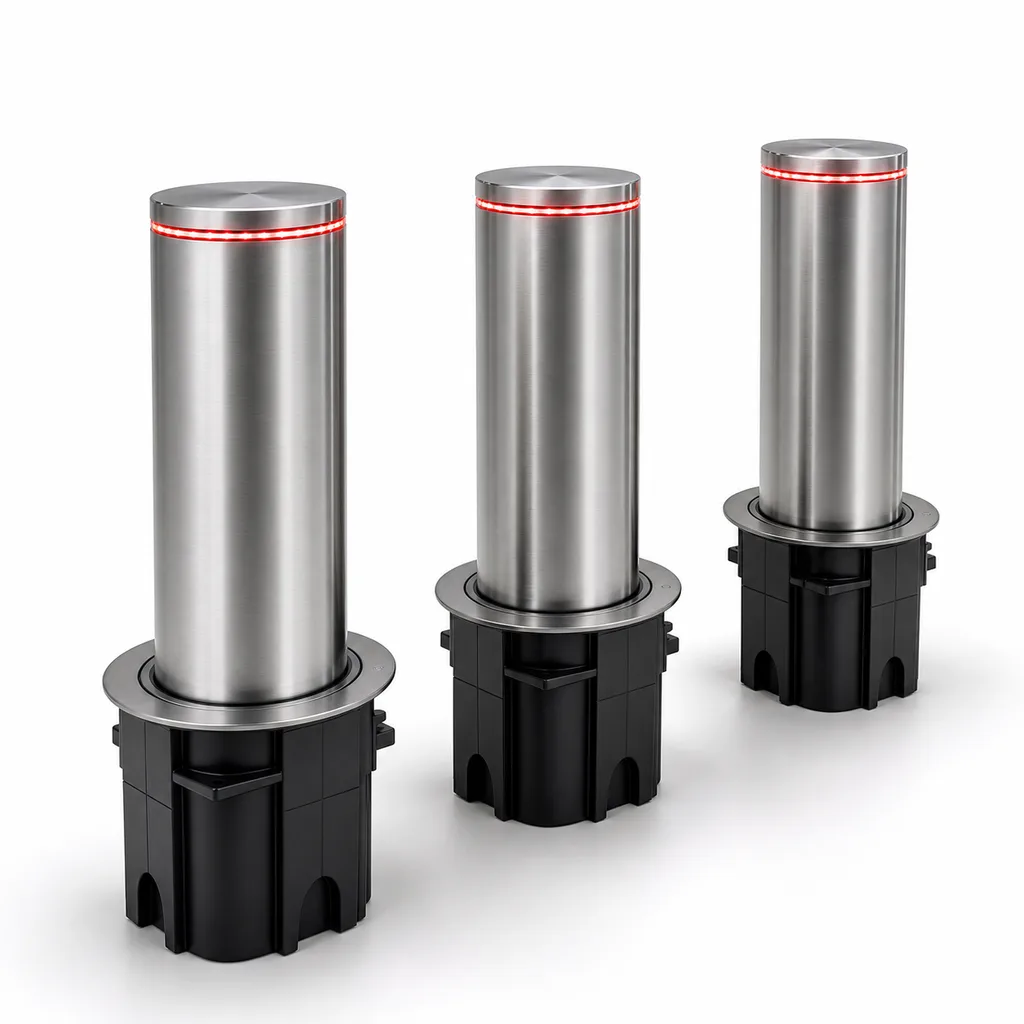
The RC-BOL-HVM350 is a grid-powered intelligent automatic rising bollard system designed for urban vehicle access control and Hostile Vehicle Mitigation (HVM). It combines a crash-rated mechanical bollard, a hydraulic or electromechanical drive, an LED safety warning ring, a smart access controller and an IoT gateway into one project-deployable platform. Cities, governments, hotels, embassies, airports, stadiums and high-end commercial plazas use it to selectively allow authorised vehicles into pedestrian-only or restricted zones while physically stopping unauthorised or hostile vehicles. The system is engineered to integrate seamlessly with ANPR cameras, RFID readers, intercoms, traffic lights and city command platforms, and is delivered as a complete end-to-end solution — hardware, web management portal and mobile App — by REDCOAST.LTD, with the core PCBs (motor controller, LED warning driver, IoT gateway) designed in-house and adapted per project.
Key Features
- Crash-rated versions available up to PAS 68 / IWA 14-1 / ASTM F2656 M50/K12 (stops a 7.2 t truck at 80 km/h) for true HVM protection.
- Three drive options: hydraulic (high cycle, EFO emergency fast operation), electromechanical (oil-free, low maintenance) and semi-automatic, selectable by project.
- Emergency Fast Operation (EFO) rise time as fast as 0.6–1.5 s for anti-terror lockdown of an entry point.
- Integrated LED safety warning ring (red/green/amber, programmable patterns) driven by REDCOAST's in-house constant-current LED PCB.
- Built-in inductive loop interface, photocell safety beam interface and ground radar interface to prevent dropping on vehicles, pedestrians or animals.
- Smart access control: RFID/UHF cards, ANPR (license plate recognition), mobile App QR, intercom with operator, and time-window scheduling.
- Cloud + edge IoT gateway with remote diagnostics, cycle counting, predictive maintenance alerts and integration with Smart City / VMS / SCADA platforms.
- Operates from standard grid AC supply with battery backup for EFO and safe-state operation during outages — no solar panel, suitable for urban infrastructure.
- Stainless steel sleeves (AISI 304/316) with powder-coated or fluorocarbon-painted housing for long-term corrosion resistance in coastal and polluted environments.
- All-weather operation: -30 °C to +60 °C standard, optional heater kit for -40 °C climates.
Technical Architecture
The RC-BOL-HVM350 is a layered system. At the bottom of the pit, the drive module (hydraulic power unit with custom-tuned valves, or a brushless electromechanical actuator with planetary gearbox) raises and lowers the bollard sleeve. The drive is controlled by REDCOAST's in-house Motor Drive Controller PCB, which manages soft-start ramping, current limiting, end-stop sensing, anti-jam detection, EFO triggering and oil-temperature / motor-temperature monitoring. Position is read via a magnetic Hall-effect sensor array, eliminating mechanical limit switches that wear out.
The Top Cap PCB integrates the LED warning ring driver, dual-channel safety photocell input, and a CAN-bus link to the underground drive board. The LED ring uses 24 V constant-current segments to display state animations (rising, falling, locked-up, locked-down, fault), aligned with EN 12368 visibility requirements for traffic devices.
A centralised Cabinet Controller — installed in a roadside IP55 stainless cabinet — hosts the Access Logic Board, the IoT Gateway and an industrial-grade 24 VDC / 48 VDC power supply. The Access Logic Board interfaces with inductive vehicle loops, ground radar, ANPR camera RS-485/IP triggers, RFID/UHF readers, GSM intercom and dry-contact inputs from gate barriers or traffic signals. The IoT Gateway runs an edge agent that streams telemetry (cycle counts, drive current, oil temperature, fault codes, geofence events) to the REDCOAST cloud or to the customer's existing Smart City / building management platform via MQTT, REST or BACnet. Updates are deployed OTA, and field engineers can diagnose remotely.
For sites with multiple bollards (typical for a pedestrian street entrance), one Cabinet Controller manages 1–8 bollards on a CAN/RS-485 daisy chain, synchronising rise/fall as a single group.
Connectivity & Power
The system is grid-powered from a standard AC 100–240 V / 50–60 Hz feed routed to the roadside cabinet. A 7 Ah / 12 Ah sealed lead-acid or LiFePO4 backup battery inside the cabinet supports at least one full EFO cycle and a safe lock-up / lock-down position transition during power outages. No solar panel is fitted — this is an urban infrastructure product designed to live on the city grid.
Connectivity is selectable per project: native 4G LTE or 5G (with global-band modem), wired Ethernet for sites with fibre, NB-IoT for telemetry-only deployments, and LoRaWAN for campus mesh integration. All variants support local Modbus-TCP and a REST API for SCADA / VMS / city platform integration.
Protection & Reliability
- Drive module: IP68 (continuous submersion) — designed for pit flooding without failure, with stainless drainage and a sump-pump option for low-lying sites.
- Cabinet: IP55 stainless 304/316, ventilated, with surge protection on AC mains and on every external signal line.
- Operating temperature: -30 °C to +60 °C standard; optional -40 °C cold-climate kit (cabinet heater, low-viscosity hydraulic oil); humidity 0–100% RH.
- MTBF target: 2,000,000+ cycles for the electromechanical drive; 1,000,000+ for the hydraulic drive (sector benchmark).
- Salt-spray tested housings for coastal deployments; AISI 316 sleeve option for marine air.
- Fail-safe modes selectable: Fail-Safe-Down (free passage if power lost) or Fail-Secure-Up (perimeter locked if power lost) — configurable on commissioning, important for embassies, military and critical infrastructure.
Application Scenarios
- Pedestrian streets and historic city centres — protect car-free shopping streets while letting delivery vans in during scheduled time windows; the bollards drop on schedule or on ANPR-whitelist.
- Government buildings, embassies and consulates — full M50/K12 HVM protection at perimeter entrances; EFO lockdown can be triggered from the guard room.
- 5-star hotels, resorts and gated residential complexes — discrete-looking stainless bollards control VIP / guest entry with App QR or RFID, with intercom escalation to reception.
- Airports, train stations and transit terminals — kerbside and forecourt anti-ram protection, integrated with traffic lights and ANPR.
- Stadiums, arenas and event venues — temporary lockdown of perimeter during matches and concerts; reopen automatically after the event.
- Industrial parks, logistics hubs and bus depots — automated truck and bus access with weight loops and ANPR.
Case-style Examples
Pedestrian high street retrofit. A historic shopping street suffered from constant illegal car entry that endangered pedestrians and damaged the public realm. Three RC-BOL-HVM350 bollards were installed at each end (six total), with an M30 crash rating, ANPR + RFID for licensed delivery vehicles, scheduled drop windows 05:00–08:00, intercom for taxis, and an LED warning ring synchronised with an audible alarm. Unauthorised entries dropped to zero; deliveries became orderly and time-bounded.
Government perimeter HVM upgrade. A ministry compound required PAS 68 M50 protection without disrupting daily staff and visitor flow. A nine-bollard array with hydraulic EFO (1.0 s rise) was integrated with the existing card-access turnstile control system and the building's command room, with Fail-Secure-Up logic. The REDCOAST IoT gateway pushed cycle counts and predictive-maintenance alerts to the facilities team, eliminating surprise downtime.
Hotel forecourt access control. A waterfront luxury hotel needed to keep its arrival drive elegant while controlling vehicle access. Slim 220 mm stainless bollards (a lighter traffic-control variant of the same platform) were installed with a flush-finish top cap, App QR for VIP arrivals, ANPR for staff and supplier vehicles, and a discrete LED ring that turned green only when authorised — preserving the aesthetic of the entrance.
Customization & Selection Guide
Choose the crash rating that matches the threat: M30/K4 for traffic control where forced ramming is unlikely, M40/K8 for moderate-threat sites, M50/K12 for embassies / government / critical infrastructure. Choose the drive based on duty cycle: hydraulic for high cycle counts and EFO-critical sites, electromechanical for lower-cycle sites where oil-free operation is preferred. Diameters from 220 mm (slim traffic-control style) to 350 mm (full HVM) are available; rise height 600–1200 mm depending on the threat profile. Finishes: brushed stainless, mirror polished, powder-coated to any RAL colour, or fluorocarbon paint for harsh coastal environments. Access methods can be mixed — ANPR plus RFID plus App plus intercom — and assigned per time slot.
Deployment & After-sales
REDCOAST.LTD delivers the bollard system as a complete project: civil works drawings (pit dimensions, drainage, conduit routing), bollard hardware, control cabinet, web management portal and mobile App, with on-site commissioning available. Typical lead time after spec-freeze is 6–10 weeks depending on crash rating and quantity. Warranty is 24 months on the drive module and electronics, with remote diagnostics included for the warranty period. An optional service contract extends remote monitoring, preventive site visits and spare-part SLAs for the operational life of the asset.
Standards & Compliance
The RC-BOL-HVM350 is engineered toward PAS 68 (UK), IWA 14-1 (ISO), ASTM F2656 (US) crash-test references, EN 12368 for the LED traffic indicator, EN 12453 for safety in power-operated doors and gates (as a reference for safety logic), CE / RoHS / REACH for the EU, and IEC 60529 IP68 / IP55 for ingress protection. The hydraulic system can be designed to comply with EN ISO 4413. The IoT stack supports TLS-encrypted MQTT and signed OTA updates, aligned with current OT/IT cybersecurity expectations.
Why REDCOAST.LTD
REDCOAST.LTD is an end-to-end smart-IoT solution provider for outdoor public infrastructure. We deliver hardware + Web management platform + mobile App as one integrated system, by one team, tailored to each project. Because the core PCBs of this product — the motor drive controller, the LED warning driver, the access logic board and the IoT gateway — are designed in-house, we can re-spin firmware, change I/O, adapt to local crash-rating verification, and integrate with whatever city / building platform the customer already runs, instead of being locked to a third-party module. That makes us the right partner for governments, integrators and high-end developers who need a bollard system that fits their exact site, exact threat model and exact existing IT stack.
Talk to us about your site survey, threat profile and integration requirements, and we will scope an RC-BOL-HVM350 configuration tailored to your project.
Specifications
Bollard Mechanical
- Sleeve Diameter
- 220 / 275 / 350 mm
- Rise Height
- 600-1200 mm
- Sleeve Material
- AISI 304 / AISI 316 stainless steel
- Wall Thickness (HVM grade)
- 10-20 mm
- Finish
- Brushed / Mirror polished / Powder-coated RAL / Fluorocarbon paint
- Reflective Banding
- Class 1 retro-reflective EN 12899
Drive System
- Drive Type
- Hydraulic / Electromechanical / Semi-automatic
- Standard Rise Time
- 3-6 s
- EFO Emergency Rise Time
- 0.6-1.5 s
- Standard Fall Time
- 2-4 s
- Duty Cycle
- Up to 100% (continuous-rated drive)
- Cycle Life
- 1,000,000-2,000,000+ cycles
- Hydraulic Pressure (HPU)
- 120-180 bar
- Manual Override
- Hex-key drop + hand pump
Crash Resistance & Security
- PAS 68 Rating (option)
- V/7500[N3]/48/90:0/0 up to V/7500[N3]/80/90:0/0
- IWA 14-1 Rating (option)
- V/7200[N3C]/48 to V/7200[N3C]/80
- ASTM F2656 Rating (option)
- M30 / M40 / M50 (K4 / K8 / K12 equivalent)
- Penetration after impact
- <1 (P1) typical for M50 m
- Fail-Mode
- Fail-Secure-Up / Fail-Safe-Down (selectable)
Lighting & Indication
- Top LED Ring
- Red / Green / Amber programmable
- LED Driver
- REDCOAST in-house constant-current PCB
- Visibility Standard
- EN 12368 compliant
- Audible Warning
- 85 dB @ 1 m piezo buzzer (optional)
- LED Lifetime
- >50,000 h
Control & Connectivity
- Access Methods
- ANPR / RFID UHF / RFID Mifare / Mobile App QR / Intercom / Push-button
- Safety Inputs
- Inductive loop, photocell beam, ground radar
- Bollards per Controller
- 1-8 on CAN/RS-485 daisy chain
- Cellular
- 4G LTE Cat-4 / 5G Sub-6 (global bands)
- Wired
- 10/100 Ethernet, RS-485, dry contacts
- IoT Protocols
- MQTT (TLS) / REST / Modbus-TCP / BACnet
- OTA Updates
- Signed firmware OTA
Power (Grid)
- Input Voltage
- AC 100-240 V
- Frequency
- 50 / 60 Hz
- Average Power (idle)
- 15-30 W
- Peak Power (rising)
- 500-1500 W
- Backup Battery
- 12 V / 7-12 Ah LiFePO4 or VRLA (cabinet)
- Backup Operation
- >=1 full EFO cycle + safe-state transition
- Surge Protection
- Class II on AC + signal lines
Environmental & Protection
- Drive Module IP Rating
- IP68 (submersion-rated pit)
- Cabinet IP Rating
- IP55 stainless
- Operating Temperature
- -30 to +60 (standard); -40 to +60 (cold-climate kit) °C
- Humidity
- 0-100 % RH
- Salt-spray Tested
- Yes (AISI 316 + coated)
- Pit Drainage
- Gravity drain + optional sump pump
Capabilities — configurable per project
Specifications are tailored to each project — the options below show what we can support.
Crash Rating
- M30 / K4 (traffic control)
- M40 / K8 (medium threat)
- M50 / K12 PAS 68 (full HVM)
- Non-crash-rated traffic-control variant
Drive Technology
- Hydraulic high-cycle
- Electromechanical oil-free
- Semi-automatic
- Fixed / removable manual
Access Method
- ANPR license plate
- RFID UHF long-range
- RFID Mifare card
- Mobile App QR
- Intercom + operator
- Time-window schedule
Connectivity
- 4G LTE
- 5G
- Wired Ethernet / Fibre
- NB-IoT (telemetry-only)
- LoRaWAN campus
Finish & Aesthetic
- Brushed stainless 304
- Marine stainless 316
- Powder-coated any RAL colour
- Fluorocarbon-painted (coastal)
- Mirror-polished (premium)
Related solution guidance

Smart Street Lighting
Plan an IoT street lighting system with LED luminaires, pole controllers, adaptive dimming, fault alarms, asset management and platform integration.
Solar IoT Guide
A design guide for solar-powered outdoor IoT: load calculation, battery autonomy, low-power firmware, telemetry and maintenance planning.
Power and Connectivity
How to choose power, battery, solar, NB-IoT, LTE, LoRaWAN, gateways and monitoring strategy for outdoor IoT infrastructure.
Frequently Asked Questions
Are all REDCOAST.LTD rising bollards crash-rated for hostile vehicle mitigation?
No. The RC-BOL-HVM350 family includes a non-crash-rated traffic-control variant as well as HVM options. HVM configurations are specified against PAS 68, IWA 14-1 or ASTM F2656 ratings (M30, M40 or M50; K4, K8 or K12 equivalent). Confirm the rating and the applicable test report for the exact configuration selected for your site.
Which drive types are available, and how fast does the bollard rise?
Hydraulic, oil-free electromechanical and semi-automatic drives are available. Standard rise time is 3-6 s, emergency fast operation (EFO) rise time is 0.6-1.5 s and standard fall time is 2-4 s, with a rated cycle life of 1,000,000-2,000,000+ cycles.
What happens to the bollards during a power failure?
The system runs on AC 100-240 V mains, and a 12 V / 7-12 Ah LiFePO4 or VRLA battery in the cabinet supports at least one full EFO cycle plus a safe-state transition. Fail mode is selectable as fail-secure-up or fail-safe-down, and a hex-key drop with a hand pump provides manual override.
Which vehicle access methods can control the bollards?
Supported methods are ANPR license plate recognition, long-range UHF RFID, Mifare RFID cards, mobile app QR codes, intercom with operator release, push-buttons and time-window schedules. Inductive loops, photocell beams or ground radar can be added as safety inputs.
How many bollards can one controller manage?
One controller manages 1-8 bollards on a CAN/RS-485 daisy chain. Larger sites use multiple controller cabinets.
Can the bollard system integrate with our existing security or building management platform?
Yes. The gateway supports MQTT over TLS, REST, Modbus-TCP and BACnet over 4G LTE, 5G or Ethernet, with signed OTA firmware updates. REDCOAST.LTD also supplies a Web management portal and mobile app, and third-party integration scope is agreed per project.
Is the rising bollard suitable for coastal or cold-climate sites?
The drive module is rated IP68 for a submersion-rated pit and the stainless control cabinet is IP55. The standard operating range is -30 to +60 °C, extended to -40 °C with the cold-climate kit, and AISI 316 with coated finishes is salt-spray tested for coastal deployments.
What does REDCOAST.LTD deliver, and what is the typical lead time?
REDCOAST.LTD delivers the bollard system as a complete project: civil works drawings for pit, drainage and conduit routing, bollard hardware, control cabinet, Web management portal and mobile app, with on-site commissioning available. Typical lead time after specification freeze is 6-10 weeks depending on crash rating and quantity, and warranty is 24 months on the drive module and electronics.