Overview
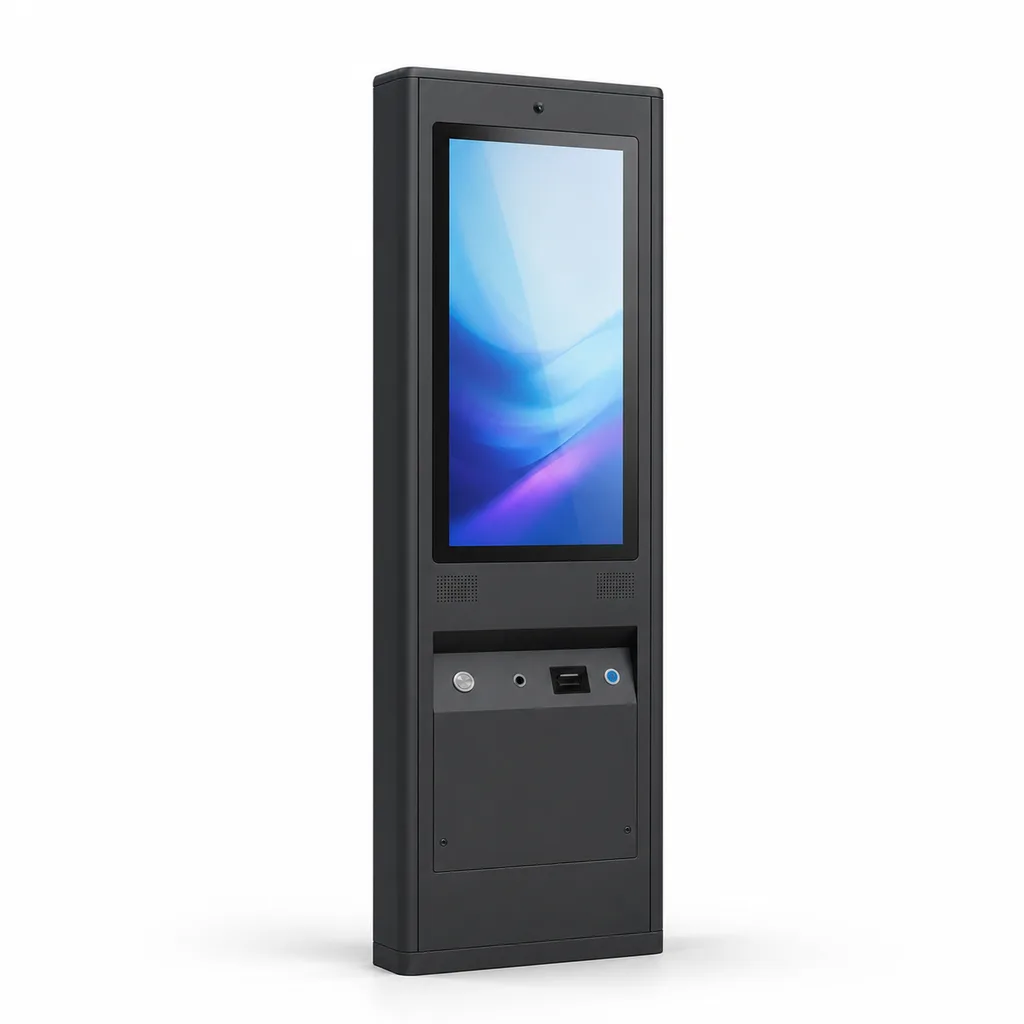
The REDCOAST.LTD RC-KIOSK-65U is a grid-powered, weatherproof outdoor interactive information kiosk engineered for 24/7 public deployment in plazas, transit interchanges, civic centres, shopping districts, university campuses, hospitals, and tourism corridors. Designed for harsh outdoor environments and unattended operation, the terminal combines a high-brightness sunlight-readable touchscreen, a rugged powder-coated steel cabinet, an edge AI computing module, integrated cameras and environmental sensors, public-address speakers, a 4G/5G + Wi-Fi 6 gateway, and an optional integrated small-cell antenna into a single self-contained pillar. It delivers wayfinding, real-time transit and event information, public service announcements, emergency mass notification, contactless payments and ticketing, advertising slots, and remote diagnostics — all controlled by REDCOAST's open kiosk CMS and remotely monitored through the same single-pane platform used across our smart-pole, streetlight, traffic-signal, and surveillance product lines.
Key Features
- Sunlight-readable 55, 65, or 75-inch outdoor LCD (2,500–5,000 nits) with anti-reflective tempered glass, optical bonding, and 24/7 industrial duty cycle
- 10-point projected-capacitive multi-touch with glove and rain-mode operation, calibrated for outdoor accuracy in direct rainfall
- REDCOAST self-designed mainboard, power-management, and display-driver PCBs with octa-core ARM SoC (RK3588 or NXP i.MX 8M Plus, configurable per project), 8–16 GB RAM, 64–256 GB eMMC, optional NVMe SSD for content caching
- Built-in 4G LTE Cat-12 / 5G Sub-6 modem, Wi-Fi 6 dual-band public hotspot, gigabit Ethernet, BLE 5.2, and NFC for tap-to-pay and assistive devices
- Front-facing 8 MP wide-angle camera and optional 360° panoramic camera for safety, presence detection, and privacy-preserving people-flow analytics
- IP65 outdoor enclosure, IK10 vandal-resistant cover glass, EN 50125-3 transport-grade ruggedization for roadside vibration
- Internal climate control with PTC heater, sealed-loop heat exchanger, automatic backlight brightness, and silver-back LCD for high-ambient performance
- Online UPS based on LiFePO4 batteries providing 30–120 minutes of backup for graceful shutdown and continued emergency notification during grid outages
- Open CMS with HTML5/Web content support and REST/MQTT integration with municipal transit feeds, weather APIs, EMS, and existing digital-signage platforms
- Accessibility built in: ADA-compliant lower reach zone, audio jack with optional induction loop, dual front speakers, multilingual voice guidance, high-contrast and large-font modes, optional braille assistance panel
Technical Architecture
The RC-KIOSK-65U is built around a modular hardware stack designed in-house by REDCOAST.LTD. The mainboard PCB integrates an edge AI SoC with a dedicated NPU (up to 6 TOPS) for vision and audio inference, paired with redundant boot storage and a hardware watchdog supervisor. A separate power-management PCB handles AC/DC conversion, surge clamping, UPS charging, and per-rail current/voltage monitoring, exposing telemetry to the supervisor MCU for predictive diagnostics and remote root-cause analysis. A third display-driver PCB handles HDMI/LVDS to the panel, controls the backlight, and reads ambient and panel-temperature sensors to apply automatic brightness adaptation and thermal derating before the panel ever sees stress.
Software runs on Android 13 or a hardened Debian Linux kiosk image, selectable per project. The kiosk CMS supports HTML5 content packages, REST/MQTT integration with municipal data sources, programmatic SDKs for partners, and offline content caching for resilience when the uplink is interrupted. Edge AI workloads — including on-device face-blurring for privacy compliance, queue detection, ADA service-request detection, abandoned-object alarms, and aggressive-behaviour alerts — run locally on the NPU, so only metadata and aggregated counts leave the device. Remote management is delivered through REDCOAST's unified IoT operations platform: firmware OTA, content scheduling, health dashboards, alarm rules, and historical analytics are accessible from a single console shared with our other smart-city products.
The kiosk communicates with the city through a secure VPN tunnel over its built-in 4G/5G modem or wired Ethernet uplink. MQTT over TLS 1.3 is used for telemetry and command-and-control, HTTPS for content sync, and the unit publishes Prometheus-compatible health metrics for integration into operator NOCs. SNMP v3 is supported for legacy management platforms. Secure boot, signed firmware updates, and TPM 2.0–backed device identity protect against tampering across the firmware lifecycle.
Connectivity & Power
The RC-KIOSK-65U is powered from a standard AC 100–240 V, 50/60 Hz mains supply with a universal-input PSU rated for 1,500 W peak. Typical operating draw is 250–450 W depending on display size and ambient brightness, since the auto-dimming engine matches backlight output to actual sunlight conditions rather than running the panel at maximum nits continuously. The built-in online LiFePO4 UPS provides 30–120 minutes of backup, enough for safe shutdown and continued emergency notification through any short grid outage. Surge protection is rated to IEC 61643-11 Class II (40 kA, 8/20 µs) on both the AC inlet and the data lines, with replaceable surge cartridges accessible without opening the main service door — a critical detail for field maintenance teams.
Connectivity is multi-path by design. Wired gigabit Ethernet is the primary uplink in fixed installations served by civil works. A multi-band 4G LTE Cat-12 / 5G Sub-6 modem provides cellular failover or acts as the primary uplink in temporary or fast-deployed scenarios where trenching is impractical. Wi-Fi 6 (802.11ax, dual-band, 2×2 MIMO) doubles as backhaul fallback and as a public hotspot, broadcasting a captive-portal citizen SSID and a separate management SSID for operators. BLE 5.2 and NFC support tap-to-pay terminals, transit cards, and assistive devices for accessibility users.
Protection & Reliability
The cabinet is fabricated from 2 mm cold-rolled steel, hot-dip galvanized for corrosion protection and then finished with a smooth matte powder-coated topcoat (standard RAL 7016 anthracite or RAL 9016 traffic white; custom RAL on request). The front face uses 6 mm anti-reflective tempered cover glass bonded to the LCD with optical clear adhesive, eliminating internal condensation and improving sunlight contrast. The rear service door uses a tamper-evident triangle lock. The IP65 enclosure resists wind-driven rain, dust, and ice. Internal climate management uses a sealed-loop heat exchanger — no external air enters the electronics bay — keeping the unit free of dust accumulation even in arid or polluted environments where conventional fan-cooled kiosks fail prematurely.
Operating temperature range is -30 °C to +50 °C, with an extended -40 °C to +60 °C option using a desert/arctic conditioning kit. Salt-spray testing follows ISO 9227 NSS for 720 hours, qualifying coastal deployments. Vibration and shock follow EN 50125-3 for roadside installations. Designed cabinet service life is 10 years; the display backlight is rated 50,000 hours. Standard warranty is 24 months with extension options to 60 months under SLA.
Application Scenarios
- Urban transit hubs and bus stations: real-time arrival displays, multimodal trip planning, contactless ticket purchase, accessibility services, and emergency announcements integrated with the city's mass-notification platform. The kiosk reduces queues at staffed information desks and gives 24/7 service coverage.
- Tourist plazas and heritage districts: multilingual wayfinding, AR-enabled points-of-interest navigation, free public Wi-Fi captive portal, and curated advertising slots that often fund the deployment. Multilingual voice and large-font modes serve international visitors with low friction.
- University and corporate campuses: building wayfinding, event schedules, room booking, campus-security alerts, lost-and-found posting, and integration with student/employee single sign-on for personalized services. After-hours edge-AI detection routes safety alerts to campus security in seconds.
- Hospital and medical complexes: clinic wayfinding, queue ticketing, visitor check-in, and multilingual triage information, with privacy-compliant edge AI for anonymous people-flow analytics that inform facilities planning.
- Civic centres and government service plazas: e-government kiosks for permits, license renewals, civic queries, and digital identity verification via NFC and optional biometric modules, extending service hours beyond office hours.
- Shopping districts and pedestrian streets: store directories, district maps, loyalty-program integration, programmatic advertising slots, and emergency-evacuation guidance that integrates with civil-protection systems.
Case-style Examples
-
City-centre wayfinding deployment: An integrator deployed thirty-six RC-KIOSK-65U units along a pedestrianized historic main street to replace aging paper maps. Each unit shows multilingual wayfinding, transit arrivals, an event calendar, and emergency information. Advertising slots managed by the municipal tourism agency now offset roughly half of operational costs. People-flow analytics from the on-board NPU feed the city's urban-planning department to optimize foot-traffic policy. Over the first nine months, the units averaged 92.6 % uptime per kiosk, and the municipality reports a measurable rise in citizen satisfaction with public information services.
-
Transit interchange passenger information upgrade: For an intercity bus interchange handling roughly 25,000 passengers per day, the operator deployed twelve RC-KIOSK-65U terminals at platforms and concourse entrances. Each kiosk integrates the operator's GTFS-RT feed for live departure updates, supports ticket purchase via NFC and QR, and broadcasts emergency notification audio when paired with the operator's public-address backbone. The kiosks reduced average passenger queueing at staffed information desks by an estimated 38 % and removed the need to print and refresh paper timetables.
-
University campus wayfinding and safety upgrade: A university campus deployed eighteen units across the main quads and parking-garage entrances. The kiosks consolidate building wayfinding, room booking, event schedules, and integrated SOS-call functionality routed to campus security via SIP. Edge AI detects fallen-person events near each kiosk after-hours, dispatching campus patrols within minutes. The unified REDCOAST CMS lets the facilities team push content updates to all units simultaneously, replacing what was previously a per-building manual workflow.
Customization & Selection Guide
REDCOAST.LTD adapts the RC-KIOSK series per project. Key decision points for buyers:
- Display size and brightness: 43-inch entry-level for sheltered indoor-adjacent spots, 55-inch mainstream, or 65/75-inch flagship for high-visibility plazas. Choose 5,000 nits for unshaded, south-facing installations; 2,500 nits is sufficient for shaded plazas, transit concourses, and covered pedestrian zones.
- Camera and edge AI: opt-in or omit cameras per local privacy regulations. Choose front-only, dual front+top, or 360° panoramic depending on intended analytics — and decide whether faces are blurred on-device or never captured at all.
- Payment and identity: select NFC tap-to-pay only, an EMV-certified payment terminal for full card acceptance, or a biometric reader (face / fingerprint / palm-vein) for e-government services with high assurance requirements.
- Accessibility: standard ADA lower reach zone is included; add induction-loop audio, braille assistance panel, and motorized height-adjustment for full-spectrum accessibility coverage.
- Connectivity: choose Ethernet-only for fixed installations with civil works available, or 4G/5G primary for temporary or rapid-deployment scenarios. Add an integrated small-cell antenna mount module for joint deployment with telecom operators.
- Software: ship with the REDCOAST kiosk CMS, integrate with a customer's existing CMS via the open SDK, or run a fully custom HTML5 application provided by the customer's developer.
- Cabinet finish: standard RAL 7016 anthracite or RAL 9016 white; custom RAL colours available to match brand or municipal palette.
Deployment & After-sales
Each unit ships fully assembled and pre-configured. Installation requires a concrete foundation per the supplied drawings, AC mains supply, and either an Ethernet drop or unobstructed sky visibility for the integrated 4G/5G antenna. A two-person crew typically installs a unit in under two hours. REDCOAST provides remote commissioning, content authoring training for the operator's team, and ongoing remote monitoring through our unified platform. Spare-parts kits are stocked for every PCB module in the assembly, allowing field replacement in minutes rather than complete unit swaps. Standard warranty is 24 months with extension options up to 60 months under SLA. Multi-language operator training and on-site commissioning support are available globally.
Standards & Compliance
The RC-KIOSK-65U is engineered against the following references: IEC 60950-1 / IEC 62368-1 product safety; IEC 61000-6-2 / IEC 61000-6-4 EMC; IP65 (IEC 60529) ingress protection; IK10 (IEC 62262) impact resistance; IEC 61643-11 Class II surge protection; ISO 9227 NSS salt-spray; EN 50125-3 vibration; CE, FCC, UKCA, RoHS, REACH; ADA 2010 Standards / EN 301 549 accessibility; ISO/IEC 27001-aligned secure firmware update process. Country-specific certifications and language localization are delivered per project at the customer's request.
Why REDCOAST.LTD
REDCOAST.LTD is not a reseller of off-the-shelf kiosks. We design the mainboard, power-management PCB, and display-driver PCB in-house, fabricate the enclosure under our own QC, and integrate the firmware, kiosk CMS, and remote management platform end-to-end. This means we can rework parts of the BOM to match a buyer's budget, swap an SoC for one available in-country to satisfy local-content requirements, add a payment module from a partner the buyer already uses, or rebrand the CMS for a city operator — without depending on a third-party OEM's roadmap. We deliver consistent quality at project scale, integrate naturally with our smart pole, streetlight, traffic-signal, and surveillance product lines for unified operations, and stand behind a single SLA for hardware, firmware, and cloud platform.
For specifications tuned to your city, campus, or transit network — and a sample project plan with BOM, civil works, and deployment timeline — contact REDCOAST.LTD to start a customization conversation today.
Specifications
Display & Touch
- Display Size
- 55 / 65 / 75 inch
- Brightness
- 2500-5000 nits
- Resolution
- 1920x1080 (FHD) / 3840x2160 (4K UHD)
- Backlight Life
- 50,000 hours
- Touch Technology
- PCAP, 10-point multi-touch
- Cover Glass
- 6 mm anti-reflective tempered, IK10
- Optical Bonding
- Yes (full-lamination)
- Viewing Angle
- 178 / 178 ° H/V
Computing & Software
- SoC
- ARM octa-core (RK3588 / i.MX 8M Plus)
- NPU Performance
- up to 6 TOPS
- Memory
- 8-16 GB LPDDR4X
- Storage
- 64-256 GB eMMC, optional 256-1024 GB NVMe SSD
- Operating System
- Android 13 / Debian Linux (hardened kiosk image)
- Secure Element
- TPM 2.0 + signed firmware update
Connectivity
- Cellular
- 4G LTE Cat-12 / 5G Sub-6 (configurable)
- Wi-Fi
- Wi-Fi 6 (802.11ax) dual-band, 2x2 MIMO
- Ethernet
- 1 x Gigabit RJ45 (PoE++ optional)
- BLE
- 5.2
- NFC
- ISO/IEC 14443 A/B, 13.56 MHz
- Optional
- Small-cell antenna mount for telecom co-deployment
Power (grid mains)
- Input Voltage
- AC 100-240, 50/60 V / Hz
- Typical Power Consumption
- 250-450 W
- Peak Power Consumption
- 1500 W
- UPS Backup
- Online LiFePO4, 30-120 min runtime
- Surge Protection
- IEC 61643-11 Class II, 40 kA (8/20 µs)
- Power Factor
- >0.9
Protection & Environment
- Ingress Protection
- IP65 (IEC 60529)
- Impact Rating
- IK10 (IEC 62262)
- Operating Temperature
- -30 to +50 (extended -40 to +60 option) °C
- Storage Temperature
- -40 to +70 °C
- Humidity
- 5-95 non-condensing %
- Salt Spray
- ISO 9227 NSS, 720 hours
- Vibration / Shock
- EN 50125-3 (roadside)
Mechanical & Finish
- Cabinet Material
- 2 mm cold-rolled steel, hot-dip galvanized + powder-coated topcoat
- Standard Finish
- RAL 7016 anthracite or RAL 9016 white (custom RAL on request)
- Dimensions (65-inch model)
- 800 x 250 x 2300 (W x D x H) mm
- Weight
- 180-260 kg
- Mounting
- Anchor-bolt to concrete foundation
- Service Access
- Rear door, tamper-evident triangle lock
Audio & Accessibility
- Speakers
- 2 x 20 W stereo, IP-rated
- Microphone
- Dual-mic array with noise cancellation
- Audio Jack
- 3.5 mm with optional induction-loop driver
- Accessibility Reach Zone
- 800-1200 (ADA-compliant lower zone) mm
- Voice Guidance
- Multilingual TTS, on-device
- Braille Assistance Panel
- Optional
Capabilities — configurable per project
Specifications are tailored to each project — the options below show what we can support.
Display Size
- 43-inch
- 55-inch
- 65-inch
- 75-inch
Computing Tier
- Standard (no AI)
- Performance
- AI-accelerated (NPU + cameras)
Connectivity
- Ethernet only
- Ethernet + 4G LTE failover
- 5G Sub-6 primary
- Small-cell co-deployment
Payment & Identity
- NFC tap-to-pay
- EMV-certified payment terminal
- Biometric (face/fingerprint/palm)
Cabinet Finish
- RAL 7016 anthracite
- RAL 9016 traffic white
- Custom RAL colour
Related solution guidance
Airports and Hubs
IoT infrastructure for transport hubs: parking guidance, road safety, outdoor lighting, signage, monitoring and operational dashboards.
Power and Connectivity
How to choose power, battery, solar, NB-IoT, LTE, LoRaWAN, gateways and monitoring strategy for outdoor IoT infrastructure.
Campuses
Campus IoT for lighting, parking, safety, smart poles, environmental data and facility maintenance workflows.
Frequently Asked Questions
What outdoor temperature range does the RC-KIOSK-65U operate in?
Standard configuration operates from -30 °C to +50 °C. An extended desert/arctic kit raises this to -40 °C to +60 °C. The unit uses a sealed-loop heat exchanger and a PTC heater to manage internal climate without exposing electronics to outside air.
Can the touchscreen be read in direct sunlight?
Yes. The display is available at 2,500–5,000 nits with anti-reflective tempered cover glass and optical bonding. The 5,000-nit option is recommended for unshaded south-facing plazas; automatic brightness adapts the backlight to ambient conditions to balance readability and power.
How does the kiosk handle power outages?
It carries an online UPS based on LiFePO4 batteries with 30–120 minutes of runtime. This is enough for safe shutdown and to continue broadcasting emergency notifications during typical grid outages. UPS state and health are reported continuously through the remote management platform.
Is the kiosk ADA-compliant for accessibility?
Yes. The lower zone is engineered to the ADA 2010 reach range, with multilingual voice guidance, large-font and high-contrast modes, a 3.5 mm audio jack with optional induction-loop driver, and an optional braille assistance panel. The platform also supports gesture-only navigation for users with limited mobility.
Can I integrate my city's existing transit or signage data feeds?
Yes. The kiosk CMS supports REST and MQTT integration with GTFS-RT transit feeds, weather APIs, civic mass-notification systems, and existing digital-signage platforms. REDCOAST.LTD can also run a fully customer-supplied HTML5 application on top of the open SDK.
What protections against vandalism does the enclosure offer?
The cabinet is 2 mm cold-rolled steel, hot-dip galvanized and powder-coated, with a 6 mm IK10 tempered cover glass and a tamper-evident triangle lock on the rear service door. Internal sensors detect door-open and shock events and raise an alarm through the management platform.
Can REDCOAST.LTD customize the hardware and software for our project?
Yes. REDCOAST.LTD delivers the kiosk hardware, CMS and management platform as one solution and designs the mainboard, power-management and display-driver PCBs in-house, so the BOM, SoC, payment module and CMS can be tailored per project. Custom cabinet finish, branded UI and country-specific certifications are delivered per the buyer's requirements.
How is the kiosk fleet managed once deployed?
All units report telemetry over TLS-encrypted MQTT to the REDCOAST.LTD unified IoT operations platform. Operators get firmware OTA, content scheduling, health dashboards, alarm rules and people-flow analytics from one console — shared with our streetlight, traffic-signal and surveillance products.