Overview
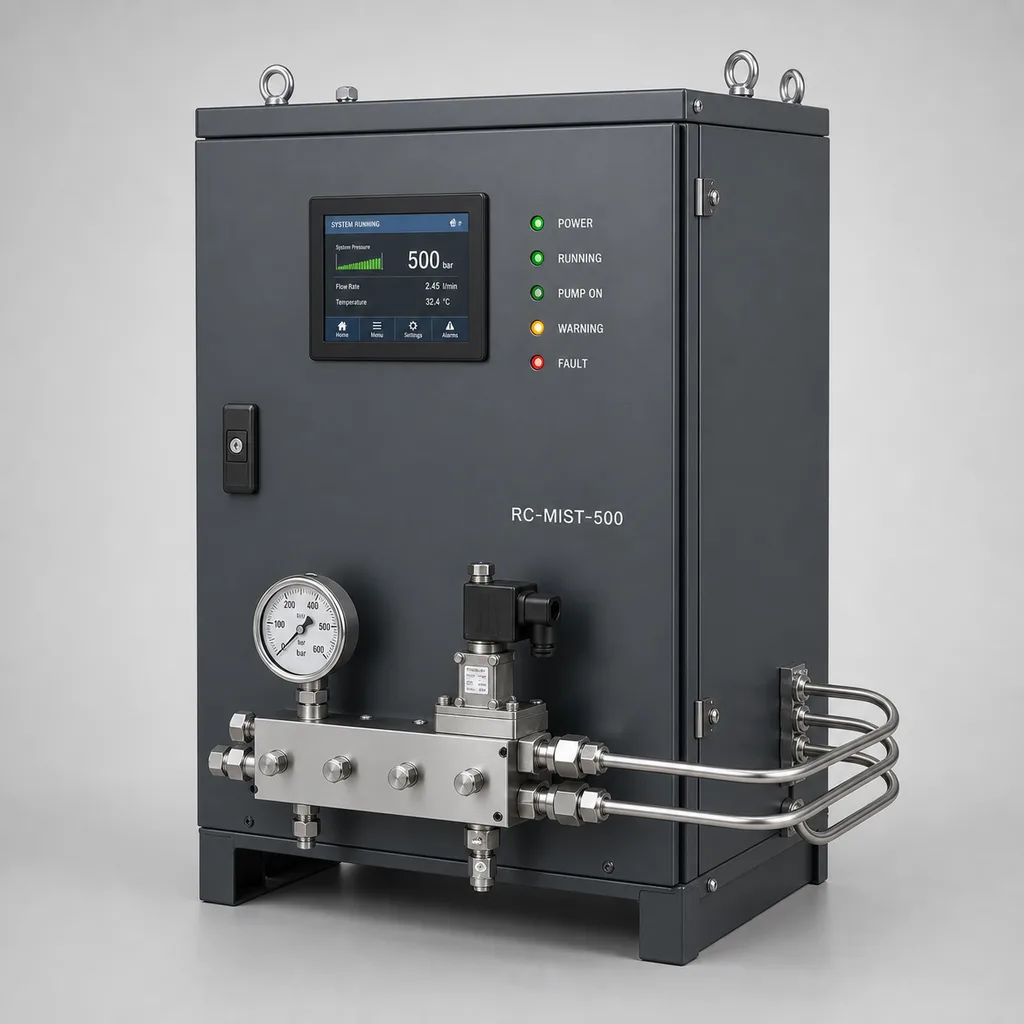
The RC-MIST-500 is a grid-powered, fully automated high-pressure misting cooling system engineered by REDCOAST.LTD for municipalities, park authorities, transit operators, event venues and commercial districts that need to keep outdoor public spaces usable during extreme heat. As heat waves become longer and more frequent worldwide, cities are adopting evaporative mist cooling as one of the most energy-efficient tools for urban heat mitigation: a fine 10–30 micron mist flash-evaporates in warm air and can lower the perceived temperature in the treated zone by 4–12 °C while consuming only a fraction of the energy of mechanical air conditioning. Unlike garden-grade misting kits, the RC-MIST-500 is a complete engineered solution — a 70-bar pump station, stainless-steel nozzle lines, drinking-water-grade filtration and UV hygiene treatment, and a self-developed edge controller with cloud platform and mobile app — designed for continuous public-space duty and delivered as one integrated package.
Key Features
- True high-pressure adiabatic cooling: ceramic-plunger pump delivers 70 bar (1,000 psi) working pressure through 0.15–0.30 mm anti-drip nozzles, producing a 10–30 µm dry mist that evaporates before reaching skin or pavement — cooling without wetting.
- Climate-triggered automation: self-developed controller reads ambient temperature, relative humidity and wind speed, and starts, modulates or pauses misting automatically against configurable thresholds (e.g., run above 30 °C, throttle when RH exceeds 70 %, pause in strong wind).
- Variable-speed pump control: VFD-driven pump with closed-loop pressure regulation adapts flow to the number of active zones, avoiding pressure spikes, water hammer and wasted energy.
- Up to 16 independently valved zones: solenoid-driven zone manifolds let one pump station serve multiple courtyards, shade structures, queue lines or bus bays, each with its own schedule and occupancy logic.
- Water hygiene by design: 5 µm + 1 µm pre-filtration, inline UV-C disinfection and automatic flush-and-drain cycles on every shutdown keep stagnant water out of the lines and support Legionella risk-management plans.
- Occupancy-aware operation: optional PIR or mmWave presence detection mists only when people are actually in the zone, cutting water and energy use in low-traffic hours.
- Full IoT visibility: 4G/Ethernet connectivity, cloud dashboard and iOS/Android app for remote start/stop, schedules, alarms (dry-run, leak, filter clogging, UV lamp end-of-life) and consumption analytics.
- Self-developed electronics: pump controller, pressure-sensor conditioning, zone-valve drivers, climate-sensor interfaces and UV interlock are REDCOAST.LTD in-house PCB designs, so I/O, protocols and safety logic can be adapted per project.
- Public-space-grade construction: IP55 powder-coated pump cabinet, SS316 lines and nozzles, tamper-resistant hardware and vandal-conscious routing options.
Technical Architecture
The system is built around three hardware blocks. The pump station houses a ceramic-plunger high-pressure pump (0.75–7.5 kW depending on nozzle count) driven by a variable-frequency drive, an inlet water-treatment train (dual-stage filtration, optional softener or RO stage for hard water, and a UV-C disinfection chamber), and the master control cabinet. The distribution network consists of SS316 or 70-bar-rated high-pressure tubing routed along pergolas, shade sails, canopies, pole arms or building edges, divided into zones by solenoid valve manifolds and terminated in anti-drip misting nozzles spaced typically 0.5–1 m apart. The sensing layer combines a temperature/humidity probe, an anemometer and optional occupancy sensors per zone.
At the heart of the pump station sits the REDCOAST.LTD misting controller — a self-developed industrial PCB set combining a 32-bit MCU main board, a pressure/flow signal-conditioning board, a multi-channel solenoid driver board and the VFD/UV interlock interface. The control loop continuously compares measured line pressure against setpoint and trims pump speed, while supervisory logic enforces safety rules: dry-run cutoff on low inlet pressure, leak detection on abnormal flow-to-zone ratios, UV-lamp status interlock (no misting without verified disinfection), and automatic line flush and gravity drain at every stop so no water stands in warm pipes. Edge logic runs locally and keeps the system fully functional without connectivity; the cloud layer adds fleet management, multi-site dashboards, weather-forecast-based pre-scheduling and maintenance alerts, with the mobile app for on-site staff.
Connectivity & Power
The RC-MIST-500 is designed for mains-powered urban and campus sites — plazas, transit stations, stadium concourses and commercial streets all have grid access, so the system uses AC 220–240 V single-phase for stations up to about 2.2 kW and AC 380–415 V three-phase for larger multi-zone plants, 50/60 Hz worldwide. No solar array is used or needed in this product class; the pump cabinet includes a Type 2 surge protection device, residual-current protection and a service disconnect. For communication, the controller offers 10/100 Ethernet and a 4G LTE modem as standard; remote climate or occupancy nodes can connect over RS-485/Modbus RTU or optional LoRa where cable runs are impractical. Northbound, the platform speaks MQTT/HTTPS with TLS, and Modbus TCP or BACnet/IP gateways are available for integration into building management or smart-city platforms.
Protection & Reliability
The pump cabinet is IP55-rated, built from hot-dip galvanized steel finished with a smooth powder coat (or optional SS304 for coastal sites), with forced ventilation and thermal cutouts for hot climates up to +55 °C ambient. Wetted components are SS316, food-grade PA and ceramic — resistant to chlorinated municipal water and salty coastal air. Nozzles carry anti-drip check valves and stainless mesh pre-filters and are field-replaceable in seconds. Reliability logic includes soft-start via VFD, duty-cycle supervision, filter differential-pressure monitoring with clogging alarms, and UV-lamp hour counters. In climates with sub-zero winters the system enters a supervised winterization mode: lines are auto-drained and the pump station locks out below a configurable low-temperature threshold. Typical design life is 10 years for the pump station with routine seal and filter service; standard warranty is 24 months, extendable to 60 months under a service agreement.
Application Scenarios
- Transit stops and station forecourts: cool waiting passengers at bus rapid transit platforms, tram stops and station plazas during peak summer, improving ridership comfort and reducing heat-stress incidents.
- City plazas, parks and pedestrian streets: create walkable cool corridors and misted rest pockets as part of municipal heat-action plans, keeping public space active during afternoon heat.
- Stadium concourses and event venues: cool queue lines, fan zones and open-air concourses on match days; zones follow crowd occupancy so water is only used where people stand.
- Theme parks and waterfront attractions: misted queue lines and shaded walkways reduce guest complaints and extend dwell time; playful mist arches double as an attraction.
- Outdoor dining and commercial frontage: restaurant terraces and retail promenades stay comfortable through summer evenings, protecting revenue during the hottest months.
- Livestock, nurseries and industrial pre-cooling: the same 70-bar platform serves barn cooling, greenhouse humidification and adiabatic pre-cooling of chiller and condenser intakes.
Case-style Examples
Central plaza heat-mitigation retrofit. A city center plaza with pergola structures suffered near-zero footfall on 40 °C afternoons. A single RC-MIST-500 station with a 4 kW three-phase pump, eight zones and roughly 240 nozzles was routed along existing pergola beams. Climate-triggered operation runs the mist only above 31 °C and below 65 % RH, with occupancy sensing on the seating zones. The treated areas measure 6–9 °C cooler on dry summer afternoons, and the operator monitors all zones and water consumption from the cloud dashboard.
BRT corridor station cooling. A transit authority equipped a series of open BRT platforms with compact 1.5 kW single-phase pump stations, each serving two canopy zones. Because the stations already had grid feeds and Ethernet backhaul in the platform cabinets, integration was plug-in; the misting controllers were added to the authority's SCADA over Modbus TCP. Passenger complaints about heat dropped sharply in the first season, and the auto-flush hygiene cycle satisfied the authority's water-safety auditors.
Stadium fan-zone deployment. An event operator specified a 7.5 kW station with sixteen zones covering entry queues and an outdoor fan plaza. Zones are opened from the mobile app by event staff and modulated automatically by the climate sensors; wind interlock pauses misting during gusts so spray never drifts onto electronics or catering stands.
Customization & Selection Guide
Size the system by nozzle count: small terraces and single bus stops run 20–60 nozzles on a 0.75–1.5 kW single-phase station; mid-size plazas run 100–250 nozzles on 2.2–4 kW; large venues run up to ~400 nozzles on 5.5–7.5 kW three-phase plants, and multiple stations can be federated under one platform for district-scale projects. Choose SS316 rigid lines for permanent architectural installations and rated flexible PA tubing for seasonal or leased venues. In hard-water regions add the softener or RO option to protect nozzles; in coastal areas specify the SS304 cabinet. Humid-climate buyers should note the physics honestly: evaporative cooling performance falls as humidity rises, so in consistently humid regions we configure larger droplet 'shower-effect' zones or fan-assisted misting instead of promising dry-mist numbers. REDCOAST.LTD engineers review site drawings and climate data and return a zone layout, pump sizing and water-consumption estimate before any order.
Deployment & After-sales
A typical installation needs only a water feed (municipal supply, 1–4 bar inlet), a grid connection and mounting paths for the nozzle lines; the pump station arrives factory-tested on a compact skid or wall frame. Small sites are commissioned in one to two days; multi-zone plazas typically within a week. REDCOAST.LTD supplies zone-layout drawings, hydraulic calculations and commissioning support, trains operator staff on the platform and app, and provides remote diagnostics for the life of the system. Spare kits (nozzles, seals, filters, UV lamps) are stocked for standard models, and firmware/platform updates are delivered over the air.
Standards & Compliance
The system is designed toward CE conformity (Low Voltage Directive 2014/35/EU, EMC Directive 2014/30/EU, Machinery Directive 2006/42/EC) and RoHS. Enclosure ingress protection follows IEC 60529 (IP55 cabinet; IP66 field sensor housings). Wetted materials are drinking-water-grade, and the filtration + UV-C + auto-drain hygiene chain is engineered to support operator compliance with Legionella risk-management frameworks such as ASHRAE 188 and European water-safety guidance. Electrical protection includes IEC 61643 Type 2 SPD and residual-current devices per IEC 61008.
Why REDCOAST.LTD
REDCOAST.LTD delivers complete outdoor IoT solutions — hardware, web management platform and mobile app — engineered by one team. What sets this system apart from assembled misting kits is that the electronics inside are our own: the pump controller, sensor signal-conditioning, valve driver and hygiene-interlock PCBs are designed in-house and can be re-spun for project-specific requirements — extra I/O for fountain or lighting show synchronization, integration with our smart poles and CCMS lighting cabinets, custom protocols for an existing city platform, or OEM branding for distributors. Because we control the board-level design, firmware and cloud stack, the RC-MIST-500 adapts to your project instead of forcing your project to adapt to a catalog part.
Planning a cooling project for a plaza, station, venue or district? Send REDCOAST.LTD your site plan and climate profile — we'll respond with a tailored zone layout, system sizing and quotation.
Specifications
Pump Station & Hydraulics
- Working Pressure
- 70 (max 100) bar
- Pump Type
- Ceramic-plunger high-pressure pump, VFD-driven
- Motor Power
- 0.75-7.5 kW
- Flow Rate
- 2-25 L/min
- Inlet Water Pressure
- 1-4 bar
- Zones (solenoid valved)
- up to 16
- Duty
- Continuous, soft-start with dry-run cutoff
Nozzles & Cooling Performance
- Nozzle Orifice
- 0.15-0.30 mm
- Droplet Size
- 10-30 µm
- Nozzles per System
- 20-400 pcs
- Nozzle Spacing (typical)
- 0.5-1.0 m
- Temperature Reduction (dry climate)
- 4-12 °C
- Nozzle Material
- SS316 body, ceramic insert, anti-drip check valve
Water Treatment & Hygiene
- Pre-filtration
- 5 + 1 µm dual-stage
- UV-C Disinfection
- 254 nm, dose ≥40 mJ/cm²
- Optional Treatment
- Water softener / RO stage for hard water
- Hygiene Cycle
- Auto flush & gravity drain at every shutdown
- Filter Monitoring
- Differential-pressure clogging alarm
- UV Lamp Life
- 9,000 h (hour-counted with end-of-life alarm)
Control & Sensing
- Controller
- Self-developed 32-bit MCU control PCB set (pump, valves, sensors, UV interlock)
- Climate Triggers
- Temperature / RH / wind thresholds, fully configurable
- Temp/RH Sensor Accuracy
- ±0.3 °C / ±2 % RH
- Wind Interlock
- Anemometer 0-60 m/s, configurable pause threshold
- Occupancy Sensing (optional)
- PIR or 24 GHz mmWave per zone
- Operating Modes
- Climate-auto / schedule / occupancy / manual (app or local HMI)
- Safety Logic
- Dry-run, leak, over-pressure, UV-fail, low-temperature lockout
Connectivity & Platform
- Backhaul
- 10/100 Ethernet + 4G LTE Cat 4
- Field Bus
- RS-485 Modbus RTU; optional LoRa sensor nodes
- Northbound Protocols
- MQTT / HTTPS (TLS 1.2+); Modbus TCP / BACnet-IP gateway
- Cloud Platform
- Multi-site dashboard, alarms, water & energy analytics
- Mobile App
- iOS / Android, zone control and alerts
- Firmware Updates
- OTA, signed images
Electrical (Grid Power)
- Input Voltage
- AC 220-240 single-phase / AC 380-415 three-phase V
- Frequency
- 50/60 Hz
- Power Consumption
- 0.75-7.5 kW
- Surge Protection
- Type 2 SPD (IEC 61643)
- Earth-fault Protection
- RCD 30 mA
Mechanical & Environmental
- Cabinet Ingress Protection
- IP55 (field sensors IP66)
- Cabinet Material
- Hot-dip galvanized steel, smooth powder-coated; optional SS304
- High-pressure Lines
- SS316 rigid or 70-bar-rated PA flexible tubing
- Operating Temperature
- +2 to +55 (auto winterization lockout below threshold) °C
- Pump Station Footprint
- 600 × 400 × 1200 (typical 2.2 kW skid) mm
- Design Life / Warranty
- 10-year design life; 24-month warranty (extendable to 60)
Capabilities — configurable per project
Specifications are tailored to each project — the options below show what we can support.
Pump Capacity
- 0.75-1.5 kW single-phase (20-60 nozzles)
- 2.2-4 kW (100-250 nozzles)
- 5.5-7.5 kW three-phase (up to ~400 nozzles)
Water Treatment
- Standard dual filtration + UV-C
- Softener stage
- RO stage for hard water
Line & Cabinet Material
- SS316 rigid lines
- 70-bar PA flexible tubing
- SS304 coastal cabinet
Control Triggers
- Climate-auto (temp/RH/wind)
- Schedules
- PIR/mmWave occupancy
- Manual via app/HMI
Integration
- Standalone cloud + app
- Modbus TCP / BACnet-IP to BMS or SCADA
- Smart pole / lighting cabinet integration
- Fan-assisted misting for humid climates
Related solution guidance
Environmental Monitoring
Deploy environmental monitoring stations with sensors, solar power, gateways, dashboards, alarms and data integration for city and industrial sites.
Street Lighting Guide
A practical guide to choosing smart street lighting controllers, connectivity, platform features, dimming logic and acceptance tests.
Solar IoT Guide
A design guide for solar-powered outdoor IoT: load calculation, battery autonomy, low-power firmware, telemetry and maintenance planning.
Frequently Asked Questions
How much can a high-pressure misting system lower outdoor temperature?
In dry climates, flash evaporation of a 10-30 micron mist typically lowers the temperature in the treated zone by 4-12 °C. The effect depends on relative humidity: the drier the air, the stronger the cooling. In consistently humid climates the RC-MIST-500 can be configured with fan-assisted misting or larger-droplet shower zones instead, because pure evaporative cooling weakens as humidity rises.
Does mist cooling get people and furniture wet?
No, when engineered correctly. At 70 bar the 0.15-0.30 mm nozzles produce droplets so fine they evaporate before settling, and anti-drip check valves stop residual dripping when zones close. A wind interlock pauses misting during gusts so spray does not drift onto electronics, food service areas or walkways.
Is a public misting system safe regarding Legionella?
The RC-MIST-500 is designed to support Legionella risk-management plans: municipal water passes dual 5 µm/1 µm filtration and a 254 nm UV-C chamber before atomization, misting is interlocked to verified UV operation, and every shutdown triggers an automatic flush and drain so no water stagnates in warm lines. Operators still follow local water-safety regulations, and the platform logs hygiene cycles for audits.
How much water does an outdoor misting system use?
Each nozzle emits roughly 3-6 litres per hour at 70 bar, so a 100-nozzle plaza zone uses about 300-600 L/h while actively misting - far less than irrigation of an equivalent area. Climate triggers, occupancy sensing and duty-cycled misting typically cut actual consumption by 40-70 % compared with continuous operation.
What power supply does the RC-MIST-500 need?
It is a grid-powered system: AC 220-240 V single-phase for pump stations up to about 2.2 kW, and AC 380-415 V three-phase for larger multi-zone plants, at 50 or 60 Hz. Plazas, transit stations and venues normally have grid access, so no solar equipment is used in this product; the cabinet includes Type 2 surge protection and a 30 mA RCD.
Can the misting system integrate with an existing smart city or building management platform?
Yes. The controller exposes MQTT/HTTPS northbound and Modbus TCP or BACnet/IP through an optional gateway, so it can join SCADA, BMS or smart-city platforms. REDCOAST.LTD designs the controller PCBs and firmware in-house, so custom protocols and integrations with its own smart poles and lighting cabinets are available per project.
What happens in winter or in freezing weather?
The system enters a supervised winterization mode: below a configurable low-temperature threshold the controller locks out misting, drains the high-pressure lines by gravity and keeps the pump station protected. Seasonal venues can also physically decommission flexible-tubing zones and store them until the next season.
How many nozzles and what pump size do I need for my site?
As a rule of thumb: 20-60 nozzles (0.75-1.5 kW) for a terrace or single transit stop, 100-250 nozzles (2.2-4 kW) for a mid-size plaza, and up to about 400 nozzles (5.5-7.5 kW) for stadium concourses, with multiple stations federated for district projects. REDCOAST.LTD sizes the pump, zones and water demand from your site plan and climate data before quotation.