Overview
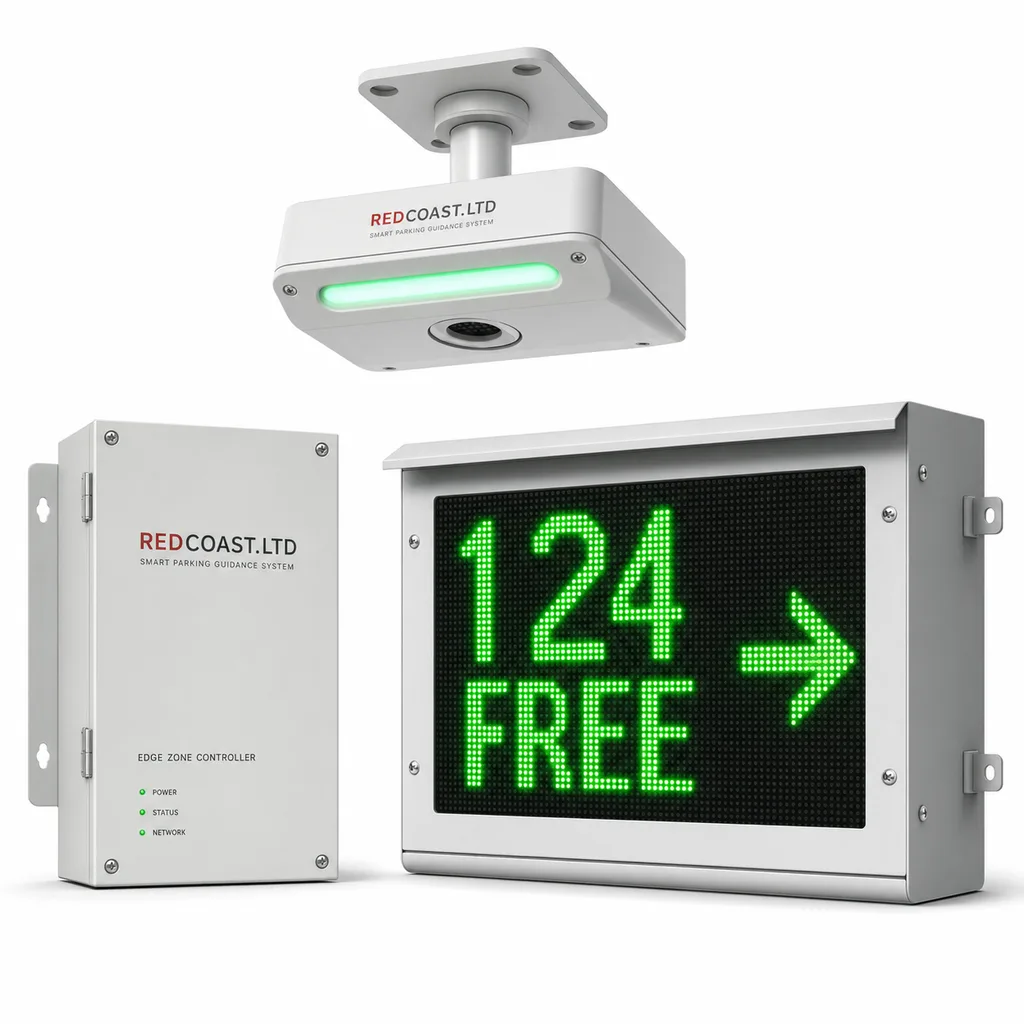
The REDCOAST.LTD Smart Parking Guidance & Management System (PGS) is a grid-powered, end-to-end platform for indoor parking garages, outdoor surface lots, and hybrid airport-scale facilities that gives every driver real-time visibility into where they can park. It combines an all-in-one per-bay Sensor-Indicator Unit (ultrasonic detection + RGBW colour indicator), zone-level edge controllers, multi-pitch LED count signs at every decision point, an on-site site gateway, a multi-tenant cloud SaaS dashboard for operators, and a white-label driver mobile app with reservation, payment and find-my-car. Every key board in the stack — the sensor-indicator PCB, the zone controller, the LED count-sign driver — is designed and produced in-house by REDCOAST.LTD, so the system can be tuned to your ceiling height, lighting, sign format, language and integration constraints rather than the other way round. The result: shorter search time per driver, higher facility turnover, lower in-cabin emissions, and full operational visibility for the facility manager.
Key Features
- All-in-one per-bay Sensor-Indicator Unit combining a 40 kHz ultrasonic transducer with an infrared time-of-flight backup and a high-brightness RGBW LED indicator, single-cable installation
- Programmable colour mapping for bay state (Green vacant / Red occupied / Blue accessible / Yellow reserved / Purple EV) — re-flashable from the cloud without site visits
- High-contrast indoor and outdoor LED count signs with full-colour pixel pitches from P5 to P16, dynamic text, arrows, pictograms and multilingual support
- Custom Edge Zone Controller PCB managing up to 128 sensor nodes (4 × RS-485 buses × 32) with sub-second occupancy update
- Optional rooftop AI camera with ANPR/LPR for hybrid per-bay + license-plate workflows, ticketless entry and exit billing
- Cloud SaaS dashboard with live occupancy, peak heatmaps, dwell-time analytics, revenue reporting and outage alerts
- White-label driver app: map-based guidance, reservation, contactless payment, find-my-car
- Open REST + MQTT APIs for integration with BMS, payment gateways, mobility apps and smart-city platforms
- Power-over-Ethernet (802.3af/at) or 24 VDC bus options for sensor nodes, minimising retrofit cabling
- Modular, field-replaceable architecture: a single technician swaps a unit in under three minutes without disturbing the rest of the bus
Technical Architecture
At the lowest layer of the system is the bay-level Sensor-Indicator Unit (SIU). Inside the SIU, REDCOAST.LTD's dual-detection PCB combines a 40 kHz ultrasonic transducer with an infrared time-of-flight backup, so the unit holds detection accuracy above 99 % even when ultrasonic reflections are degraded by glossy floors, low ceilings, or large vans. The same board drives a high-brightness RGBW LED segment whose colour conveys the bay state to drivers from up to 30 metres. Colour mapping is fully programmable, so an EV-only row, an accessible row, or a reserved-for-staff row can be coloured differently without any hardware change.
Sensor-Indicator Units are wired in daisy-chain groups of up to 32 onto an RS-485 bus running back to an Edge Zone Controller. The Edge Zone Controller — also a REDCOAST.LTD-designed PCB — handles four such buses for up to 128 bays per controller, aggregates state every 200 ms, runs first-line occupancy logic, and forwards aggregated counts and exception events to the on-site Site Gateway over Ethernet. The Site Gateway hosts the local web UI, drives the LED Count Signs at zone entrances and decision points, and brokers traffic to the cloud through wired Ethernet (preferred) or a 4G/5G fallback.
The LED Count Sign family — driven by a dedicated REDCOAST.LTD constant-current driver PCB with over-temperature and short-circuit protection — comes in pixel pitches from P5 (indoor close-read) up to P16 (outdoor highway-side), and supports multi-line numeric counts, directional arrows, status text in multiple languages, and full-colour pictograms. Drivers can change the message dynamically based on real-time occupancy, time-of-day pricing tier, or emergency override (for example 'EVACUATE — USE NORTH RAMP').
On top of the on-site stack sits the REDCOAST.LTD cloud platform: a multi-tenant SaaS dashboard for operators with live occupancy heatmaps, revenue and dwell-time analytics, peak-hour reporting and outage alerts; a public REST + MQTT API for integration with building management systems, payment gateways and city-wide mobility platforms; and a white-label driver app delivering live availability on a map, in-app reservations, contactless payment and find-my-car assistance using the device's last GPS fix in the lot.
Connectivity & Power
The system is fundamentally a grid-powered, wired-backbone solution because parking facilities — whether multi-level garages, surface lots beside malls and hospitals, or airport long-term parking — sit inside the electrical grid by definition. Mains AC 100–240 V, 50/60 Hz feeds the Site Gateway and Edge Zone Controllers; the Edge Zone Controllers then deliver either 24 VDC bus power or IEEE 802.3af/at PoE (48 V) to the Sensor-Indicator Units, so installers can choose the cabling that best matches the existing structure — pulling a single CAT6 to each daisy-chain group is typical. LED Count Signs are typically powered locally from the nearest 230 V circuit. For the cloud uplink, wired Gigabit Ethernet is preferred for reliability, with optional 4G/5G modem failover, Wi-Fi 6 for retrofit sites without structured cabling, and LoRaWAN as a low-bandwidth out-of-band channel for critical alarms when the primary uplink is degraded. Solar is not part of this product family — by design — because every realistic deployment site is on the grid; bolting a solar panel onto a mall garage adds cost without operational benefit.
Protection & Reliability
Outdoor Sensor-Indicator Units and Count Signs are rated IP66 with UV-stabilised polycarbonate lenses; indoor units are IP54 with low-profile aluminium housings. Operating temperature range is -40 to +70 °C for the outdoor family and -20 to +50 °C for the indoor family, qualifying the system for everything from cold-climate underground garages to high-temperature outdoor lots in tropical or desert climates. All boards are conformally coated, and all power inputs are surge-protected to 4 kV common-mode to survive grid transients common in older facilities. Mean time between failures of the Sensor-Indicator Unit exceeds 70,000 hours; the field-replaceable modular design lets a single technician swap a unit in under three minutes without service interruption to the rest of the bus. The Edge Zone Controller and Site Gateway feature dual-bank firmware for safe over-the-air updates with automatic rollback on boot failure.
Application Scenarios
- Multi-level shopping mall garages: Per-bay indicators dramatically cut search time, reducing queue back-up at entrances and lowering cabin-level CO emissions. Operators recover the system cost through higher turnover and reduced staffing.
- Hospital and clinic parking: Reserved-bay colours flag accessible spaces, ambulance bays, oncology patient bays and visitor zones, while integrated cashless payment lowers staffed-booth costs and shortens patient experience friction.
- Airport short- and long-term lots: Outdoor P16 count signs guide travellers from arrival ramps to the nearest open zone, with ANPR linking entry plate to reservation and exit billing — eliminating ticket dispensers entirely.
- Office and business-park campuses: A driver-app reservation flow reduces tenant complaints, while EV-bay (purple) detection prevents non-EVs from blocking chargers and frees the building manager from policing the rule manually.
- University campuses: Per-bay availability supports faculty / student / visitor segmentation, with event-day overrides for stadiums and conference centres that re-skin the colour map in seconds.
- Government and municipal lots: Live availability data is published to open-data APIs and municipal apps, supporting smart-city mobility programmes and integrating with on-street parking sensors and city traffic management.
Case-style Examples
- Multi-level shopping mall retrofit: A four-level mall garage with 820 bays struggled with weekend queues backing onto the arterial road. The deployment used 820 indoor Sensor-Indicator Units across twenty-six Edge Zone Controllers, four indoor P8 count signs per level, and an outdoor P16 marquee at the street entrance. Average bay-search time fell from 8.4 minutes to 2.1 minutes within ninety days, and complaints to the local authority about street-side queueing ended.
- Hospital outdoor lot deployment: A regional hospital with 240 outdoor bays installed pole-mounted IP66 Sensor-Indicator Units with high-mount visors against rain ingress, plus a dual-camera ANPR setup at the gate. Misuse of accessible bays dropped by 73 % once the blue indicators became visible across the lot, and patient feedback on parking experience improved measurably in the following quarter.
- Corporate campus reservation rollout: A 1,200-bay business-park campus rolled out the white-label driver app with reservation and EV-priority colours. Within six months the tenant satisfaction score for parking rose from 2.9 to 4.4 / 5, EV-bay utilisation rose by 41 %, and the campus eliminated two dedicated parking attendant roles previously needed for EV-bay policing.
Customization & Selection Guide
For basic indoor garages under 400 bays, an entry configuration of Sensor-Indicator Units, three Edge Zone Controllers, one Site Gateway and per-floor P5 count signs is usually sufficient — total install in 2–3 weeks. For mid-sized garages between 400 and 1,500 bays, add a redundant Site Gateway, dual cloud uplinks, and P8 zone signs at every ramp and decision point. For large airport and stadium facilities above 1,500 bays, deploy the full hierarchical stack with regional aggregation gateways, P16 outdoor marquees on every approach road, ANPR cameras at every entry/exit and a private cloud option. EV-charging integration, motorbike-bay detection (narrower beam), oversized-vehicle bays (wide-beam ultrasonic), camera-vision-only sensorless zones, and even bicycle/scooter zone counters are all available as per-bay options. The driver app and the operator dashboard are fully white-label and support local language and currency.
Deployment & After-sales
A typical 800-bay deployment is commissioned in 4–6 weeks: 1 week for site survey and bus layout design, 2–3 weeks for hardware production and pre-staging in our factory, and 1–2 weeks for on-site installation, calibration and operator training. REDCOAST.LTD provides full installation drawings, on-site commissioning support, multilingual operator training, and a 36-month standard warranty with extension options up to 84 months. A remote diagnostic channel lets the support team identify a failed sensor unit before the on-site team is dispatched, and field-spare kits are stocked locally for response within agreed SLA windows. Firmware updates are delivered over the air with dual-bank rollback.
Standards & Compliance
The system is engineered to align with IEC 61347 (LED driver safety), IEC 60598-2-3 / -2-5 (luminaires and floodlights), EN 50130-4 (EMC immunity for alarm and security systems), IEC 61000-4 (general EMC), EN ISO 7010 (safety signage for accessible / EV pictograms), CE / RoHS / REACH / FCC marks, and ISO/IEC 27001-aligned cloud-platform controls. The cloud platform supports GDPR-compatible data handling and configurable data residency (EU, GCC, APAC, LATAM regions).
Why REDCOAST.LTD
REDCOAST.LTD is not a reseller. Every key PCB in this system — the per-bay sensor-indicator board, the RS-485 zone controller, the LED count-sign driver — is designed in-house by our hardware engineers, which means the system can be tuned to your specific ceiling height, lighting condition, sign format, language requirements and integration constraints rather than the other way round. We deliver the firmware, the cloud platform and the mobile app as a coherent, single-team-owned stack, and we adapt each project to the local power, climate, signage code and compliance environment — from temperate European garages to tropical Southeast-Asian malls to high-temperature Middle-Eastern airport lots. Talk to us about your facility — share floor count, bay count, ceiling profile and integration targets, and we will return a bay-level layout drawing, BOM, lead-time plan and quotation tailored to it.
Specifications
Sensor-Indicator Unit (per bay)
- Form Factor
- All-in-one ultrasonic + IR + RGBW LED
- Indicator Colors
- Red / Green / Blue / Yellow / Purple programmable
- Indicator Brightness
- >=800 cd/m²
- Visibility Range
- up to 30 m
- Viewing Angle
- 120 °
- Mounting Height
- 2.4 - 4.5 m
- Dimensions
- 180 × 90 × 45 mm
Detection Performance
- Primary Detection
- Ultrasonic 40 kHz dual-circuit
- Backup Detection
- Infrared time-of-flight
- Detection Range
- 0.3 - 5.0 m
- Detection Accuracy
- >=99 %
- Detection Latency
- <1 s
- Bay Coverage
- 1 unit per bay
LED Count Sign
- Pixel Pitch Options
- P5 / P8 / P10 / P16
- Brightness (outdoor)
- >=6500 nits
- Brightness (indoor)
- >=1500 nits
- Color
- RGB full-color
- Refresh Rate
- >=1920 Hz
- Cabinet Material
- Powder-coated aluminum / steel
- Content
- Numeric count, arrows, pictograms, multilingual text
Edge Zone Controller & Site Gateway
- Bays per Zone Controller
- up to 128 (4 × RS-485 × 32)
- Update Rate
- 200 ms
- Controllers per Site Gateway
- up to 16 (≈2048 bays)
- Gateway CPU
- Quad-core ARM Cortex-A72
- Gateway RAM
- 4 GB
- Local Storage
- 64 GB SSD
- OTA
- Dual-bank firmware with auto-rollback
Power (grid-powered, no solar)
- Input Voltage
- AC 100-240 V
- Frequency
- 50 / 60 Hz
- Sensor Bus Power
- 24 VDC bus or PoE 802.3af/at (48 V)
- Power per Sensor-Indicator Unit
- <=2 W
- Power per Zone Controller
- <=15 W
- Surge Protection
- 4 kV common-mode
Communications
- Sensor Bus
- RS-485 (Modbus RTU)
- Primary Uplink
- Gigabit Ethernet
- Failover Uplink
- 4G / 5G
- Retrofit Uplink
- Wi-Fi 6
- Cloud Protocols
- MQTT / HTTPS REST
- API
- Open REST + MQTT for BMS, payment, ANPR, mobility apps
- Optional ANPR Camera
- 4 MP IP66, H.265
Environmental & Reliability
- IP Rating (outdoor)
- IP66
- IP Rating (indoor)
- IP54
- Operating Temp (outdoor)
- -40 to +70 °C
- Operating Temp (indoor)
- -20 to +50 °C
- Humidity
- 5 - 95 % non-condensing
- MTBF
- >=70,000 h
- Design Service Life
- >=7 years
Capabilities — configurable per project
Specifications are tailored to each project — the options below show what we can support.
Deployment Type
- Indoor multi-level garage
- Outdoor surface lot
- Hybrid airport-scale facility
- Underground hospital garage
Detection Mode
- Ultrasonic + IR per bay
- Camera-vision per bay (sensorless)
- Hybrid per-bay + ANPR gate
- ANPR-only count (entry/exit)
Count Sign Pixel Pitch
- P5 indoor close-read
- P8 indoor zone
- P10 outdoor zone
- P16 outdoor highway-grade
Cloud Uplink
- Wired Gigabit Ethernet
- 4G / 5G failover
- Wi-Fi 6 retrofit
- Dual-redundant
Driver Experience
- White-label mobile app
- SDK for existing tenant app
- Web-only QR landing
- Headless API-only
Related solution guidance
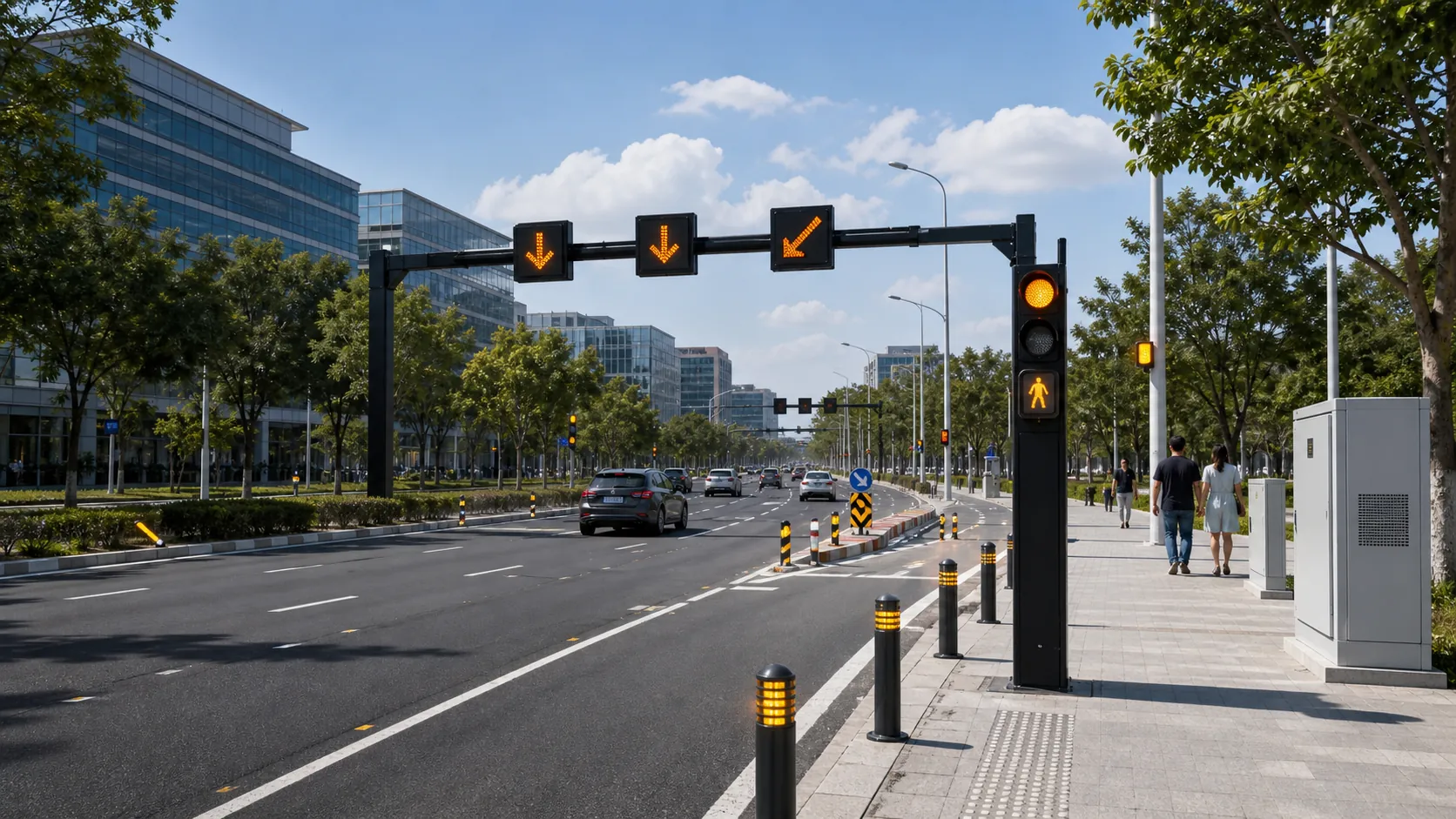
Airports and Hubs
IoT infrastructure for transport hubs: parking guidance, road safety, outdoor lighting, signage, monitoring and operational dashboards.
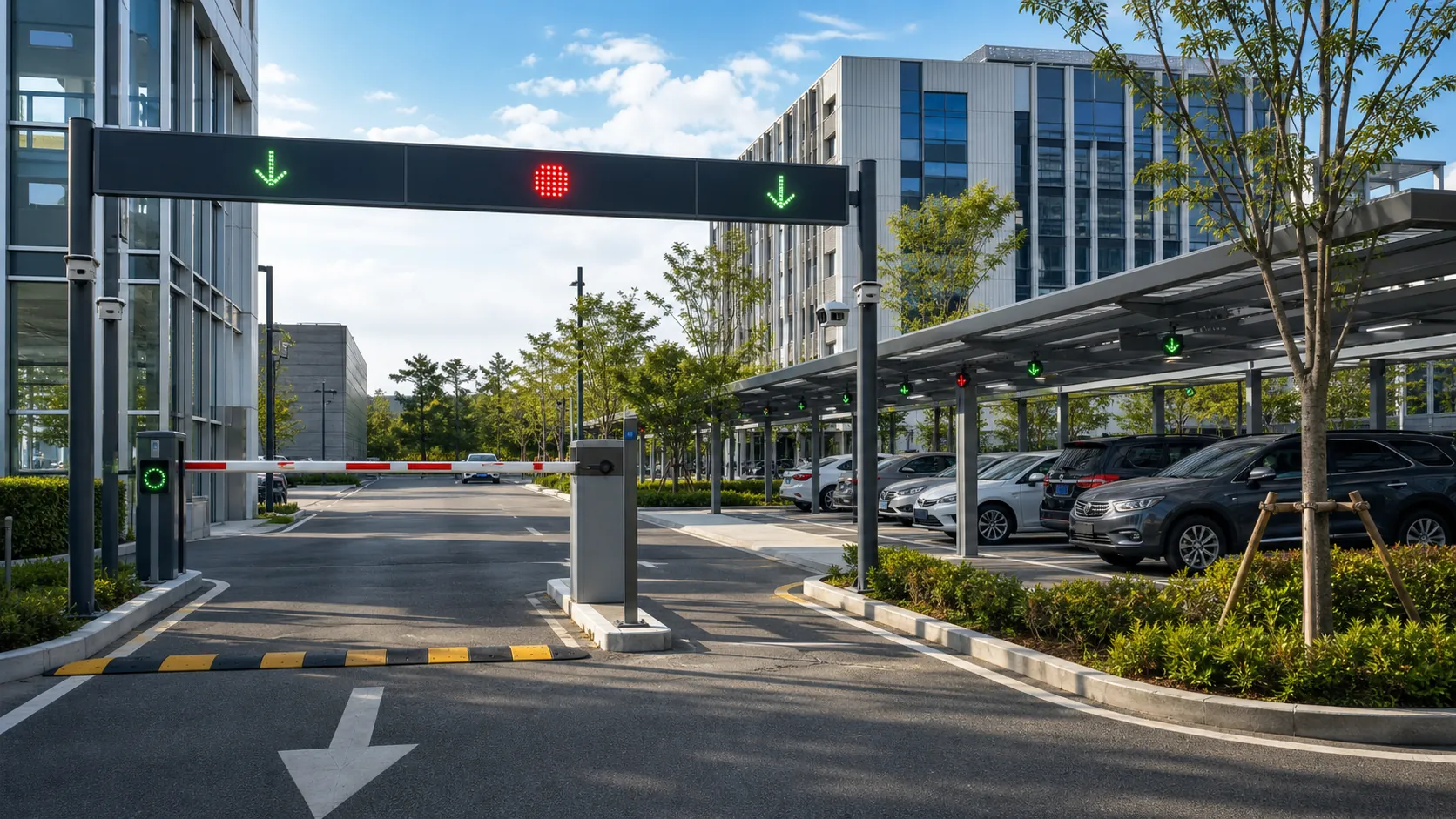
Parking Guidance
Design outdoor and indoor parking guidance with occupancy detection, entrance displays, bay indicators, operator dashboards and integration-ready APIs.
Parking Guide
How to plan parking occupancy detection, signs, dashboards, APIs and deployment acceptance for smart parking guidance systems.
Frequently Asked Questions
What is a smart parking guidance system?
A smart parking guidance system (PGS) detects the occupancy of every parking bay in real time and tells drivers — via overhead colour indicators, LED count signs and a mobile app — exactly where the empty spaces are. The REDCOAST.LTD PGS adds a cloud SaaS dashboard, reservation, payment and ANPR integration on top, turning a confusing facility into a frictionless experience for drivers and a fully measurable operation for the manager.
How accurate are the per-bay sensors and do they work with all vehicle types?
The REDCOAST.LTD Sensor-Indicator Unit combines a 40 kHz ultrasonic transducer with an infrared time-of-flight backup, delivering greater than 99 % detection accuracy across sedans, SUVs, large vans, motorbikes (with narrow-beam option) and oversized vehicles (with wide-beam option). Detection holds even under glossy floors, low ceilings or partial bay occlusion, with sub-second update.
Can REDCOAST.LTD customise the indicator colours for reserved, accessible and EV bays?
Yes. The RGBW LED indicator supports five colour states out of the box (typically Green vacant / Red occupied / Blue accessible / Yellow reserved / Purple EV), and the mapping is fully programmable from the cloud — you can re-flash a single bay, a whole row or the entire facility without any site visit, and create event-day overrides in seconds.
Does the system work outdoors as well as indoor garages?
Yes. The outdoor Sensor-Indicator Unit and outdoor LED count signs are rated IP66 with UV-stabilised lenses and operate from -40 to +70 °C, suitable for cold-climate, tropical and desert environments. The indoor family uses a slimmer IP54 housing for low-profile ceiling mounting in garages with finished interiors.
How is the system powered and what cabling is needed?
The system is grid-powered: AC 100–240 V feeds the Edge Zone Controllers and Site Gateway, which then deliver either 24 VDC bus power or IEEE 802.3af/at PoE to the Sensor-Indicator Units. Typical install uses a single CAT6 daisy-chain per group of up to 32 bays, dramatically reducing retrofit cabling versus star-wired alternatives. Solar is not used — every realistic parking facility is already on the grid.
Can the system integrate with ANPR, payment gateways and our BMS?
Yes. The platform exposes open REST and MQTT APIs and ships with reference integrations for major ANPR camera brands, common payment gateways (Visa/Mastercard, Apple Pay, Google Pay, regional providers), and BACnet/Modbus-based building management systems. Custom integration work is part of the standard project scope.
What is the typical project lead time, warranty and after-sales support?
A typical 800-bay deployment is commissioned in 4–6 weeks (1 week survey, 2–3 weeks production and pre-staging, 1–2 weeks installation and tuning). Standard warranty is 36 months with extensions available up to 84 months. Remote diagnostics, OTA firmware updates with dual-bank rollback, on-site commissioning, multilingual operator training and field-spare kits are all included or available.
How is occupancy data secured and where is it stored?
The cloud platform is engineered against ISO/IEC 27001 controls and supports GDPR-compatible data handling, configurable data residency across EU, GCC, APAC and LATAM regions, and on-premise / private-cloud deployment for tenants with strict data-sovereignty requirements. All bus and uplink traffic is encrypted (TLS 1.3 / MQTTS) end-to-end.