Overview
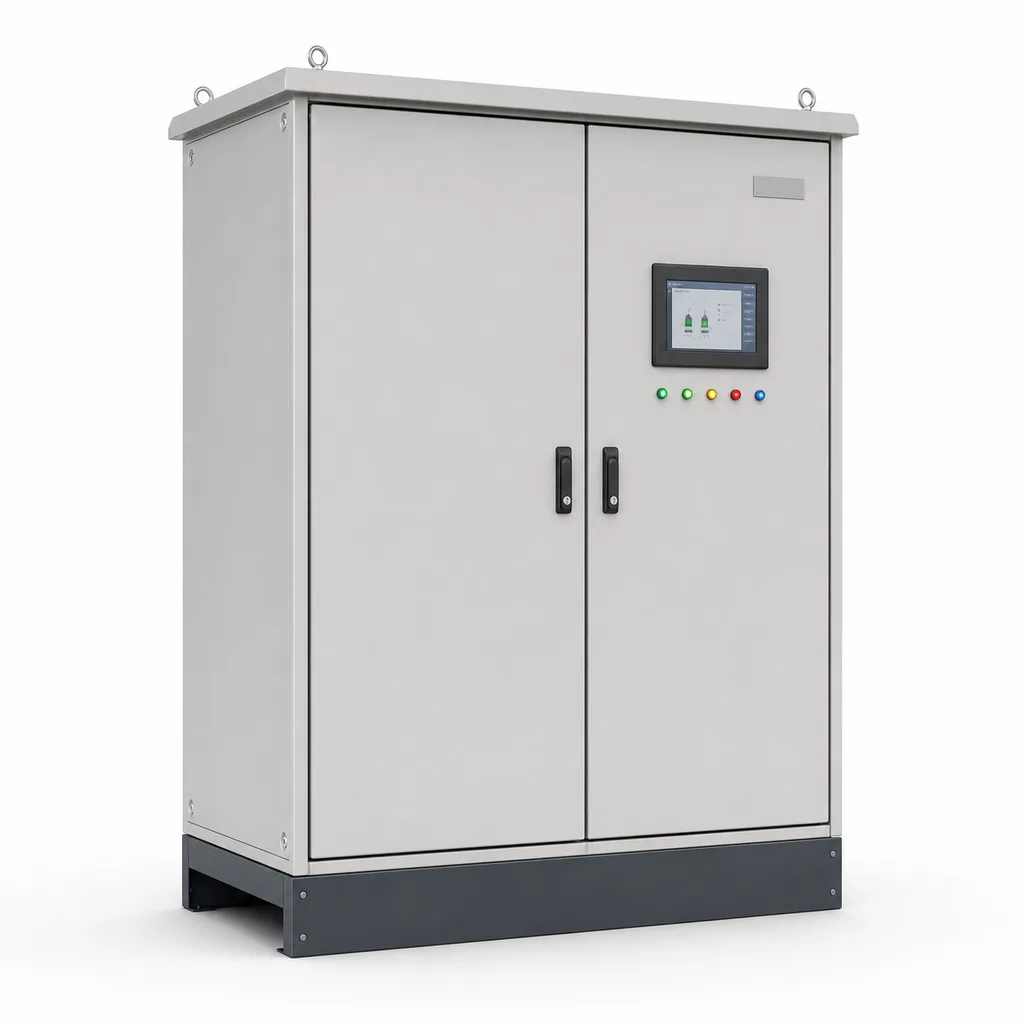
The RC-PSC-600 is a complete automation and remote monitoring solution for municipal sewage lift stations, stormwater and drainage pumping stations, underpass and tunnel dewatering stations, and industrial effluent transfer stations. It is delivered as an end-to-end package: a purpose-built pump station control cabinet with REDCOAST.LTD-designed controller and signal-conditioning electronics, field instrumentation, a cloud or on-premise SCADA platform, and a mobile app for operations teams. The system replaces aging float-and-relay panels and unmonitored stations with intelligent level-based control, full motor protection, and real-time telemetry, so utilities and city drainage departments can prevent overflows and flooding, cut energy and maintenance costs, and manage dozens of unmanned stations from a single control room. As pump stations are fixed municipal infrastructure with a utility connection, the RC-PSC-600 is a grid-powered (three-phase mains) product; a LiFePO4 UPS keeps the controller and telemetry alive through outages and a generator ATS interface is available for stations that require full backup pumping capacity.
Key Features
- Automatic level-based pump control with duty / standby / assist logic, automatic pump alternation for even wear, staggered starts to limit inrush, and anti-cycling timers to protect motors.
- Supports 1 to 6 pumps per station, from small 2.2 kW submersible lift pumps to 355 kW axial-flow storm pumps, with DOL, star-delta, soft-starter or VFD starting.
- Redundant level sensing: radar or hydrostatic primary transducer plus independent float switches wired to a hard-wired backup control chain, so the station keeps pumping even if the controller or primary sensor fails.
- Full motor and supply protection on every pump: overload, phase loss/reversal, over/under-voltage, seal-leakage and winding over-temperature (PT100/PTC) inputs, with per-pump energy metering to Class 0.5S.
- Open-protocol telemetry — Modbus RTU/TCP, DNP3, IEC 60870-5-104 and MQTT over TLS — so the station drops into an existing utility SCADA or runs on the REDCOAST.LTD web platform with mobile alarm push, SMS and email.
- Edge autonomy: all control logic runs locally in the cabinet; loss of the 4G or fiber link never interrupts pumping, and buffered data back-fills automatically on reconnection.
- Operations analytics: run-hours, start counts, drawdown-based flow estimation, pump efficiency trending and blockage/ragging detection flags that turn telemetry into actionable maintenance work orders.
- Custom electronics, not a parts-bin build: the RTU mainboard, multi-channel instrumentation signal-conditioning PCB, motor protection/metering board and relay I/O board are designed in-house and can be re-spun to match a project's exact I/O map.
- Outdoor or indoor build standards: IP66 outdoor kiosk or IP54 indoor cabinet, C4/C5-M corrosion protection, optional H2S/CH4 gas monitoring for wet-well safety.
Technical Architecture
The heart of the system is the REDCOAST.LTD pump station RTU: a dual-processor board that pairs a real-time 32-bit industrial MCU (deterministic pump control, protection interlocks, watchdog supervision) with a Linux-class edge gateway (protocol stacks, data logging, secure communications, local web HMI). Because both are our own board-level designs, the controller is not a generic PLC with add-on cards — the I/O count, protection inputs and communication ports are laid out for pump stations specifically, and can be modified at PCB level for unusual projects, such as stations mixing legacy hardwired interlocks with new VFD Modbus control.
Around the RTU sit three further REDCOAST.LTD boards. The instrumentation signal-conditioning PCB accepts 4–20 mA loops from radar, hydrostatic or ultrasonic level transmitters, pressure transmitters and flow meters, with per-channel galvanic isolation and surge clamping — essential in lightning-exposed wet wells. The motor protection and metering board samples three-phase voltage and current per pump, computing true RMS values, energy, power factor and imbalance, and trips the pump contactor on protection events within one cycle group. The relay I/O board drives contactors, soft-starter enables, VFD run/speed references, valve actuators and alarm beacons through robust, socketed relays. Data flows from the field layer up to the edge gateway, which timestamps and stores every event locally (several years of history at typical logging rates) and synchronizes with the SCADA platform, where operators see station mimics, wet-well trends, pump curves and alarm dashboards across their whole network.
Control logic follows water-industry practice: start/stop setpoints per pump stage, automatic duty rotation on each cycle or by run-hours, assist-stage cut-in on rising level or inflow surge, high-level and overflow alarms, and a fully independent float-switch chain that can run the station in a degraded but safe mode with the controller bypassed.
Connectivity & Power
Standard telemetry is industrial 4G LTE with dual SIM failover; stations along fiber-served corridors can use the built-in Ethernet port, and a dual-path fiber + 4G configuration is available for critical flood-control stations. Southbound, RS-485 and Ethernet ports speak Modbus to VFDs, soft starters, flow meters and power analyzers. Northbound, the gateway publishes DNP3, IEC 60870-5-104 or MQTT/TLS, and the platform exposes OPC UA and REST APIs for integration with city flood-management or utility asset systems.
Power is utility mains: three-phase AC 380–480 V, 50/60 Hz for the pump switchgear (single-phase 220–240 V builds for small package stations), with Type 1+2 surge protection at the incomer. The control and telemetry section runs from an isolated 24 V DC system backed by a LiFePO4 UPS sized for 4–8 hours, so level alarms and outage notifications keep flowing during blackouts — exactly when a drainage authority most needs visibility. An ATS/generator interface (start command, status, changeover supervision) is available for stations that must keep pumping through extended outages. This is a grid product: no solar array is fitted or required.
Protection & Reliability
Cabinets are fabricated from powder-coated galvanized steel (hot-dip galvanized substrate with a smooth matte polyester powder finish) or 316L stainless steel for coastal and high-H2S sites, rated IP66 for outdoor kiosks and IP54 for indoor switchrooms, with thermostatic heating/ventilation for -25 to +55 °C operation and 5–95 % RH. All field inputs are isolated and surge-protected (combined wave 20 kA on instrumentation loops), and the protection chain is designed so that a single component failure never leaves the wet well uncontrolled — float backup, hardwired high-level alarm and watchdog-supervised relays see to that. Relays and contactors are selected for ≥1 million mechanical operations; electronics carry a standard 3-year warranty (extendable to 5) and a design life of 15 years, with socketed wear parts for in-field replacement.
Application Scenarios
- Municipal sewage lift stations: unmanned neighborhood stations get automatic alternation, seal-leak and blockage detection, and overflow alarms — reducing sanitary spill events and emergency call-outs.
- Stormwater and flood-control pump stations: large multi-pump stations on urban drainage networks run staged storm response automatically and report capacity status to the city flood center in real time.
- Underpass and road tunnel dewatering: dewatering sumps at low points integrate with warning signage — the RC-PSC-600 pairs directly with the REDCOAST.LTD underpass flood warning and barrier system for a closed-loop response.
- Industrial parks and estates: effluent transfer and stormwater stations inside industrial estates report to the park's facility platform via OPC UA/REST, meeting discharge-compliance logging needs.
- Irrigation and land-drainage districts: river-intake and polder drainage stations with long distances between sites are supervised from one dashboard with 4G telemetry.
- Airports, ports and campuses: apron and terminal-area drainage stations where an unnoticed pump failure directly threatens operations gain continuous monitoring and predictive maintenance flags.
Case-style Examples
City-wide lift station modernization. A drainage utility operating dozens of aging float-and-relay sewage lift stations retrofits each with an RC-PSC-600 indoor cabinet, keeping existing pumps and starters. Radar level transmitters replace failing floats (which remain as backup), and all stations report to one SCADA. Result: overflow incidents drop sharply, night patrols are replaced by exception-based dispatch, and run-hour balancing extends pump overhaul intervals.
Storm pump station for a flood-prone district. A new 4×160 kW axial-flow stormwater station is delivered with VFD starting, dual-path fiber + 4G telemetry, generator ATS interface and IEC 60870-5-104 integration into the district flood-management platform. During storm events the station stages pumps automatically against forecast-linked setpoints, while operators watch wet-well levels and pump loading live from the control center and mobile app.
Underpass dewatering with closed-loop warning. A city equips five low-lying underpasses with dewatering sump controllers linked to REDCOAST.LTD flood-warning signs and barriers. When inflow exceeds pumping capacity, the controller escalates from pump-assist to automatic motorist warning and lane closure — no operator in the loop is required at 2 a.m.
Customization & Selection Guide
Choose by station size and criticality. Small package lift stations (1 duty + 1 standby, ≤15 kW) suit the compact single-phase or light three-phase build with DOL starting and 4G-only telemetry. Mid-size stations (2+1 or 3+1, 15–90 kW) typically add soft starters, radar level sensing and per-pump energy metering. Large storm stations (up to 6 pumps, ≤355 kW each) specify VFDs, dual-path communications, generator ATS and gas monitoring. Coastal or high-sulfide sites should select the 316L stainless cabinet and conformal-coated boards; cold climates add the heater package. Utilities with existing SCADA choose the DNP3 or IEC 60870-5-104 profile; greenfield customers deploy the REDCOAST.LTD platform (cloud or on-premise). Because the electronics are designed in-house, non-standard I/O maps, legacy protocol bridges and unusual pump counts are engineering variations, not exceptions.
Deployment & After-sales
Each cabinet is built, programmed and factory acceptance tested against the project's pump schedule and I/O list before shipment, so site work is limited to mounting, terminating field cables and commissioning — typically one to two days per station for a retrofit. REDCOAST.LTD supplies wiring diagrams, setpoint schedules and commissioning checklists, supports remote commissioning over the telemetry link, and provides operator training for the SCADA and app. Standard delivery is project-dependent but driven by switchgear lead times; the electronics are our own production. After-sales support includes remote diagnostics, firmware updates over the air, spare-board kits and multi-year support agreements.
Standards & Compliance
Designed in accordance with IEC 61439-1/-2 (low-voltage switchgear assemblies), IEC 60204-1 (electrical safety of machinery), IEC 61000-6-2/-6-4 (industrial EMC), IP ratings per IEC 60529, and CE/RoHS directives. Telemetry security follows TLS 1.2+ with VPN options; communication profiles implement Modbus, DNP3 (IEEE 1815) and IEC 60870-5-104. Corrosion protection classes per ISO 12944 (C4/C5-M). Project-specific compliance documentation and type-test reports are provided with each delivery.
Why REDCOAST.LTD
REDCOAST.LTD delivers complete smart-infrastructure solutions — hardware, web management platform and mobile app — engineered and integrated by one team. What sets the RC-PSC-600 apart is that the boards inside are our own: the RTU mainboard, instrumentation signal-conditioning PCB, motor protection/metering board and relay I/O board are REDCOAST.LTD designs, and we open new PCB revisions to match a project's exact requirements rather than forcing the station to fit a catalog controller. That board-level control means deeper customization, cleaner integration between cabinet, platform and app, and long-term spare-part security for infrastructure with a multi-decade life.
Tell us your station schedule — pump counts, motor ratings, wet-well geometry and SCADA environment — and we will engineer, build and deliver a tailored RC-PSC-600 package. Contact REDCOAST.LTD for a project-specific proposal.
Specifications
Pump Station Controller (RTU)
- Architecture
- 32-bit real-time MCU + Linux edge gateway (dual-processor, custom PCB)
- Pumps Supported
- 1-6 per station
- Control Modes
- Level-based auto (duty/standby/assist), alternation, hand-off-auto per pump
- Digital Inputs
- 16-32 (isolated) ch
- Analog Inputs
- 8-16 x 4-20 mA (isolated) ch
- Relay Outputs
- 10-24 ch
- Local HMI
- 7-inch industrial touchscreen + status LEDs
- Local Data Logging
- up to 5 years at 1-min intervals
Level Sensing & Instrumentation
- Radar Level Sensor (primary)
- 0-30 m range, +/-3 mm accuracy
- Hydrostatic Level (option)
- 0-20 m, 0.25% FS
- Ultrasonic Level (option)
- 0-15 m
- Backup Float Switches
- 2-4 (independent hardwired chain)
- Flow Meter Interface
- 4-20 mA / pulse / Modbus RTU
- Pressure Transmitter Interface
- 0-25 bar, 4-20 mA
- Loop Surge Protection
- 20 kA combined wave, per channel
Motor Control & Protection
- Motor Rating per Pump
- 2.2-355 kW
- Starting Methods
- DOL / star-delta / soft starter / VFD
- Electrical Protection
- Overload, phase loss/reversal, over/under-voltage, imbalance
- Pump Protection Inputs
- Seal leakage, winding over-temp (PT100/PTC), vibration (option)
- Energy Metering
- Per-pump, Class 0.5S
- Anti-cycling / Staggered Start
- Configurable timers, 1-600 s
Power Supply (Grid)
- Input Voltage
- AC 380-480 V 3-phase (220-240 V 1-phase option)
- Frequency
- 50/60 Hz
- Control Circuit
- 24 V DC, isolated
- Control/Telemetry UPS
- LiFePO4, 4-8 h backup
- Generator Interface
- ATS start/status/changeover supervision
- Surge Protection
- Type 1+2 SPD at incomer
Communication
- Cellular
- 4G LTE Cat 4, dual SIM (5G option)
- Wired
- 10/100 Ethernet, RS-485 x2; fiber option
- SCADA Protocols
- Modbus RTU/TCP, DNP3 (IEEE 1815), IEC 60870-5-104, MQTT
- Platform Integration
- OPC UA, REST API
- Security
- TLS 1.2+, VPN, role-based access
- Store-and-Forward
- Automatic back-fill after link loss
Enclosure & Environment
- Cabinet Material
- Powder-coated galvanized steel / 316L stainless
- IP Rating
- IP66 outdoor kiosk / IP54 indoor
- Operating Temperature
- -25 to +55 °C
- Humidity
- 5-95 (non-condensing) % RH
- Corrosion Class
- ISO 12944 C4 / C5-M
- Wet-well Gas Monitoring (option)
- H2S 0-100 ppm, CH4 0-100 %LEL
Software Platform
- Deployment
- Cloud SaaS or on-premise
- Stations per Tenant
- 1-1000+
- Alarm Channels
- Mobile app push, SMS, email
- Analytics
- Run-hours, start counts, drawdown flow estimate, efficiency trending
- Data Retention
- >=5 years
- Mobile App
- iOS / Android, live status + alarm acknowledgement
Capabilities — configurable per project
Specifications are tailored to each project — the options below show what we can support.
Pump Configuration
- 1 duty + 1 standby
- 2 + 1 / 3 + 1 stages
- Up to 6 pumps
- DOL / soft starter / VFD
Cabinet Build
- Indoor IP54
- Outdoor IP66 kiosk
- 316L stainless coastal
- Cold-climate heater package
Level Sensing
- Radar
- Hydrostatic
- Ultrasonic
- Float-only retrofit
Connectivity
- 4G dual SIM
- 5G
- Fiber Ethernet
- Dual-path fiber + 4G
SCADA Integration
- REDCOAST.LTD cloud platform
- On-premise platform
- Third-party via DNP3 / IEC 60870-5-104 / OPC UA
Related solution guidance
Environmental Monitoring
Deploy environmental monitoring stations with sensors, solar power, gateways, dashboards, alarms and data integration for city and industrial sites.
Power and Connectivity
How to choose power, battery, solar, NB-IoT, LTE, LoRaWAN, gateways and monitoring strategy for outdoor IoT infrastructure.
Solar IoT Guide
A design guide for solar-powered outdoor IoT: load calculation, battery autonomy, low-power firmware, telemetry and maintenance planning.
Frequently Asked Questions
How many pumps can the RC-PSC-600 control, and how does pump alternation work?
One controller manages 1 to 6 pumps per station, from 2.2 kW submersible lift pumps to 355 kW storm pumps. It runs level-based duty/standby/assist staging with automatic alternation on each cycle or by accumulated run-hours, so wear is balanced across pumps, plus staggered starts and anti-cycling timers to protect motors and the supply.
Can the system integrate with our existing SCADA instead of using a new platform?
Yes. The RTU natively publishes Modbus RTU/TCP, DNP3 (IEEE 1815) and IEC 60870-5-104, and the platform layer offers OPC UA and REST APIs. You can drop stations into an existing utility SCADA, use the REDCOAST.LTD web platform and mobile app, or run both in parallel during migration.
What happens if the 4G or fiber connection to the station is lost?
Nothing changes at the station: all control logic runs locally in the cabinet, so pumping continues normally. Data is logged on board and automatically back-filled to the SCADA when the link recovers, and a dual-SIM 4G modem or dual-path fiber + 4G configuration is available for critical flood-control stations.
How is the station protected against level sensor failure?
The system uses layered redundancy: a radar or hydrostatic transmitter is the primary sensor, and 2-4 independent float switches are wired into a hardwired backup chain that can start and stop pumps even if the controller or primary sensor fails. High-level and overflow floats also trigger alarms independently of the main logic.
Does monitoring keep working during a power outage?
Yes. The control and telemetry section runs on an isolated 24 V DC system backed by a LiFePO4 UPS sized for 4-8 hours, so operators receive the outage alarm and continue to see wet-well levels while mains is down. For stations that must keep pumping, a generator ATS interface manages automatic changeover.
Can we retrofit the RC-PSC-600 onto an existing pump station without replacing the pumps?
Yes, retrofit is a primary use case. Existing pumps, starters and cabling are kept; the new cabinet takes over control, protection and telemetry, and existing floats can remain as the backup chain. A typical retrofit is commissioned in one to two days per station after factory acceptance testing.
What standards does the control cabinet comply with?
Cabinets are designed to IEC 61439-1/-2 for low-voltage assemblies and IEC 60204-1 for electrical safety, with EMC per IEC 61000-6-2/-6-4, ingress protection per IEC 60529 (IP66 outdoor / IP54 indoor) and CE/RoHS compliance. Corrosion protection follows ISO 12944 class C4 or C5-M for coastal sites.
Why choose a custom-PCB controller over a standard PLC panel?
The RTU mainboard, instrumentation signal-conditioning, motor protection/metering and relay I/O boards are REDCOAST.LTD designs laid out specifically for pump stations, so isolation, surge protection and I/O mapping match the application instead of relying on generic add-on cards. It also means non-standard I/O maps or legacy interfaces can be handled by a board revision, and spare parts remain available from the manufacturer for the station's full life.