Overview
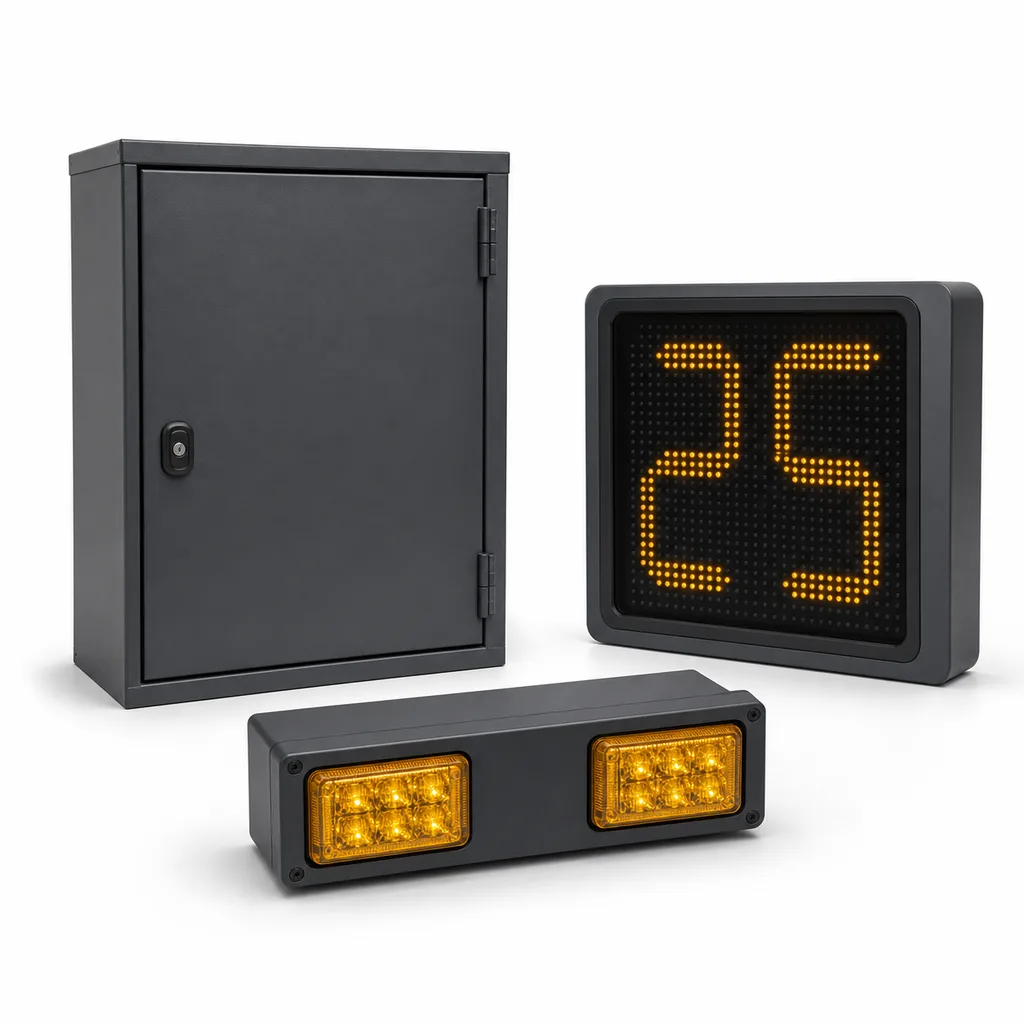
The RC-SZS-500 Smart School Zone Active Safety Management System is a grid-powered, edge-intelligent traffic safety platform purpose-built to protect children on and around school campuses. Deployed in urban and suburban environments where mains power is readily available, the system combines school-schedule-aware zone activation, 24 GHz Doppler radar speed measurement, high-intensity full-matrix LED speed feedback displays, RRFB-class amber flashing beacons, and electronically changeable variable speed limit signs into a single zone-coordinated solution. All subsystems are managed from a unified cloud dashboard and mobile app. The RC-SZS-500 serves municipalities, transport departments, and school operators worldwide who need a verifiable, data-backed, standards-compliant tool to slow vehicle speeds and increase pedestrian visibility during arrival and dismissal periods — going beyond static signage without the recurring costs and legal complexity of camera-based enforcement.
Key Features
- School-Calendar-Aware Zone Activation: The self-designed RC-SZS-ECU edge controller stores an annual school calendar — including term breaks, public holidays, and early-dismissal events — and activates the entire zone automatically. No manual switching, no forgotten deactivations during school holidays.
- 24 GHz Multi-Lane Radar Detection: Custom 24 GHz FMCW radar signal-conditioning PCB measures every approaching vehicle's speed across 1–3 lanes simultaneously with ±1 km/h accuracy from up to 150 m range, feeding real-time speed data to the display and analytics engine.
- High-Intensity Speed Feedback Display (SFD): Full-matrix LED display panels (600 × 600 mm to 800 × 800 mm) show each driver their actual speed in large amber digits; when the detected speed exceeds the zone limit, the display switches to a bold flashing WARNING message — leveraging self-enforcement psychology without citation infrastructure.
- RRFB-Class Dual Amber Flashing Beacons: At each crosswalk within the zone, high-intensity wig-wag alternating amber beacons (≥200 cd peak, SAE J595 Class 1) activate on pedestrian push-button press, radar detection, or scheduled zone activation — dramatically increasing driver yield rates at unsignalised crossings.
- Electronic Variable Speed Limit Signs (eVSLS): Full-matrix LED panels display the reduced school zone speed (15–40 km/h / 10–25 mph) only when the zone is active; outside school hours the sign goes dark or reverts to the normal road speed — eliminating the driver confusion associated with flashing amber signs that are left active around the clock.
- Zone-Wide Edge Coordination: All devices — radar units, speed feedback displays, RRFB beacons, and VSL signs — are orchestrated from a single zone edge controller over wired Ethernet/RS-485, enabling synchronised activation, consistent state-of-health reporting, and a single IP address for the city traffic management centre to query.
- Grid Power with LiFePO4 UPS Backup: AC 100–240 V primary input; the self-designed RC-SZS-UPS PCB provides 2–8 hours of LiFePO4 battery backup, keeping the zone operational during short grid interruptions at the most critical morning arrival windows.
- NTCIP 1210 / REST API Integration: Open-protocol interfaces allow the RC-SZS-500 to be queried and commanded by city-level traffic management centres, enabling remote manual override for unscheduled events (emergencies, early dismissal), automated alarm forwarding, and data extraction for safety audits.
- Rich On-Board Traffic Analytics: Speed histograms, pedestrian activation counts, and zone-event logs are stored locally and synced to the cloud platform — generating the evidence base for safety audit reports, infrastructure grant applications, and national statistics submissions.
- MUTCD 11th Edition & EN 12899 Compatible: Beacon flash patterns, sign luminance levels, and operational logic are tunable to both US (MUTCD) and European (EN 12899) standards, enabling deployment across different regulatory jurisdictions from the same hardware platform.
Technical Architecture
The RC-SZS-500 is structured as a zone-level network rather than a collection of independent standalone devices. At each zone entry point, one RC-SZS-RDU radar detection unit — built around REDCOAST.LTD's custom 24 GHz FMCW radar signal-conditioning PCB — continuously samples vehicle speed and lane occupancy, transmitting structured data frames to the zone edge controller over RS-485 at 10 Hz update rate. The RC-SZS-ECU edge controller (ARM Cortex-A processor, embedded Linux, 2 GB RAM, 32 GB eMMC) hosts the annual school calendar, zone activation logic, and the NTCIP 1210 / REST gateway. Its custom control PCB drives all zone output devices: the RC-SZS-SFD speed feedback display driver board pushes pixel-accurate, brightness-corrected content to the full-matrix LED panel at up to 64 Hz; the RC-SZS-BKN beacon driver board executes the wig-wag alternating flash pattern at precisely MUTCD-specified cadence; and the RC-SZS-VSD variable speed sign driver board switches the displayed speed on schedule or on command within 200 ms.
Within each beacon or sign housing, REDCOAST.LTD's custom LED constant-current driver PCBs regulate output with ambient-light-sensor automatic brightness control — maintaining ≥6,000 cd/m² under direct equatorial sunlight and reducing to a safe ≥500 cd/m² at night without manual intervention. The UPS PCB (RC-SZS-UPS) actively monitors AC input voltage, manages LiFePO4 cell balancing across a 4S1P to 8S2P pack configuration, and reports real-time battery state-of-health to the cloud platform via the zone controller — so operators know battery condition before a power outage occurs, not after.
The cloud management platform aggregates data from all deployed zone controllers, presents a real-time zone-status map, generates weekly speed-compliance trend reports, and distributes over-the-air firmware updates to all field devices without any site visit.
Connectivity & Power
Primary uplink from the zone edge controller to the city traffic management centre uses 10/100/1000 Mbps Ethernet (primary) or 4G/5G cellular (backup or standalone where fibre-to-cabinet is impractical). Within the zone perimeter, devices communicate over RS-485 (up to 32 nodes per zone segment, 1,200 m maximum segment length) or short-run Ethernet, keeping field wiring simple and using commodity cable that any local contractor can terminate. The system exposes NTCIP 1210 for school speed limit sign interfaces, NTCIP 1202 for optional traffic signal coordination, and a RESTful JSON API for integration with proprietary city platforms and school building management systems.
Grid power is drawn at AC 100–240 V, 50/60 Hz — compatible with any national power standard globally. Total system power consumption ranges from 80 W for a minimal 2-device zone to 400 W for a large multi-crosswalk zone with ANPR camera modules. The onboard LiFePO4 UPS delivers 2–8 hours of backup at full load, recharging from full discharge in under 6 hours. All AC-to-DC conversion and battery management is handled on REDCOAST.LTD's custom UPS PCB — no external off-the-shelf UPS unit is bolted in as an afterthought, eliminating the compatibility and maintenance issues that plague third-party UPS integrations.
Protection & Reliability
Beacon heads and sign enclosures are rated IP65, fully sealed against dust ingress and direct water jets — a prerequisite for monsoon-season school zones across tropical climates in Southeast Asia, South Asia, and sub-Saharan Africa. The roadside edge controller cabinet is IP55. All steel enclosures and pole sections are hot-dip galvanised for corrosion protection then finished with a smooth matte powder coat (RAL 7016 anthracite or customer-specified colour) to corrosion class C4, with an optional C5 marine-grade coating for coastal school zones within 1 km of salt water.
Operating temperature spans -30 °C to +65 °C — the same hardware family deploys in northern European winters and Middle Eastern summers. Aluminium alloy sign housings and beacon heads withstand 160 km/h wind loads per EN 1991-1-4 structural standard. LED arrays carry a rated lifetime of ≥100,000 hours (L70 per IEC 62031), corresponding to over 18 years of daily operation. Electronics MTBF exceeds 80,000 hours. Warranty baseline is 3 years on control electronics and 5 years on LED assemblies.
Application Scenarios
Urban Primary School Entrance on an Arterial Road: A school fronting a 50 km/h four-lane arterial uses the RC-SZS-500 with two radar units, two speed feedback displays at the zone entry, four RRFB beacons at the pedestrian crossing, and electronic VSL signs reducing the posted limit to 30 km/h. The zone controller activates automatically at 07:30 and 14:45 on school days; the city TMC monitors all zones remotely. Speed compliance during activation hours improves from around 55% to above 85% within a single academic term.
Multi-School Zone Corridor Management: A 1.4 km school zone corridor serving three consecutive schools is managed as a single zone network with eight radar-SFD pairs and six RRFB crosswalk positions. The zone controller synchronises all 14 devices; the municipal traffic department views the entire corridor on one dashboard page and triggers manual early-dismissal override via the web portal — no radio call to a field technician needed.
Suburban Highway School Zone with eVSL: A school situated off a 70 km/h state highway uses electronic variable speed signs to display 40 km/h only during active school hours. Radar speed feedback displays 400 m upstream give advance speed cues before drivers reach the signed zone, increasing compliance at the limit sign itself and reducing hard-braking events at zone entry.
University Campus Perimeter Road: A university campus with dense bicycle and pedestrian movement deploys RC-SZS-500 at seven priority crossings around campus perimeter roads, activated via the REST API integration with the campus access control and bell-schedule system — ensuring beacon activation aligns precisely with lecture end times, not just a fixed daily clock.
School Bus Route Industrial Area: A factory district where school buses transit a private access road installs the system with ANPR camera integration (optional module): the ANPR detects the school bus plate and triggers zone activation regardless of the time of day, ensuring active warning precisely when children are embarking or alighting — not dependent on a fixed schedule.
City-Wide School Safety Programme Integration: A municipality deploying RC-SZS-500 across 30 schools integrates all zone controllers into the city traffic operations centre via NTCIP 1210. Speed analytics from all zones feed automatically into an annual school safety audit report submitted to the national transport authority, supporting the city's infrastructure grant application with evidenced compliance data.
Case-Style Examples
Arterial Road School Zone Modernisation: A transport department managing twelve primary schools along a heavily trafficked 4-lane arterial road had relied on static school zone signs and crossing guard staffing alone. Crossing guards were unavailable on staff-absence days, and there was no mechanism to warn drivers approaching during those periods. They deployed RC-SZS-500 at six highest-risk school entrances: radar-triggered speed feedback displays and RRFB beacons were installed at each crossing, with electronic VSL signs reducing the posted limit from 50 to 30 km/h during school hours. The system activated automatically on the school calendar, including staff-absence days where the authority pushed manual zone-on commands remotely via the portal. After one full academic year, speed compliance during activation hours rose from 54% to 91%; recorded pedestrian near-miss incidents fell by more than 60%.
Greenfield Campus Infrastructure Integration: A private international school campus in a newly developed city district specified the RC-SZS-500 as embedded road infrastructure from the campus master plan stage. All five pedestrian crossings at campus entrances were equipped with RRFB beacons and radar speed feedback displays; the zone edge controller was networked directly to the campus BMS. REDCOAST.LTD delivered a custom firmware build integrating the school's proprietary bell-schedule API — zone activation and deactivation tracked the live school timetable, automatically adjusting for exam periods, sports days, and public holidays without any administrator intervention. The campus facilities manager described the integration as "invisible infrastructure that just works."
National School Zone Standardisation Programme: A national transport authority running a multi-year school safety infrastructure programme across 350 schools conducted a 12-school pilot evaluation of competing systems. RC-SZS-500 was selected for the full programme roll-out on the basis of NTCIP 1210 compliance (enabling central monitoring from the existing national TMC), the open REST API (integrating with the authority's proprietary data warehouse), and REDCOAST.LTD's ability to deliver fully factory-tested, pre-configured units with individual zone parameters loaded before shipment. Per-zone 10-year total cost of ownership — including power, maintenance, and software licensing — was independently assessed at 38% below the incumbent supplier's equivalent system. REDCOAST.LTD supported the programme with staged delivery, commissioning documentation, and a resident-engineer handover programme at regional maintenance depots.
Customisation & Selection Guide
For small zones (1–2 crosswalks, single-lane or two-lane road): a minimal RC-SZS-500 configuration with one radar detection unit, one speed feedback display, two RRFB beacons, and the base edge controller meets the requirement at the lowest capital cost. No eVSL signs are required if the road already has static school zone signs.
For multi-crosswalk urban zones (4–12 crossings, multi-lane arterial): expand the device count with multiple radar-SFD pairs, RRFB beacons at every crossing, and eVSL signs at zone boundary entry points. The edge controller supports up to 32 RS-485 device nodes per zone; larger deployments use a second controller in the same zone with a master-slave link.
For high-approach-speed roads (60–80 km/h): specify the extended-range 150 m radar unit and the larger 800 × 800 mm SFD panel with 400 mm character height for adequate reaction distance. Add an upstream advance warning SFD 400–600 m before the zone boundary per MUTCD Section 4S.04 spacing guidance.
For tropical or coastal deployments: the base IP65 / C4 rating handles standard monsoon and humid coastal conditions. For sites within 500 m of salt water or in industrial-atmosphere areas, specify the C5 marine-grade powder coat and stainless-steel fasteners throughout.
For cold-climate deployments (-20 °C and below): specify the thermostatically controlled sign enclosure heater option, which uses the custom PCB's onboard heating element and NTC thermistor to maintain the LED driver and electronics above -10 °C operating threshold during extreme cold snaps.
For V2X-connected school zones: pair RC-SZS-500 with REDCOAST.LTD's RC-RSU-200 C-V2X/DSRC dual-mode roadside unit (sold separately) to broadcast SPAT and MAP messages including school zone speed advisories to connected and autonomous vehicles in the zone — ensuring forward compatibility with smart mobility infrastructure.
Deployment & After-Sales
RC-SZS-500 devices ship factory-tested and pre-configured with the zone layout and school calendar loaded. On-site installation involves mounting sign and beacon heads to new or existing poles, routing Ethernet/RS-485 cable between devices and the zone controller cabinet, connecting the cabinet to the grid supply, and completing network commissioning via the cloud portal. A typical 4-to-6-device zone installation takes 1 to 2 days for an experienced civil crew; no specialised electronics test equipment is required on site beyond a laptop with the commissioning tool.
Firmware updates are distributed over-the-air through the cloud platform — no site visit is required for feature additions or security patches. The cloud dashboard provides 24/7 real-time health monitoring with automated fault alerts: device-offline notifications, LED-output degradation warnings, UPS low-battery alerts, and radar signal-quality flags. Standard product warranty is 3 years on electronics and 5 years on LED assemblies. Extended 5-year electronics warranty is available. LED modules, driver PCB assemblies, and power modules are held in regional spare-parts stock and dispatched within 5 business days. Remote technical support is available in English, Arabic, Spanish, and Mandarin.
Standards & Compliance
- MUTCD 11th Edition (FHWA, USA) — sign luminance, beacon flash rate, flash pattern, placement, and operational timing requirements for school zone devices
- SAE J595 Class 1 — peak luminous intensity ≥200 cd for RRFB amber beacon indications
- EN 12899-1 / EN 12899-5 (Europe) — fixed vertical road signs and illuminated traffic devices: dimensional, photometric, and retroreflectivity requirements
- IEC 62031 — LED modules for general lighting (L70 lumen maintenance lifetime methodology)
- IEC 62262 / IK10 — mechanical impact resistance for outdoor enclosures
- NTCIP 1210 — school zone speed limit sign communications interface
- NTCIP 1202 — actuated traffic signal controller interface (for optional signal coordination)
- CE Marking — EMC Directive 2014/30/EU and Low Voltage Directive 2014/35/EU
- RoHS 3 (EU 2015/863) — restriction of hazardous substances in electronic equipment
- IP65 / IP55 — ingress protection (sign and beacon heads / zone controller cabinet)
- EN 1991-1-4 — structural wind load standard for sign and beacon pole calculations
- National-standard compliance packages (GCC traffic device standards, ASEAN member-state requirements, Latin American regional standards) available on project-specific request.
Why REDCOAST.LTD
Every electronic subsystem in the RC-SZS-500 — the 24 GHz radar signal-conditioning PCB, the RRFB beacon driver board, the full-matrix LED display driver, the zone edge controller, and the LiFePO4 UPS management PCB — is designed in-house by REDCOAST.LTD's hardware engineering team. This means failure modes are understood at the board level; flash timing, brightness calibration, and radar sensitivity thresholds can be adjusted in firmware without hardware redesign; and when a government programme requires an interface to a non-standard TMC protocol, REDCOAST.LTD's software team implements it at the gateway layer without a middleware vendor adding cost and risk.
The same engineering team that designs the PCBs writes the cloud platform and mobile app, so there is no integration gap between the field hardware and the management software — a single point of accountability from hardware specification through to after-sales support. Whether the scope is a 2-device pilot or a 350-school national safety programme, REDCOAST.LTD scales delivery and technical support to match the programme timeline.
Contact REDCOAST.LTD with your school count, road classification, target national standard, and deployment timeline — our engineering team will return a site-specific configuration proposal within 5 business days.
Specifications
Radar Detection Unit
- Radar Frequency
- 24 GHz (FMCW Doppler)
- Detection Range
- 80–150 m
- Speed Measurement Accuracy
- ±1 km/h
- Lane Coverage
- 1–3 lanes (adjustable beam)
- Detectable Speed Range
- 5–250 km/h
- Output Interface
- RS-485 / 10/100 Ethernet
- Update Rate
- 10 Hz
Speed Feedback Display (SFD)
- Display Panel Size
- 600×600 to 800×800 mm
- LED Matrix Pitch
- P10 / P12 mm
- Peak Brightness (Daytime)
- ≥6,000 cd/m²
- Night Brightness (Auto-Dimmed)
- ≥500 cd/m²
- Character Height
- ≥250 mm
- Viewing Angle (H × V)
- ±30° × ±20°
- IP Rating
- IP65
RRFB Amber Flashing Beacon
- LED Configuration
- 2× high-intensity amber clusters, wig-wag alternating
- Peak Luminous Intensity
- ≥200 cd (SAE J595 Class 1)
- Flash Rate
- 1.0–2.0 Hz
- Activation Modes
- push button / PIR / radar trigger / scheduled
- Night Auto-Dimming
- ambient light sensor, ≥50 cd night floor
- LED Lifetime
- ≥100,000 h
- IP Rating
- IP65
Electronic Variable Speed Limit Sign (eVSLS)
- Display Type
- Full-matrix LED, amber / white selectable
- Speed Range Displayed
- 15–50 km/h (10–30 mph)
- Peak Brightness (Daytime)
- ≥6,000 cd/m²
- Communication Interface
- RS-485 / Ethernet (NTCIP 1210)
- State-Change Latency
- ≤200 ms
- Operating Modes
- Scheduled / Manual override / Always-off
- IP Rating
- IP65
Zone Edge Controller
- Processor
- ARM Cortex-A, embedded Linux
- RAM / Storage
- 2 GB / 32 GB eMMC
- Device Capacity per Zone
- up to 32 RS-485 nodes
- Network Interface
- 1× GbE + optional 4G/5G
- Protocol Support
- NTCIP 1210, NTCIP 1202, REST API
- Calendar Depth
- rolling 5-year annual school calendar
- Cabinet IP Rating
- IP55
Power & UPS
- Input Voltage
- AC 100–240 V, 50/60 Hz
- System Power Consumption
- 80–400 W (zone size dependent)
- UPS Battery Chemistry
- LiFePO4 (custom REDCOAST.LTD PCB managed)
- UPS Backup Duration
- 2–8 h (configurable pack size)
- UPS Recharge Time
- < 6 h from full discharge
- UPS Cell Monitoring
- individual cell balancing + SoH reporting
Environmental & Mechanical
- Operating Temperature
- -30 to +65 °C
- Storage Temperature
- -40 to +70 °C
- Wind Load Resistance
- 160 km/h (EN 1991-1-4)
- Corrosion Grade
- C4 standard / C5 marine option
- Enclosure Finish
- Hot-dip galvanised + smooth matte powder coat, RAL 7016 or custom
- Electronics MTBF
- >80,000 h
- Warranty
- 3 yr electronics / 5 yr LED assemblies
Capabilities — configurable per project
Specifications are tailored to each project — the options below show what we can support.
Radar Detection Configuration
- Standard 80 m single-lane radar
- Extended-range 150 m multi-lane radar
- Dual radar (zone entry + mid-zone speed check)
- Radar + PIR dual-technology trigger
Zone Device Complement
- Radar + SFD only (minimal zone)
- Radar + SFD + RRFB beacons
- Radar + SFD + RRFB + eVSL signs (full zone)
- Full zone + ANPR school-bus-triggered activation
Upstream Connectivity
- Gigabit Ethernet (primary)
- Ethernet + 4G/5G backup cellular
- 4G/5G standalone (no fibre required)
- V2X RSU companion link (C-V2X/DSRC broadcast)
Environmental Grade
- Standard C4, IP65/IP55
- Tropical C4/C5 marine-grade coating
- Cold-climate heated enclosure (thermostatically controlled)
- Desert high-UV stabilised housing
Management Integration
- Standalone cloud dashboard + mobile app
- NTCIP 1210 integration to city TMC
- REST API integration to school BMS / bell-schedule
- Custom protocol gateway to proprietary city platform
Related solution guidance
Traffic Safety Checklist
Deployment checklist for connected traffic warning signs, beacons, road guidance devices, power, visibility, monitoring and acceptance tests.
Traffic Safety
Plan connected traffic safety systems with warning beacons, LED signs, road guidance devices, sensing, control cabinets and monitoring software.
Airports and Hubs
IoT infrastructure for transport hubs: parking guidance, road safety, outdoor lighting, signage, monitoring and operational dashboards.
Frequently Asked Questions
How does a smart school zone safety system differ from a static school zone sign?
The REDCOAST.LTD RC-SZS-500 combines 24 GHz radar speed detection, LED speed feedback displays, RRFB-class amber beacons and electronic variable speed limit signs that switch on automatically with the school calendar. Drivers see their own speed and a flashing alert only when the zone is active, whereas a static sign gives no dynamic feedback.
What is an RRFB beacon and how is it activated in this system?
An RRFB is a pair of high-intensity amber LED indicators that flash in an alternating wig-wag pattern at 1-2 Hz. In the RC-SZS-500 the beacons reach ≥200 cd (SAE J595 Class 1) and can be triggered by a push button, pedestrian detection or the school schedule.
How does schedule-aware activation handle holidays and early dismissals?
The zone edge controller stores a rolling 5-year school calendar with term dates, public holidays, early dismissals and exam days. Outside active periods the speed feedback displays stay dark and eVSL signs show no reduced limit, so drivers do not learn to ignore warnings. Operators can activate the zone instantly from the web portal or by TMC command.
Which protocols are supported for traffic management centre integration?
The zone controller supports NTCIP 1210 for school zone speed limit signs, optional NTCIP 1202 for traffic signal coordination, and a RESTful JSON API over HTTPS for city platforms or school building systems. 4G/5G cellular can serve as the primary or backup uplink where fibre is unavailable.
How large a school zone can one controller manage?
One RC-SZS-ECU zone controller handles up to 32 RS-485 device nodes (radar units, speed displays, beacons and VSL signs combined) over up to 1,200 m per bus, covering roughly a 1-1.5 km corridor. Larger zones add a second controller linked over Ethernet so both appear as one logical zone.
What power does the system need, and what happens during a grid outage?
It runs on AC 100-240 V, 50/60 Hz, drawing 80-400 W depending on zone size. A built-in LiFePO4 UPS provides 2-8 hours of backup, selected by battery pack size at order, and the cloud dashboard reports grid-loss and battery-state events in real time.
Which traffic device standards is the RC-SZS-500 designed to?
It is designed to meet MUTCD 11th Edition beacon and sign requirements, SAE J595 Class 1 beacon intensity, EN 12899-1/-5 sign requirements, NTCIP 1210 for TMC interfacing and IEC 62031 for LED lifetime methodology, with CE and RoHS 3. Country-specific compliance packages for GCC, ASEAN and Latin American markets are available on request and confirmed per project.
Can the system follow non-standard or daily-changing bell schedules?
Yes. The zone controller's REST API accepts real-time schedule commands, so it can connect to a school's bell-schedule or ERP system and receive zone-on and zone-off events as schedules change, without the transport department maintaining a separate schedule database.