Overview
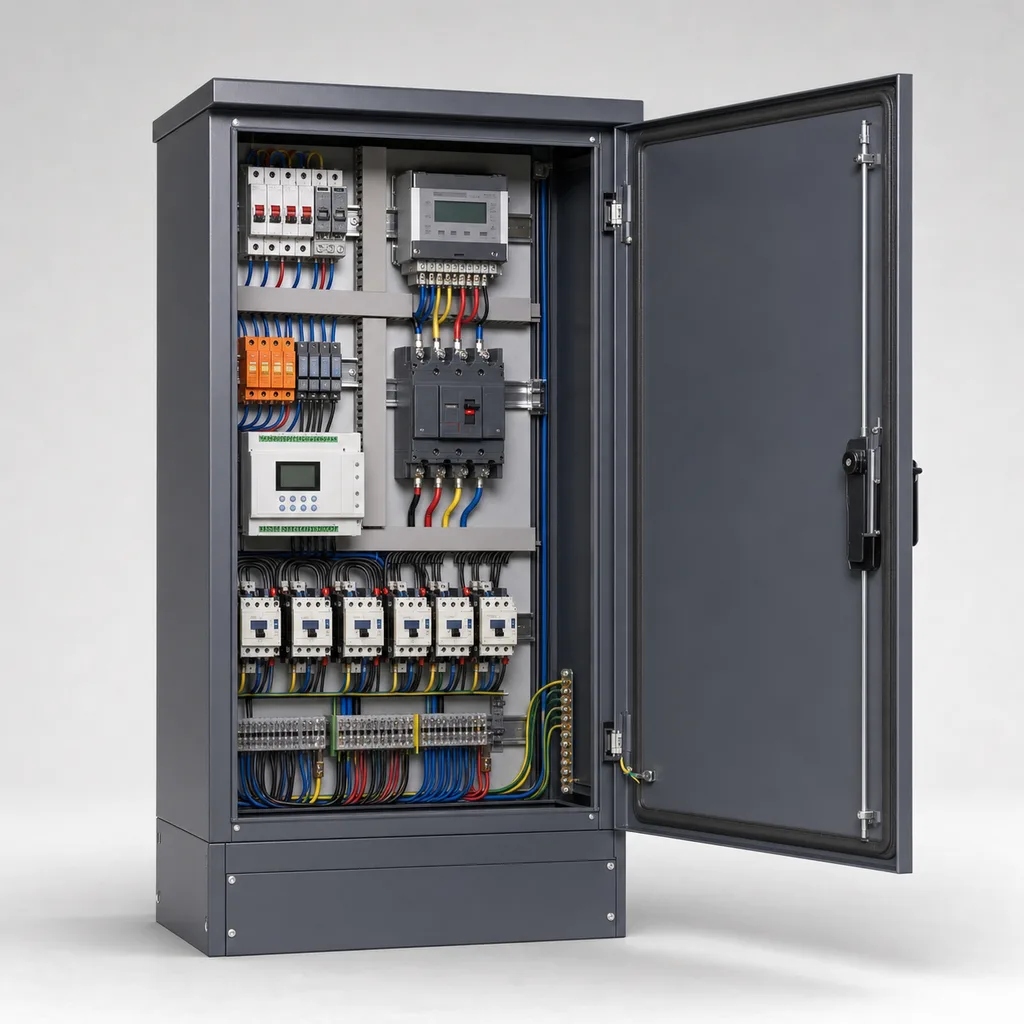
The REDCOAST.LTD RC-CCMS-400 is a grid-powered Smart Street Lighting Control Cabinet — known across global tenders as a CCMS (Central Control and Monitoring System) panel or an intelligent feeder pillar. It sits at the head of a low-voltage lighting feeder, between the mains supply and the luminaires, and turns an entire street or district of lamps into one remotely managed, fully metered asset. In a single enclosure it switches, dims, meters and protects every outgoing lighting circuit while streaming live electrical data to a central management platform over cellular or wired links. It is built for municipalities, highway and road authorities, industrial parks, ports and campus operators that want measurable energy savings, faster fault response and full visibility of their lighting network — without the cost of putting an individually networked node on every luminaire. Because REDCOAST.LTD designs the control-and-metering PCB in-house, the cabinet is delivered as one integrated hardware, web-platform and mobile-app solution, tuned to each project rather than assembled from mismatched parts.
Key Features
- Cabinet-level (group/segment) control of a whole feeder — up to 200 luminaires across 3–12 outgoing circuits managed as one entity, with no per-lamp node required.
- Built-in revenue-grade energy metering: 3-phase 4-wire, Class 0.5S active energy, true-RMS per-phase voltage, current, power factor, active/reactive/apparent power, frequency and THD.
- Multi-mode switching and dimming: astronomical clock, photocell, calendar schedules, part-night / midnight dimming, and instant remote command.
- Real-time fault and anomaly detection: over/under voltage, over/under current, phase failure, load imbalance, abnormal day/night burn, earth leakage and cable-theft alarms.
- Anti-theft and tamper protection: unexpected outgoing-current monitoring, door-open sensor and enclosure tamper alerts to catch copper-cable theft and vandalism early.
- Resilient connectivity: 4G LTE Cat-1/Cat-4 with 2G/3G fallback, NB-IoT option, dual SIM, Ethernet and RS-485 Modbus, plus local Wi-Fi/Bluetooth for commissioning.
- Standards-based electrical safety: Type 2 (or Type 1+2) surge protection, RCD/RCBO earth-leakage protection, MCB/MCCB overcurrent and up to 10 kA short-circuit withstand.
- Autonomous edge logic: keeps running to a stored schedule and astronomical clock even when the network is down, then back-fills logs on reconnection.
- Open integration: MQTT/TLS and Modbus, TALQ-ready platform, and interoperability with REDCOAST.LTD single-lamp NEMA/Zhaga controllers for hybrid group-plus-individual control.
- Rugged, corrosion-resistant enclosure in GRP, stainless steel or powder-coated steel, IP54–IP65 and IK10.
Technical Architecture
At the core of the RC-CCMS-400 is a REDCOAST.LTD-designed control and metering board that combines an isolated 3-phase measurement front-end, a 32-bit edge controller and a cellular/wired communications module. The metering front-end reads phase voltages directly and phase/circuit currents through split-core current transformers (CTs), computing four-quadrant energy and full power-quality parameters in firmware. Incoming mains passes through a main MCCB and a surge-protection stage, then feeds a bank of contactors — one per outgoing lighting circuit — each protected by its own MCB and monitored by a dedicated CT. The edge controller drives the contactors according to the active control mode and, where dimming is required, issues 0–10 V, DALI-broadcast or PWM commands through an optional group-dimmer stage.
The control logic is layered so the cabinet is never dependent on a live connection. A local astronomical clock, synchronised by GNSS or NTP and backed by a real-time clock, computes sunrise and sunset from the installed latitude and longitude; on top of it sit calendar schedules and multi-step dimming profiles. Remote commands from the central platform simply override or update these local rules. Every measurement, switching event and alarm is time-stamped and logged on-board (30–90 days at 15-minute resolution), so no data is lost during outages.
On the data side, the communications module maintains an encrypted MQTT/TLS session to the REDCOAST.LTD management platform, publishing metering, status and alarm messages and subscribing to control commands. The same platform exposes a web dashboard and a mobile app for operators — map view, per-cabinet and per-circuit energy, fault tickets and remote switching. Northbound APIs plus TALQ and Modbus support let the cabinet feed an existing city CMS or SCADA where required, and the RS-485 bus lets it also supervise REDCOAST.LTD single-lamp controllers on projects that mix group and individual dimming.
Connectivity & Power
The RC-CCMS-400 is a mains-powered device intended for locations that already have a grid supply — city streets, arterial roads, roundabouts, industrial parks, ports and campuses — so it carries no solar panel or standalone battery bank; a small supercapacitor/Li backup only preserves the clock and sends a last-gasp power-fail alarm. Standard input is 3×230/400 V AC, 50/60 Hz (a single-phase 230 V variant is available for small feeders), and the controller itself draws under 5 W. Connectivity is deliberately flexible: 4G LTE Cat-1/Cat-4 with 2G/3G fallback and dual-SIM redundancy is the default for distributed roadside cabinets; NB-IoT suits dense, low-data metering deployments; and 10/100 Ethernet or RS-485 Modbus is used where fibre or a wired field bus already exists. Local Wi-Fi/Bluetooth speeds up on-site commissioning.
Protection & Reliability
Electrical safety follows IEC 61439 assembly practice. Each cabinet includes Type 2 surge protection (Type 1+2 for exposed or lightning-prone sites) with Up ≤ 1.5 kV, RCD/RCBO earth-leakage protection (30/300 mA), MCB/MCCB overcurrent devices and a short-circuit withstand rating up to 10 kA. Phase-failure, imbalance and abnormal-consumption logic protect both the load and the asset, while door and tamper sensors guard against intrusion and copper theft. The enclosure is offered in UV-stable GRP, 304/316 stainless steel or powder-coated steel with IP54–IP65 ingress protection and IK10 impact resistance; an optional thermostat-controlled heater and ventilation extend the operating range from −40 to +55 °C and handle up to 95 % RH. Corrosion protection to class C4 (industrial) or C5-M (coastal/marine) is available for salt-laden environments, making the cabinet suitable for a wide range of climates and grid conditions worldwide.
Application Scenarios
- Urban arterial and residential street lighting: one cabinet manages a whole street or district, cutting energy with part-night dimming and reporting dark lamps automatically so crews are dispatched only when needed.
- Industrial parks, logistics yards and ports: group control of high-mast and pole lighting with accurate energy sub-metering per zone for cost allocation and load management.
- Campus and institutional estates (universities, hospitals): scheduled and photocell control across large grounds, with remote override for events and security patrols.
- Highway interchanges, roundabouts and tunnel approaches: robust grid-side control of continuous lighting runs, with reinforced surge protection for exposed sites and fast fault localisation.
- City-wide street-lighting modernisation: retrofit onto existing feeders to add metering, remote control and theft detection without changing luminaires — a fast, low-disruption first step toward a full smart-lighting rollout.
- Public squares, parks and commercial districts: multi-circuit scheduling for decorative, pathway and floodlighting on independent timelines.
Case-style Examples
- Arterial lighting modernisation (retrofit): A road authority needed energy savings and outage visibility across dozens of mixed-vintage feeders without a full luminaire swap. RC-CCMS-400 cabinets were installed at each feeder pillar with 6–9 outgoing circuits, Class 0.5S metering and 4G backhaul. Part-night dimming and dark-lamp alarms cut energy use and maintenance visits, and the metering data reconciled billing against the utility.
- Port and logistics yard sub-metering: A container-yard operator wanted per-zone energy accountability and central control of high-mast lighting. Stainless-steel C5-M cabinets with per-circuit CT metering and RS-485 links to floodlight drivers delivered zone-level energy reports and remote scheduling, with surge protection sized for the exposed coastal site.
- Campus roll-out (hybrid group + individual): A university estate combined group control on secondary roads with individual dimming on main pedestrian routes. A single RC-CCMS-400 handled cabinet-level switching while supervising REDCOAST.LTD single-lamp controllers over RS-485, unifying both under one dashboard.
Customization & Selection Guide
Choose the enclosure by environment: GRP for general urban use and cost, powder-coated steel for standard security, and 304/316 stainless with C5-M coating for coastal, port or heavy-industrial sites. Size the number of outgoing circuits (3, 6, 9 or 12) and contactor/MCB ratings to the connected lighting load. Pick connectivity by site: 4G with dual SIM for isolated roadside cabinets, NB-IoT for dense low-data deployments, Ethernet/RS-485 where a wired network already exists. Add the group-dimmer module (0–10 V / DALI / PWM) only where dimming is required — switch-only cabinets are the most economical. Select Type 1+2 SPD and a heater/ventilation kit for lightning-prone or extreme-climate sites. For utility-billed or metering-critical projects, specify the Class 0.5S meter and per-circuit CTs. REDCOAST.LTD adjusts circuit count, protection, communications and firmware logic per project because the control board is developed in-house.
Deployment & After-sales
Cabinets ship pre-wired, pre-tested and factory-configured with the customer's schedules, tariffs and platform credentials, so field work is limited to mounting (plinth, pole-base or wall), landing the incoming and outgoing cables, and confirming the network link. On-board Wi-Fi/Bluetooth commissioning and a mobile app make first power-up fast, and cabinets auto-register to the platform. REDCOAST.LTD provides platform onboarding, remote diagnostics, firmware-over-the-air updates, spare-parts support and project-based warranty terms, plus engineering support for integration with an existing city CMS or SCADA. Lead times are quoted per project scope and volume.
Standards & Compliance
Designed to IEC 61439-1/-5 (low-voltage assemblies, including assemblies for public networks), IEC 60529 (IP ratings), IEC 60947 (switchgear and controlgear), IEC 61643 (surge protection) and IEC 62053 (metering accuracy), with CE and RoHS conformity and BS 7671 installation compatibility. The management platform supports TALQ-based interoperability and MQTT/TLS-secured communications. Specific certifications are aligned to the destination market on a project basis.
Why REDCOAST.LTD
REDCOAST.LTD delivers end-to-end smart-lighting solutions — hardware, web platform and mobile app — integrated and supported by one team. Unlike pure integrators, we design and fabricate the CCMS control-and-metering PCB in-house (custom PCBs cut to each project), so circuit count, protection, metering accuracy, communications and control logic can all be tailored rather than forced to fit an off-the-shelf box. The result is a cabinet that fits your feeders, your tariffs, your climate and your management software.
Talk to REDCOAST.LTD about a custom Smart Street Lighting Control Cabinet configured for your feeders, load and climate — request specifications, a sample configuration or a project quotation today.
Specifications
Controller & Metering
- Metering Type
- 3-phase 4-wire, true-RMS, four-quadrant
- Active Energy Accuracy
- Class 0.5S (IEC 62053-22)
- Reactive Energy Accuracy
- Class 2 (IEC 62053-23)
- Measured Parameters
- V, I, PF, P/Q/S, frequency, THD (per phase)
- Voltage Measurement Range
- 3×230/400 (±20%) V AC
- Current Input
- split-core CT, 50/5 to 400/5 A
- On-board Data Logging
- 30-90 days @ 15-min interval
- Time Synchronisation
- GNSS / NTP + RTC, astronomical clock
Switching & Outgoing Circuits
- Outgoing Lighting Circuits
- 3-12 (configurable)
- Main Incomer
- MCCB 63-250 A
- Contactor Rating (AC-3)
- 25-63 per pole A
- Per-circuit Protection
- MCB Type C, 6-63 A
- Per-circuit Metering
- dedicated CT per circuit
- Manual Override
- Auto / On / Off per circuit
- Max Connected Load
- up to 40 kW
Control & Dimming
- Switching Modes
- astro clock / photocell / calendar / remote
- Dimming Output (optional)
- 0-10 V, DALI broadcast, PWM
- Dimming Profiles
- multi-step part-night / midnight
- Astronomical Offset
- ±120 configurable min
- Offline Operation
- local schedule + astro failover
- Luminaires per Cabinet
- up to 200 lamps
Connectivity & Interfaces
- Cellular
- 4G LTE Cat-1/Cat-4, 2G/3G fallback
- IoT Option
- NB-IoT
- SIM
- dual SIM (redundant)
- Wired
- 10/100 Ethernet, RS-485 Modbus RTU
- Local Commissioning
- Wi-Fi / Bluetooth
- Protocols
- MQTT/TLS, Modbus TCP, TALQ-ready
- Positioning
- GNSS (time + location)
Power (Grid)
- Input Voltage
- 3×230/400 (single-phase 230 option) V AC
- Frequency
- 50/60 Hz
- Controller Self-consumption
- < 5 W
- Backup
- supercap/Li for RTC + power-fail alarm
- Solar / Battery Bank
- not applicable (grid-powered)
Electrical Protection
- Surge Protection
- Type 2 (Type 1+2 option), Up ≤ 1.5 kV, In 20 kA
- Earth-leakage
- RCD/RCBO 30 / 300 mA
- Overcurrent
- MCB/MCCB per IEC 60947
- Short-circuit Withstand (Icw)
- up to 10 kA
- Fault Detection
- phase-fail, imbalance, cable-theft, door/tamper
Enclosure & Environmental
- Material
- GRP / 304-316 stainless / powder-coated steel
- IP Rating
- IP54-IP65
- Impact Resistance
- IK10
- Operating Temperature
- -30 to +55 (-40 with heater) °C
- Humidity
- up to 95 (non-condensing) %RH
- Corrosion Class
- C4 / C5-M option
- Mounting
- plinth / pole-base / wall
Capabilities — configurable per project
Specifications are tailored to each project — the options below show what we can support.
Enclosure Material
- GRP (glass-reinforced polyester)
- Stainless steel 304/316
- Powder-coated steel
Outgoing Circuits
- 3
- 6
- 9
- 12
Connectivity
- 4G LTE dual-SIM
- NB-IoT
- Ethernet
- RS-485 Modbus
Dimming
- Switch-only
- 0-10 V
- DALI
- PWM
Surge Protection
- Type 2
- Type 1+2 (exposed/lightning-prone)
Related solution guidance

Smart Street Lighting
Plan an IoT street lighting system with LED luminaires, pole controllers, adaptive dimming, fault alarms, asset management and platform integration.
Street Lighting Guide
A practical guide to choosing smart street lighting controllers, connectivity, platform features, dimming logic and acceptance tests.
Power and Connectivity
How to choose power, battery, solar, NB-IoT, LTE, LoRaWAN, gateways and monitoring strategy for outdoor IoT infrastructure.
Frequently Asked Questions
What is a CCMS or smart street lighting control cabinet?
A CCMS (Central Control and Monitoring System) cabinet, also called a smart feeder pillar or segment controller, is a grid-connected panel installed at the head of a lighting feeder. It switches, dims, meters and protects a whole group of street lights and streams live electrical data to a central platform, so an operator can manage an entire street or district as one asset.
How many street lights can one RC-CCMS-400 control?
A single cabinet manages up to about 200 luminaires spread across 3 to 12 outgoing circuits, with each circuit switched by its own contactor and monitored by a dedicated current transformer. The exact number depends on the connected load and how the circuits are grouped for switching and dimming.
Do I need to replace my luminaires or put a node on every lamp?
No. Cabinet-level control works with existing luminaires and adds metering, remote switching, scheduling and fault detection at the feeder without touching each lamp. For sites that also want per-lamp dimming, the cabinet can supervise REDCOAST.LTD single-lamp NEMA/Zhaga controllers over RS-485 in a hybrid setup.
Is the cabinet grid-powered or does it use solar?
The RC-CCMS-400 is grid-powered, designed for city streets, roads, parks, industrial parks, ports and campuses that already have a mains supply. It carries no solar panel or battery bank; a small supercapacitor or Li backup only keeps the clock alive and sends a power-failure alarm during an outage.
How does the cabinet detect street-lighting cable theft?
It continuously meters the current on each outgoing circuit and compares it against the expected load and schedule. An unexpected drop or an abnormal daytime draw, together with door-open and tamper sensors, triggers an instant cable-theft or intrusion alarm to the central platform, helping crews respond before more copper is lost.
What communication does it use where there is no fibre?
By default it uses 4G LTE Cat-1/Cat-4 cellular with 2G/3G fallback and dual-SIM redundancy, which suits distributed roadside cabinets with no wired network. NB-IoT is available for dense, low-data deployments, and Ethernet or RS-485 Modbus can be used where fibre or a field bus already exists.
Which standards does the cabinet comply with?
It is designed to IEC 61439-1/-5 for low-voltage assemblies (including public-network assemblies), IEC 60529 for IP ratings, IEC 60947 for switchgear, IEC 61643 for surge protection and IEC 62053 for metering accuracy, with CE and RoHS conformity and BS 7671 installation compatibility. Market-specific certifications are aligned per project.
Can it integrate with our existing central management software?
Yes. The cabinet reports over MQTT/TLS to the REDCOAST.LTD web and mobile platform, and it also supports TALQ-based interoperability plus Modbus and northbound APIs so it can feed an existing city CMS or SCADA. REDCOAST.LTD provides engineering support for third-party integration on a project basis.