Overview
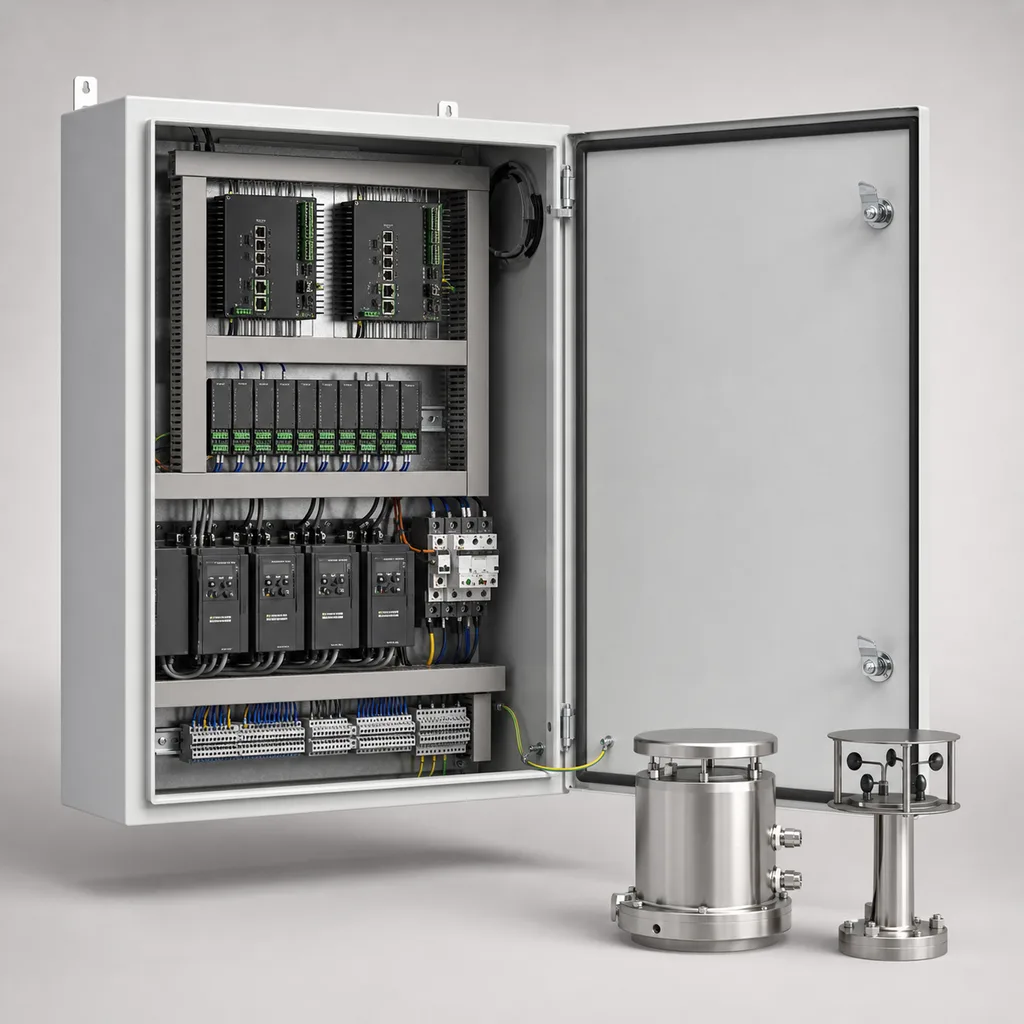
The REDCOAST.LTD RC-TVC-800 is a grid-powered, edge-intelligent ventilation control and air-quality monitoring system for road, urban and highway tunnels. It continuously measures carbon monoxide, nitrogen dioxide, visibility (smoke opacity) and longitudinal airflow, and automatically stages jet fans to keep pollutant and visibility levels safely below regulatory limits while minimising energy use. In a fire or incident it switches to emergency mode and drives tunnel airflow above the critical velocity to hold back smoke back-layering and protect the evacuation path. Delivered as an end-to-end package — self-developed field electronics, a redundant edge controller, a central management platform and a mobile app — it gives tunnel operators demand-based ventilation, full situational awareness and open integration with existing SCADA.
Key Features
- Continuous multi-parameter monitoring: CO, NO2, NO (optional), visibility / extinction coefficient, bidirectional air velocity, and temperature.
- Demand-controlled jet-fan staging that ventilates on set-points with hysteresis, cutting fan run-hours and energy versus fixed timer schedules.
- Dedicated emergency / fire ventilation mode that establishes and maintains longitudinal airflow above critical velocity to prevent smoke back-layering.
- Traffic- and incident-feedforward: uses loop / AID / traffic-detection data to pre-empt congestion pollution before it builds up.
- Reversible jet-fan control via soft-starter or VFD, with F300 / F400 fire-rated interfaces (EN 12101-3).
- Functional-safety architecture up to SIL 2 (IEC 61508) with hot-standby redundant controllers and integrated UPS.
- Open integration: Modbus, OPC-UA, BACnet/IP and NTCIP to SCADA, tunnel CMS, traffic control and fire-alarm systems.
- Self-developed multi-channel signal-conditioning PCBs for accurate, low-drift sensing and long service life.
- Web management platform plus mobile app for live dashboards, alarms, trend analysis, and predictive maintenance.
Technical Architecture
The system is organised in three tiers. At the field tier, distributed sensor nodes house NDIR / electrochemical gas cells, an optical transmissometer for visibility, and an ultrasonic anemometer for bidirectional air velocity. Every node is built around REDCOAST.LTD's own multi-channel signal-conditioning PCB, which provides isolated 4–20 mA, RS-485 / Modbus and Pt100 inputs with on-board linearisation and temperature compensation, so raw sensor signals are digitised cleanly at source. At the control tier, an industrial edge ventilation controller runs the real-time control algorithm: it compares measured CO, NO2 and visibility against configurable set-points, applies hysteresis and time-averaging to avoid fan hunting, and computes the number and direction of jet fans required. Feedforward inputs from traffic and incident detection let it act before pollutant peaks occur. At the actuation tier, jet-fan control cabinets receive commands over fieldbus and drive soft-starters or variable-frequency drives, with motor current and status feedback closing the loop. Measured data, fan states, alarms and events stream to the central platform over a redundant fibre ring; edge autonomy means the tunnel stays safely ventilated even if the uplink to the control centre is lost.
Connectivity & Power
Communication is standards-based and open. Field devices use Modbus RTU/TCP; the controller exposes OPC-UA and BACnet/IP for SCADA and building-management integration and NTCIP for ITS / traffic-control centres. The primary backbone is a redundant fibre-optic ring for deterministic, EMI-immune transport along the tunnel; 4G/5G is available as an out-of-band or remote-portal fallback. The system is mains-powered — tunnels have grid supply — with dual A/B feeds where available and an integrated LiFePO4 UPS that keeps controllers and monitoring alive through short outages and during controlled shutdown. It is not solar / off-grid equipment; supply is engineered to the tunnel's electrical infrastructure.
Protection & Reliability
Field nodes are sealed to IP65 / IP66 against tunnel washing, dust and diesel soot; control cabinets are IP54 / IP55 with active thermal management. The jet-fan interface supports fire-rated fans certified F300 (300 °C / 60 min) and F400 (400 °C / 120 min) to EN 12101-3. Electronics operate from -30 to +70 °C with C4 / C5-M anti-corrosion coatings for the humid, salt- and chemical-laden air found in tunnels. Reliability is engineered in: redundant hot-standby controllers, watchdog supervision, surge protection and a functional-safety design rated to SIL 2 give predictable fail-safe behaviour, with controller MTBF above 100,000 hours and a design life of 10–15 years.
Application Scenarios
- Long mountain highway tunnels: where accumulated CO and haze over kilometres demand staged longitudinal ventilation and dependable smoke control in emergencies.
- Urban river-crossing and undersea tunnels: high traffic and frequent congestion require demand-based ventilation to hold air quality without over-running fans.
- Underground urban expressways and cut-and-cover tunnels: dense city corridors needing tight coordination with traffic and incident management.
- Road underpasses and short town tunnels: compact installations where a single controller manages a modest jet-fan array and local sensing.
- Legacy tunnel refurbishment: adding NO2 sensing, visibility control and demand logic to old fixed-speed systems to cut energy and meet current safety standards.
Case-style Examples
- Long highway tunnel ventilation upgrade: A multi-kilometre unidirectional tunnel replaced fixed-timer fan operation with RC-TVC-800 demand control. Staged jet-fan operation driven by live CO and visibility set-points cut fan run-hours and energy substantially while keeping pollutant levels comfortably under PIARC limits, and the emergency mode was commissioned to hold critical velocity for the design fire.
- Urban river-crossing tunnel: A congested bidirectional city tunnel deployed the system with dense CO/NO2 and visibility monitoring feeding a hot-standby controller. Traffic-feedforward let ventilation ramp ahead of rush-hour queues, and full OPC-UA integration surfaced every fan and sensor inside the operator's existing SCADA.
- Legacy tunnel retrofit: An older tunnel with only CO monitoring added visibility and NO2 sensing plus demand control. The retained jet fans were re-commissioned under VFD control, lowering energy and extending fan life while modernising the tunnel to current safety expectations.
Customization & Selection Guide
Configuration follows the tunnel. Choose the ventilation strategy — longitudinal jet-fan (most common), semi-transverse, or full-transverse with damper control — from traffic direction, length and gradient. Size the sensing suite by length and risk: CO + visibility is the baseline; add NO2 / NO for air-quality-regulated urban tunnels and use denser sensor spacing for long or congested tubes. Select a single, hot-standby dual, or a dedicated SIL2 safety controller by criticality. For integration, pick standalone operation, SCADA-integrated, or a full tunnel CMS that also coordinates lighting, traffic and fire systems. REDCOAST.LTD engineers the sensor spacing, fan count and control set-points to the specific tunnel geometry and applicable code.
Deployment & After-sales
Sensor nodes and cabinets mount to tunnel walls, ceiling niches or the control room; commissioning includes sensor calibration, fan-direction verification and control-loop tuning against the tunnel's ventilation study. REDCOAST.LTD delivers as an integrated project with full documentation, factory acceptance testing (FAT) and site acceptance testing (SAT), operator training, remote diagnostics and multi-year support, backed by spare-parts and calibration programmes that keep the system in specification.
Standards & Compliance
Designed to align with PIARC road-tunnel ventilation guidance, NFPA 502, and the EU minimum-safety directive 2004/54/EC; fire-rated fan interfaces to EN 12101-3; functional safety to IEC 61508 (SIL 2); EMC to EN 50121 / CE; and RoHS. Field protection to IP65 / IP66. Final certification scope is tailored per project and jurisdiction.
Why REDCOAST.LTD
REDCOAST.LTD delivers the complete solution — hardware, web platform and mobile app — integrated by one team. Because we design and fabricate our own PCBs (multi-channel signal conditioning, jet-fan drive interface, edge controller and power management), every layer is controllable and deeply customisable: we tune sensor front-ends, add channels, and adapt control logic to each tunnel rather than forcing a fixed off-the-shelf box. That board-level capability, combined with software and platform ownership, is why operators get a system matched to their tunnel and standards, not a compromise.
Talk to REDCOAST.LTD about a ventilation and air-quality control system engineered for your tunnel — contact us for a tailored proposal and configuration.
Specifications
Environmental Sensing
- CO Measuring Range
- 0-300 ppm
- NO2 Measuring Range
- 0-30 ppm
- NO Measuring Range (optional)
- 0-100 ppm
- Visibility (Extinction Coefficient)
- 0-0.05 m^-1
- Air Velocity (bidirectional)
- 0-15 m/s
- Air Temperature
- -40 to +85 °C
- Sensor Inputs per Node
- 8-16 (4-20 mA / RS-485 / Pt100) ch
- Sampling Interval
- 1 s
Ventilation Control (Jet-Fan Interface)
- Jet-Fan Channels per Controller
- up to 32
- Fan Power Supported
- 15-100 kW/fan
- Drive Method
- Soft-starter / VFD (Modbus), reversible
- Fire-rated Fan Interface
- F300 (300°C/60min) / F400 (400°C/120min), EN 12101-3
- Longitudinal Airflow Control Range
- 0-10 m/s
- Critical-velocity Target (configurable)
- 2.5-3.5 m/s
- Command Latency
- < 2 s
Edge Controller & Compute
- Architecture
- Industrial edge controller (ARM/x86), Linux RT
- Control Cycle
- 0.1-1 s
- Redundancy
- Hot-standby dual controller (optional)
- Onboard I/O (expandable)
- 32 DI / 32 DO / 16 AI / 8 AO
- Local Storage
- 64-256 GB
- Functional Safety
- up to SIL 2 (IEC 61508)
Communication & Integration
- Fieldbus / Protocols
- Modbus RTU/TCP, OPC-UA, BACnet/IP
- ITS Protocol
- NTCIP 1200 series
- Backbone
- Redundant fibre-optic ring (SFP)
- Wireless Fallback
- 4G / 5G (optional)
- External Interfaces
- SCADA / Tunnel CMS / Traffic control / Fire alarm / Linear heat detection
- Cybersecurity
- TLS, RBAC, IEC 62443-aligned
- Time Sync
- NTP / PTP
Power (Grid)
- Input Voltage
- AC 220 / 380, 50/60 Hz (dual A/B feed optional) V
- Backup
- Integrated LiFePO4 UPS
- UPS Hold-up (controllers/sensors)
- 30-120 min
- Controller Power Consumption
- 25-60 W
- Surge Protection
- Type 2 SPD, 20 kA
Enclosure & Environmental
- Field Node Ingress Protection
- IP65 / IP66
- Cabinet Ingress Protection
- IP54 / IP55
- Operating Temperature
- -30 to +70 °C
- Humidity
- 5-100 (condensing) %RH
- Corrosion Protection
- C4 / C5-M coating
- Mounting
- Tunnel wall / ceiling niche / control room
Compliance & Reliability
- Design Guidance
- PIARC, NFPA 502, EU 2004/54/EC
- Functional Safety
- IEC 61508 (SIL 2)
- EMC / Certification
- EN 50121, CE, RoHS
- Controller MTBF
- > 100,000 h
- Warranty
- up to 5 years
- Design Life
- 10-15 years
Capabilities — configurable per project
Specifications are tailored to each project — the options below show what we can support.
Ventilation Strategy
- Longitudinal (jet-fan)
- Semi-transverse
- Full-transverse (damper control)
Sensing Suite
- CO + Visibility (baseline)
- + NO2 / NO
- + Air velocity/direction
- + Linear heat / fire detection
Controller Redundancy
- Single controller
- Hot-standby dual
- Dedicated SIL2 safety controller
Integration Level
- Standalone
- SCADA-integrated
- Full tunnel CMS (lighting + traffic + fire)
Connectivity
- Fibre ring
- Fibre + 4G/5G backup
Related solution guidance

Environmental Monitoring
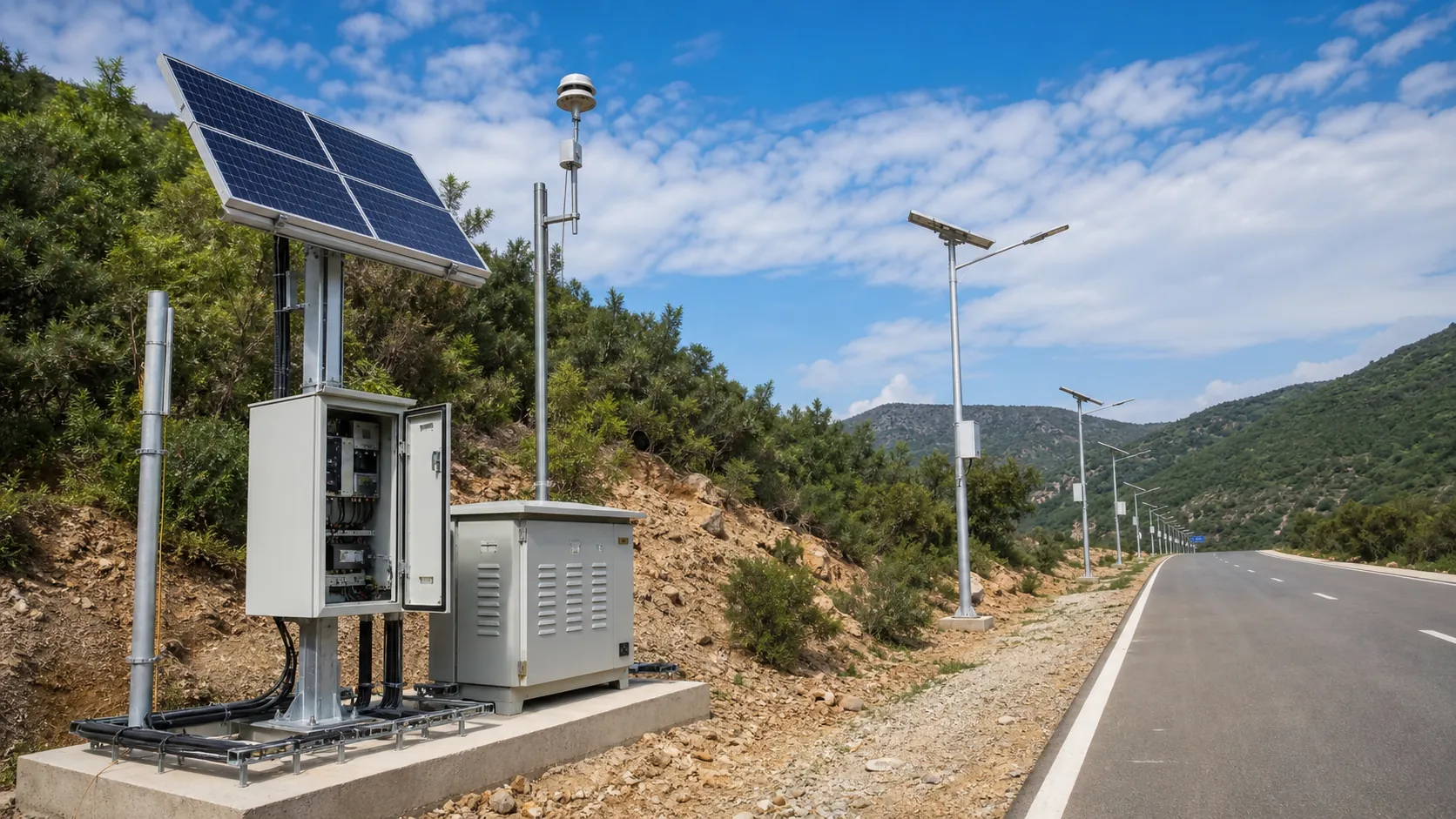
Deploy environmental monitoring stations with sensors, solar power, gateways, dashboards, alarms and data integration for city and industrial sites.
Solar IoT Guide
A design guide for solar-powered outdoor IoT: load calculation, battery autonomy, low-power firmware, telemetry and maintenance planning.
Power and Connectivity
How to choose power, battery, solar, NB-IoT, LTE, LoRaWAN, gateways and monitoring strategy for outdoor IoT infrastructure.
Frequently Asked Questions
Which air quality parameters does the tunnel ventilation control system measure?
The baseline configuration measures CO (0-300 ppm) and visibility as an extinction coefficient (0-0.05 m^-1). NO2 (0-30 ppm), NO (0-100 ppm) and bidirectional air velocity (0-15 m/s) are project options, with a 1 s sampling interval.
How does the controller stage the jet fans?
The edge controller stages up to 32 reversible jet fans of 15-100 kW each per controller through soft-starters or VFDs over Modbus, using the selected sensor readings and configurable set-points. Command latency is under 2 s with a 0.1-1 s control cycle.
How is emergency fire ventilation handled?
Emergency control is commissioned against the tunnel's ventilation study, geometry and selected ventilation strategy, with a configurable critical-velocity target of 2.5-3.5 m/s. Fire-rated fan interfaces to EN 12101-3 (F300 or F400) are supported.
Which tunnel ventilation strategies can the system control?
It supports longitudinal jet-fan ventilation (the most common), semi-transverse ventilation and full-transverse ventilation with damper control. The strategy is chosen from traffic direction, tunnel length and gradient.
Can it integrate with our existing tunnel SCADA or traffic management center?
Yes. Interfaces include Modbus RTU/TCP, OPC-UA, BACnet/IP and NTCIP 1200-series over a redundant fibre-optic ring, with optional 4G/5G fallback. REDCOAST.LTD also provides a Web platform and mobile app for operation.
Is the system solar-powered, and what happens during a power outage?
No. It is mains-powered at AC 220/380 V, 50/60 Hz, with an optional dual A/B feed. An integrated LiFePO4 UPS keeps controllers and sensors running for 30-120 minutes.
Can existing tunnel fans and equipment be retained in a retrofit?
Yes. Retrofit scope can add sensors and re-commission existing fans with soft-starter or VFD control. Commissioning includes sensor calibration, fan-direction verification and control-loop tuning against the tunnel's ventilation study.
Which standards and safety levels is the system designed to?
It is designed to align with PIARC road-tunnel ventilation guidance, NFPA 502 and EU Directive 2004/54/EC, with functional safety up to SIL 2 (IEC 61508) and EMC to EN 50121 and CE. Final certification scope depends on the project configuration and jurisdiction.