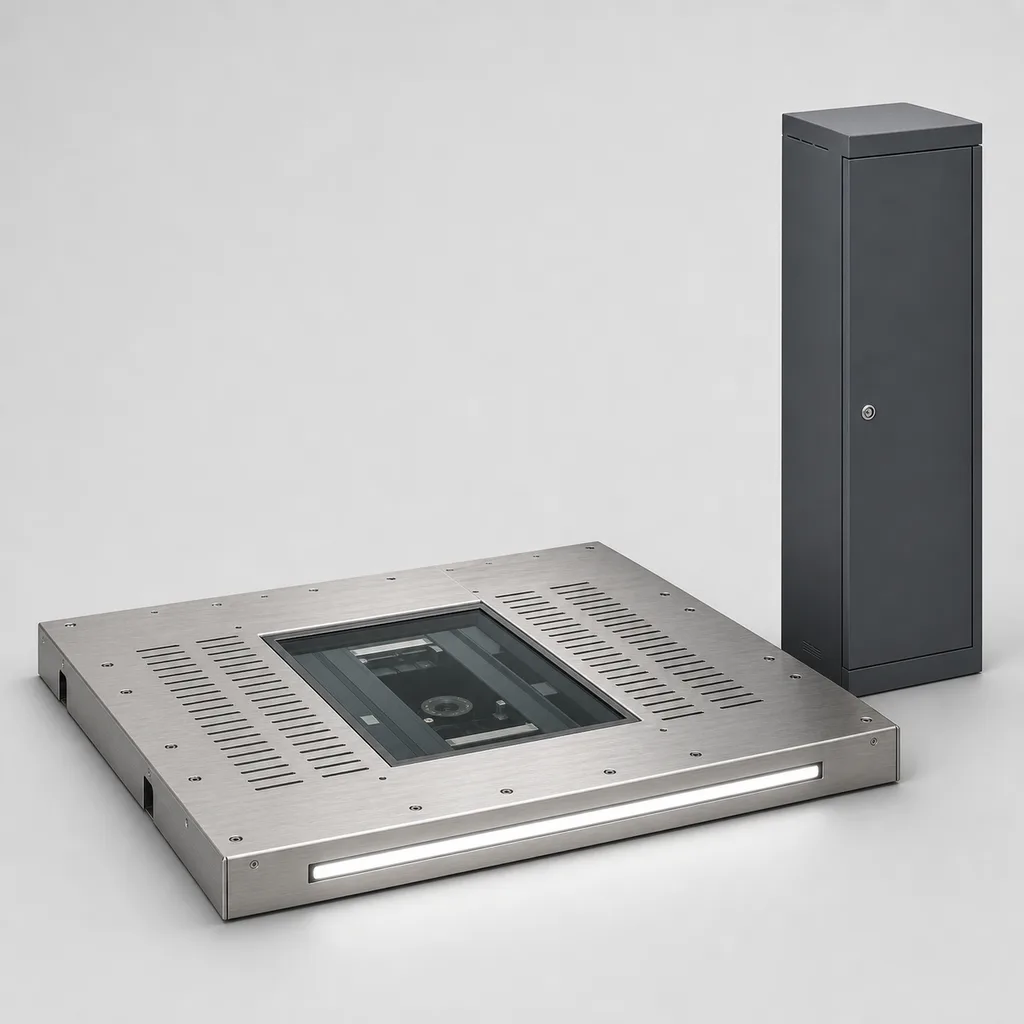
Overview
The REDCOAST.LTD RC-UVS-500 is a grid-powered Under Vehicle Surveillance & Inspection System (UVSS/UVIS) that captures a complete, high-resolution image of a vehicle's undercarriage as it drives over an embedded scanner — without requiring the vehicle to stop. It is purpose-built for high-security vehicle checkpoints, where officers must detect improvised explosive devices, contraband, magnetic-mounted objects, hidden compartments, foreign materials and unauthorized structural modifications in the one area conventional CCTV and manual mirror inspection cannot cover. Combined with integrated ANPR, AI-based anomaly detection and direct interlock to boom barriers and hostile-vehicle-mitigation bollards, the RC-UVS-500 turns a gatehouse into a fast, automated, evidence-logged inspection point for government, military, aviation, border, port, energy and hospitality sites worldwide.
Key Features
- High-resolution line-scan imaging: builds a seamless composite undercarriage image up to 12,000 × 7,500 px with up to 180° full-width, distortion-free coverage of the entire chassis.
- Drive-through operation: real-time speed synchronization images vehicles moving at up to 30 km/h (40 km/h optional), so there is no need to stop and no queue build-up at busy gates.
- AI threat detection: automatically compares each scan against the vehicle's stored undercarriage "fingerprint" and flags added, removed or altered objects, foreign materials and suspicious modifications, typically within 2–3 seconds.
- Integrated ANPR/ALPR: reads and logs license plates at ≥98% accuracy, linking every undercarriage image to plate, date, time, lane and direction of travel.
- Rugged drive-over scanner: 316 stainless-steel enclosure, IP68 rated, engineered for axle loads up to 50 t (78 t heavy-duty option) with an anti-slip, self-draining top plate.
- Grid-powered with UPS backup: wide-range mains input with a LiFePO4 UPS keeps scanning, ANPR and barrier control running through power interruptions.
- Three form factors: flush-embedded fixed unit, no-excavation surface-mount ramp, and portable/mobile ramp for temporary checkpoints.
- Open integration: relay I/O and open REST API connect to barriers, HVM bollards, boom gates, turnstiles, access control and Video Management Systems.
- Self-developed REDCOAST.LTD electronics: line-scan imaging & LED illumination driver board, ANPR edge-AI board, presence-detection (loop/laser/radar) signal-conditioning board, barrier/bollard interlock I/O board and UPS power-management PCB.
- All-climate 24/7 duty: operates from -40 °C to +75 °C and is conformally coated and salt-fog tested for desert, coastal, tropical and freezing environments.
Technical Architecture
The system centers on an embedded scanning unit installed flush across the traffic lane. Inside its stainless-steel housing, a line-scan camera (2,048–5,000 px per line, up to 18 kHz line rate) and a high-CRI white LED illumination array image the passing undercarriage line by line. REDCOAST.LTD's self-developed imaging-and-illumination driver board synchronizes the line-scan rate to the vehicle's actual speed — measured by dual inductive loops (or optional laser/radar presence detectors) — so the picture is geometrically correct whether a car creeps or drives through at 30 km/h. Thousands of individual lines are stitched in real time into a single seamless composite of the full chassis.
Roadside, a control cabinet houses the edge-AI processor, the ANPR and driver/overview camera interfaces, the barrier/bollard interlock I/O board and the UPS power-management PCB. As a vehicle approaches, presence detection triggers the ANPR camera to capture the plate and an overview camera to record the vehicle front and occupant. The edge-AI engine registers the plate, retrieves the last stored undercarriage image for that plate (the "vehicle fingerprint"), and runs a pixel-level difference and object-detection analysis against the fresh scan — highlighting anomalies for the operator to confirm. Verdict, images and metadata are pushed to the REDCOAST.LTD management platform (Web) and mobile app, while relay outputs command the barrier or bollard to raise or hold according to watchlist status and inspection result. Every event is stored as a searchable, tamper-evident record for audit and forensic use, and multiple lanes can be aggregated to one operator workstation.
Connectivity & Power
Local devices communicate over Gigabit Ethernet and RS-485; the scanner unit runs on 24 VDC supplied and monitored by the control cabinet. The cabinet accepts wide-range mains input (AC 100–240 V, 50/60 Hz) — the default supply for permanent checkpoints, which almost always have grid power at the gatehouse, so this product is not solar-dependent. A built-in LiFePO4 UPS provides at least two hours of hold-up so scanning, ANPR and barrier control survive outages. For remote or newly built sites, optional 4G/5G, Wi-Fi or fiber uplinks connect the checkpoint to a central command center. Where a genuinely off-grid temporary checkpoint has no mains at all, REDCOAST.LTD can quote a solar-plus-battery variant, but the standard RC-UVS-500 is a mains-powered installation — power is chosen by site, not defaulted to solar.
Protection & Reliability
The embedded scanner is machined from 304/316 stainless steel with an anti-corrosion, anti-slip top plate and integrated drainage, rated IP68 for continuous exposure to rain, wash-down and surface flooding. It withstands drive-over axle loads up to 50 tonnes as standard and 78 tonnes in the heavy-duty configuration, so passenger cars, SUVs, buses, trucks and articulated trailers can all pass at speed; portable ramp units are IP66. Electronics operate from -40 °C to +75 °C at 5–95% non-condensing humidity, and are conformally coated and salt-fog tested for coastal and desert deployment. LED illumination is rated for 50,000 hours, and a sealed optical chamber keeps dust and moisture off the sensor. Surge protection on power and signal lines, an IK10 impact-rated housing and redundant local storage protect both uptime and evidence integrity. The RC-UVS-500 is engineered for continuous 24/7 duty with a design service life of 8–10 years and is backed by REDCOAST.LTD warranty and spare-parts support.
Application Scenarios
- Government & military compounds: permanent main-gate screening of every entering vehicle for explosives and hidden threats, with plate logging and barrier interlock for a fully automated, auditable access point.
- Airports & aviation: landside and airside service-road checkpoints inspect catering, fuel, cargo and staff vehicles, keeping throughput high while enforcing zero-trust vehicle screening.
- Land border crossings & customs: high-throughput drive-through inspection reveals hidden compartments and smuggling under vehicles, with ANPR feeding customs and enforcement watchlists.
- Seaports & logistics terminals: trucks and trailers are scanned at gate-in/gate-out to deter contraband, stowaways and unauthorized modifications on heavy commercial vehicles.
- Hotels, embassies & VIP venues: discreet undercarriage screening at the arrival lane protects guests and dignitaries against vehicle-borne threats without disrupting the driveway experience.
- Energy & critical infrastructure: power plants, refineries, substations and data centers screen contractor and delivery vehicles at the perimeter as part of a layered physical-security posture.
Case-style Examples
- Government complex gate retrofit: A capital-city ministry needed vehicle screening at an existing gatehouse but could not close the road for deep civil works. A surface-mount RC-UVS-500 ramp was installed in a single night, wired to mains with UPS, integrated with the existing boom barrier and paired with ANPR. Guards now clear routine staff vehicles in seconds and stop only flagged anomalies, cutting inspection time while raising coverage to 100% of entries.
- High-throughput border lane: A land-border authority required drive-through inspection of heavy trucks without creating queues. A flush-embedded, heavy-duty (78 t) unit with white+IR illumination scans vehicles at up to 30 km/h, links each undercarriage image to the plate and customs watchlist, and stores tamper-evident records for later audit — combining security with the throughput the crossing depends on.
- Temporary VIP event checkpoint: For a multi-day international summit, a portable ramp UVSS was deployed at a pop-up perimeter gate, powered from the venue mains and networked over 5G to a central command post. After the event it was recovered and redeployed, giving the operator a reusable, rapid-setup screening asset.
Customization & Selection Guide
Choose the fixed embedded unit for permanent, high-security lanes where a flush, drive-over installation and maximum robustness are required; the surface-mount ramp where excavation is impractical or a fast retrofit is needed; and the portable unit for temporary or mobile checkpoints. Select the 50 t scanner for car/van/bus lanes and the 78 t heavy-duty version for truck and trailer traffic. Pick white LED illumination for general use, IR for covert or glare-sensitive lanes, or white+IR dual for mixed conditions. ANPR is tuned to the plate formats of the deployment region, and AI detection sensitivity is configured per threat model. Specify integration scope (barrier, HVM bollard, boom, turnstile, access control, VMS), connectivity (Ethernet, fiber, 4G/5G), number of lanes and whether lanes report to a shared central operator workstation. REDCOAST.LTD sizes lane width, top-plate load class and cabinet capacity to the exact site.
Deployment & After-sales
Delivery begins with a site survey covering lane geometry, traffic type, foundation/loop layout, power and network availability. REDCOAST.LTD supplies civil and loop drawings, then installs and calibrates the scanner, ANPR, illumination and interlocks, and trains operators on the Web platform and mobile app. Fixed embedded units require a shallow foundation and loop cutting; surface and portable units install with minimal or no civil works. Systems support remote diagnostics and firmware updates over the network, and REDCOAST.LTD provides spare-parts stocking, service-level agreements and lifecycle support. Lead times are project-dependent and quoted per configuration and quantity.
Standards & Compliance
The RC-UVS-500 is engineered toward CE and RoHS conformity, with ingress protection to IEC 60529 (IP68/IP66), electrical safety to IEC/EN 62368-1, EMC to EN 55032/EN 55035, impact protection to IK10, and drive-over load classes referencing EN 124 (D400/E600/F900) for the top plate. The video subsystem aligns with EN 62676 for surveillance systems, and the management platform follows ISO 27001-oriented information-security practices with configurable, privacy-aware ANPR data handling for jurisdictions with data-protection regimes. The system integrates cleanly with PAS 68 / IWA 14-rated hostile-vehicle-mitigation bollards and barriers as part of a certified perimeter. Final certification scope is confirmed per project and destination market.
Why REDCOAST.LTD
REDCOAST.LTD delivers the RC-UVS-500 as an end-to-end solution — hardware, Web platform and mobile app integrated and supported by one team, not a bag of third-party parts. Because we design and build our own boards in-house (the line-scan imaging & LED driver, the ANPR edge-AI board, the presence-detection signal-conditioning board, the barrier interlock I/O board and the UPS power-management PCB), we can tailor lane width, load class, illumination, detection logic and integration to each site, and adapt to any climate, grid and compliance environment. The UVSS also plugs directly into REDCOAST.LTD's wider access-control portfolio — LPR barrier gates, HVM rising bollards and ANPR surveillance poles — for a single, coherent checkpoint.
Contact REDCOAST.LTD to specify an under vehicle surveillance system for your checkpoint — tell us your lane type, throughput, threat model and integration needs, and we will engineer a custom UVSS/UVIS to match.
Specifications
Imaging & Scanning
- Camera Type
- Line-scan CCD/CMOS
- Line Resolution
- 2048-5000 px/line
- Line Scan Rate
- up to 18 kHz
- Composite Undercarriage Image
- up to 12000 x 7500 px
- Field of View
- up to 180 °
- Max Vehicle Speed (scan)
- ≤30 (40 optional) km/h
- Image Ready Time
- <1 s
- Signal-to-Noise Ratio
- >48 dB
Illumination
- Type
- High-CRI White LED array (IR optional)
- LED Service Life
- 50,000 h
- LED Supply / Power
- 24 VDC / up to 320 W
- Auto Brightness Compensation
- Yes (rain / low-light)
ANPR & Overview
- ANPR/ALPR Camera
- 2, IR-illuminated MP
- Plate Recognition Accuracy
- ≥98 %
- Driver / Overview Camera
- 2-4 MP
- Presence Detection
- Dual inductive loop / laser / radar
- Threat Analysis Time
- 2-3 s
Mechanical & Protection
- Scanner Material
- 304/316 stainless steel
- Embedded Unit Dimensions
- ~1200 x 350 x 300 (lane width to 3.5 m) mm
- Drive-over Load Capacity
- 50 (78 heavy-duty) t
- IP Rating
- IP68 fixed / IP66 portable
- Impact Rating
- IK10
- Top Plate
- Anti-slip, self-draining
Power (grid, mains-powered checkpoint)
- Input Voltage
- AC 100-240 V
- Mains Frequency
- 50/60 Hz
- Control Cabinet Power
- ~500 typical W
- Scanner Unit Supply
- 24 VDC
- UPS Backup
- LiFePO4, ≥2 h hold-up
Environmental
- Operating Temperature
- -40 to +75 °C
- Relative Humidity
- 5-95 (non-condensing) %
- Salt Fog / Dust Tested
- Yes
- Design Service Life
- 8-10 years
Connectivity & Software
- Wired Interfaces
- Gigabit Ethernet, RS-485
- Wireless (optional)
- 4G/5G, Wi-Fi, Fiber
- Software
- Real-time stitching, reference comparison, AI anomaly detection, ANPR, watchlist, event DB
- Integration
- Barrier/bollard relay I/O, VMS, access control, REST API
- Records
- Searchable, tamper-evident (plate, time, lane, direction)
Capabilities — configurable per project
Specifications are tailored to each project — the options below show what we can support.
Form Factor
- Fixed embedded (flush in-ground)
- Surface-mount ramp (no excavation)
- Portable / mobile ramp
Load Class
- 50 t (car/van/bus)
- 78 t heavy-duty (truck/trailer)
Illumination
- White LED
- IR LED
- White + IR dual
Recognition & AI
- ANPR/ALPR
- AI anomaly / foreign-object detection
- Driver/occupant capture
- Dangerous-goods (ADR) plate reading
Integration & Connectivity
- Boom barrier
- HVM rising bollard
- Access control / turnstile
- VMS
- 4G/5G / Fiber central management
Related solution guidance
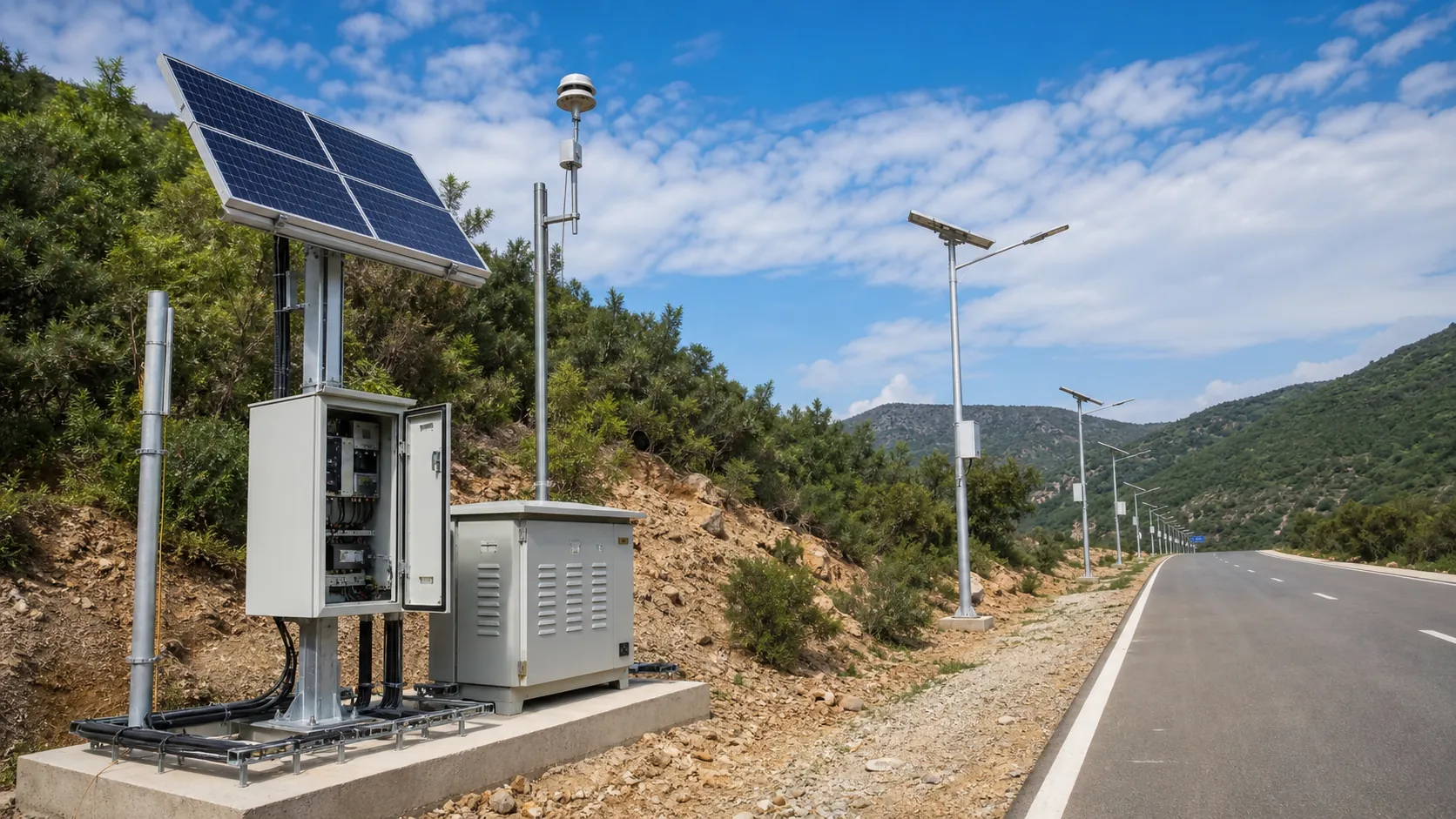
Power and Connectivity
How to choose power, battery, solar, NB-IoT, LTE, LoRaWAN, gateways and monitoring strategy for outdoor IoT infrastructure.

Industrial Parks
Industrial park IoT for lighting, access areas, environmental monitoring, energy visibility, parking and maintenance operations.
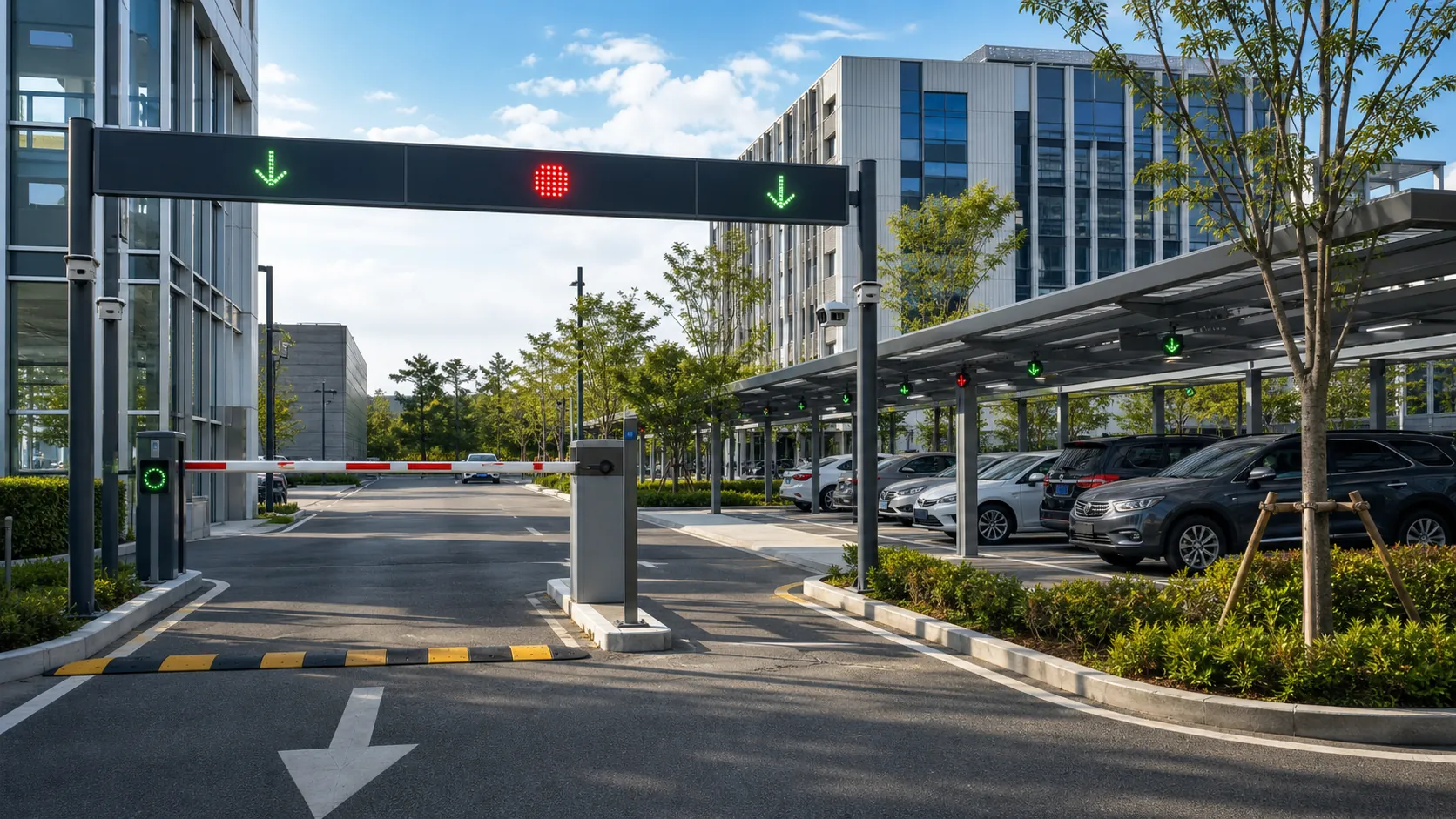
Parking Guidance
Design outdoor and indoor parking guidance with occupancy detection, entrance displays, bay indicators, operator dashboards and integration-ready APIs.
Frequently Asked Questions
What is an under vehicle surveillance system (UVSS) and how does it work?
A UVSS (also called UVIS) captures a high-resolution image of a vehicle's undercarriage as it drives over an embedded scanner. A line-scan camera and LED illumination image the chassis line by line, and software stitches the lines into one composite picture. Officers use it to spot explosives, contraband, hidden compartments and modifications that cameras and mirrors miss.
Does the vehicle need to stop to be scanned?
No. The RC-UVS-500 uses real-time speed synchronization to match the line-scan rate to the vehicle's actual speed, so it images vehicles moving at up to 30 km/h (40 km/h optional). This keeps checkpoints fast and avoids queue build-up while still capturing a sharp, full-chassis image.
How does the system detect threats hidden under a vehicle?
It stores an undercarriage 'fingerprint' for each license plate. On each pass, the edge-AI engine reads the plate with ANPR, retrieves the reference image and runs a pixel-level difference and object-detection analysis, flagging added, removed or altered objects and foreign materials in about 2–3 seconds for an operator to confirm.
What is the difference between fixed, surface-mount and portable UVSS?
The fixed unit is embedded flush in the road for permanent high-security lanes and is rated IP68. The surface-mount ramp installs with little or no excavation for fast retrofits. The portable ramp is IP66 and can be deployed and recovered for temporary or mobile checkpoints such as events and pop-up perimeters.
Can it integrate with barriers, bollards and access control?
Yes. The RC-UVS-500 provides relay I/O and an open REST API to command boom barriers, HVM rising bollards, turnstiles and access-control systems based on watchlist status and the inspection verdict, and it feeds images and events to VMS and command-center platforms. It pairs directly with REDCOAST.LTD's LPR barrier gates and rising bollards.
What load can the drive-over scanner withstand?
The stainless-steel scanner is rated for drive-over axle loads up to 50 tonnes as standard and up to 78 tonnes in the heavy-duty configuration, with an anti-slip, self-draining top plate. That covers passenger cars, SUVs, buses, trucks and articulated trailers passing at checkpoint speed.
Is the system grid-powered, and what happens during a power outage?
It is designed for mains-powered checkpoints (AC 100–240 V), because gatehouses normally have grid power — it is not solar by default. A built-in LiFePO4 UPS gives at least two hours of hold-up so scanning, ANPR and barrier control keep working through outages. A solar-plus-battery variant is available only for genuinely off-grid temporary sites.
Where is a UVSS typically deployed?
Common sites include government and military compounds, airports, land border crossings and customs, seaports and logistics terminals, embassies, hotels and VIP venues, and critical infrastructure such as power plants, refineries and data centers — anywhere every entering vehicle must be screened for under-vehicle threats.