Overview
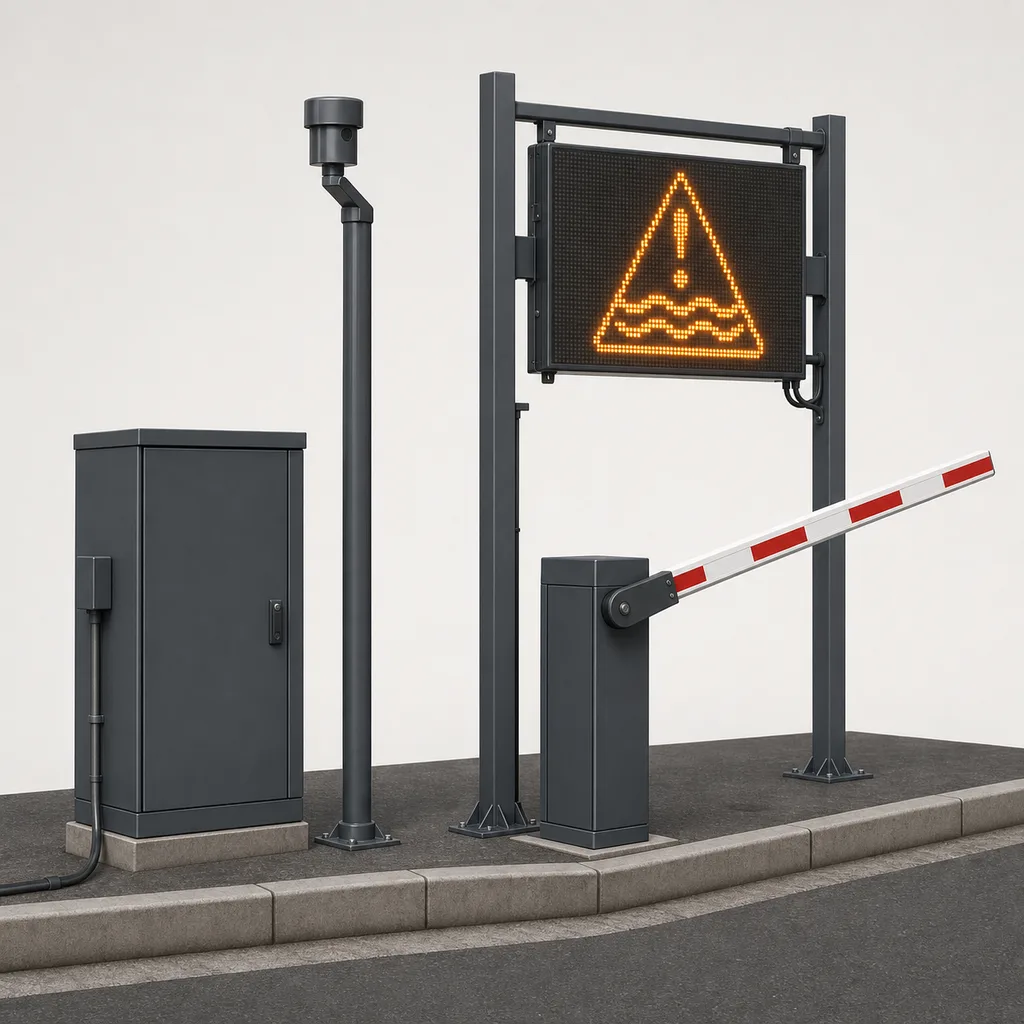
The REDCOAST.LTD RC-UFW-300 is a grid-powered flood warning and automatic barrier system engineered for urban road underpasses, railway undercrossings, depressed expressways, low-water crossings and low-lying road sags that flood rapidly during heavy rain. It continuously measures standing water on the carriageway with redundant non-contact radar and submersible sensing, and the instant water reaches a preset depth it automatically escalates from advisory messaging to full-matrix 'DO NOT ENTER — TURN AROUND' warnings, high-intensity flashing beacons and physical boom-barrier closure — keeping vehicles out of a drowning zone without waiting for an operator to react. Because more than half of all flood-related vehicle drownings happen when a driver enters submerged roadway, the value proposition is simple and measurable: the system removes human hesitation and reaction lag from the most dangerous seconds. It is delivered as an end-to-end package — self-developed hardware, a Web management platform and a mobile app — that is fully autonomous at the roadside yet fully visible from a city traffic-management or emergency-operations center.
Key Features
- Triple-redundant water-level sensing — 80 GHz FMCW non-contact radar as the primary gauge, backed by a submersible 4–20 mA pressure transducer and a conductive-electrode 'water-on-road' switch, so no single failure mode (debris, foam, spray, condensation, drift or lightning) can blind the site.
- Three-tier automatic escalation — advisory → active warning (VMS + beacons) → physical barrier closure, each depth threshold independently configurable in millimetres with rate-of-rise logic.
- Full-matrix LED variable message sign with multi-language text and pictogram support, plus RRFB-style high-intensity amber beacons readable beyond 250 m in direct sun.
- Automatic boom barrier driven by a 24 V DC brushless servo (3–6 m arm) with encoder obstacle detection, soft-stop ramps and anti-entrapment current limiting, so it never closes onto a vehicle or a person.
- Fully local decision engine — the roadside edge controller runs a self-contained state machine and keeps protecting drivers even when the network is completely down.
- Integrated edge-AI / ANPR camera for incident evidence, stalled-vehicle detection inside the flooded zone, and false-alarm suppression.
- Grid-powered with LiFePO4 UPS backup that sustains sensing, warning and communications through the grid outages that so often accompany the same storms that cause the flood.
- Open integration via NTCIP 1203, MQTT, Modbus TCP, ONVIF and REST API into existing ITS, SCADA and city command platforms — plus SMS and mobile-app push to operators and responders.
Technical Architecture
The RC-UFW-300 is organised around a hardened roadside edge controller that REDCOAST.LTD designs at board level. A self-developed signal-conditioning PCB acquires and linearises the primary 80 GHz radar gauge — mounted on the underpass wall or a dedicated pole directly above the lowest point of the sag — together with the submersible pressure transducer and the conductive electrode. Running three physically different measurement principles in parallel means the controller can vote across inputs and apply hysteresis and rate-of-rise filtering to reject the splash and wake thrown up by passing vehicles, delivering a trustworthy road-surface water depth rather than a noisy raw reading.
When a depth threshold is crossed, an on-board state machine drives three actuator subsystems through REDCOAST.LTD's own driver boards: a constant-current LED matrix driver for the variable message sign and beacons; a motor-control board for the barrier's 24 V DC brushless servo, with encoder feedback, current-limit anti-entrapment and soft-stop ramps; and relay / opto-isolated I/O for auxiliary sirens, in-road warning studs, traffic signals or a second downstream sign on the far approach. Every state transition is time-stamped, logged in non-volatile memory and streamed to the cloud for audit.
The edge/cloud split is deliberate. All life-safety logic executes locally so the barrier and signs respond in well under a second regardless of connectivity, while the cloud layer handles configuration, multi-site dashboards, historical analytics, optional weather-radar and rain-gauge fusion for pre-emptive alerting, and dispatch. The Web platform and the mobile app give operators live water-level curves, camera views, barrier and beacon status and one-touch manual override, with automatic push notifications and an API hand-off into municipal traffic-management and emergency-response systems.
Connectivity & Power
Communication is selected per site. Wired Ethernet or fibre is preferred where a duct already exists — the typical case for a city underpass — while dual-SIM 4G/5G suits standalone dips and rural low-water crossings; LoRa and RS-485 are available for linking a satellite sensor or a paired sign on the opposite approach. The system is grid-powered (AC 100–277 V, 50/60 Hz), which fits its urban and roadside deployment where mains is available and avoids the panel size, shading and theft problems of solar in built-up areas. Critically, an integrated LiFePO4 UPS keeps water-level sensing, the warning display and communications alive for 12–48 hours after a grid failure — because the storm that floods an underpass is exactly the event that tends to knock out local power. The barrier can be driven from the UPS and, as a final layer, released and operated manually.
Protection & Reliability
Electronics sit in an IP66 enclosure inside an IP55 roadside cabinet with an optional active thermal-management module for hot climates; all boards are conformal-coated against the near-100% condensing humidity that surrounds a flooding event. Power and signal lines carry 10–20 kA surge protection — essential where lightning and water coincide. The system operates from -30 to +70 °C and is built to withstand salt fog, sand and dust. Poles, brackets and cabinets use a hot-dip-galvanised base with a smooth powder-coated or fluorocarbon-painted finish for long outdoor corrosion life, and are rated for wind up to 200 km/h. Redundant sensing, watchdog-supervised firmware, remote health monitoring and field-replaceable modules together target years of unattended service with a low mean-time-to-repair.
Application Scenarios
- Urban road and railway underpasses — the classic flash-flood death trap; the system detects ponding at the sag, warns approaching drivers and physically closes the lane before water becomes impassable.
- Low-water crossings and river fords on rural roads — standalone sites where a sudden rise catches drivers who assume the crossing is still shallow.
- Depressed expressways and highway culvert dips — high-speed sags where reaction distance is short and a full-matrix VMS gives drivers early notice.
- Tunnel entrances and portals — protecting the descending approach where water accumulates and stalls vehicles inside the bore.
- Coastal causeways, ferry ramps and tidal roads — where flooding is driven by tide and storm surge as well as rainfall.
- Industrial, port and mining haul-road dips — private roads that flood and must be closed to protect vehicles and cargo.
Case-style Examples
City underpass network retrofit. A municipality upgrading a cluster of flood-prone road and rail underpasses specifies fibre-connected RC-UFW-300 units at each site, each with a full-matrix VMS, dual boom barriers and an ANPR camera, all reporting to a single Web dashboard at the traffic-management center. Operators gain live water-level curves and remote override for every underpass at once, and each site continues to protect drivers autonomously if the link drops.
Rural low-water crossing, standalone. A remote crossing with no fibre duct is equipped with a dual-SIM 4G unit, a fixed 'When Flooded Turn Around' LED sign with beacons and a single boom, powered from a nearby mains feed with a 48-hour LiFePO4 UPS. The site runs unattended, closes the crossing on rising water and pushes an alert to the roads authority's app.
Depressed expressway sag. On a high-speed depressed section prone to culvert backup, upstream full-matrix VMS units warn drivers hundreds of metres ahead while barriers hold traffic clear of the flooded low point, integrated into the existing ATM/ITS platform over NTCIP.
Customization & Selection Guide
Start from the site's flood dynamics and traffic. For fast-onset, high-consequence urban underpasses, specify triple-redundant sensing, dual boom barriers and a full-matrix VMS. For lower-speed rural crossings, a single boom with a fixed 'Turn Around' LED sign and beacons is a cost-effective, robust choice; where physically closing the road is not permitted, deploy the warning-only configuration (VMS + beacons + studs, no barrier). Choose fibre/Ethernet where a duct exists, dual-SIM 4G/5G for standalone sites. Size the UPS autonomy (12 h / 24 h / 48 h) to the expected outage duration in your region. Add the edge-AI/ANPR camera where evidence capture, stalled-vehicle detection or false-alarm suppression matters. Because the platform is board-level self-developed, thresholds, escalation logic, display legends, languages and integration protocols are all tailored to the project rather than forced onto a fixed product.
Deployment & After-sales
The system ships as pre-integrated roadside assemblies (sensor pole, cabinet, VMS and barrier) with a commissioning guide; civil works (foundations, ducting, mains connection) follow standard roadside practice and can be executed by local contractors to REDCOAST.LTD drawings. Radar sensor height and threshold calibration are performed on-site against surveyed road levels. Delivery lead time is project-dependent and confirmed at order; typical scope includes factory acceptance test, on-site commissioning support, operator training on the Web platform and app, and a documented maintenance schedule. Ongoing support covers remote diagnostics, firmware updates, spare-module supply and a warranty aligned to the deployment environment.
Standards & Compliance
The product is designed toward relevant international directions including CE and RoHS for the electronics, IEC 60529 (IP66/IP55 ingress protection), IEC 61000 EMC and IEC 61643 surge-protection practice, and traffic-device conventions such as MUTCD Part 6 incident/warning signing and EN 12966 for the variable message sign. ITS integration follows NTCIP 1203 (DMS) with MQTT/Modbus/ONVIF/REST for platform interoperability. Final certification scope is confirmed per destination market and project specification.
Why REDCOAST.LTD
REDCOAST.LTD delivers the complete smart-IoT solution — hardware, Web management platform and mobile app — integrated and supported by one team. What sets us apart from pure integrators is that we design and develop our own PCBs and board-level hardware: the radar signal-conditioning board, the LED matrix driver, the barrier motor controller and the UPS power-management board in the RC-UFW-300 are our own designs. That means the escalation logic, the sensing redundancy, the interfaces and the enclosures can be shaped precisely to your site and standards, with no black boxes and no dependence on someone else's roadmap. Systems are engineered for global deployment and adapt to varied climates, electrical networks and regulatory environments.
Protect your underpasses and low-lying roads before the next storm — contact REDCOAST.LTD to scope a tailored flood warning and automatic barrier solution for your sites.
Specifications
Water-Level Detection
- Primary Sensor
- 80 GHz FMCW non-contact radar
- Measuring Range
- 0.1-15 m
- Accuracy
- ±2 mm
- Resolution
- 1 mm
- Update Rate
- up to 10 Hz
- Redundant Sensing
- Submersible pressure transducer + conductive electrode
- Trigger Tiers
- 3 (advisory / warning / closure), each configurable
LED Warning Display & Beacons
- Display Type
- Full-matrix RGB/amber LED VMS
- Pixel Pitch
- P10-P20 mm
- Legend
- 'FLOODED — DO NOT ENTER / TURN AROUND' + pictogram, multi-language
- Brightness
- up to 7000, auto-dimming cd/m²
- Beacons
- Dual high-intensity amber LED, RRFB-style flash
- Legibility Distance
- ≥250 m
- Sign Standard
- MUTCD Part 6 / EN 12966
Automatic Barrier
- Boom Length
- 3-6 (straight / fence / articulated) m
- Motor
- 24 V DC brushless servo, encoder feedback
- Opening/Closing Time
- 3-6 s
- Duty Cycle
- 80 (S6) %
- Obstacle Detection
- Encoder current-limit + loop/radar, soft-stop
- Manual Release
- Key-operated emergency release
Edge Controller & AI Camera
- Processing
- Quad-core industrial edge controller, local state machine
- Camera
- 4/8 MP ANPR + IR illuminator MP
- Edge AI
- Stalled-vehicle detection, plate capture, false-alarm suppression
- Local I/O
- RS-485, opto-isolated DI/DO, relay outputs
- Autonomy
- Full life-safety logic runs without network
Connectivity & Integration
- Wired
- Gigabit Ethernet / fibre optic
- Cellular
- 4G/5G, dual-SIM failover
- Auxiliary Radio
- LoRa (satellite sensors / paired sign)
- ITS Protocols
- NTCIP 1203, MQTT, Modbus TCP, ONVIF, REST API
- Alerting
- SMS + mobile-app push + platform API
Power (grid + UPS backup, non-solar)
- Input Voltage
- AC 100-277 V
- Frequency
- 50/60 Hz
- Power Consumption
- 40-350 (peak during display + barrier) W
- UPS Backup
- Integrated LiFePO4, 12-48 h detection/warning autonomy
- Surge Protection
- 10-20 (power & signal SPD) kA
Mechanical & Environmental
- Electronics Ingress
- IP66
- Roadside Cabinet
- IP55, optional active cooling
- Operating Temperature
- -30 to +70 °C
- Humidity
- up to 100 (condensing) %RH
- Wind Rating
- up to 200 km/h
- Finish
- Hot-dip galvanised + smooth powder-coat / fluorocarbon paint
Capabilities — configurable per project
Specifications are tailored to each project — the options below show what we can support.
Water-Level Sensing
- 80 GHz non-contact radar
- Submersible pressure transducer
- Conductive electrode switch
- Triple-redundant hybrid
Actuation / Barrier
- Single boom (3-6 m)
- Dual boom
- Fence/skirt boom
- Warning-only (no barrier)
Warning Display
- Full-matrix LED VMS
- Fixed 'Turn Around' LED sign + beacons
- RRFB beacons + in-road studs only
Connectivity
- Fibre / Ethernet
- 4G/5G dual-SIM
- LoRa
- RS-485
Integration
- Standalone autonomous
- City ITS / SCADA (NTCIP)
- Cloud + mobile app
- Third-party REST API
Related solution guidance
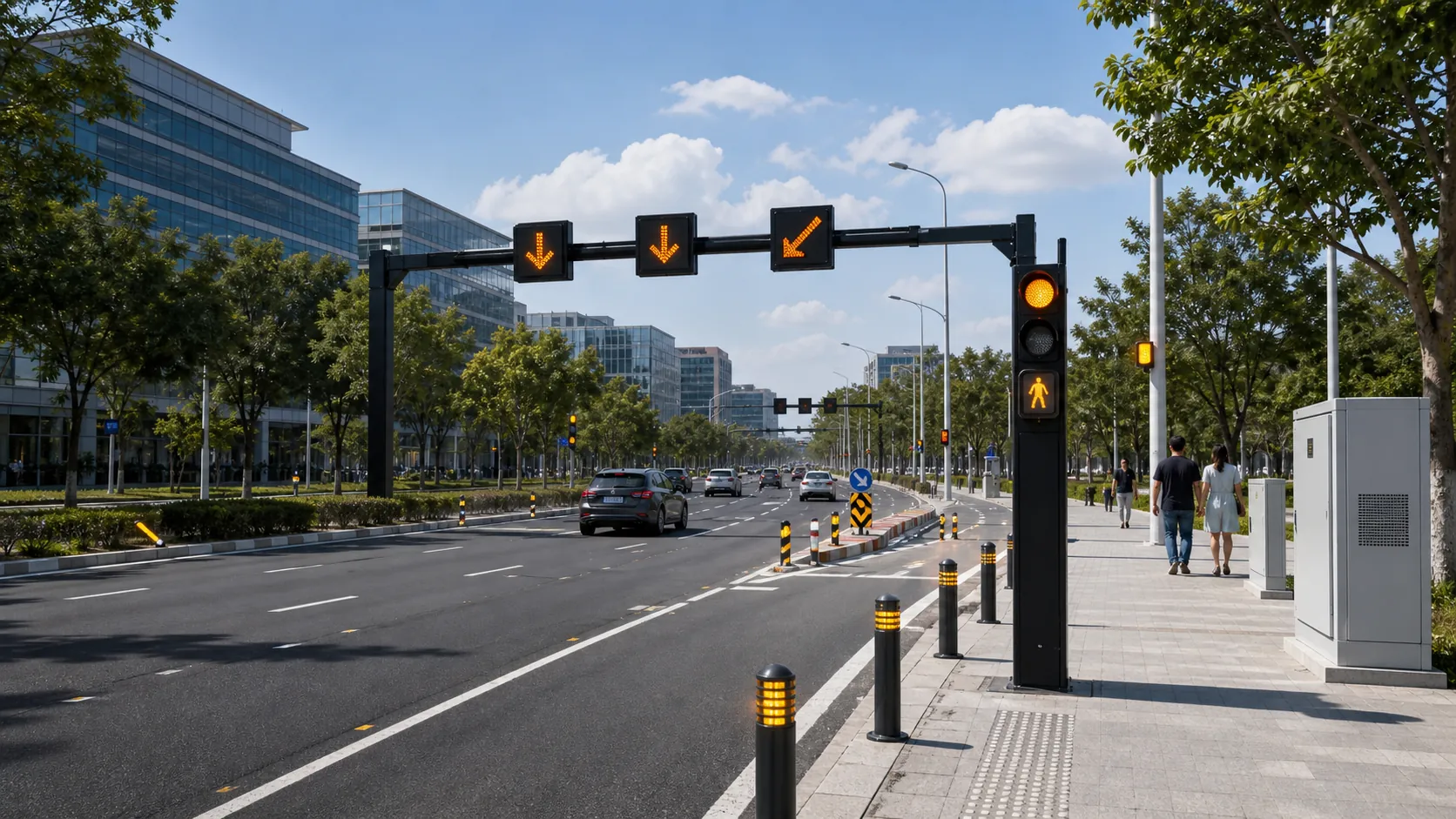
Traffic Safety Checklist
Deployment checklist for connected traffic warning signs, beacons, road guidance devices, power, visibility, monitoring and acceptance tests.
Traffic Safety
Plan connected traffic safety systems with warning beacons, LED signs, road guidance devices, sensing, control cabinets and monitoring software.
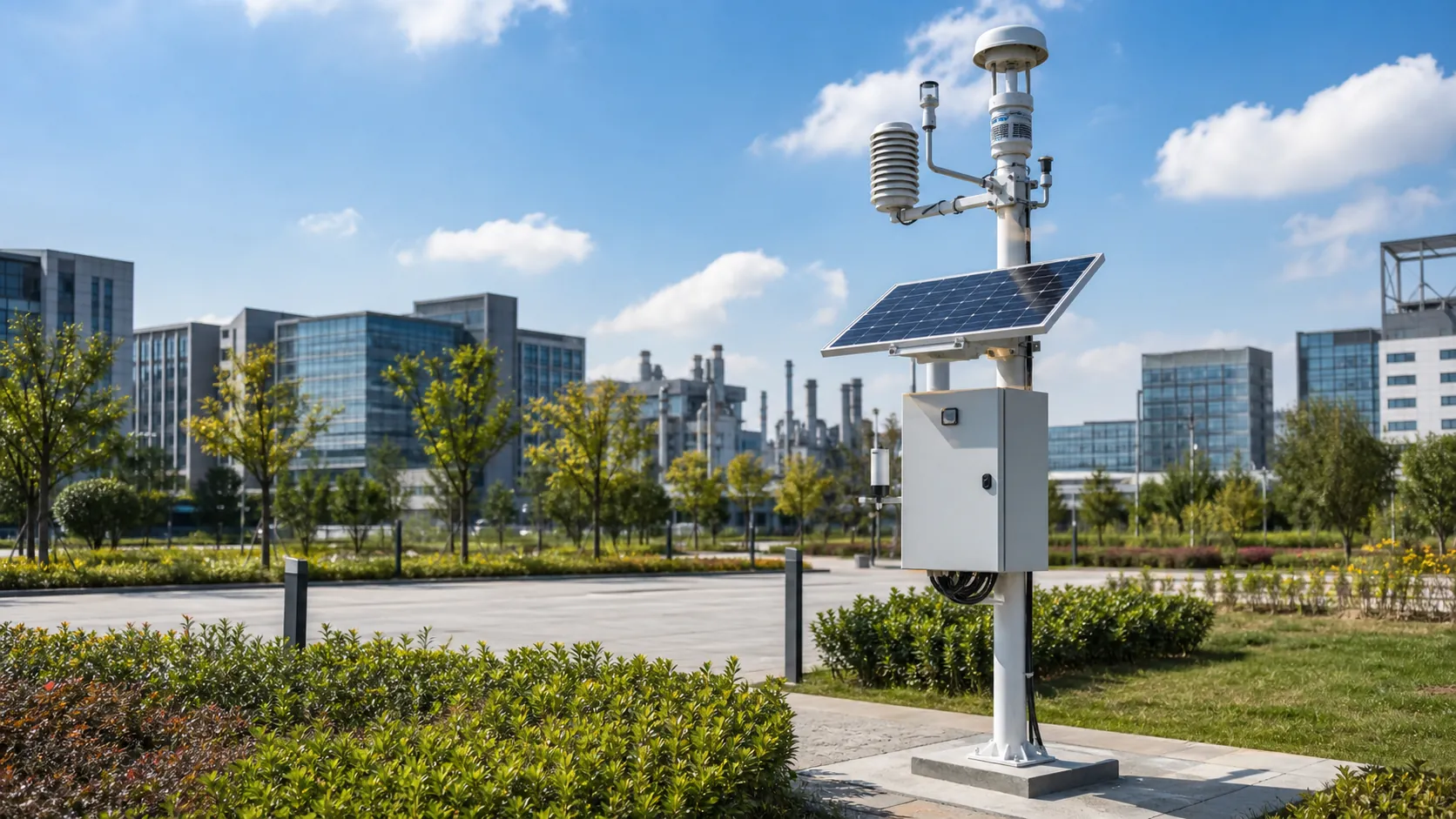
Environmental Monitoring
Deploy environmental monitoring stations with sensors, solar power, gateways, dashboards, alarms and data integration for city and industrial sites.
Frequently Asked Questions
How does the system detect that a road is flooding?
It measures water depth on the carriageway with a primary 80 GHz non-contact radar gauge, backed by a submersible pressure transducer and a conductive electrode. The controller votes across all three and applies rate-of-rise filtering, so splash from passing vehicles or a single sensor fault cannot cause a false trigger or a missed flood.
Does it keep working during a power outage?
Yes. It is grid-powered but includes an integrated LiFePO4 UPS that keeps sensing, warning displays and communications running for 12-48 hours after a grid failure. This matters because the storms that flood an underpass are exactly the events that tend to cut local power. The barrier can also be released and operated manually.
How does the barrier avoid trapping a car or a person?
The 24 V DC brushless servo uses encoder current-limit obstacle detection, a loop or radar presence sensor and soft-stop ramps, so it reverses instead of closing onto a vehicle or pedestrian. Escalation is staged — signs and beacons warn first — and a key-operated emergency release allows manual operation at any time.
Is this product grid-powered or solar-powered?
It is grid-powered (AC 100-277 V), which suits urban underpasses, tunnel portals and roadside sites where mains is available. A LiFePO4 UPS provides outage backup. Solar is not used because it adds panel size, shading and theft issues in built-up areas; for genuinely off-grid remote crossings, an off-grid variant can be scoped separately.
Can it integrate with our city traffic-management or emergency-response platform?
Yes. It supports NTCIP 1203 for the message sign, plus MQTT, Modbus TCP, ONVIF and a REST API, so it plugs into existing ITS, SCADA and command platforms. It also sends SMS and mobile-app alerts to operators and responders, while every site keeps running its life-safety logic locally even if the link drops.
How accurate is the water-level measurement?
The 80 GHz radar gauge resolves water depth to ±2 mm with 1 mm resolution and updates up to 10 times per second, so escalation thresholds can be set precisely in millimetres. Non-contact radar stays accurate through heavy rain, debris, foam and darkness, unlike float or purely conductive sensors.
What warning does a driver actually see before the road is closed?
The system escalates in three tiers: an advisory message, then an active warning with a full-matrix LED sign reading 'FLOODED — DO NOT ENTER / TURN AROUND' plus RRFB-style flashing amber beacons visible beyond 250 m, and finally physical closure of the lane with the boom barrier — giving drivers clear notice well before the low point.
What standards does the system comply with?
It is designed toward CE, RoHS, IEC 60529 (IP66/IP55), IEC 61000 EMC and IEC 61643 surge protection, with the variable message sign following MUTCD Part 6 and EN 12966. Because REDCOAST.LTD develops the hardware at board level, the exact certification scope is tailored to your destination market and project.