Overview
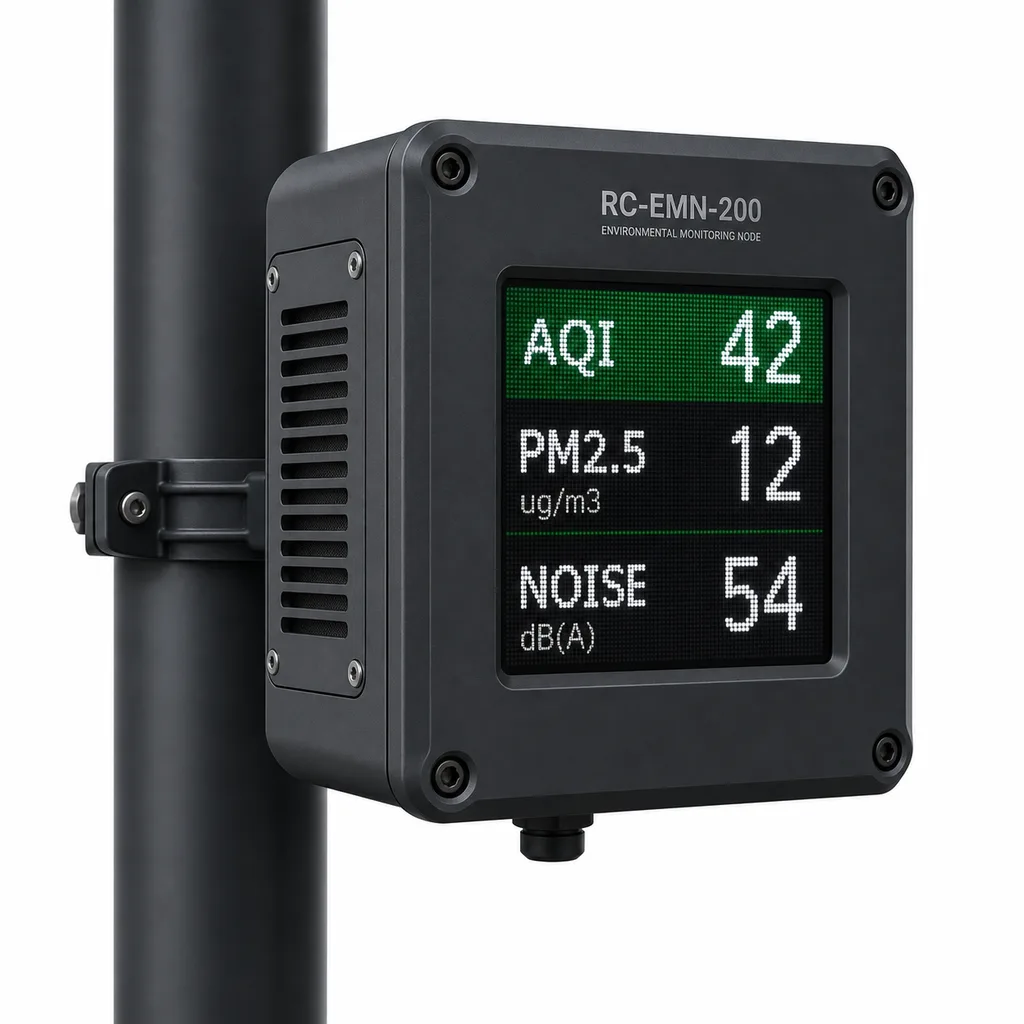
The RC-EMN-200 is a compact, mains-powered urban environmental monitoring node designed for high-density city-wide sensor network deployment. Purpose-built for municipal authorities, smart city programme managers, campus facility operators, and urban planners, it simultaneously measures ambient air quality (PM1/PM2.5/PM10 and four gas species), noise levels, and full microclimate parameters—publishing structured real-time data to cloud or on-premise city platforms while displaying colour-coded AQI and noise readings on a built-in outdoor LED panel for immediate public transparency. Unlike remote stand-alone monitoring stations that serve as single reference points, the RC-EMN-200 is engineered for hyper-local spatial resolution: dozens to hundreds of nodes deployed across a city block grid expose pollution hotspots, noise exceedance corridors, and thermal anomalies that isolated reference stations cannot resolve. REDCOAST.LTD designs the sensor signal-conditioning PCB, display driver board, and embedded IoT gateway in-house, so the full hardware stack is tuned for urban electromagnetic environments, decade-long calendar life, and minimal on-site maintenance.
Key Features
- Six-species air quality sensing in one unit: PM1, PM2.5, and PM10 via laser-scattering optical particle counter (OPC); NO2, O3, CO, and SO2 via four-electrode electrochemical cells on field-replaceable cassettes—all processed on a custom 24-bit ADC signal-conditioning PCB with cross-sensitivity and temperature-drift compensation.
- IEC 61672-1 Class 2 noise measurement: Calibrated MEMS microphone array reports L_Aeq, L_max, and L_min in dB(A) at intervals from 1 second to 1 minute; timestamped exceedance events are logged locally for regulatory reporting.
- Full microclimate sub-board: Temperature (±0.2 °C), relative humidity (±2% RH), barometric pressure (±0.5 hPa), UV index, and ambient illuminance—all on one sensor subboard sharing the enclosure thermal management.
- Public-facing outdoor LED display panel: 256 × 96 px P4 RGB matrix (IP65, IK08, 600 cd/m² auto-dim) rotates live AQI colour band, noise dB(A), and temperature—giving residents and city visitors an immediate read of the micro-environment around them.
- Retrofit pole-clamp design: 80–165 mm diameter clamp attaches directly to existing 8 m street lamp poles, smart poles, traffic signal masts, or utility columns—no new civil works required for most city deployments.
- Dual-mode cellular backhaul with local buffer: 4G LTE Cat.1 as primary; NB-IoT Cat.NB2 as low-power fallback. 128 MB NAND flash stores a 24-hour rolling data buffer and a 90-day compressed archive, ensuring no data loss during connectivity gaps.
- FIWARE NGSI-LD native integration: Out-of-the-box MQTT TLS 1.3 and REST (HTTPS) push to FIWARE Orion-LD brokers; pre-built adapters available for AWS IoT Core, Azure IoT Hub, and custom city OS environments.
- OTA firmware management: Secure signed over-the-air updates via cellular—no technician dispatch needed for software maintenance across a city-wide fleet.
- NEMA 7-pin and Zhaga Book 18 power tap compatibility: Unit draws AC mains directly from the adjacent streetlight's smart socket, eliminating the need for a dedicated power cable run at each installation point.
- Custom PCB stack from REDCOAST.LTD: All three internal boards—sensor signal-conditioning, IoT gateway, and display driver—are designed and manufactured by REDCOAST.LTD, enabling long-term component control, custom gas species additions, and project-specific firmware.
Technical Architecture
The RC-EMN-200 hardware stack comprises three purpose-designed PCBs housed in a single die-cast aluminium enclosure. The Sensor Signal-Conditioning Board hosts four electrochemical cell sockets (Alphasense B4-series footprint compatible), the laser-scattering OPC module interface, a calibrated MEMS microphone conditioning circuit, and the microclimate sensor array. Each electrochemical channel is processed through an independent 24-bit delta-sigma ADC to achieve sub-ppb resolution; an on-board NTC network compensates for temperature-induced baseline drift without external reference gas requirements. The OPC module uses a sealed airflow path with a self-cleaning fan purge cycle every 6 hours to prevent dust accumulation and optical window fouling.
The IoT Gateway Board is built around a dual-core ARM Cortex-A7 processor at 1 GHz with an integrated Cat.1/NB-IoT multi-mode modem. Edge firmware executes the US EPA NowCast AQI algorithm and EU Common AQI scale (selectable per project), classifies readings into colour bands (Good/Moderate/Unhealthy/Very Unhealthy/Hazardous), detects anomaly spikes, and queues NGSI-LD entity payloads for MQTT delivery. A 128 MB NAND flash holds a 24-hour rolling high-resolution buffer and a 90-day compressed archive; stored data batch-uploads on reconnect so no readings are lost during cellular outages. Configurable alarm thresholds trigger push notifications to city NOC dashboards when, for example, PM2.5 exceeds 35 μg/m³ (WHO 24-hour guideline) or noise exceeds 70 dB(A).
The Display Driver Board receives processed AQI and noise data from the gateway board over a hardened internal CAN bus and drives the external P4/P6 RGB LED matrix via custom constant-current PWM controllers. Brightness auto-adjusts via an ambient light sensor from 10% at night to 100% in direct sunlight. All three boards communicate internally via isolated interfaces to prevent ground loops in electrically noisy urban pole environments, and all PCBs are conformal-coated to IPC-CC-830B for humidity and condensation protection.
Connectivity & Power
Primary power is AC mains (100–240 V, 50/60 Hz) tapped via NEMA 7-pin smart socket, Zhaga Book 18 Edition 3 interface, or a dedicated 2-pin IP67 weatherproof connector on the pole junction box—whichever is available on the host pole. Full-operation power draw (all sensors active, display on) is 20–28 W; display-off standby is approximately 8 W, making the unit compatible with poles that budget limited auxiliary power for add-on devices. An optional 25 Wh Li-ion UPS buffer cartridge maintains sensor operation and data logging through grid interruptions of up to 90 minutes without display, preserving data continuity during planned maintenance windows.
For communications, the primary 4G LTE Cat.1 modem supports global band selection and is used for high-frequency data push (1-minute averages or finer). NB-IoT Cat.NB2 serves as a low-power fallback in RF shadow zones or as the sole mode for display-off energy-saving deployments. RS-485 Modbus RTU is available as a wired daisy-chain option for campus networks with Ethernet backbone; an optional RJ45 100BASE-TX port enables direct Ethernet connection at poles with fibre/copper infrastructure.
Protection & Reliability
The die-cast aluminium enclosure is rated IP65 (dust-tight, rain-resistant) per IEC 60529, with IK08 impact protection on the LED display module. Enclosure surface treatment follows the same hot-dip galvanized primer plus smooth matte powder-coat finish used across REDCOAST.LTD's urban product line, ensuring corrosion resistance in coastal salt-air and high-humidity tropical environments. A 500-hour salt-spray test per IEC 60068-2-11 is completed as standard on production batches. The UV-resistant polycarbonate cover over the OPC air inlet prevents photodegradation under sustained high solar irradiance (Middle East, equatorial Southeast Asia). All wiring connectors are IP67-rated.
Operating temperature range is −30 °C to +65 °C; individual temperature compensation on each electrochemical channel maintains gas measurement accuracy across this full range without field recalibration. Electronics MTBF is rated at >60,000 hours. Electrochemical cell service life is 24–36 months typical under urban ambient conditions, with a tool-less cassette swap taking under 5 minutes per unit in the field—no specialised equipment or gas calibration equipment required on site. Cellular modem and display module are each independently hot-swappable at the board level.
Application Scenarios
Urban arterial road corridor air quality networks: Nodes mounted every 300–500 m along major transit corridors provide PM2.5 and NO2 profiles that enable dynamic low-emission zone activation, variable speed limit enforcement, and real-time public advisory. Cities can comply with WHO AAQS 2021 annual PM2.5 guideline (5 μg/m³) and national air quality standards without installing expensive reference-grade analysers at every point.
School zone and playground environmental health monitoring: Units deployed near school entrances and playground perimeters deliver continuous PM2.5 and NO2 exposure records, satisfying duty-of-care obligations, supporting green school certifications, and informing recess scheduling decisions during high-pollution events.
Commercial district and entertainment precinct noise ordinance compliance: Installed in late-night entertainment zones, construction exclusion zones, or near-airport residential buffer areas, the RC-EMN-200 timestamps all noise exceedance events above configurable dB(A) thresholds, generating exportable compliance reports for regulatory authorities without requiring a dedicated noise enforcement officer on-site.
Campus and industrial park microclimate and air quality mapping: University campuses, technology parks, and manufacturing estates use grid deployments of RC-EMN-200 nodes to characterise Urban Heat Island gradients, monitor HVAC exhaust dispersion, guide tree-planting and green-roof investment, and produce ISO 14001 environmental performance data.
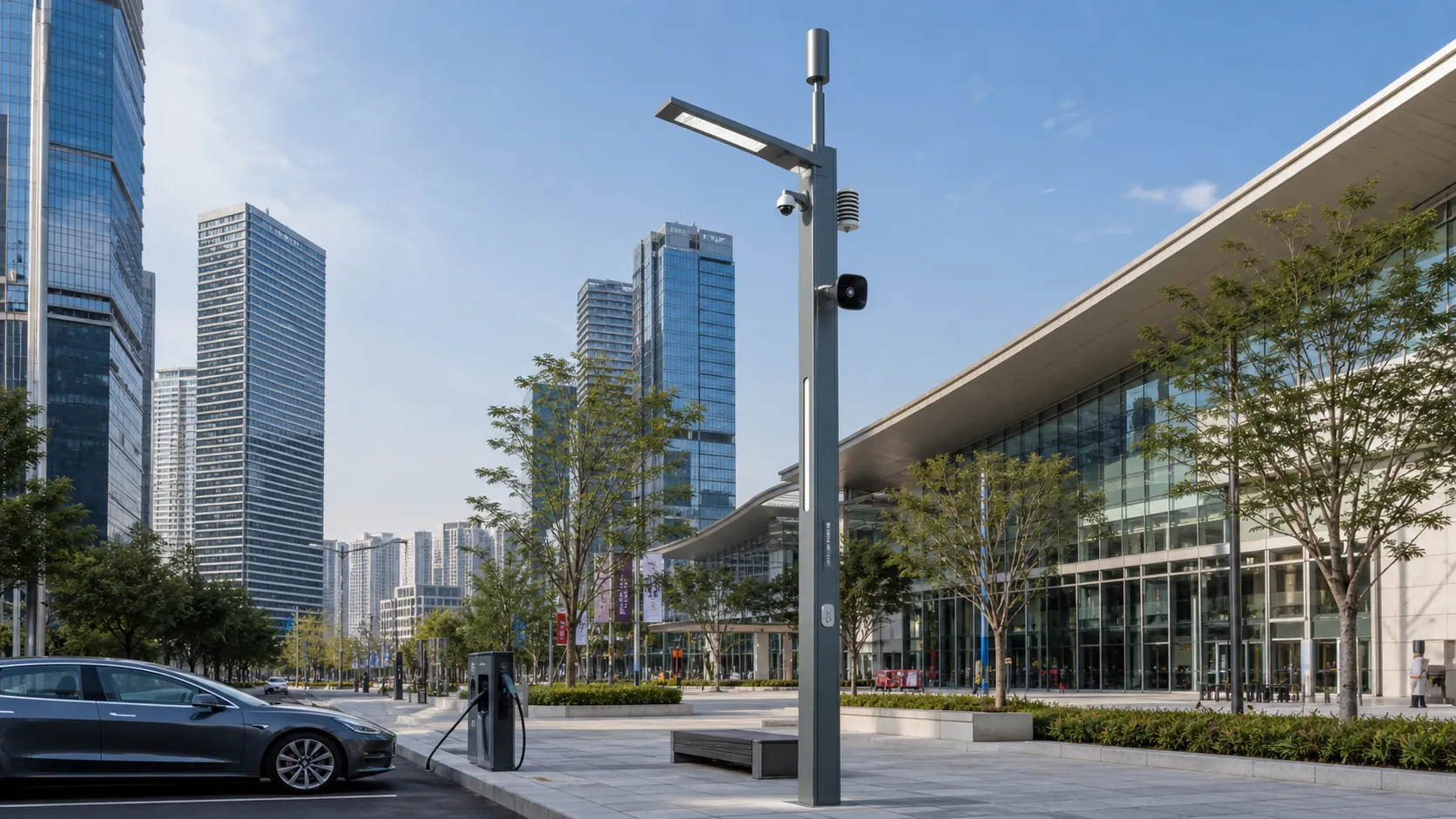
Smart city infrastructure co-deployment: The RC-EMN-200 retrofits directly onto REDCOAST.LTD's multifunctional smart poles and smart LED street light poles, sharing existing pole hardware and tapping the NEMA 7-pin auxiliary socket. Environmental telemetry joins the city's unified IoT platform alongside lighting control, ANPR camera data, and parking sensor data for fully integrated situational awareness.
Temporary site monitoring for events, construction, and demolition: Plugged into construction site temporary power or event venue mains outlets, the unit's pole-clamp and optional ground-stake mount enables rapid deployment for air quality and noise baseline capture during any time-bounded project requiring environmental monitoring under permit conditions.
Case-style Examples
Urban Arterial Retrofit — Road Corridor PM2.5 Hotspot Mapping A metropolitan transport authority managing a 12 km mixed-use arterial corridor needed hyper-local PM2.5 and NO2 data to support a proposed low-emission zone boundary decision and to comply with a national air quality compliance notice. REDCOAST.LTD supplied 28 RC-EMN-200 units clamped to existing 8 m street lamp poles at 400 m average spacing, each tapping the NEMA 7-pin auxiliary socket of the host luminaire. No new civil works were required. Units were pre-configured at factory with the operator's SIM APN and FIWARE Orion-LD broker endpoint; first data push occurred within 12 minutes of energising each unit. Within the first 30 days, the network revealed a PM2.5 spike up to 68 μg/m³ during morning freight movements near a major intersection—data the authority used to justify a targeted freight time-banding restriction that reduced the 24-hour average at that location by 34%.
Mixed-Use Development Environmental Baseline Study — Construction Phase A developer proceeding with an 80-hectare mixed-use urban renewal project was required under planning consent to establish a 12-month pre-construction environmental baseline for PM2.5, NO2, and noise, then continue monitoring throughout a 26-month construction programme. Ten RC-EMN-200 units on 5 m temporary steel posts (mains-powered from site compound temporary power boards) provided 24/7 continuous measurement across the site perimeter and nearest sensitive receptor locations. Redeployment between construction phases took two technicians half a day. All data was delivered via REST API to the developer's environmental consultant reporting platform, satisfying both the national EIA monitoring protocol and the local council noise and dust management plan reporting obligations.
University Campus Sustainability Programme — Real-Time Public Environmental Dashboard A 35,000-student urban university campus deployed 14 RC-EMN-200 nodes across student walkways, sports facilities, and main gate approaches as part of its ISO 14001 environmental management system and public sustainability commitment. The onboard P4 LED panels display live colour-coded AQI category and noise dB(A) readings at each location, giving the campus community direct awareness without requiring an app or QR code scan. Aggregated 5-minute averages are published on the campus public sustainability dashboard and integrated into the mobile campus app. Analysis of the first semester's data identified a noise hotspot at 74 dB(A) L_Aeq near engineering workshop ventilation exhaust outlets; targeted acoustic screening reduced the reading to 66 dB(A) within one term, which was publicly visible on the pole display—demonstrating immediate, tangible impact to the campus community.
Customization & Selection Guide
Standard urban air quality + noise deployment: RC-EMN-200 with NO2, O3, CO electrochemical cells + PM2.5/PM10 OPC + noise + microclimate + 4G/NB-IoT + P4 LED display. Optimal for city-wide pollution monitoring networks on existing street lamp infrastructure.
High-pollution industrial zone variant: Add SO2 and optionally H2S electrochemical cells; upgrade OPC to PM1 channel resolution; select RS-485 Modbus for wired industrial network backbone. Suitable for port areas, petrochemical perimeters, and waste processing facilities.
Minimum power draw, display-off mode: Disable LED display and use NB-IoT-only connectivity; total draw drops to under 10 W. Suitable for poles with a tightly budgeted auxiliary power circuit or for energy-efficiency-focused deployments.
High-visibility public display variant: Upgrade to P6 pitch outdoor LED panel (800 cd/m²) legible at >20 m viewing distance. Suitable for busy pedestrian plazas, transit hubs, and high-footfall commercial streets where maximum public impact is the priority.
Indoor-outdoor transitional zone: Add CO2 (NDIR) sensor module and optional short-range occupancy radar to extend applicability to underground carpark entrances, covered transit stations, and building lobby approaches.
Wired campus Ethernet backbone: Select RS-485 Modbus RTU daisy-chain + Ethernet RJ45 option; remove cellular modem to reduce ongoing SIM cost for sites with existing fibre smart city backhaul.
Deployment & After-sales
A standard two-technician installation crew can mount and commission four to six RC-EMN-200 units per day on existing poles. The pole clamp takes under 15 minutes; power tap to NEMA/Zhaga socket requires no electrical permit in most jurisdictions (secondary plug-in connection, not hardwired). REDCOAST.LTD ships every unit pre-configured with customer SIM/APN credentials, MQTT broker endpoint, and initial threshold alarm settings—first data push typically occurs within 15 minutes of power-on with no further on-site configuration needed.
Factory commissioning includes a zero/span verification report for each electrochemical cell channel and OPC particle count verification against a reference sample. Electrochemical cell cassette replacement is a tool-less 5-minute field operation with no gas calibration equipment required at time of swap; post-swap auto-calibration runs on the gateway board using a stored baseline profile. Replacement cassettes are available in single-species or full-complement packs.
Lead time from confirmed purchase order to delivery is 8–12 weeks for standard configurations and 12–16 weeks for custom gas species or display content changes. Spare parts—sensor cassettes, display modules, PCBs, cellular modem units—are stocked for a minimum of 10 years from first production. Remote diagnostics, threshold reconfiguration, and OTA firmware updates are included in the annual platform subscription. Standard warranty is 2 years; optional 5-year extended coverage with on-site swap is available.
Standards & Compliance
- IP65 dust and water ingress protection (IEC 60529)
- IK08 mechanical impact resistance (IEC 62262)
- IEC 60068-2-11 salt-spray corrosion resistance (500 h production batch test)
- IEC 61672-1 Class 2 sound level meter standard for noise measurement
- US EPA NowCast AQI and EU Common AQI (CAQI) calculation algorithms embedded in firmware
- CE marking (LVD 2014/35/EU, EMC 2014/30/EU, Radio Equipment Directive 2014/53/EU)
- RoHS compliant (EU Directive 2011/65/EU)
- FIWARE NGSI-LD data model (ETSI CIM ISG CIM 009)
- MQTT v5.0 / TLS 1.3 secure transport
- IPC-CC-830B conformal coating standard on all PCBs
- EU Ambient Air Quality Directive 2024/2881 data compatibility
Why REDCOAST.LTD
Most pole-mounted environmental monitoring products on the market are assembled from commercially available development modules—a third-party cellular gateway PCB, generic sensor breakout boards, and off-the-shelf display controllers bolted into an enclosure. REDCOAST.LTD takes a different path: the sensor signal-conditioning board, IoT gateway board, and display driver board of the RC-EMN-200 are all designed in-house from schematic to PCB layout, manufactured with full component traceability, and supported by REDCOAST.LTD's own firmware team. The 24-bit per-channel electrochemical ADC design, the custom noise-floor-managed OPC interface, and the hardened internal CAN bus between boards are engineering decisions made for urban outdoor environments—not accommodated as afterthoughts in a generic platform.
This hardware ownership means that when a project needs an additional gas species, a different display language, integration with a proprietary city OS, or a custom alarm logic for a specific regulatory framework, REDCOAST.LTD engineers modify the design at the source—without waiting on a third-party hardware vendor's product roadmap or paying integration consultant fees.
Combined with REDCOAST.LTD's established portfolio of smart street lighting, ANPR surveillance poles, multifunctional smart poles, and traffic management systems, the RC-EMN-200 lets cities build a unified smart infrastructure—one physical pole, one supplier, one integration team, one service contract—covering lighting, surveillance, traffic, EV charging, and environmental intelligence simultaneously.
Contact REDCOAST.LTD with your network density targets, parameter requirements, and city platform environment—custom configuration quotes are returned within 5 business days.
Specifications
Air Quality Sensors
- Particulate Measurement
- PM1 / PM2.5 / PM10, laser-scattering optical particle counter (OPC)
- PM2.5 Measurement Range
- 0–500 μg/m³
- PM2.5 Accuracy
- ±10% reading or ±5 μg/m³ (whichever greater)
- Gas Species Measured
- NO2, O3, CO, SO2 (electrochemical 4-electrode cells, field-replaceable cassettes)
- NO2 Detection Range
- 0–2,000 ppb
- CO Detection Range
- 0–500 ppm
- Electrochemical ADC Resolution
- 24-bit per channel with temperature-drift compensation
- Electrochemical Cell Service Life
- 24–36 months
Noise & Microclimate
- Noise Measurement Standard
- IEC 61672-1 Class 2, L_Aeq / L_max / L_min, A-weighted
- Noise Measurement Range
- 30–120 dB(A)
- Noise Accuracy
- ±1.5 dB
- Temperature Range / Accuracy
- -30 to +65 °C / ±0.2 °C
- Relative Humidity / Accuracy
- 0–100% RH / ±2% RH
- Barometric Pressure / Accuracy
- 300–1,100 hPa / ±0.5 hPa
- UV Index
- 0–11+ UVI, ±0.5 UVI
- Ambient Illuminance
- 1–100,000 lux
Computing & Connectivity
- Processor
- Dual-core ARM Cortex-A7, 1 GHz
- Local Data Buffer
- 128 MB NAND flash — 24 h rolling high-res + 90-day compressed archive
- Primary Connectivity
- 4G LTE Cat.1, global band selection, dual-SIM
- Fallback Connectivity
- NB-IoT Cat.NB2
- Wired Option
- RS-485 Modbus RTU + optional RJ45 Ethernet 100BASE-TX
- Data Push Interval
- 1 / 5 / 10 / 60 min (remote configurable)
- Data Protocol
- MQTT v5.0 TLS 1.3, REST HTTPS, NGSI-LD (FIWARE Orion-LD)
- OTA Firmware Update
- Supported — secure signed over cellular
Public Display Panel
- LED Pixel Pitch
- P4 (standard) or P6 (long-range, >20 m) mm
- Resolution
- 256 × 96 px (P4) / 192 × 64 px (P6)
- Brightness (auto-dim range)
- 60–600 (P4) / 80–800 (P6) cd/m²
- Viewing Angle
- >120°
- Display Protection
- IP65, IK08 polycarbonate front panel
Power (Grid/Mains)
- Input Voltage
- AC 100–240 V
- Input Frequency
- 50/60 Hz
- Power Consumption — full operation
- 20–28 W
- Power Consumption — display-off standby
- ~8 W
- Power Tap Interface
- NEMA 7-pin / Zhaga Book 18 Ed.3 / 2-pin IP67 connector
- Optional UPS Buffer
- 25 Wh Li-ion, ≥90 min backup (sensor + data log, no display)
Mechanical & Environmental
- Enclosure Material
- Die-cast aluminium, hot-dip galvanized + smooth matte powder-coat finish
- Enclosure IP Rating
- IP65 (IEC 60529)
- Impact Protection
- IK08 (IEC 62262)
- Salt Spray Resistance
- 500 h (IEC 60068-2-11)
- Operating Temperature
- -30 to +65 °C
- Pole Clamp Diameter Compatibility
- 80–165 mm
- Unit Dimensions (sensor head + display)
- 420 × 220 × 165 mm
- Weight (with display)
- ≈5.2 kg
Capabilities — configurable per project
Specifications are tailored to each project — the options below show what we can support.
Gas Sensor Configuration
- NO2 + O3 + CO standard urban (default)
- Add SO2 for industrial / port perimeter zones
- Add H2S for wastewater treatment or heavy industrial
- Add CO2 (NDIR) for indoor-outdoor transitional applications
Connectivity Mode
- 4G LTE Cat.1 + NB-IoT dual-mode (standard)
- 4G + NB-IoT + RS-485 Modbus RTU + Ethernet
- NB-IoT only — ultra-low-power display-off mode (<10 W)
- 5G NR — ultra-dense urban deployment or edge AI uplink
Display Option
- P4 LED matrix panel — standard, optimal viewing to 15 m
- P6 LED matrix panel — high-brightness, visible >20 m
- No display — sensor-only backend node for maximum power saving
- Custom content layout — city branding, bilingual AQI labels, QR code
Mounting Configuration
- Pole clamp 80–165 mm — retrofit to existing lamp / smart pole
- Standalone 5 m steel post — new installation, powder-coat finish
- Temporary ground stake — event, construction, EIA baseline survey
- Wall bracket — building facade or parapet mounting
Platform & Data Integration
- FIWARE NGSI-LD (Orion-LD broker) — standard
- AWS IoT Core / Azure IoT Hub with pre-built adapter
- On-premise edge gateway with local web dashboard
- Custom API adapter for proprietary city OS or SCADA
Related solution guidance

Environmental Monitoring
Deploy environmental monitoring stations with sensors, solar power, gateways, dashboards, alarms and data integration for city and industrial sites.
Smart Pole
Build smart pole infrastructure with lighting, cameras, environmental sensors, communication modules, public safety devices and a unified management platform.
Smart Pole Checklist
A buyer checklist for smart pole modules, structure, power, communication, cabinet layout, platform integration and maintenance access.
Frequently Asked Questions
How is the RC-EMN-200 different from a reference-grade air quality monitoring station?
Reference-grade analysers (e.g., TEI 42i for NO2, TEOM for PM) are laboratory-precision instruments costing USD 30,000–80,000 each and requiring climate-controlled cabinets, span gas cylinders, and trained operators—typically one per city or per regulatory zone. The RC-EMN-200 uses electrochemical and optical sensing technology that delivers indicative-grade measurements accurate enough for city hotspot mapping, public AQI disclosure, and compliance trend monitoring at a fraction of the cost per node. Best practice is to deploy a small number of reference stations for regulatory calibration anchor points alongside a dense network of RC-EMN-200 nodes for high spatial resolution—the two tiers complement each other.
Can the RC-EMN-200 be installed on existing street lamp poles without replacing the pole or running new cabling?
Yes—this is the primary installation scenario. The unit's 80–165 mm pole clamp attaches to any standard round or tapered street lamp column, and power is drawn from the lamp's existing NEMA 7-pin auxiliary socket or Zhaga Book 18 interface, which are standard on most smart and semi-smart street luminaires. No new cable trench, conduit, or electrical permit for hardwired connection is required in most jurisdictions; the power tap is a plug-in secondary connection. A two-person crew can typically mount and commission four to six units per day on existing infrastructure.
What gases and pollutants does the RC-EMN-200 measure, and how often are sensors replaced?
The standard configuration measures PM1, PM2.5, and PM10 (laser-scattering OPC), plus NO2, O3, and CO via electrochemical four-electrode cells; SO2, H2S, and CO2 (NDIR) are available as factory-installed options. Electrochemical cells have a typical service life of 24–36 months in urban ambient conditions; replacement cassettes are tool-less field-swappable in under 5 minutes with no on-site gas calibration equipment required—post-swap auto-calibration runs automatically. The OPC optical module does not require periodic replacement; a self-cleaning fan purge cycle prevents window fouling.
What does the built-in outdoor LED display show, and can it be customised?
By default the display rotates between: (1) AQI colour band and category label (Good/Moderate/Unhealthy/etc.), (2) real-time PM2.5 value in μg/m³, (3) NO2 level, (4) noise level in dB(A), and (5) current temperature. Display content, rotation speed, language, and colour mapping are remotely configurable via the city platform API. Custom layouts—city branding, bilingual labels, QR code linking to a public data portal—can be factory-programmed or pushed via OTA update.
What smart city platforms does it integrate with out of the box?
The RC-EMN-200 natively supports FIWARE NGSI-LD (ETSI CIM 009) entity push to Orion-LD brokers via MQTT TLS 1.3 and REST HTTPS, which is compatible with the majority of European and international smart city platforms. Pre-built adapters are available for AWS IoT Core and Azure IoT Hub. For cities running proprietary city OS or SCADA environments, REDCOAST.LTD develops a custom data adapter as part of the project scope—the gateway firmware is modifiable at source.
What happens to measurement data if cellular connectivity is lost?
The embedded 128 MB NAND flash stores a 24-hour rolling high-resolution data buffer (1-minute averages) and a 90-day compressed historical archive. When connectivity is restored—whether the primary 4G link or the NB-IoT fallback—the gateway board automatically batch-uploads all buffered records in chronological order to the city platform broker, with timestamps preserved. No data is lost during connectivity gaps up to the buffer duration; longer outages are flagged with a gap marker in the data stream.
Does the RC-EMN-200 require mains power, or can it operate off solar?
The RC-EMN-200 is designed for mains-powered urban deployments and requires an AC 100–240 V supply—this is fundamental to its high-sensor-count, display-equipped feature set and its suitability for city street lamp poles that already carry mains power. For off-grid or solar deployments in remote locations, REDCOAST.LTD offers a separate product line (the solar-powered AQMS and remote IoT monitoring stations) designed from the ground up for battery and solar-panel operation with lower average power draw.
How does REDCOAST.LTD handle project-specific customisation such as adding a new gas species or changing the data protocol?
Because REDCOAST.LTD designs all three internal PCBs—sensor signal-conditioning, IoT gateway, and display driver—in-house, adding a new electrochemical gas species means adding a sensor socket and ADC channel to the signal-conditioning board design, a firmware driver update, and a platform data model extension. This is done within the project scope without dependence on a third-party hardware vendor. Custom gas species additions typically add 4–6 weeks to the standard 8–12 week lead time. Protocol and API customisations are handled entirely in firmware.