Overview
The Grid-Powered High-Speed Weigh-In-Motion (HS-WIM) Pre-selection & Overload Enforcement Station from REDCOAST.LTD is a turnkey roadside system that measures axle loads, axle spacing, gross vehicle weight (GVW) and classifies vehicles at highway speeds of 10–130 km/h, without forcing trucks to stop. Built around our own quartz piezoelectric sensor signal-conditioning PCB, multi-lane synchronized acquisition controller, ANPR evidence imaging board, NTCIP-compatible LED variable message sign (VMS) driver and edge AI gateway, the station automates overload pre-selection for static weigh stations and — when equipped with Class A(5) sensor configurations — supports direct legal enforcement under the COST 323 and OIML R-134 frameworks. Powered from mains AC and protected by an IP55 LiFePO4-backed cabinet, it is engineered for highway gantries, bridge approach protection, mining and quarry haul roads, port access corridors and national overload-control programmes in any climate, from coastal humidity to desert heat and alpine cold.
Key Features
- Multi-lane HS-WIM with quartz piezoelectric or piezo-polymer sensors, 1–4 lanes per cabinet
- 24-bit, 1–2 kHz per-channel ADC chain on REDCOAST.LTD's proprietary charge-amplifier signal-conditioning PCB
- COST 323 Class B+(7) standard configuration; selectable Class A(5) for direct enforcement, or Class C(15) for low-cost data collection
- Built-in temperature and speed compensation for asphalt and quartz sensor characteristics
- IEEE 1588 PTP-synchronized acquisition across lanes, enabling double-array reconstruction and dynamic-bounce rejection
- Integrated dual-camera ANPR per lane (overview + plate, 4K, global shutter, IR-cut day/night, 850 nm IR illumination)
- Edge AI engine for axle counting, axle-group classification (UNECE R3 / Euro 13 / FHWA), plate OCR and evidence packaging
- NTCIP 1204 LED VMS driver to display per-plate or per-class instructions such as 'Overweight — exit at next bay'
- 4G/5G dual-SIM cellular, optional single-mode fiber backhaul, OCIT and REST/MQTT integrations
- Tamper-evident, time-stamped, cryptographically signed evidence packages with TLS 1.3 dispatch
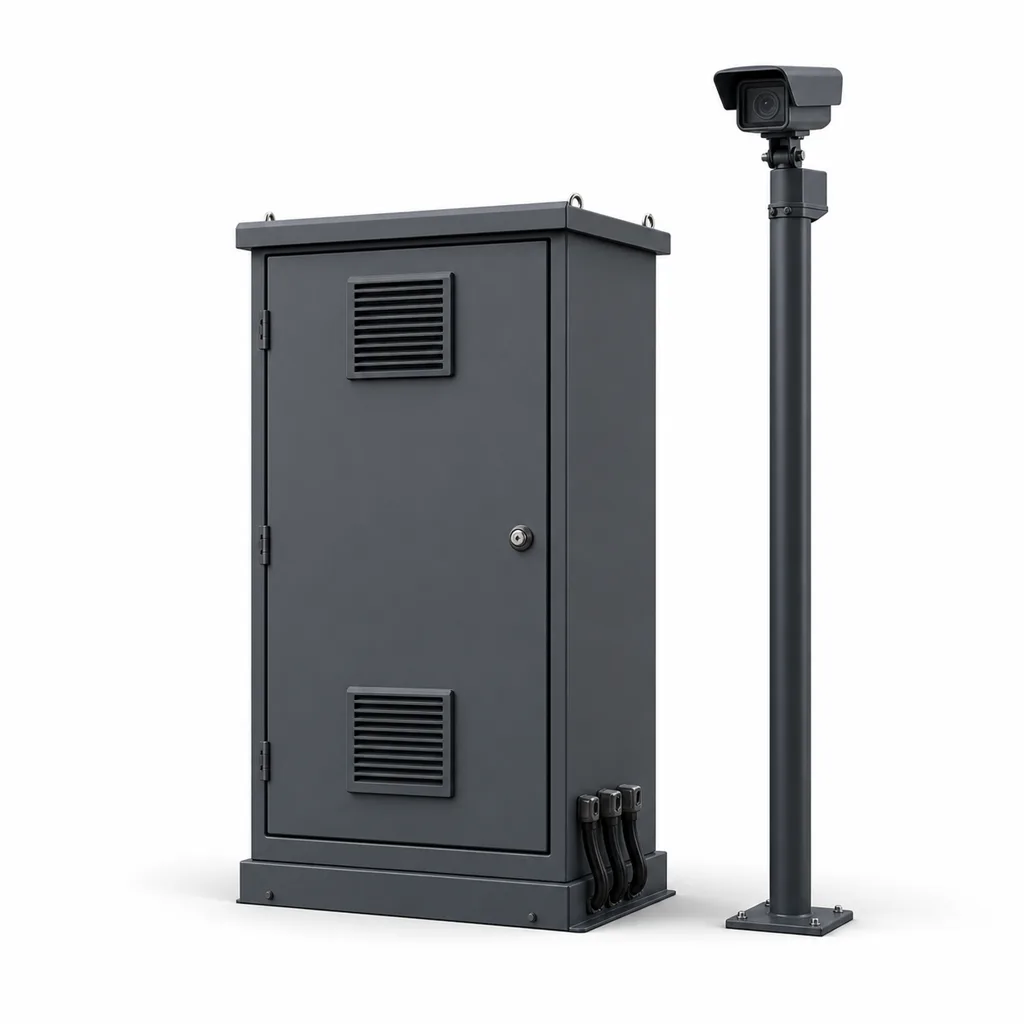
- Modular IP55 roadside cabinet with active forced-air cooling, LiFePO4 UPS and Class III SPD on every line
Technical Architecture
The station combines a pavement sensor array, a master roadside cabinet, and an ANPR/VMS pole subsystem. In the pavement, two or three transverse rows of quartz piezoelectric weighing sensors are installed in epoxy-grouted slots, sandwiched between inductive loops that trigger acquisition and provide a redundant speed reference. Each sensor channel feeds REDCOAST.LTD's charge-amplifier and signal-conditioning PCB, which performs analogue front-end filtering, automatic gain ranging and oversampled 24-bit ADC at 1–2 kHz per channel. Low-noise differential design and short, shielded cable runs preserve signal integrity under the heavy electromagnetic stress generated by heavy trucks at speed.
A multi-channel acquisition controller — also a REDCOAST.LTD board — aggregates the sensor data with IEEE 1588 PTP synchronization, so paired-sensor reconstruction can resolve true axle dynamics and reject pavement-resonance artefacts. Real-time firmware extracts per-axle peak forces, applies the temperature- and speed-corrected calibration, and assembles per-vehicle records: axle count, axle spacing, axle-group classification, GVW, individual axle weights, vehicle speed and lane.
In parallel, the ANPR subsystem captures synchronized images of every weighed vehicle. Two cameras per lane — an overview wide-angle and a plate close-up — are externally hardware-triggered by the acquisition controller, ensuring perfect plate-to-weight pairing. Plate OCR runs locally on an NVIDIA Jetson-class edge AI module, supporting Latin, Arabic, Cyrillic and customised scripts.
For pre-selection deployments, the controller drives an upstream LED VMS via the integrated NTCIP-capable driver board, instructing specific trucks (by plate or by axle class) to exit at the next inspection bay. For enforcement deployments, evidence packages are signed, time-stamped and uploaded to the central back office over 4G/5G or fiber with cryptographic chain-of-custody.
Connectivity & Power
The station is mains-powered (AC 100–240 V, 50/60 Hz) and typically draws 200–400 W under full operation, including cabinet thermal management, IR illuminators and edge AI. An internal LiFePO4 UPS sustains the entire station through grid outages of up to 8 hours, preserving evidence integrity through brief power events. Backhaul options include redundant 4G/5G LTE Cat-12 with dual SIM, single-mode fiber via SFP (1000BASE-LX), and wired Gigabit Ethernet. Supported protocols include NTCIP 1204 (VMS), REST/MQTT for cloud platforms, FTP/SFTP for evidence dispatch, OCIT for European traffic management centres, and SNMP v3 for network management. This is a permanently installed grid-tied station — no solar panel is included, since highway gantries, bridge approaches and port corridors always have utility power readily available.
Protection & Reliability
Sensor installation follows COST 323 best practice with epoxy grouting and a documented pavement-condition survey. Roadside cabinets are IP55-rated stainless or powder-coated steel, with active forced-air thermal management for -30 to +60 °C operation, Class III surge protection on every power and signal line, IK10 impact resistance, and tamper-evident locks with reed-switch alarms wired into the cabinet monitoring unit (CMU). The sensor and controller PCBs are conformally coated for humidity, salt-spray and condensation resistance. Controller MTBF exceeds 100,000 hours; quartz piezo sensor service life is typically 8–12 years depending on traffic volume and pavement condition. Standard warranty is 36 months on electronics, extendable to 5 years for legal-enforcement deployments.
Application Scenarios
- Bridge and viaduct protection: deployed at approaches to weight-restricted bridges to detect overweight trucks before they enter the structure, with the option of direct integration into the bridge SHM platform for correlated load events.
- National overload enforcement corridors: paired with downstream weigh stations or police bays, pre-selecting trucks that exceed legal GVW thresholds and dramatically improving inspection productivity.
- Mining and quarry haul road monitoring: continuous per-vehicle weight logging for production accounting, pavement-damage assessment and royalty reconciliation.
- Port and inland container terminal access: verifying container declared weight (VGM) against measured weight to support SOLAS compliance and detect mis-declaration.
- Toll-by-weight motorway sections: feeding measured GVW into MLFF tolling back-offices for distance-weight tariffs.
- Pavement engineering and traffic data collection: long-term ESAL (equivalent single-axle load) statistics for road-asset management agencies and pavement design teams.
Case-style Examples
- Suburban motorway overload pre-selection corridor: a national highway authority installed the HS-WIM station 2 km upstream of an existing static weigh bay. The pre-selection logic reduced the number of trucks pulled in for static weighing by 80 %, while the strike rate — actual overloads found among pulled trucks — rose from 12 % to 64 %, freeing inspector capacity for follow-up enforcement against repeat offenders.
- Cable-stayed bridge approach protection: a port-access cable-stayed bridge with a 60-tonne posted limit required protection from heavy mining trucks. Two HS-WIM stations, one per direction, were deployed in a 4-lane Class B+(7) configuration and integrated with the operator's existing bridge SHM platform. Overweight vehicles trigger upstream LED VMS warnings, and bridge-load events are correlated for asset management.
- Quarry haul road accounting station: a quarry operator installed a 2-lane configuration on its outbound haul road to weigh every loaded truck without operational delay. Weight data feeds directly into the operator's ERP for production reconciliation, and per-truck overload trends inform pavement maintenance budgeting.
Customization & Selection Guide
- Pavement engineering / data collection only: choose a 2-lane Class C(15) configuration with piezo-polymer sensors and a reduced controller spec; lowest cost, no enforcement traceability needed.
- Pre-selection feeding a static weigh station: choose 2–3-lane Class B+(7) with quartz piezo sensors, full ANPR and an upstream VMS — the most common configuration globally.
- Direct legal enforcement: choose Class A(5) double-array quartz piezo, OIML R-134 traceable calibration, redundant evidence storage, and full chain-of-custody options. Pair with national legal-metrology certification for your jurisdiction.
- Mining or private roads: omit ANPR and VMS, focus on per-vehicle records routed into the customer's ERP/SCADA.
- Tolling integration: select the OCIT or REST/MQTT bridge into the MLFF back-office and align evidence formats with the tolling operator.
Deployment & After-sales
Typical project timeline is 10–14 weeks from purchase order to commissioning, depending on civil works and pavement availability. REDCOAST.LTD delivers a complete kit: pavement sensors, installation jigs, controller cabinet, ANPR poles and cameras, optional VMS, edge AI module, central back-office software, and on-site commissioning. Pavement slotting, sensor grouting and traffic management are coordinated with the customer's civil contractor. After deployment, calibration verification is performed with a known-weight reference truck (typically 3-axle pre-loaded). Remote diagnostics, firmware updates and calibration drift monitoring are included for the warranty period. Local agent and operator training is provided in English and the local language. Spare-part kits and an on-call engineering hotline support long-term operation.
Standards & Compliance
- COST 323 European specification for WIM — Class A(5), B+(7), B(10), C(15), D, E
- OIML R-134 — Automatic instruments for weighing road vehicles in motion (for direct enforcement)
- ASTM E1318 — Type I, II, III, IV WIM systems
- ISO 22951 — Data dictionary for ITS
- NTCIP 1204 for the VMS subsystem
- IEC 60068 environmental testing series
- CE marking, EMC Directive 2014/30/EU, RoHS 2011/65/EU
- IP55 enclosure, IK10 impact resistance
- TLS 1.3 evidence transport, X.509 device identity
Why REDCOAST.LTD
REDCOAST.LTD designs and manufactures the core PCBs of this system in-house: the quartz piezo signal-conditioning board, the multi-channel synchronized acquisition controller, the ANPR camera trigger board, the NTCIP VMS driver and the LiFePO4 UPS / cabinet monitoring unit (CMU). Because we own the hardware platform end-to-end, we can adapt channel count, sensor type, accuracy class, evidence format and back-office protocol on a per-project basis — without being constrained by an off-the-shelf vendor's roadmap. Combined with our own edge AI software stack and our existing highway gantry product family (overheight detection, MLFF tolling, bridge SHM), this is one of the few WIM solutions on the market that is genuinely board-level customisable rather than merely system-integrated. We deliver as an end-to-end solution — hardware, embedded firmware, edge AI, web management platform and mobile app — under a single project team.
Contact REDCOAST.LTD for a project-specific WIM configuration, accuracy-class recommendation and budgetary quotation.
Specifications
WIM Sensors & Detection
- Sensor Type
- Quartz piezoelectric or piezo-polymer
- Sensor Configuration
- 2-row or 3-row per lane
- Lanes per Cabinet
- 1-4 lanes
- Vehicle Speed Range
- 10-130 km/h
- Trigger
- Inductive loops + sensor cross-correlation
- Axle Detection Resolution
- <=25 mm
- Sampling Rate
- 1-2 kHz per channel
- ADC Resolution
- 24 bit
Weighing Accuracy & Classification
- Accuracy Class
- COST 323 A(5) / B+(7) / B(10) / C(15) selectable
- GVW Accuracy (Class B+(7))
- +/-10 %
- GVW Accuracy (Class A(5))
- +/-5 %
- Axle Spacing Accuracy
- +/-2 %
- Vehicle Speed Accuracy
- +/-2 %
- Vehicle Classification Scheme
- UNECE R3 / Euro 13 / FHWA / custom
- Throughput
- up to 2000 vehicles/lane/hour
ANPR & Imaging
- Cameras per Lane
- 2 (overview + plate)
- Plate Camera Resolution
- 3840x2160 (4K)
- Shutter
- Global shutter, 1/10000 s
- Plate OCR Accuracy (daylight, clean plates)
- >=98 %
- Supported Scripts
- Latin, Arabic, Cyrillic, custom
- IR Illumination
- 850 nm, 30-50 m range
- Trigger Source
- Hardware-triggered by acquisition controller
Edge Controller (Acquisition + AI)
- CPU
- Quad-core ARM Cortex-A72 + Jetson AI module
- AI Performance
- 21-100 TOPS
- Local Storage
- 512 GB - 2 TB NVMe
- Time Synchronization
- IEEE 1588 PTP / GPS / NTP
- Operating System
- Linux + REDCOAST.LTD firmware stack
- Evidence Format
- JPEG + signed XML + per-axle CSV
- Security
- TLS 1.3, X.509 device identity, signed packages
Power & Cabinet (Grid)
- Input Voltage
- AC 100-240 V
- Mains Frequency
- 50/60 Hz
- Power Consumption
- 200-400 W typical
- UPS Backup
- LiFePO4, up to 8 h autonomy
- Cabinet IP Rating
- IP55
- Cabinet Cooling
- Active forced air with replaceable filters
- Surge Protection
- Class III SPD on AC, signal and Ethernet
- Operating Temperature
- -30 to +60 degC
Connectivity & Backhaul
- Cellular
- 4G/5G LTE Cat-12, dual SIM
- Wired
- GbE, optional SFP fiber (1000BASE-LX)
- Protocols
- NTCIP 1204, REST/MQTT, FTP/SFTP, OCIT
- Remote Management
- SNMP v3, OTA firmware updates
- VPN
- OpenVPN / IPsec / WireGuard
Compliance & Reliability
- WIM Standards
- COST 323, OIML R-134, ASTM E1318
- EMC
- EN 50293, EN 61000-6-2/4
- Safety
- IEC 62368-1, CE, RoHS
- Sensor Service Life
- 8-12 years
- Controller MTBF
- >100,000 hours
- Warranty (Electronics)
- 36 (extendable to 60) months
Capabilities — configurable per project
Specifications are tailored to each project — the options below show what we can support.
Accuracy Class
- Class A(5) enforcement
- Class B+(7) pre-selection
- Class B(10)
- Class C(15) data collection
Sensor Type
- Quartz piezoelectric
- Piezo-polymer cable
- Bending plate
Lane Count per Cabinet
- 1 lane
- 2 lanes
- 3 lanes
- 4 lanes
Integrated Subsystems
- ANPR only
- ANPR + VMS
- ANPR + VMS + barrier control
- ANPR + SHM bridge integration
Backhaul
- 4G/5G cellular
- Single-mode fiber SFP
- Hybrid cellular + fiber failover
- Wired GbE only
Related solution guidance

Environmental Monitoring
Deploy environmental monitoring stations with sensors, solar power, gateways, dashboards, alarms and data integration for city and industrial sites.
Solar IoT Guide
A design guide for solar-powered outdoor IoT: load calculation, battery autonomy, low-power firmware, telemetry and maintenance planning.
Power and Connectivity
How to choose power, battery, solar, NB-IoT, LTE, LoRaWAN, gateways and monitoring strategy for outdoor IoT infrastructure.
Frequently Asked Questions
What is the difference between HS-WIM and LS-WIM, and which does this station use?
HS-WIM (High-Speed Weigh-In-Motion) measures vehicles at full highway speed (10–130 km/h) without slowing them down, while LS-WIM is typically limited to 10–30 km/h on a controlled approach. The REDCOAST.LTD RC-WIM-300 is an HS-WIM station: trucks are weighed at mainline speed, and only the overloaded ones are diverted to a downstream static weigh bay.
Can this REDCOAST.LTD WIM station be used for direct legal enforcement, or only for pre-selection?
Both. The standard Class B+(7) configuration is intended for pre-selection feeding a static weigh bay or police inspection. With the Class A(5) double-array quartz piezo configuration plus OIML R-134 traceable calibration and tamper-evident evidence chain, it can support direct legal enforcement, subject to national legal-metrology type approval in the deployment country.
What accuracy can I expect at highway speeds?
In the Class B+(7) configuration GVW accuracy is typically within +/-10 %, axle-spacing within +/-2 %, and speed within +/-2 %. The Class A(5) configuration tightens GVW accuracy to within +/-5 %. Actual accuracy depends on pavement condition at the sensor site, sensor type and traffic mix — REDCOAST.LTD performs a pre-installation pavement survey to confirm class feasibility.
Which sensor type should I choose: quartz piezo or piezo-polymer?
Quartz piezoelectric sensors deliver the highest accuracy and the longest service life (8–12 years) and are required for enforcement-grade Classes A(5) and B+(7). Piezo-polymer cables are cheaper and faster to install, but their accuracy and life are lower, so they are best for data collection (Class C(15) or D). REDCOAST.LTD will recommend the right choice based on your accuracy needs, traffic volume and budget.
How long does a WIM sensor stay accurate in the pavement?
A correctly installed quartz piezoelectric sensor in good asphalt typically maintains its specification for 8–12 years; piezo-polymer cables typically 3–6 years. Long-term accuracy depends heavily on pavement quality at the installation site, traffic volume and climate. The station includes remote calibration-drift monitoring so any drift is detected before it becomes a measurement problem.
Can the station integrate with my existing tolling, traffic-management or ERP back-office?
Yes. The station speaks NTCIP 1204 (VMS), REST/MQTT, FTP/SFTP and OCIT out of the box, and evidence packages are exported in JPEG + signed XML + per-axle CSV. REDCOAST.LTD's edge controller is firmware-customisable, so additional protocols or evidence formats can be added per project, including direct integration with MLFF tolling back-offices or mining ERP systems.
Does this station need solar power for remote highway locations?
No. The RC-WIM-300 is a permanently grid-tied station designed for highway gantries, bridge approaches, port corridors and similar locations where mains AC is always available. An internal LiFePO4 UPS provides up to 8 hours of autonomy through grid outages so evidence is never lost. For truly off-grid remote roads, REDCOAST.LTD can quote a separate solar-powered LS-WIM data-collection variant — but this is not the standard product.
How long does it take from order to commissioning?
Typical lead time is 10–14 weeks from purchase order to commissioning, including manufacturing, pavement sensor installation, civil works coordination, calibration with a known-weight reference truck, and on-site operator training. Timeline depends on civil-works scheduling and traffic-management windows in the target jurisdiction.