Overview
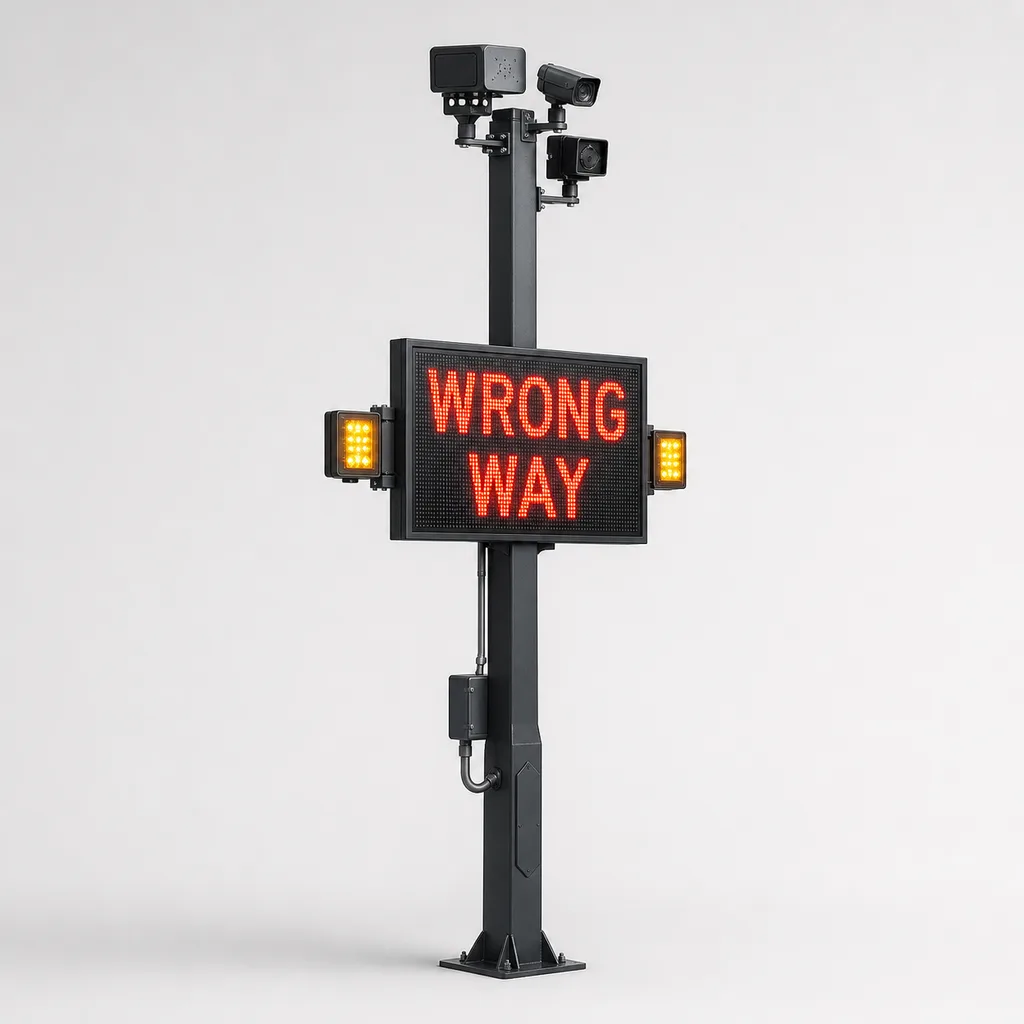
Wrong-way driving (WWD) on divided highways, expressways and one-way urban access roads is among the deadliest traffic events worldwide — a wrong-way vehicle on a high-speed carriageway is statistically far more likely to cause a head-on collision than any other crash type. Confusing ramp geometry, glare at night, signage missed in adverse weather, intoxicated or fatigued driving, and disorientation among elderly drivers are the most common root causes. The REDCOAST.LTD RC-WWD-200 Grid-Powered Wrong-Way Driver Detection and Active Warning System is a mains-powered intelligent transport system (ITS) product purpose-built for these high-risk locations. A multi-sensor detection node at the off-ramp throat continuously monitors vehicle direction; an edge AI controller verifies the event in under two seconds; and an active full-matrix LED warning sign assembly fires immediately, prompting the wrong-way driver to stop and turn around while simultaneously notifying the Traffic Management Centre (TMC) and pushing warnings to downstream DMS/VMS overhead signs. Powered from the local roadway lighting circuit or a dedicated grid feed and protected by an integrated LiFePO4 UPS, the system delivers continuous 24/7 protection across city interchanges, rural expressways, airport feeders, toll plazas and tunnel approaches — in any climate, regulatory environment or vehicle mix.
Key Features
- Multi-sensor wrong-way detection combining 77 GHz traffic radar (with explicit direction discrimination), long-wave thermal imaging and AI-enhanced ANPR camera for reliable performance in rain, fog, snow, glare and night-time conditions.
- Active full-matrix LED warning signs displaying alternating "WRONG WAY" and "DO NOT ENTER" patterns, paired with synchronized rectangular rapid flashing beacons (RRFBs) for unmistakable driver alerting.
- Closed-loop event verification: radar primary trigger plus AI camera secondary confirmation actively suppresses false alarms from pedestrians, animals, maintenance vehicles and legitimate reversing manoeuvres.
- Edge AI controller built on REDCOAST.LTD's in-house ITS controller PCB, supporting NTCIP 1203 v3 (DMS), NTCIP 1204 (ESS), NEMA TS2 Type 2 and DATEX II — drop-in compatible with existing ATMS platforms.
- ANPR-based evidentiary capture records plate, time, lane, direction and event clip for police, operator and insurance use.
- Downstream coordination with TMC, DMS/VMS overhead gantries, ramp meters and adjacent traffic-signal controllers via NTCIP and MQTT.
- Mains supply with LiFePO4 UPS providing ≥8 hours hold-up under grid outage.
- Optional in-pavement reverse-orientation LED markers that illuminate red toward the wrong-way driver only — invisible to correct-direction traffic.
- Web dashboard and mobile app for live status, event playback, sign override, OTA updates and remote diagnostics.
- Multilingual and standards-flexible sign formats for English, bilingual Arabic-English, Spanish-English, French-English and pictogram-only variants.
Technical Architecture
The system comprises four cooperating subsystems: the detection node, the active warning node, the edge controller cabinet, and the backhaul / integration layer.
The detection node is mounted on a 6-metre smooth matte powder-coated steel pole (default RAL 7016 anthracite) installed 25–60 m inside the off-ramp throat. It carries a 77 GHz FMCW traffic radar with ±0.2 km/h velocity resolution and direction discrimination, a 640 × 512 long-wave thermal imaging sensor for adverse-weather robustness, and a 4 MP global-shutter AI ANPR camera with IR-cut filter and active LED illuminator. Each sensor feeds REDCOAST.LTD's in-house multi-channel signal conditioning PCB, where radar IQ data are filtered, ANPR video is ISP-processed and thermal radiometry is calibrated. A YOLO-class edge AI model running locally on the controller classifies "wrong-way passenger car", "wrong-way truck/HGV", "maintenance vehicle" and "pedestrian/animal" — only the first two categories trigger an alert.
The active warning node carries one or two full-matrix LED warning signs (typically 800 × 1200 mm and 1200 × 1800 mm formats) driven by REDCOAST.LTD's NTCIP 1203 sign driver PCB with 256-step dimming, pixel-level diagnostics and Type 2 surge protection. Twin RRFB beacons strobe in WW alternating pattern aligned with FHWA and EN 12966 practice. Optional in-pavement LED markers — red toward the wrong-way driver, dark toward correct-direction traffic — reinforce the warning at night and in low-visibility conditions.
The edge controller cabinet is a wall-mounted IP55 enclosure with active ventilation containing the main controller PCB (ARM Cortex-A53 quad-core), 16 GB eMMC + 4 GB DDR4, NEMA TS2-compatible I/O board, 4G/5G modem, Gigabit Ethernet fiber uplink, RS-485 / RS-232 channels for legacy signs, and a 25.6 V / 50 Ah LiFePO4 UPS supervised by REDCOAST.LTD's CMU (cabinet monitoring unit) PCB.
The backhaul / integration layer pushes detected events as NTCIP 1204 / DATEX II / MQTT messages to the TMC and adjacent DMS/VMS gantries within two seconds. Events are also streamed to the REDCOAST.LTD cloud platform for analytics, repeat-offender pattern detection, KPI reporting and historical investigation.
Connectivity & Power
RC-WWD-200 draws AC 100–240 V, 50/60 Hz from the roadway mains, protected by Type 2 surge arrestors rated 10 kA. A LiFePO4 UPS (25.6 V / 50 Ah) provides at least 8 hours of full-function hold-up — long enough to ride out typical grid outages and severe-weather events. Backhaul options include 4G LTE / 5G NR cellular on global bands, single-mode fiber (1000Base-LX, up to 40 km) and Gigabit Ethernet directly to the ATMS core. Field I/O includes RS-485 (Modbus RTU and NTCIP), RS-232, dry contacts and Ethernet, enabling direct integration with existing ramp meters, DMS gantries, traffic-signal controllers and lane-control signals.
Protection & Reliability
All outdoor assemblies are rated IP66; the controller cabinet is IP55 with active ventilation. The system operates from -30 °C to +60 °C at 5–95% non-condensing humidity. Coastal-grade variants are tested to EN ISO 9227 480 h salt spray. EMC is certified to EN 50293 and FCC Part 15B. MTBF design target exceeds 80 000 hours for the controller, with 7-year service life for the LED warning sign at 100% duty cycle. Modular construction allows on-site replacement of the radar, ANPR camera, thermal imager, sign panel, controller or UPS without taking the whole system offline.
Application Scenarios
- Urban freeway off-ramps and one-way arterials: Catches confused or impaired drivers at downtown interchanges, university districts and entertainment districts at night.
- Rural divided highway entrances and emergency crossovers: Critical where ramp geometry is non-standard, lighting is sparse or signage is far apart.
- Airport feeder roads and toll plaza approaches: Disoriented arriving travellers and time-of-day visitor surges raise WWD risk significantly.
- Tunnel and long-span bridge approaches: Confined geometry magnifies head-on consequences; ramp protection feeds tunnel and bridge ATMS for upstream lane closure and speed reduction.
- Industrial parks, ports and bonded warehouses: One-way internal traffic plans require enforcement of vehicle direction for safety and operational compliance.
- MLFF / open-road tolling lanes after lane reassignment: Catches drivers entering closed or wrong-direction lanes during dynamic toll operations.
Case-style Examples
- Major Urban Interchange Retrofit: A six-leg city interchange recorded several WWD events per year, including one fatal head-on crash on a heavily-travelled feeder. RC-WWD-200 units were installed on each exit ramp and integrated with two upstream DMS gantries that automatically display "WRONG-WAY VEHICLE AHEAD — REDUCE SPEED". Post-commissioning, all WWD attempts were aborted within 80 m of the ramp throat and no head-on injuries were reported in the following 18 months.
- International Airport Access Network: A large international airport faced disoriented departing passengers entering its perimeter access road in the wrong direction at night. RC-WWD-200 was installed at five access points with full ANPR evidence capture and a private MQTT feed into the airport operations centre. Average patrol response time dropped from 15 minutes to under 3 minutes, and several cases were used in post-event driver education programmes.
- Toll Plaza Wrong-Way Lane Protection: Following a multi-lane free-flow (MLFF) conversion, drivers occasionally entered closed lanes against traffic during off-peak operations. RC-WWD-200 was integrated with lane control signals (LCS) to flash red lane closure in the same activation cycle as WRONG WAY signs, instantly aligning all lane-direction cues for the driver.
Customization & Selection Guide
- Sensor mix: Radar-only for budget-conscious or low-risk sites; radar + ANPR for evidentiary capture and operator workflow; radar + ANPR + thermal for high-traffic, adverse-weather and night-critical sites.
- Geometry: Single-pole, dual-pole, cantilever or overhead-gantry configurations to match ramp width, traffic speed and required sight distance.
- Sign size and language: 800 × 1200 mm or 1200 × 1800 mm full-matrix LED; English MUTCD-style by default; bilingual Arabic-English, Spanish-English, French-English, Portuguese-English; pictogram-only for international corridors.
- Backhaul: 4G/5G for greenfield or remote sites; single-mode fiber for sites with existing TMC trunk; GbE direct for short-haul.
- Integration: Standalone NOC operation, fully NTCIP-integrated with city ATMS / DMS / VMS / ramp meters, or DATEX II feed into a national TMC.
- Power resilience: Standard 8-hour LiFePO4 UPS; extended 24-hour or 48-hour battery banks on request; optional fuel-cell or diesel-generator interface for mission-critical sites.
Deployment & After-sales
Standard delivery is 6–10 weeks ex-works after design freeze. REDCOAST.LTD provides turnkey installation including site survey, foundation pour, pole erection, sensor alignment and calibration, sign commissioning and ATMS integration testing. Remote OTA firmware updates, 7×24 NOC monitoring and a 24-month warranty (extendable to 60 months) are standard. Spare parts are stocked in regional warehouses for major markets, and REDCOAST.LTD's engineering team provides remote and on-site technical support throughout the product life cycle.
Standards & Compliance
CE, RoHS, EN 12966 (variable message signs), EN 50293 (EMC for traffic signal systems), MUTCD-style WRONG WAY / DO NOT ENTER signage practice, NTCIP 1203 v3 (DMS), NTCIP 1204 (environmental sensor stations), NEMA TS2 Type 2, IEC 60529 IP66, EN ISO 9227 salt spray, ISO 9001 quality and ISO 14001 environmental management.
Why REDCOAST.LTD
REDCOAST.LTD is an end-to-end smart IoT solutions vendor — hardware, web management platform and mobile App delivered as one integrated system by one team, not a reseller of off-the-shelf modules. Our differentiator is that we design our own PCBs in-house: the 77 GHz radar signal conditioning board, the NTCIP 1203 LED sign driver, the edge AI controller, the cabinet monitoring unit and the UPS power-management board are all REDCOAST.LTD designs. That means we can tune any WWD product to a specific country's signage standard, language, MUTCD or EN variant, or proprietary TMC protocol — from the radar firmware up to the cloud analytics dashboard, every layer is in-house and PCB-level customizable. Whether you operate one ramp or one thousand, REDCOAST.LTD delivers a coherent, supportable, road-authority-grade solution.
Contact REDCOAST.LTD to request a wrong-way driver detection feasibility study, a sample event report or a tailored quote for your highway, expressway, airport or campus.
Specifications
Detection
- Radar Frequency
- 77 GHz FMCW
- Radar Detection Range
- up to 200 m
- Velocity Resolution
- ±0.2 km/h
- ANPR Camera
- 4 MP global shutter, 1/1.8" CMOS
- Thermal Imager
- 640 × 512 LWIR
- Detection-to-Alert Latency
- <2 s
- False-Alarm Rate (typical)
- <1 per month per site
Active Warning Display
- LED Sign Pixel Pitch
- 20 / 25 / 31.25 mm
- Sign Sizes
- 800 × 1200 / 1200 × 1800 mm
- Peak Luminance
- up to 10 000 cd/m²
- Auto Dimming Steps
- 256
- RRFB Flash Pattern
- WW alternating, 4 flashes/s
- In-pavement LED Stud (optional)
- red toward wrong-way driver only
Edge Controller
- CPU
- ARM Cortex-A53 quad-core 1.5 GHz
- RAM / Storage
- 4 GB DDR4 / 16 GB eMMC
- OS
- Linux RT
- NTCIP Profiles
- 1203 v3, 1204, 2103, 2304
- NEMA
- TS2 Type 2
- I/O
- 8 DI / 8 DO / 4 RS-485 / 2 RS-232 / 4 GbE
Power (Grid)
- Input Voltage
- AC 100–240 V, 50/60 Hz
- Typical Power Consumption
- 250–500 (350 with active warning) W
- UPS Battery
- LiFePO4 25.6 V / 50 Ah
- Battery Hold-up
- ≥8 (extendable to 24/48) h
- Surge Protection
- Type 2, 10 kA
Connectivity
- Cellular
- 4G LTE Cat-12 / 5G NR Sub-6
- Fiber
- 1000Base-LX single-mode, up to 40 km
- Ethernet
- 4 × GbE
- Protocols
- NTCIP, DATEX II, MQTT, Modbus RTU/TCP
Environmental & Protection
- IP Rating (outdoor)
- IP66
- IP Rating (cabinet)
- IP55 with active ventilation
- Operating Temperature
- -30 to +60 °C
- Humidity
- 5–95 non-condensing %
- Salt Spray
- EN ISO 9227, 480 h
- EMC
- EN 50293, FCC Part 15B
Mechanical
- Pole Material
- Q235 steel, hot-dip galvanized + matte powder-coated finish
- Default Color
- RAL 7016 anthracite (configurable)
- Pole Height
- 4–8 m
- Sign Mount
- pole-side / cantilever / overhead gantry
- Foundation
- 800 × 800 × 1200 reinforced concrete with anchor cage mm
Capabilities — configurable per project
Specifications are tailored to each project — the options below show what we can support.
Sensor Configuration
- Radar only
- Radar + ANPR
- Radar + ANPR + Thermal
Sign Mount
- Pole-side
- Cantilever arm
- Overhead gantry
Sign Language Variant
- English MUTCD
- Bilingual Arabic-English
- Bilingual Spanish-English
- Pictogram-only
Backhaul
- 4G/5G cellular
- Single-mode fiber
- GbE direct
ATMS Integration
- Standalone NOC
- NTCIP-integrated city ATMS
- DATEX II national TMC
Related solution guidance
Traffic Safety Checklist
Deployment checklist for connected traffic warning signs, beacons, road guidance devices, power, visibility, monitoring and acceptance tests.
Traffic Safety
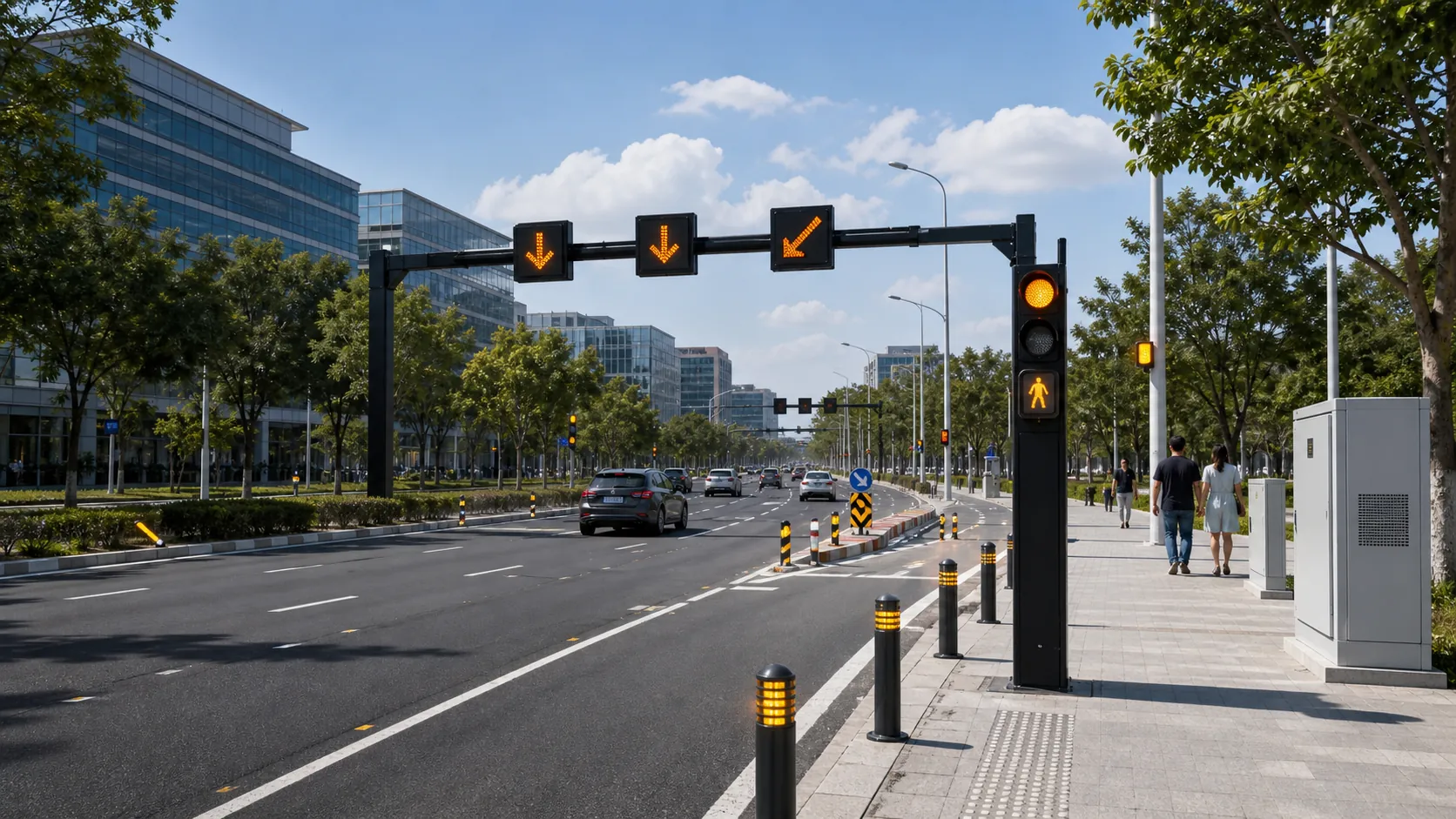
Plan connected traffic safety systems with warning beacons, LED signs, road guidance devices, sensing, control cabinets and monitoring software.
Airports and Hubs
IoT infrastructure for transport hubs: parking guidance, road safety, outdoor lighting, signage, monitoring and operational dashboards.
Frequently Asked Questions
How fast does the RC-WWD-200 react after a wrong-way vehicle enters an off-ramp?
From the moment the 77 GHz radar registers a vehicle moving against the legal direction, the edge AI controller confirms the event with the ANPR camera and activates the LED warning signs and RRFB beacons in under two seconds. The same event is pushed to the TMC and any integrated downstream DMS/VMS simultaneously.
Can the system tell the difference between a real wrong-way driver and a maintenance vehicle?
Yes. The on-board AI model classifies detections into wrong-way passenger car, wrong-way HGV, maintenance vehicle, pedestrian and animal categories, and only the wrong-way vehicle classes trigger active warnings. Authorised maintenance crews can also be whitelisted by ANPR plate or beacon code.
What happens during a local power failure?
The integrated LiFePO4 UPS provides at least eight hours of full-function hold-up on the standard configuration, with optional 24-hour and 48-hour battery banks available. All detection, warning and TMC reporting functions continue normally on battery.
Is the RC-WWD-200 compatible with our existing TMC / ATMS platform?
The system supports NTCIP 1203 v3, NTCIP 1204, NEMA TS2 Type 2, DATEX II and MQTT out of the box, making it drop-in compatible with most national and city ATMS platforms. REDCOAST.LTD also provides custom protocol adapters if your TMC uses a proprietary interface.
Does the system work reliably in heavy rain, fog, snow or at night?
Yes. The radar is unaffected by visible-light conditions; the thermal imager adds a second physically independent channel for adverse weather; and the ANPR camera uses active IR illumination for low-light evidence capture. Field experience shows stable performance across rain, fog, snow and full night-time operation.
Can REDCOAST.LTD customize the signage language and standard for our country?
Yes. Because REDCOAST.LTD designs the NTCIP 1203 sign driver PCB and the controller firmware in-house, we can support MUTCD English, EN 12966-compliant European variants, bilingual Arabic-English, Spanish-English, French-English, Portuguese-English and pictogram-only formats. Custom layouts can be added without changing the hardware.
What is the typical false-alarm rate?
Sites configured with radar plus ANPR confirmation typically see fewer than one false alarm per month per site after the initial tuning period. False alarms are further reduced by maintenance-vehicle whitelisting and time-of-day filtering.
How is evidentiary ANPR data handled and stored?
Each confirmed event captures the plate image, a short pre/post video clip, the radar trace and a timestamp, stored locally on encrypted storage and mirrored to the REDCOAST.LTD cloud or your private server. Retention, access control and data-export workflows are configurable to meet local data-protection requirements.