Overview
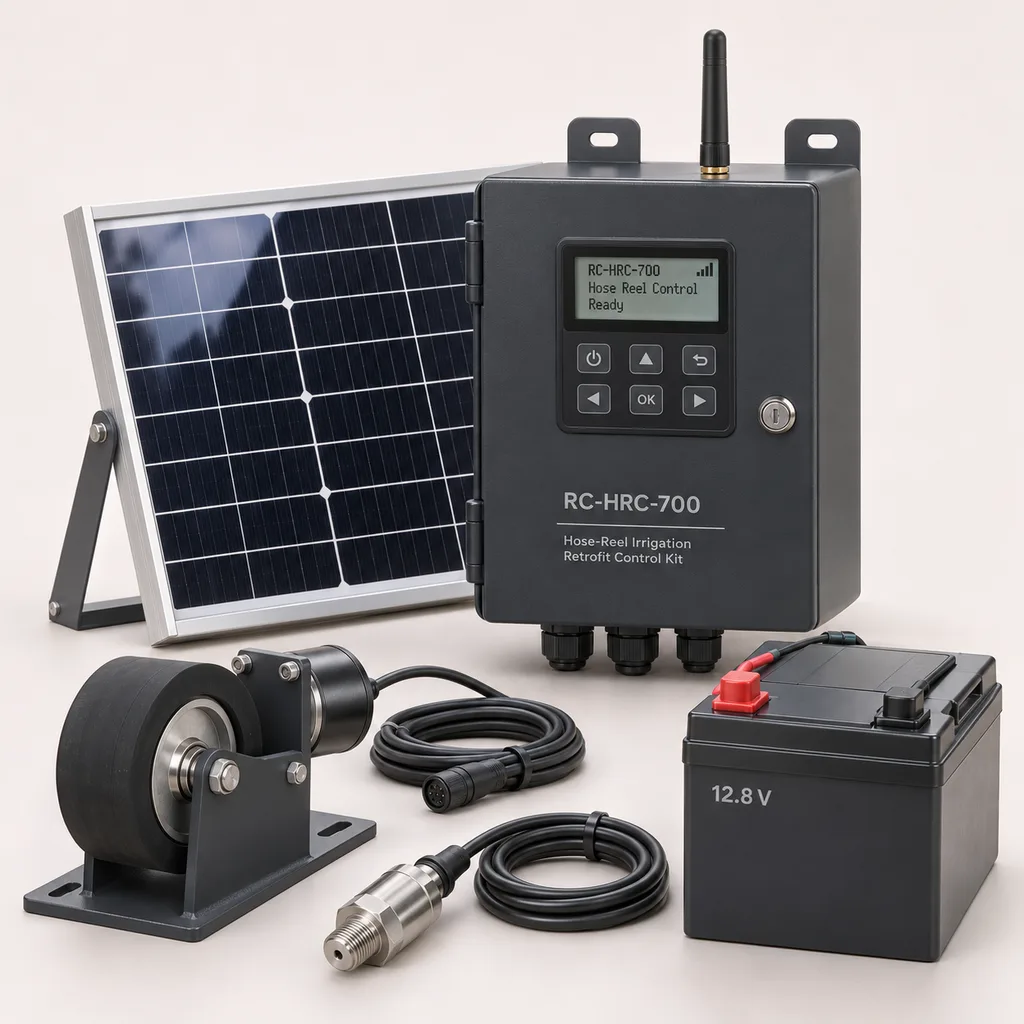
The RC-HRC-700 is a hose-reel irrigator remote control and retrieval monitoring retrofit package from REDCOAST.LTD, combining machine-mounted electronics, field sensors, a Web management platform, and a mobile App. It is intended for farms, irrigation contractors, public agricultural estates, and equipment integrators operating water-turbine-driven travelling rain guns or compatible sprinkler booms. The package addresses repeated field visits, unnoticed retrieval stalls, uncertain finish times, and fragmented irrigation records through local speed control and remote operating visibility. Its reference configuration uses a small solar panel and battery because the reel moves between field locations without an electrical connection; irrigation pumping remains separately powered. The specifications describe a proposed project configuration, with machine compatibility and acceptance performance confirmed through engineering and commissioning.
Key Features
- Retrofit existing water-driven reels: Retain the drum, hose, turbine, gearbox, and sprinkler while replacing or adding the electronic control assembly, compatible actuator interfaces, and monitoring harness.
- Closed-loop retrieval regulation: Measure hose movement with a roller encoder and adjust the turbine bypass actuator against a commissioned speed setpoint.
- Eight distance-based speed segments: Apply different retrieval speeds along one irrigation lane, with separately adjustable start and finish dwell periods.
- Pressure and movement alarms: Identify sustained low pressure, excessive pressure, missing movement pulses, unexpected end-stop activation, and actuator overload using configurable persistence timers.
- Water-use records: Accept an external meter's pulse output, record run totals, and calculate nominal applied depth from measured flow, lane spacing, and retrieval speed.
- Local operation during network outages: Execute the accepted irrigation program on the controller and retain timestamped records for later synchronization.
- Fleet visibility: Show each reel's operating state, remaining distance, estimated completion time, battery condition, and last reported asset location in the Web platform and App.
- Project-specific hardware: REDCOAST.LTD develops the controller, pressure-input circuitry, motor-drive stage, and solar charging PCB around the selected machine interfaces.
Technical Architecture
The machine package comprises an embedded controller, two reversible low-voltage actuator channels, a hose-measuring roller with directional pulse sensing, an end-of-run input, a pressure transducer, and an optional external flow meter. One actuator adjusts the existing turbine bypass or speed-regulating mechanism; the second operates a compatible existing stop mechanism. Water pressure drives the original turbine and gearbox. Separating low-power electronic control from the mechanical drive is an established commercial approach, illustrated by the BAUER RAINSTAR control architecture.
The controller compares measured travel against the active distance segment and makes short actuator corrections with a deadband to avoid continual hunting. Encoder calibration uses a measured hose travel distance; counting drum revolutions alone requires compensation for changing winding diameter. Nominal applied depth is calculated as D = 1000Q/(vS), where D is millimetres, Q is flow in cubic metres per hour, v is retrieval speed in metres per hour, and S is lane spacing in metres. This calculation describes gross average application, not measured soil uptake or distribution uniformity. Without a flow meter, the display identifies depth and volume as estimates derived from the entered nozzle-flow value.
An operating state machine separates setup, armed, pre-irrigation, retrieval, post-irrigation, completed, and fault conditions. Remote commands carry expiry times and require controller acknowledgement; a queued start does not execute unexpectedly after reconnection. A local arming action is required after repositioning before remote starting is enabled. The original mechanical end trip remains independent, and the retrofit is not a safety-rated emergency-stop system. Shutdown is commissioned for the actual machine's pressure-rise closure, pressure-drop bypass, or pump-stop arrangement, with protection against pump deadheading and damaging pressure transients.
Connectivity & Power
The standard communication option is LTE Cat 1 bis with a deployment-specific modem band set and SIM profile. Scheduled telemetry defaults to 15-minute intervals, while detected faults trigger an immediate transmission attempt when service is available. To conserve energy, remote commands are collected during communication sessions and may wait up to the selected reporting interval; an App stop is not an emergency stop. Bluetooth Low Energy supports nearby commissioning without mobile-network coverage. An isolated RS-485 interface connects supported Modbus RTU instruments; MQTT over TLS carries telemetry to the platform, and an authenticated HTTPS API exchanges records with farm or asset-management software. The cloud provides supervision and reporting; local control does not depend on internet latency.
The reference power package contains a 30 Wp photovoltaic module, a 12.8 V 12 Ah LiFePO4 battery, and a 3 A MPPT charger. It supplies the controller, sensors, communications, and intermittent actuators only. It does not power the irrigation pump or replace the water turbine. The daily energy design budget is 12 Wh under the stated telemetry schedule, limited display use, and short actuator corrections; weak cellular coverage, frequent adjustments, or added instruments require a new budget.
Seven days without solar input require 84 Wh at that budget. A nominal 153.6 Wh battery, limited to 80% discharge with a further 15% allowance for conversion losses and reserve, provides approximately 104 Wh at room temperature when new. A 30 Wp panel receiving two equivalent full-sun hours with a 0.65 overall yield factor produces approximately 39 Wh per day. These are sizing calculations, not universal autonomy guarantees: winter irradiance, shading, battery age, and temperature determine the final configuration. Battery charging is inhibited outside the specified cell-temperature window.
Protection & Reliability
The controller enclosure has an IP66 design target with sealed cable entries, a replaceable gasket, and a pressure-equalizing vent. Metal brackets and the enclosure use a galvanized corrosion-protection base beneath a smooth matte powder-coated finish. Conformal coating, fused power branches, reverse-polarity protection, actuator current monitoring, and a hardware watchdog address common field faults. IP66 qualification applies to the completed enclosure with its connectors fitted; it does not authorize immersion or pressure-washer cleaning.
The proposed complete package operates at ambient temperatures from -10 to +50 degrees Celsius, with battery charging permitted only at cell temperatures from 0 to +45 degrees Celsius. A sun shield and mounting away from hot pump or engine components help maintain these limits. Coastal salt exposure, abrasive dust, transport vibration, and solar-bracket wind loads are assessed against the installation conditions before environmental qualification. Maintenance focuses on encoder traction, pressure-port blockage, damaged cables, gasket condition, panel cleanliness, and battery capacity; warranty scope and spare-parts arrangements are defined in the supply agreement.
Application Scenarios
Dispersed vegetable fields
A grower moves several reels between separated plots with no fixed electrical outlets. The system provides finish-time estimates and pressure alarms so staff can plan machine transfers and investigate interruptions without routine trips solely to read the controller.
Contract irrigation fleets
A contractor operates different reel sizes across customer properties. Machine-specific calibration profiles and operator permissions create consistent records while preserving each reel's permitted pressure and retrieval limits.
Turf production and sod farms
Long irrigation lanes require controlled travel speed and attention to overlap between passes. Segment programming supports different planned application depths, while flow records help supervisors compare the intended run with actual water delivery.
Public agricultural and training estates
A public operator needs a traceable record of machine use and water consumption across teaching or demonstration fields. Timestamped sessions and exportable meter totals support operational review without treating estimated application depth as a certified agronomic measurement.
Irregular fields outside pivot coverage
A travelling rain gun can serve strips and field corners that are unsuitable for a fixed pivot layout. The retrofit adds monitoring and scheduled speed changes while leaving hose routing, sprinkler selection, and safe operating clearance under local supervision.
Case-style Examples
The following examples are illustrative engineering scenarios, not completed customer projects or measured savings claims.
Overnight irrigation of a vegetable block
An operator has a compatible reel with 300 m of deployed hose, a measured flow of 30 m3/h, and 60 m lane spacing. At 20 m/h retrieval speed, the travel portion lasts approximately 15 hours and the nominal application is 25 mm, excluding start and finish dwell effects. The selected package adds the roller encoder, pressure transducer, external pulse meter, and cellular connection. The expected operational result is a visible finish estimate and a timestamped run record, with alarms available to prompt inspection if pressure or movement departs from commissioned limits.
Retrofit of a mixed contractor fleet
A contractor wants to monitor six water-driven reels without replacing their hydraulic machinery. The initial pilot uses one representative machine to verify actuator voltage, stroke direction, stop logic, encoder mounting, and cellular coverage before adapting harnesses for the remaining models. Each reel receives its own calibration profile and can complete its accepted program during a communications outage. The intended outcome is one fleet view with attributable operating records; labor savings are measured during the pilot rather than assumed.
Customization & Selection Guide
Start with the reel manufacturer, model, hose diameter and length, turbine mechanism, available actuator interfaces, and the existing mechanical stop arrangement. Supply photographs and electrical diagrams where available. A monitoring-only configuration suits machines whose controls should remain untouched; speed-control and coordinated-stop functions require verified mechanical and electrical compatibility. The reference application envelope covers 63-110 mm hose diameters and 100-500 m hose lengths, but these are separate selection ranges, not a guarantee that every diameter-length-flow combination is feasible.
Select the sprinkler and pump using the nozzle manufacturer's performance table and the complete hydraulic loss calculation. Pressure at the reel inlet includes the additional head needed for the turbine, hose, fittings, and elevation; it must not be substituted directly for nozzle pressure. For context, the Komet Twin 101 Ultra technical data lists nozzle-pressure and flow ranges that vary with nozzle selection. A flow meter is the preferred option when water accounting matters. Choose a larger solar package only after calculating the site load and worst-season solar resource, and select connectivity from a field signal survey.
Deployment & After-sales
Installation begins with mechanical inspection, energy isolation, depressurization, and verification that the original guards and stop mechanism remain functional. The installer mounts the controller outside the hose sweep and service-access paths, fits the measuring roller and pressure tap, routes protected cables, and secures the solar module for operation and transport. Commissioning includes measured-distance calibration, pressure comparison with a reference gauge, meter-pulse verification, actuator travel checks, and testing of the agreed stop sequence with the actual pump.
Acceptance also checks loss of communications, low battery, sensor disconnection, blocked actuator travel, end-of-run operation, and recovery after power restoration. A prototype schedule is agreed after interface review; custom PCB development, tooling, and additional qualification are quoted separately from repeat production. REDCOAST.LTD can supply wiring diagrams, interface maps, commissioning procedures, spare controller assemblies, remote diagnostics, and operator training. Software maintenance includes controlled updates, configuration backups, and an agreed support period; remote updates are scheduled while the machine is stopped.
Standards & Compliance
The compliance plan is defined for the delivered configuration and destination. The following references guide engineering and procurement; listing them does not claim that this proposed model already holds certification.
- Traveller performance: ISO 8224-1:2003, including its applicable amendment, addresses operating characteristics and laboratory and field testing for traveller irrigation machines. The published edition and replacement status are checked when the project test plan is frozen.
- Machine safety: EN 908:1999+A1:2009 provides a relevant safety reference for irrigation reel machines. Retrofit assessment covers the complete modified machine, including guards, hose guidance, stability, and operating instructions.
- Enclosure protection: IEC 60529 supplies the IP classification and test framework for the IP66 enclosure target.
- Battery safety: IEC 62619:2022 provides an industrial lithium-battery safety reference where applicable to the selected pack. Battery transport documentation is checked separately for the supplied battery.
- Market access: Applicable EMC, radio-spectrum, electrical-safety, and restricted-substance requirements are established for each destination. CE, RoHS, FCC, or other declarations and approvals are supplied only where the relevant assessment and documentation have been completed.
Why REDCOAST.LTD
REDCOAST.LTD delivers the equipment electronics, embedded control, Web platform, and mobile App as one coordinated solution. In-house PCB and board-level development allows actuator drivers, sensor conditioning, connector arrangements, power management, and communication interfaces to be adapted to the actual reel instead of forcing every machine into a fixed controller format. The same team can align hardware revisions, firmware behavior, commissioning tools, and fleet reporting throughout the project.
Contact REDCOAST.LTD with your reel model, hose dimensions, pump arrangement, and operating requirements to request a tailored RC-HRC-700 retrofit proposal.
Specifications
Machine Compatibility & Programming
- Drive Type
- Water-turbine-driven reel with compatible speed-regulating and stop actuators
- Reference Hose Outside Diameter
- 63-110; verify hydraulic and mechanical compatibility mm
- Configured Hose Travel Length
- 100-500; machine-dependent m
- Retrieval Speed Setpoint
- 5-120; limited to verified machine capability m/h
- Speed Setpoint Resolution
- 0.1 m/h
- Distance-Based Speed Segments
- 1-8 per run
- Stored Run Programs
- 16 programs
- Pre- and Post-Irrigation Dwell
- 0-60 each min
Sensors & Measurement
- Pressure Measurement Range
- 0-16 gauge; alarm limits set below machine rating bar
- Pressure Sensor Accuracy Target
- ±0.5% of full scale at 25 °C, excluding installation effects
- Pressure Sampling Rate
- 1; operational monitoring, not water-hammer capture Hz
- Pressure Connection
- G1/4 or 1/4 NPT; 316L wetted diaphragm
- Hose Movement Sensor
- Dual-channel Hall encoder on measuring roller
- Configured Travel Resolution
- 0.01 nominal; accuracy depends on calibration and roller slip m
- External Flow-Meter Input
- 1 pulse channel, 0-100; meter supplied separately Hz
- Additional Digital Inputs
- 4 dry-contact channels for end trip, pressure switch, and status
Actuation & Local Control
- Reversible Actuator Outputs
- 2 H-bridge channels; only 1 channel driven at a time
- Actuator Supply
- Battery-referenced DC 10.8-14.6; matched actuators required V
- Actuator Current Capacity
- 2 continuous; 5 for up to 2 seconds per active channel A
- Actuator Protection
- Current limiting, short-circuit detection, adjustable 1-60 second travel timeout
- Auxiliary Relay Outputs
- 2 dry contacts, each rated 1 A at 30 V DC resistive
- Speed Regulation Acceptance Target
- ±5% averaged over 10 m at stable pressure after calibration
- No-Movement Alarm Persistence
- 30-300; set for minimum speed and encoder resolution s
- Restart Authorization
- Local arming required after repositioning or power restoration
Solar Power for Field Electronics
- Solar Module
- 30 standard; 50 optional Wp
- Battery Chemistry and Capacity
- LiFePO4, 12.8 V, 12 Ah, 153.6 Wh nominal
- MPPT Charger
- 3 A maximum charge current; 30 V maximum PV open-circuit voltage including cold conditions
- Daily Energy Design Budget
- 12 with 15-minute telemetry, display use up to 15 min/day, and intermittent actuation Wh/day
- Actuator Duty Used for Energy Budget
- Up to 120 seconds/day combined at 2 A average
- No-Sun Autonomy Sizing Target
- 7 at 12 Wh/day, new battery at 20-25 °C, 80% discharge limit and 15% additional allowance days
- Permitted Battery Charging Temperature
- 0 to +45 at the cells; charging inhibited outside this range °C
- Energy Supply Boundary
- Controller, sensors, modem, and intermittent actuators; irrigation pump separately powered
Connectivity & Software
- Cellular Backhaul
- LTE Cat 1 bis; modem bands and SIM selected for deployment
- Local Wireless Access
- Bluetooth Low Energy, 2.4 GHz
- Wired Instrument Interface
- 1 isolated RS-485 port; Modbus RTU, 9600-115200 bit/s
- Routine Telemetry Interval
- 1-60 configurable; 15 default; remote commands collected during sessions min
- Server Interfaces
- MQTT over TLS 1.2 or later; authenticated HTTPS API
- Offline Log Capacity
- 100000 timestamped records in a circular buffer records
- Asset Positioning
- GNSS, 3-10 m typical in open sky; scheduled asset fixes, not hose-position feedback
- User Access
- Web dashboard and mobile App; administrator, supervisor, and operator roles
Enclosure & Environmental Design
- Enclosure Protection Target
- IP66 with specified glands and connectors installed; qualification required
- Complete-Package Operating Ambient
- -10 to +50; battery charging limits apply separately °C
- Ambient Humidity
- 5-95, non-condensing inside enclosure % RH
- Reference Enclosure Size
- 300 × 240 × 160, excluding mounting brackets and solar module mm
- Enclosure and Bracket Finish
- Galvanized steel base with smooth matte powder coating, RAL 7016
- Local Operator Interface
- 128 × 64 pixel transflective LCD with sealed membrane keys
- Field Cable Harness Lengths
- 2 standard; 5 optional after voltage-drop review m
- Maintenance Planning Interval
- 6 months plus inspection before each irrigation season
Capabilities — configurable per project
Specifications are tailored to each project — the options below show what we can support.
Retrofit Scope
- Monitoring only with original controls retained
- Retrieval speed control with verified actuator interface
- Speed control plus coordinated existing stop mechanism
Measurement Package
- Pressure, roller encoder, and end-of-run input
- Base sensors plus external pulse flow meter
- Base sensors plus compatible RS-485 flow instrument
Field Power Package
- 30 Wp solar module with 12.8 V 12 Ah LiFePO4 battery
- 50 Wp solar module with 12.8 V 20 Ah LiFePO4 battery
- Existing verified 12 V machine battery with matched charging profile
Platform Deployment
- Managed Web platform and mobile App
- Customer-hosted platform with agreed maintenance scope
- API integration with an existing farm-management platform
Machine Interface
- Machine-specific adapter harness retaining compatible actuators
- Replacement 12 V speed and stop actuator kit after mechanical review
- Custom PCB connector layout and input conditioning for OEM production
Related solution guidance
Solar IoT Guide
A design guide for solar-powered outdoor IoT: load calculation, battery autonomy, low-power firmware, telemetry and maintenance planning.
Solar Off-Grid IoT
Design solar-powered outdoor IoT systems with panels, batteries, controllers, low-power devices, gateways and remote power monitoring.
Environmental Monitoring
Deploy environmental monitoring stations with sensors, solar power, gateways, dashboards, alarms and data integration for city and industrial sites.
Frequently Asked Questions
Can this controller retrofit any hose-reel irrigator?
Compatibility must be checked against the reel's turbine regulation, actuator voltage and current, stop mechanism, and sensor mounting options. The reference package targets water-driven reels with 63-110 mm hose diameters and 100-500 m travel lengths, without implying that every combination is hydraulically suitable. Machines with unsuitable control interfaces can receive a monitoring-only package or a separately engineered actuator conversion.
Does the solar panel power the irrigation pump or pull in the hose?
The 30 Wp reference panel supplies field electronics and short actuator movements through a battery. The existing water turbine and gearbox retract the hose, while a separately powered pump supplies irrigation water. Pump flow, pressure, and energy consumption must be calculated independently.
Will the irrigator keep working when the mobile network is unavailable?
The controller executes the locally accepted program and stores records without a cloud connection. Remote visibility and new commands remain unavailable until communications return, and expired commands are rejected. Local fault handling and the original mechanical end trip remain active according to the commissioned configuration.
How does the system calculate irrigation depth?
Nominal gross depth in millimetres equals 1000 times flow in m3/h divided by retrieval speed in m/h and lane spacing in metres. For example, 30 m3/h at 20 m/h with 60 m spacing gives 25 mm. Wind, overlap, pressure variation, runoff, and soil infiltration affect the actual result, so field distribution testing remains necessary.
Can I stop a reel immediately from the mobile App?
The energy-saving configuration collects remote commands during communication sessions, so a command may wait up to the configured interval and requires usable coverage. The App stop is a supervised operational request, not an emergency-stop function. Local stop controls, mechanical trips, and the commissioned pump and valve sequence provide the machine-level response.
What happens if the reel stalls or water pressure falls?
The controller evaluates the configured movement or pressure threshold and its persistence timer, records the fault, and attempts to send an alarm. Where a compatible stop interface has been commissioned, it also initiates the agreed local shutdown sequence. Stopping only the drum can leave water flowing, so pump behavior and water shutoff must be verified together during installation.
How long can the controller operate without sunshine?
The reference sizing target is seven days at 12 Wh/day using a new 12.8 V 12 Ah battery at room temperature. This calculation limits discharge to 80% and includes a further 15% allowance for losses and reserve. Cold weather, battery aging, poor cellular coverage, and higher actuator duty can reduce autonomy, so the final package requires a site-specific energy budget.
Does REDCOAST.LTD develop the electronics and software?
REDCOAST.LTD can develop the controller PCB, sensor conditioning, actuator drivers, solar power-management circuitry, embedded firmware, Web platform, and mobile App for the project. Standard sensing elements and radio modules are selected where appropriate, while board-level interfaces and control behavior are engineered around the machine. Custom development scope, verification, support, and ownership terms are defined in the project agreement.