Overview
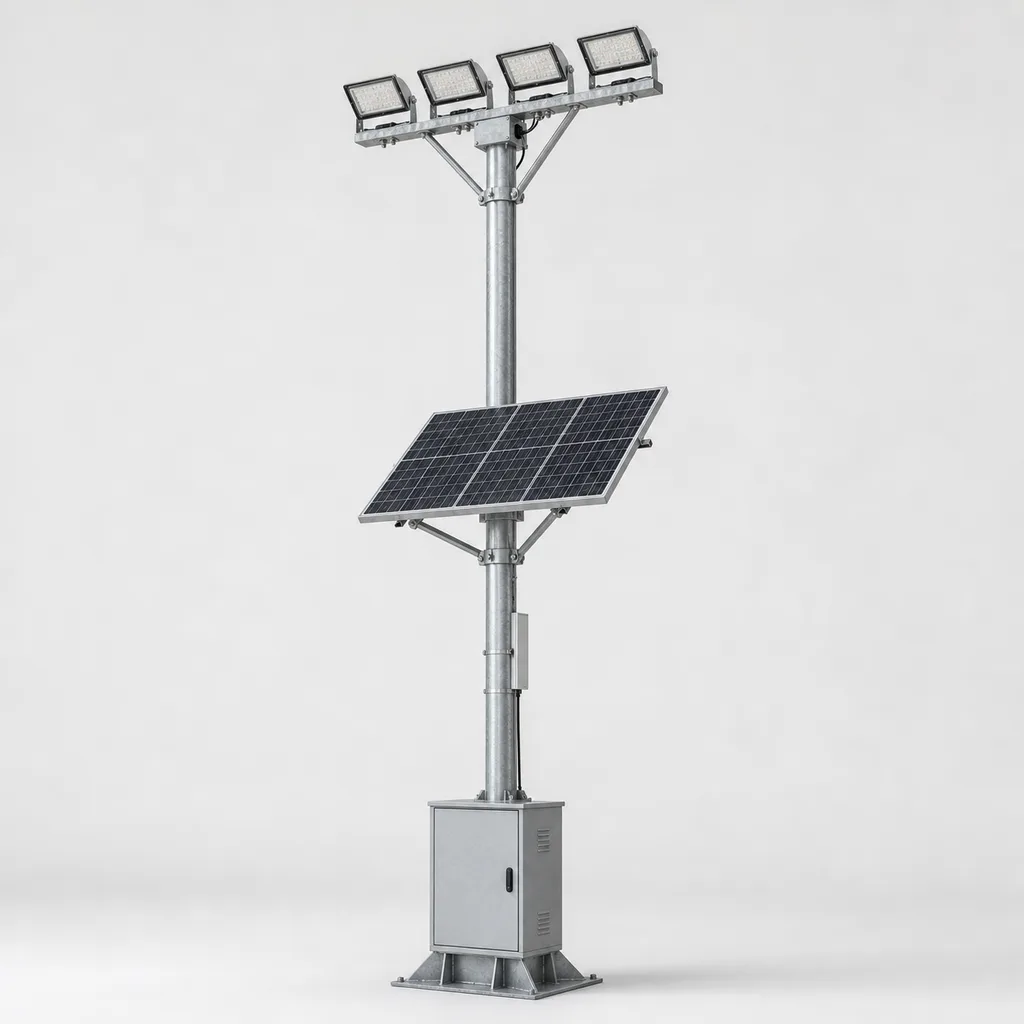
The Redcoast RC-HM-600 is an off-grid solar smart high-mast and large-area flood lighting system engineered for high-output illumination of open spaces — container terminals, logistics yards, parking lots, sports grounds, mining sites, border crossings and public squares. It targets facility owners, governments, ports and system integrators who need reliable wide-area light where grid power is absent, unstable or expensive to trench. Unlike a roadway street light, the RC-HM-600 lifts multiple high-flux LED flood modules onto an 8–30 m mast to flood thousands of square meters with uniform, low-glare light. Every system is built around Redcoast's own-design MPPT power-management PCB and edge controller, giving customers a software-and-hardware package they can tune per project rather than an off-the-shelf assembly.
Key Features
- High-output area illumination: 2–6 LED flood heads, 60–200 W each, total system output up to 600 W and 100,000+ lm, designed for 20–30 lux average yard lighting with high uniformity.
- True off-grid autonomy: mono PERC solar array plus LiFePO4 storage sized for 3–5 days of rainy-day autonomy, so lights stay on without the grid.
- Redcoast in-house MPPT PCB: custom power-management board with MPPT charging, battery protection, temperature compensation and per-head load switching — not a generic controller.
- Smart adaptive dimming: microwave/PIR/radar motion detection plus time-of-night profiles, dimming to 30% during idle hours and ramping to 100% on activity to stretch battery runtime.
- Remote CMS & telemetry: every pole reports state of charge, load current, fault flags and energy yield to Redcoast's cloud platform and mobile app over 4G/5G, NB-IoT or LoRa.
- Storm-grade structure: hot-dip galvanized steel mast rated for wind resistance up to 150 km/h, with optional lowering/raising head frame for ground-level maintenance.
- Wide-climate hardware: IP66 / IK09 luminaires and IP66 battery enclosure operating from -30 to +60 °C, suitable for coastal salt-fog, desert sand and high-altitude sites.
- Long service life: LiFePO4 cells rated 4,000+ cycles and LED modules rated 50,000+ hours, reducing lifecycle cost versus diesel or lead-acid alternatives.
Technical Architecture
The RC-HM-600 is a layered solar-storage-load system. At the top of the mast, a cluster of LED flood heads with high-efficacy optics directs light onto the target area; head count, wattage and beam angle are selected to hit the project's lux and uniformity targets. Mid-mast or at the base, a mono PERC solar array charges a LiFePO4 battery bank housed in a ventilated IP66 enclosure. The heart of the system is Redcoast's self-developed MPPT power-management PCB: it performs maximum-power-point tracking to harvest the most energy from the panels, manages charge/discharge with cell-level protection and temperature compensation, and switches each lighting head independently so dimming and zone control happen at the hardware level.
An edge controller co-located on the power board runs the lighting logic — dusk-to-dawn switching via light sensor, time-segmented dimming profiles, and motion-triggered boost from the radar/PIR sensor. The same controller samples battery voltage, state of charge, load current, panel yield and enclosure temperature, then publishes that telemetry to the Redcoast CMS cloud. Operators see each pole on a map dashboard and mobile app, push dimming schedules, set low-battery protection thresholds and receive fault alarms. Because the firmware and PCB are Redcoast's own, control logic, sensor mix and reporting fields can be customized per deployment rather than constrained by a vendor's fixed feature set.
Connectivity & Power
Connectivity is selectable to match the site. 4G/5G suits standalone poles or scattered sites needing rich, frequent telemetry and remote firmware updates. NB-IoT fits dense, low-data municipal fleets where cellular coverage exists and ultra-low power reporting is preferred. LoRa is ideal for private campuses, ports and remote clusters that aggregate many poles to a local gateway without recurring SIM costs. On the power side, the standard configuration is fully off-grid solar-plus-storage; for sites with intermittent mains the system offers grid-assist hybrid charging, and for low-sun or extreme-latitude locations a wind-solar hybrid input can be added. Battery banks are offered at 12.8 V, 25.6 V or 51.2 V LiFePO4 from 100 to 400 Ah, sized against local solar insolation and the chosen autonomy days.
Protection & Reliability
Luminaires and the battery/control enclosure are rated IP66 against dust and powerful water jets, with IK09 impact resistance on the flood heads. The galvanized mast and stainless hardware are specified for coastal salt-fog environments, while sealed gaskets and filtered breathers protect against desert sand ingress. The system operates from -30 to +60 °C, with the MPPT board applying temperature-compensated charging to preserve battery health in both cold and hot climates. LiFePO4 chemistry is chosen for its 4,000+ cycle life and thermal stability, and the controller enforces deep-discharge protection, over-current limiting and per-head fault isolation so a single failed head never darkens the whole mast. Redcoast backs the hardware with a project-based warranty and remote diagnostics that flag degrading batteries or dropping panel yield before they cause an outage.
Application Scenarios
- Container terminals & ports: floods berths, storage blocks and access roads with uniform 20–25 lux for safe 24/7 cargo handling where trenching grid cable across an active yard is impractical.
- Logistics & truck yards: lights large parking and staging areas, dimming during idle hours and boosting on truck arrival to cut energy use while keeping operations safe.
- Sports fields & community grounds: delivers high-output, low-glare illumination for evening play in towns and campuses without a grid connection or metered power bills.
- Mining & industrial sites: provides robust area lighting for remote pits, laydown yards and processing areas in dusty, off-grid conditions.
- Border crossings & checkpoints: ensures reliable, always-on perimeter and inspection-area lighting at remote sites with optional integration to surveillance poles.
- Public squares & parks: lights large gathering spaces with scheduled scene dimming for late-night energy savings and remote festival/event control.
Case-style Examples
Off-grid container yard lighting: A bulk storage yard needed area lighting across roughly 30,000 m² with no nearby grid feed. The deployment used 25 m masts, each carrying 4 × 150 W LED flood heads on 500 Wp arrays and 48 V / 300 Ah LiFePO4 banks, tuned to a 22 lux average. Motion-aware dimming dropped output to 30% between handling shifts, extending autonomy to four rainy days and eliminating a planned diesel generator line.
Remote sports ground retrofit: A community wanted evening football and basketball lighting but faced high costs to extend mains to the site. Redcoast supplied 12 m masts with 3 × 120 W heads and a booking-linked schedule in the CMS, so lights run at full output only during reserved play windows and idle otherwise, keeping the system fully solar-powered year-round.
Logistics parking apron: A distribution operator deployed RC-HM-600 poles around a truck apron using LoRa back to a site gateway, avoiding recurring SIM fees. Each pole reports state of charge and load to the operations dashboard, and motion boost on truck arrival reduced average nightly consumption by close to half versus constant full output.
Customization & Selection Guide
Start from the area and target lux: small lots and pathways are well served by 2 × 60–100 W heads on 8–12 m masts, while ports, yards and sports grounds typically need 4–6 × 120–200 W heads on 18–30 m masts. Size the solar array and LiFePO4 bank to local insolation and required autonomy — 3 days for sunny climates, 5 days for cloudy or monsoon regions. Choose connectivity by fleet density and data needs (LoRa for clustered private sites, NB-IoT for dense municipal fleets, 4G/5G for standalone poles). For extreme environments, specify salt-fog coastal coating, desert sand sealing, or wind-solar hybrid input for low-sun latitudes. Budget-sensitive projects can phase battery capacity and motion dimming to lower upfront cost while preserving uptime.
Deployment & After-sales
Masts ship in sections with pre-wired luminaire frames, the battery/control enclosure and the solar array for foundation-mounted installation; an optional lowering frame lets crews service heads at ground level without a crane. Redcoast provides foundation drawings, commissioning support and CMS onboarding so the fleet is visible on day one. Lead time is project-dependent based on mast height, head count and certification needs, and is confirmed at order. After-sales covers remote diagnostics, spare-part supply and firmware updates over the air, with a project-based warranty on luminaires, batteries and the power-management board.
Standards & Compliance
The RC-HM-600 is built toward CE and RoHS conformity, with luminaires designed to IP66 / IK09 and LED safety and EMC aligned to IEC 60598 and IEC 61347 families. LiFePO4 batteries follow IEC 62619 / UN 38.3 transport requirements, and solar modules align to IEC 61215 / IEC 61730. Specific certification packages (including local market marks) are prepared per project, since Redcoast manufactures the PCB and assembles the system in-house.
Why Redcoast
Redcoast designs and builds its own MPPT power-management PCB and edge controller, develops the CMS web platform and mobile app, and integrates the full solar-storage-lighting system — so the RC-HM-600 is a true software-and-hardware package, not a re-badged assembly. Because the board, firmware and platform are ours, we open custom PCB and adjust optics, sensors, power sizing and reporting per project to fit your climate, grid situation and budget.
Contact Redcoast to discuss your area, lux target and site conditions, and we will design a custom off-grid high-mast lighting configuration for your project.
Specifications
Lighting
- LED Flood Heads
- 2-6 pcs
- Power per Head
- 60-200 W
- Total System Power
- up to 600 W
- Luminous Efficacy
- up to 170 lm/W
- System Luminous Flux
- up to 100,000 lm
- Color Temperature
- 3000 / 4000 / 5700 K
- CRI
- >=70
- Beam Angle
- 30 / 60 / 90 (selectable) deg
Solar & Power
- Solar Panel
- Mono PERC 200-600 Wp
- Panel Efficiency
- 21-22 %
- Battery
- LiFePO4 100-400 Ah
- System Voltage
- 12.8 / 25.6 / 51.2 V
- Battery Cycle Life
- >=4000 cycles
- Rainy-day Autonomy
- 3-5 days
- Charge Controller
- In-house MPPT PCB
Mast & Structure
- Mast Height
- 8-30 m
- Mast Material
- Hot-dip galvanized steel
- Wind Resistance
- up to 150 km/h
- Maintenance
- Optional lowering head frame
Control & Connectivity
- Connectivity
- 4G/5G / NB-IoT / LoRa
- Dimming
- 0-100 step / time-segment %
- Motion Sensor
- Microwave / PIR / Radar
- Control Mode
- Dusk-to-dawn / schedule / motion / remote
- Management
- Cloud CMS + Mobile App
- Telemetry
- SoC, load, yield, fault alarms
Protection & Environment
- Luminaire IP Rating
- IP66
- Enclosure IP Rating
- IP66
- Impact Resistance
- IK09
- Operating Temperature
- -30 to +60 C
- Environment
- Coastal salt-fog / desert / high-altitude
- LED Lifespan
- >=50,000 h
Capabilities — configurable per project
Specifications are tailored to each project — the options below show what we can support.
Power Source
- Off-grid solar + LiFePO4
- Grid-assist hybrid
- Wind-solar hybrid
Connectivity
- 4G/5G
- NB-IoT
- LoRa
Mast Height & Heads
- 8-12 m / 2 heads
- 15-20 m / 4 heads
- 25-30 m / 4-6 heads
Control
- Dusk-to-dawn
- Time-segment dimming
- Motion-adaptive
- CMS schedule
Environmental Build
- Coastal salt-fog
- Desert sand-sealed
- High-altitude
Related solution guidance
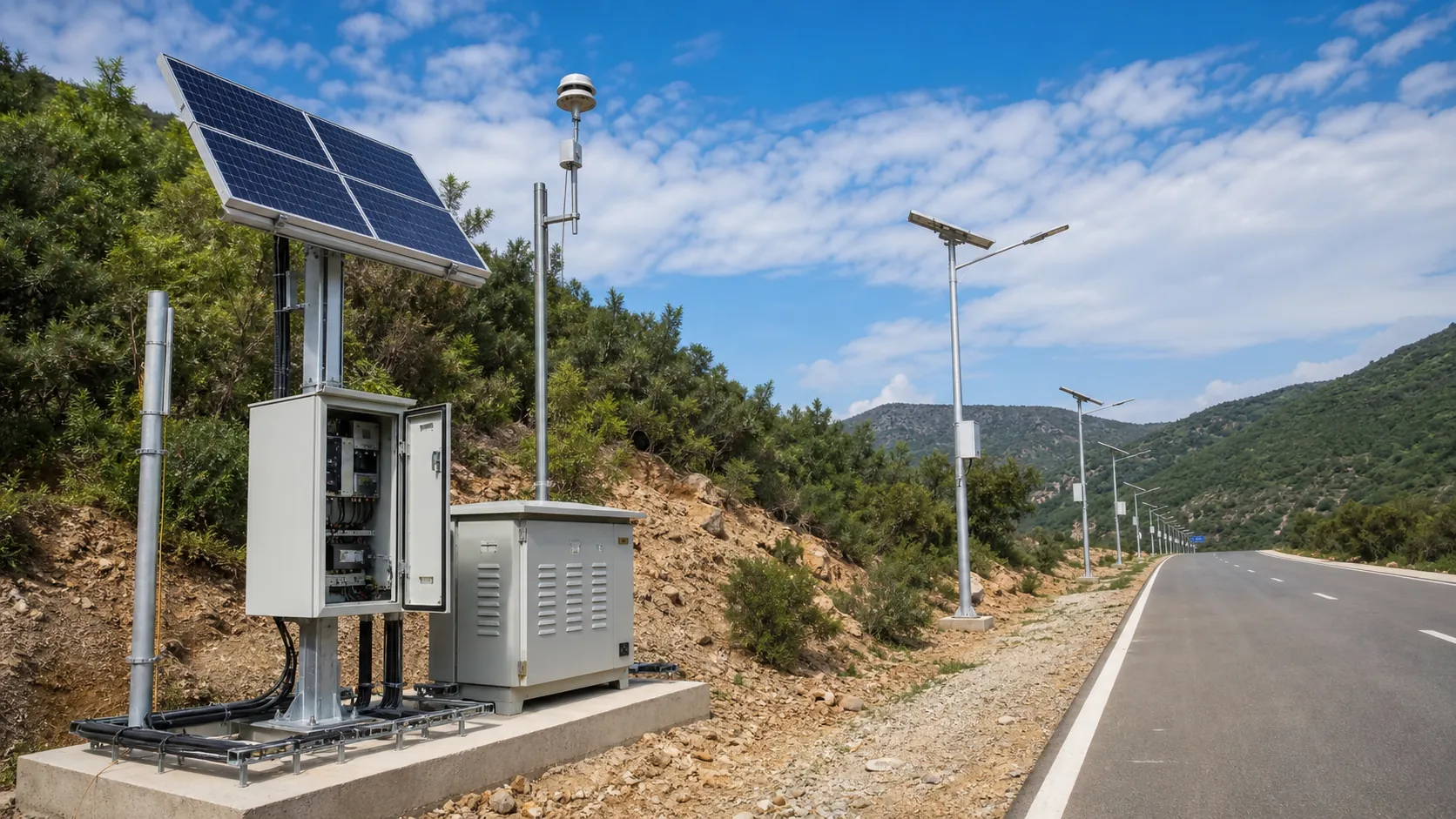
Ports and Logistics
Outdoor IoT infrastructure for ports, yards and logistics areas: lighting, guidance, safety, solar power, monitoring and maintenance visibility.
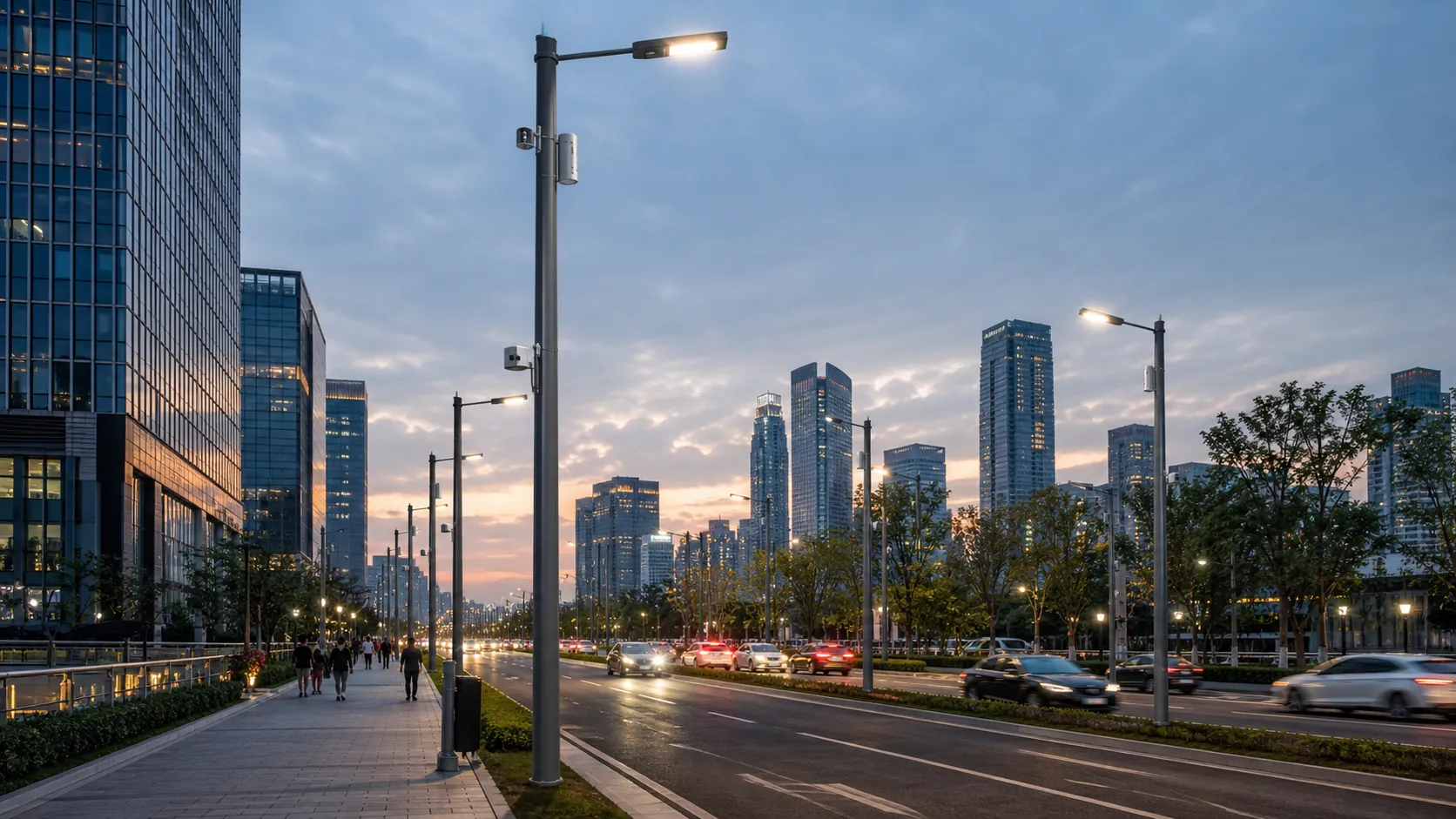
Smart Street Lighting
Plan an IoT street lighting system with LED luminaires, pole controllers, adaptive dimming, fault alarms, asset management and platform integration.
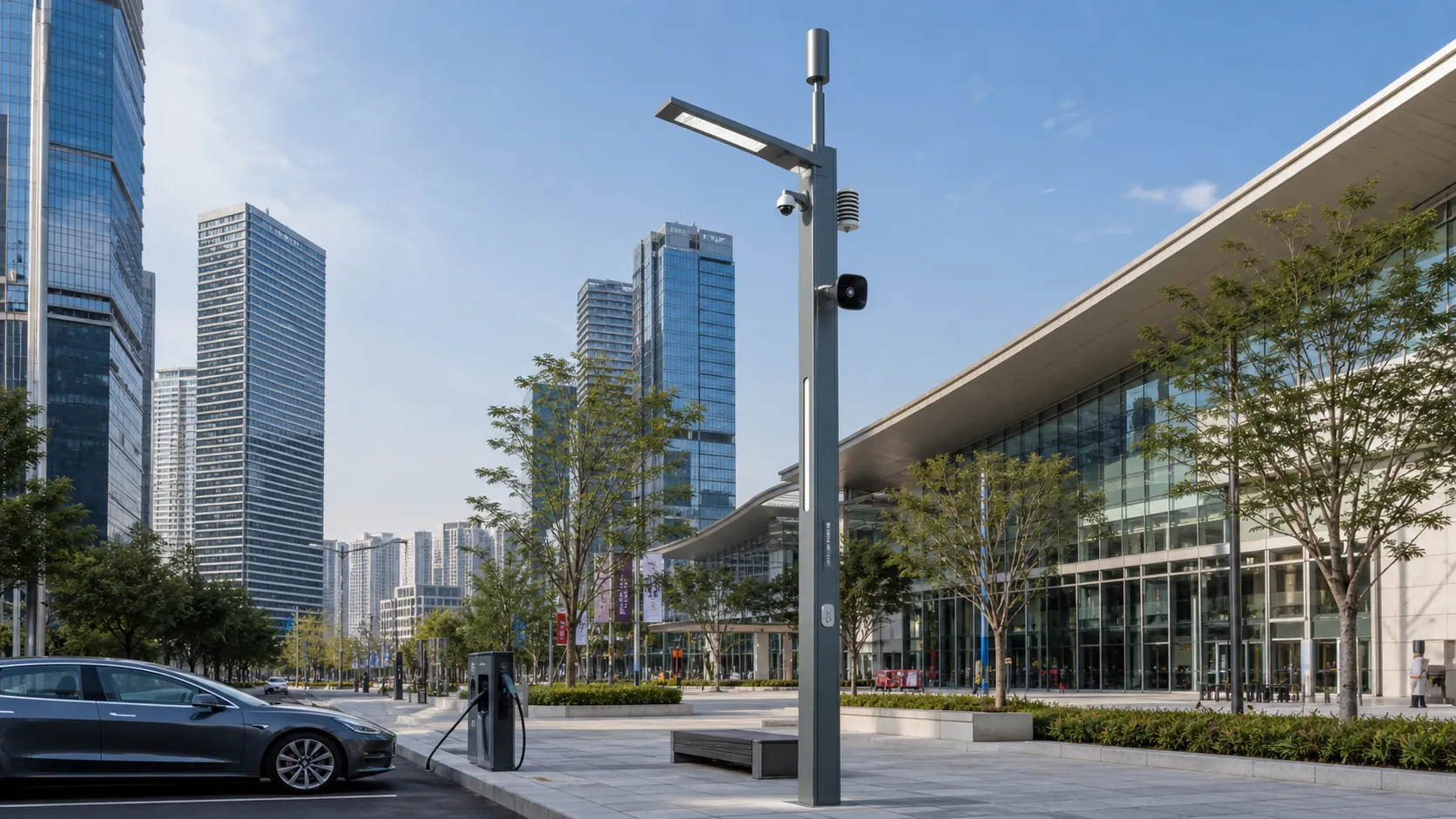
Campuses
Campus IoT for lighting, parking, safety, smart poles, environmental data and facility maintenance workflows.
Frequently Asked Questions
How large an area can one solar high-mast light cover?
It depends on mast height, head count and target lux. A typical 25 m mast with 4 x 150 W heads covers thousands of square meters at a 20-25 lux average, suitable for yards and storage blocks. REDCOAST.LTD sizes the configuration to your area and uniformity requirement.
Will the lights stay on during several cloudy or rainy days?
Yes. The LiFePO4 battery bank is sized for 3-5 days of rainy-day autonomy depending on your local solar insolation. Motion-adaptive dimming further stretches runtime by lowering output during idle hours.
Is this a true off-grid system or does it need mains power?
The standard RC-HM-600 is fully off-grid, powered by solar and LiFePO4 storage with no grid connection required. Grid-assist hybrid and wind-solar hybrid options are available for low-sun or critical sites.
Can I monitor and control the lights remotely?
Yes. Each pole connects via 4G/5G, NB-IoT or LoRa to the REDCOAST.LTD cloud CMS and mobile app, where you can set dimming schedules, view state of charge and energy yield, and receive fault alarms in real time.
What environments can it withstand?
Luminaires and enclosure are rated IP66 with IK09 impact resistance and operate from -30 to +60 °C. Build options cover coastal salt-fog, desert sand sealing and high-altitude sites, with masts rated for wind up to 150 km/h.
Does REDCOAST.LTD design its own hardware or integrate off-the-shelf parts?
REDCOAST.LTD delivers the lighting hardware, CMS platform and mobile app as one solution, and designs and manufactures its own MPPT power-management PCB and edge controller. This lets us customize optics, sensors, power sizing and reporting per project rather than relying on fixed vendor hardware.
How is the system maintained on tall masts?
An optional lowering head frame lets crews bring the luminaires to ground level for servicing without a crane, and over-the-air firmware updates plus remote diagnostics reduce site visits.
What certifications does the product support?
It is built toward CE and RoHS, with luminaires to IP66/IK09 and IEC 60598/61347 lighting standards, LiFePO4 to IEC 62619/UN 38.3, and solar modules to IEC 61215/61730. Project-specific certification packages are prepared as needed.