Overview
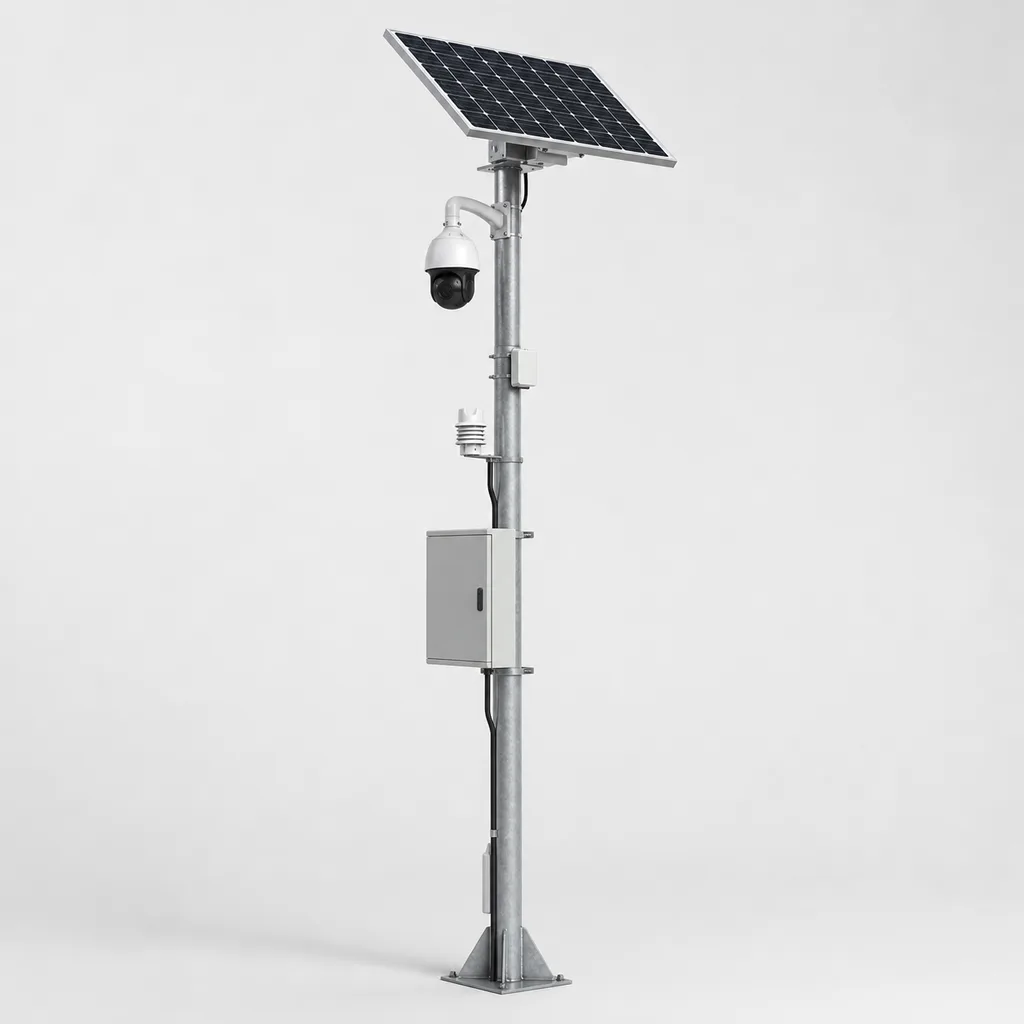
The Redcoast RC-SGS-300 is a fully self-powered, off-grid surveillance and telemetry station built for sites where neither mains power nor fixed networks reach: highway perimeters, pipelines, mines, ports, solar and wind farms, construction laydown yards, water and pump stations, border roads and remote agricultural land. It fuses a high-power solar generation set, a LiFePO4 battery bank, an HD PTZ/fixed AI camera, environmental and asset telemetry, and cellular/satellite backhaul into one pole-mounted unit. The pain it solves is simple but expensive to fix any other way — you need eyes and data at a location where trenching power and laying fibre would cost more than the asset being protected. The RC-SGS-300 drops in, powers itself from the sun, and pushes live video, alarms and sensor data to your control room or to the Redcoast cloud platform and mobile app.
Key Features
- True off-grid autonomy — sized for 3–7 days of cloudy-weather reserve so the station keeps recording and transmitting through poor solar yield, not just on sunny days.
- Redcoast custom power-management PCB — an in-house designed board integrating MPPT charging, battery management (BMS), load scheduling, low-voltage disconnect and remote power telemetry, tuned to the exact load profile of each project.
- Edge-AI camera — 4 MP / 8 MP (4K) PTZ or fixed bullet with on-device human/vehicle classification, line-crossing and intrusion detection to cut false alarms and cellular data cost.
- Multi-bearer backhaul — 4G LTE as standard, with 5G NR, NB-IoT for low-rate telemetry, LoRa for sensor mesh, and optional LEO satellite (e.g. Starlink) for zero-coverage sites.
- Edge storage + cloud — onboard SD up to 512 GB or an embedded NVR (1–4 TB) for local retention, with event clips and metadata synced to the cloud over the link.
- Integrated telemetry — optional air-quality, weather, water-level, vibration, door/tamper and energy-metering inputs turn the station into a combined security + environmental node.
- Remote management — firmware, configuration, power policy and recording schedules are all manageable over the air from the Redcoast Web platform and mobile app.
- Rapid deployment — pre-wired and factory-commissioned; a two-person crew can erect and bring a unit online in hours without civil power works.
Technical Architecture
The station is organised around three coordinated subsystems: generation/storage, compute/sensing, and communications. Solar panels feed the Redcoast power-management PCB, whose MPPT stage extracts 15–30% more energy than a basic PWM controller and charges a LiFePO4 bank through an integrated BMS that handles cell balancing, temperature compensation and protection. The same board exposes battery state-of-charge, panel yield, load current and door/tamper status as live telemetry, so operators see the energy health of every remote site, not just its video.
The compute layer is an edge controller/IoT gateway that runs the camera analytics, aggregates sensor inputs (Modbus/RS-485, dry contacts, analog and LoRa), and applies event logic locally. Because detection and classification happen at the edge, the link only carries verified events and requested live streams — critical when bandwidth is metered cellular or satellite. The controller also enforces an adaptive power policy: under low battery it can taper frame rate, dim IR, or drop the camera to a low-power patrol cadence while keeping telemetry alive, then restore full performance once charge recovers.
The communications layer selects the best available bearer and buffers data when the link is down, forwarding on reconnection so no events are lost. All three subsystems are designed and assembled by Redcoast around a project-specific PCB, which is how the station can be tuned to a 10 W telemetry-only load on one project and a 40 W PTZ-plus-5G load on the next without over- or under-sizing the solar and battery.
Connectivity & Power
Connectivity. 4G LTE Cat 4/Cat 6 is the default backhaul for most regions and balances cost with live-video capability. 5G NR suits high-resolution multi-camera or low-latency needs near coverage. NB-IoT and LoRa are used for low-power, long-range telemetry where only periodic sensor and status data is needed. For sites with no terrestrial coverage at all, a LEO satellite terminal provides backhaul — at higher power draw, which the solar set is sized to match. Dual-SIM failover and a local Wi-Fi maintenance hotspot are available.
Power. Monocrystalline panels of 150–400 W feed a LiFePO4 bank of 100–400 Ah (≈1.3–5 kWh) through a 20–40 A MPPT stage. A 150 W panel with a 100 Ah battery comfortably supports a ~10–15 W telemetry-and-low-duty-camera load with multi-day reserve; continuous 4K PTZ with edge AI and 5G (≈30–40 W, ~0.8–1.0 kWh/day) calls for a 300–400 W array and 200–300 Ah of storage. Grid or wind-solar hybrid input is available where partial power exists or where winter solar yield is marginal.
Protection & Reliability
The electronics enclosure is rated IP66 against dust and heavy rain, with the camera at IP66/IP67. The station operates from −30 °C to +60 °C; an optional battery heater extends cold-climate cranking, and ventilated/insulated cabinet options handle desert heat. Conformal-coated boards and a salt-mist-resistant, hot-dip galvanised or powder-coated pole suit coastal and industrial air. Poles are engineered for high wind loading (commonly up to ~150 km/h depending on height and panel area) with surge/lightning protection on power and signal lines. LiFePO4 chemistry delivers 3,000–6,000+ cycles (10+ year design life) with safe deep discharge, and the BMS guards against over-charge, over-discharge and thermal events. Tamper switches and an optional GPS/anti-theft beacon protect the asset itself.
Application Scenarios
- Highway and perimeter security — long unlit stretches of road, fence lines and right-of-way get continuous AI-verified intrusion monitoring without trenching power for kilometres.
- Critical infrastructure — pipelines, substations, water and pump stations gain combined security video plus operational telemetry (level, pressure, vibration, energy) from one self-powered node.
- Construction and laydown yards — temporary, relocatable surveillance for equipment and materials on sites that have no permanent power and move every few months.
- Ports, mines and logistics yards — wide-area asset oversight and tamper alarms in dusty, high-vibration environments where cabling is impractical.
- Renewable energy sites — solar and wind farms monitor their own perimeters and panel rows, with the station drawing from the same abundant sunlight.
- Remote environmental & agricultural monitoring — air-quality, weather and field conditions reported from locations far beyond the grid edge.
Case-style Examples
Off-grid highway corridor upgrade. A roads authority needed intrusion and incident monitoring along an unlit rural corridor with no power for tens of kilometres. Redcoast configured RC-SGS-300 units with 4K PTZ cameras, 300 W panels, 200 Ah LiFePO4 and 4G backhaul, set to edge-AI vehicle/person detection. The result was verified-event alerting to the control room with multi-day storm reserve and zero civil power works.
Off-grid pump-station telemetry & security. A remote water pump station required both CCTV and live operational data. The station combined a fixed AI camera, RS-485 metering of flow and tank level, and NB-IoT telemetry on a 150 W / 100 Ah set sized for a low continuous load — giving the operator one dashboard for both intrusion alarms and process data.
No-coverage mine perimeter. A mining client had no cellular coverage at the pit edge. Redcoast specified a satellite-backhauled variant with a 400 W array and 300 Ah bank to carry the higher terminal power, plus a cabinet heater for cold nights, delivering reliable remote oversight where no terrestrial link existed.
Customization & Selection Guide
Start from the load: telemetry-only or low-duty camera sites can use the 150 W / 100 Ah base set; continuous HD PTZ or multi-camera sites should step up to 300–400 W and 200–300 Ah. Choose backhaul by coverage and bandwidth need — NB-IoT/LoRa for data-only, 4G for most video, 5G for high-resolution or low-latency, satellite where there is no signal. Pick autonomy by climate: 3 days for sunny regions, 5–7 days for cloudy or high-latitude winters (or add wind-solar hybrid). Match enclosure and pole options to environment (coastal salt, desert heat, high wind). Redcoast finalises panel, battery, controller and pole sizing per project so the system is neither under-powered nor over-built.
Deployment & After-sales
Units ship pre-wired and factory-commissioned with a configuration matched to the agreed site profile. Mounting is a screw-pile, concrete base or existing-structure bracket; a small crew brings a station online without grid connection. Lead time is driven by camera, battery and backhaul selection and is confirmed per order. After-sales covers remote firmware and configuration updates over the air, energy and link health monitoring through the Redcoast platform, spare-parts supply, and engineering support; extended warranty and managed-monitoring options are available.
Standards & Compliance
Designed toward CE and RoHS, IP66/IP67 ingress protection, IK08+ impact options, IEC 62133 / UN38.3 for the LiFePO4 battery, IEC/EN surge-protection practice for outdoor power and signal lines, and regional cellular certifications (e.g. PTCRB/CE-RED) for the chosen modem. Exact certification scope is aligned to the destination market on a project basis.
Why Redcoast
Redcoast is not a box-assembler — we design and build our own boards. The RC-SGS-300's MPPT/BMS power-management PCB and edge IoT gateway are developed in-house and tuned to each project's real load, climate and backhaul, and paired with our own Web platform and mobile app. That software-plus-self-developed-hardware control is why we can right-size the solar and battery, add the exact sensor mix you need, and adapt the station per deployment rather than forcing your site to fit a fixed SKU.
Tell us your site's load, climate and coverage and we'll engineer a self-powered monitoring station around it — contact Redcoast for a tailored configuration and quote.
Specifications
Camera & Edge AI
- Resolution
- 4 MP / 8 MP (4K)
- Camera Type
- PTZ or Fixed Bullet
- IR Night Range
- up to 50-80 m
- Edge Analytics
- Human / Vehicle / Line-cross / Intrusion
- Optical Zoom (PTZ)
- up to 25x
- Edge Storage
- SD up to 512 / NVR 1-4 TB GB/TB
Solar & Power Management
- Solar Panel
- 150-400 W
- Battery
- LiFePO4 100-400 Ah
- Battery Energy
- 1.3-5.1 kWh
- System Voltage
- 12.8 / 25.6 V
- MPPT Controller
- 20-40 A
- Cloudy-day Autonomy
- 3-7 days
- Continuous Load Budget
- 8-40 W
Connectivity
- Cellular
- 4G LTE Cat4/Cat6, 5G NR (opt.)
- Low-power Telemetry
- NB-IoT, LoRa
- Satellite Backhaul
- LEO (optional)
- SIM
- Dual-SIM failover
- Local Maintenance
- Wi-Fi hotspot
Sensors & I/O
- Sensor Interfaces
- RS-485 (Modbus), Dry Contact, Analog
- Environmental
- Air quality / Weather (opt.)
- Asset Telemetry
- Level / Pressure / Vibration / Energy (opt.)
- Security I/O
- Tamper, Door, GPS beacon (opt.)
Enclosure & Structure
- Enclosure Rating
- IP66
- Camera Rating
- IP66 / IP67
- Pole Height
- 4-8 m
- Pole Finish
- Hot-dip galvanised / Powder-coated
- Wind Rating
- up to 150 km/h
- Surge Protection
- Power + Signal lines
Environment & Reliability
- Operating Temp
- -30 to +60 ℃
- Battery Cycle Life
- 3000-6000+ cycles
- Design Life
- 10+ years
- Coating
- Conformal-coated PCB, salt-mist resistant
Capabilities — configurable per project
Specifications are tailored to each project — the options below show what we can support.
Power Source
- Solar off-grid
- Wind-solar hybrid
- Grid + solar backup
Backhaul
- 4G LTE
- 5G NR
- NB-IoT / LoRa
- LEO satellite
Camera
- 4 MP fixed bullet
- 8 MP (4K) fixed
- PTZ with optical zoom
- Dual-sensor + thermal
Autonomy / Climate
- 3-day (sunny)
- 5-day
- 7-day (cloudy/winter)
Telemetry Add-ons
- Air quality / weather
- Water level / pressure
- Vibration / tilt
- Energy metering
Related solution guidance
Environmental Monitoring
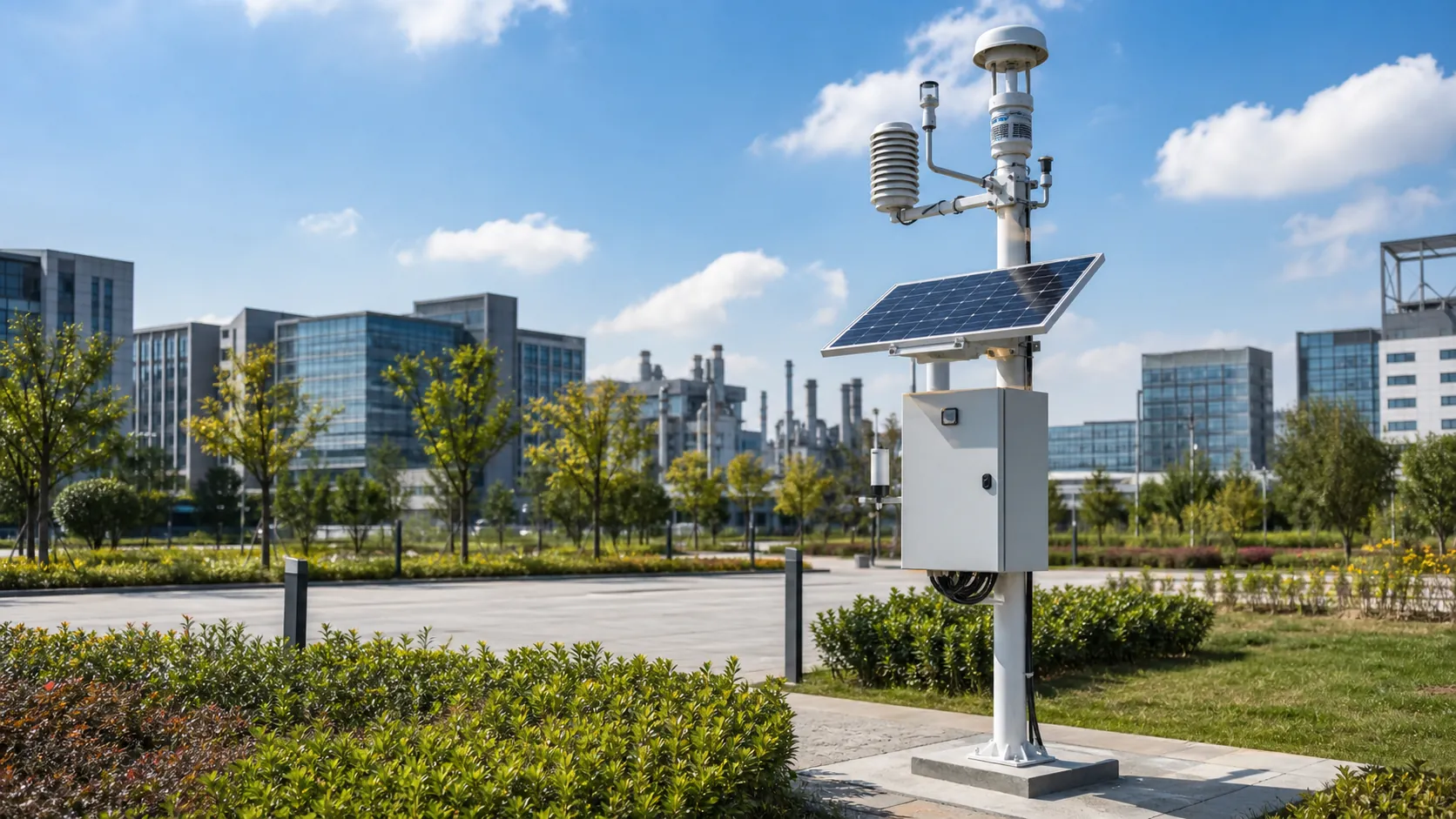
Deploy environmental monitoring stations with sensors, solar power, gateways, dashboards, alarms and data integration for city and industrial sites.
Campuses
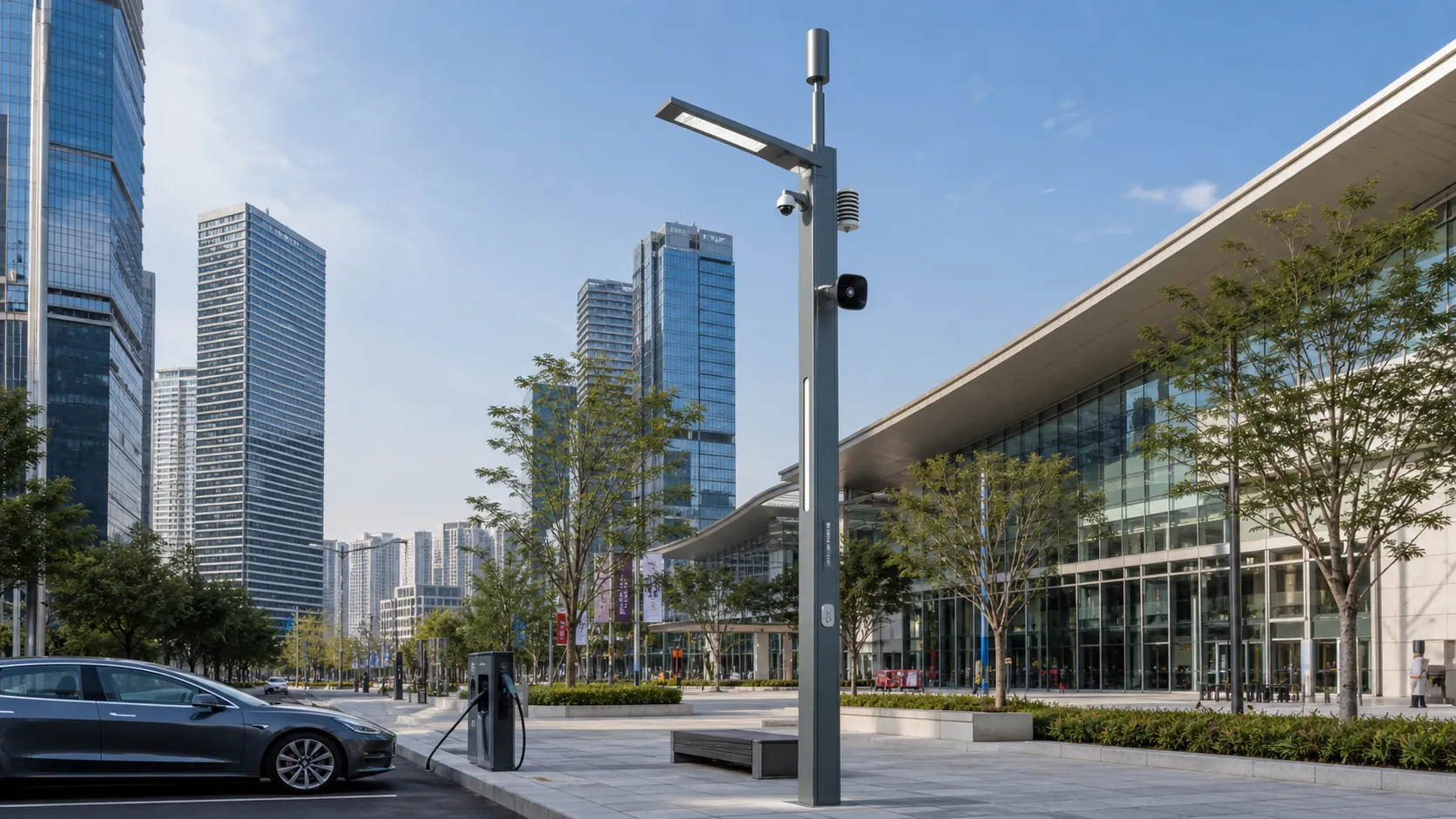
Campus IoT for lighting, parking, safety, smart poles, environmental data and facility maintenance workflows.
Ports and Logistics
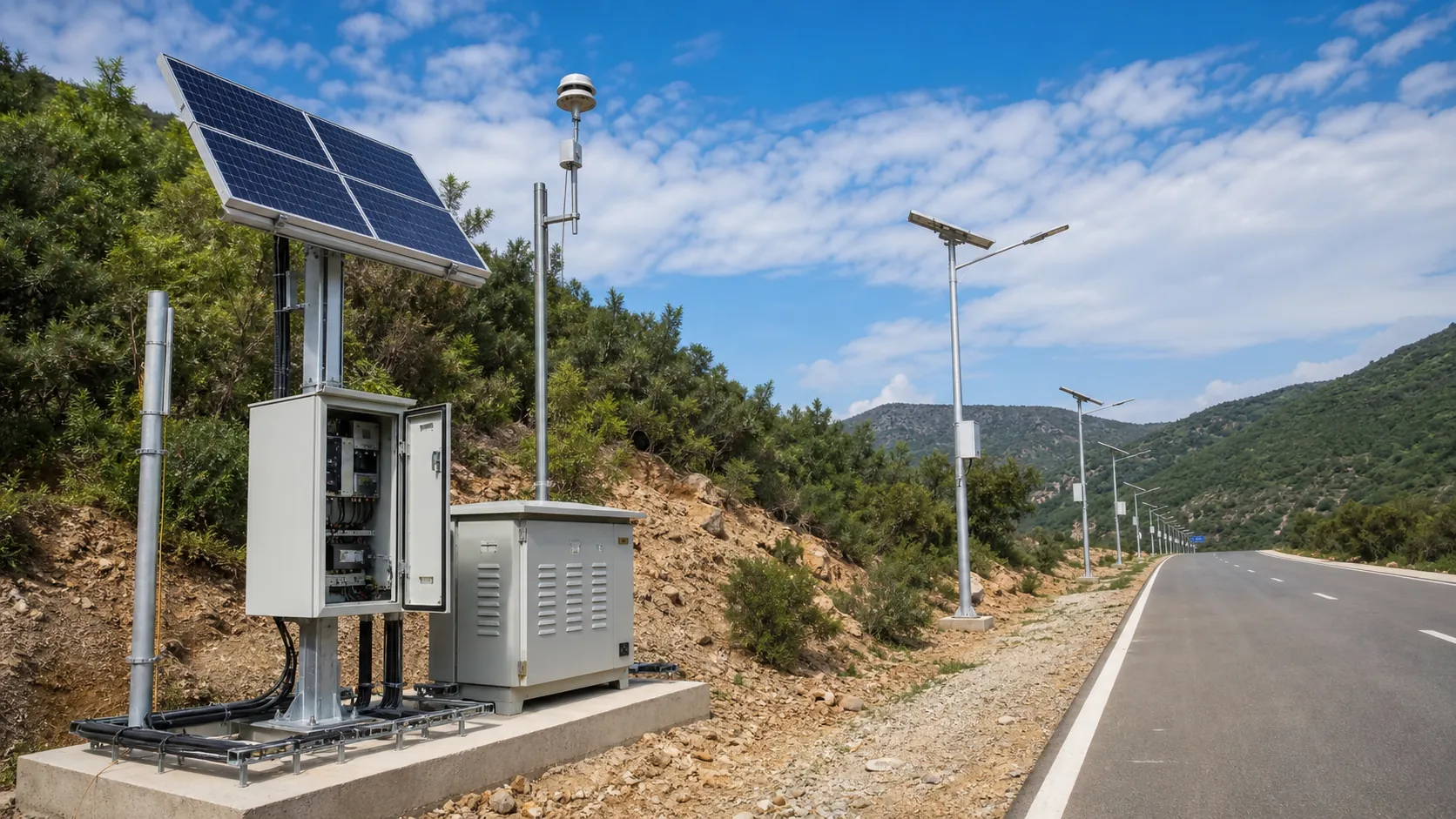
Outdoor IoT infrastructure for ports, yards and logistics areas: lighting, guidance, safety, solar power, monitoring and maintenance visibility.
Frequently Asked Questions
How does an off-grid solar surveillance station work without mains power or fixed internet?
Solar panels charge a LiFePO4 battery through an MPPT power-management board, which runs the camera, sensors and modem. The station transmits live video, alarms and telemetry over 4G/5G, NB-IoT/LoRa, or satellite, so it needs neither grid power nor a wired network.
How many cloudy days can the RC-SGS-300 keep running?
It is sized for 3 to 7 days of autonomy depending on configuration and climate. Sunny regions typically use 3-day reserve, while cloudy or high-latitude winter sites use 5-7 days, optionally with a wind-solar hybrid input.
What solar panel and battery size do I need for a 24/7 camera?
A continuous HD PTZ with edge AI and cellular draws roughly 30-40 W (about 0.8-1.0 kWh/day), which suits a 300-400 W panel and 200-300 Ah LiFePO4 bank. Telemetry-only or low-duty camera sites can run on a 150 W panel and 100 Ah battery.
Can it work where there is no cellular coverage at all?
Yes. A LEO satellite backhaul option (e.g. Starlink) provides connectivity at no-coverage sites. The satellite terminal draws more power, so REDCOAST.LTD sizes the solar array and battery accordingly.
Does REDCOAST.LTD make the hardware or just assemble off-the-shelf parts?
REDCOAST.LTD delivers the station as one integrated solution — hardware, Web platform and mobile app from one team. The MPPT/BMS power-management PCB and edge IoT gateway are developed in-house and tuned to each project's load, climate and backhaul.
What environments can the station survive?
The enclosure is IP66 and the camera IP66/IP67, with operation from -30 to +60 °C. Conformal-coated boards, salt-mist-resistant galvanised poles, surge protection and high wind ratings make it suitable for coastal, desert, mining and high-wind sites.
Can it monitor more than just video?
Yes. Optional RS-485/Modbus, dry-contact and analog inputs add environmental (air quality, weather) and asset telemetry (level, pressure, vibration, energy), turning the station into a combined security and operational monitoring node.
How is it deployed and managed after installation?
Units ship pre-wired and factory-commissioned and mount on a screw-pile, concrete base or existing structure without grid works. Firmware, power policy and recording schedules are managed over the air, and energy and link health are monitored from the REDCOAST.LTD platform.