Overview
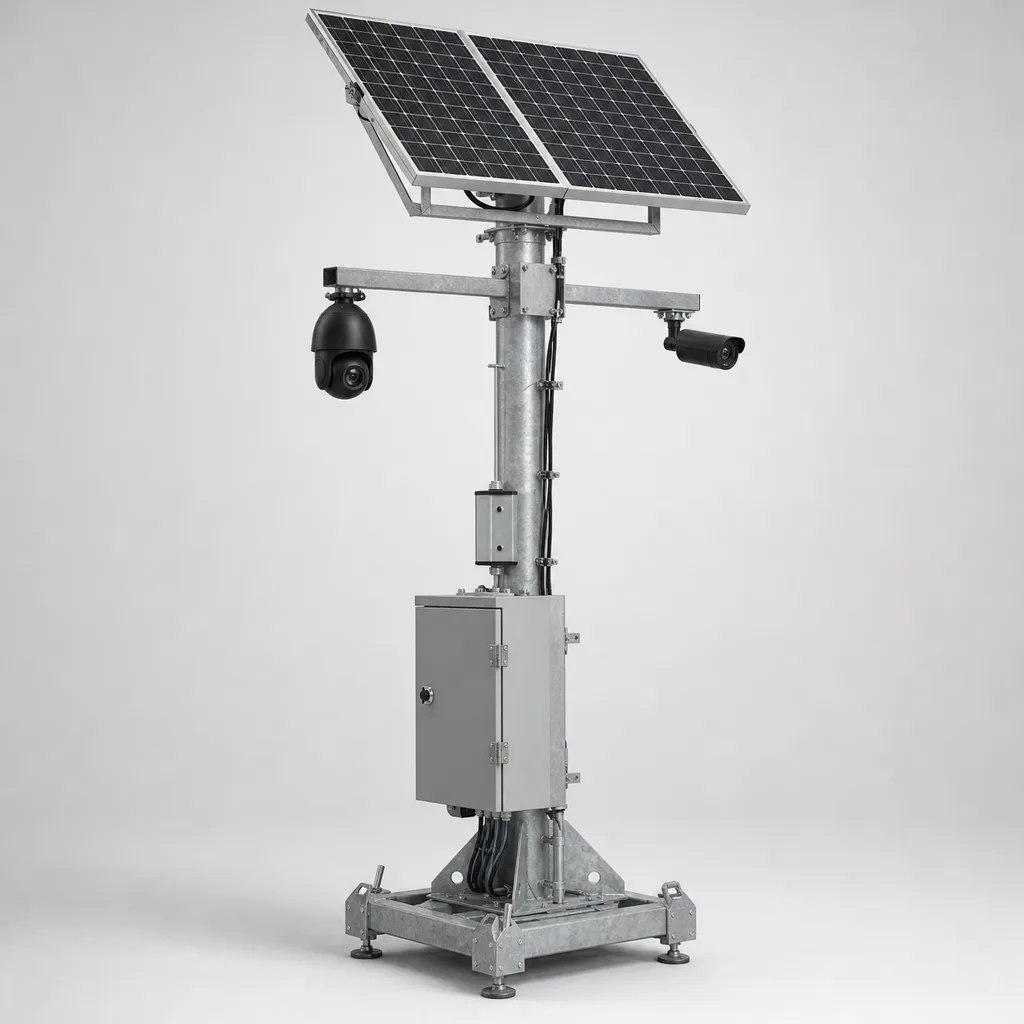
The Redcoast RC-SCT-300 Off-Grid Solar-Powered AI Surveillance Tower is a fully self-contained video monitoring station for locations that have neither reliable grid power nor fixed network cabling. It combines a high-resolution day/night camera payload, an on-board edge-AI gateway, a Redcoast-designed solar power-management PCB, LiFePO4 energy storage and multi-carrier cellular backhaul on a single galvanized pole or telescopic mast. Built for governments, industrial parks, system integrators and infrastructure operators, it solves the core pain of remote-site security: how to watch a perimeter, a construction lay-down yard, a substation, a border road or a pipeline corridor when there is no power socket within kilometres. Because Redcoast develops its own boards and platform software in-house, the tower is delivered as a tuned hardware-plus-software system rather than a bag of third-party parts bolted together.
Key Features
- True off-grid autonomy — solar array plus LiFePO4 storage sized for 5–7 days of operation through cloudy weather, with no mains connection required.
- Redcoast-designed power-management PCB — MPPT solar charging, battery protection, load scheduling and remote power telemetry on a single custom board, optimised for surveillance duty cycles.
- Edge-AI gateway — on-board human/vehicle classification and intrusion-line detection that filters false alarms (wind, animals, shadows) before they ever consume cellular bandwidth.
- Multi-carrier 4G/5G backhaul — dual-SIM with automatic carrier failover; optional LoRa/NB-IoT for low-bandwidth status telemetry.
- Bandwidth-aware recording — local NVR storage with event-triggered upload, so footage is preserved even during network outages.
- Flexible payloads — fixed 4K bullet, PTZ with optical zoom, or thermal/visible bi-spectrum camera options.
- Rapid deployment — fixed 6 m pole, 9 m mast or telescopic/trailer variants for temporary sites.
- IP66 outdoor enclosure with anti-corrosion coating for coastal, desert and high-humidity environments.
- Remote management via Redcoast web platform and mobile app: live view, PTZ control, power status, geofencing and OTA updates.
- Tamper and theft protection — door sensors, accelerometer-based tilt/impact alarms and GPS tracking.
Technical Architecture
The system is organised around three Redcoast-built subsystems working together. First, the power subsystem: a monocrystalline solar array feeds the custom power-management PCB, which performs MPPT charge control, multi-stage LiFePO4 protection (over-charge, over-discharge, over-current, temperature cut-off) and intelligent load shedding. During prolonged low-sun periods the board can throttle non-critical loads (for example reducing PTZ patrols or frame rate) to protect camera uptime, and it reports state-of-charge, panel voltage and load current back to the platform.
Second, the edge-AI gateway ingests the camera RTSP streams, runs object detection and classification locally, and writes continuous or event-based recordings to local storage. By making the decision "is this a person/vehicle crossing the line?" at the edge, the tower transmits only meaningful clips and metadata, which is essential when the only link is metered cellular. Third, the connectivity subsystem manages dual-SIM cellular with automatic failover, optional Ethernet/PoE for adding cameras, and a low-power telemetry channel for health data. Data flow is therefore split: heavy video stays local and is pulled on demand, while lightweight events and device health stream continuously to the cloud. This edge/cloud split is what keeps an off-grid tower both responsive and power-frugal.
Connectivity & Power
For connectivity, the standard configuration is dual-SIM 4G LTE with 5G as an option for high-resolution multi-camera sites; carriers fail over automatically so a single network outage does not blind the site. LoRa or NB-IoT can be added purely for status telemetry where video backhaul is handled separately or stored locally. For power, the array is typically 120–600 W of monocrystalline panels paired with 100–600 Ah of LiFePO4 storage, sized against local irradiance and the chosen camera payload. Grid-tie and wind-solar hybrid inputs are available where partial infrastructure exists, giving a redundant supply for mission-critical perimeters.
Protection & Reliability
The electronics enclosure is rated IP66 against dust and heavy rain, with conformal-coated boards and an anti-corrosion finish suitable for salt-fog coastal sites. The tower operates from -30 °C to +60 °C and is engineered for wind loading appropriate to its mast height, with foundation and guy-wire options for high-wind zones. LiFePO4 chemistry is chosen for its wide temperature tolerance and long cycle life (2000+ cycles), which keeps battery replacement intervals long in hard-to-reach locations. Tamper sensors, tilt/impact detection and GPS tracking protect the asset itself, while OTA firmware keeps the AI models and security patches current without a site visit.
Application Scenarios
- Remote perimeter and border roads — autonomous towers watch long, unpowered boundaries and stream intrusion events back to a control room, where running cable or grid power is impractical.
- Construction and infrastructure sites — temporary trailer/telescopic towers protect plant, fuel and materials at lay-down yards during the build phase, then relocate.
- Electrical substations and utility assets — fixed towers monitor unmanned substations, water-treatment sites and pumping stations for intrusion and equipment tampering.
- Pipeline, rail and corridor monitoring — a chain of towers covers linear assets across terrain with no fixed network.
- Quarries, mines and laydown logistics — dust-tolerant towers oversee access roads and weighbridges in harsh, dusty conditions.
- Smart parks and campus perimeters — towers extend surveillance to car parks, back fences and outer zones beyond the reach of building wiring.
Case-style Examples
Remote substation perimeter (off-grid fixed deployment): an operator needed intrusion detection at a cluster of unmanned substations with no spare grid capacity for cameras. A 9 m mast configuration with a 4K PTZ payload, 400 W array and 300 Ah LiFePO4 bank delivered round-the-clock coverage; edge-AI line-crossing detection cut nuisance alerts so the control room only handled genuine events.
Construction laydown yard (temporary relocatable deployment): a contractor protecting fuel and plant on a multi-phase project used telescopic trailer towers that could be towed between active zones. Dual-SIM 4G with local NVR storage meant theft-attempt footage was retained even when one carrier dropped, and the units were redeployed three times across the project life.
Coastal port boundary (harsh-environment deployment): for a salt-fog quayside perimeter, conformal-coated boards, an IP66 enclosure and anti-corrosion mast finish were specified, with bi-spectrum thermal/visible cameras to maintain detection through sea haze and at night.
Customization & Selection Guide
Start with the payload: fixed 4K bullet for static choke points and lowest power; PTZ with optical zoom for wide-area patrol; bi-spectrum thermal for low-visibility or long-range detection. Next size power against local sun-hours and desired autonomy — budget-led sites take 120–200 W panels with 100–200 Ah storage, while mission-critical perimeters take 400–600 W with 400–600 Ah plus hybrid input. Choose the mast: 6 m pole for parks/campuses, 9 m for wide perimeters, telescopic/trailer for temporary or relocatable use. Finally pick backhaul: dual-SIM 4G is the default; add 5G for multi-camera high-resolution sites and LoRa/NB-IoT where only telemetry is needed. Redcoast tunes board firmware and power scheduling to the final configuration.
Deployment & After-sales
Fixed towers install on a concrete foundation or ground screws; telescopic/trailer variants are tow-and-deploy with no civil works. Each tower ships pre-integrated, commissioned and provisioned to the Redcoast platform so it connects on power-up. Delivery timelines scale with customisation depth — standard configurations ship faster, while bespoke PCB or payload changes add board/firmware lead time, all confirmed per project. After-sales covers a hardware warranty, OTA firmware and AI-model updates, remote diagnostics through the platform, and spare-parts support.
Standards & Compliance
Designed toward CE and RoHS conformity, IP66 ingress protection, IK-rated impact resistance on the enclosure, and IEC-aligned practice for the solar charging and LiFePO4 battery management. Camera and cellular modules are selected to meet regional radio and EMC requirements for the destination market.
Why Redcoast
Redcoast designs the power-management PCB, integrates the edge-AI gateway and develops the web and mobile management platform in-house. That means power scheduling, AI tuning, telemetry and the user app are engineered as one system — and the board can be re-spun for unusual payloads, voltages or sensor mixes. We are a custom hardware developer, not a reseller of off-the-shelf kits, which lets us match the tower to your exact site, climate and network reality.
Contact Redcoast to specify your site conditions, payload and autonomy targets, and we will configure — or custom-develop — an off-grid surveillance tower for your project.
Specifications
Camera & Imaging
- Resolution
- 2MP / 4MP / 8MP (4K)
- Payload Type
- Fixed bullet / PTZ / bi-spectrum thermal
- Optical Zoom (PTZ)
- up to 25x
- Night Vision
- IR / color / starlight
- IR Range
- up to 100 m
- Cameras per Tower
- 1-4
Edge AI & Recording
- AI Functions
- Human/vehicle classification, line-crossing, intrusion zone
- Local Storage
- 256 GB - 4 TB (SD/SSD/HDD)
- Recording Mode
- Continuous / event-triggered
- False-alarm Filtering
- edge pre-filter before upload
Power System
- Solar Panel
- 120-600 W
- Battery
- LiFePO4 100-600 Ah
- Charge Control
- MPPT (Redcoast PCB)
- Autonomy (no sun)
- 5-7 days
- Battery Cycle Life
- >2000 cycles
- Power Inputs
- Solar / grid-tie / wind-solar hybrid
Connectivity
- Cellular
- Dual-SIM 4G LTE / optional 5G
- Carrier Failover
- automatic
- Telemetry (optional)
- LoRa / NB-IoT
- Local Network
- Ethernet / PoE
Mast & Structure
- Mast Type
- Fixed pole / telescopic / trailer
- Height Options
- 6 / 9 / 12 m
- Material
- Hot-dip galvanized steel
- Mounting
- Foundation / ground-screw / towable
Protection & Environment
- Ingress Protection
- IP66
- Impact Rating
- IK10
- Operating Temp
- -30 to +60 ℃
- Anti-corrosion
- conformal-coated PCB + salt-fog finish
- Security
- tamper / tilt / GPS tracking
Management & Software
- Platform
- Redcoast Web + mobile app
- Functions
- live view, PTZ, power status, geofence, OTA
- Power Telemetry
- SoC, panel V, load current
- Firmware Update
- OTA
Capabilities — configurable per project
Specifications are tailored to each project — the options below show what we can support.
Camera Payload
- Fixed 4K bullet
- PTZ optical zoom
- Bi-spectrum thermal/visible
Power
- Solar off-grid
- Grid-tie hybrid
- Wind-solar hybrid
Connectivity
- Dual-SIM 4G
- 5G
- LoRa/NB-IoT telemetry
Mast
- 6 m fixed pole
- 9 m mast
- 12 m mast
- Telescopic trailer
Deployment Environment
- Coastal/salt-fog
- Desert/high-dust
- High-altitude/cold
Related solution guidance
Solar IoT Guide
A design guide for solar-powered outdoor IoT: load calculation, battery autonomy, low-power firmware, telemetry and maintenance planning.
Power and Connectivity
How to choose power, battery, solar, NB-IoT, LTE, LoRaWAN, gateways and monitoring strategy for outdoor IoT infrastructure.
Solar Off-Grid IoT
Design solar-powered outdoor IoT systems with panels, batteries, controllers, low-power devices, gateways and remote power monitoring.
Frequently Asked Questions
How does an off-grid solar surveillance tower work without grid power?
A monocrystalline solar array charges a LiFePO4 battery bank through a power-management board, which runs the camera, edge-AI gateway and cellular link entirely on stored solar energy. REDCOAST.LTD sizes the array and battery for 5–7 days of autonomy through cloudy weather, so the tower keeps recording even without sun.
What network does the tower use if there is no internet at the site?
It uses dual-SIM 4G LTE cellular backhaul, with 5G as an option, and automatically fails over between carriers to stay online. Video is stored locally and events are pushed over cellular, with optional LoRa/NB-IoT for low-bandwidth status telemetry.
Does it record continuously, and is footage lost during a network outage?
Yes, it records to local NVR storage (256 GB–4 TB) either continuously or on AI-triggered events. Because footage is held on the tower, recordings are preserved during a cellular outage and can be uploaded once the link recovers.
How does the edge-AI reduce false alarms?
The on-board AI classifies humans and vehicles and applies line-crossing and intrusion-zone rules at the edge, so wind, animals and shadows are filtered out before any alert is sent. This both cuts nuisance alarms and saves cellular bandwidth and power.
Can it survive harsh coastal, desert or high-altitude conditions?
Yes. The enclosure is rated IP66 with conformal-coated boards and an anti-corrosion finish for salt-fog and dust, and it operates from -30 °C to +60 °C. LiFePO4 chemistry tolerates wide temperatures and lasts 2000+ cycles for long maintenance intervals.
Is the tower fixed or can it be relocated?
Both. Fixed 6/9/12 m poles install on a foundation or ground screws for permanent sites, while telescopic and trailer variants are towable and need no civil works, making them ideal for construction and temporary deployments.
Does REDCOAST.LTD build the hardware or just assemble third-party parts?
REDCOAST.LTD delivers the tower as an end-to-end solution: it designs its own power-management PCB, integrates the edge-AI gateway, and develops the web and mobile platform in-house. The board and configuration can be customised for unusual payloads, voltages or sensors, so the tower is tuned to your site rather than a generic kit.
What management features does the platform provide?
The REDCOAST.LTD web platform and mobile app give live view, PTZ control, AI event alerts, battery state-of-charge and power telemetry, geofencing, tamper/GPS tracking and OTA firmware and AI-model updates — all remotely without a site visit.