Overview
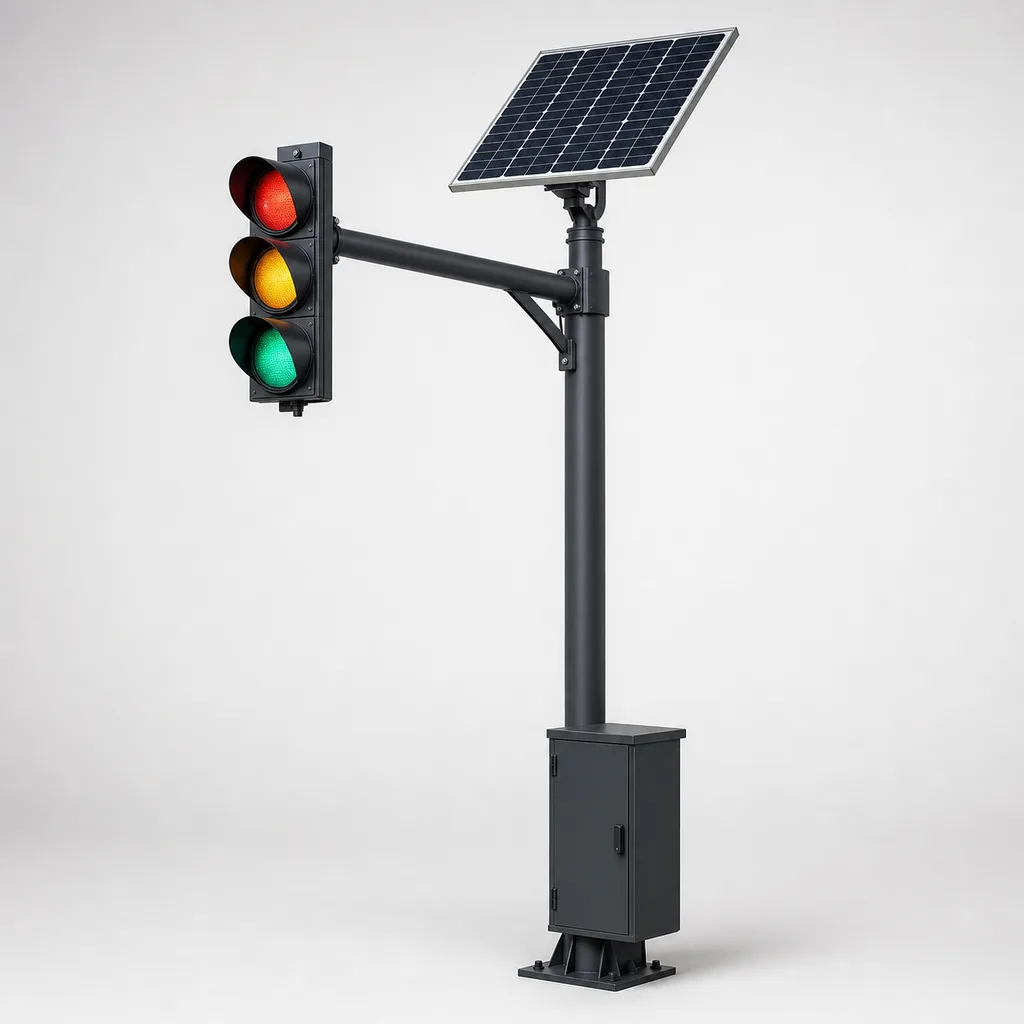
The Redcoast RC-TS-300 Off-Grid Solar Smart Traffic Signal System is a fully self-powered signalized-intersection solution engineered for sites where running grid power and trenching cable is slow, expensive, or simply impossible. It is built for remote rural junctions, fast-growing peri-urban roads, temporary work zones, and any location where the grid is unreliable or unavailable. Each approach is controlled by high-intensity LED signal heads driven by Redcoast's own signal-driver electronics, powered by a monocrystalline solar array and a LiFePO4 battery bank, and supervised by an in-house Malfunction Management Unit (conflict monitor) that keeps the intersection fail-safe at all times. The result is a turnkey signalized intersection that installs in a day, runs for years without a power bill, and can be monitored and re-timed remotely.
Key Features
- 100% off-grid operation — solar + LiFePO4 storage delivers 5–7 days of autonomy with zero grid connection and zero trenching.
- Redcoast self-developed signal-driver PCB — constant-current LED drive holds signal intensity stable across the full 18–32 V battery range, so red/amber/green never dim as the battery discharges.
- Built-in conflict monitor (MMU) — independent hardware watchdog detects conflicting greens, dark-signal and voltage faults and forces the intersection to flashing-red/all-red fail-safe.
- Multiple control modes — fixed-time, vehicle-actuated (radar/microwave detection), pedestrian push-button with countdown, GPS-synchronized coordination, and low-power overnight flashing mode.
- Remote management — 4G/5G, NB-IoT or LoRa link reports battery state, lamp faults and signal status, and allows remote timing-plan changes and firmware updates.
- High-efficiency LED signal heads — 200/300/400 mm aspects to EN 12368 / ITE photometric classes, visible in direct sunlight, with optional anti-phantom louvers.
- Permanent or portable — fixed mast-arm/pole configurations for junctions, or trailer/skid-mounted heads for work-zone and event traffic control.
- Powder-coated steel structures — hot-dip galvanized then powder-coated poles and cabinets for long outdoor life in coastal, desert and high-humidity climates.
Technical Architecture
The system is organized around three Redcoast-designed hardware blocks. First, the MPPT solar power-management board harvests energy from the monocrystalline array, charges the LiFePO4 bank with temperature-compensated multi-stage charging, and provides regulated 24 V to the controller and signal heads. Second, the multi-channel LED signal-driver board delivers stable constant-current outputs to each aspect; because intensity is regulated rather than voltage-driven, the signals stay at rated brightness whether the battery is full or near its cutoff. Third, the signal controller with integrated Malfunction Management Unit runs the timing logic and continuously cross-checks every channel: if it ever detects conflicting green/green or yellow/green combinations, an absent (dark) display, a clearance-interval fault or an out-of-range supply, it immediately drops the intersection to a safe flashing-red or all-red state and raises a remote alarm.
Data flows from on-site sensors (radar vehicle detectors, pedestrian push-buttons, door and tilt sensors) into the controller, which executes the active timing plan locally — the intersection never depends on the cloud to run. A communications gateway then pushes status and telemetry to Redcoast's management platform, where operators see live signal state, battery health, solar yield and fault history, and can deploy new timing plans or coordinate GPS time across adjacent intersections. This edge-first, cloud-supervised design means safety-critical control is autonomous while management stays centralized.
Connectivity & Power
For connectivity, 4G/5G suits sites with cellular coverage and frequent remote re-timing; NB-IoT fits low-bandwidth, battery-frugal telemetry over wide areas; and LoRa links clusters of nearby intersections or detectors where no public network exists. GPS is used for accurate time-of-day plan switching and for coordinating signal offsets along a corridor.
For power, the standard configuration pairs a 200–600 W monocrystalline array with a 24 V LiFePO4 bank sized for 5–7 days of autonomy at the site's latitude and traffic profile. Grid-tie and wind-solar hybrid options are available for high-load four-way intersections or extreme-shade locations. All power electronics are derated for continuous outdoor duty and protected against reverse polarity, over-current, over-discharge and lightning surges.
Protection & Reliability
Signal heads are rated IP65 and the control/battery cabinet IP66, with stainless hardware and UV-stable gaskets. The system operates from -30 to +60 °C and is specified for salt-fog (coastal), dust/sand (desert) and high-humidity environments. Poles and mast arms are wind-rated to the project's design wind speed. LED modules carry a long service life (L70 > 50,000 h) and LiFePO4 cells deliver 3,000+ cycles; surge protection and the hardware conflict monitor together protect both equipment and road users. Typical hardware warranty is 2–5 years depending on configuration.
Application Scenarios
- Remote rural intersections — bring signalized control to junctions far from the grid, eliminating the cost and delay of power-line extension.
- Road-work and construction zones — portable solar signal heads provide temporary alternating one-way control on resurfacing or bridge projects, redeployable in hours.
- Peri-urban growth corridors — newly developed roads get signals before grid infrastructure catches up, with remote re-timing as traffic grows.
- Grid-unstable regions — intersections stay lit and safe through outages and brownouts that would dark a grid-fed signal.
- School and pedestrian crossings — push-button actuation with pedestrian countdown improves safety at standalone crossings.
- Border posts, mines and industrial estates — private-road signalized control where utility connection is impractical.
Case-style Examples
Remote highway junction upgrade: A four-leg junction on a long rural highway needed signalization but lay 3 km from the nearest feeder. An RC-TS-300 with 400 W arrays per approach, 24 V/200 Ah LiFePO4 banks and radar actuation was installed in two days. Vehicle-actuated timing minimizes delay on the minor road, and 4G telemetry lets the authority adjust plans seasonally without a site visit.
Work-zone alternating traffic control: A bridge-deck repair required single-lane shuttle control for six weeks. Two trailer-mounted solar signal heads with LoRa link between them maintained synchronized red/green alternation, ran entirely off-grid, and were relocated as the work front advanced.
Grid-unreliable town intersection: A town center signal suffered daily brownouts. A solar-plus-grid-tie RC-TS-300 kept the intersection fully signalized during outages and switched to flashing-red fail-safe only on genuine faults, sharply reducing dark-signal incidents.
Customization & Selection Guide
Start from the number of approaches and aspects: a simple two-way work-zone setup needs only two 3-aspect heads and small arrays, while a busy four-way junction with pedestrian phases needs larger storage and a higher-channel controller. Choose signal-head size (200 mm for low-speed/urban, 300/400 mm for high-speed approaches) per local standard and approach speed. Size the solar array and LiFePO4 bank to the worst-month solar resource and desired autonomy (5–7 days standard, more for cloudy climates). Select detection (radar/microwave for actuation, push-buttons for pedestrians) and connectivity (4G/5G for active management, NB-IoT for low-touch telemetry, LoRa for off-network clusters). Specify pole/mast-arm geometry and powder-coat color to match local conventions.
Deployment & After-sales
Systems ship as pre-wired, pre-commissioned assemblies to minimize on-site labor; foundation, pole erection and head alignment typically complete within a day per intersection. Redcoast provides timing-plan setup, remote-platform onboarding, operator training, and ongoing technical support. Lead time is project-dependent and confirmed at quotation; spares kits and extended-warranty options are available.
Standards & Compliance
Signal heads are designed to EN 12368 / ITE photometric requirements; controller functional safety follows EN 12675 principles; remote management aligns with NTCIP-style object models; structures, EMC and materials follow CE, RoHS, IEC and relevant IP-rating standards. Local conformity (e.g. MUTCD, EN, GCC or national codes) is configured per project so the system fits the destination market's rules.
Why Redcoast
Redcoast designs its own boards — signal driver, conflict-monitor controller and MPPT power management are developed in-house, not bought off the shelf. That means we can open a new PCB for a project's exact channel count, detection mix, voltage and connectivity, and deliver the software platform and mobile app as one integrated package. Hardware and software from one team, tuned to your intersection and your local standards.
Talk to Redcoast about a custom off-grid solar traffic signal configuration for your roads — tell us your approaches, traffic and climate, and we will engineer the boards and the system around them.
Specifications
Signal Heads
- Aspect Diameter
- 200 / 300 / 400 mm
- Aspects per Head
- 3 (R/A/G), 4-5 optional
- LED Power per Aspect
- 5-15 W
- Photometric Standard
- EN 12368 / ITE
- Intensity Auto-dimming
- Day/Night
- LED Lifetime (L70)
- >50,000 h
Control
- Control Modes
- Fixed-time / Actuated / Coordinated / Flashing
- Conflict Monitor (MMU)
- Integrated hardware watchdog
- Fail-safe State
- Flashing-red / All-red
- Phases
- 2-8
- Time Sync
- GPS
- Detection Input
- Radar / Microwave / Push-button
Power
- Solar Panel
- Monocrystalline 200-600 W
- Battery
- LiFePO4 24V 100-300 Ah
- Charge Controller
- MPPT, temperature-compensated
- Backup Autonomy
- 5-7 (extendable) days
- Power Option
- Solar / Solar+Grid-tie / Wind-solar hybrid
Connectivity
- Cellular
- 4G / 5G
- Low-power WAN
- NB-IoT
- Mesh/Off-network
- LoRa
- Management Protocol
- NTCIP-style object model
- Local I/O
- RS-485 / Digital I/O
Mechanical
- Pole Height
- 3-6 m
- Mounting
- Fixed mast-arm/pole or trailer/skid
- Pole Finish
- Hot-dip galvanized + powder coat
- Wind Rating
- up to 150 km/h
Protection & Environment
- Signal Head IP Rating
- IP65
- Cabinet IP Rating
- IP66
- Operating Temperature
- -30 to +60 °C
- Surge Protection
- Integrated SPD
- Battery Cycle Life
- >3,000 cycles
Capabilities — configurable per project
Specifications are tailored to each project — the options below show what we can support.
Power
- Off-grid solar
- Solar + grid-tie backup
- Wind-solar hybrid
Connectivity
- 4G/5G
- NB-IoT
- LoRa
Detection
- Radar/microwave actuation
- Pedestrian push-button
- Fixed-time only
Deployment
- Permanent mast-arm intersection
- Trailer/portable work-zone
- Skid-mounted
Signal Head Size
- 200 mm
- 300 mm
- 400 mm
Related solution guidance
Ports and Logistics
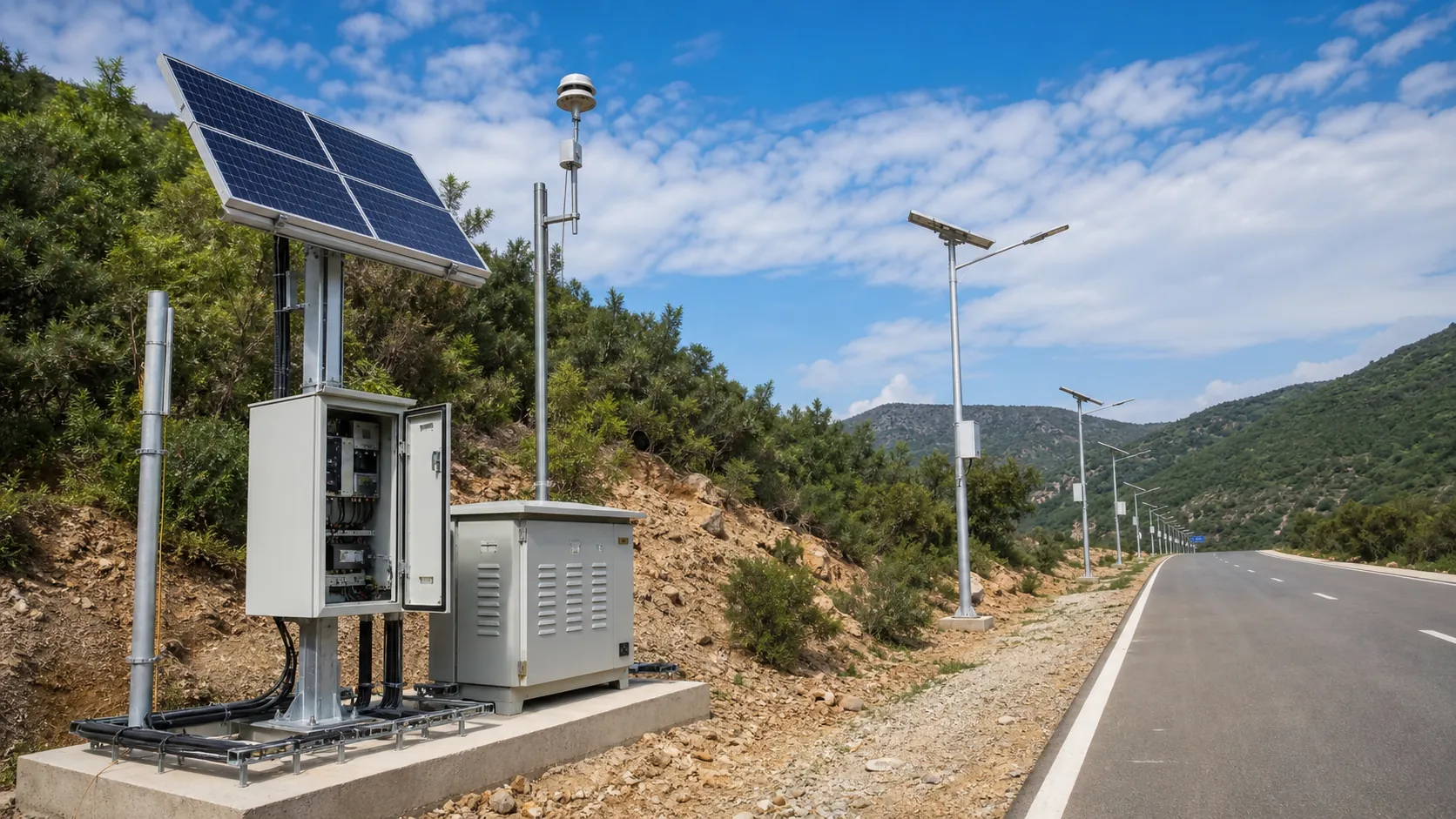
Outdoor IoT infrastructure for ports, yards and logistics areas: lighting, guidance, safety, solar power, monitoring and maintenance visibility.
Traffic Safety Checklist
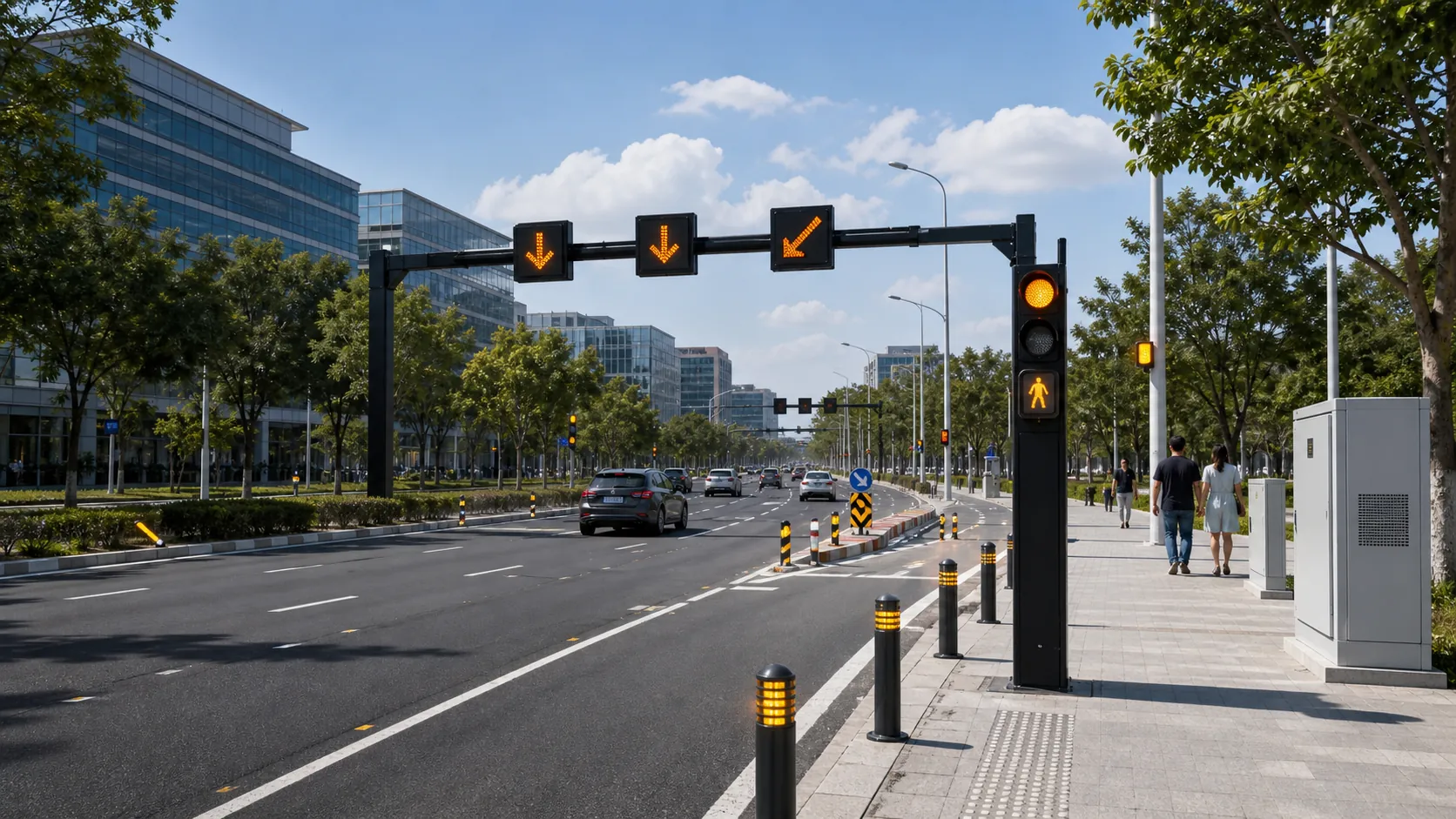
Deployment checklist for connected traffic warning signs, beacons, road guidance devices, power, visibility, monitoring and acceptance tests.
Traffic Safety
Plan connected traffic safety systems with warning beacons, LED signs, road guidance devices, sensing, control cabinets and monitoring software.
Frequently Asked Questions
How long does a solar traffic signal run without sun?
The standard RC-TS-300 carries 5–7 days of autonomy from its LiFePO4 battery bank, sized to the site's worst-month solar resource. For very cloudy climates the bank and array can be upsized, or a grid-tie/wind-solar hybrid option added, so the intersection stays fully signalized through extended overcast periods.
Is a solar traffic light safe if the battery gets low or a fault occurs?
Yes. An independent hardware Malfunction Management Unit (conflict monitor) continuously checks for conflicting greens, dark signals and out-of-range voltage. On any fault it immediately forces the intersection to a fail-safe flashing-red or all-red state and sends a remote alarm, so the junction is never left in an unsafe configuration.
Do the signals dim as the battery discharges?
No. The REDCOAST.LTD constant-current signal-driver PCB regulates LED current rather than voltage, holding rated intensity stable across the full battery range. Red, amber and green stay equally visible whether the battery is full or near its discharge cutoff.
Can the system be used for temporary work zones?
Yes. Trailer- or skid-mounted solar signal heads provide alternating one-way shuttle control for road works, bridge repairs and events. They run fully off-grid, synchronize over LoRa between heads, and can be relocated in hours as the work front moves.
How is the intersection managed and re-timed remotely?
Each system links over 4G/5G, NB-IoT or LoRa to the REDCOAST.LTD management platform, reporting signal state, lamp faults, battery health and solar yield. Operators can change timing plans, coordinate corridor offsets via GPS, and push firmware updates without a site visit.
Which standards do the signal heads meet?
Signal heads are designed to EN 12368 / ITE photometric requirements, controller safety follows EN 12675 principles, and management aligns with NTCIP-style object models. Local conformity such as MUTCD, EN, GCC or national codes is configured per project.
Does REDCOAST.LTD make the electronics or just assemble bought-in parts?
REDCOAST.LTD delivers the signal hardware and platform software as one package and develops its own boards — the LED signal driver, the conflict-monitor controller and the MPPT power-management board are designed in-house. A new PCB can be opened for a project's exact channel count, voltage, detection mix and connectivity.
What climates can the system handle?
The system operates from -30 to +60 °C with IP65 signal heads and an IP66 cabinet, and is specified for coastal salt-fog, desert dust/sand and high-humidity environments. Poles are hot-dip galvanized then powder-coated and wind-rated to the project's design wind speed.