Overview
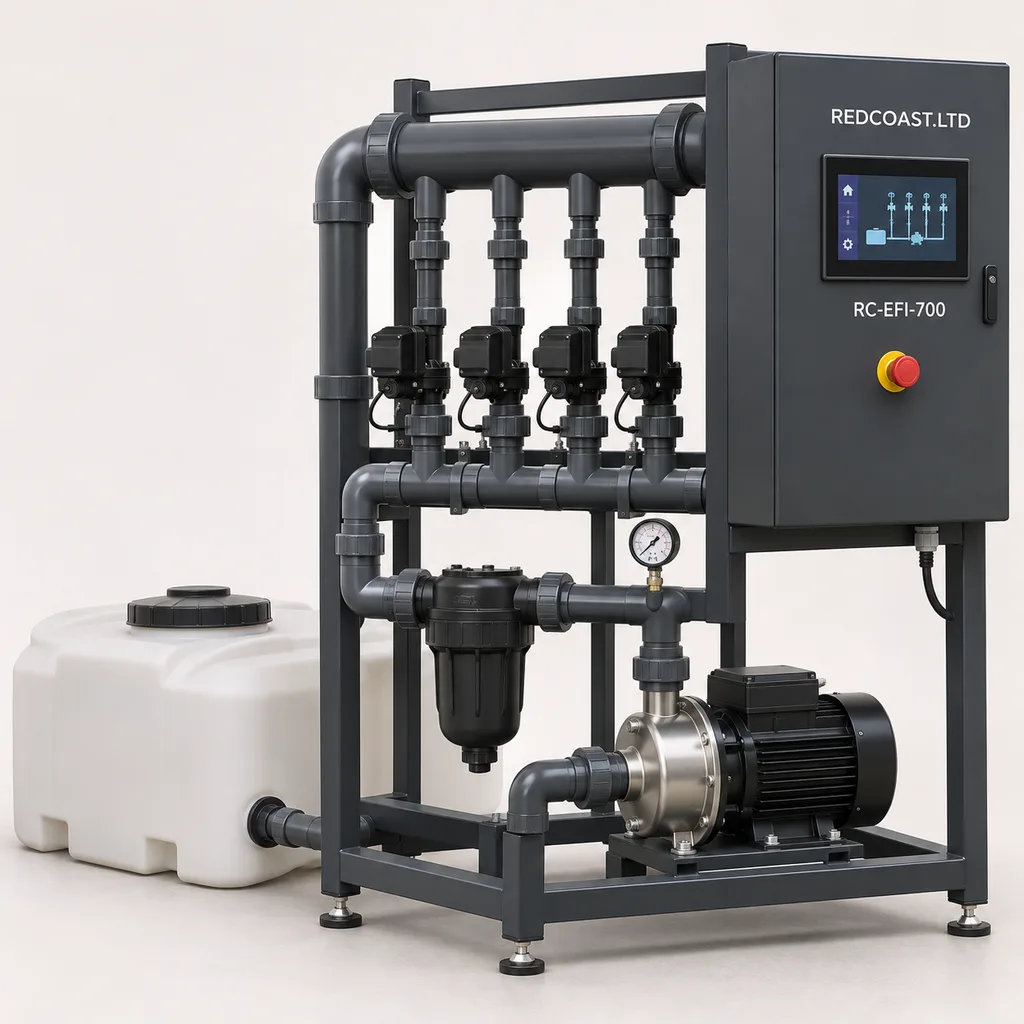
The REDCOAST.LTD RC-EFI-700 is a mains-powered ebb-and-flow irrigation recirculation station for municipal plant nurseries, landscape supply facilities, garden centers and commercial propagation sites. It coordinates shallow bench flooding, timed soaking, verified drainage and water recovery, addressing inconsistent manual watering and unattended irrigation faults. The proposed package combines a hydraulic skid, reservoir, bench valve assemblies, sensors, local touchscreen, Web management platform and mobile App. REDCOAST.LTD develops the control hardware and project-specific PCBs, allowing the equipment, firmware and operator workflow to match existing benches and nursery practices. The specifications below describe an engineering reference configuration for procurement and customization; final contractual ratings require an approved design and acceptance testing.
Key Features
- Four independently scheduled zones: The reference station operates one zone at a time, giving each crop group its own flood depth, soak period and irrigation window.
- A complete flood-and-drain sequence: Bench level confirmation, valve feedback and drainage checks govern each cycle, with separate maximum fill and drain timers.
- Recoverable irrigation water: Excess water returns through a dedicated gravity header to an opaque reservoir; logged supply volumes and reservoir levels help operators investigate unexpected losses.
- Practical hydraulic capacity: A reference duty point of 6 m³/h at 15 m total dynamic head serves compact bench blocks, with the pump selected against the actual installation curve.
- Independent overflow provisions: High-level pump inhibition, a passive bench overflow and spring-return drain valves provide separate responses to excessive filling and power loss.
- Local operation during network outages: Stored schedules and equipment interlocks execute at the station, while the platform provides supervision, records and authorized setting changes.
- Serviceable custom electronics: REDCOAST.LTD designs the main controller, protected valve-output circuitry, sensor interfaces and isolated communication circuits for the project.
- Water-quality expansion: Optional EC, pH and treatment-permissive inputs help integrate an existing nutrient preparation or disinfection system without assuming that filtration disinfects water.
Technical Architecture
The hydraulic path starts at a covered reservoir supplying a centrifugal pump, flow meter, pressure sensor and 200 µm screen filter. A distribution manifold feeds four bench branches, each with a supply valve and a separate gravity-drain valve. Removable level assemblies identify drained, target and high-high conditions; an unobstructed overflow route bypasses the controlled drain valve. The reservoir maximum operating level must remain below the bench drainage outlets. Bottom watering and subsequent drainage are established horticultural methods, but timing must follow substrate and crop requirements, as explained in Oregon State University's ebb-and-flow guidance.
The local controller first checks reservoir availability, valve positions, bench status and any configured treatment permissive. It closes the selected drain, opens the supply path and starts the pump only after the required valve feedback arrives. Reaching the target level stops filling and begins the soak period; the pump stops before the supply valve closes. After soaking, the drain opens, and the next zone waits for drained-level confirmation. Abnormal flow, a fill timeout, high-high level or failed drainage causes an alarm and inhibits further filling. The reference high-high and reservoir low-level contacts also interrupt the pump-enable circuit independently of the network and normal scheduling software.
The electronics architecture separates low-voltage sensing and valve control from mains switching and the motor drive. Project-designed PCBs provide protected inputs, current-limited outputs, isolated RS-485, watchdog supervision and nonvolatile settings; selected industrial components perform motor power conversion and electrical protection. The gateway sends time-stamped cycle states, supplied volumes, levels and faults to the Web platform and App. Each remote command is checked against local permissions and interlocks before execution, and operator changes are recorded. Irrigation recipes remain under the grower's control rather than being inferred from a generic crop label.
Connectivity & Power
The reference installation uses AC 220–240 V, single phase, 50 Hz, available at a fixed nursery service area. A selected inverter supplies the matched three-phase pump motor; a separate isolated 24 V DC supply powers controls and actuators. The 0.75 kW pump rating denotes motor shaft output, while approximately 600–1,200 W is the preliminary total electrical-input budget during filling. Controls typically require a design allowance of 25–45 W with the pump stopped. Alternative 60 Hz and three-phase mains packages require matching drives, motors and protection schedules.
Ethernet is the default connection for a nursery LAN, with optional 4G LTE for sites lacking a wired uplink. Modbus RTU connects field instruments, and Modbus TCP can interface with a site supervisory system on a controlled local network. MQTT over TLS supports platform telemetry. A cloud outage does not cancel locally stored irrigation schedules, but loss of mains power stops pumping, closes spring-return supply valves and releases spring-return drains. On restoration, the controller checks water levels and valve states before permitting another cycle; faulted cycles require acknowledgement.
Protection & Reliability
The reference cabinet targets IP65 protection with its door closed and the specified glands installed; the selected pump motor targets at least IP55. These are enclosure requirements to be verified on the supplied assembly, not claims that the entire skid is submersible. Hot-dip galvanized steel beneath a smooth matte powder-coated finish protects the frame and cabinet, while wetted materials are selected separately for the water chemistry. Sites exposed to coastal salt, fertilizer aerosols or abrasive dust require a coating and maintenance specification matched to those conditions.
The baseline wet system operates at +5 to +40 °C ambient with water at +5 to +35 °C. Freezing conditions require draining and winterization, or a separately engineered heated installation; a small cabinet heater cannot protect external water pipes. Direct sun, condensation and electrical-room ventilation are considered during enclosure selection. Reservoir low-level protection helps prevent pump damage, consistent with Grundfos guidance on dry-running protection. Service access to filters, level assemblies, valve actuators and pump seals supports planned maintenance, while replacement intervals and warranty coverage are defined for the actual operating conditions.
Application Scenarios
- Municipal landscape plant nurseries: Irrigate bedding plants and container-grown planting stock before transfer to parks, streets and public gardens. Separate schedules let staff manage different production batches while retaining a common maintenance dashboard.
- Commercial ornamental propagation: Operate compatible flood benches holding potted flowers or young ornamental plants. Repeatable fill and drain sequences help staff identify hydraulic faults that a simple timer would not reveal.
- Garden-center holding areas: Water compatible bench displays outside customer opening hours in a covered growing area. Local controls and alarm notifications reduce reliance on staff returning solely to inspect irrigation equipment.
- Landscape contractors' plant holding yards: Manage plants held temporarily before installation on construction or estate projects. Each zone can be disabled when empty, with changes recorded as stock moves between benches.
- Horticultural research and demonstration facilities: Apply documented irrigation sequences to separate trial blocks. Exported cycle records support comparison of management treatments, while independent reservoirs are specified where trials must not share nutrient solution.
Case-style Examples
The following are illustrative configuration examples, not completed customer projects or measured performance claims.
Municipal bedding-plant bench retrofit. A nursery has four existing benches, each 1.5 × 10 m, and wants supervised watering without replacing its nursery management software. One RC-EFI-700 serves the four 15 m² zones sequentially, with Ethernet integration and a separate 1,000 L low-profile reservoir. A 20 mm water depth represents 300 L of geometric bench volume before considering pot displacement, substrate uptake and pipe volume. Using a preliminary 350 L transfer allowance, a 750 L starting reservoir inventory leaves approximately 400 L, above an illustrative 250 L low-level cutoff. The intended result is a traceable irrigation sequence and a repeatable fault response; commissioning establishes the actual volumes and crop settings.
Covered garden-center retrofit. A site with reliable mains power but no network cable selects the same four-zone skid with a 4G gateway. Its existing benches receive separate supply and drain connections, removable level assemblies and passive overflow returns. A pump delivering 6 m³/h supplies 100 L/min, so a 350 L transfer has an ideal lower-bound duration of 3.5 minutes before site restrictions and control delays. The commissioning team measures the installed fill time and sets a suitable timeout, giving staff a concrete way to detect a closed valve, blocked filter or loss of supply.
Propagation facility with controlled water reuse. A grower already owns a nutrient preparation unit and a validated water-treatment process. A project variant separates return-water collection from the treated supply tank, with treatment status and available clean-water volume included in the irrigation permissive. Failed treatment status blocks reuse according to the agreed operating sequence, while the platform records the affected zones. The intended benefit is coordinated operation across existing equipment; treatment effectiveness remains dependent on the selected process, flow and water quality.
Customization & Selection Guide
Start with bench dimensions, tray channels, pot type, substrate, crop grouping and the required irrigation window. The reference uses 10–30 mm selectable flood depths with 20 mm as its planning value, a range also found in commercial ebb-and-flow bench specifications. These depths are configuration options, not universal crop prescriptions. Confirm absorption and drainage in a representative planted bench before extending settings to the whole nursery.
Size the reservoir from the largest simultaneous withdrawal, pump minimum operating inventory, pipe drain-back and required freeboard. The reference 1,000 L tank does not imply four benches can flood together. Larger zones, longer pipe runs or shorter irrigation windows may require a different pump, a larger tank or multiple independent stations. Gravity-return diameter and slope must accommodate the measured drainage rate without backing water into another bench.
Select EC and pH monitoring when operators need water-quality trends, and specify separate loops where crop hygiene or fertilizer recipes require separation. A screen filter removes particles; disease control requires an appropriately designed treatment process. Priva's October 2026 water-reuse guidance identifies pathogen, nutrient and chemical accumulation as practical concerns in recirculation. The base station does not dose fertilizer or provide a validated disinfection barrier. Existing dosing equipment can exchange ready, fault and demand signals through the agreed interface.
Deployment & After-sales
Place the skid on a level service pad with access for filter cleaning and pump removal. Position the low-profile reservoir so its maximum water level remains below the bench outlets, and provide accessible gravity returns, an overflow destination and protected cable routes. Fresh-water makeup from a potable supply requires a correctly designed air-gap arrangement selected for the assessed contamination risk. Benches, supports, buried services and drainage works are identified separately in the supply schedule.
Factory acceptance covers wiring, sensor simulation, valve sequencing, pump interlocks, communication loss, power interruption and record export. Site acceptance adds measured flow and pressure, actual fill and drain times, high-level and low-level fault trials, and inspection for residual pooling across each bench. A crop trial is needed before production scheduling. Delivery is planned through layout approval, component selection, any new PCB development, assembly, factory testing and commissioning; the project quotation establishes milestone dates. Handover includes drawings, I/O lists, settings backups and maintenance instructions, with remote diagnostics, replacement modules and App support included according to the service agreement.
Standards & Compliance
The project compliance plan identifies the rules applicable to the complete assembly and installation. Relevant references include IEC 60204-1:2016 with Amendment 1:2021 for machinery electrical equipment and IEC 60529 for enclosure ingress classifications. Industrial EMC evaluation may use IEC 61000-6-2 and IEC 61000-6-4 where their scope applies and no dedicated product standard takes precedence; commercial premises may require a different EMC assessment.
For installations using an EN-based backflow framework, EN 1717:2025+A1:2026 provides the current referenced risk-assessment framework for protecting potable water. Local electrical, plumbing, water-reuse and discharge requirements remain part of project design. Certificates, declarations and test reports must identify the actual supplied configuration; this reference product page does not claim completed third-party certification.
Why REDCOAST.LTD
REDCOAST.LTD delivers an integrated irrigation equipment and software package, with one coordinated design covering hydraulics, control behavior, Web supervision and the mobile App. Its in-house board-level engineering includes new PCB layouts, sensor conditioning, actuator interfaces and power-management circuitry when a project's requirements call for them. This allows the station to fit existing bench layouts, selected industrial pumps, local electrical supplies and an integrator's data interfaces. Procurement can therefore specify a concrete operating sequence and acceptance criteria while retaining a clear route for expansion and service.
Contact REDCOAST.LTD with your bench layout, crop groups, available mains supply and water analysis to request a customized RC-EFI-700 configuration and quotation.
Specifications
Hydraulic Reference Configuration
- Controlled zones
- 4, operated sequentially; 1 active flood/soak/drain cycle zones
- Reference bench area
- 15 per zone; 4 benches of 1.5 × 10 m m²
- Pump duty-point target
- 6 at 15 m total dynamic head; verified against selected pump curve m³/h
- Pump motor shaft rating
- 0.75; matched to inverter and hydraulic duty kW
- Reservoir nominal capacity
- 1000; separate opaque, low-profile HDPE tank L
- Reference pipe connections
- DN40 supply; DN75 gravity-return header, subject to route and slope calculation
- Particle filtration
- 200 µm supply screen; 1 mm return basket; no disinfection rating
- Wetted materials
- 316 stainless-steel pump wetted parts, uPVC headers and EPDM seals; water chemistry checked at selection
Flood, Soak and Drain Control
- Selectable flood depth
- 10–30; reference setting 20 above bench datum mm
- Soak timer range
- 1–20; set by crop and substrate trial min
- Fill timeout range
- 1–15; reference commissioning starting value 6 min
- Drain timeout range
- 1–20; reference commissioning starting value 10 min
- Bench level thresholds
- 5 drained-check, 20 target and 35 high-high in the reference configuration mm
- Passive overflow elevation
- 45 above bench datum with tray wall at least 60 mm; independent of drain valve mm
- De-energized valve positions
- 4 supply valves closed; 4 gravity-drain valves open, using spring-return actuators
Sensors and Field Interfaces
- Bench level detection
- 3 discrete level points per zone in serviceable assemblies; 12 points total
- Supply flow measurement range
- 0.5–10; Modbus RTU instrument with full-pipe installation m³/h
- Supply flow accuracy target
- ±2 of reading within the specified measuring range %
- Discharge pressure range
- 0–4; sensor accuracy target ±0.5% of full scale bar
- Reservoir level range
- 0–2; hydrostatic sensor accuracy target ±0.5% of full scale m
- Optional EC measurement
- 0–10; accuracy target ±0.1 mS/cm after calibration mS/cm
- Optional pH measurement
- 0–14; accuracy target ±0.1 pH after calibration pH
Grid Power
- Reference mains input
- AC 220–240, single phase, 50 Hz V
- Reference motor-drive output
- AC 230, three phase, matched to selected 0.75 kW motor V
- Control and actuator supply
- DC 24, 150 W isolated power supply V
- Preliminary input power during filling
- 600–1200, including pump drive and controls; excludes external treatment equipment W
- Preliminary idle power
- 25–45 with pump stopped and no optional heater W
- Electrical protection architecture
- Lockable isolator, branch overcurrent protection, motor protection and protective bonding; ratings set by circuit design
Controller, Connectivity and Software
- Controller I/O reference
- 32 digital inputs, 12 protected 24 V outputs and 4 analog 4–20 mA inputs
- Actuator-output current limit
- 1 per channel; 4 aggregate maximum A
- Local operator interface
- 7-inch touchscreen with manual, automatic and maintenance modes
- Wired communication
- 1 × 10/100 Ethernet; 2 × isolated RS-485
- Application protocols
- Modbus RTU, Modbus TCP on local network, MQTT over TLS 1.2 or later
- Optional cellular uplink
- 4G LTE Cat 1; modem bands and SIM selected for deployment
- Local record retention target
- 30 days at 60-second trend intervals, plus event records
- Management interfaces
- Web dashboard, mobile App and CSV export; viewer, operator and administrator roles
Environment and Mechanical Package
- Control cabinet ingress target
- IP65, closed door and specified glands installed; assembly verification required
- Pump motor ingress requirement
- IP55 minimum for the selected motor
- Wet-system ambient range
- +5 to +40; nonfreezing installation °C
- Irrigation water temperature range
- +5 to +35 °C
- Reference skid envelope
- 1000 W × 650 D × 1400 H; excludes tank, benches and service clearances mm
- Frame and cabinet finish
- Hot-dip galvanized steel with smooth matte powder-coated RAL 7016 anthracite finish
- Reservoir installation geometry
- Low-profile tank; maximum operating water level below all connected bench drain outlets
Capabilities — configurable per project
Specifications are tailored to each project — the options below show what we can support.
Zone and Hydraulic Package
- 4-zone sequential reference skid with 1000 L tank
- 8-zone sequential variant with recalculated cycle capacity
- Independent skids and reservoirs for separate crop groups
Water Management
- Single-reservoir particle-filtered recirculation
- EC and pH monitoring package
- Separate return and supply tanks with external treatment permissive
Electrical Supply
- 220–240 V single phase, 50 Hz reference package
- 208–240 V single phase, 60 Hz package
- 380–415 V three phase, 50 Hz package
Software and Integration
- Ethernet with Web platform and mobile App
- 4G LTE with Web platform and mobile App
- On-premises supervisory integration via documented Modbus registers
Mechanical Delivery
- Skid and sensor retrofit package for existing benches
- Skid, reservoir and compatible flood-bench package
- Sheltered coastal installation with project-specific coating and fastener selection
Related solution guidance

Environmental Monitoring
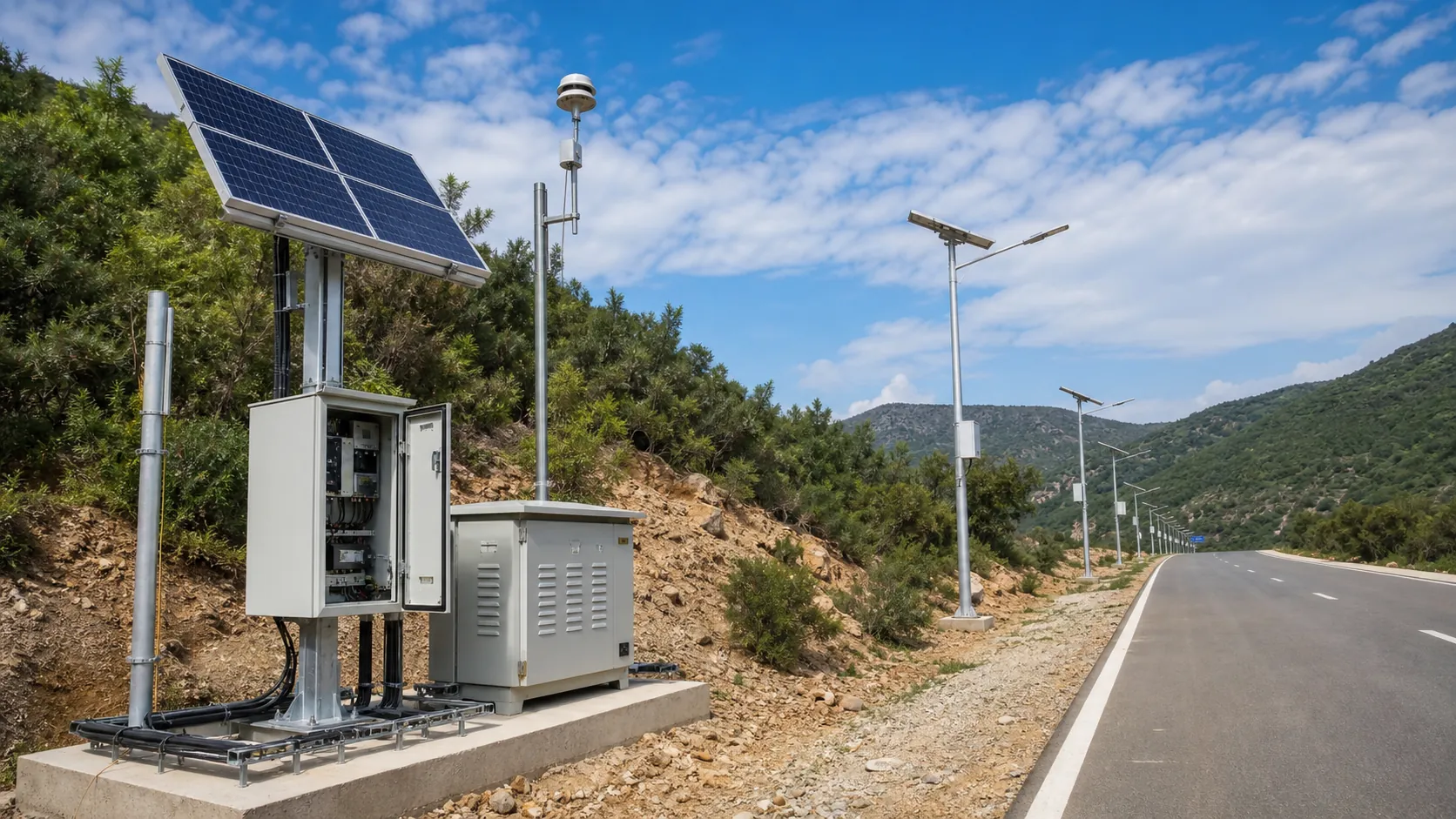
Deploy environmental monitoring stations with sensors, solar power, gateways, dashboards, alarms and data integration for city and industrial sites.
Solar IoT Guide
A design guide for solar-powered outdoor IoT: load calculation, battery autonomy, low-power firmware, telemetry and maintenance planning.
Solar Off-Grid IoT
Design solar-powered outdoor IoT systems with panels, batteries, controllers, low-power devices, gateways and remote power monitoring.
Frequently Asked Questions
What does an ebb-and-flow irrigation station do?
It pumps water into a compatible bench to wet the bottom of plant containers, holds it for a selected period and then drains excess water for collection. The RC-EFI-700 reference configuration coordinates four zones sequentially, including level checks, valve feedback and fault logging. Bench design, substrate and crop requirements determine the operating recipe.
How many nursery benches can one RC-EFI-700 operate?
The reference package operates four 15 m² bench zones, with one complete flood, soak and drain cycle active at a time. Bench count alone does not determine capacity: required water volume, elevation, pipe losses and the irrigation window must also be checked. An eight-zone variant requires a revised schedule and hydraulic review.
How is the recirculation tank sized?
Allow for the largest simultaneous transfer, the pump's minimum retained water inventory, returning pipe contents and freeboard. A 15 m² bench flooded to 20 mm has a geometric water volume of 300 L before pot displacement, absorption and piping are considered. The reference 1000 L reservoir is a planning configuration, with actual operating levels established during commissioning.
Does the station work without internet access?
Yes, the proposed control architecture stores schedules locally and executes valve and pump interlocks at the station. Loss of internet interrupts remote supervision but does not itself stop an otherwise permitted local cycle. Loss of mains power stops the pump, closes spring-return supply valves and opens spring-return drains.
Can recovered irrigation water be reused without disinfection?
The answer depends on crop-health requirements and the water-management plan; particle filtration alone does not establish microbiological safety. Shared recirculation can spread contamination between benches, so some installations need separate loops or a validated treatment process. The station can accept an external treatment permissive, while EC and pH readings provide water-quality information rather than proof of pathogen removal.
Can existing benches, pumps or fertilizer equipment be retained?
Compatible equipment can be retained after checking hydraulic capacity, drainage geometry, materials and electrical interfaces. Existing benches need adequate channels, overflow provisions and accessible level sensing; a pump must meet the required flow and head. Fertilizer dosing remains a separate process, with ready, demand and fault signals integrated where needed.
What information is needed for a customized quotation?
Provide bench drawings and elevations, zone count, crop and substrate details, source-water analysis, available mains voltage and frequency, and the preferred communications method. Identify any pumps, nutrient preparation equipment or treatment systems to retain. REDCOAST.LTD can then define the hydraulic package, custom PCB and firmware scope, software interfaces and acceptance tests.