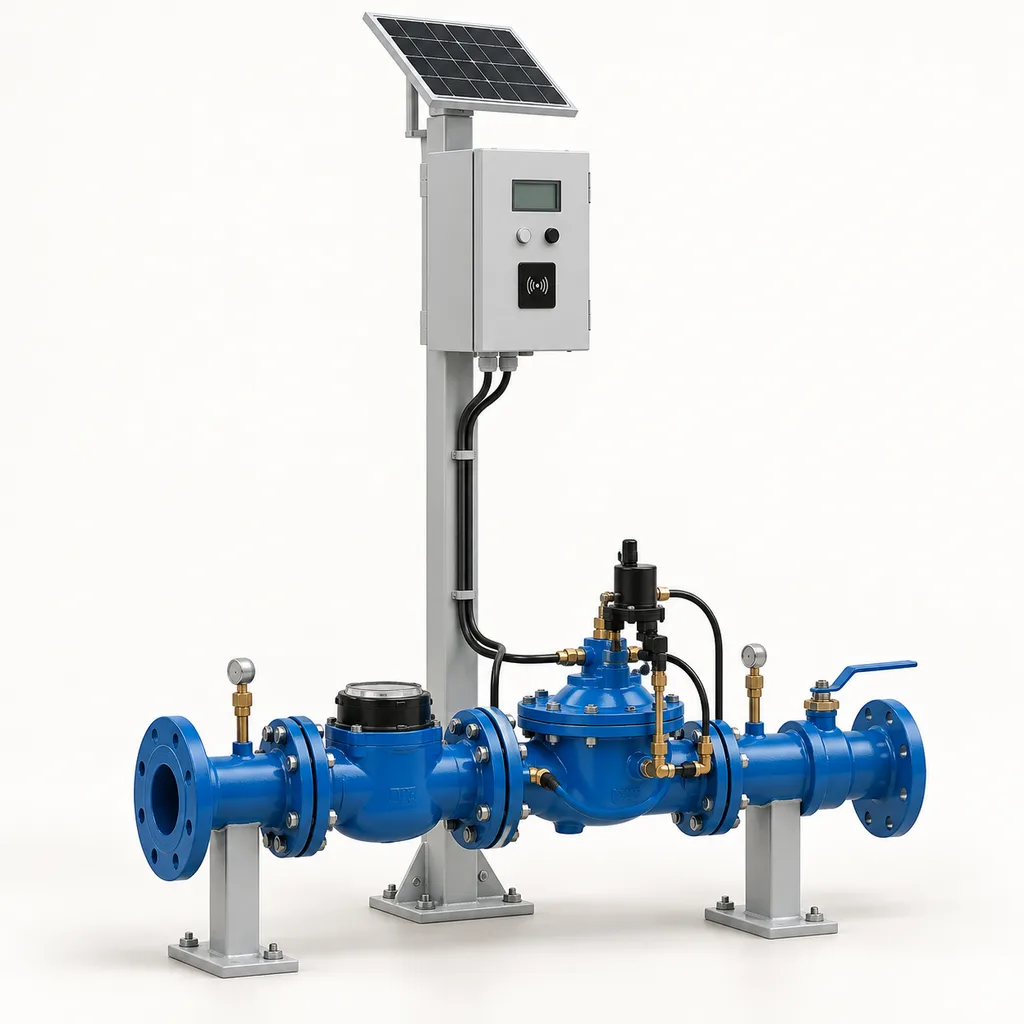
Overview
The RC-IHM-600 Smart Irrigation Hydrant Metering & Water Allocation Station from REDCOAST.LTD combines a metered field outlet, access control, local valve operation, a Web management platform and a mobile app. It is intended for irrigation districts, agricultural cooperatives, estate operators and integrators managing shared pressurized water networks. Operators can assign each user a volume allowance and delivery window, record withdrawals and investigate abnormal consumption without visiting every outlet. The reference configuration serves remote field boundaries without electricity, using a small solar supply for electronics and a hydraulic valve driven by existing pipeline pressure.
Key Features
- Metered delivery at the farm boundary: DN50, DN80 and DN100 assemblies connect a pulse-output irrigation water meter to a hydraulically operated shutoff valve.
- Volume and time permissions: Allocate water in cubic metres, restrict delivery windows and stop a session when its commissioned limit is reached.
- Offline quota enforcement: Store a hydrant-specific allowance locally so an approved session can continue through a communications outage.
- User identification: Optional authenticated NFC credentials associate withdrawals with an account, field and operator-approved entitlement.
- Pressure-aware operation: Two pressure channels distinguish an unavailable upstream supply from downstream restrictions and unusual demand.
- Low-energy field hardware: A latching pilot consumes energy during switching; solar electricity powers monitoring and communications rather than pumping.
- Serviceable custom electronics: REDCOAST.LTD develops the pulse acquisition, pressure interface, solenoid driver, low-power controller and MPPT power-management PCBs.
- Operational records: The Web platform and app expose totalizers, session history, remaining allowances, alarms and maintenance status, with CSV exports and an integration API.
Technical Architecture
The reference DN80 assembly contains an irrigation-rated mechanical pulse meter, a diaphragm control valve with a latching hydraulic pilot, upstream and downstream pressure transmitters, manual isolation and a lockable electronics enclosure. An integrated hydrometer or separate meter-and-valve arrangement can be selected after checking available pressure and installation space. This hydraulic principle is established in commercial irrigation equipment: a combined meter and diaphragm valve uses line pressure for actuation and an electrical command for switching. BERMAD solenoid-controlled hydrometer.
Inside the enclosure, a REDCOAST.LTD controller PCB counts meter pulses, powers the pressure sensors intermittently and drives the selected pilot through a protected polarity-reversing output. An independent watchdog, nonvolatile transaction journal and brownout handling protect operating records. Before opening, firmware checks the access credential, local allowance, time window, supply pressure and battery reserve. During delivery it accumulates measured volume and evaluates sustained high-flow, no-flow and pressure alarms; a successful electrical pulse is recorded separately from hydraulic confirmation.
At session completion, the controller starts closing early using the observed flow and commissioned valve response, then continues counting until flow stops. A 10-litre pulse represents measurement resolution, not a promise that a delivery will stop within 10 litres: valve travel and water remaining in motion contribute additional volume. The cloud manages accounts and distributes signed, station-specific allowances, while the station performs the time-critical counting and stopping locally. Offline allowances are reserved against the central account before download, preventing the same balance from being independently spent at several disconnected hydrants.
Connectivity & Power
Choose LTE-M or NB-IoT for scattered outlets with suitable operator coverage, or LoRaWAN Class A for clustered outlets served by an agricultural gateway. Regional radio hardware and channel plans are selected for the installation country. The default reporting interval is 15 minutes, with local events queued immediately for transmission when a link is available. Class A downlinks follow uplinks, so a remote command may wait for the next receive opportunity; local quota control remains active during that delay. LoRaWAN device-class behavior.
The reference power package is a 20 W monocrystalline module, a 12.8 V, 12 Ah LiFePO4 battery and a REDCOAST.LTD MPPT controller. The design allowance is 10 Wh per day for the complete station at the stated reporting profile, including sampled sensors and up to 20 opening/closing cycles. This is a budgeting target to verify on the configured hardware. It excludes pumps, heat tracing and continuous high-power communications; the water network must supply its own pressure.
A seven-day no-sun design allowance requires 70 Wh. The nominal 153.6 Wh battery yields approximately 104 Wh when calculated at 80% usable depth of discharge and an assumed 85% downstream energy factor, leaving a reserve under new-battery, 25°C conditions. At an illustrative 2.5 peak-sun-hours and 65% overall daily harvest factor, the 20 W module supplies about 32.5 Wh per day. Final sizing uses the site's worst operating month, shading, temperature, battery ageing and actual radio retries; the calculation is not a field autonomy test.
Protection & Reliability
The electronics enclosure has an IP66 design target, with sealed cable entries, a replaceable door gasket and a pressure-equalizing membrane. It is mounted above the design flood level because IP66 does not establish submersion protection. Steel cabinets, posts and brackets receive hot-dip galvanizing beneath a smooth powder-coated or fluorocarbon-painted finish; coated hydraulic castings, isolated dissimilar metals and suitable fasteners are selected for the water chemistry and atmospheric exposure. Coastal, dusty and high-wind sites require coating, gland, mounting and foundation details matched to their exposure.
Controller electronics are specified for a design range of -20 to +60°C, while the standard wet-service site range is +5 to +45°C with shading and battery-temperature monitoring. The reference battery charges only between +5 and +45°C at cell level; electronics temperature capability does not imply that the battery can charge throughout that range. Freeze-prone pipework must be protected or drained. Low battery triggers a controlled closing attempt before shutdown, but a latching valve can retain its position after an abrupt wiring or power failure, so independent upstream isolation remains necessary. Replaceable pilot, meter, battery and electronics modules support maintenance; service intervals and warranty terms are defined against the selected components and duty cycle.
Application Scenarios
- Irrigation-district farm turnouts: Install a station where a shared pressurized main enters an individual holding. Account-linked delivery records help operators reconcile allocations and identify outlets that exceed their agreed withdrawal windows.
- Agricultural cooperative networks: Give members separate credentials and reserved water allowances at shared field outlets. Local enforcement keeps an already authorized delivery manageable when cellular coverage is intermittent.
- Orchard and vineyard estates: Meter water supplied to separate production blocks before it reaches each block's irrigation controller. Managers can compare delivered volumes with irrigation plans and investigate unexpected overnight flow.
- Remote nursery production blocks: Place stations at unpowered outdoor growing areas supplied from an existing pressurized distribution main. Solar-powered electronics avoid an electrical trench while the existing irrigation system continues controlling crop-level application.
- Seasonal agricultural tenancies: Associate each temporary plot with a dated entitlement and a recorded opening totalizer. Closing records give the operator and tenant a shared basis for consumption reconciliation without assuming that an operational meter is automatically approved for billing.
Case-style Examples
The following examples describe proposed configurations and expected operating workflows, rather than completed installations or measured savings.
Shared orchard supply: A cooperative needs to serve 24 field outlets from an existing pressure main, with no electrical supply at the plots. A proposed configuration uses DN80 stations at 20-40 m³/h, individual 20 W solar packages and LoRaWAN coverage verified by a field survey. Each grower receives a station-specific volume allowance, and the operator can review withdrawals and unresolved alarms from one dashboard.
Scattered leased growing plots: An estate needs consistent records from eight distant outlets where cellular connectivity is intermittent. DN50 stations with LTE-M, authenticated NFC access and preassigned local allowances let approved users start deliveries without waiting for a cloud round trip. When connectivity returns, session records synchronize for reconciliation; pilot commissioning establishes the practical delivery tolerance and low-battery closing behavior.
Customization & Selection Guide
Start with minimum and maximum flow, available inlet pressure, required outlet pressure, water quality and the existing flange standard. The recommended selection bands are 5-20 m³/h for DN50, 10-50 m³/h for DN80 and 15-80 m³/h for DN100; these are duty bands, not the meter's complete certified measuring range. Check the pressure-loss curve of the selected valve and meter at maximum flow. The reference operating envelope is 1-10 bar with PN16 main hydraulic bodies, and every pilot, tube and fitting must meet the specified station working pressure.
Select a mechanical meter where water quality and maintenance access suit its moving parts. A separately qualified electromagnetic meter is an alternative for suitable conductive water, with its power draw included in a revised energy budget. Specify a mechanical pressure-reducing or flow-limiting pilot when a hydraulic limit is required: an on/off quota controller alone does not continuously regulate pressure or maximum flow. Final meter straight-run requirements, filtration, air release, backflow prevention and transient protection come from the selected equipment and pipeline design.
For an economical installation, use operator-assigned allowances and a single cellular link. Add NFC access for shared outlets, a private LoRaWAN network for a surveyed cluster, or a billing-system interface where the authority has an approved metrology route. Commercial prepaid irrigation systems already combine access credentials, volume budgets and online records, establishing a practical procurement category. iSAtech irrigation access and allocation system. RC-IHM-600 specifications describe an engineering reference configuration; contractual ratings and acceptance criteria are fixed in the project submittal.
Deployment & After-sales
Installation begins with a hydraulic and communications survey, followed by a dimensional drawing showing meter orientation, service clearances, isolation points and panel location. The pipe must remain full during measurement, and supports must prevent pipe loads from being transferred into the meter body. Flush the line before connecting sensitive hydraulic equipment, verify the pulse factor against the meter register and prove valve closing under representative flow. Commissioning also checks disconnected communications, exhausted allowance, low battery, blocked pilot flow and discrepancies between a closing command and continued water movement.
Delivery is staged through configuration approval, sample qualification, factory acceptance and batch release; scheduling depends on meter availability, custom PCB scope, enclosure tooling and required tests. Handover includes wiring diagrams, hydraulic schematics, firmware versions, radio settings, platform training and a recommended spare-parts list. Remote diagnostics, controlled firmware updates and replaceable PCB assemblies support subsequent service, while metrology calibration and hydraulic servicing follow the selected suppliers' procedures and local requirements. No fixed saving, universal service life or unconditional delivery lead time is assumed.
Standards & Compliance
Irrigation-meter selection should reference ISO 16399:2023 and its 2025 amendment, which address irrigation-water meters in full closed conduits, including relevant electronic ancillary devices. ISO 16399:2023, Amendment 1:2025. Procurement must distinguish operational allocation records from legally approved charging: a pulse interface, NFC credential or software invoice does not establish legal metrology approval. Where consumption determines a financial charge, the meter, register, software path and installation must satisfy the applicable authority's requirements.
The enclosure qualification plan uses IEC 60529 for the specified ingress-protection level. IEC 60529 consolidated edition. EMC and radio testing, material declarations and battery transport documentation are selected for the destination and final assembly; CE-related documentation, RoHS evidence and other market approvals are supplied only where applicable and supported. Component certificates do not automatically cover the completed station. This reference product description does not claim completed type approval, EMC testing or field qualification.
Why REDCOAST.LTD
REDCOAST.LTD delivers the field station, embedded control, Web platform and mobile app as one coordinated irrigation-management solution. Its in-house hardware development includes creating new PCBs and board-level designs for the meter interface, sensor excitation, latching-valve driver, communications carrier and solar power management when a project needs different interfaces or operating behavior. Suitable specialist meters and hydraulic valves are selected alongside that custom electronics work, with one integration specification connecting physical operation to user accounts, alarms and service records. This gives buyers a defined product that can be adapted to their pipeline, operating rules and existing software.
Send REDCOAST.LTD your outlet sizes, flow and pressure ranges, water analysis, site conditions and allocation rules to request a configured RC-IHM-600 proposal.
Specifications
Hydraulic Assembly
- Outlet sizes
- DN50 / DN80 / DN100; reference configuration DN80
- Recommended duty flow
- DN50: 5-20; DN80: 10-50; DN100: 15-80 m³/h
- Station working pressure
- 1-10; verify valve differential-pressure requirement at selected flow bar
- Main hydraulic body rating
- PN16; complete station limited to 10 bar by selected pilot assembly
- Water temperature
- +1 to +45; no frozen water °C
- Pipe connections
- EN 1092-2 PN16 flanges; alternative ANSI Class 150 matching assembly
- Valve closing-time selection target
- 5-30; set by hydraulic commissioning and transient assessment s
Metering & Pressure Sensing
- Reference meter technology
- Mechanical irrigation meter with dry register and pulse output
- Meter accuracy selection requirement
- ±2% of reading within the selected meter's declared Q2-Q3 range
- Meter pulse factor
- 10 standard; 100 option L/pulse
- Pulse input capacity
- 2 channels, 0-100 Hz; reed-switch or open-collector input
- Pressure measurement channels
- 2; upstream and downstream, 0-16 bar, switched 4-20 mA excitation
- Pressure sensor accuracy requirement
- ±0.5% of full scale at 25°C; full-range drift specified by sensor selection
Local Control & User Access
- Controlled outlets
- 1 metered outlet per station
- Session volume setting
- 0.1-999999.9; final delivery tolerance depends on flow and closing response m³
- Session duration setting
- 1-1440 min
- Latching pilot output
- 12 V DC polarity reversal; 20-100 ms pulse; 3 A peak design capacity
- Auxiliary digital inputs
- 4 dry-contact inputs for door, valve feedback and external interlocks
- Local interface
- 2.7-inch reflective monochrome LCD; Start/Stop buttons; optional authenticated NFC reader
- Pressure sampling interval
- 1-60; default 10 during delivery, 60 while idle s
Off-grid Power
- Solar module
- 20 standard / 40 extended-energy option; monocrystalline W
- LiFePO4 battery
- 12.8 V, 12 Ah standard / 24 Ah option; BMS and cell-temperature sensing
- Nominal battery energy
- 153.6 standard / 307.2 option Wh
- Station energy design budget
- 10 at 15-minute reporting and up to 20 opening/closing cycles; no heating or pumping Wh/day
- No-sun autonomy design target
- 7 at 10 Wh/day, new 12 Ah battery at 25°C, 80% usable discharge and 85% energy factor days
- MPPT charging output
- 5 maximum; configured to battery manufacturer's charging limits A
- PV input design window
- 15-30 operating; 35 maximum cold open-circuit voltage V DC
- Battery temperature limits
- Charge +5 to +45; discharge -20 to +50; measured at cells °C
Communications & Interfaces
- Cellular options
- LTE-M or NB-IoT; operator and band selection required
- Private-network option
- LoRaWAN Class A; EU868 / US915 / AU915 / AS923 regional variants
- Reporting interval
- 1-60; default 15; shorter intervals require revised energy budget min
- Field service interface
- 1 isolated RS-485 port; Modbus RTU; 9600-115200 bit/s
- Internet transport
- MQTT or HTTPS over TLS 1.2/1.3 through cellular or gateway backhaul
- Remote command behavior
- Queued delivery with acknowledgment; latency depends on radio wake and receive schedule
Enclosure & Environmental Design
- Electronics enclosure ingress target
- IP66 to IEC 60529; above-flood mounting; assembled-unit test required
- Standard wet-service ambient range
- +5 to +45 with sunshield and battery-temperature monitoring °C
- Controller electronics design range
- -20 to +60; separate from battery and hydraulic operating limits °C
- Cabinet dimensions
- 400 × 300 × 200, H × W × D; excludes mounting post and panel mm
- Cabinet and support finish
- Hot-dip galvanized steel substrate with smooth matte powder coat, RAL 7035
- Mounting interface
- Wall bracket or 60-100 mm outside-diameter post
- Solar bracket tilt adjustment
- 15-60; structural loads and anchors sized for the site degrees
Software, Records & Security
- Management interfaces
- Browser-based Web portal; Android/iOS project app
- Local transaction capacity
- 100000 timestamped records; circular storage with upload acknowledgment records
- Local credential capacity
- 1000 station-authorized user identifiers users
- Account roles
- Administrator / Operator / Irrigator / Read-only
- Data integration
- REST API with JSON; CSV session and totalizer exports
- Control-security design
- Unique device credentials; signed allowance updates; signed firmware; role-based command audit
Capabilities — configurable per project
Specifications are tailored to each project — the options below show what we can support.
Hydraulic Control Package
- Metered on/off delivery
- Pressure-reducing pilot with metered delivery
- Flow-limiting pilot with metered delivery
Access & Accounting Workflow
- Operator-assigned volume allowances
- Authenticated NFC access with reserved offline allowances
- Billing-system integration using an approved metrology configuration
Network Deployment
- Individual LTE-M stations
- Individual NB-IoT stations
- Private LoRaWAN Class A cluster with gateway backhaul
Energy & Exposure Package
- 20 W panel with 12 Ah LiFePO4 battery
- 40 W panel with 24 Ah LiFePO4 battery
- Enhanced coastal coating and fluorocarbon topcoat
Platform Deployment
- Managed cloud with Web portal and mobile app
- Customer-controlled server deployment
- API integration with an existing irrigation-management platform
Related solution guidance
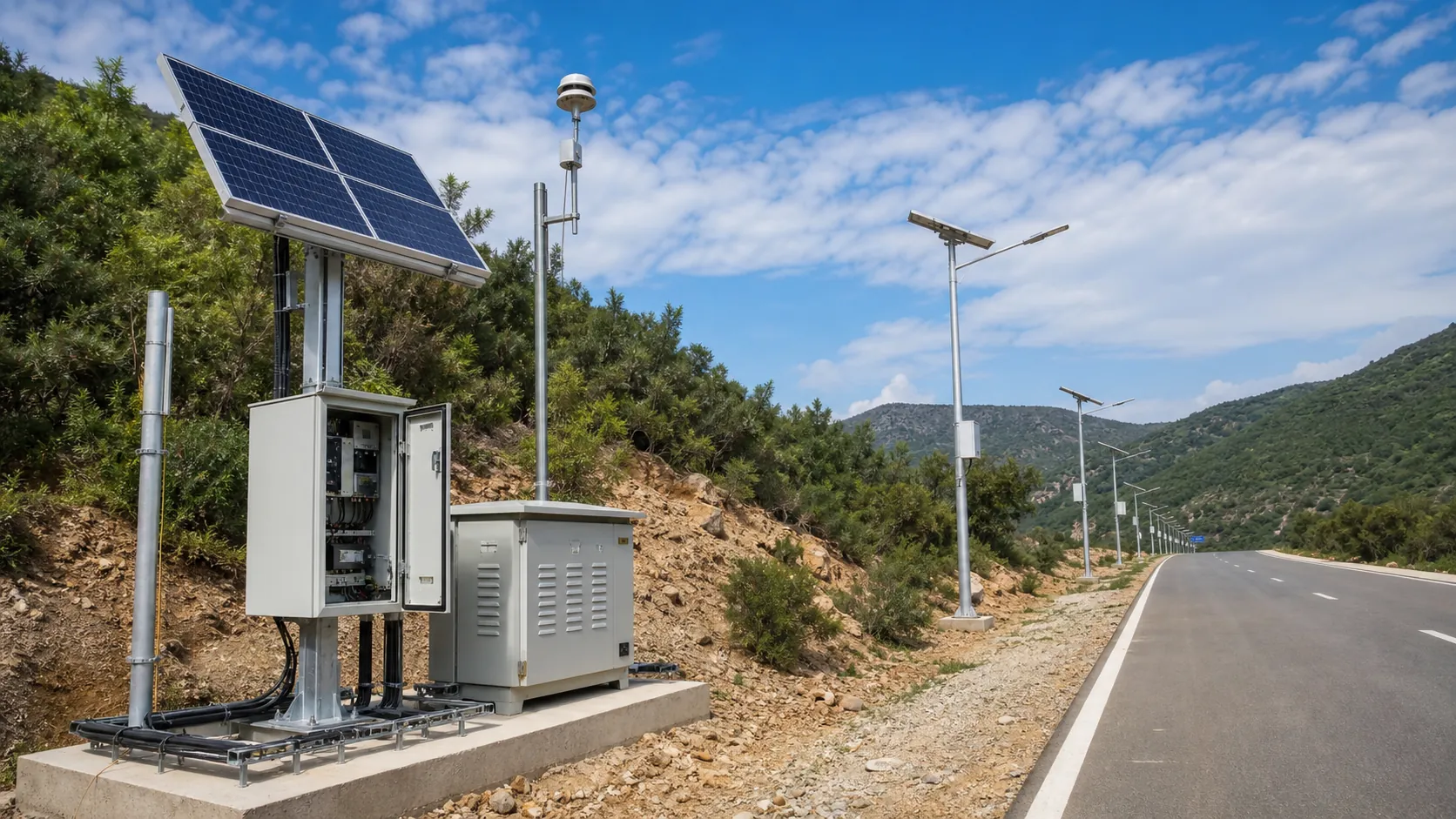
Solar IoT Guide
A design guide for solar-powered outdoor IoT: load calculation, battery autonomy, low-power firmware, telemetry and maintenance planning.
Solar Off-Grid IoT
Design solar-powered outdoor IoT systems with panels, batteries, controllers, low-power devices, gateways and remote power monitoring.
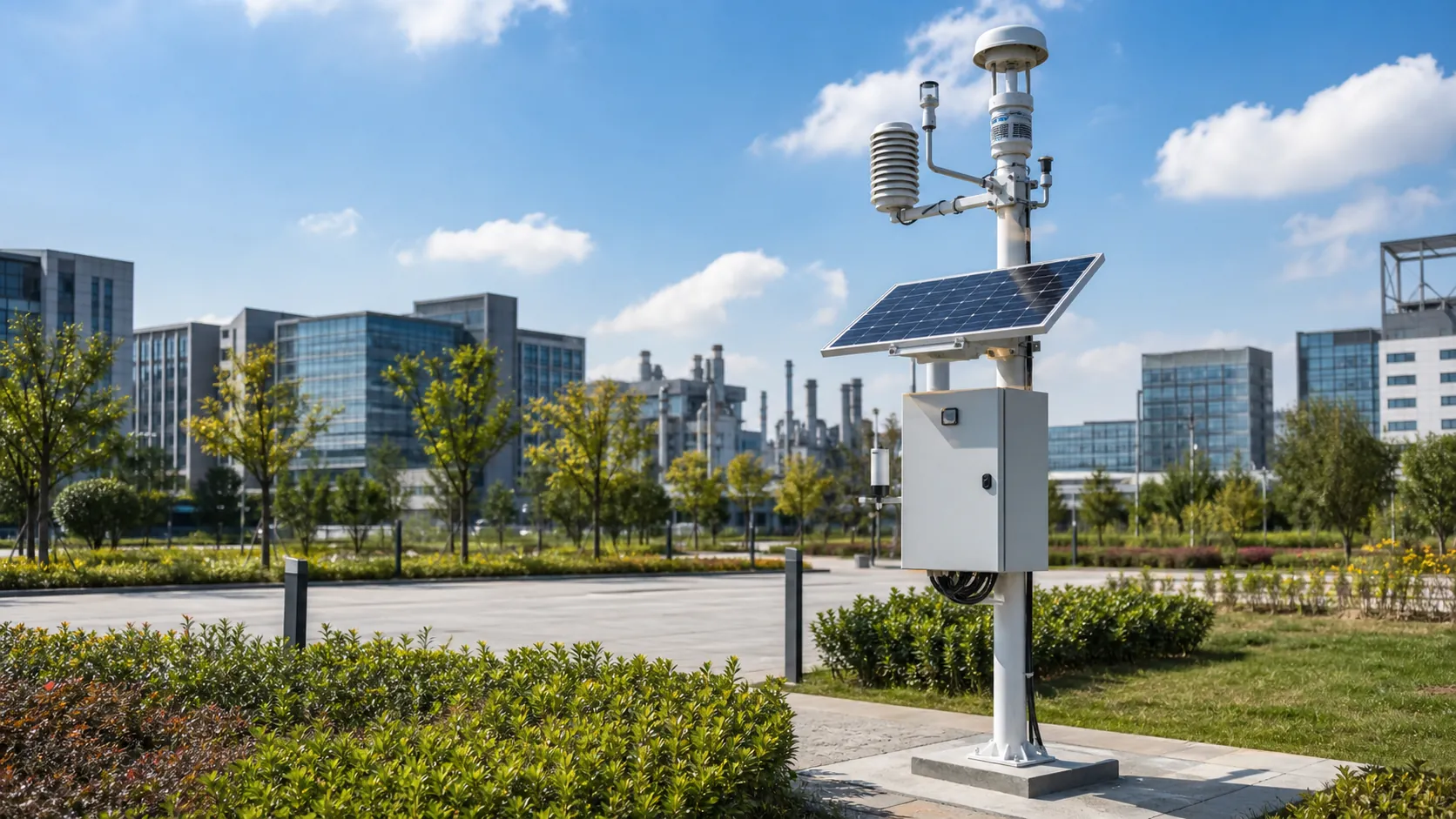
Environmental Monitoring
Deploy environmental monitoring stations with sensors, solar power, gateways, dashboards, alarms and data integration for city and industrial sites.
Frequently Asked Questions
How is this station different from a soil-moisture irrigation controller?
The RC-IHM-600 manages water delivered at a shared network outlet, including measured volume, user entitlement and delivery windows. A crop irrigation controller decides how water is distributed among downstream zones using schedules or agronomic inputs. The two systems can operate together, with the hydrant enforcing the agreed supply allowance.
Can the solar panel run an irrigation pump?
The standard 20 W solar module powers the station electronics, sampled sensors and latching-valve commands. Hydraulic actuation uses pressure already present in the pipeline. A pump requires a separate supply and must be sized from required flow, head and operating hours.
What happens when cellular or LoRaWAN connectivity is lost?
Previously downloaded permissions and reserved allowances remain available locally, and the controller continues counting volume and enforcing the session limit. Each offline allowance is assigned to a specific station to prevent duplicate use across disconnected outlets. Records synchronize after reconnection, while remote commands require a confirmed communication opportunity.
Does the valve automatically close if all electrical power disappears?
A latching pilot can remain in its last position after abrupt power loss or a broken cable. The controller is designed to detect a declining battery and attempt closure while energy remains, then check the hydraulic response. Applications requiring closure after every power failure need a separately engineered fail-closing actuator or independent hydraulic isolation arrangement.
Can the station be used for prepaid irrigation or billing?
It can manage volume entitlements and export consumption records to an accounting system. Monetary charging requires a meter and complete measurement path accepted by the relevant authority, including any applicable software and sealing requirements. NFC access and a cloud dashboard alone do not establish legal metrology approval.
How accurately can it stop after a requested volume?
The selected meter's accuracy, pulse factor and actual valve closing response all affect the final delivered quantity. At 50 m³/h, ten seconds of unchanged flow would deliver about 139 litres, illustrating why a 10-litre pulse does not imply a 10-litre stopping tolerance. Commissioning measures the closing behavior and sets an early-close allowance and achievable delivery tolerance.
Will the standard station work through freezing weather?
The standard wet-service configuration is intended for +5 to +45°C ambient conditions, with cell-temperature limits enforced separately. Exposed water components must be drained or protected before freezing, and the reference battery does not charge below +5°C. Heating or extended winter operation requires a separately calculated power and thermal configuration.
What information is needed to select the right hydrant size?
Provide the pipe size and flange standard, minimum and maximum flow, inlet pressure range, required outlet pressure and water-quality information. Also provide outlet locations, radio coverage, operating season and the desired account or allocation workflow. REDCOAST.LTD uses these inputs to specify the hydraulic assembly, custom PCB interfaces, power package and platform integration.