Overview
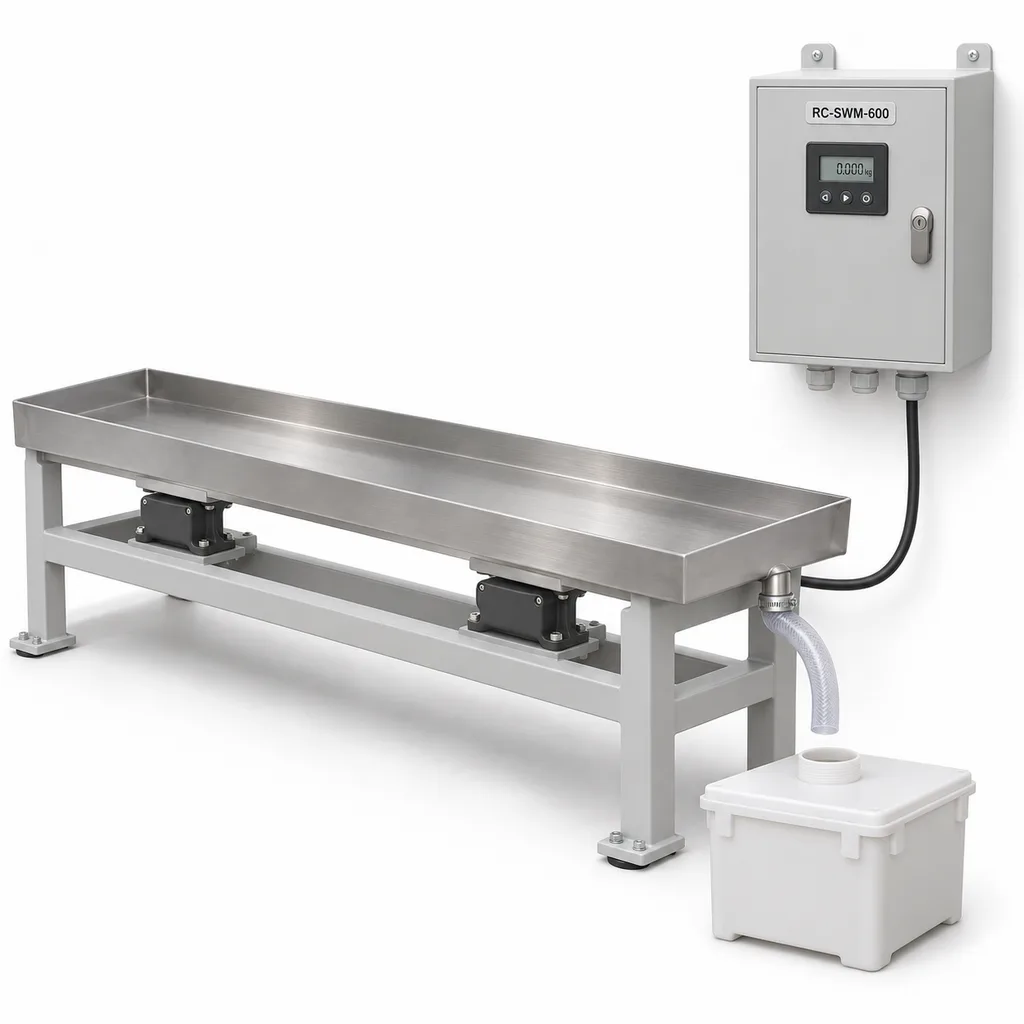
The RC-SWM-600 Substrate Weighing and Drainage Monitoring Station is an integrated irrigation measurement solution from REDCOAST.LTD for commercial greenhouses, container nurseries and horticultural research facilities. It combines a representative crop weighing platform, drainage measurement, water-quality sensing, an edge controller, a Web platform and a mobile App to show what happens between irrigation commands and actual substrate response. Growers can compare overnight mass loss, irrigation recovery, drainage onset and drain conductivity before adjusting their irrigation strategy. Designed for facilities with an existing electricity supply, the station uses mains power and connects to the installed irrigation controller through documented industrial interfaces.
Key Features
- Representative crop weighing: A 1,200 × 300 mm reference platform accommodates a substrate slab or a small group of containers, with a 100 kg gross weighing range including the platform tare.
- Separate drainage measurement: A gravity-fed tipping bucket records 5 mL increments and measures sample drainage independently of platform mass, helping distinguish retained water from collected outflow.
- Drain EC and temperature: Standard conductivity and temperature measurements help identify changing salt concentration in collected drainage; an optional pH channel adds acidity monitoring.
- Local irrigation requests: Configurable mass-loss thresholds, allowed irrigation windows and minimum intervals generate bounded requests to an existing controller, which retains pump and valve authority.
- Measurement quality flags: Overload, unstable weight, drain overflow, stale samples and missing upstream volume data are identified before values are used for automatic decisions.
- Retrofit connectivity: Ethernet and isolated RS-485 support documented Modbus integration, while optional LTE provides remote access where a wired internet connection is unavailable.
- Useful operating records: The Web platform and mobile App combine crop-group trends, drainage totals, calibration history, maintenance events and alarm acknowledgements.
- Project-specific hardware: REDCOAST.LTD develops the weighing acquisition, probe interface, isolated communications and supervisory I/O PCBs to match the selected sensors and host controller.
Technical Architecture
The reference package contains one weighing head, one drainage assembly and one wall-mounted controller; two-head and four-head configurations extend coverage to additional representative crop groups. Two industrial load cells support the removable weighing platform, while a nearby acquisition PCB provides regulated bridge excitation, a nominal 24-bit converter, filtering and temperature logging. Nominal converter resolution is an electronics specification, not a statement of weighing accuracy. Flexible irrigation tubing, slack signal cables and a freely discharging drain keep external forces away from the weighing platform; crop supports and trellis connections must also be assessed during commissioning.
Collected drainage falls through an air gap into a tipping-bucket assembly mounted independently of the weighing platform. The reference collector has a maximum inlet flow of 3.6 L/h; actual short-term drainage peaks must remain within that limit, even when the average daily flow is low. Water then passes through a small probe chamber, where EC, temperature and optional pH are measured. Chamber refresh time, probe immersion and sample age accompany the readings, so old standing water is not presented as fresh drainage. Removable screens and accessible wetted parts simplify cleaning without disturbing load-cell alignment.
The edge controller associates irrigation events with stable weight changes, drainage totals and imported applied-water records. Drainage fraction is calculated only when the delivered volume and collected drainage refer to the same sample and accounting window; values derived by scaling a zone meter are labeled estimates. Between irrigation events, changes in mass can indicate combined evaporation and transpiration, but drainage, harvesting, plant growth and external support forces also affect the result. Approved irrigation requests are issued locally with a validity flag and a bounded duration. On invalid sensor data, automatic requests are suspended and the host controller follows its independently commissioned fallback schedule.
Connectivity & Power
The station accepts AC 100–240 V, 50/60 Hz, through an isolated industrial supply, with 24 V DC distributed to the low-voltage field electronics. The reference mains-input budget is 12–20 W for one weighing head with EC, temperature and Ethernet, and a maximum design budget of 40 W for four heads with optional probes and LTE. Irrigation pumps, dosing equipment and valve power are supplied by their own control system. Mains power suits permanent greenhouse and nursery infrastructure; solar equipment is not part of this configuration.
Ethernet is preferred where a facility LAN is available. Two isolated RS-485 ports separate the measurement bus from a compatible host controller, and an optional LTE Cat 1 bis modem provides a carrier-dependent uplink. The interface package defines Modbus registers, units, timestamps, data-quality flags and request acknowledgements; MQTT over TLS and HTTPS support platform integration. Local acquisition continues during an internet outage, with 90 days of one-minute records allocated for four heads. A mains outage stops measurement and de-energizes the outputs; on restart, stable readings and valid host communication are required before new requests are permitted.
Protection & Reliability
The enclosure design target is IP65 with the door closed and specified cable glands installed. Selected load cells and sealed field electronics target IP67, while the open weighing surface and drainage inlet remain accessible process equipment. The controller operating target is -10 to +50 °C, but liquid measurement requires +5 to +45 °C and protection from freezing. These separate limits prevent an electronics temperature rating from being mistaken for a complete wet-system rating.
The cabinet and structural support use hot-dip galvanized steel beneath a smooth matte powder-coated finish; the wetted tray uses 316L stainless steel and the drainage body uses compatible engineering polymer. Coastal installations require a coating and fastener review, and exposed nursery installations need a rain exclusion arrangement that preserves representative crop conditions. Wind, spray, debris and contact with neighboring plants can disturb weighing, so stable foundations and physical isolation matter more than a nominal structural wind claim. A 24-month equipment warranty can be specified in the quotation, with probe consumables, calibration and chemical exposure conditions defined separately.
Application Scenarios
- Substrate vegetable greenhouses: Install a representative slab station in each materially different irrigation group. Operators compare recovery after a pulse with subsequent drainage and drying trends when adjusting start times and intervals.
- Container ornamental nurseries: Use a pot-tray configuration for representative containers within a sheltered production area. The station helps reveal differences between programmed irrigation and water retained by the selected sample.
- Tabletop berry production: Position a weighing head beneath a representative grow bag with its own drainage collection. The resulting record helps evaluate irrigation timing as crop size, radiation and picking activity change.
- Municipal plant production centers: Monitor nursery stock used for parks, streets and public landscapes. Shared dashboards let horticultural supervisors review irrigation behavior and maintenance across several production blocks.
- Substrate and irrigation trials: Place separate heads under matched treatments and record crop handling events. Researchers receive time-aligned mass, drain volume and water-quality data without treating a single sample as a statistically representative whole crop.
Case-style Examples
The following are illustrative engineering configurations, not claims of completed customer installations.
Existing greenhouse irrigation retrofit: A grower already has a reliable fertigation controller but lacks a direct view of substrate drying in two crop groups. A two-head RC-SWM-600 adds one representative slab per group, EC and temperature sensing, Ethernet reporting and read-only Modbus integration during the initial observation period. Staff compare overnight mass loss, morning recovery and delayed drainage before enabling supervised irrigation requests. The intended operational result is an auditable relationship between irrigation commands and sample response; water savings are measured against the site's baseline rather than promised as a fixed percentage.
Container nursery irrigation comparison: A nursery wants to understand why similar containers respond differently in two sheltered production bays. One four-head controller monitors two representative samples per bay, using pot-tray platforms, independent drainage collectors and optional pH channels. The deployment begins with physical checks for tubing tension, blocked drains and unequal emitter delivery, then records irrigation and maintenance events over a complete production interval. Staff can investigate whether differences follow irrigation delivery, substrate behavior or maintenance conditions; the system does not infer the cause from weight alone.
Customization & Selection Guide
Start with the crop arrangement, saturated sample mass, substrate dimensions, emitter count and expected peak drainage. Select a weighing platform that accommodates the complete sample with room for mature crop mass and retained water, while keeping the total within its gross capacity. Choose sampling locations by irrigation recipe, substrate type, crop stage and known hydraulic variation. One station represents its sample; the number of heads is not a guaranteed coverage area.
Use the standard EC and temperature package when the immediate need is drainage-volume and salinity-trend monitoring. Add pH where acidity trends affect the operating decision and staff can maintain the electrode. Buyers with an existing climate computer should provide its communication documentation and available I/O before selecting Modbus or relay integration. Begin in monitoring mode, establish usable thresholds from observed crop behavior, then enable automatic requests with the grower and irrigation integrator. Higher drain flows require a separately sized collection system and a revised measurement specification.
Deployment & After-sales
Installation starts with a level, rigid support beside a representative crop row, a protected mains connection and a clear gravity drain route. The technician verifies platform clearances, uses traceable test masses across several load points, checks drainage volume with a measured water dose and calibrates water-quality probes with suitable reference solutions. Commissioning also exercises sensor disconnection, overflow, internet loss, host communication loss and power restoration. The handover includes the wiring diagram, register map, calibration record, operating limits and a demonstrated fallback sequence.
An indicative project plan allows 2–3 weeks for interface and mechanical definition followed by 6–10 weeks for a first article after requirements are frozen; procurement, new PCB development and third-party testing can change that schedule. Production timing is confirmed after sample acceptance. Support can include remote configuration assistance, replacement sensor assemblies, documented firmware updates and operator training. Inspect drainage paths and platform freedom weekly at first, then adjust maintenance frequency to observed contamination and drift. Seasonal shutdown includes draining wet components and storing pH electrodes according to the probe manufacturer's instructions.
Standards & Compliance
The published configuration is a project engineering baseline. Numerical accuracy, environmental performance and ingress values are design or acceptance targets until verified on the ordered assembly; this page does not claim existing REDCOAST.LTD test reports or certification.
The electrical safety assessment should use the applicable provisions of IEC 61010-1:2010+A1:2016 for measurement and control equipment. EMC planning should use IEC 61326-1:2020, with the electromagnetic environment and performance criteria agreed for the installation. Enclosure ingress tests should follow IEC 60529 on the assembled enclosure, including its glands and connectors. Destination-specific conformity, radio approvals and material documentation are established for the supplied configuration; no legal-for-trade weighing approval is claimed.
The sensing approach has an established commercial basis: Priva's 2026 sensor overview describes combining weight, drainage, EC and optional pH for irrigation management. Aranet's greenhouse monitoring overview documents 50–100 kg weighing options and low-volume drainage sensing. These references support category and specification benchmarking, not validation of this proposed assembly.
Why REDCOAST.LTD
REDCOAST.LTD delivers the complete measurement and management solution: installed hardware, embedded firmware, the Web platform, the mobile App and integration with the project's irrigation infrastructure. Its in-house hardware development includes new PCB layouts and board-level design for load-cell acquisition, probe conditioning, isolated interfaces and power supervision. That capability lets the project adapt enclosure geometry, channel count, connectors, operating logic and software data models together. Project-specific engineering is supported by documented interfaces and acceptance checks, giving growers and integrators a clear path from a representative measurement point to maintainable irrigation feedback.
Contact REDCOAST.LTD with your crop layout, substrate dimensions, irrigation controller details and drainage conditions to request a tailored RC-SWM-600 configuration.
Specifications
Weighing System
- Measurement heads per controller
- 1 standard; 2 or 4 with expansion heads
- Reference weighing platform
- 1200 × 300 mm
- Gross weighing range
- 0–100, including platform tare and crop kg
- Displayed mass increment
- 10; display resolution is not measurement accuracy g
- Static weighing acceptance target
- ±50 after calibration at 20 ±5 °C, with stable loading and no external contact forces g
- Acquisition converter
- 24-bit nominal ADC with local bridge excitation and filtering
Drainage and Water Balance
- Drain volume increment
- 5 per tipping-bucket event mL
- Maximum collector inlet flow
- 3.6, including short-duration peaks L/h
- Collected-volume acceptance target
- ±5% over at least 1 L at 0.6–3.0 L/h, with clean water and a level collector
- Drain hose internal diameter
- 12, continuously falling gravity discharge mm
- Downstream probe chamber volume
- 150 nominal; readings include sample-age and immersion status mL
- Drainage fraction calculation
- 100 × collected drain volume / validated applied volume for the same sample and accounting window %
- Applied-volume data source
- Host Modbus record; zone-volume scaling is labeled estimated and requires verified emitter allocation
Drain Water Quality
- EC measurement range
- 0.00–20.00 mS/cm
- EC acceptance target
- ±(2% of reading + 0.05 mS/cm) at 25 °C after calibration with a clean, immersed probe
- Optional pH measurement range
- 2.00–12.00 pH
- Optional pH acceptance target
- ±0.10 at 25 °C after two-point calibration, using fresh reference solutions pH
- Liquid temperature range
- +5 to +45 °C
- Temperature acceptance target
- ±0.5 after calibration °C
- EC temperature compensation
- 25 °C reference; selectable coefficient 0.0–3.0%/°C
Control and Data
- Digital status inputs
- 4 isolated inputs for 24 V DC status signals channels
- Supervisory relay outputs
- 8: four request and four validity contacts; each 30 V DC, 1 A resistive maximum
- Local measurement update
- 1, with configurable stability filtering s
- Local archive capacity
- 90 days at 60-second intervals for four heads
- Irrigation request pulse
- 2–30; host acknowledgement required before another request s
- Minimum request interval
- 5–120 min
- Configurable mass-loss trigger
- 0.20–10.00; selected against sample mass and observed measurement variability kg
- Host communication timeout
- 5–60; automatic requests suspended after expiry s
Connectivity and Integration
- Ethernet
- 1 × 10/100BASE-T port
- Isolated RS-485
- 2: measurement network and host interface ports
- RS-485 serial rate
- 9600–115200 bit/s
- Reference field-bus length
- Up to 200 at 9600 bit/s with termination and suitable cable; 24 V conductor sizing verified separately m
- Optional cellular uplink
- LTE Cat 1 bis; modem bands and antenna selected for the installation's carrier
- Application interfaces
- Modbus RTU/TCP, MQTT over TLS 1.2 or later, HTTPS API and CSV export
Mains Power
- Input voltage
- AC 100–240 V
- Input frequency
- 50/60 Hz
- Field electronics supply
- 24 V DC SELV from an isolated supply
- Installed DC power-supply rating
- 60 W
- Reference operating consumption
- 12–20 at mains input, one head with EC, temperature and Ethernet W
- Maximum configured input budget
- 40, four heads with optional pH and LTE; irrigation actuators excluded W
- Mains protection arrangement
- Class I cabinet with protective-earth terminal, input fuse and separately protected DC branches
Construction and Environment
- Ingress protection targets
- IP65 controller enclosure; IP67 selected load cells and sealed field electronics; open wet paths excluded
- Controller ambient temperature
- -10 to +50 °C
- Wet-system operating temperature
- +5 to +45; freeze protection required outside this range °C
- Electronics humidity range
- 10–95, non-condensing inside electronics enclosures % RH
- Controller cabinet dimensions
- 400 × 300 × 180, height × width × depth mm
- Cabinet and support finish
- Hot-dip galvanized steel beneath smooth matte RAL 7035 powder coating
- Wetted materials
- 316L stainless steel tray and polypropylene drainage assembly
- Mounting arrangement
- Wall-mounted controller and independent crop-bench or floor-mounted weighing support
Capabilities — configurable per project
Specifications are tailored to each project — the options below show what we can support.
Sampling Geometry
- 1200 × 300 mm substrate-slab platform
- 600 × 400 mm container tray
- 1200 × 500 mm large-container platform
Measurement Coverage
- One representative crop group
- Two independent sample heads
- Four independent sample heads
Water-Quality Package
- Drain EC and temperature
- Drain EC, temperature and pH
- Drain EC/pH plus separate feed-water EC comparison
Host Integration
- Monitoring and data export
- Modbus irrigation requests with acknowledgement
- Relay requests with hardwired acknowledgement and validity contacts
Platform and Uplink
- Ethernet with hosted Web platform and mobile App
- Ethernet plus LTE with hosted Web platform and mobile App
- On-premises server with Ethernet and documented API
Related solution guidance

Environmental Monitoring
Deploy environmental monitoring stations with sensors, solar power, gateways, dashboards, alarms and data integration for city and industrial sites.
Solar IoT Guide
A design guide for solar-powered outdoor IoT: load calculation, battery autonomy, low-power firmware, telemetry and maintenance planning.
Solar Off-Grid IoT
Design solar-powered outdoor IoT systems with panels, batteries, controllers, low-power devices, gateways and remote power monitoring.
Frequently Asked Questions
What does substrate weighing tell a grower that a moisture probe does not?
Weighing records changes in the mass of the whole supported sample, while a moisture probe measures conditions near its sensing volume. Combining weight trends with separately measured drainage helps interpret irrigation recovery and subsequent drying. Weight alone does not directly measure volumetric water content or isolate plant transpiration from evaporation, drainage and crop handling.
Can the RC-SWM-600 work with an existing irrigation or fertigation controller?
It can exchange data and supervised requests through an agreed Modbus interface or relay contacts with acknowledgement signals. Compatibility requires the host's register map, signal voltages and operating sequence to be reviewed during project definition. The existing controller retains pump, valve, dosing and fallback-schedule control.
How is drainage percentage calculated, and why can the result be misleading?
Drainage percentage equals collected drainage volume divided by water applied to the same representative sample, multiplied by 100. Both quantities must use a suitable accounting window that includes delayed drainage. A whole-zone meter cannot provide the sample's delivered volume without validated emitter allocation and distribution assumptions; such results are labeled estimates.
How many weighing stations are needed for a greenhouse or nursery?
One controller accommodates one, two or four independent sample heads. Sampling should reflect differences in crop stage, substrate, irrigation recipe and hydraulic conditions, with repeated samples where variability justifies them. Coverage is determined by representative sampling rather than a fixed number of hectares per station.
Will monitoring and irrigation continue if the internet or mains supply fails?
Local acquisition and valid local requests continue during an internet outage, with stored records available for later upload. A mains outage stops the station and de-energizes its outputs. The host irrigation controller must have a commissioned fallback strategy, and the station requires stable measurements and valid host communication before resuming automatic requests.
Does drainage EC show the exact nutrient composition in the root zone?
No: EC indicates overall electrical conductivity and cannot identify individual nutrients. Collected drainage also differs from substrate pore water and can be affected by mixing and sample age. EC trends should therefore be interpreted with irrigation-water composition, crop observations and appropriate laboratory or substrate measurements.
What maintenance does a weighing and drainage monitoring station require?
Check that tubing, cables, leaves and crop supports do not impose unintended forces on the platform, and keep the collector and gravity drain clear. Verify weight and drainage volume periodically with suitable reference checks, and clean and calibrate EC/pH probes according to the selected probe documentation. Begin with weekly visual inspections and adjust the interval using recorded contamination and drift.