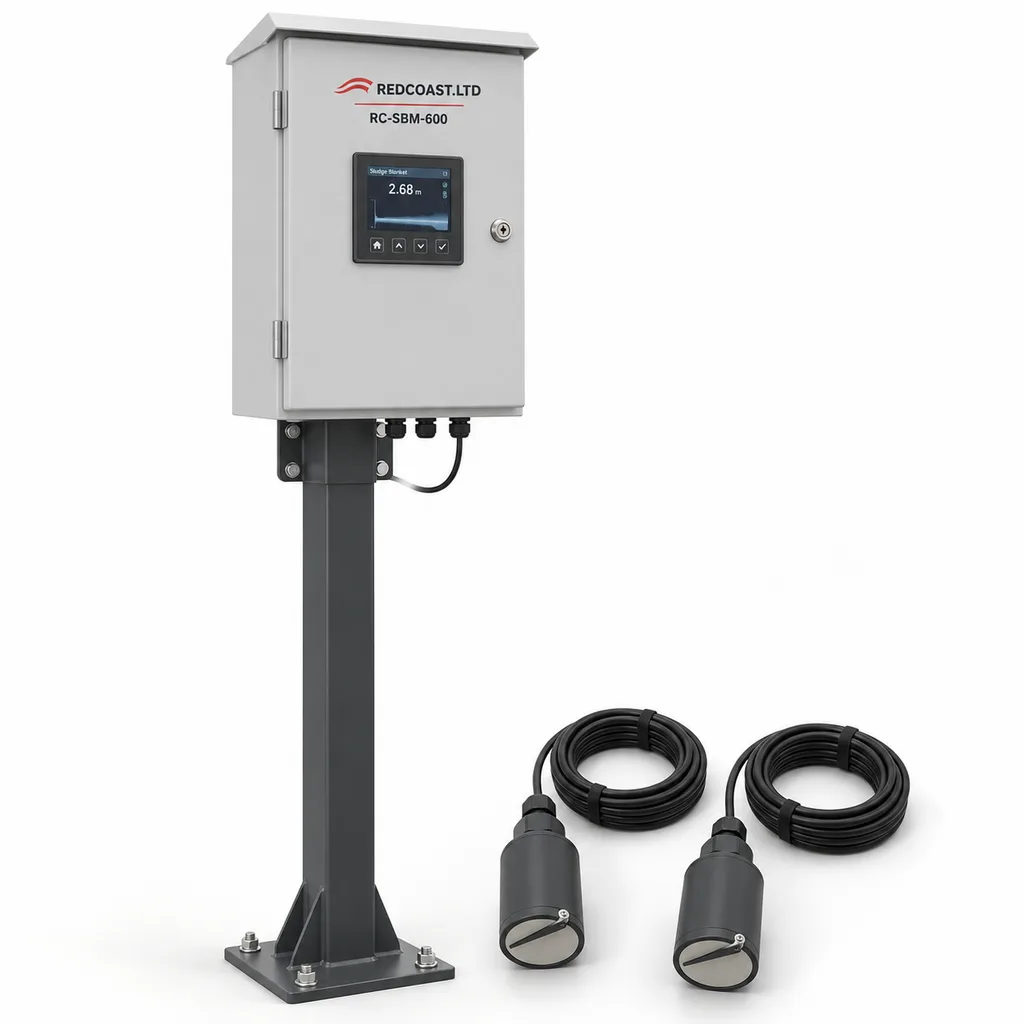
Overview
The RC-SBM-600 is a grid-powered sludge blanket monitoring and desludging coordination station for municipal wastewater plants, industrial treatment facilities, and reclaimed-water production sites. It measures the submerged boundary between clarified water and settled sludge, helping operators recognize rising blankets, investigate uneven settling, and coordinate sludge withdrawal before solids reach downstream treatment. REDCOAST.LTD combines field instrumentation, a purpose-designed control cabinet, a Web management platform, and a mobile App in one project-configured solution. Its reference configuration covers one or two measuring points, with local alarms and PLC interfaces that continue operating when the internet connection is unavailable. Specifications below define the proposed configuration and qualification targets; the selected sensor package, installation geometry, and acceptance tests establish the final project datasheet.
Key Features
- Two independent measuring points: Monitor two nearby basins or compare two positions within one clarifier, retaining separate depth, quality, alarm, and maintenance records.
- Useful process measurements: Display interface depth below the liquid surface and blanket height above the local tank floor, with an explicit measurement datum for each channel.
- Supervised probe cleaning: Coordinate the selected probe's automatic wiper, suppress measurements during cleaning, and report cleaning faults when diagnostic feedback is available.
- Local withdrawal requests: Apply configurable alarm persistence, hysteresis, minimum run permissions, and plant interlocks before sending a request to the existing sludge-handling PLC.
- Custom hardware designed by REDCOAST.LTD: Dedicated controller and isolated I/O PCBs accommodate project-specific signal conditioning, communications, diagnostic circuits, and cabinet layouts.
- Clear fault behavior: Distinguish excessive sludge height from weak echoes, stale readings, maintenance mode, and lost communication instead of treating every missing measurement as an empty basin.
- Integrated operations software: Basin trends, alarm acknowledgment, maintenance records, and configurable reports are accessible through the Web platform and mobile App.
- Practical retrofit interfaces: Ethernet, isolated RS-485, 4–20 mA inputs and outputs, and low-voltage relay contacts connect to existing treatment-plant automation.
Technical Architecture
A downward-facing ultrasonic probe is immersed below the water surface at a surveyed measuring position. The sensing package evaluates returning echoes to identify a solids interface; its transmitter supplies the measured distance and available diagnostic information to the station. This is an established measurement category: published instruments include a 0.3–10 m range for Endress+Hauser Turbimax CUS71D, while Xylem WTW IFL 700 IQ specifications distinguish 0.01 m resolution from 0.1 m accuracy. The RC-SBM-600 reference envelope is deliberately specified as 0.4–8 m from the probe face, with a ±0.10 m acceptance target under an agreed stable-interface test condition; display increments do not imply equivalent field accuracy.
REDCOAST.LTD develops the controller PCB, isolated analog acquisition and output circuits, protected communications interfaces, power supervision, and firmware that bring the measurement into the plant workflow. Specialist acoustic probes and their matching transmitters are selected for the process; proprietary sensor buses require the manufacturer's transmitter or a documented interface. For a fixed vertical installation, blanket height equals the surveyed probe-face-to-local-floor distance minus the measured interface distance. Interface depth below the water surface additionally requires the immersion offset, or a live surface-level input where water level varies. An uneven tank floor or moving bracket therefore requires a corrected datum rather than a universal tank-depth setting.
The edge controller validates timestamps and instrument status, applies filtering, and records measurement validity alongside each value. A sustained high blanket can generate an operator alarm and a withdrawal request, but the plant PLC retains pump protection, valve permissives, maximum operating time, and the approved process sequence. Invalid measurements inhibit new blanket-based requests; an active sequence transfers to the PLC's agreed fallback strategy. Secondary-clarifier return and waste sludge decisions remain coordinated with the plant's process controls. Cloud services provide fleet visibility, reports, and authorized configuration, while essential control remains local.
Connectivity & Power
Treatment plants and industrial sites normally have permanent electrical infrastructure, so this model uses AC 100–240 V, 50/60 Hz mains power. The reference cabinet budget is 18–30 W during normal two-probe monitoring, up to 45 W without heating, and up to 90 W with the optional 40 W anti-condensation heater operating. These figures cover instrumentation and controls; sludge pumps, valve actuators, and their motor-control equipment require separate supplies. An existing plant-backed instrument circuit can supply the cabinet where continuity is required.
Ethernet is the preferred connection to a plant network. Isolated Modbus RTU and 4–20 mA interfaces suit older PLC installations, while an optional 4G LTE Cat 1 bis modem provides remote access where fixed data wiring is unavailable. Radio bands and network approval must match the installation country. Modbus stays within the protected plant network; remote telemetry uses authenticated MQTT over TLS or an approved VPN gateway. The station buffers time-stamped records during communication outages and synchronizes them after reconnection. Cellular connectivity does not change the mains-powered installation.
Protection & Reliability
The cabinet is specified for an IP66 enclosure qualification target with its doors closed and all cable entries correctly assembled. Submerged probes are procured to an IP68 requirement with a declared continuous-immersion condition of at least 1 m; an IP designation alone does not define unlimited immersion depth. The reference ambient qualification target is -20 to +50°C at a shaded cabinet location, with the heater option below 0°C, while the wetted sensor operates in unfrozen process liquid from +1 to +50°C.
Above-water steel cabinet and pedestal parts use hot-dip galvanizing beneath a smooth matte powder-coated finish. Wetted materials are selected separately for sewage chemistry, with PVDF, 316L stainless steel, and compatible elastomers as reference options. Coastal salt exposure, corrosive vapors, intense sunlight, and chemical washdown require a specific materials and thermal review; the enclosure rating does not establish corrosion life. Pedestal anchorage and sensor arms are checked against local wind loading and the movement of scraper equipment.
Replaceable probes, terminal modules, seals, and wiper parts support repair without replacing the complete station. Commissioning establishes an inspection interval from actual fouling and signal-quality trends. Initial weekly visual checks can be extended when site records justify doing so. Warranty coverage, spare-part support, and response times are defined in the project quotation, with cleaning consumables identified separately.
Application Scenarios
- Municipal secondary clarifiers: Track blanket movement through daily inflow variations and identify persistent high levels. Operators review these trends alongside return-sludge flow, settling tests, and effluent measurements before adjusting the process.
- Primary settling tanks: Observe solids accumulation between withdrawal cycles and compare the response after extraction. The station provides a measured basis for reviewing timer schedules without replacing the pump controller.
- Industrial wastewater sedimentation: Monitor settling after coagulation and flocculation in a dedicated treatment area. Site trials establish whether the process produces an interface that ultrasound can resolve reliably.
- Reclaimed-water treatment facilities: Add upstream settling visibility before filtration and disinfection. A rising blanket alarm supports an earlier operational response, while downstream quality instruments continue to determine treated-water quality.
- Gravity sludge thickeners: Follow interface position during feed and withdrawal cycles. Where solids inventory or dry-solids throughput is required, pair the station with separate concentration and flow measurements.
Case-style Examples
The following are illustrative configurations, not reported customer installations or guaranteed savings.
Two-clarifier retrofit: A treatment facility relies on manual blanket checks once per shift and wants visibility between rounds. One RC-SBM-600 receives two probe-and-transmitter channels, exchanges status with the existing PLC over Ethernet, and retains independent trends for each basin. The intended result is a traceable view of how the basins respond to loading and withdrawal, with performance assessed against manual reference checks during the pilot.
Primary settling withdrawal review: An industrial plant uses a fixed extraction timer despite changing production loads. A single-probe station sends a sustained-high-blanket request through a relay, while pump availability, valve position, and maximum run time remain enforced by the plant PLC. Operators compare blanket response and measured withdrawal volume before approving any revised extraction sequence.
Reclaimed-water facility with limited data wiring: A site has mains power at the clarifier but no available network connection at the basin. A two-channel cabinet uses cellular telemetry for the operations team and hardwired signals for local automation. During a cellular outage, local alarms and permitted control continue, and buffered trend records are uploaded when communication returns.
Customization & Selection Guide
Start with the basin drawing, normal and minimum liquid levels, local floor elevation, scraper travel, expected sludge characteristics, and available mounting positions. A probe must remain submerged, maintain its specified near-field clearance, and have an unobstructed acoustic path. Air bubbles, heavy suspended solids, diffuse interfaces, floating debris, and internal structures can reduce measurement availability. A representative site trial is the appropriate selection step when these conditions dominate.
Choose one measuring point for a compact basin with a known settling pattern. Use two points to compare nearby basins or investigate spatial variation; two probes do not create a complete three-dimensional sludge map. Large or irregular basins may require additional stations and manual sampling. For a restricted budget, prioritize reliable installation, instrument diagnostics, and a usable PLC interface before adding remote connectivity.
Specify monitoring-only operation where the process strategy has not yet been validated. Add withdrawal requests after the operator has approved alarm thresholds, persistence, hysteresis, and fallback behavior. If an installed sensor is being retained, supply its exact model, transmitter, output configuration, and register map. REDCOAST.LTD can design a new PCB revision for the required channel count or interface arrangement, while sensor compatibility is confirmed against the actual device rather than assumed from its connector.
Deployment & After-sales
The cabinet mounts to a wall or a 1,000 mm pedestal adjacent to a safe access walkway. Sensor brackets allow retrieval from the walkway and are positioned clear of rotating or traveling scraper mechanisms. Installation includes protective earthing, cable segregation, drip loops, sealed glands, an accessible isolator, and a documented local measurement datum.
Factory acceptance covers I/O behavior, invalid-signal handling, cleaning status, communication loss, alarm delivery, and configuration backup. Site acceptance compares automatic readings with an agreed manual reference method under representative conditions and tests the complete PLC handoff. A steady reading alone does not establish a correct measurement.
For procurement planning, allow an indicative 10–14 weeks after requirements and interfaces are frozen for a custom electronics build and pilot preparation; sensor availability, qualification scope, and site access determine the contractual schedule. Delivery documentation includes wiring drawings, I/O schedules, interface maps, configuration backups, and maintenance instructions. Remote troubleshooting and technician training are arranged with the project support package.
Standards & Compliance
The qualification plan references IEC 60529, consolidated edition 2.2 for enclosure protection, IEC 61010-1:2010 with Amendment 1:2016 for applicable measurement and control equipment safety, and IEC 61326-1:2020 for electromagnetic compatibility. The applicable editions, installation category, test configuration, and destination-market requirements are fixed at design freeze. These references define a verification route and are not claims that this new configuration already holds certification.
The base configuration is for non-hazardous locations and does not carry an explosion-protection or functional-safety claim. Hazardous-area requirements require a separately engineered and assessed equipment package. Any required conformity declaration and radio approval must cover the delivered configuration.
Operational demand is supported by Xylem application note A202505, which documents a 64-clarifier sludge-level retrofit. EPA-hosted process-control training also identifies blanket monitoring as relevant to managing solids carryover. These sources support the application; site-specific alarm thresholds and performance acceptance remain process-engineering decisions.
Why REDCOAST.LTD
REDCOAST.LTD delivers the complete monitoring workflow: field hardware, custom electronics, embedded control, Web software, mobile App, and commissioning support. Its ability to develop new PCBs and perform board-level hardware design allows the solution to fit existing plant interfaces, enclosure constraints, diagnostic requirements, and maintenance practices. Customers can specify a coordinated system through one engineering scope, with clear boundaries between measurement, local automation, and supervisory reporting.
Contact REDCOAST.LTD with your basin drawings, sludge characteristics, existing PLC interfaces, and monitoring objectives to request a tailored RC-SBM-600 configuration.
Specifications
Measurement — Reference Configuration
- Measurement principle
- Submerged ultrasonic echo with matched sensor transmitter
- Measurement channels
- 1 or 2 independent probe channels
- Probe-face-to-interface range
- 0.4–8.0 m
- Displayed distance increment
- 0.01; resolution is not field accuracy m
- Interface accuracy target
- ±0.10 under an agreed stable-interface acceptance test m
- Measurement update interval
- 10–60, according to selected sensor package s
- Calculated process variables
- Interface depth below liquid surface; blanket height above surveyed local floor
- Normal probe immersion depth
- 0.2–1.0 below the operating water surface; verify the full water-level excursion m
Mains Power
- Input voltage
- AC 100–240, single phase V
- Supply frequency
- 50/60 Hz
- Normal operating power budget
- 18–30 for two probes, display, and Ethernet; heater off W
- Maximum power budget without heater
- 45 including instrument and communication peaks W
- Maximum power budget with heater
- 90 including optional 40 W heater; excludes pumps and actuators W
- Field instrument supply budget
- 24 V DC, 0.5 A total across both channels
Plant I/O and Hardware Interfaces
- Analog inputs
- 4 isolated channels, 4–20 mA
- Analog outputs
- 2 isolated channels, 4–20 mA; maximum 500 ohm load
- Digital inputs
- 6 dry-contact inputs for plant permissives and equipment status
- Relay outputs
- 4 SPDT signal contacts, 1 A at 30 V DC resistive; external motor control required
- Serial interfaces
- 2 isolated RS-485 ports; 9,600–115,200 baud
- Controller hardware
- Dedicated main controller PCB plus isolated I/O PCB
Local Control and Diagnostics
- Operating modes
- Monitoring only; alarm relay; PLC withdrawal request
- Alarm persistence setting
- 30–600 s
- Blanket-height hysteresis
- 0.10–1.00, bounded by the commissioned measurement span m
- Stale-data timeout
- 120–600; configured to at least three sensor update intervals s
- Scheduled cleaning interval
- 15–360 for sensor packages with a programmable wiper min
- Startup control inhibit
- 60–300 and until valid measurements are established s
Connectivity and Data
- Ethernet interface
- 1 × 10/100BASE-T
- Optional cellular interface
- 4G LTE Cat 1 bis; country-specific band selection
- Data protocols
- Modbus RTU; Modbus TCP; MQTT over TLS 1.2 or later
- Telemetry upload interval
- 1–15; alarms transmitted on event when connected min
- Local data retention target
- 90 days of two-channel summaries at 60-second intervals; 8 GB storage
- Local operator display
- 4.3-inch color HMI inside the lockable cabinet
Mechanical Installation
- Cabinet dimensions
- 600 × 400 × 250, height × width × depth mm
- Cabinet mounting options
- Wall mount or 1,000 mm pedestal
- Cabinet assembly weight target
- 18–25, excluding pedestal and probes kg
- Probe cable options
- 10 or 30, subject to the selected transmitter's cable limits m
- Steel surface treatment
- Hot-dip galvanized substrate plus 80–120 µm smooth matte powder topcoat
- Standard finish colors
- RAL 7035 light grey cabinet; RAL 7016 anthracite pedestal
Protection and Environmental Qualification Targets
- Cabinet ingress protection
- IP66 with doors closed and qualified cable entries
- Submerged probe protection
- IP68 procurement requirement; declared continuous immersion at 1 m minimum
- Cabinet ambient temperature
- -20 to +50 in shade; heater option required below 0 °C
- Process liquid temperature
- +1 to +50; unfrozen liquid °C
- Internal operating humidity
- 5–95, non-condensing % RH
- Reference wetted materials
- PVDF; 316L stainless steel; EPDM seals, selected for process chemistry
Capabilities — configurable per project
Specifications are tailored to each project — the options below show what we can support.
Measurement Package
- One probe and matched transmitter
- Two probes for adjacent basins
- Two probes for spatial comparison within one basin
Automation Scope
- Monitoring and reporting
- Local alarm contacts
- Interlocked withdrawal requests to the plant PLC
Network Connection
- Ethernet plant LAN
- Ethernet plus 4G telemetry
- Isolated serial and analog connection to existing SCADA
Mechanical and Environmental Package
- Wall-mounted shaded cabinet
- Pedestal cabinet with sunshield
- Heated cabinet for sub-zero ambient conditions
- Coastal coating and materials package
Custom Electronics and Software
- New PCB layout for project-specific I/O
- Sensor-transmitter protocol adapter
- Customer-hosted Web platform and mobile App
- Integration with the customer's maintenance system
Related solution guidance

Environmental Monitoring
Deploy environmental monitoring stations with sensors, solar power, gateways, dashboards, alarms and data integration for city and industrial sites.
Solar IoT Guide
A design guide for solar-powered outdoor IoT: load calculation, battery autonomy, low-power firmware, telemetry and maintenance planning.
Solar Off-Grid IoT
Design solar-powered outdoor IoT systems with panels, batteries, controllers, low-power devices, gateways and remote power monitoring.
Frequently Asked Questions
What does a sludge blanket monitoring station measure?
It measures the position of the interface between clearer water and settled sludge using a submerged ultrasonic sensing package. With a surveyed installation datum, the station calculates interface depth below the liquid surface and blanket height above the local floor. Changing water level requires a corresponding surface-level input if depth below the surface must remain accurate.
Can the RC-SBM-600 measure sludge concentration or dry-solids mass?
The ultrasonic interface measurement does not directly measure suspended-solids concentration or dry-solids mass. Concentration requires a separate suitable instrument, while mass calculations also require representative volume or flow data. The station can bring these additional signals into the same operational view through its available interfaces.
Can the station automatically operate a sludge withdrawal pump?
It can issue a configured withdrawal request after valid measurements exceed the approved threshold for the required duration. The existing PLC or motor-control system retains pump protection, valve permissives, maximum run time, and the process fallback sequence. The station's relay contacts are signal interfaces and do not supply pump motor power.
Is the 8 m measurement range the permitted probe immersion depth?
No: 0.4–8 m is the reference distance from the submerged probe face to the detected interface. Normal probe immersion is only 0.2–1.0 m below the operating water surface, subject to the selected probe's rating and the full water-level excursion. A 0.01 m display increment also does not imply 0.01 m accuracy; the reference accuracy target is ±0.10 m under the agreed stable-interface test.
What happens if the internet or mains power fails?
The station uses AC 100–240 V mains power and does not require solar equipment. Loss of internet connectivity leaves local measurement, alarms, and permitted PLC interfaces operating, with records buffered for later upload. If mains power fails, operation stops unless the cabinet is supplied from the site's backed-up instrument circuit; plant fallback behavior must be defined during commissioning.
Can existing sludge sensors and SCADA systems be retained?
Existing instruments can be assessed for connection through 4–20 mA, documented Modbus registers, or their manufacturer's transmitter. A proprietary probe bus is not automatically compatible with RS-485 simply because the wiring looks similar. Supply the sensor model, transmitter version, signal allocation, and SCADA requirements so compatibility can be checked before ordering.
How often does the ultrasonic probe need cleaning or verification?
The interval depends on biofilm, grease, bubbles, solids loading, and the selected cleaning mechanism. Begin with weekly visual inspections and periodic manual reference checks, then adjust the schedule using site evidence and the probe manufacturer's instructions. Automatic wiping reduces routine fouling but does not eliminate inspection, wear-part replacement, or verification after the mounting position changes.
Does REDCOAST.LTD develop the electronics or only assemble instruments?
REDCOAST.LTD develops the station's controller and isolated I/O PCBs, embedded firmware, Web platform, and mobile App. New board layouts can adapt channel counts, signal conditioning, communication interfaces, and cabinet dimensions to a project. Specialist acoustic probes are selected with their required transmitters, and the complete system is commissioned against the agreed process and interface requirements.