Overview
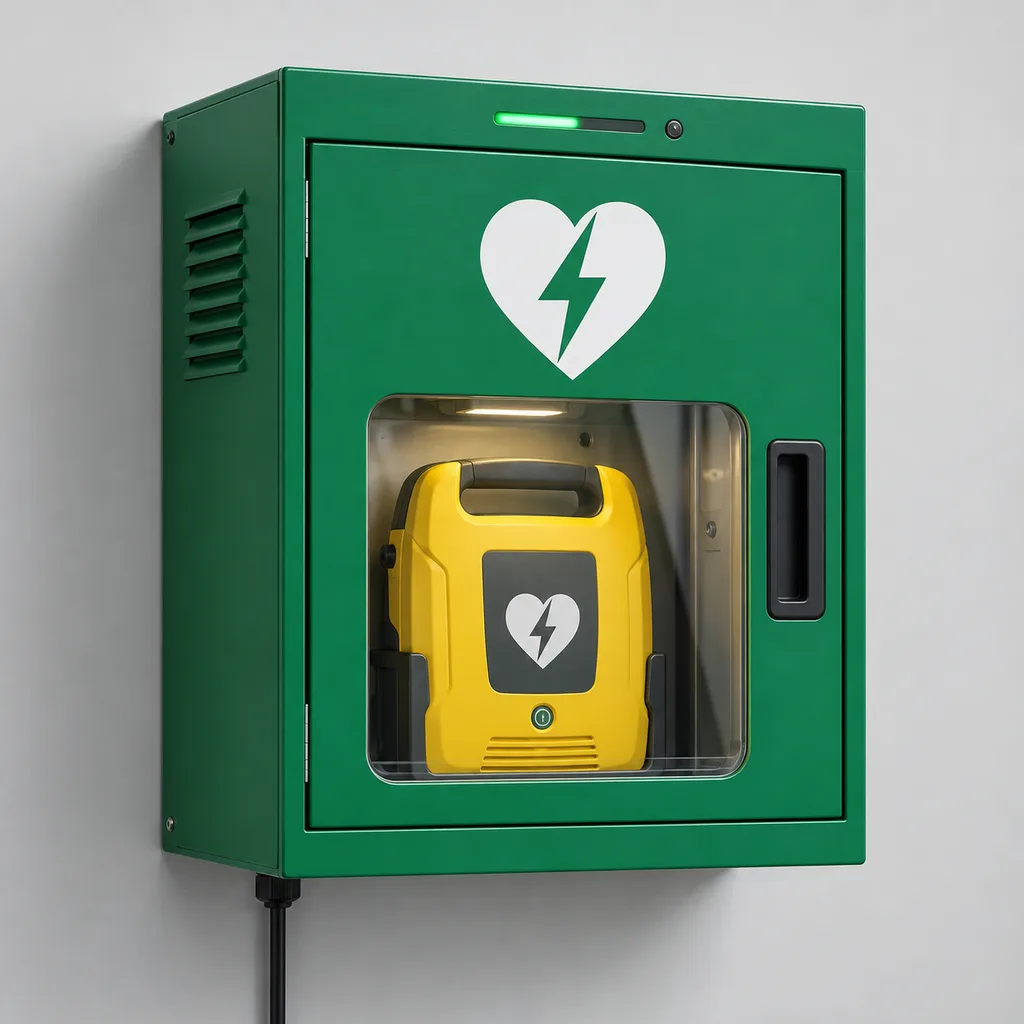
The REDCOAST.LTD RC-AED-300 is a connected outdoor cabinet for public access defibrillators (PADs). It runs on mains power and controls its own temperature. It is built for cities, transit operators, park and beach authorities, campuses, industrial parks and community defibrillator programs that keep an AED available outdoors 24/7. Most AED manufacturers specify a standby range of 0 to +50 °C. A basic unpowered cabinet lets the AED freeze in winter or overheat in direct sun, well outside that range. Owners also do not learn that an AED is missing, faulted or past its pad expiry date until the next monthly check, or worse, during a cardiac arrest. The RC-AED-300 keeps the AED inside a configurable +5 to +35 °C window and checks its presence and readiness around the clock. It reports every door opening, removal, fault and power interruption to a web platform and mobile app within seconds. Owners can prove the AEDs are ready, bystanders and emergency dispatchers can find them quickly, and the network needs far fewer routine site visits.
Key Features
- Active heating and cooling: an 80 W PTC fan heater (2 × 80 W on the arctic variant) and an optional 24 V thermoelectric cooler with a vented sun shield keep the AED, its battery and its electrode pads inside the manufacturer's standby range. Depending on the variant, this works in ambient temperatures from −40 °C to +55 °C.
- AED presence and readiness sensing: two presence sensors (an IR reflective sensor and a mechanical switch) and an optional optical sensor that reads the AED's own status light. 'AED missing' and 'AED needs attention' are reported as separate alerts.
- Unlocked by default, protected by an alarm: current resuscitation-council guidance says public AEDs should be reachable immediately, so the cabinet ships unlocked. Opening the door triggers a configurable strobe, a 100 dB(A) siren and a voice prompt in the local language telling the rescuer to call the local emergency number.
- Optional keypad or remote-release lock that always opens on power loss: if a site risk assessment requires a lock, a keypad code lock or a lock released remotely by a dispatcher or control room can be fitted. Both open automatically if power is lost, so the AED is never trapped.
- Dispatcher locator mode: the control room or a connected dispatch system can remotely switch on the cabinet's lit AED sign, strobe and voice prompt. A bystander sent to fetch the AED can find it in seconds, day or night.
- 24 h battery backup: an internal LiFePO4 battery keeps the controller, sensors, cellular link, interior light, sign backlight and alarms running for at least 24 hours if mains power fails.
- AED fleet platform and mobile app: a live map of every cabinet with readiness status, temperature history, pad and battery expiry tracking, guardian checklists, event logs and automatic SMS, e-mail, push and webhook alerts.
- Open integration: MQTT over TLS, HTTPS REST API, webhooks, RS-485 Modbus RTU and dry contacts. These let the cabinet share data with national AED registries, community first-responder platforms and building security panels.
- Low voltage only where the public can touch: mains wiring ends in a sealed service compartment that needs a tool to open. Everything a member of the public can touch runs at 24 V DC SELV (safety extra-low voltage).
- Wall, semi-recessed or free-standing pillar formats, with handles at or below 1,200 mm so the cabinet can meet wheelchair reach-range rules.
Technical Architecture
The RC-AED-300 runs on circuit boards designed by REDCOAST.LTD, not an off-the-shelf alarm module. Each board has one job:
- Main controller board: a low-power ARM Cortex-M microcontroller with a hardware watchdog, a real-time clock, a secure chip that stores TLS credentials, a 10,000-event memory log, and the cellular, Ethernet and Bluetooth interfaces.
- Thermal management board: two independent temperature sensors (a digital ±0.3 °C sensor plus a backup thermistor) and a humidity sensor. It drives the heater and the reversible thermoelectric cooler. A hardware thermal cut-out works even if the firmware stops.
- Power management board: converts AC 100–240 V to a 24 V DC SELV supply, charges and protects the LiFePO4 backup battery, provides surge protection and logs brown-outs.
- Signal and beacon board: drives the interior light, the backlit ILCOR AED sign and the strobe, plus an amplifier for the siren and voice prompts.
- Optional boards: a two-way SIP intercom with echo cancellation and a 2 MP event camera.
All safety functions run on the cabinet itself and keep working when the network is down. These include temperature control, door and presence detection, local alarms, the automatic lock release and power-loss handling. Events are time-stamped, stored, and uploaded to the cloud once the connection returns. To prevent condensation, the cabinet keeps the inside at least 3 °C above the dew point. Temperature control pauses while the door is open. If the inside temperature stays outside the set window for longer than a configured time, the cabinet raises a climate-fault alarm.
The cabinet sends data to the REDCOAST.LTD AED fleet platform over MQTT with TLS 1.2/1.3. Status check-ins are sent every 1 minute to 24 hours (configurable). Alarm events are sent immediately, typically in under 10 seconds over LTE or Ethernet: door open, AED removed, AED returned, readiness fault, tampering, power loss and climate fault. The platform alerts site guardians, produces monthly readiness reports and tracks pad and battery expiry dates entered or scanned in the mobile app. The same data is available through a REST API and webhooks for registries, dispatch systems and third-party dashboards.
Connectivity & Power
Connectivity: the standard module uses LTE Cat-1. LTE-M/NB-IoT versions are available where those low-power networks suit the operator or region better, and frequency bands are chosen for each destination country. A 10/100 Mbps Ethernet port suits building walls and campuses with existing networks. Cellular and Ethernet can run together, with one taking over if the other fails. Bluetooth Low Energy 5.x is used for on-site setup and guardian checks from the mobile app. On private campus networks, a LoRaWAN option can carry status and alarm messages, but not intercom audio or images. Two dry-contact outputs, two digital inputs and an RS-485 Modbus RTU port connect the cabinet to security panels, building management systems or an existing CCTV platform.
Power: the RC-AED-300 is designed for urban and campus sites with mains power and does not use solar panels. Input is AC 100–240 V, 50/60 Hz, through a dedicated 6 A breaker and 30 mA RCD. The supply must be live 24 hours a day, for example from a building distribution board or a smart-pole or street-furniture feeder. Do not use a street-lighting circuit that is switched off during the day. Average consumption is 3–8 W in mild weather. Peak demand while the heater or cooler runs is up to 110 W on the standard variant and up to 180 W on the arctic and hot-climate variants. During a power cut, the 12.8 V 6 Ah LiFePO4 backup battery keeps monitoring, communications, lighting and alarms running for at least 24 hours. The sign backlight dims automatically on battery to make the charge last. Heating and cooling do not run on battery. A mains-lost alert is sent as soon as power fails. For mild-climate sites on a building network, a version powered over IEEE 802.3bt PoE (Power over Ethernet) is available, with the heater limited to 60 W.
Protection & Reliability
With the door closed, the enclosure is rated IP65 (IEC 60529) against dust and water and IK10 (IEC 62262) against impact. The window is double-glazed, UV-stabilised, anti-fog polycarbonate rated IK08. Cabinet bodies are made from 2.0 mm marine-grade aluminium (5754) or 1.5 mm 316L stainless steel. Pillar stations use hot-dip galvanised steel against corrosion, finished with a smooth polyester powder coat or fluorocarbon paint. Coastal and desert versions add finishes tested for 1,000 h or more of salt spray (ISO 9227 NSS) and stainless fasteners. On the hot-climate variant, the cooler is a sealed unit whose cooling fan sits outside the IP65 compartment, and a vented sun shield reduces heat from direct sunlight. Pillar stations are bolted down on an M16 anchor cage and designed for 3-second wind gusts of at least 45 m/s.
An AED cabinet may sit unused for months and then has to work perfectly the one time it is needed. The reliability design follows from that:
- The controller tests its sensors, heater, cooler, siren and battery on a schedule and reports any failure.
- Any fitted lock opens automatically on power loss.
- The hardware thermal cut-out protects the AED even if the firmware stops.
- Electronic modules can be replaced on site.
The enclosure is designed to last at least 10 years and the electronics at least 8 years. The standard warranty is 3 years and can be extended to 5 years.
Application Scenarios
- City streets, squares and high streets: public AEDs on building walls, smart poles or free-standing pillars in busy pedestrian areas. Unlocked, alarmed cabinets give bystanders immediate access, and the platform shows the city which units are ready at any moment.
- Parks, beaches and waterfront promenades: busy outdoor areas often see extreme heat or cold. The hot-climate variant, with its cooler and coastal finish, protects the AED from sun and salt. Lifeguards or park rangers get an alert when the AED is taken.
- Transit hubs and park-and-ride sites: bus and rail stations, ferry terminals and interchanges need AEDs outside ticket barriers and outside staffed hours. Linking the cabinet to the operator's control room adds intercom calls, camera snapshots and dispatcher locator mode.
- University, corporate and industrial campuses: facilities teams manage dozens of AEDs across large sites. Ethernet, dry contacts into the security panel and the fleet platform replace paper checklists with time-stamped readiness records.
- Sports grounds, golf courses and event routes: athletes and spectators face a higher-than-average risk of sudden cardiac arrest. Pillar stations at pitch sides, clubhouses and along marathon or cycling routes are easy to spot and can be moved between seasons.
- Residential communities and rural villages: community-funded AEDs often rely on volunteer guardians. Automatic alerts for removal, faults, power loss and pad expiry let a small team look after many units with confidence.
Case-style Examples
Citywide public AED network. A city council wanted to grow from a handful of donated cabinets to 120 outdoor AEDs across a district. It had no reliable way to know whether each device was present and ready. The council chose RC-AED-300 wall cabinets for building walls and pillar stations for squares. All units were unlocked and alarmed, with LTE monitoring and readiness sensing. A live readiness dashboard and automatic pad-expiry reminders replaced the monthly paper checks. Missing or faulty AEDs are now reported within minutes instead of at the next inspection, and the list of AED locations is exported to the regional ambulance service's registry.
Hot-climate beach promenade. A coastal authority needed AEDs along a long seafront where summer shade temperatures often pass 45 °C and its old cabinets turned into ovens. It installed white RC-AED-300 pillar stations with the hot-climate cooler, vented sun shields and a 316L stainless steel body with fluorocarbon paint for the coast. They were powered from the promenade's 24-hour street-furniture supply. Inside temperatures stayed within the set window all summer. Lifeguard towers get a push alert whenever a cabinet opens, and the lit sign helps bystanders find the nearest unit.
Campus cabinets linked to a security control room. A university and science park wanted every outdoor AED connected to its existing 24/7 security team. Wall cabinets on building exteriors were connected by Ethernet, with LTE as backup. Dry contacts were wired into the access-control panel, and the optional intercom and event camera were routed to the control room. When a cabinet opens, the operator sees the camera snapshot and can talk to the rescuer. The operator then sends the on-site first-aid team while the caller is still on the phone to emergency services.
Customization & Selection Guide
- Climate variant (by the coldest and hottest temperature on site): standard (−30 to +45 °C) covers most temperate cities. Arctic (−40 to +40 °C, two heaters) suits sub-arctic and high-altitude sites. Hot-climate (−10 to +55 °C, with cooler and sun shield) is for desert, tropical and sun-exposed coastal sites.
- Mounting format (by site): surface wall mount for building walls. Semi-recessed kit where accessibility rules limit how far a cabinet may stick out into a walkway. Free-standing pillar (1,900–2,400 mm) for squares, parks and anywhere without a suitable wall.
- Access policy (after a local risk assessment): unlocked with alarm (recommended for public sites), keypad code lock, or remote-release lock controlled by a control room. All locks open automatically on power loss.
- Connectivity (by available infrastructure): LTE Cat-1 for street and park sites. Ethernet for buildings and campuses. Both together for backup. LoRaWAN only where a private network already exists.
- Budget tiers: Essential includes the heated cabinet, alarm, LTE monitoring and the platform. Connected adds optical readiness sensing, dispatcher locator mode and API integration. Pro adds the intercom, event camera, hot-climate cooling or pillar format, and an extended warranty.
- AED compatibility: the 450 × 380 × 180 mm compartment takes most mainstream AEDs. Send us the AED model when you enquire, and we will check the bracket, sensor position and optical readiness sensing against its datasheet.
Deployment & After-sales
Wall cabinets fix with four M8 anchors and take a 3-core mains cable through a rear cable gland. A qualified electrician usually installs one in one to two hours. Pillar stations sit on a 500 × 500 × 600 mm concrete foundation with a cast-in M16 anchor cage and an underground conduit for the mains cable. Setup takes about 15 minutes in the mobile app over Bluetooth:
- Scan the cabinet's QR code and assign it to a site.
- Enter the AED model and the pad and battery expiry dates.
- Set the temperature window and alarm behaviour.
- Run a self-test.
Standard configurations usually ship 4–6 weeks after order confirmation. Custom circuit board, enclosure or colour variants usually take 8–12 weeks, including prototype approval. REDCOAST.LTD provides installation drawings, wiring diagrams, remote diagnostics and over-the-air firmware updates. Spare parts stay available for at least 10 years, and integrators and operators get English-language technical support.
Standards & Compliance
- Electrical safety and EMC: designed to IEC 62368-1 and EN 55032 / EN 55035. Designed for CE (LVD 2014/35/EU, EMC 2014/30/EU, and RED 2014/53/EU for radio variants), UKCA and FCC Part 15 conformity, using pre-certified cellular modules.
- Environmental: RoHS 2011/65/EU and REACH-compliant materials.
- Enclosure protection: IP65 (IEC 60529), IK10 enclosure and IK08 window (IEC 62262), and ISO 9227 NSS salt-spray testing for coastal finishes.
- Signage: the universal ILCOR AED sign to ISO 7010 (E010), in ISO 3864 colours (RAL 6032 signal green).
- Accessibility: handle height at or below 1,200 mm, plus semi-recessed and pillar options. These support installations that follow wheelchair reach-range and protruding-object rules such as the 2010 ADA Standards.
- Scope: the RC-AED-300 is a storage, monitoring and alerting cabinet and is not a medical device. The AED inside carries its own medical-device approvals. REDCOAST.LTD does not make AEDs; the customer supplies them or buys them through local authorised distributors.
Why REDCOAST.LTD
REDCOAST.LTD delivers complete smart-infrastructure solutions: hardware, a web management platform and a mobile app, designed and integrated by one team for each project. Unlike cabinet resellers, we design our own hardware. The controller, thermal, power and signal boards in the RC-AED-300 are all REDCOAST.LTD designs. If your project needs a different lock, sensor, radio band, registry interface or building-system protocol, we can redesign the board instead of telling you it cannot be done. The same engineering team builds smart poles, SOS emergency call stations and public-address systems. Your AED cabinets can therefore share power, network and control-room integration with the rest of your public-safety equipment. You get one accountable supplier, a configuration built for your project and long-term support.
Tell us how many AEDs you plan to install, where they will go and the temperature range on site, and REDCOAST.LTD will propose an RC-AED-300 configuration and quotation for your public AED network.
Specifications
Cabinet & Mechanical
- AED Compartment (internal H × W × D)
- 450 × 380 × 180 mm
- Wall Cabinet (external H × W × D)
- 560 × 470 × 250 mm
- Pillar Station Height
- 1,900-2,400 (standard 2,100) mm
- Cabinet Handle Height (pillar)
- ≤1,200 mm
- Enclosure Material
- 2.0 mm aluminium 5754 or 1.5 mm 316L stainless; pillar: hot-dip galvanised steel, powder-coated / fluorocarbon-painted
- Window
- Double-glazed UV-stabilised polycarbonate, anti-fog
- Thermal Insulation
- 25 mm closed-cell PU
- Weight
- 18-24 (wall) / 60-80 (pillar) kg
Climate Control
- Interior Setpoint Window
- +5 to +35 (configurable) ℃
- Heater
- 80 W PTC fan heater (standard) / 2 × 80 W (arctic)
- Cooling (hot-climate variant)
- 24 V DC thermoelectric cooler, 60 W rated capacity, vented sun shield
- Ambient Operating Range
- -30 to +45 (standard); -40 to +40 (arctic); -10 to +55 (hot-climate) ℃
- Temperature Sensing
- Dual sensors: digital ±0.3 + NTC backup ℃
- Humidity Sensing
- 0-100 (±3) %RH
- Anti-condensation Control
- Interior held ≥3 above dew point ℃
Monitoring & Alarms
- AED Presence Detection
- IR reflective sensor + mechanical switch (dual)
- AED Readiness Sensing (optional)
- Optical sensor over AED visual status indicator (verified per AED model)
- Door Monitoring
- Dual reed switches
- Tamper / Tilt Detection
- 3-axis accelerometer
- Local Siren
- 100 dB(A) at 1 m, duration 0-180 s configurable
- Visual Alarm & Locator
- Red/white LED strobe + backlit ILCOR AED sign
- Voice Prompts
- Multi-language, configurable emergency number
- Event Log
- 10,000 events, RTC time-stamped
Connectivity & Integration
- Cellular
- LTE Cat-1 or LTE-M/NB-IoT (regional band sets)
- Wired Network
- Ethernet 10/100 Mbps, RJ45
- Local Commissioning
- Bluetooth Low Energy 5.x
- Cloud Protocols
- MQTT over TLS 1.2/1.3, HTTPS REST API, webhooks
- Field I/O
- 2 × dry contact out (1 A @ 30 V DC), 2 × digital in, RS-485 Modbus RTU
- Heartbeat Interval
- 1 min-24 h (configurable)
- Alarm Push Latency
- typically <10 s
Power (Mains)
- Input Voltage
- AC 100-240, 50/60 Hz V
- Average Consumption (no heating/cooling)
- 3-8 W
- Peak Consumption
- ≤110 (standard) / ≤180 (arctic, hot-climate) W
- Backup Battery
- LiFePO4 12.8 V 6 Ah (76.8 Wh) with BMS
- Backup Runtime (monitoring, comms, lighting, alarms; sign auto-dimmed)
- ≥24 h
- User Compartment Voltage
- 24 V DC SELV
- Surge Protection
- SPD 10 kA (8/20 μs)
- Optional PoE Input (temperate sites)
- IEEE 802.3bt Type 4, heater limited to 60 W
Protection & Reliability
- Ingress Protection
- IP65 (IEC 60529)
- Impact Resistance
- IK10 enclosure / IK08 window (IEC 62262)
- Coastal Finish Salt Spray
- ISO 9227 NSS ≥1,000 h
- Pillar Wind Resistance
- ≥45 (3-s gust) m/s
- Design Life
- ≥10 (enclosure) / ≥8 (electronics) years
- Warranty
- 3 standard, 5 extended years
Optional Modules
- SOS Intercom
- SIP full-duplex, echo cancellation, 3 W speaker + MEMS mic
- Event Camera
- 2 MP, snapshot burst on door open, privacy mode configurable
- Keypad Code Lock
- 4-6 digit code, remote code update, fail-safe on power loss
- Remote-release Lock
- Platform/API or dry-contact release, fail-safe
- Additional Compartment
- Bleeding-control / first-aid kit, 300 × 380 × 180 mm
- AED Tracker Tag
- LTE-M + GNSS clip-on tag for removed-AED location
Capabilities — configurable per project
Specifications are tailored to each project — the options below show what we can support.
Climate Variant
- Standard heated (-30 to +45 ℃)
- Arctic dual-heater (-40 to +40 ℃)
- Hot-climate thermoelectric cooling + sun shield (-10 to +55 ℃)
Mounting Format
- Surface wall mount
- Semi-recessed wall kit
- Free-standing pillar station 1,900-2,400 mm
- Smart-pole integrated bracket
Access Policy
- Unlocked with alarm (recommended)
- Keypad code lock (fail-safe)
- Remote-release lock via control room/API (fail-safe)
Connectivity
- LTE Cat-1
- LTE-M/NB-IoT
- Ethernet + LTE failover
- LoRaWAN (status/alarm only)
Add-on Modules
- SOS SIP intercom
- 2 MP event camera
- Optical AED readiness sensor
- Bleeding-control kit compartment
Related solution guidance
Power and Connectivity
How to choose power, battery, solar, NB-IoT, LTE, LoRaWAN, gateways and monitoring strategy for outdoor IoT infrastructure.

Environmental Monitoring
Deploy environmental monitoring stations with sensors, solar power, gateways, dashboards, alarms and data integration for city and industrial sites.
Campuses
Campus IoT for lighting, parking, safety, smart poles, environmental data and facility maintenance workflows.
Frequently Asked Questions
Should an outdoor public access defibrillator cabinet be locked or unlocked?
Current guidance from bodies such as the Resuscitation Council UK is that public AEDs should be kept in unlocked cabinets so they can be reached immediately. Code locks add delay, and evidence shows theft is uncommon. The RC-AED-300 therefore ships unlocked, with a door-open alarm, AED presence monitoring and an optional tracker tag. If a local risk assessment still requires a lock, a keypad lock or a remote-release lock can be fitted, and both open automatically if power is lost.
What temperature range does an AED need when stored outdoors?
Most AED manufacturers specify a standby range of about 0 to +50 °C; for example, Philips states 0–50 °C for the HeartStart FRx. Electrode pads and batteries also wear out faster at temperature extremes. A plain metal cabinet in direct sun can exceed this range within hours and can drop well below freezing in winter. The RC-AED-300 heats the compartment and, on the hot-climate variant, also cools it, keeping the AED within a configurable +5 to +35 °C window.
Which AED brands and models fit the RC-AED-300?
The 450 × 380 × 180 mm compartment takes most mainstream AEDs, including typical models from Philips, ZOLL, Stryker/Physio-Control, HeartSine, Cardiac Science and Mindray. Sizes and status lights differ between models, so REDCOAST.LTD checks the bracket, presence sensor position and optional readiness sensor against your AED's datasheet when you enquire. The cabinet works with any brand and does not tie you to one supplier.
How does a smart AED cabinet know whether the defibrillator is ready to use?
The RC-AED-300 always detects whether the AED is physically in the cabinet, using an IR reflective sensor and a mechanical switch. For AED models with a status light, an optional optical sensor placed over that light reports whether the device shows ready or needs attention. The platform also tracks pad and battery expiry dates and reminds owners before they run out.
What happens to a connected AED cabinet during a power cut?
The cabinet runs on AC 100–240 V mains and contains a 12.8 V 6 Ah LiFePO4 backup battery. During a power cut, the controller, sensors, cellular link, interior light, sign backlight and alarms keep working for at least 24 hours, and a mains-lost alert is sent immediately. Heating and cooling do not run on battery, so during long outages the platform also flags any temperature drift.
Can the cabinet integrate with ambulance dispatch, AED registries or a security control room?
Yes. The REDCOAST.LTD platform offers an HTTPS REST API, webhooks and CSV export to keep AED locations and status in sync with national registries such as The Circuit in the UK or PulsePoint AED in the US, subject to each platform's access rules. Dispatchers or control rooms can switch on the cabinet's locator sign and strobe remotely. Dry contacts, RS-485 Modbus and an optional SIP intercom connect the cabinet to building security systems.
Is a smart AED cabinet a medical device, and what certifications apply?
No. The RC-AED-300 is a storage, monitoring and alerting cabinet, not a medical device, and the AED inside carries its own medical approvals. The cabinet is designed for CE (LVD and EMC, plus RED for radio variants), UKCA and FCC conformity. It uses RoHS-compliant materials, has IP65 and IK10 enclosure ratings, and carries the ISO 7010 E010 / ILCOR universal AED sign.
How long does it take to install and commission an outdoor AED cabinet?
A qualified electrician usually takes one to two hours to fix a wall-mounted RC-AED-300 and connect it to a 24-hour mains supply with a 6 A breaker and 30 mA RCD. Pillar stations need a small concrete foundation with an anchor cage, which must cure before the pillar is mounted. Setup in the mobile app over Bluetooth takes about 15 minutes, including the AED model, expiry dates, temperature window and alarm settings.