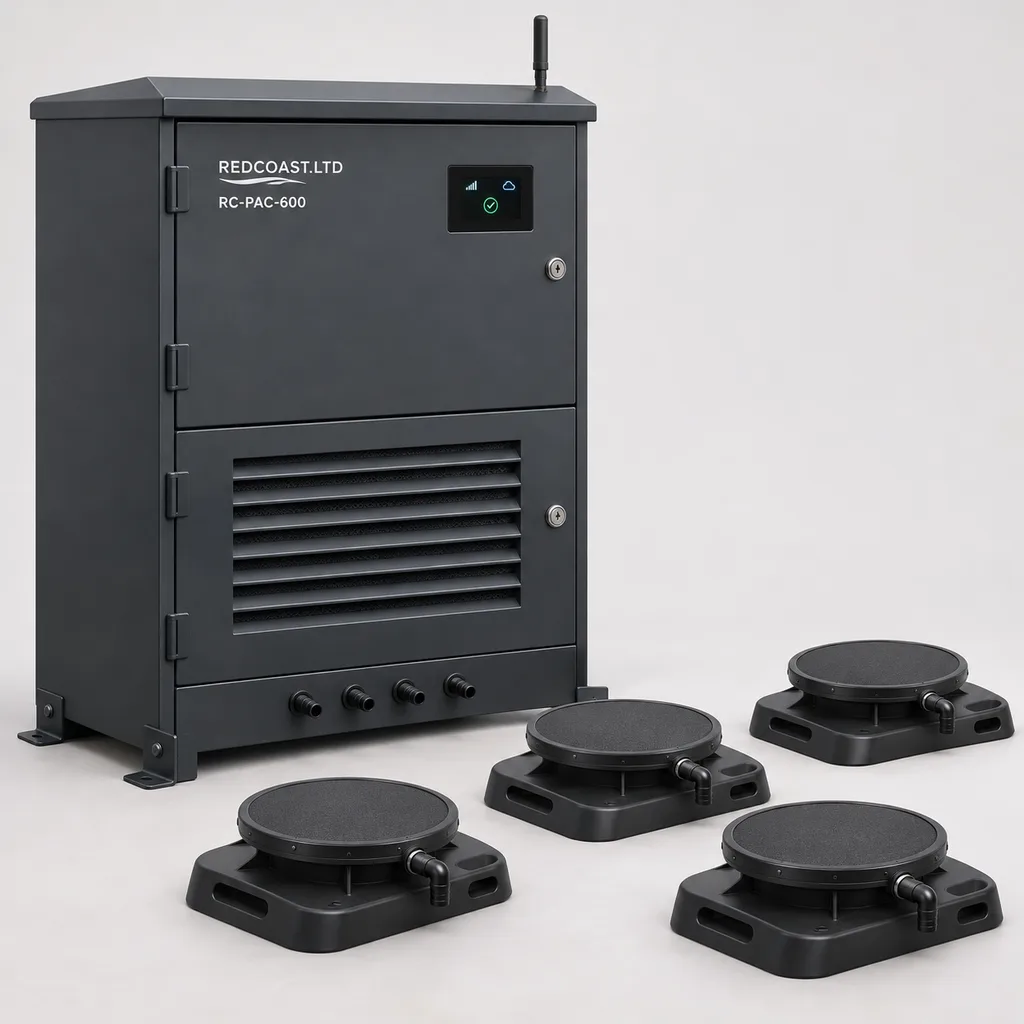
Overview
The RC-PAC-600 is a grid-powered pond aeration and dissolved oxygen control station for park authorities, campus operators, golf-course managers, irrigation reservoir owners, and water-management integrators. It combines shore-mounted air compressors, submerged diffusers, optical dissolved oxygen sensors, local control, and a Web platform with a mobile App. The system addresses a practical maintenance problem: operators need to know whether aeration is required, whether air is actually reaching the water, and whether a developing equipment fault needs attention. REDCOAST.LTD provides the complete project solution, including purpose-designed controller PCBs and board-level hardware adaptations for the selected sensors, electrical supply, and operating workflow.
Key Features
- Oxygen feedback with operating schedules: Combine measured dissolved oxygen, water temperature, minimum circulation periods, and seasonal schedules instead of relying on a timer alone.
- Two independently monitored air circuits: The reference package uses two oil-free compressors and four diffuser discs, allowing staged operation and separate pressure and airflow supervision.
- Direct evidence of aeration delivery: Compare compressor commands, contactor feedback, current, air pressure, and airflow to distinguish a stopped motor from a running compressor with a pneumatic problem.
- Custom electronics developed in-house: REDCOAST.LTD designs the main controller, isolated sensor interfaces, contactor-driver circuitry, and low-voltage power-distribution PCBs around the project requirements.
- Local operation during network outages: Stored schedules and permitted control rules continue at the station; measurements and events upload when connectivity returns.
- Serviceable shore installation: Compressors, filters, electrical protection, and balancing valves remain accessible from the bank, while weighted airlines feed the submerged diffuser assemblies.
- Actionable maintenance records: The platform links oxygen alarms, filter inspections, sensor cleaning, compressor runtime, and operator acknowledgments to individual assets.
- Measured operating cost: A dedicated energy meter records station consumption so owners can compare actual operating schedules without relying on assumed savings.
Technical Architecture
The reference configuration contains two independent pneumatic circuits. Each oil-free rocking-piston compressor supplies two EPDM membrane diffuser discs through a pressure sensor, airflow transmitter, non-return valve, manual balancing manifold, and weighted tubing. Rising bubbles transfer oxygen and induce circulation; the resulting water movement also changes temperature and oxygen distribution. Shore-fed diffused aeration is an established equipment arrangement, but diffuser placement and performance depend on depth and basin geometry. Manufacturer reference: Otterbine diffused aeration.
A dedicated controller PCB handles isolated RS-485 communications, analog pressure and airflow inputs, contactor feedback, and equipment alarms. A separate driver and power-distribution board supplies the 24 V DC control circuits; mains motors are switched through appropriately rated contactors and protected motor branches. Two optical dissolved oxygen probes with integral temperature measurement provide the standard feedback configuration. They are positioned at representative locations or depths outside the immediate bubble plumes, with accessible retrieval arrangements; an optional conductivity sensor supplies salinity compensation where needed. Optical sensing with replaceable caps and submerged installations is commercially established. Sensor reference: HORIBA process optical DO probe.
The controller checks reading freshness, sensor diagnostics, and configurable disagreement limits before accepting a control input. After commissioning, the lower valid oxygen reading can request additional aeration within the approved operating envelope; hysteresis, minimum running time, and restart delays prevent rapid cycling. Setpoints must be achievable at the water temperature, salinity, and local atmospheric pressure; calibration and compensation settings are recorded during commissioning. A persistent low-oxygen condition generates an operator alarm rather than an assumption that more runtime will solve every water-quality problem. Sensor failure invokes a commissioned fallback schedule and a maintenance alarm. Network loss preserves local control, while motor overload, excessive temperature, and excessive pressure retain local protective authority; a mobile command cannot override those interlocks.
Connectivity & Power
The station is intended for sites with an existing electrical service, including park maintenance areas, campus utility zones, and irrigation pump compounds. The reference build uses AC 220–240 V, single-phase, 50 Hz; a separately selected AC 208–240 V, 60 Hz motor and protection package serves compatible supplies. Frequency and voltage are fixed when ordering. The low-power electronics supply accepts AC 100–240 V, but that does not make the compressor motors universal-voltage devices. No solar array or energy-storage battery is included.
Ethernet is the default backhaul where a managed network reaches the site. An optional LTE Cat 1 modem supports locations with cellular coverage; the modem band set, antenna, and operator compatibility are selected for the installation. Local equipment communicates over isolated Modbus RTU, while the gateway uses MQTT over TLS and HTTPS for platform integration. Remote access includes role-based permissions, command expiry, and an audit trail; commissioning must verify the destination network and account configuration.
Energy depends on the measured load and actual duty cycle. For example, a combined compressor-and-fan load of 0.60 kW running for 12 hours, plus 0.02 kW of continuous electronics, uses approximately 7.68 kWh per day. This is a calculation example, not a promised daily consumption or saving. A grid interruption stops aeration; the platform identifies missed heartbeats, and any requirement for uninterrupted operation must be addressed in the site's electrical infrastructure.
Protection & Reliability
The enclosure separates a sealed electronics compartment with an IP66 design target from a filtered, ventilated compressor compartment with an IP54 design target. This distinction preserves the airflow needed to remove compressor heat. The standard operating envelope is +5 to +45 °C ambient with non-frozen water; colder locations require a separately engineered heater, condensate-management arrangement, and protected airline routing. High-temperature sites require a thermal assessment using the actual shade, solar exposure, filter condition, and compressor duty.
Fabricated steel cabinets and mounting brackets receive hot-dip galvanizing followed by a smooth matte exterior powder coat. Coastal options use an agreed fluorocarbon topcoat system and corrosion-resistant fasteners, with coating preparation and inspection requirements written into the purchase specification. Dust loading determines filter service frequency, while anchorage is designed for local wind and flood exposure. No universal salt-spray lifetime, wind-speed rating, or maintenance-free service life is implied.
Initial aeration of a strongly stratified pond requires particular care because mixing can bring oxygen-poor bottom water upward. The commissioning plan therefore includes temperature and oxygen profiling, a progressive startup schedule, and observation before full automatic operation. Manufacturer guidance also identifies winter icing and air-filter maintenance as application-dependent concerns. Kasco RobustAire installation and maintenance manual. Service planning separates consumable optical caps, filters, compressor wear parts, and electronics; warranty periods and exclusions are stated in the project quotation.
Application Scenarios
- Municipal park ponds: Install the cabinet in a maintenance area and monitor oxygen at representative points in the pond. Operators receive equipment and water-condition alarms alongside scheduled inspection records, helping them organize service before a routine fault remains unnoticed.
- Golf-course irrigation storage: Locate the station near an existing irrigation electrical service and distribute diffusers around the surveyed storage basin. The management team can review oxygen trends and aeration runtime together with irrigation withdrawals, while maintaining separate filtration and water-quality controls.
- Campus and business-park lakes: Use Ethernet connectivity to connect several ponds to a common facilities dashboard. Maintenance staff can compare equipment condition across locations and assign work orders without visiting every compressor cabinet daily.
- Managed stormwater amenity ponds: Monitor oxygen changes following runoff events and use the approved circulation schedule to manage aeration. The station complements sediment and nutrient management; it does not increase drainage capacity or remove pollutants by itself.
- Nursery and landscape irrigation reservoirs: Add monitored aeration to existing lined reservoirs where an electrical supply is available. Retrieve sensors and diffusers without damaging the liner, and keep irrigation disinfection, filtration, and agronomic water-quality decisions as separate treatment steps.
Case-style Examples
The following examples illustrate proposed configurations and acceptance methods; they are not claims of completed customer installations.
Park pond maintenance upgrade: A facilities team operates a pond with a surveyed working depth of 3–4 m and an existing bank-side electrical connection, but its aerator has only a manual timer. A proposed RC-PAC-600 installation uses two oxygen probes, four diffuser discs, Ethernet, and separate monitoring of both compressor circuits, followed by progressive startup and representative dawn measurements. The intended operational result is documented oxygen trends and earlier identification of lost airflow; acceptance compares baseline and post-commissioning profiles rather than promising a fixed percentage improvement.
Irrigation reservoir retrofit: An irrigation operator needs better visibility into a 4.5 m deep storage basin whose water level changes through the week. The proposed configuration adds cellular backhaul, a level-input interlock, retrievable diffuser bases, and a low-water limit that prevents operation outside the approved diffuser depth. Acceptance includes simulated sensor failure, blocked-airline detection, offline operation, and energy logging, giving the operator a tested maintenance workflow and a record of actual operating cost.
Customization & Selection Guide
Begin with a depth survey, pond outline, seasonal water-level range, inlet and outlet positions, and representative oxygen and temperature profiles. Add electrical supply details, compressor-to-water distance, airline routes, nearby noise-sensitive boundaries, and access constraints. Surface area alone is insufficient for equipment sizing. At 5 m water depth, static water pressure is approximately 49 kPa before tubing losses and diffuser resistance; therefore, compressor selection must use a delivery curve at the required backpressure rather than unrestricted airflow.
The reference package specifies 60–80 L/min of inlet-referenced air delivery per compressor at 60 kPa gauge pressure. The actual operating point depends on the selected compressor, supply frequency, hose length, and diffuser loading, and must be verified during acceptance testing. A larger basin may need additional stations or a different aeration technology. Deep natural lakes with cold-water habitat requirements need an ecological assessment because destratification can alter temperature distribution. Application reference: Mississippi State University Extension, updated August 2025.
For a cost-focused installation, use existing Ethernet and standard pressure, airflow, and oxygen instrumentation. For variable-salinity water, add conductivity measurement and verify the compensation method. Near occupied buildings, commission the installation against an agreed sound-pressure limit and provide the required acoustic enclosure treatment. A retrofit-only control package can retain suitable existing aeration equipment after its electrical interfaces, protection, airflow capability, and service condition have been checked.
Deployment & After-sales
Installation starts with an approved cabinet location above the site's design flood level, a suitable concrete plinth, protected electrical routing, and a diffuser layout. The electrical contractor establishes earthing, isolation, overcurrent protection, and the locally required residual-current protection. Airline and sensor routes remain clear of maintenance machinery, irrigation suction points, and public access paths. Liners require compatible ballast and retrieval methods, with no unapproved penetrations.
Factory acceptance covers I/O mapping, alarm logic, contactor feedback, data retention, network interruption, and protective shutdown behavior. Site acceptance adds measured airflow at operating pressure, sensor comparison against a calibrated reference, progressive startup, communications coverage, and an agreed observation period. Standard-component procurement, custom PCB prototyping, environmental testing, and software integration are separate schedule items; the quotation identifies their milestones and delivery dependencies. Handover includes wiring diagrams, an I/O list, maintenance instructions, configuration backups, and operator training. Remote diagnostics, replacement electronics, sensor-cap identification, and compressor service kits form the support scope.
Standards & Compliance
The numerical specification defines a proposed made-to-order configuration, with component selection and acceptance criteria finalized for each project. Enclosure ratings, environmental limits, measurement accuracy, and electrical performance require verification on the delivered configuration; this page does not represent a completed type-test report.
- Optical oxygen measurement: ISO 17289:2014 describes the optical method for dissolved oxygen measurement and is listed by ISO as confirmed in 2026. The project measurement procedure must address calibration, temperature, and salinity correction. ISO 17289.
- Ingress protection: IEC 60529 provides the enclosure protection classification used for the IP66 electronics-compartment and IP54 compressor-compartment targets. Testing must include the installed glands, vents, seals, and cable entries. IEC 60529.
- Electrical equipment: IEC 60204-1:2016 with Amendment 1:2021 is a design reference for the assembled machinery electrical system, subject to applicability and national adoption. The project also requires installation-specific protective-device coordination and electrical verification. IEC 60204-1.
- Electromagnetic compatibility: Select the applicable product-family requirements first. Where generic standards apply, IEC 61000-6-1:2016 addresses immunity for relevant public and commercial environments, while IEC 61000-6-3:2026 is an emissions reference where residential-location requirements apply. IEC immunity standard, IEC emissions standard.
Required conformity documentation, material declarations, radio approvals, and any third-party listing are defined for the destination and final bill of materials. Component approvals do not automatically establish compliance of the complete station.
Why REDCOAST.LTD
REDCOAST.LTD takes responsibility for the coordinated hardware, embedded control, Web platform, mobile App, and project integration scope. Its in-house hardware capability includes developing new PCBs and board-level designs to accommodate the required sensor interfaces, electrical isolation, contactor circuits, service diagnostics, and enclosure layout. Specialist compressors and sensing elements are selected for their documented performance, while the control architecture and operating workflow are engineered around the customer's installation. This allows owners and integrators to specify a coherent solution with clear interfaces, maintainable components, and testable acceptance criteria.
Contact REDCOAST.LTD with your pond survey, electrical supply, water-quality objectives, and integration requirements to request a customized RC-PAC-600 configuration.
Specifications
Aeration & Pneumatics
- Compressor arrangement
- 2 oil-free rocking-piston compressors; 2 independent air circuits
- Diffuser package
- 4 EPDM membrane discs, nominal 300 mm diameter; 2 per circuit
- Reference air delivery per compressor
- 60–80 at 60 kPa gauge; inlet reference 20 °C and 101.3 kPa absolute L/min
- Reference diffuser installation depth
- 2.5–5.0 below operating water level; hydraulic verification required m
- Normal operating pressure envelope
- 30–80 gauge; selected compressor curve governs flow kPa
- Weighted airline internal diameter
- 12 or 16, selected for branch length and flow mm
- Airline length per diffuser branch
- 25–100; pressure-loss calculation required m
Water & Equipment Sensing
- Dissolved oxygen measuring points
- 2 optical probes with integral temperature sensing
- Dissolved oxygen measuring range
- 0–20 mg/L
- Dissolved oxygen accuracy target
- ±0.2 mg/L or ±2% of reading, whichever is greater; after calibration
- Water temperature measurement
- 0–50; accuracy target ±0.3 °C
- Air pressure instrumentation
- 2 transmitters; 0–160 kPa gauge; accuracy target ±1% full scale
- Airflow instrumentation
- 2 transmitters; 0–150 L/min each; accuracy target ±3% full scale at stated reference conditions
- Optional water-level input
- 4–20 mA via an additional isolated input board; selectable 0–5 or 0–10 m sensor range
Local Control & Data
- Sensor polling interval
- 5 s
- Oxygen control setpoint range
- 2.0–10.0; commissioned for the water body mg/L
- Oxygen control hysteresis
- 0.5–3.0 mg/L
- Compressor minimum run / restart delay
- 10–60 / 3–15 min
- General-purpose I/O
- 4 isolated 4–20 mA inputs; 8 digital inputs; 4 relay outputs for control circuits
- Control relay rating
- 2 A at 24 V DC resistive; interposing contactors switch compressor motors
- Local data retention
- At least 90 days at 1-minute intervals for 20 logged channels
Connectivity & Platform
- Wired network
- 1 × 10/100BASE-T Ethernet
- Field serial interfaces
- 2 × isolated RS-485; Modbus RTU; 9,600–115,200 bit/s
- Optional cellular connection
- LTE Cat 1; destination-specific modem bands and SIM
- Application protocols
- MQTT over TLS 1.2 or later; HTTPS; optional Modbus TCP integration
- Normal telemetry interval
- 60–900; event-triggered alarm transmission when connected s
- Management interfaces
- Web dashboard; mobile App; CSV export; documented HTTPS API
Grid Power
- Standard mains input
- AC 220–240 V, single-phase, 50 Hz
- Alternative mains build
- AC 208–240 V, single-phase, 60 Hz; matched motors and protection
- Electronics power-supply input / output
- AC 100–240 V, 50/60 Hz / DC 24 V
- Reference compressor electrical input
- 0.45–0.65 per running compressor at selected duty point kW
- Station input-power design limit
- 1.50 with both compressors, electronics, and ventilation; excludes optional heating kW
- Monitoring electronics consumption
- 18–35, excluding compressors and cabinet fans W
- Power distribution
- 2 protected motor branches; lockable main isolator; Type 2 surge protection
Enclosure & Operating Environment
- Electronics compartment ingress target
- IP66; final assembled enclosure test required
- Ventilated compressor compartment ingress target
- IP54; final assembled enclosure test required
- Standard station ambient temperature
- +5 to +45; installation-specific thermal verification °C
- Operating water temperature
- 0 to +40; liquid, non-frozen water °C
- Submerged probe protection requirement
- IP68 for continuous immersion to 6 m with specified cable assembly
- Reference cabinet dimensions
- 900 × 1100 × 500, width × height × depth; excluding plinth mm
- Cabinet and bracket finish
- Hot-dip galvanized steel with smooth matte RAL 7016 powder coat; optional fluorocarbon topcoat
Capabilities — configurable per project
Specifications are tailored to each project — the options below show what we can support.
Aeration Package
- Two-compressor, four-disc reference package
- One-compressor, two-disc package after sizing
- Controller retrofit for verified existing aerators
Measurement Package
- Two optical oxygen and temperature probes
- Oxygen, temperature, and conductivity
- Oxygen, temperature, and reservoir level
Network Integration
- Ethernet to managed cloud platform
- LTE Cat 1 to managed cloud platform
- Ethernet to customer-hosted platform with Modbus TCP integration
Enclosure Treatment
- Standard ventilated cabinet with matte powder coat
- Coastal fluorocarbon topcoat and corrosion-resistant fasteners
- Acoustic treatment with verified cooling airflow
Board-level Customization
- Additional isolated analog sensor channels
- Additional motor-status and alarm I/O
- Customer-specific connector and service-test layout
Related solution guidance
Environmental Monitoring
Deploy environmental monitoring stations with sensors, solar power, gateways, dashboards, alarms and data integration for city and industrial sites.
Solar IoT Guide
A design guide for solar-powered outdoor IoT: load calculation, battery autonomy, low-power firmware, telemetry and maintenance planning.
Solar Off-Grid IoT
Design solar-powered outdoor IoT systems with panels, batteries, controllers, low-power devices, gateways and remote power monitoring.
Frequently Asked Questions
What is a smart pond aeration and dissolved oxygen control station?
It combines aeration equipment, water sensors, local controls, and remote management in one coordinated system. The RC-PAC-600 uses optical oxygen readings and approved operating schedules to control shore-mounted compressors, while pressure, airflow, and motor feedback help identify equipment faults. REDCOAST.LTD supplies the hardware, custom control PCBs, Web platform, and mobile App as a project package.
How large a pond can one RC-PAC-600 aeration station serve?
A dependable coverage figure cannot be determined from surface area alone. The reference configuration has two compressors and four diffuser discs for surveyed installation depths of 2.5–5.0 m, but sizing also depends on basin shape, oxygen demand, water turnover, and airline losses. Submit a depth survey and oxygen profiles so the diffuser arrangement and acceptance criteria can be calculated for the actual site.
Does this pond aeration system use solar power?
The RC-PAC-600 configuration described here uses an existing mains electrical supply and includes no solar panels or battery. Standard power is AC 220–240 V at 50 Hz, with a separately specified AC 208–240 V, 60 Hz build. Compressor motors and protection are selected for the ordered supply; the electronics' wider input range does not apply to the motors.
Can aeration remove algae or make irrigation water safe to drink?
This station does not provide filtration, disinfection, or guaranteed algae removal. Its function is monitored aeration and circulation, and any water-quality improvement must be assessed against the site's nutrient loading, sediment conditions, and oxygen demand. Drinking-water or reclaimed-water compliance requires the appropriate treatment processes and independent water-quality testing.
What happens if the internet, an oxygen sensor, or grid power fails?
Internet loss leaves approved local schedules and control rules operating, with data retained for later upload. An invalid oxygen reading triggers a maintenance alarm and the commissioned fallback strategy rather than an unrestricted demand for maximum aeration. Grid loss stops the compressors and controller; the platform can flag missed heartbeats, and restoration follows the configured restart sequence.
Can REDCOAST.LTD retrofit existing aerators and develop custom PCBs?
Yes, the project can retain suitable compressors and diffusers after checking their electrical protection, interfaces, airflow performance, and maintenance condition. REDCOAST.LTD can develop new controller and interface PCBs for additional sensors, equipment-status inputs, connector layouts, and integration requirements. The quotation separates retained equipment, new hardware, software integration, and acceptance testing.
What maintenance and commissioning does a diffused aeration station need?
Commissioning includes water-column profiling, progressive startup, airflow balancing, sensor comparison, and protective-function checks. Routine service covers optical-window cleaning, calibration checks, air filters, cooling passages, hoses, and compressor wear parts. Inspection intervals depend on fouling, dust, temperature, and runtime, and are documented in the project maintenance schedule.