Overview
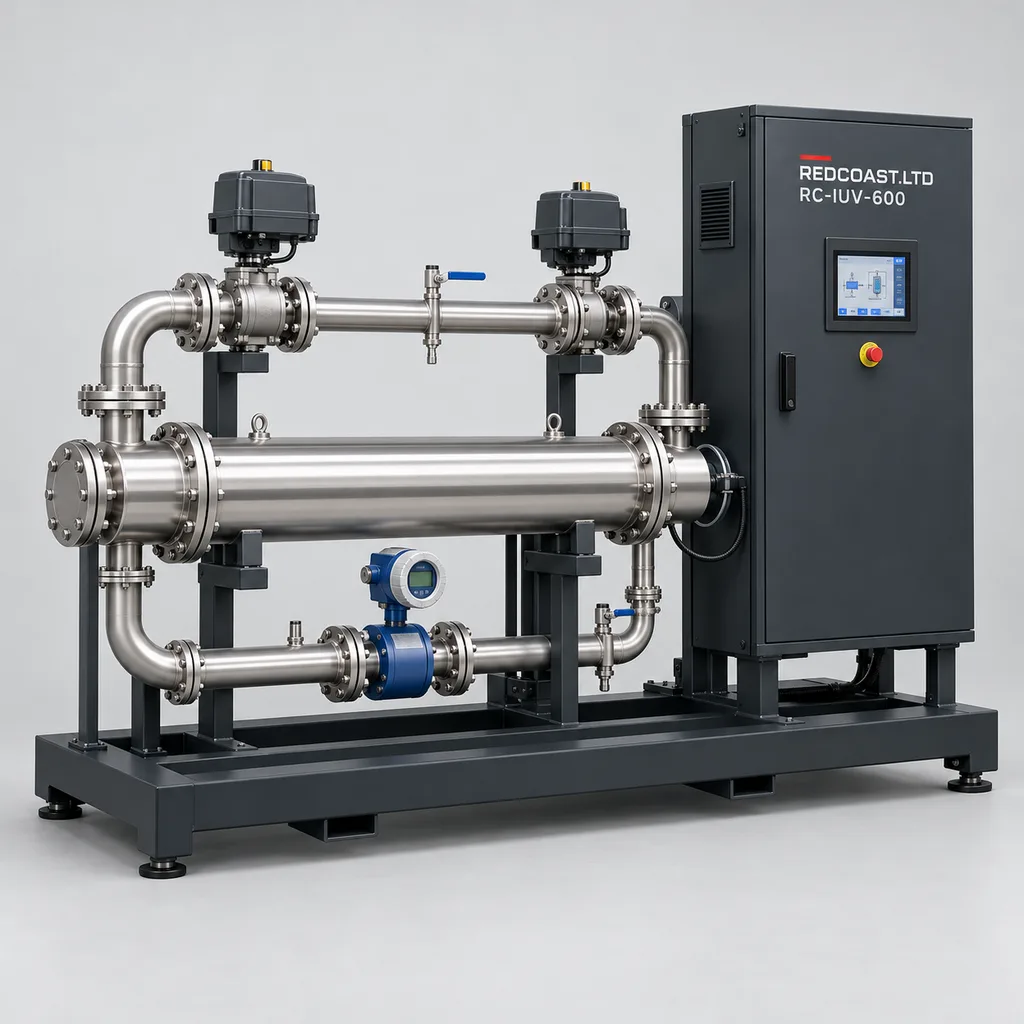
The RC-IUV-600 is a grid-powered reclaimed water UV disinfection and irrigation interlock skid for parks, campuses, commercial landscapes, nurseries, and managed estates. REDCOAST.LTD combines the treatment interface, local release controls, Web management platform, and mobile App into one project-configured solution. Installed after suitable upstream treatment and storage, it checks operating conditions before allowing water into the irrigation network and records interruptions that require attention. In-house controller PCB, isolated sensor-interface PCB, and valve-control board development allow the system to match existing pumps, irrigation controllers, and operator workflows.
Key Features
- Three hydraulic duty options: Select a 2, 5, or 10 m³/h design duty, with the permitted treatment flow established from the selected reactor's validation report and actual inlet water quality.
- Monitored UV treatment: Combine reactor UV intensity, lamp status, water temperature, flow, turbidity, and optional online UV transmittance measurements in a local operating-permission decision.
- Automatic irrigation isolation: A spring-return outlet valve, monitored return valve, and hardwired pump-permission contact coordinate startup, treatment faults, and power-loss shutdown.
- Purpose-built electronics: REDCOAST.LTD designs the application controller, isolated 4–20 mA acquisition circuits, RS-485 interfaces, actuator outputs, and equipment-health monitoring at board level.
- Independent local operation: The treatment sequence runs locally during an internet outage, while the gateway stores records and uploads them when communication returns.
- Useful maintenance records: Track lamp hours, starts, sleeve cleaning, sensor calibration, valve-position faults, and interrupted irrigation batches through the platform and App.
- Practical retrofit interfaces: Modbus RTU/TCP, dry contacts, and Ethernet connect the skid to irrigation scheduling, pump controls, and existing building or utility supervision.
- Serviceable installation: Flanged connections, isolation points, upstream and downstream sampling taps, accessible terminals, and removable instrument assemblies simplify inspection and maintenance.
Technical Architecture
The hydraulic assembly contains a closed-vessel UV reactor, electromagnetic flow meter, pressure transmitter, turbidity measurement point, temperature input, outlet isolation valve, and return connection. It receives previously treated, filtered water; upstream biological treatment, fine filtration, storage, and pumping are separate plant functions. The reference selection basis is inlet UV transmittance of at least 70% per centimetre at 254 nm and turbidity no higher than 2 NTU. These are preliminary engineering assumptions, not universal reuse limits: the selected reactor and project water-quality plan can impose stricter requirements. UV does not remove dissolved salts or replace the other treatment stages.
REDCOAST.LTD's custom control boards supervise the assembly while retaining the selected reactor manufacturer's validated lamp, ballast, sensor, and dose-monitoring arrangement. At startup, the irrigation outlet remains closed while the controller proves the return path, establishes the specified reactor conditions, and checks all required measurements. Irrigation permission is issued only after these conditions remain acceptable for the configured stabilization period. A lamp failure, excessive flow, invalid critical sensor, or out-of-envelope reading removes permission and initiates isolation and return sequencing. Manufacturer guidance explains why lamp warmup, reactor conditions, and monitoring must be considered together. UV operating guidance.
A dedicated local controller handles process decisions; an Ethernet/cellular gateway handles dashboards, notifications, and historical data. The supplied architecture uses a de-energize-to-stop pump-permission circuit and a spring-return irrigation valve, with position feedback. Valve travel, sensor response, sample transport, and water already downstream create a finite isolation delay; commissioning must establish that delay and any necessary hold-up or quarantine volume. The system therefore records actual interruption behavior instead of promising instantaneous exclusion of every off-specification water parcel.
Connectivity & Power
The standard electrical configuration uses single-phase AC 230 V ±10%, 50/60 Hz. Allow 0.4–1.8 kW for the selected UV package, controls, instruments, and valve actuators; the feed pump, upstream treatment, and optional climate equipment have separate loads. Internal controls use 24 V DC. A lockable isolator, protective bonding, branch protection, and coordinated surge protection form part of the electrical design. This configuration is intended for sites with permanent utility power.
Ethernet suits pump houses and campus networks; an optional 4G LTE router suits distributed landscape facilities with cellular coverage. Modbus runs on the local control network, while remote telemetry uses encrypted MQTT or HTTPS connections. Project delivery can include hosted management or an on-premises server, named user accounts, access permissions, and logged configuration changes. Loss of cloud access does not change the local water-release conditions. Loss of mains power closes the irrigation outlet and removes pump permission; restart requires the normal treatment checks.
Protection & Reliability
The electrical cabinet has an IP65 design target, subject to verification of the assembled enclosure, glands, display, and cooling arrangement. Standard operation is specified for a sheltered, frost-free location at +5 to +40 °C ambient, with process water at +5 to +35 °C. A canopy limits direct solar heating, but high ambient temperatures require engineered thermal management. Freezing sites require a heated enclosure and protected pipework or a verified seasonal drain-down procedure; a weatherproof cabinet alone cannot prevent frozen water.
The base frame and carbon-steel cabinet use hot-dip galvanizing beneath a smooth matte powder-coated finish. Wetted pipework and the reactor use 316L stainless steel, with seals selected against the water chemistry and cleaning agents. Coastal installations require a project-specific coating system, fasteners, and corrosion review. Sealed cable entries and a maintained enclosure protect electronics from dust, while the foundation and shelter are checked against local wind and flood conditions.
Maintenance follows the selected reactor's lamp-life limit and measured performance, not a blanket service-life claim. Sleeve fouling, UV sensor condition, valve operation, and calibration records remain visible to operators. Spare lamps, seals, actuators, and controller boards can be included in the service package; warranty duration and exclusions are defined in the supply agreement.
Application Scenarios
Municipal parks and public landscapes
Install the skid between a reclaimed-water storage outlet and the irrigation distribution header. Treatment permission can be linked to the existing watering schedule, allowing operators to distinguish a water-quality interruption from an ordinary scheduling delay.
Campus and business-park reuse networks
Connect an existing treated-water plant to distributed landscaping zones through a monitored release point. Facilities staff gain shared alarm and maintenance records without replacing the site's entire building management system.
Ornamental nurseries and propagation facilities
Place a selected UV package after suitable filtration in a recirculating irrigation system. Reactor selection must address the relevant plant pathogen and required reduction; a generic bacterial disinfection rating does not establish control of every fungal spore or plant disease.
Sports grounds and managed turf
Use the skid at the outlet of the reclaimed-water supply serving practice fields or landscaped areas. Operators can plan irrigation around maintenance windows and review which batches were released, interrupted, or recirculated.
Commercial estates with treated greywater
Add a monitored final UV stage after an appropriately designed greywater treatment process. The skid provides operating-condition supervision and irrigation isolation, while the wider treatment system remains responsible for the approved reuse quality.
Case-style Examples
The following are illustrative engineering scenarios, not claims of completed customer installations.
Campus irrigation retrofit: A campus requires 30 m³ during a six-hour overnight watering window. A 5 m³/h duty is the arithmetic minimum, so the project evaluates a 10 m³/h skid operated within its validated range to leave time for startup, interruptions, and maintenance. Ethernet connects it to facilities management, and a dry contact enables the existing irrigation controller only when treatment conditions are acceptable. The expected operational benefit is a documented watering sequence and a clear reason whenever irrigation is withheld; water savings depend on the wider reuse scheme.
Nursery recirculation upgrade: An ornamental nursery needs a 2 m³/h return-water treatment stage after filtration. Seasonal UVT samples and the target organism determine the reactor and operating setpoints, while a separate return line receives water during warmup or a treatment fault. The App schedules sleeve inspection and records calibration visits. Acceptance would require the agreed microbiological sampling and functional tests; a healthy dashboard indication alone would not establish pathogen reduction.
Customization & Selection Guide
Start with peak instantaneous flow, daily volume, irrigation window, available pressure, and the position of storage tanks. Size treatment against the simultaneous zone demand, not daily volume alone. Supply seasonal water analyses covering UVT, turbidity, suspended solids, hardness, iron, manganese, and the organisms relevant to the intended use. The Water Research Commission's irrigation UV study identifies the need to assess water chemistry, microorganisms, and irrigation hydraulics together. Irrigation UV selection research.
The initial selection range is a 40 or 80 mJ/cm² validated UV dose requirement. Neither value is a universal disinfection guarantee, and some reuse objectives require a higher dose or additional barriers. The reactor's documented operating envelope must cover the ordered flow, minimum UVT, lamp-aging allowance, and sleeve-fouling allowance. Online UVT is valuable where source quality changes; omitting it requires a monitoring method explicitly permitted by the selected validation approach.
Choose a single treatment train where irrigation can pause, or two independently isolatable trains where continuity justifies additional capital and service costs. Check return-line capacity, pump shutdown behavior, valve travel time, and surge pressure before finalizing the piping. UV provides no continuing disinfectant residual, so downstream storage and long distribution lines require their own hygiene and, where necessary, additional disinfection provisions. Wastewater UV design guidance.
Deployment & After-sales
Mount the skid on a level, drained foundation above the assessed flood level, inside a pump house or suitable weather shelter. Provide the specified lamp-withdrawal clearance, maintenance access, isolation valves, a permitted return or reject destination, electrical earthing, and communications. The installer must prevent potable/non-potable cross-connections and identify reclaimed-water pipework according to the project's requirements.
Delivery proceeds through water-analysis review, reactor selection, interface approval, panel and PCB engineering, assembly, factory tests, and site acceptance. The quotation defines the schedule after long-lead instruments, validation evidence, and customization are confirmed. A newly developed board or an unproven interface requires additional engineering and verification time.
Factory and site tests cover wiring, protective functions, instrument faults, valve feedback, power interruption, network loss, and the complete startup/shutdown sequence. Onsite acceptance also checks hydraulic behavior, sensor transport delay, calibration, and the approved sampling plan. Handover includes wiring diagrams, I/O mapping, operating instructions, backup configuration, and a spare-parts list. Remote diagnostics and App-based service records help the customer's maintenance team investigate faults and plan replacements.
Standards & Compliance
The published values describe the RC-IUV-600 configuration envelope and design targets. The order-specific datasheet identifies the actual reactor, instruments, electrical ratings, verified assembly protection, and supplied certificates; this product concept does not assert completed system certification.
ISO 16075-2:2020 provides project-development guidance for treated-wastewater irrigation, including water quality and protective barriers. ISO explicitly states that the series is not intended for certification. The applicable reuse authority and project risk assessment determine the accepted water quality, monitoring, and validation requirements.
Select reactor validation evidence appropriate to the intended reuse duty, such as an accepted NWRI or UVDGM-based evaluation where applicable. The 2025 Onsite Water Reuse Guidebook illustrates the relationship between validated UV operation, online monitoring, and assigned treatment credit; its local requirements are not universal product ratings.
Electrical design and testing can be specified against IEC 60204-1, including the applicable amendment, with enclosure testing against IEC 60529. Applicable EMC, radio, materials, and pressure-equipment obligations are established for the destination and final assembly. Component approvals do not automatically certify the complete skid.
Why REDCOAST.LTD
REDCOAST.LTD delivers the complete equipment, control software, Web platform, and mobile App as one coordinated solution. Its in-house PCB and board-level hardware development supports project-specific sensor channels, isolated interfaces, actuator control, power distribution, and diagnostics. This flexibility allows the package to fit existing infrastructure while preserving the selected UV reactor's validated treatment arrangement. Buyers receive an agreed hardware and software scope, traceable operating records, and a practical path from requirements to supported deployment.
Contact REDCOAST.LTD with your water analysis, peak flow, irrigation schedule, and interface requirements to configure an RC-IUV-600 solution for your project.
Specifications
Hydraulics and Process
- Nominal design flow options
- 2 / 5 / 10; permitted flow subject to reactor validation and inlet quality m³/h
- Operating pressure
- 1–6 gauge bar
- Process connection options
- DN40 / DN50 flanged
- Wetted materials
- 316L stainless steel; EPDM seals subject to chemistry review
- Process water temperature
- +5 to +35 °C
- Skid pressure-loss design target
- ≤0.5 at 10 m³/h; excluding upstream filters and external pipework bar
UV Treatment and Water Monitoring
- UV source
- Low-pressure high-output mercury/amalgam lamp; nominal 254 nm
- Validated UV dose selection requirements
- 40 / 80; project-specific reactor validation required mJ/cm²
- Reference minimum inlet UV transmittance
- 70; stricter reactor or project limit takes precedence % over 1 cm at 254 nm
- Reference maximum inlet turbidity
- 2; stricter reactor or project limit takes precedence NTU
- Turbidity instrument measurement range
- 0–20 NTU
- Optional online UVT measurement range
- 10–100 % over 1 cm at 254 nm
- Water sampling connections
- 2; upstream and downstream points
Grid Power
- AC input voltage
- 230 ±10% nominal; 207–253 operating range V AC
- Supply configuration
- Single-phase, L + N + PE
- Input frequency
- 50 / 60 Hz
- Configured skid operating load
- 0.4–1.8; includes UV and controls, excludes feed pump and climate equipment kW
- Control and instrumentation load
- 20–80; included in skid operating load W
- Internal control supply
- 24 V DC
Local Control and I/O
- Analog inputs
- 8 isolated 4–20 mA channels; 16-bit conversion
- Digital inputs
- 12 × 24 V DC; valve feedback, permissives, and equipment status
- Actuator outputs
- 6 × 24 V DC; 1 A per channel, 3 A combined maximum
- Dry-contact outputs
- 4; rated 2 A at 30 V DC for interposing control circuits
- Process evaluation interval
- 1; physical response also depends on sensors and valves s
- Trend logging interval
- 60; state changes logged as events s
- Valve power-loss positions
- Irrigation outlet: spring-return closed; return path: spring-return open
Connectivity and Operator Interface
- Ethernet interface
- 1 × RJ45, 10/100 Mbit/s
- Serial interfaces
- 2 isolated RS-485 ports; Modbus RTU
- Optional cellular uplink
- 4G LTE Cat 1 or Cat 4; destination-specific modem bands
- Network protocols
- Modbus TCP on local network; MQTT over TLS 1.2+; HTTPS
- Local trend retention
- 90 minimum at 60-second logging intervals days
- Local HMI
- 7-inch touchscreen; 800 × 480 pixels
Mechanical and Environmental Design
- Electrical cabinet ingress target
- IP65; assembled configuration verification required
- Standard ambient operating range
- +5 to +40; sheltered, frost-free installation °C
- Operating relative humidity
- 10–90, non-condensing % RH
- Frame and cabinet finish
- Hot-dip galvanized steel with smooth matte powder coating, RAL 7016
- Reference 10 m³/h skid envelope
- 2000 × 900 × 1700, L × W × H; finalized with reactor selection mm
- Reference maintenance clearances
- 1500 axial lamp withdrawal; 800 front access; verify selected reactor mm
Capabilities — configurable per project
Specifications are tailored to each project — the options below show what we can support.
Treatment Train Arrangement
- Single train with scheduled maintenance shutdown
- Two independently isolatable duty/standby trains
Water-Quality Instrumentation
- Validated UV-intensity setpoints with scheduled laboratory UVT checks
- Online UVT plus turbidity monitoring
- Online UVT, turbidity, and conductivity monitoring
Reactor Maintenance
- Manual sleeve-cleaning arrangement
- Manufacturer-approved automatic sleeve wiping
Software Deployment
- Hosted Web platform and mobile App
- On-premises management server
- Customer SCADA integration with documented data mapping
Installation Environment
- Sheltered frost-free pump house
- Engineered heated enclosure and protected pipework
- Coastal coating and corrosion-resistant hardware package
Related solution guidance
Environmental Monitoring
Deploy environmental monitoring stations with sensors, solar power, gateways, dashboards, alarms and data integration for city and industrial sites.
Street Lighting Guide
A practical guide to choosing smart street lighting controllers, connectivity, platform features, dimming logic and acceptance tests.
Solar IoT Guide
A design guide for solar-powered outdoor IoT: load calculation, battery autonomy, low-power firmware, telemetry and maintenance planning.
Frequently Asked Questions
What water can the RC-IUV-600 treat?
It is configured for previously treated and suitably filtered water intended for an approved irrigation reuse application. Reactor selection requires seasonal water-quality data and a defined treatment objective; raw sewage and uncharacterized greywater are outside the standard configuration. UV does not remove salinity, suspended solids, or dissolved chemical contaminants.
How do I choose between the 2, 5, and 10 m³/h configurations?
Start with peak simultaneous irrigation demand and the time available to deliver the daily volume. The selected reactor must achieve the required validated dose at that flow and at the specified minimum UVT, including the applicable aging and fouling allowances. Pipe diameter or lamp wattage alone cannot establish treatment capacity.
Is a UV dose of 40 mJ/cm² sufficient for every reuse project?
No; the required dose depends on the target organisms, reduction objectives, source water, and accepted validation method. The 40 and 80 mJ/cm² options are selection requirements, not universal pathogen-removal guarantees, and some projects need higher doses or additional treatment barriers. The relationship between validation and treatment credit is illustrated in the [2025 Onsite Water Reuse Guidebook](https://www.sfpuc.gov/sites/default/files/documents/OnsiteWaterReuseGuide2025.pdf).
Can the skid work with an existing irrigation controller and pump?
Yes, the proposed interfaces include a hardwired irrigation-permission contact and Modbus RTU/TCP for status exchange. The project must verify pump stopping behavior, valve timing, return-line capacity, and the consequences of interrupted watering. Existing irrigation scheduling remains in place while the skid determines whether its treatment conditions permit release.
What happens when internet access or mains power fails?
An internet outage leaves local treatment control active and queues records for later upload. A mains failure removes pump permission and returns the irrigation outlet valve to its closed position. Valve movement is finite, so commissioning must verify the actual isolation time and management of water already in the downstream pipe. Restart follows the normal warmup and operating-condition checks.
Does UV protect water throughout a long irrigation network?
UV provides treatment within the reactor and does not leave a continuing disinfectant residual. Downstream tanks, dead legs, and pipework therefore need their own hygiene provisions and may require additional treatment under the project reuse plan. The system should be positioned and commissioned with those downstream risks in view.
What maintenance is required?
Maintain lamps and sleeves according to the selected reactor's documented limits, and inspect fouling based on actual water conditions. Calibrate the instruments, exercise the isolation and return valves, and verify their feedback signals at the agreed maintenance intervals. The Web platform and App record these activities, but they do not replace physical inspections or microbiological sampling.
Does REDCOAST.LTD develop its own hardware for this product?
Yes; REDCOAST.LTD can develop project-specific controller, isolated sensor-interface, actuator-control, and power-distribution PCBs together with firmware and the management platform. The UV reactor, lamps, ballast, and dose-monitoring arrangement are selected and retained within their documented validation conditions. This combines board-level customization with an evidence-based treatment selection process.