Overview
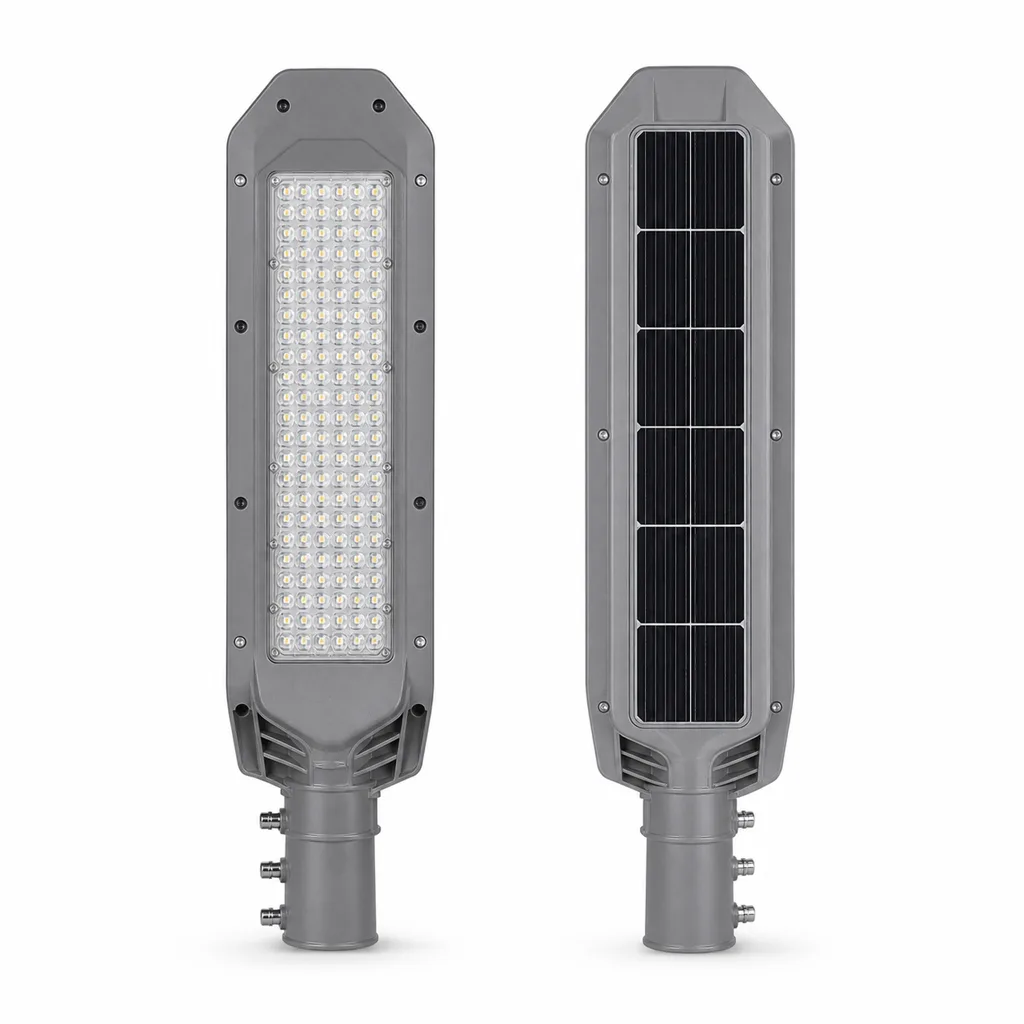
The Redcoast RC-SSL-200 is an all-in-one integrated smart solar LED street light: the monocrystalline solar panel, LiFePO4 battery, MPPT charge controller, LED light engine, motion/photocell sensors and optional IoT module are built into a single weatherproof aluminum housing that bolts onto a standard pole arm. It is designed for sites where extending the grid is slow, costly, or simply impossible — new residential roads, perimeter and access roads, parks, rural villages, industrial yards, parking lots and highway service areas. By removing trenching, cabling and metering, it cuts civil works to almost nothing and delivers fully autonomous dusk-to-dawn lighting that keeps working through cloudy spells and power outages. For operators it solves three pain points at once: high installation cost, unreliable grid supply, and the operational blindness of conventional solar lights that fail silently in the field.
Key Features
- True all-in-one design — panel, battery, controller, LED and sensors in one sealed body; one-bolt mounting, no exposed wiring, installed by two people in minutes.
- High-efficacy LED engine delivering up to 200 lm/W with configurable 30–200 W output for road classes from footpaths to main carriageways.
- Long-life LiFePO4 storage rated for 3,000+ cycles (8–10 years) with an integrated BMS for over-charge, over-discharge, temperature and cell-balancing protection.
- MPPT solar charging with ≥98% conversion efficiency, harvesting more energy than PWM controllers in weak-light and high-temperature conditions.
- Smart adaptive dimming — microwave radar + PIR motion sensing brightens the light when people or vehicles approach and dims to a safe baseline when the area is empty, stretching autonomy.
- Multi-rainy-day autonomy of 3–7 consecutive cloudy days depending on battery configuration, with automatic power budgeting to protect the battery.
- Optional remote management via 4G/NB-IoT/LoRa, reporting battery state, solar yield, fault alarms and allowing remote dimming schedules from the Redcoast web and mobile platform.
- IP66 / IK09 ruggedization with die-cast aluminum housing and tempered glass for coastal, desert, dusty and high-humidity environments.
- Tool-free maintenance — battery and electronics accessible without removing the fixture; modular design simplifies field service.
Technical Architecture
The RC-SSL-200 is a self-contained energy system. By day, the monocrystalline panel feeds the MPPT controller, which continuously tracks the panel's maximum power point and charges the LiFePO4 pack through the BMS. An onboard microcontroller runs the energy-management firmware: it estimates remaining state of charge, predicts the night's load from the selected dimming profile, and trims output if recent solar harvest has been poor — so the light never goes fully dark before dawn. At dusk the photocell switches the LED engine on; the radar and PIR sensors then modulate brightness in real time, holding a low standby level and ramping to full output on detected motion.
The control logic supports multiple time-segmented dimming stages (for example 100% / 60% / 30% across the night) combined with motion override, which is the single biggest lever on autonomy. Where remote management is specified, an optional communication module pushes telemetry — battery voltage and SoC, daily solar energy, LED runtime, controller temperature and fault codes — to the Redcoast cloud. Operators see each fixture on a map, receive alarms (battery degradation, no-charge, sensor fault), and edit dimming schedules over the air for one light or a whole batch. Edge logic keeps the light running normally even if connectivity drops; the cloud is for visibility and control, not for basic operation.
Connectivity & Power
Power is fully off-grid by default: integrated monocrystalline PV (50–180 W class, ≥22% cell efficiency) and a LiFePO4 battery sized to the lighting load. For sites that do have intermittent mains, a hybrid variant can accept a DC grid-assist input to top up the battery during long monsoon periods — useful in regions with seasonal heavy rain. Connectivity is optional and chosen to match the deployment: NB-IoT for dense urban roll-outs needing low-power, carrier-grade coverage; 4G/LTE where higher data rate or legacy network reach matters; and LoRa for private, gateway-based networks across campuses, industrial parks or rural clusters with no reliable cellular. Lights without any module run as standalone smart luminaires with onboard sensing and scheduling.
Protection & Reliability
The luminaire carries an IP66 ingress rating against dust and heavy water jets and an IK09 impact rating against vandalism and debris. The die-cast aluminum housing doubles as a heat sink to keep LED junction temperature down and extend the rated 50,000-hour engine life. The system operates from -30 °C to +60 °C; the BMS suspends charging below freezing to protect the lithium cells and re-enables it as temperature recovers. Optional anti-corrosion coating and stainless fasteners are available for coastal salt-fog and high-humidity sites, and conformal-coated electronics resist dust and condensation. Redcoast backs the product with a quality-oriented warranty program (typically 3–5 years on the system, with LiFePO4 cells rated for 8–10 years of service) and field-replaceable modules to minimize lifetime cost.
Application Scenarios
- New residential and access roads — developers light streets before the grid arrives, avoiding trenching across finished pavement and meeting handover deadlines.
- Perimeter, fence-line and patrol roads — autonomous lighting around plants, ports, solar farms and logistics yards where running cable along a long perimeter is uneconomic.
- Parks, promenades and pedestrian paths — soft, motion-aware lighting that saves energy when paths are empty and brightens for safety when people pass.
- Rural villages and remote settlements — reliable street lighting in areas with no grid or with frequent outages, deployed quickly without utility coordination.
- Parking lots and transport hubs — even, high-CRI lighting for safety and surveillance in open lots and service areas.
- Disaster recovery and temporary sites — rapidly deployable lighting that needs no power infrastructure on the ground.
Case-style Examples
Main-road lighting upgrade (off-grid): A municipal arterial outside the existing grid footprint was lit with 120 W RC-SSL-200 units on 10 m poles at 30 m spacing, configured with a 100 Ah LiFePO4 pack and a 100% / 50% / 30% dimming profile plus motion override. The project avoided several kilometers of cable trenching, was energized within days of pole erection, and the NB-IoT modules let the operator monitor every fixture's battery health from a single dashboard.
Off-grid campus and perimeter deployment: An industrial park needed lighting along a 4 km perimeter road with no nearby feed. Sixty 60 W units were deployed on a private LoRa network with one gateway, giving security staff centralized status and fault alarms while each light ran autonomously on adaptive dimming — sustaining lighting through a multi-day overcast stretch on the oversized rainy-day battery option.
Remote village lighting: A cluster of small communities with an unreliable grid received 40–60 W standalone units (no comms) on existing poles. Quick bolt-on installation by a small crew brought safe night-time lighting to streets and a market area without any utility works, with LiFePO4 batteries chosen for long maintenance-free service in high ambient heat.
Customization & Selection Guide
Start from the road class and required illuminance: footpaths and parks typically use 30–60 W, secondary roads 60–100 W, and main carriageways 100–200 W. Then size the battery to local solar conditions and the autonomy target — specify a larger LiFePO4 pack and panel for regions with long rainy seasons or short winter days, and a smaller pack for high-irradiance, mostly-clear climates. Choose the dimming strategy to balance brightness and autonomy: heavy time-dimming plus motion sensing maximizes rainy-day reserve. Add a communication module (NB-IoT / 4G / LoRa) only where remote monitoring and OTA scheduling justify the cost — standalone units are the most economical for simple roll-outs. For harsh coasts or deserts, select the anti-corrosion / reinforced-mounting options. Redcoast can also open custom PCB and firmware to match unusual loads, sensor mixes, or integration with an existing city platform.
Deployment & After-sales
Installation is bolt-on: mount the unit to a pole arm, set the panel tilt to local latitude, and the light is operational — no electrician, no metering, no trenching. Units ship pre-configured with the agreed dimming profile and (if ordered) pre-provisioned comms modules, keeping field setup minimal. Lead time is project-driven and confirmed at order; Redcoast supports staged delivery for large roll-outs. After-sales covers remote diagnostics through the management platform, field-replaceable battery and electronics modules, spare-parts supply, and engineer support for commissioning and platform integration.
Standards & Compliance
The RC-SSL-200 is engineered toward international market requirements including CE and RoHS, IP66 ingress and IK09 impact protection, LED photobiological safety (IEC/EN 62471), luminaire safety (IEC/EN 60598) and EMC directives. LiFePO4 batteries are built to UN38.3 transport requirements with cell-level protection. Specific certifications are confirmed per project and target market so the product clears local approval for any climate, grid and regulatory environment.
Why Redcoast
Redcoast is a customization-first smart-IoT integrator: software and hardware under one roof, with in-house PCB design and firmware so the product is shaped to the project rather than the project bent to a catalog part. We tune LED power, battery and panel sizing, dimming logic, sensor mix and connectivity to your roads, climate and budget, and connect every light to our own web and mobile management platform. From single-road pilots to city-scale and cross-border roll-outs, we deliver a luminaire that fits.
Tell us your road class, climate and autonomy target, and our engineers will propose a tailored RC-SSL-200 configuration — contact Redcoast for a custom solar street lighting quote.
Specifications
Lighting
- LED Power
- 30-200 W
- Luminous Efficacy
- up to 200 lm/W
- Luminous Flux
- 3,000-30,000 lm
- Correlated Color Temperature
- 3000-6500 K
- Color Rendering Index
- >70 Ra
- Beam Distribution
- Type II/III asymmetric
- LED Lifespan
- 50,000 h
Solar & Charging
- Solar Panel Type
- Monocrystalline
- Panel Power
- 50-180 W
- Cell Efficiency
- ≥22 %
- Charge Controller
- MPPT
- Conversion Efficiency
- ≥98 %
- Recommended Daily Sun Hours
- ≥4 h
Battery & Autonomy
- Battery Chemistry
- LiFePO4
- System Voltage
- 12.8 / 25.6 V
- Capacity
- 30-100 Ah
- Energy
- 384-2,560 Wh
- Cycle Life (@80% DOD)
- ≥3,000 cycles
- Nightly Operation
- 8-12 h
- Rainy-day Autonomy
- 3-7 days
Smart Control
- Motion Sensing
- Microwave radar + PIR
- Ambient Light Control
- Photocell dusk-to-dawn
- Dimming Profile
- Multi-stage time + motion
- Standby / Active Levels
- 20-100 %
- Battery Protection
- Integrated BMS
Connectivity & Management
- Communication (optional)
- 4G/LTE, NB-IoT, LoRa
- Telemetry
- SoC, solar yield, runtime, faults
- Remote Control
- OTA dimming & scheduling
- Management Platform
- Redcoast Web + Mobile App
- Edge Operation
- Standalone (comms-independent)
Mechanical & Protection
- Housing
- Die-cast aluminum
- Lens
- Tempered glass
- Ingress Protection
- IP66
- Impact Protection
- IK09
- Recommended Pole Height
- 4-12 m
- Mounting
- Pole-arm bolt-on
Environmental & Compliance
- Operating Temperature
- -30 to +60 ℃
- Humidity
- 5-95 (non-condensing) %RH
- Corrosion Option
- Salt-fog coating + SS fasteners
- Certifications
- CE, RoHS, UN38.3
- Warranty (system)
- 3-5 years
Capabilities — configurable per project
Specifications are tailored to each project — the options below show what we can support.
LED Power Class
- 30-60 W (path/park)
- 60-100 W (secondary road)
- 100-200 W (main road)
Battery Sizing
- Standard (3-day)
- Extended (5-day)
- Monsoon (7-day)
Connectivity
- Standalone (no comms)
- NB-IoT
- 4G/LTE
- LoRa
Power Mode
- Pure off-grid solar
- Solar + DC grid-assist hybrid
Environment Pack
- Standard
- Coastal anti-corrosion
- Desert dust/heat
- High-altitude/cold
Related solution guidance

Smart Street Lighting
Plan an IoT street lighting system with LED luminaires, pole controllers, adaptive dimming, fault alarms, asset management and platform integration.
Solar IoT Guide
A design guide for solar-powered outdoor IoT: load calculation, battery autonomy, low-power firmware, telemetry and maintenance planning.
Solar Off-Grid IoT
Design solar-powered outdoor IoT systems with panels, batteries, controllers, low-power devices, gateways and remote power monitoring.
Frequently Asked Questions
What is an all-in-one integrated solar street light and how is it different from a split system?
An all-in-one light builds the solar panel, LiFePO4 battery, MPPT controller, LED and sensors into one housing that bolts onto a pole arm. Unlike split systems with separate panels and ground-mounted batteries, there is no external wiring, so installation is faster and tidier. The trade-off is a fixed panel-to-battery ratio per unit, which REDCOAST.LTD sizes per project.
How many cloudy or rainy days can the RC-SSL-200 keep working?
With the standard battery it sustains lighting for about 3 cloudy days, and 5 to 7 days with the extended or monsoon battery options. The onboard controller also budgets power across the night, trimming brightness after poor solar days so the light never dies before dawn.
Does it need mains electricity or any cabling?
No. The default configuration is fully off-grid, powered only by its solar panel and LiFePO4 battery, with no trenching, cabling or metering required. A hybrid variant can optionally accept a DC grid-assist input to top up the battery during long rainy seasons where intermittent mains is available.
How long does the LiFePO4 battery last?
The LiFePO4 pack is rated for over 3,000 charge cycles at 80% depth of discharge, which corresponds to roughly 8 to 10 years of nightly operation. An integrated BMS protects against over-charge, over-discharge and extreme temperatures, and the battery is field-replaceable.
Can the lights be monitored and controlled remotely?
Yes, with the optional NB-IoT, 4G or LoRa module. Each light reports battery state of charge, solar yield, runtime and fault alarms to the REDCOAST.LTD web platform and mobile app, and operators can change dimming schedules over the air. Lights without a module still run autonomously using onboard sensing and scheduling.
What LED power and brightness should I choose for my road?
Footpaths and parks typically use 30 to 60 W, secondary roads 60 to 100 W, and main carriageways 100 to 200 W, with luminous flux up to about 30,000 lm. REDCOAST.LTD recommends a configuration based on your road class, pole height, spacing and required illuminance.
Is it suitable for hot deserts or salty coastal areas?
Yes. The standard unit is rated IP66 / IK09 and operates from -30 to +60 °C. For salt-fog coasts REDCOAST.LTD offers an anti-corrosion coating with stainless fasteners, and for deserts a dust-and-heat pack, so the light fits a wide range of climates.
What certifications does the product carry?
It is engineered toward CE, RoHS, IP66 ingress and IK09 impact ratings, photobiological safety (IEC/EN 62471) and luminaire safety (IEC/EN 60598), with batteries built to UN38.3 transport requirements. Exact certifications are confirmed per project and target market.