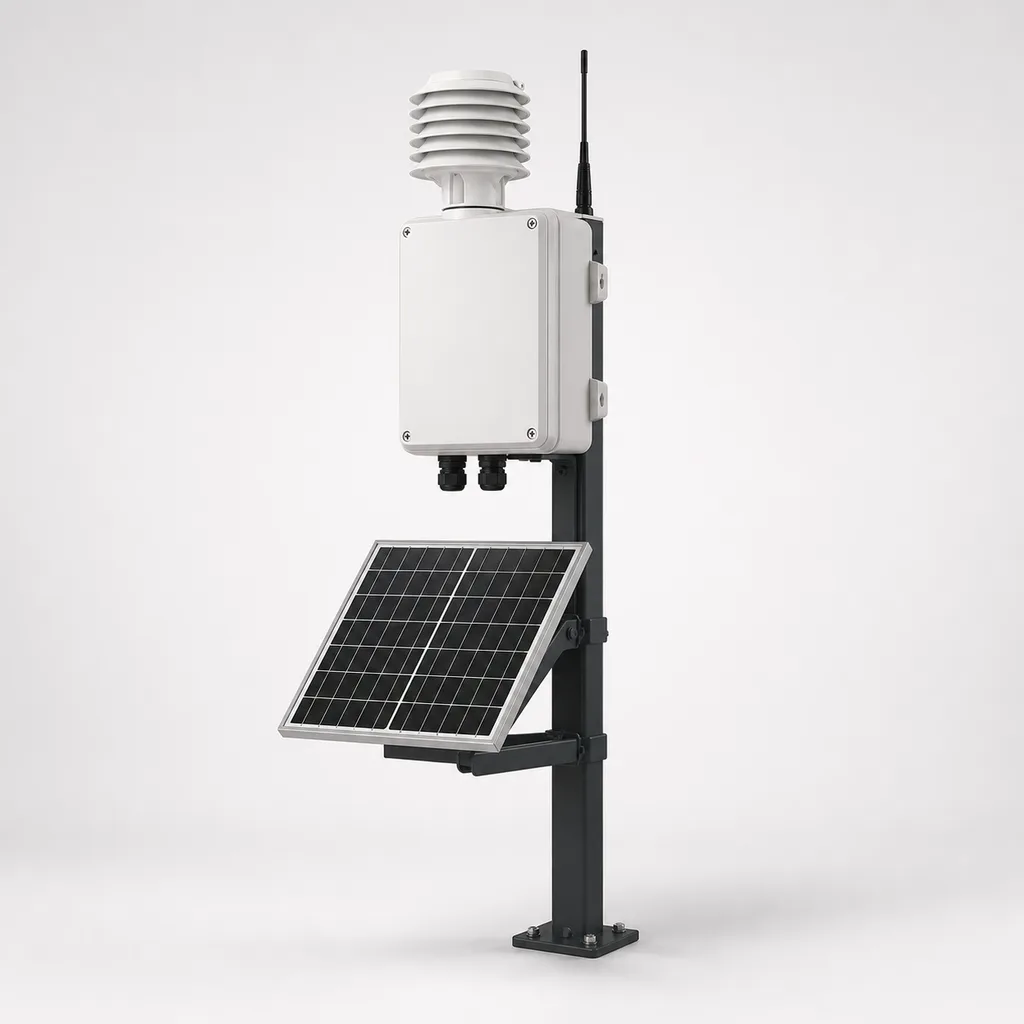
Overview
The Redcoast RC-AQMS-200 Off-Grid Solar Air Quality Monitoring Station is a pole- or wall-mounted outdoor node engineered for continuous, unattended measurement of ambient particulate matter, criteria gases and meteorological parameters — at urban roadsides, industrial fence-lines, ports, airports, mining and construction sites, agricultural perimeters and remote villages where mains power is unreliable or unavailable. It combines a Redcoast-designed multi-channel sensor signal-conditioning PCB, an MPPT solar power-management board, an edge IoT gateway and a cloud / mobile platform into a single ruggedised unit ready for multi-year field deployment. The station is designed for environmental protection agencies, municipal smart-city programmes, industrial operators with emissions obligations, research institutions and system integrators who need a reliable, configurable, network-scale solution that does not depend on grid power.
Key Features
- Multi-pollutant payload covering PM1, PM2.5, PM10 plus a configurable gas bank (NO₂, O₃, CO, SO₂, H₂S, NH₃ and TVOC), each channel digitally compensated for temperature and humidity drift.
- In-house multi-channel sensor signal-conditioning PCB: low-noise transimpedance front-end for electrochemical cells, NDIR driver, PID excitation rail, ratiometric reference and 24-bit ΔΣ ADC sampling — Redcoast designs and manufactures this board to match each gas mix.
- Laser-scattering particulate module with sheath-flow inlet, heated dryer and isokinetic sampling head; optional beta-attenuation module for regulatory near-reference accuracy.
- Integrated meteorological block: T, RH, atmospheric pressure, plus optional ultrasonic wind-speed/wind-direction, rainfall, solar radiation and noise level.
- True off-grid power: 60–200 W mono-PERC solar panel, LiFePO₄ 50–200 Ah battery and Redcoast MPPT controller delivering 10–15 days of autonomy without sun.
- Edge IoT gateway with on-board data logging (≥1 year of 1-minute records), local averaging, AQI calculation, alarm thresholds and OTA firmware updates.
- Cellular 4G LTE Cat-1 / Cat-M1 + NB-IoT by default, with LoRaWAN, Wi-Fi or Ethernet/RS485 as project options; native MQTT, HTTP/JSON and Modbus TCP/RTU.
- Industrial-grade housing with double-louvre radiation shield and aspirator, IP66 main enclosure, –30 °C to +60 °C operation, anti-UV ASA polymer shell over a marine-grade aluminium chassis.
- Web dashboard, REST API and white-labelled mobile app for real-time maps, historical trends, episode alerts and automated reports compatible with WHO and national AQI scales.
- Modular calibration with hot-swappable sensor cartridges; on-site span/zero calibration ports and optional co-location with reference analysers documented in a deployment certificate.
Technical Architecture
At the heart of the RC-AQMS-200 sits the Redcoast AQ-FE2 sensor front-end PCB, a custom four-layer board that conditions up to six independent electrochemical gas channels, one PID/MOS auxiliary channel and one NDIR channel. Each electrochemical channel uses a stabilised potentiostat, low-leakage TIA stage and 24-bit ΔΣ ADC with internal reference compensation, sampling each cell at 1 Hz and pushing temperature/humidity-corrected concentration to the main controller. Particulate matter is measured by a laser-scattering optical engine with a thermally regulated inlet that heats the air sample above the local dew point, eliminating fog and high-humidity overcount errors that plague low-cost monitors. An optional beta-attenuation module replaces or complements the optical engine for regulatory-grade PM at sites where mass-based reference is mandated.
The edge gateway is a Cortex-A7 or A53-class Linux controller that fuses all sensor streams, applies factory calibration coefficients, performs T/RH compensation, runs configurable rolling averages (1 min / 5 min / 15 min / 1 h / 24 h), computes US-EPA NowCast AQI and local AQI scales (EAQI, India NAQI, China AQI, etc.), and triggers alarm events when thresholds are crossed. Data is stored locally in a ring-buffered SQLite log of at least one year at 1-minute resolution, so connectivity outages never lose history. Synchronised time comes from the cellular network, NTP or an optional GNSS receiver that also geolocates mobile or temporary deployments.
The Redcoast PM-MPPT power-management PCB below the sensor block performs three-stage MPPT solar charging, LiFePO₄ battery management with cell-level balancing, deep-discharge protection, low-temperature charge inhibition and a watchdog-controlled load output for the gateway and sensors. All boards are conformal-coated, mounted on vibration-damping standoffs and connected through M12 industrial connectors so the station tolerates transport, vibration and salt-spray exposure without degradation.
Connectivity & Power
Connectivity is fully modular. The default configuration ships with a multi-band 4G LTE Cat-1 modem (Cat-M1 / NB-IoT fallback) and embedded eSIM/dual nano-SIM, suitable for almost any operator worldwide. Projects in dense smart-city networks or remote rural environments can swap to LoRaWAN (EU868 / US915 / AS923) for long-range low-power telemetry, while Wi-Fi 2.4/5 GHz, Ethernet PoE or RS485/Modbus are available for fixed industrial sites and SCADA integration. The IoT gateway speaks MQTT 3.1.1 / 5.0, HTTPS/REST, Modbus TCP and RTU out of the box and can be customised to push into existing data lakes such as InfluxDB, Kafka, AWS IoT Core, Azure IoT Hub or any private MQTT broker.
Power is provided by a 60 W to 200 W mono-PERC solar panel and a 50 Ah to 200 Ah LiFePO₄ battery, sized at design time against the requested sensor payload, telemetry interval and worst-month insolation at the deployment latitude. Hybrid configurations add a small wind turbine for high-latitude or coastal sites, or a wall plug with seamless changeover for transitional grid-tied installations.
Protection & Reliability
The complete station is rated IP66 on the main enclosure, IP65 on the sensor head, and operates continuously from –30 °C to +60 °C with up to 100 % condensing humidity. The housing is a marine-grade aluminium chassis wrapped in a UV-stable ASA polymer shell that resists salt fog (5 % NaCl, 1 000 h ISO 9227), wind-blown sand and abrasion. All exposed steel pole brackets are hot-dip galvanised, then finished with a smooth matte powder coating in RAL 7016 anthracite, RAL 9016 traffic white or a project-specific colour, producing a clean architectural appearance — not a rough zinc-plated look. Mean Time Between Failures (MTBF) at field conditions exceeds 60 000 hours for electronics; sensor cartridges are hot-swappable on a typical 12 / 24-month replacement cycle depending on chemistry and pollutant levels.
Application Scenarios
- Urban smart-city networks. Dense low-cost networks of 50–500 RC-AQMS-200 nodes across districts complement reference stations, producing block-level pollution maps that inform traffic management, public health advisories and low-emission zone enforcement.
- Industrial fence-line monitoring. Refineries, chemical plants, steel mills, cement works and waste-to-energy facilities deploy stations on perimeter fences to satisfy continuous emissions monitoring obligations and to demonstrate community accountability.
- Port, airport and logistics hubs. Stations track diesel-related NO₂ and PM near container terminals, taxiways and warehouse clusters, supporting Green Port and decarbonisation programmes.
- Mining, quarrying and construction sites. Mobile pole-mounted stations monitor blasting dust and fugitive emissions in real time, triggering automatic dust-suppression systems when thresholds are exceeded.
- Agricultural and rural air quality. Off-grid units track ammonia and PM from livestock operations, biomass burning and crop spraying, providing data to regulators and to farmers managing application timing.
- School, hospital and residential safety. Low-profile mast-mounted nodes around schools, hospitals and apartment compounds give administrators and parents real-time AQI on a public dashboard or mobile app.
Case-style Examples
- District-scale urban network. A municipal environmental agency deployed 180 RC-AQMS-200 nodes across a metropolitan area on existing streetlight poles, configured with PM2.5, PM10, NO₂ and O₃ channels and 5-minute telemetry over Cat-M1. The platform delivers ward-level heat maps and exposure indices that feed the city's health surveillance system; data are co-validated quarterly against three EPA reference stations.
- Industrial fence-line deployment. A petrochemical complex installed twelve fence-line stations with the full six-gas bank (NO₂, O₃, CO, SO₂, H₂S, TVOC) plus PM and meteorological sensors, all running on solar + LiFePO₄ to avoid trenching power across the perimeter. Alarms route into the plant SCADA via Modbus TCP for incident response, while a public dashboard demonstrates real-time compliance to neighbouring communities.
- Off-grid mining site. An open-pit mining operator deployed twenty pole-mounted RC-AQMS-200 units along haul roads and the pit rim, integrated with automated water cannons. When PM10 1-minute averages exceed the configured threshold, the platform triggers water spraying in the affected zone — reducing total dust events by more than half during the first dry season.
Customization & Selection Guide
The RC-AQMS-200 is configured per project rather than sold as a single SKU. Selection starts with the pollutant list: pure particulate monitoring is the most economical choice and uses only the optical PM module; criteria-gas monitoring adds two to six electrochemical channels; full ambient monitoring stacks PM, six gases, meteorology and noise. Power sizing follows the duty cycle of the chosen payload — heated PM inlets, NDIR cells and ultrasonic anemometers each add measurable consumption, so the solar panel and battery are selected against the worst month's insolation at the deployment latitude. Connectivity is then chosen by environment: 4G/Cat-M1 for almost any city or rural site with cellular coverage, NB-IoT or LoRaWAN when the operator runs a private LPWAN, and Modbus/RS485 or Ethernet when the station integrates into existing industrial SCADA. Finally, the calibration tier is chosen: factory-calibrated for indicative monitoring, three-point gas calibration with co-location report for near-reference performance, or full reference traceability with an on-site span/zero kit. Redcoast's engineering team helps customers map regulatory and budget constraints to the right configuration.
Deployment & After-sales
A typical RC-AQMS-200 mounts on a 60–120 mm diameter pole with stainless U-bolts, on a wall bracket, or on a custom solar mast supplied by Redcoast. Installation is two-person, requires no power trenching and is normally completed in under two hours per station; commissioning is wireless via the Redcoast mobile app, which links the device's QR-coded serial to the cloud account and validates each sensor channel before handover. Each unit ships with a deployment certificate documenting factory calibration. After-sales coverage includes a standard 24-month warranty on electronics and solar/battery components, a sensor-cartridge replacement programme, remote diagnostics through the cloud, and engineering support during initial network design and integration.
Standards & Compliance
The station's design references EN 14625 (O₃), EN 14626 (CO), EN 14211 (NO₂), EN 14212 (SO₂) and the US EPA Air Sensors Performance Targets for PM2.5 and ozone; AQI computation supports US EPA NowCast, European EAQI, China HJ 633, Indian NAQI and WHO 2021 guideline values, all configurable per deployment. Electrical and electromagnetic certifications include CE, RoHS, REACH, FCC Part 15 and IC; the solar/battery subsystem complies with IEC 62133 and UN 38.3 for transport; the enclosure is tested to IP66 and IK08; cellular modules carry GCF, PTCRB and regional operator certifications. Redcoast supplies the documentation packs required for customs clearance and tender submission worldwide.
Why Redcoast
Redcoast is not a re-badger of off-the-shelf air sensors. We design the sensor signal-conditioning PCB, the MPPT power-management PCB, the edge gateway firmware and the cloud platform in-house, which means we can re-route, re-mix and recalibrate the station to any pollutant mix, telemetry stack or industrial protocol a project demands — without months of vendor escalation. Customers benefit from a single accountable partner for hardware, firmware, app and platform, with the speed and unit economics that come from owning the board design. From 50-node smart-city pilots to 500-node national networks, our team helps you specify, deliver, install and operate the system.
Get in Touch
Contact Redcoast to discuss your air quality monitoring requirements — we will propose a customised RC-AQMS-200 configuration, a network architecture and a price for your project.
Specifications
Particulate Matter Sensing
- Measurement Method
- Laser scattering (optional beta attenuation)
- PM Channels
- PM1 / PM2.5 / PM10
- PM2.5 Range
- 0-1000 µg/m³
- PM10 Range
- 0-2000 µg/m³
- Accuracy
- ±10 µg/m³ or ±10% of reading
- Resolution
- 0.1 µg/m³
- Inlet
- Heated sheath-flow isokinetic head
Gas Sensing
- Channels
- Up to 6 electrochemical + 1 NDIR + 1 PID/MOS
- NO2 Range
- 0-20 ppm
- O3 Range
- 0-10 ppm
- CO Range
- 0-1000 ppm
- SO2 Range
- 0-20 ppm
- TVOC Range
- 0-10 ppm
- Typical Detection Limit
- <5 ppb (electrochemical)
- Compensation
- Built-in T/RH cross-sensitivity algorithm
Meteorological Sensing
- Temperature
- -40 to +70, ±0.2 °C
- Humidity
- 0-100, ±2 %RH
- Atmospheric Pressure
- 300-1100, ±0.5 hPa
- Wind Speed (option)
- 0-60, ±0.3 m/s
- Wind Direction (option)
- 0-360, ±2 °
- Rainfall (option)
- 0-999.9, 0.1 resolution mm
- Noise Level (option)
- 30-130 dB(A)
Edge Controller & Data
- Processor
- ARM Cortex-A7 / A53 Linux
- Local Storage
- ≥16 (≥1 yr @ 1-min resolution) GB
- Sampling Rate
- 1 Hz / channel
- Averaging Windows
- 1 / 5 / 15 / 60 min, 24 h
- AQI Scales
- US EPA NowCast, EAQI, NAQI, China HJ 633, WHO 2021
- Alarms
- Per-channel thresholds + escalation
- OTA Updates
- Supported (firmware + calibration)
Communication
- Cellular
- 4G LTE Cat-1, Cat-M1, NB-IoT (default)
- LPWAN (option)
- LoRaWAN EU868 / US915 / AS923
- Wi-Fi (option)
- 2.4/5 GHz, 802.11 b/g/n/ac
- Wired (option)
- Ethernet PoE, RS485 / Modbus RTU
- Protocols
- MQTT 3.1.1/5.0, HTTPS, Modbus TCP/RTU, OPC UA
- GNSS (option)
- GPS / GLONASS / BeiDou / Galileo
Power & Solar System
- Solar Panel
- 60-200 mono-PERC W
- Battery
- LiFePO4 50-200, 12.8 Ah / V
- Autonomy
- 10-15 days no sun
- MPPT Efficiency
- ≥98 %
- Average Consumption
- 2-8 (configuration dependent) W
- Optional Inputs
- Small wind turbine, AC grid charger
- Battery Cycle Life
- ≥3000 @ 80% DoD
Enclosure & Mechanical
- Main Enclosure
- IP66, IK08
- Sensor Head
- IP65 with double-louvre radiation shield
- Operating Temperature
- -30 to +60 °C
- Material
- Marine-grade aluminium chassis + UV-stable ASA shell
- Finish
- Smooth matte powder-coated, RAL 7016 default
- Salt Spray
- 1000 h, 5% NaCl (ISO 9227)
- Mounting
- Pole Ø60-120 mm, wall, or solar mast
- Weight
- 8-14 (configuration dependent) kg
Capabilities — configurable per project
Specifications are tailored to each project — the options below show what we can support.
Pollutant Package
- PM only
- PM + 2-gas
- PM + 4-gas
- Full ambient (PM + 6-gas + met + noise)
Power Source
- Solar standalone
- Solar + grid hybrid
- Wind-solar hybrid
- Grid-tied with battery backup
Connectivity
- 4G LTE Cat-1 / Cat-M1
- NB-IoT
- LoRaWAN
- Wi-Fi
- Ethernet PoE
- RS485 / Modbus
Calibration Tier
- Factory indicative
- Near-reference (multi-point + co-location report)
- Reference-traceable with beta-attenuation PM
Mounting
- Pole-mount
- Wall-mount
- Dedicated solar mast
- Mobile trailer / skid
Related solution guidance

Environmental Monitoring
Deploy environmental monitoring stations with sensors, solar power, gateways, dashboards, alarms and data integration for city and industrial sites.
Power and Connectivity
How to choose power, battery, solar, NB-IoT, LTE, LoRaWAN, gateways and monitoring strategy for outdoor IoT infrastructure.
Solar IoT Guide
A design guide for solar-powered outdoor IoT: load calculation, battery autonomy, low-power firmware, telemetry and maintenance planning.
Frequently Asked Questions
What pollutants can the RC-AQMS-200 measure?
The standard configuration measures PM1, PM2.5, PM10, NO₂, O₃, CO, SO₂ and TVOC plus temperature, relative humidity and atmospheric pressure. H₂S, NH₃, CO₂, methane (CH₄), noise, wind and rainfall are available as factory options, and the modular sensor block makes future channel additions straightforward.
How is the station powered if there is no grid available?
A 60–200 W solar panel charges a 50–200 Ah LiFePO₄ battery through a REDCOAST.LTD MPPT controller; sizing is calculated against the worst-month insolation of the deployment site to give 10–15 days of autonomy without sun. Grid charging and wind-hybrid inputs are also available for sites where the energy budget is tight.
Is the data accurate enough for regulatory reporting?
Out of the box the station is indicative-grade, suitable for dense smart-city networks and trend monitoring. With three-point factory calibration plus an on-site co-location report against an EPA or EN reference analyser it reaches near-reference performance acceptable for many supplementary regulatory uses, and a full beta-attenuation PM module is available for sites that need mass-based reference PM.
What communication options are supported?
4G LTE Cat-1 / Cat-M1 / NB-IoT is the default; LoRaWAN, Wi-Fi, Ethernet PoE and RS485/Modbus are project options. The gateway speaks MQTT, HTTPS/REST and Modbus, and can be customised to push into any private MQTT broker, AWS IoT Core, Azure IoT Hub or InfluxDB/Kafka backend.
How often do the sensors need calibration or replacement?
Electrochemical gas cells typically deliver 12–24 months of service depending on pollutant levels and climate, after which the cartridge is hot-swapped in the field. Optical PM modules last 3–5 years with periodic inlet cleaning, and REDCOAST.LTD provides a sensor-replacement programme plus remote drift monitoring through the cloud.
Can the station integrate with our existing SCADA or environmental data system?
Yes — Modbus TCP and RTU are built into the gateway, the REST API exposes real-time and historical data in JSON, and MQTT publication can be directed to any broker. Integration targets include WinCC, Ignition, AWS IoT Core, Azure IoT Hub and custom national environmental data platforms.
What is the minimum and maximum operating temperature?
The station operates from –30 °C to +60 °C continuously. Battery charging is automatically inhibited below 0 °C to protect the LiFePO₄ cells, and the sensor block uses a heated PM inlet to maintain accuracy under cold and high-humidity conditions.
How long does a typical deployment take?
Installation of a single station on an existing pole or wall is normally a two-person, two-hour job; commissioning is wireless via the REDCOAST.LTD mobile app and the station appears on the dashboard within minutes. Network-scale rollouts of 50–500 nodes are typically planned for 8–16 weeks of delivery and commissioning.